

Relationships offer a key source of resilience for women with serious mental illness (SMI). Social support has been found to foster the recovery process of people with SMI, improving mental health, life satisfaction, and coping ability (Aschbrenner et al., Reference Aschbrenner, Mueser, Bartels, Carpenter-Song, Pratt, Barre and Kinney2015; Mizock & Russinova, Reference Mizock and Russinova2015; Padgett, Henwood, Abrams, & Drake, Reference Padgett, Henwood, Abrams and Drake2008; Rogers, Anthony, & Lyass, Reference Rogers, Anthony and Lyass2004). Alternatively, the stigma of mental illness can contribute to isolation, psychological distress, and suicidality (Johnson, Reference Johnson1997; Linz & Sturm, Reference Linz and Sturm2013; Wright, Wright, Perry, & Foote-Ardach, Reference Wright, Wright, Perry and Foote-Ardah2007). Women with SMI may also find romantic relationships particularly difficult to navigate, given the effects of stigma and their high risk of intimate partner violence (IPV; Goodman, Rosenberg, Mueser, & Drake, Reference Goodman, Rosenberg, Mueser and Drake1997; Link, Cullen, Shrout, Struening, & Dohrenwend, Reference Link, Struening, Cullen, Shrout and Dohrenwend1989). However, more research is needed to better understand the experiences of women with SMI in their intimate relationships. Therefore, the present qualitative study was conducted with 20 women with SMI in order to better understand their experiences with romantic and intimate relationships. Themes resulting from data analysis utilising grounded theory methodology will be presented. Clinical implications and directions for future research will be discussed.
Women with SMI and Relationships
Mental illness is relatively common in the United States, with current estimates of one in five Americans having a diagnosable mental illness. SMI is less common, with 4.2% of the U.S. adult population meeting criteria for SMI; however, it is a leading cause of disability in the United States (National Institute of Mental Health [NIMH], 2016). SMI is characterised by complex, cyclical, and persistent symptoms that impair functioning across more than one life domain (i.e., social, occupational, academic, self-care; Corrigan & Shapiro, Reference Corrigan and Shapiro2010; NIMH, 2016). Women with SMI tend to face unique challenges with regard to physical and sexual violence, as well as parenting stressors (Borba et al., Reference Borba, DePadilla, McCarty, von Esenwein, Druss and Sterk2012; Cogan, Reference Cogan1998; Goodman et al., Reference Goodman, Rosenberg, Mueser and Drake1997; Mowbray, Bybee, Hollingsworth, Goodkind, & Oysermann, Reference Mowbray, Bybee, Hollingsworth, Goodkind and Oyserman2005). The intimate relationship experiences of women with SMI are central to these challenges and require additional study (Cogan, Reference Cogan1998; Pickens, Reference Pickens1999). More information is needed to better understand their lived experiences and choices in intimate and relationships in particular, not only in the case of IPV, but also to better understand their general experiences with dating and romance.
Social networks
Few studies have explored the relationship needs of women with SMI (McCann, Reference McCann2010a, Reference McCann2010b). One mixed method study investigated the social networks of 25 women with SMI living in Vermont (Cogan, Reference Cogan1998). Most common relational needs included issues of emotional and sexual abuse, sexual health, and child custody. In another study, qualitative case study methodology was used to examine the social networks of three women with bipolar and schizoaffective disorders using sociometric diagrams (Pickens, Reference Pickens1999). Changes in residential treatment settings and providers disrupted key sources of social support. Interpersonal conflict appeared to result from perceptions of stigma and judgment. This limited research on the social networks of women with SMI suggests social barriers of stigma and abuse, which likely have applications to their intimate and romantic relationships, though more needs to be understood in this area. Lastly, a qualitative study looked at the peer relationship needs of young men and women with first-episode psychosis and identified themes pertaining to the loss of friendships and development of new friendships throughout the development of psychosis (MacDonald, Sauer, Howie, & Albiston, Reference MacDonald, Sauer, Howie and Albiston2005).
Intimate and romantic relationship barriers
Positive relationships have been found to be a key factor in the recovery process for people with SMI (Boucher, Groulou, & Whitney, Reference Boucher, Groleau and Whitley2016). However, women with SMI may have less intimacy and commitment in their relationships when compared to the general population (Perry & Wright, Reference Perry and Wright2006). Women with SMI tend to have high rates of relationship problems, and can find it difficult to develop and maintain romantic partnerships (Seeman, Reference Seeman2015; Wright et al., Reference Wright, Wright, Perry and Foote-Ardah2007). Some estimates suggest that the majority of women with SMI do not have a partner, or have limited short-term relationships, or long-term relationships without a serious commitment (Perry & Wright, Reference Perry and Wright2006).
Many individuals with SMI have the desire to connect with a romantic partner. However, the relationship skills of women with SMI may be challenged by poor health, social deficits, and difficulty meeting the emotional and physical demands of intimacy (Padgett et al., Reference Padgett, Henwood, Abrams and Drake2008). In addition, women with SMI may lack previous trustworthy relationships, and feel anxiety about intimacy or entering into unhealthy relationships (Miklowitz, Reference Miklowitz2002; Padgett et al., Reference Padgett, Henwood, Abrams and Drake2008).
Social isolation is a common consequence of mental illness stigma (Padgett et al., Reference Padgett, Henwood, Abrams and Drake2008; Wright et al., Reference Wright, Wright, Perry and Foote-Ardah2007). Prejudice and discrimination (external stigma) can lead to shame and self-stigma (internalised stigma; Linz & Sturm, Reference Linz and Sturm2013; Perry & Wright, Reference Perry and Wright2006; Wright et al., Reference Wright, Wright, Perry and Foote-Ardah2007). Stigma can result in a fear of disclosure of mental health problems and abandoning the pursuit of a relationship (Padgett et al., Reference Padgett, Henwood, Abrams and Drake2008; Perry & Wright, Reference Perry and Wright2006). Relationship barriers may be compounded for women with SMI who experience additional sources of stigma, such as homophobia, racism, substance abuse, criminal history, or homelessness (Mizock & Russinova; Padgett et al., Reference Padgett, Henwood, Abrams and Drake2008). However, these relationship barriers have not been fully explored or characterised in the literature.
Sexuality
A particular area of concern for women with SMI pertains to sexual relationships. Women with SMI have a high risk of contracting sexually transmitted infections (STIs), in spite of some research suggesting that condom use is higher among people with SMI (Perry & Wright, Reference Perry and Wright2006). This occurrence may be due to a greater number of partners or reduced length of time before engaging in a sexual encounter (Perry & Wright, Reference Perry and Wright2006). Additionally, people with SMI who have more permissive attitudes towards sex are also more likely to have multiple sexual partners (Bonfils, Fermin, Slayers, & Wright, Reference Bonfils, Firmin, Salyers and Wright2015). Other factors that appear to contribute to negative sexual health outcomes for women with SMI include a history of sexual abuse and poor communication between clients and healthcare providers, as well as a lack of sexual education (Matevosyan, Reference Matevosyan2010).
However, other researchers have investigated STI risk among young men and women with first-episode psychosis and found they tend to be less likely than their counterparts to use condoms, particularly if they are unemployed and lack peer support (Brown, Lubman, & Paxton, Reference Brown, Lubman and Paxton2011). In a qualitative study on men and women with psychotic disorders in the Netherlands, the researchers identified unmet sexual needs as occurring due to a range of factors, such as medication side effects, social stigma, problems with social skills, psychotic symptoms, and low sexual self-esteem (de Jager, van Greevenbroek, Nugter, & van Os, Reference de Jager, van Greevenbroek, Nugter and van Os2018).
A quantitative study was conducted in Switzerland with 30 women with schizophrenia to investigate issues of sexual activity and sexual desire. They found similar levels of sexual desire as their counterparts, with less sexual activity whether with others or on their own, and were less sexually satisfied (Huguelet et al., Reference Huguelet, Mohr, Miserez, Castellano, Lutz, Boucherie and Demicheli2015). McCann (Reference McCann2010a) disseminated a similar quantitative survey to both men and women with schizophrenia in the United Kingdom to investigate their sexual and relationship needs. McCann found that a considerable portion of participants had not been sexually active for a number of years despite having sexual desire, and many attributed their sexual issues to side effects of their medication (McCann, Reference McCann2010a). In a qualitative study that accompanied this mixed-method study, McCann (Reference McCann2010b) spoke to the ability of women and men with schizophrenia to communicate their sexual relationship needs, despite stereotypes that might suggest otherwise. That study found issues with sexual knowledge and understanding, stigma and self-esteem, and concerns with safer sex and sexual barriers in an inpatient unit were obstacles for men and women with SMI in meeting their sexual relationship needs.
Intimate partner violence
Another relationship challenge for women with SMI that has been investigated in the literature is a high rate of sexual and physical victimisation (Estroff, Zimmer, Lachicotte, & Benoit, Reference Estroff, Zimmer, Lachicotte and Benoit1994; Friedman, Loue, Goldman-Heaphy, & Mendez, Reference Friedman, Loue, Goldman Heaphy and Mendez2011; Swanson et al., Reference Swanson, Swartz, Essock, Osher, Wagner, Goodman and Meador2002; Trevillion, Oram, Feder, & Howard, Reference Trevillion, Oram, Feder and Howard2012). They are more likely to experience enmeshed or detached interpersonal networks that contribute to high IPV rates, in contrast to their male and female counterparts (Estroff et al., Reference Estroff, Zimmer, Lachicotte and Benoit1994). Some estimates suggest that IPV among women with SMI is more than 2 to 3 times the rate of those without SMI (Goodman et al., Reference Goodman, Salyers, Mueser, Rosenberg, Swartz, Essock and Swanson2001; Khalifeh et al., Reference Khalifeh, Moran, Borschmann, Dean, Hart, Hogg and Howard2015). This incidence may be further stratified by race and ethnicity. For example, one study found that two-thirds of Latina women with SMI experienced IPV (Friedman et al., Reference Friedman, Loue, Goldman Heaphy and Mendez2011). Notably, 23% of this sample also committed violence against their partner, suggesting that women with SMI may also be perpetrators of violence in their relationships.
However, women with SMI who have survived violence are often not believed or are discriminated against when reporting abuse (Khalifeh et al., Reference Khalifeh, Moran, Borschmann, Dean, Hart, Hogg and Howard2015). As a result, IPV can contribute to physical injury and other negative outcomes, including chronic health problems, as well as reduced functioning, quality of life, and mental health (Campbell, Reference Campbell2002; Pico-Alfonso et al., Reference Pico-Alfonso, Garcia-Linares, Celda-Navarro, Blasco-Ros, Echeburúa and Martinez2006; World Health Organization [WHO], 2000). Clearly IPV is an important topic for women with SMI. Nevertheless, more research is needed to fully explore their range of positive and negative experience in the realm of intimate and romantic relationships.
Study Rationale
Researchers have called for further investigation into the intimate and romantic relationships of women with SMI (Cogan, Reference Cogan1998; McCann, Reference McCann2010a, Reference McCann2010b; Perry & Wright, Reference Perry and Wright2006; Pickens, Reference Pickens1999). Relationships play a particular role in the mental health of women with SMI, given the importance placed on women's relationships in gender socialisation and development (Cogan, Reference Cogan1998). There is a need for more research on the views of women with SMI, with a specific focus on their experiences with gender and relationships, as women's subjective experiences of SMI appear to commonly differ from men (Manuel, Hinterland, Conover, & Herman, Reference Manuel, Hinterland, Conover and Herman2012; Ritsher, Coursey, & Farrell, Reference Ritsher, Coursey and Farrell1997; Scheyett & McCarthy, Reference Scheyett and McCarthy2006; Schön, Reference Schön2010).
Much of the research that has been conducted on women with SMI and relationships looks at both men and women together, focuses on youth with first-episode psychosis, narrows in on a specific diagnosis, or explores less severe mental illnesses, such as mild to moderate depression and anxiety disorders. This research has also focused on issues of violence and sexual risk, such as in the case IPV, STDs, or other sexual and physical issues of risk and danger.
As seen in this literature review, researchers have identified a few of the relationship needs, barriers, and problems with violence and sexual health of women with SMI. However, more research is needed to focus on, and more specifically characterise, the intimate and romantic relationship dynamics among women with SMI, beyond issues of risk and danger. This research is needed in a more integrated and in-depth way, including both negative and positive relationship experiences. Qualitative analysis has been identified as a valuable method to capture the complexity and nuances of the relationship experiences of people with SMI (Pickens, Reference Pickens1999). Therefore, grounded theory methodology was used to investigate this research area in the present study.
Method
Participants
Twenty women with SMI were recruited from wellness groups within a Northeast psychosocial rehabilitation centre. Ages ranged from 32 to 66 years, with a mean of 50 (SD = 10.15). Twelve participants reported co-occurring diagnoses, and eight reported a single diagnosis. Diagnoses included: major depressive disorder (n = 10), post-traumatic stress disorder (n = 8), anxiety (n = 7), bipolar disorder (n = 5), borderline personality disorder (n = 4), schizophrenia spectrum disorder (n = 3), schizoaffective disorder (n = 2), and high functioning autism (n = 1). With regard to sexual orientation, 12 identified as straight/heterosexual, 4 as lesbian, 2 as bisexual, 1 identified as questioning her sexual orientation, and 1 participant identified as pansexual. The sample contained 11 single women, 4 divorced women, and 1 married participant. The current relationship status of the remaining 4 participants was unknown.
Procedure
The psychosocial recovery centre from which participants were recruited provides mental wellness groups and other psychiatric rehabilitation services to people with SMI in the local community. The selection criteria included the following: (a) female-identified; (b) 18 years or older; (c) major mental health disorder; and (d) functional impairment in social life, work, school, and/or activities of daily living or self-care.
University institutional review board approval was granted for this study. Participants signed informed consent forms prior to beginning the interviews. The interviews lasted approximately 60 minutes and were conducted either by phone or in a designated research space within the centre. Phone interviews were utilised when participants were not available for the in-person interviews scheduled at the centre. Participants received $25 gift cards to participate in the study.
Data were collected over the course of two months. Recruitment continued until saturation of themes occurred, based on consensus of the research team, per the standards of grounded theory methodology (Glaser & Strauss, Reference Glaser and Strauss1967; Mason, Reference Mason2010). The interviews were recorded and transcribed verbatim. Excerpts in the present article were edited in some sections to enhance readability through the removal of non-lexical utterances, repetitions of words, and other areas of speech, while retaining the original meaning.
The first author developed a semistructured interview guide to conduct the interviews. Questions investigated topics related to the women's experience of gender, stigma, and mental health. The focus of this article is on data pertaining to the participants’ experiences with romantic and intimate relationships. This segment of the dataset was analysed by a research team consisting of a clinical psychologist (first author) and three clinical psychology doctoral students (co-authors).
Data Analysis
Grounded theory methodology directed thematic analysis of the data (Corbin & Strauss, Reference Corbin and Strauss2008; Heydarian, Reference Heydarian2016). In this process, themes are developed based on the extent to which the data fits the conceptual categories that emerge from the data analysis process (Suddaby, Reference Suddaby2006). Our grounded theory approach included the constructivist iteration of this method (Charmaz, Reference Charmaz, Wertz, Charmaz, McMullen, Josselson, Anderson and McSpadden2011), in which it is understood that researchers cannot avoid ‘contamination’ of the data given their pre-existing knowledge of the literature in any area. Moreover, researchers may be required to conduct a literature review in order to garner research funding and submit background on the proposed study to an institutional review board. Thus, the groundedness does not result from the removal of the researcher's view from the data analysis in the constructivist grounded theory approach. Rather, this approach emphasises ‘that a theory cannot be grounded in the data by an active passivity that allows its emergence, but rather by a proactive focus on the data, acknowledging that it is not the research methodology that aims to discover a theory despite the researcher, but it is the researcher who aims to construct a theory through the methodology’ (Ramalho, Adams, Huggard, & Hoare, Reference Ramalho, Adams, Huggard and Hoare2015, p. 6).
Data analysis followed a series of steps involving weekly meetings among two coders on the research team. First, open coding of a sample of five interviews was conducted by the two coders. A line-by-line, open-coding process was applied. These coders compared differences and similarities between their codes in the process of establishing the initial codebook. Next, the remaining interviews were coded by the two coders using the initial codebook. This led to the development of the final codebook — a comprehensive list of over 100 codes. Next, NVivo qualitative analysis software was used to apply codes to the transcripts and organise the codes under broader conceptual categories in the process of axial coding. Finally, in the selective coding stage, the present four-person research team was assembled to further analyse the category of codes pertaining to intimate relationships of focus in this article.
Data Quality
In order to enhance data quality, several strategies were implemented. First, memos were created and redistributed among the research team, which included research team meeting notes, notable interview excerpts, and initial data interpretations. Reflexive journalling (Morrow, Reference Morrow2005) was also conducted to monitor researcher biases and potential effects on interviewing and data analysis. Interrater reliability was supported by the use of two coders in developing the codebook. Cross-checking (Polkinghorne, Reference Polkinghorne2007) was also used, entailing the team members’ review of one another's coding, development of themes, and selection of interview excerpts. Lastly, consensus (Edwards, Dattilio, & Bromley, Reference Edwards, Dattilio and Bromley2004) was a strategy used to reach agreement between researchers when occasional differences in coding and data interpretation arose.
Results
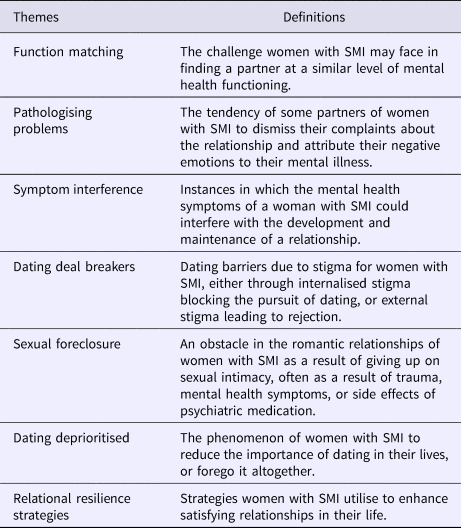
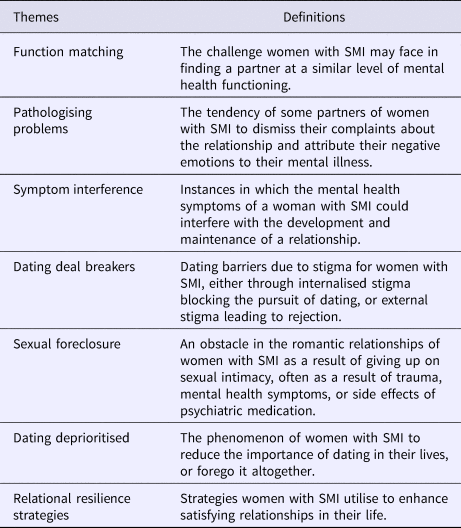
Data analysis led to the identification of several themes pertaining to the intimate and romantic relationships experienced by women with SMI (see Table 1). These themes are detailed in this section.
Intimate and Romantic Relationship Themes for Women With SMI
Function Matching
The first theme, function matching, refers to the challenges women with SMI face in finding a romantic partner at a similar or complementary functioning level. This could arise due to differences in medication adherence between partners. For example, one participant stated: ‘I was taking my medication but the other person wasn't taking his medication. So it wasn't working.’ Another interview excerpt demonstrated how one woman was unable to develop feelings for a man because her level of functioning differed from his:
I don't want to live a life where there is the possibility of instability. Because I consider myself very stable right now … I had some dates with this guy that I found out spent 2.5 years in [name redacted] State Hospital and 18 years in a group home. He has only been in his own place for 8 months now. I had grown so much more than he had. I had to drag him along … I watched the way he ate. He was messy, you know. His shorts didn't fit right. I'm being critical, but I wanted someone. I couldn't hook into him. I just couldn't get any feelings. And he realised he was just starting to put his feet down on the ground.
This quote suggests the risk a woman with SMI may take in entering into a relationship when a partner has a lower level of functioning than hers, which could take a toll on her mental health. In contrast, another woman attested to the helpfulness of matching another partner in mental health functioning levels. She indicated that with regard to her mental illness, ‘He's okay with it, because he has a mental health [experience] too.’
It should be noted that no participants spoke to dating someone with a higher functioning level. In fact, our findings suggest that they felt they would be rejected by others who did not have a mental illness. One participant stated to this effect: ‘Well, no one would want to be involved [with me] because they would think that I was not stable. They would have the problem with the stigma.’ In sum, the participants indicated that they could have a difficult time developing and sustaining relationships with partners who did not progress at the same rate, had different levels of independence, or faced other barriers to self-care.
Pathologising Problems
The theme pathologising problems refers to the tendency of some of the partners of women with SMI to dismiss their complaints about the relationship and attribute their negative emotions to their mental illness. For example, one participant described her past relationships.
I think there were a few people that looked at me through that lens too strongly, or maybe where I might have been struggling in the relationship somehow. I think that a couple of them chalked that struggling up not to something they were doing but to something that was wrong with me.
This participant felt that some of her partners over-perceived signs of her mental illness when she made a legitimate complaint. Another woman corroborated this experience.
I have always been then plagued by confidence, because my husband would always say, ‘You're manic.’ If I ever got more assertive, if I ever spoke out more, he would just call that mania. And he would take me to the doctor, or tell me to call the doctor. And he didn't want to hear a word of it. He just wanted me to be [the] meek, little … woman he married. And as I grew healthier and healthier, I did get more assertive. And he just thought that I was manic all the time. And so I was very, very unsure of my confidence. Is this really me?… Do I really have a case here? And I wasn't sure whether I was manic or not myself.
This theme demonstrated that at times women with SMI could feel barred from expressing their relationship concerns without fear of their partner's dismissal, often leading to greater self-doubt.
Symptom Interference
Symptom interference was another theme that emerged from the interviews, referring to how the symptoms of the SMI could interfere with relationship development and maintenance. Sometimes these symptoms could deplete their energy for dating. For example, one participant explained that feeling ‘sick’ from her bipolar disorder disrupted her ability to seek out a relationship:
It was very difficult for me to date because I was getting sick all the time. So, it was very hard for me to concentrate and really get to work on finding somebody … I was sick, I was sick. I just remember I was sick. It's only now that I'm not so bipolar.
Similarly, another participant felt her mental health problems made her too sensitive to the potential ups and downs another person would bring into her life. She stated, ‘The only thing that's happened with my dating life is the fact that I don't have one because I can't deal with the stress of other people.’ Another participant also stated, ‘I don't feel like I have the extra — the leftover emotional resources to have a healthy relationship. And I'm certainly not interested in having an unhealthy relationship. I'm just not gonna’ bother.’ This participant emphasised that at times for women with SMI, finding a healthy relationship in particular might require additional energy that they did not have, leading to avoiding dating altogether.
Dating Deal Breakers
The dating deal breakers theme included obstacles in dating due to the effects of internalised stigma or external stigma. One woman explained her experience of external stigma: ‘I've had people that didn't want to date me because I admitted I was depressed. One person outwardly admitted it. And then I put on Craigslist ads that I was disabled and people don't answer.’ While it is important to note that one may feel entitled to choose a mate without mental health problems, this participant felt she was prejudged, uniformly rejected, and punished for bringing honesty to her dating life.
A particularly prominent dating deal breaker for women in this study appeared to occur due to internalised stigma. One participant explained the difficulty of disclosing her SMI to a potential mate because of her anticipation of stigma: ‘It's kind of hard to tell them you have a mental illness and you don't want that to carry on into a kid.’ Another participant described similar impasses in the dating process: ‘Manic depression feels like more ill and more of a stigma … like I won't find somebody to be in a relationship that way [because they] would feel I'm dangerous or something.’ Yet another woman described her reluctance to date due to her expectation of stigma.
I would like to meet somebody, but you know, who would want me? I don't work. I'm a bipolar. Who would want to get involved with me?… I would like to meet someone and get married again. I've dated a few times — three different guys — and it's strange how you forget how to behave … No one would want to be involved because they would think that I was not stable. They would have the problem with the stigma.
This participant's self-stigma interfered with her reaching out and giving dating a try because she anticipated stigma. It is also noteworthy that she referred to herself as ‘a bipolar’, implying self-stigma in her objectified identification with her diagnosis. Overall, this theme suggests that internalised and anticipated stigma could affect women's outreach in the dating process, as well as their behaviour while dating.
Sexual Foreclosure
Sexual foreclosure refers to the tendency of women with SMI to cease involvement in sexual activity, impacting their intimate and romantic relationships. For example, one participant described the physical and emotional pain she endured in her sexual life with her ex-husband.
Having a mental [illness] all my life as a woman, I was able to get married only by fluke, I think. Our sex life was terrible because … the meds I was taking was making my vagina very, very, very dry. So sex was terribly painful. And he was very upset at that. And so I just did it painfully. It was painful for me. I was crying for my mother, but he didn't care. And I just couldn't wait for it to be over. And, it was very bad … I tried lubricants. I tried all the things over the counter and I read all kinds of things. But it was the meds that was making me dry … But I couldn't go without the med … I had to have my mental health.
Compounding the sexual side effects of the psychiatric medication was what appeared to be sexually coercive behaviour of her ex-husband. Furthermore, this sexually abusive behaviour appeared to contribute to her disinterest in other romantic relationships in her description of an interested suitor:
I don't want anyone to be attracted to me. You know, I don't want any more romance. And I think that this particular person, I had to have a conversation with him. And he said he wanted touching and holding and kissing. And I said, ‘That's not what I want.’ And then finally after a lot of discussion he said, ‘Well that's perfectly fine.’ But it's very difficult.
Similarly, another participant described a history of profound sexual exploitation during childhood that resurfaced in the development of PTSD later in life, impacting her sexual life with her husband.
I've lost so much good stuff, but yet I'm plagued by nightmares of the bad stuff, flashbacks of the bad stuff. The body sensations of the bad stuff. But yet I hardly … get sensations of the good stuff … And I mean to the point where my husband and I stopped having intercourse because I had no feelings for him. Because I didn't know who he was.
Though this participant described a loving and healthy relationship with her husband, mental and physical symptoms of sexual trauma had led her to end sexual intimacy with him later on. These quotes demonstrated that sexual foreclosure might occur for women with SMI as a result of sexual trauma, mental health symptoms, or the side effects of psychiatric medication.
Dating Deprioritised
The theme of dating deprioritised refers to the tendency of some women with SMI to reduce the importance of dating in their lives altogether. One participant described this:
What dating life? I've never had a dating life. I don't have a dating life. I'm too busy trying to be — it's all I can do to take care of myself. I can't do relationships … I think also … I put a huge amount of focus into my mental health all the time.
Another participant explained her decision to deprioritise dating in her life, specifically with regard to turning down an interested potential mate.
Well, I've had enough of it. I was married for 25 years. And I find that two people trying to get along [is difficult] … I fought for my divorce. I fought to be single. And, I mean, he's very much like my ex-husband when he gets into these, you know, take-care-of-me things. And, he's very strong, so I never win any arguments of his.
This woman highlighted that an added caretaking burden may be placed on women in heterosexual relationships, requiring more of their energy. Ultimately, these excerpts reveal that women with SMI have to put substantial time and effort into their own self-care, which can lead to decisions to deprioritise dating in their lives, or avoid dating altogether.
Relational Resilience Strategies
Lastly, the theme of relational resilience strategies refers to methods and resources women with SMI utilise to enhance satisfying relationships in their life. For example, one participant used a singles phone service and prescreened her dates prior to meeting in person.
I have a really weird tendency to have started a bunch of my relationships years and years ago on some chat lines, because it's just really hard for me to physically go anywhere at times. So, I've done a lot more interesting stuff on the net or, like, through some chats. I usually screen people out before I ever meet or talk to anybody.
Another participant found use of online dating to be a valuable resource for increasing her odds of finding a health partner.
I'm a little happy now I finally was able to afford a nice phone so I could go on these online dating [sites]. I know that that sounds sketchy, but … I've met someone who is actually pretty nice to me, which is nice. Because the guys who I was meeting at clubs or through friends are abusive. So, this is actually a better way to meet people.
Women with SMI appeared to use various dating strategies to reduce their risk of abuse and increase their odds of finding a healthy relationship. They demonstrated resourcefulness to overcome challenges to intimacy and pursue their relationship goals.
Discussion
The present study made a number of unique contributions, and also reinforced and expanded on previous research in several areas. Furthermore, the themes generated in this study also suggest several relationship challenges that can lead to a number of outcomes. The challenges in the dating process included symptom interference, function matching issues, dating deal breakers (resulting from external stigma and internalised stigma), and pathologising problems. Potentially problematic outcomes of those relationship challenges might include sexual foreclosure and dating deprioritised. However, women with SMI may also respond to these challenges with relational resilience strategies, which could in turn help to manage relationship challenges and overcome some of the challenges in intimate and romantic relationships.
With regard to specific themes, a particular contribution pertained to the theme of function matching. This finding demonstrated that a major obstacle for women with SMI who date others with mental health challenges is finding someone who might be equivalent or complementary in their level of independence and self-care in order to foster a balanced connection.
Perhaps as a result of the challenges with function matching, the tendency led to make dating deprioritised. In this novel finding, women with SMI might avoid dating altogether as a result of mental health challenges and stigma. This was in contrast to previous findings that many women with SMI desire romantic relationships and that they improve their recovery (Boucher et al., Reference Boucher, Groleau and Whitley2016). However, some of these women may wish to place dating as a higher priority in their lives but find it is difficult to do so due to the effort required for their mental health. Participants in this study also discussed the caretaking burden placed upon women in (particularly heterosexual) relationships to be a major reason to deprioritise dating. Another nuance of this theme of dating deprioritised is the amount of energy that women with SMI expend on managing an SMI, reducing the emotional resources left for dating.
Dating deprioritised was a theme that may have another interactional relationship with the theme of sexual foreclosure. Calling it quits on sexual activity may come from deprioritising dating, or contribute to it. With regard to links to the extant literature, research has demonstrated a high risk of sexual trauma and sexual side effects of psychiatric medication for women with SMI (Goodman et al., Reference Goodman, Salyers, Mueser, Rosenberg, Swartz, Essock and Swanson2001; Post, Reference Post1994). The theme of sexual foreclosure highlighted the actual effects of these sexual issues, where romantic relationships could be impacted by women's decisions to end sexual intimacy and vice versa.
The theme of pathologising problems demonstrated that the relationship complaints of women with SMI could be dismissed by their partners. This finding resonated with previous research regarding the tendency of mental health providers to dismiss the symptom complaints of women with SMI, leading to misdiagnosis (Shefer, Henderson, Howard, Murray, & Thornicroft, Reference Shefer, Henderson, Howard, Murray and Thornicroft2014). The present study extended this phenomenon to the romantic partners of women with SMI. Pathologising problems could be another problem that could lead to sexual foreclosure and the phenomenon of dating deprioritised.
The present study also found that women with SMI faced symptom interference from their mental health challenges that could impede developing or sustaining a relationship. This finding reinforces the potential effects of mental health symptoms on functioning in various social roles for people with SMI (Yanos et al., Reference Yanos, West, Gonzales, Smith, Roe and Lysaker2012). This theme extended previous research in this area into the romantic lives of women with SMI in particular.
In addition, dating deal breakers could occur, leading women to avoid dating for fear of being prejudged as dangerous, a genetic liability, or unstable. This finding extends research on the effects of external and internalised stigma on the social functioning of people with SMI (Padgett et al., Reference Padgett, Henwood, Abrams and Drake2008; Yanos et al., Reference Yanos, West, Gonzales, Smith, Roe and Lysaker2012) into the realm of their intimate relationships.
Lastly, various methods are used by women with SMI to constitute their relational resilience strategies. These resilience strategies can help them to pursue their goals for romantic and intimate relationships, and also identify partners who are safe and healthy for them. While previous literature has suggested that relationships may be a key source of resilience for people with SMI (Aschbrenner et al., Reference Aschbrenner, Mueser, Bartels, Carpenter-Song, Pratt, Barre and Kinney2015; Padgett et al., Reference Padgett, Henwood, Abrams and Drake2008; Rogers et al., Reference Rogers, Anthony and Lyass2004), this theme identified the specific resources they might utilise, including prescreening, online dating, chat lines, and other methods to pursue healthy and safe relationships.
Clinical Implications
A number of clinical implications for counsellors, psychotherapists, rehabilitation practitioners and other mental health providers can be ascertained from these results. For one, these clinicians can explore the various topics and ideas in this section in the context of a counselling, therapy, and/or rehabilitation session. Mental health providers might even consider presenting the themes found in this article to aid in general discussions about dating with women with SMI.
Specifically, the function matching theme suggests that mental health providers can explore with women the issue of the functioning level of a potential mate with SMI, and evaluate the importance of this area in their dating pursuits. Clinicians can support women with SMI in their dating pursuits. Our findings suggest that women with SMI may find that a lower functioning level in partner may be a barrier to their satisfaction with the relationship. Having shared mental health problems and perhaps somewhat evenly matched levels of functioning appeared to lead to greater acceptance by a mate and a sense of connection in this shared experience. However, relationships could differ in this area and clinicians should inquire as to the specific meaning each women makes from the function differences or similarities in their relationships, as some women might find meaning in taking care of a partner with lower functioning levels.
The theme of pathologising problems indicates that mental health providers could assess the potential for women with SMI to feel dismissed by their partners, leading to self-doubts as to the validity of their concerns. Providers can explore how women with SMI might react to relationships where her emotions are dismissed and attributed to her mental health problems. Clinicians can affirm their emotional experiences and empower them to feel just in what they are feeling. Role playing can be used to practise scenarios involving expression of emotions and self-advocacy in their relationships.
The dating deal breakers theme reflects the importance of providers understanding how external and internalised stigma might interfere with looking for and finding a partner. This finding suggests that providers can work with women with SMI to review their experiences with dating. They can help them to detect, protect from, and prepare for encounters with stigma in the dating world, and persevere in dating in spite of it. Hence, they can engage in discussions with women with SMI about how they might handle potential rejection and prevent internalisation of any stigma associated with it.
The sexual foreclosure theme highlights the need to address topics of sexuality for women with SMI. While not all couples may require sexual activity as a component of a healthy relationship, barriers to sexual intimacy should be explored, given the potential for satisfying sexual intimacy that can be beneficial to the health of a relationship. Issues of physical or emotional pain due to medication side effects or history of sexual trauma should be assessed. Providers can also prioritise safety prevention and intervention in the cases of IPV, and to aid in recovery from physical and sexual trauma.
The themes of symptom interference and dating deprioritised both suggest that clinicians might explore potential depletion of emotional resources among women with SMI. They can work with these women to identify their relationship priorities, as well as their potential interest in resources that could be helpful to pursuing dating. It is also important to note that providers might validate some women's choices to forego dating (or sexual intimacy per the theme above), and seek meaning and fulfillment in other areas of life.
Lastly, providers can investigate the relational resilience strategies of women with SMI to heighten their sense of agency and self-efficacy in establishing safe and healthy relationships. They can explore different methods presented by women in this study to do so, such as various attempts at prescreening, online dating, dating services, and other approaches. Providers might even coach women with SMI in their use of mobile dating apps and websites by helping them to reach out and engage in discussion with potential mates online. For example, a free online dating site was created for people with mental illness in Israel to help reduce dating stigma of mental illness (Virtzberg-Rofè, Rofè, & Rudnick, Reference Virtzberg-Rofè, Rofè and Rudnick2014). As of July 2017, the site included over 1,000 participants and has found positive outcomes with regard to short-term relationships in particular. Another resources include the Helping Older People Experience Success (HOPES; Pratt, Bartels, Mueser, & Forester, Reference Pratt, Bartels, Mueser and Forester2008) group protocol to enhance social functioning among older people with SMI. This protocol could be adapted or used as a model for other group approaches to support the dating process for women with SMI.
Limitations and Future Research
The presence of several limitations in this study should be considered in the development of future research in this area. While a large sample size is not a requirement of qualitative research, it is a potential limitation to external generalisability. However, generalisability is also not a goal of most qualitative research either, but rather the in-depth study of human phenomenon (Riessman, Reference Riessman1993). Nonetheless, the sample in this study was primarily white American, heterosexual women from the northeast region of the United States. Future quantitative research might attempt to investigate these qualitative findings using a larger sample size with greater demographic variation in race/ethnicity, socioeconomic status, diagnosis, and region. Another potential limitation was the use of phone interviews when in-person interviews could not be scheduled. In-person interviews may offer advantages of allowing the researcher to read the body language of interviewees and may enhance rapport.
Although the present research included a variety of mental health diagnoses, the severity of symptoms was not addressed. Future research on this topic could evaluate differences in findings not only based on diagnosis, but also severity and duration of illness, as well as potentially confounding variables such as homelessness and substance use. It is possible that functioning level, symptom severity, stigma intensity, and other co-occurring factors could influence variation in dating experiences with regard to the themes of symptom interference, function matching, and dating deal breakers. Moreover, while multiple qualitative validity measures were utilised to enhance methodological rigour, member-checking findings with participants could enhance data quality.
Conclusion
In conclusion, the present study found that romantic and intimate relationships of women with SMI are characterised by a number of unique themes. The effects of stigma and mental health symptoms are among the variables that appear to add nuance to these experiences. Women with SMI engage various decision-making and relational strategies to enhance recovery and resilience in their life. At times, these strategies help women with SMI to pursue and prioritise their relationship goals, while at other times these women may decide to forego dating altogether. Mental health interventions and public policy are needed to reduce stigma and trauma, and enhance the relational resilience and recovery of women with SMI.