

The discovery of the Neolithic house at Yarnbury was made during the Yorkshire Dales Henge Project aimed at examining the landscapes around the known Yorkshire Pennine henges at Castle Dykes and Yarnbury and the recently discovered pair of henges at Threshfield (Gibson Reference Gibson2014 & in prep.). This project was designed to undertake geophysical survey not only over the henges themselves but also over c.15 ha of the surrounding landscape to investigate the apparent isolation of the monuments. With the exception of Threshfield, there do not appear to be any contemporary monuments associated with these henges, which is unusual in the case of such sites elsewhere (Harding & Lee Reference Harding and Lee1987; Harding Reference Harding2013). The situations of the Castle Dykes and Yarnbury henges are also unusual in that they sit not on the valley floor but on spurs formed by the main river and a minor tributary. Geophysical survey at Castle Dykes was undertaken in September 2015 and will be reported elsewhere along with the wider surveys at Yarnbury and Threshfield. An interim report on the latter has already been published (Gibson Reference Gibson2014).
Upper Wharfedale comprises a glacial valley running north-west–south-east (Atkinson Reference Atkinson2003) then taking a dramatic turn to the east where the River Wharfe meets the Millstone Grit massif that is Rombald’s Moor near Ilkley. North of this near right-angled swing is the North Craven Fault running from Malham Moor in the west to Craven Moor in the east and dividing the predominantly limestone based solid geology of the north-west from the mudstones of the south-east. Rocks of the Yoredale group (alternating bands of sandstone, shale, and limestone with some chert inclusions) line the valley sides. Overlying this is a layer of Millstone Grit which characterises the hilltops of the southern and eastern moors.
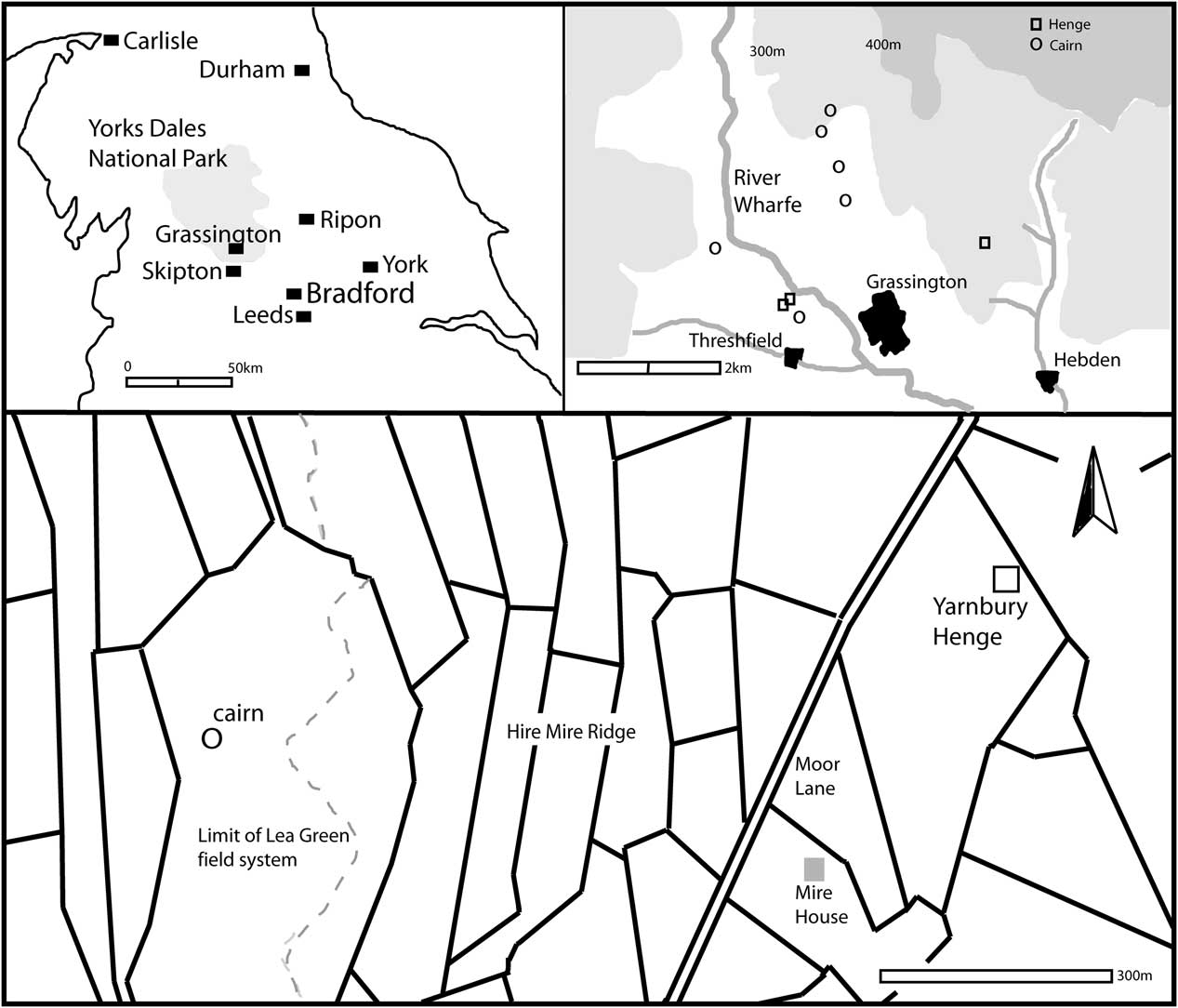
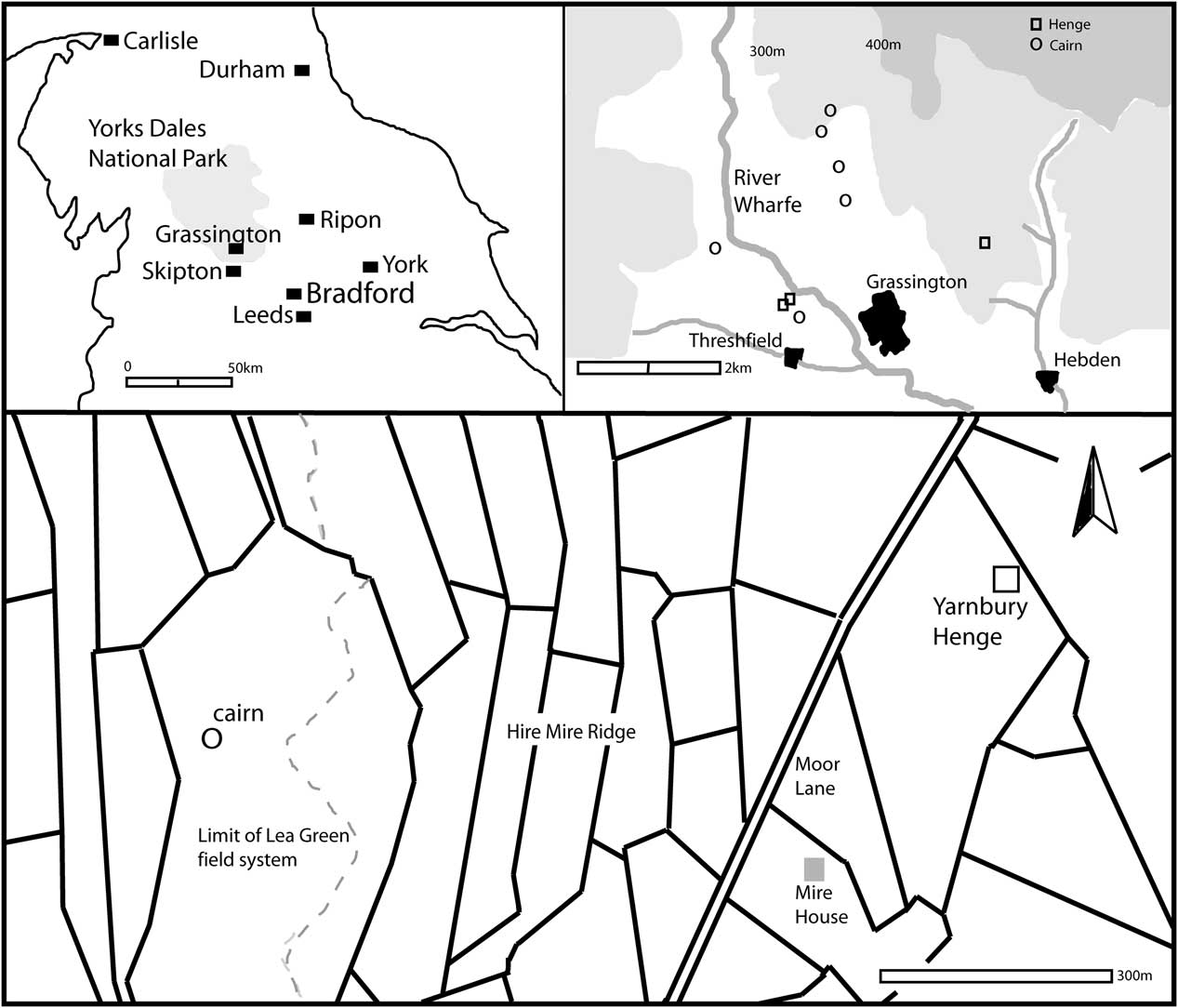
Yarnbury (Fig. 1) lies some 2 km to the north-east of the village of Grassington in Upper Wharfedale and within the southern boundary of the Yorkshire Dales National Park (SE 014654). The area is known for the intense lead mining activity dating from at least the early 17th to the late 19th century with some later small scale exploitation in the early 20th century. The landscape to the north-east of the henge is much disturbed by test pits, rakes and other features resulting from this activity. To the west starts the southern end of the Lea Green rectilinear field system (Raistrick Reference Raistrick1938) which incorporates an alignment of medium sized cairns running along a north–south orientated ridge above the east bank of, and overlooking, the River Wharfe and perhaps representing an ancient route-way now fossilised by the modern long distance path the ‘Dales Way’.
Location plan of the Yarnbury henge
Significant quantities of Mesolithic, Neolithic, and Early Bronze Age artefacts have also been recovered through fieldwalking in this area (Cherry Reference Cherry1998). These finds include fragments of polished stone axe-heads, projectile points (leaf, transverse, and barbed and tanged), scrapers, and plano-convex knives as well as cores and awls. In addition, pottery comprising fragments of Middle Neolithic Impressed Ware and Beaker have also been recovered.
The single-entranced circular enclosure at Yarnbury (SE 014654) stands on a low local horizon on a south-east sloping spur between the Wharfe and its tributary the Hebden Brook. This ridge commands extensive views to the east round to the south and the entrance appears orientated on the land mass of Simon’s Seat some 9 km to the south-east. The Historic Environment Record held by the Yorkshire Dales National Park Authority lists: 1 scraper, 1 core scraper, 1 barbed & tanged arrowhead, 1 fragment of a jet bead or pendant, 4 microliths, and 1 blade being recovered from molehills in the field within which the henge lies (Craven Museum D3185/E/3). This clearly represents a long period of activity in the environs of the site even if that activity is episodic and on a small scale. With this in mind, however, a molehill survey was conducted over the north-eastern part of the field as part of the present project prior to the geophysical survey. Despite the large number of molehills comparatively few finds were recovered and will be reported elsewhere as part of the henge survey.
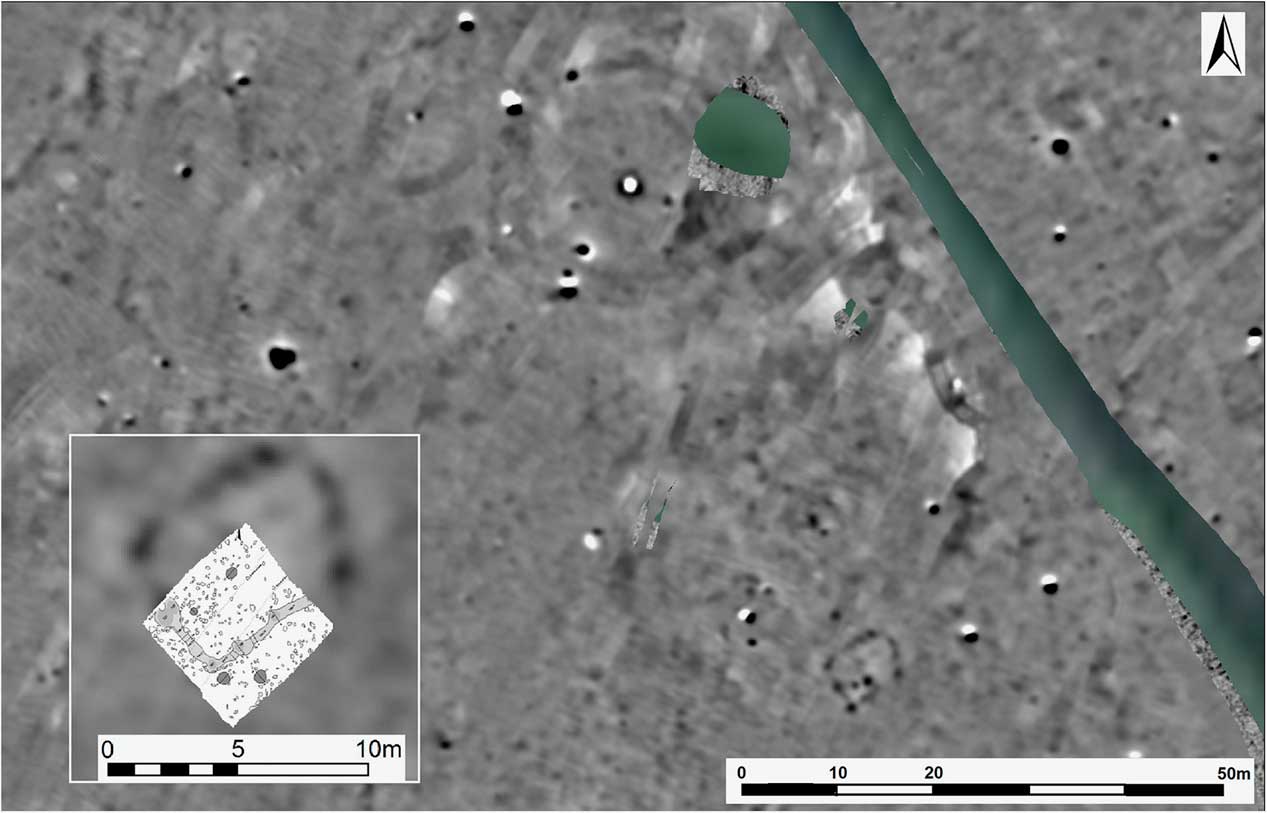
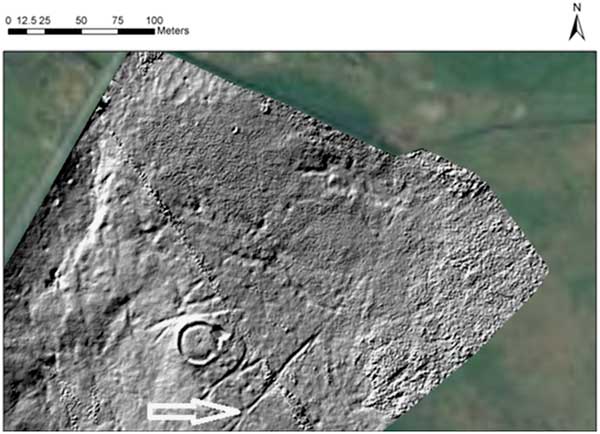
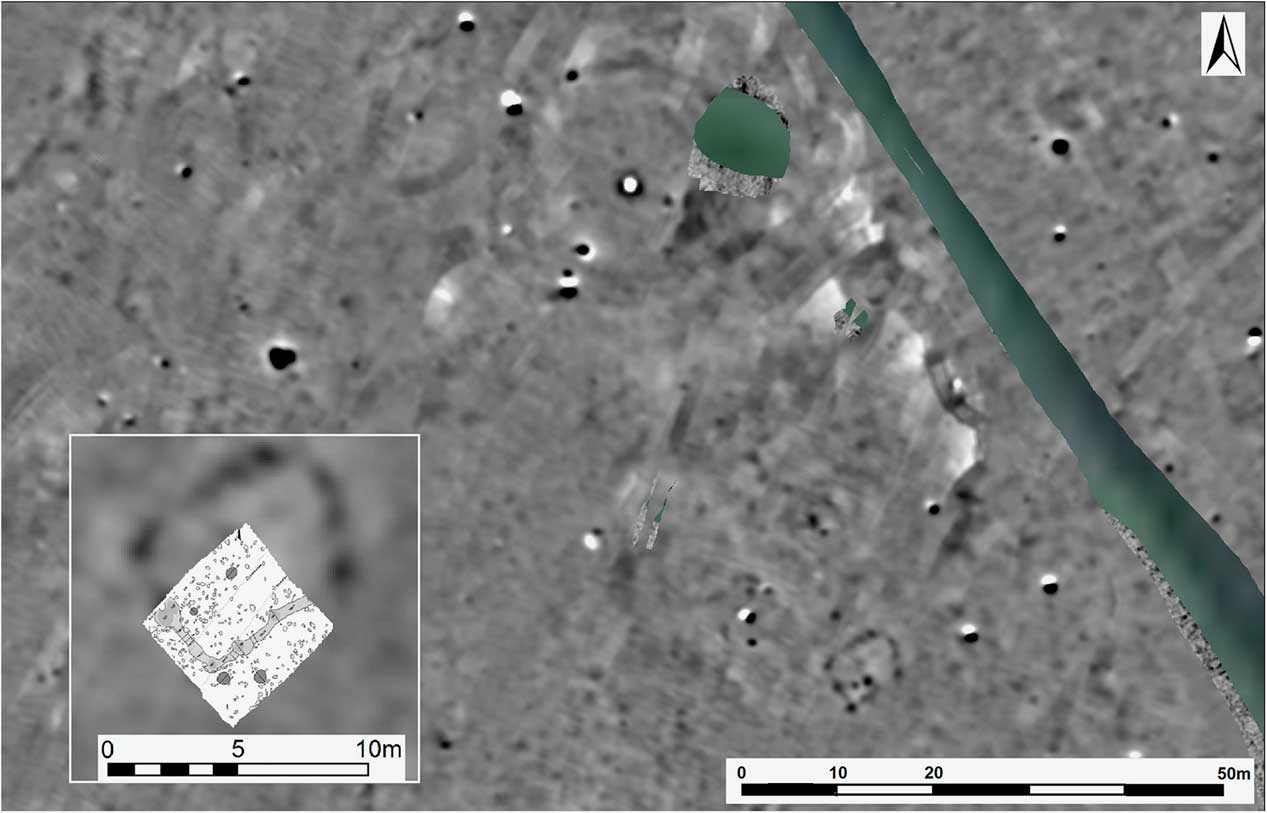
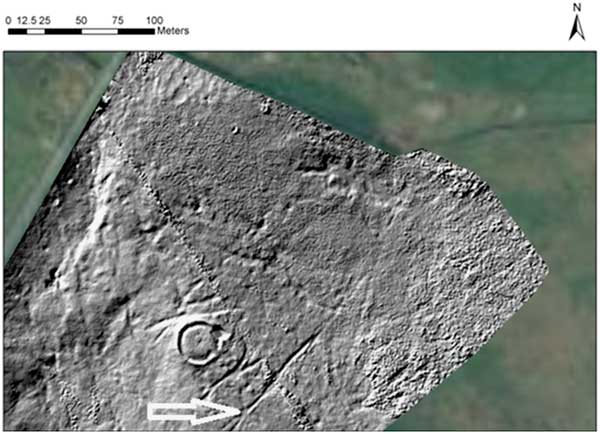
During the geophysical survey an irregular rectangular feature, measuring 7 m north-east–south-west by 8 m north-west–south-east, was located by magnetometry 60 m to the south-south-east of the henge (Fig. 2). This appeared to be a structure defined by a bedding trench with post-holes at intervals and with an entrance in the eastern corner. This entrance faces south-south-east towards the Wharfe Valley as it passes to the south of Simon’s Seat. Interestingly, the henge entrance is sighted south-east, towards this massif, which marks the midwinter sunrise. Two large positive magnetic anomalies within the rectangle possibly represent burnt features such as hearths or internal post-holes or pits. The structure coincided with a pre-enclosure hollow way or track (Fig. 3), presumably connected with the early phases of lead mining to the north-east, which suggested that either the anomaly represented a substantial construction or that it was comparatively modern in date.
Magnetometry of the Yarnbury henge and house to the south-south-east. Excavated area inset
Topographic survey of Yarnbury henge showing the pre-enclosure hollow-ways. House site arrowed
Comparatively modern buildings associated with either the lead mining or with agricultural activities in this area tend to be stone-built and as the structure appeared to underlie the route of the track, it suggested that it had a degree of antiquity and invited parallels with similar simple modular structures of the British and Irish Neolithic (Smyth Reference Smyth2014). If this comparison proved correct, then it would be of considerable local, if not national, importance given the paucity of Neolithic structural evidence in the Dales or the north of England generally. A small-scale sampling excavation was therefore planned to coincide with the excavation at the henge with the objective of obtaining securely stratified dating material from the site.
EXCAVATION
Excavation took place over three weeks in May–June 2014 and was run as a field course for students from the School of Archaeological Sciences at the University of Bradford with help from members of the Upper Wharfedale Heritage Group. A trench measuring 6×6 m was opened over the southern corner of the structure in order to sample c. 25% of the building’s floor plan. All excavation and reinstatement was by hand. The turf was stripped and stacked and the remaining topsoil [101] removed by trowelling. Finds from the topsoil were few but consisted of 4 chips, 12 flakes, 3 retouched pieces, 1 core, 1 blade, 2 scrapers, and 1 leaf-shaped arrowhead. Small fragments of pottery were also found during this cleaning process (see below).
The trackway [126] formed a linear zone of disturbance through the centre of the trench and was characterised by ‘dirty’ darker soil intermixed with rounded stones and charcoal flecks. It substantially truncated the perimeter of the structure in the south-west and the fragments of comminuted charcoal within [126] may well have been derived from the structure’s floor and/or destruction. A shallow gully [118/119] appeared to form the south-eastern edge of the track but may be more apparent than real possibly representing a slightly different, downhill, soil structure. The track was very shallow over the southern corner of the bedding trench and the packing stones of post-hole [107] were visible after removal of the topsoil showing through [126]. No finds were recorded from within this context. Finds on the top of [126], directly below the topsoil, comprised 2 chips, 4 flakes, 1 Mesolithic microlith, and 1 thumbnail scraper possibly of Beaker affinity (see below).
Bedding trench
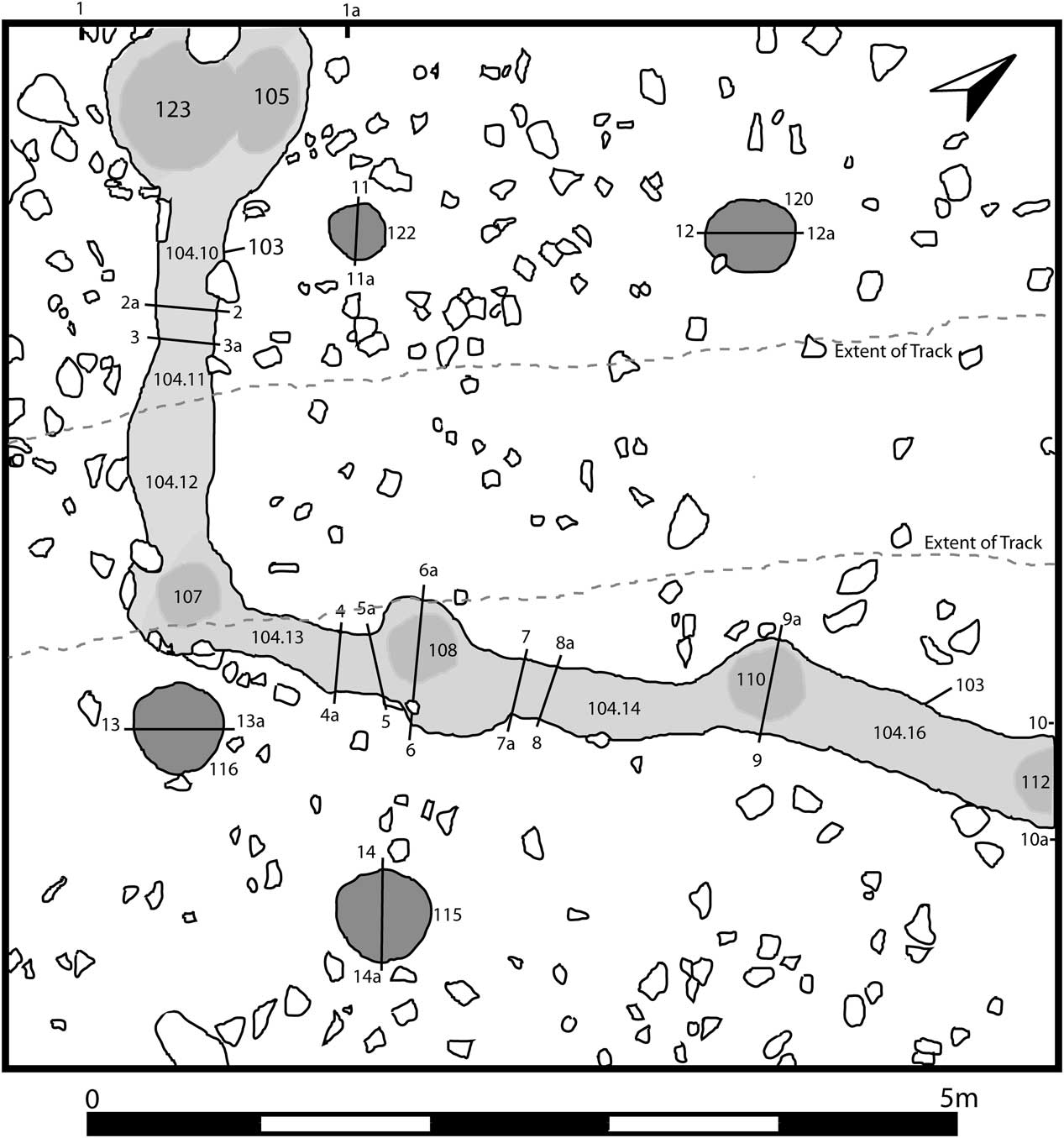
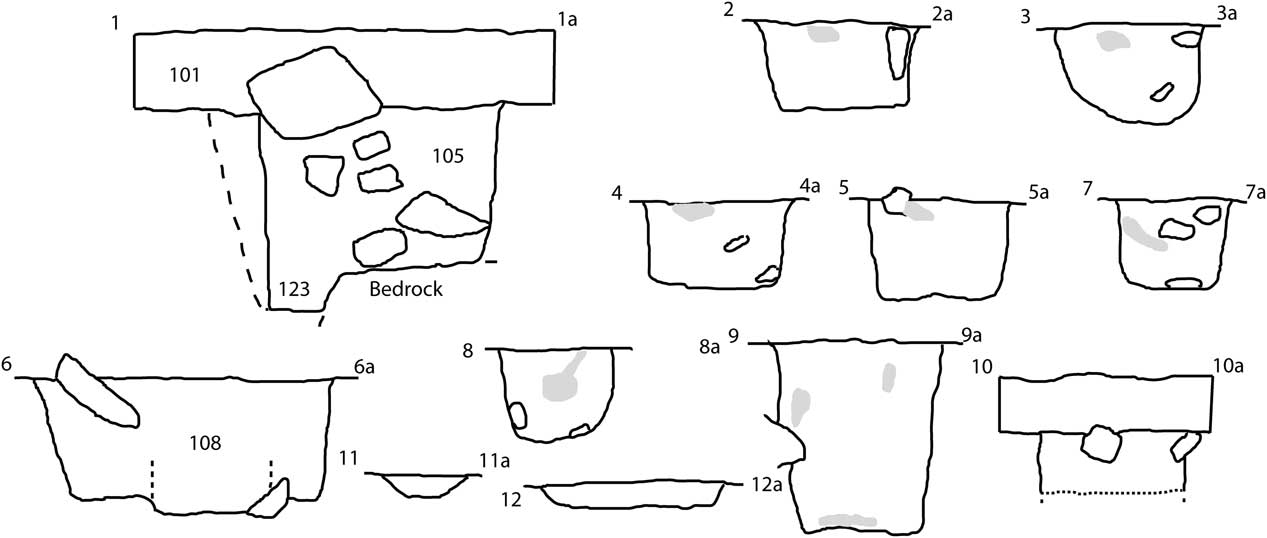
The bedding trench ([cut 103, fill 104] Fig. 4) was clearly visible as a slightly darker streak with intermittent patches of charcoal and occasional areas of pink burnt soil in the yellow-orange subsoil [102]. Other than where directly coinciding with the trackway, it does not appear to have suffered any significant degree of truncation as no old plough marks were noted and the area seems to have been in an area of permanent rough pasture. Packing stones were comparatively few, even in the post-holes and, in the bedding trench at least, the stones encountered mainly seemed to have been accidental incorporations, perhaps derived from the naturally stony soil. The exception was in some of the post-holes where substantial packing stones were present, particularly [105] which probably marks the gable support in the south-west side.
Excavation plan of the structure and other features encountered in the vicinity
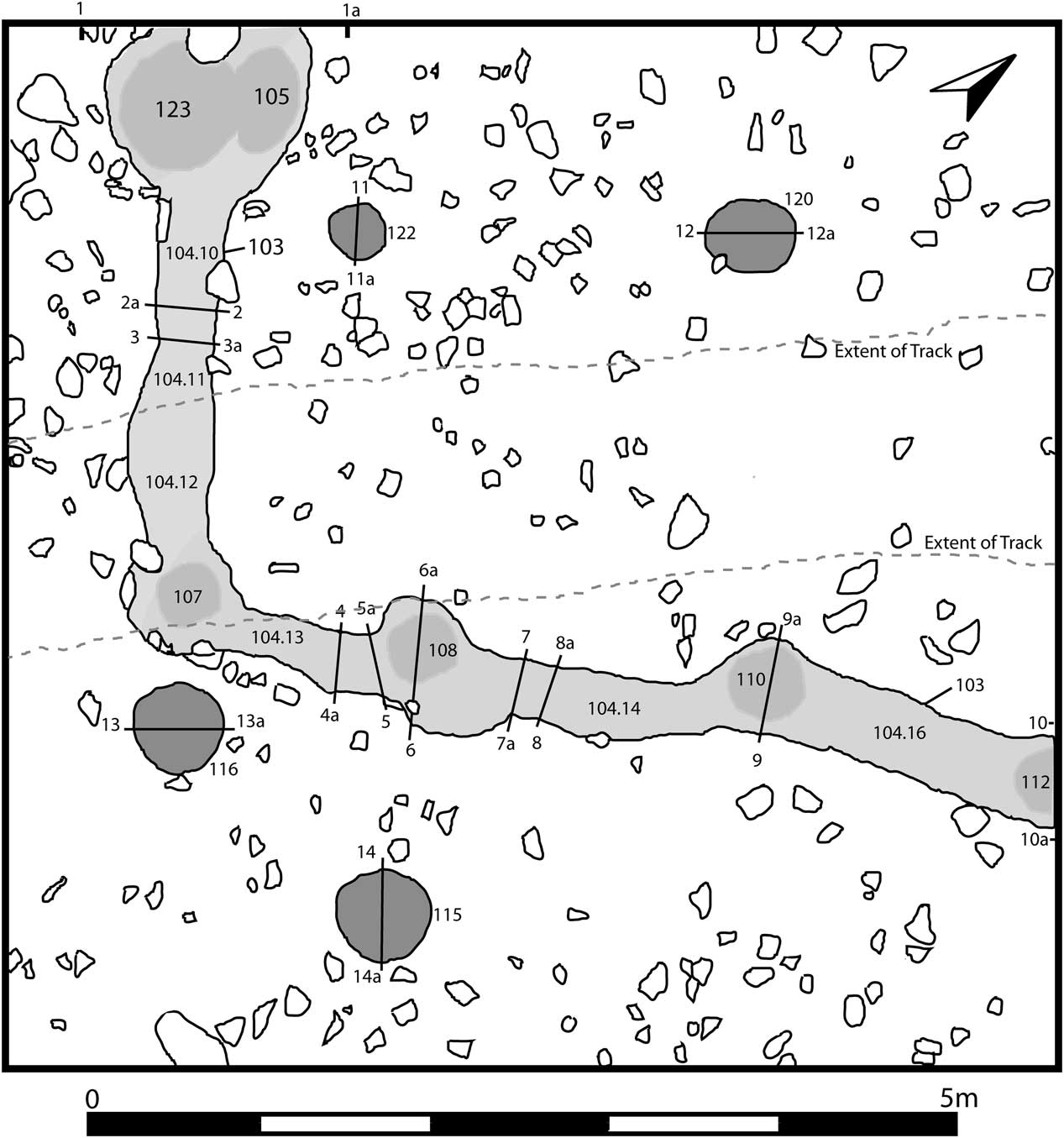
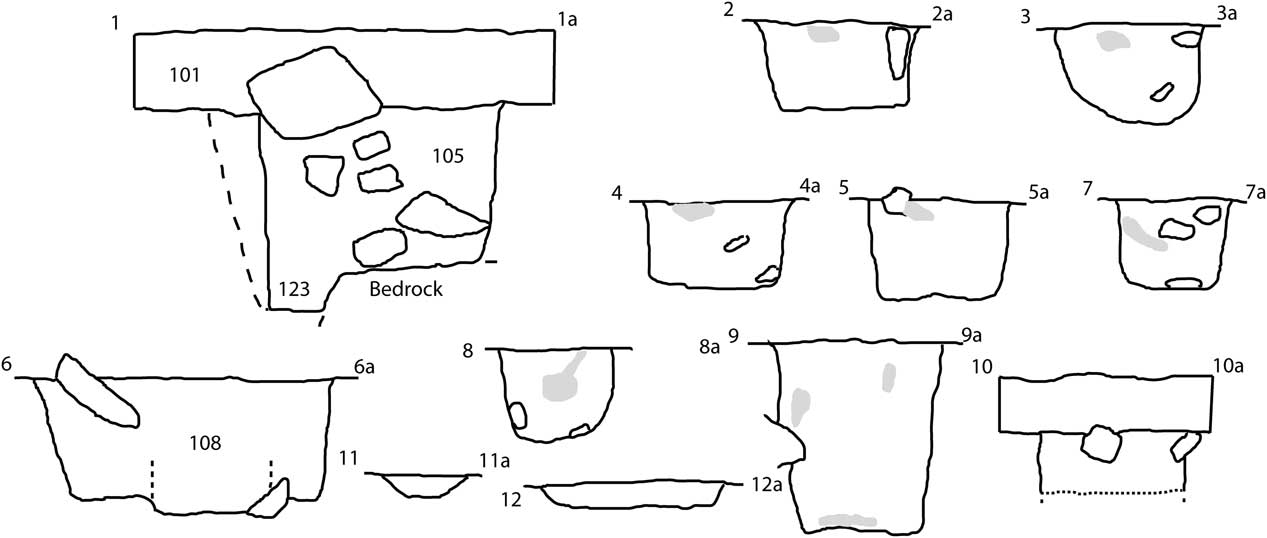
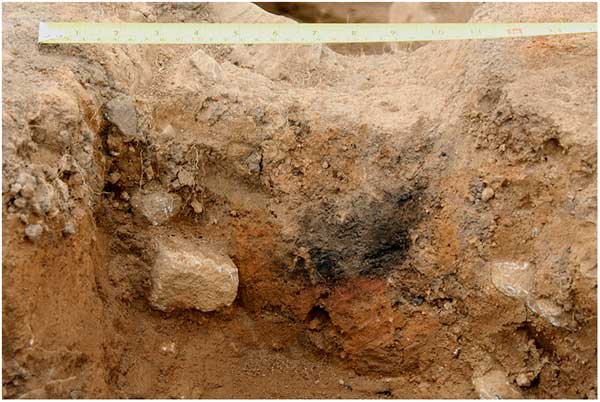
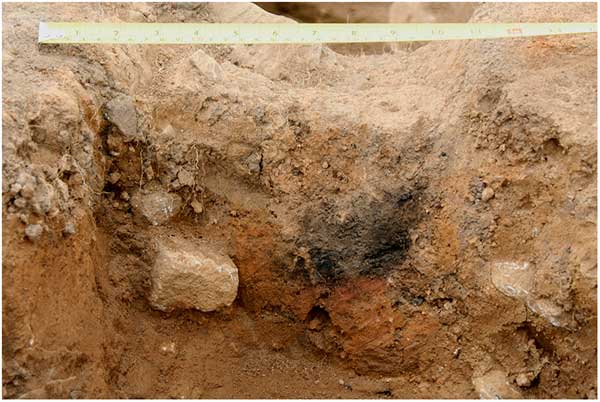
Time did not permit the complete excavation of all features but sufficient sampling was undertaken of approximately 25% of the structure to allow interpretation. The bedding trench [103] proved less substantial than the geophysical survey had suggested. It varied from 0.30 m to 0.40 m across and only c. 0.25 m deep in areas where it had not been disturbed by the track. Bedrock formed the base of the bedding trench in section 104.12 (Fig. 5). With the exception of the large gable post-hole [105] the trench tended to run on the outside of the post-holes suggesting that the interval post-holes had served as the frame for external cladding. No traces of posts or planks were noted in the fill but in section 8–8a traces of a carbonised horizontal oak pole were found (Figs 5 & 6) possibly confirming the use of framed wattle panels suggested by the charcoal report.
Sections through the bedding trench and post-hole. The section locations are identified on Fig. 4. Contexts [123] and [105] have been projected
Fragment of carbonised oak pole in section 8–8a
Finds from the bedding trench were concentrated in the south-west but were, nevertheless, few and comprised 1 chert fragment, 5 flakes, 9 small chips, and 1 retouched flake.
The post-holes
Although the positions of post-holes could be inferred from the geophysical survey (Fig. 2), with the exception of [105] and [107], none was immediately visible after the removal of the topsoil and it was only when the bedding trench was being investigated that they began to be detectable as bulges in the bedding trench sides (Fig. 4). Post-pipes were rarely observable except towards the base of the excavated sections and, as mentioned above, packing stones were generally rare or absent.
Post-hole [112] ran under the north-eastern section of the excavated area and was not fully excavated (Fig. 5, section 10–10a). It measured 0.38 m across and contained soft brown soil with fragments of oak charcoal. No post-pipe was visible in the limited section excavated but possible packing stones appeared in the upper levels. The presence of heartwood and sapwood charcoal suggests that the post was formed from an oak log. One flint flake was recovered from this context.
Post-hole [110] was only encountered as the bedding trench was being emptied and was identified by its greater depth and charcoal rich fill. The post-hole measured 0.45 m across and was 0.5 m deep below the surface of the subsoil (Fig. 5, section 9–9a). The position of the post-pipe, 0.25 m in diameter, was only visible in the lower fills marked by greater charcoal concentrations and a layer of charcoal defined the base. The presence of heartwood and sapwood charcoal suggests that the post was formed from an oak log. There were no finds from this context.
Post-hole [108] was also represented by a bulge in the walls of the bedding trench and only recognised at a lower level by an increase in charcoal within a soft brown matrix. The feature measured 0.8 m across and a packing stone in the upper fill as well as a slight depression in the base suggests a post-pipe 0.3 m in diameter (Fig. 5, section 6–6a). The feature proved comparatively shallow: 0.35 m deep. The presence of heartwood and sapwood charcoal suggests that the post was formed from an oak log and roundwood hazel may suggest the remains of wattle walls. A hazelnut shell from this feature provided a radiocarbon date of 4922±30 bp (SUERC-57194). There were no finds from this context.
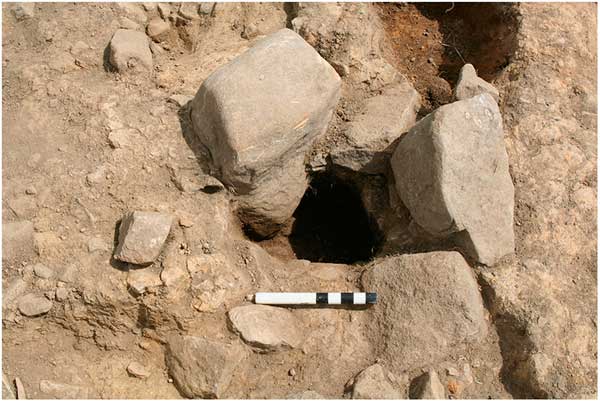
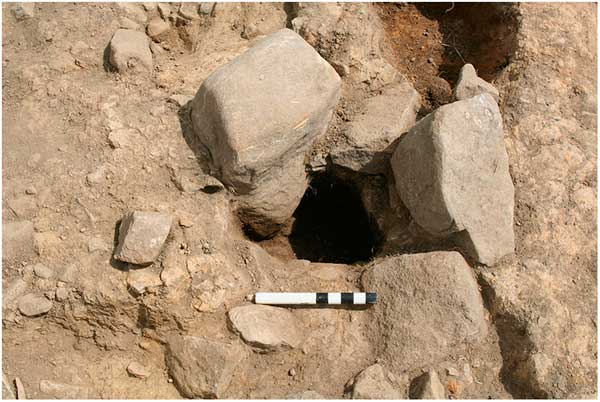
Post-hole [107] was not sectioned due to time constraints but, unlike the other posts, contained a substantial number of packing stones in the upper levels (Figs 5 & 7). What appeared to be bedrock was reached at a depth of 0.40 m. The presence of heartwood and sapwood charcoal suggests that the post was formed from an oak log and fragments of hazel and ash may again suggest traces of wattle walls. A hazelnut shell from this context provided a date of 4885±36 bp (SUERC-54901). A flint chip and possible scraper fragment were recovered from this context.
Detail of post-hole [107] during excavation
Post-hole [105] proved to be the most complex and deepest feature containing a substantial number of packing stones in its fill (Fig. 5, section 1–1a [105] and [123] projected). The post-pipe was recognised by charcoal flecks in contrast to the loamy packing material and suggested an original post 0.4 m in diameter. The base of the post rested on bedrock at a depth of 0.4 m below the surface of the subsoil. The presence of heartwood and sapwood charcoal suggests that the post was formed from an oak log and fragments of hazel and ash may, again, suggest traces of wattle walls. As the packing stones were being removed, traces of a second post-pipe [123] became visible as it entered a dip in the bedrock. This was again distinguished by increased charcoal and reached a depth of 0.5 m below the surface of the subsoil. The post-pipe suggested a post some 0.3 m diameter and the fact that it was only visible after the remains of [105] had been removed suggested that it had been replaced by [105]: it must be stated however, that there was no evidence for any other replacement of elements elsewhere in the excavated area. It is possible that a double post stood within the bedding trench at this point but if this were the case, then it would be expected that [123] would have been visible at a higher level. The charcoal from this feature was identified as oak (including sapwood) and fragments of hazel and birch may again suggest traces of wattle walls. A flint bladelet, core fragment and serrated blade were recovered from the upper fills of [105].
Other features
Four other circular features were found in the area of excavation (Figs. 4 & 5). Feature [122/125] was a small pit 0.3 m in diameter and only 5 cm deep below the surface of the subsoil [102] (Fig. 5, section 11–11a). It contained charcoal flecks identified as oak and hazel, possibly alder, and including some fragments of bark. Feature [116/117] was also a small circular depression 0.4 m in diameter and 10 cm deep below the surface of the subsoil (Fig. 5, section 13–13a). It contained a few stones and a brown loamy fill. Feature [115/124] was also a small circular depression 0.35 m in diameter by 5 cm deep below the surface of the subsoil and was filled with a soft dark loam (Fig. 5, section 14–14a). The functions of these depressions could not be determined from the archaeological evidence that they contained nor could their contemporaneity with the main structure be demonstrated. None contained any artefacts.
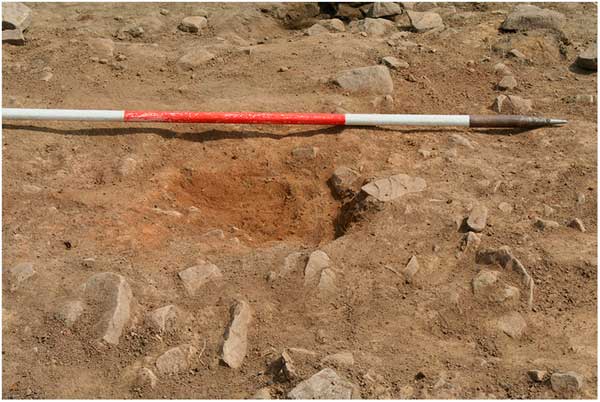
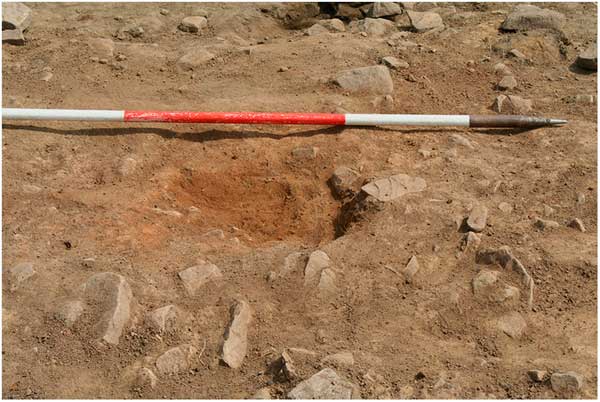
Feature [120/121] appeared as an oval patch of fire-affected soil burnt bright orange/red, measuring 0.25 m NE–SW by 20 cm NW–SE, and interpreted as a hearth. Burnt soil filled the hearth to a depth of 6 cm (Fig. 5 section 12–12a) and the burning had affected the subsoil (Fig. 8). There were no finds from this feature but extremely small and scarce fragments of comminuted charcoal were observed in the fill but not recovered. The burnt subsoil was sampled for magnetic dating.
Hearth feature [120/121] after sampling. The heat-affected base can clearly be seen
POTTERY
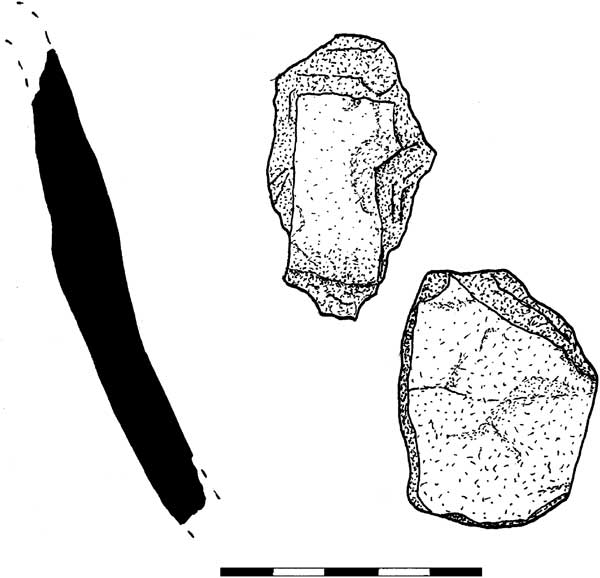
Eight sherds (30 g) of pottery were found near the south-east corner of the excavated area during the cleaning of the subsoil. They were in a soft, black-brown friable fabric, averaging 8 mm thick and with a laminated texture. The inside surfaces of these sherds were coated with a carbonaceous crust which was sampled for traces of absorbed lipids but proved negative. One of the larger sherds has traces of a slight rounded and external shoulder suggesting a Carinated Bowl (Fig. 9) with a slack carination however given the softness of the sherds, this flattening may be post-depositional. Traces of an everted neck can be seen above this shoulder. None of the sherds is decorated and no rim sherds were found. Despite the absence of rims, the fabric, the slack carination, and S-shaped profile put the vessel in the traditional Carinated Bowl class and amongst the earliest ceramic tradition in Britain reaching northern Britain and Ireland sometime in the 40th–39th centuries bc and lasting into the 36th century bc (Sheridan Reference Sheridan2007; Whittle et al. Reference Whittle, Healy and Bayliss2011). The association of this ceramic with the house is therefore entirely appropriate.
The Carinated Bowl sherds
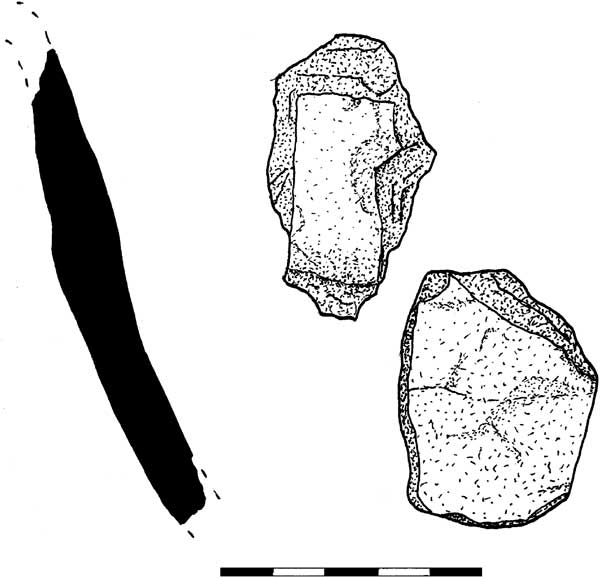
Carinated Bowl is, of course, common on the chalk of eastern Yorkshire associated with the long barrows and other contemporary monuments where radiocarbon dates, even allowing for the use of oak charcoal, place it in the early 4th millennium bc (Manby et al. Reference Manby, Moorhouse and Ottaway2003, 46–7). In Northumberland, dates from short-lived samples at Coupland also suggest an early 4th millennium date (Passmore & Waddington, Reference Passmore and Waddington2009, 175–95). The Scottish Carinated Bowls would also appear to start at least in the 39th century. The earliest dates tend to come from eastern Scotland, however, and reliable dates from more central or western sites such as Biggar, South Lanarkshire, Carzield, Pict’s Know, Dunragit, and Holywood (all Dumfries and Galloway) suggest a start date in the early 38th century (Sheridan Reference Sheridan2007, 479–92).
Further afield, in Ireland, the dates from Magheraboy, Co. Sligo, indicate that Carinated Bowl was in use well before 3600 bc and most likely from the very start of the 4th millennium, if not slightly before (Danaher Reference Danaher2007), and early 4th millennium dates (39th century) have also been obtained from Poulnabrone, Co. Clare (Lynch Reference Lynch2014). The dates for Carinated Bowl from Donegore, Co. Antrim, appear slightly later at 3800–3600 bc (Mallory et al. Reference Mallory, Nelis and Hartwell2011) whilst other sites such as Ballygally, Ballyharry, and Mullaghbouy (all in Co. Antrim) belong to the ‘House Horizon’ starting at the end of the 38th century bc (Smyth Reference Smyth2014).
There is also an increasing presence of the style in Cumberland, Westmorland, and Lancashire (Manby Reference Manby2007) though the assemblages remain to be dated precisely. Carinated Bowl is rare, however, in the central Pennines separating Cumbria and the Irish Sea zone from the Yorkshire Wolds. The site at Portfield, to the east of the Calder-Ribble confluence, is an obvious exception (Beswick & Coombs Reference Beswick and Coombs1986) and here two oval pits produced fragments of six vessels represented mainly by rims. P1 (ibid., fig. 6) has a similar slack profile to the Yarnbury vessel. To the writer’s knowledge, there have been no published finds of Carinated Bowl from the caves of the Yorkshire Dales (though there are anecdotal rumours) that are, instead, noted for their Middle and, to a lesser extent later, Neolithic and Beaker ceramics. This absence is more puzzling given the increasing number of Early Neolithic dates from the skeletal material (Leach Reference Leach2015) and the increasing number of potential Neolithic long mounds being recognised in the Dales (Luke Reference Luke2013). Fieldwalking too has produced Middle and later Neolithic ceramics but no confirmed Carinated Bowl despite the chronological range (Mesolithic to Bronze Age) of some of the lithic scatters (Cherry Reference Cherry2014). It is expected that finds of Carinated Bowl will start to be made in the Dales as research into the Neolithic in this region increases.
WORKED FLINT AND CHERT
(Philippa Bradley)
A total of 146 pieces of worked flint, chert, and quartz and 12 pieces of burnt unworked flint were recovered from investigations at Yarnbury. The flint was recovered from the excavations of the house and the henge as well as the examination of molehills from across the site. Diagnostic forms indicate Mesolithic to Neolithic activity. The finds from the henge and molehill survey will be reported elsewhere.
Raw materials and condition
The bulk of the assemblage is flint but 17 pieces of grey and brown chert were also recovered, although not all of the latter are certainly worked. The flint is mainly good quality, mid-dark brown in colour with a thin buff cortex. A few pieces of yellow and grey flint were also recovered. The flint is probably from East Yorkshire or the Lincolnshire Wolds (cf. Henson Reference Henson1985). Grey, brown, and banded chert was also recovered. The quality of this material is variable with some pieces flaking fairly well, whilst others are crude. Chert occurs within the carboniferous limestones of Derbyshire and Yorkshire so a local source is probable.
The majority of the flint is in good condition with limited edge damage. Cortication is generally light and approximately 9% of the assemblage is burnt. There is limited evidence for use – a single incidence of edge gloss was recorded, probably resulting from use on silica-rich plant materials (Unger-Hamilton Reference Unger-Hamilton1988). The damage on a few edges may have been the result of use rather than formal retouch.
Assemblage composition
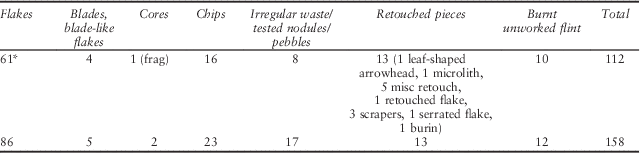
The assemblage is summarised in Table 1; all elements of the reduction sequence were recovered although there is a bias against the smaller elements such as chips and there was only one core fragment. Diagnostic retouched forms include a geometric microlith, a finely worked leaf-shaped arrowhead, and a thumbnail/button scraper. Scrapers, retouched, and serrated flakes indicate domestic activities such as hide preparation and other processing tasks.
SUMMARY LITHIC ASSEMBLAGE COMPOSITION
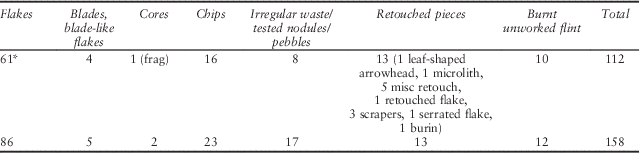
* includes a core tablet
Lithics from the house
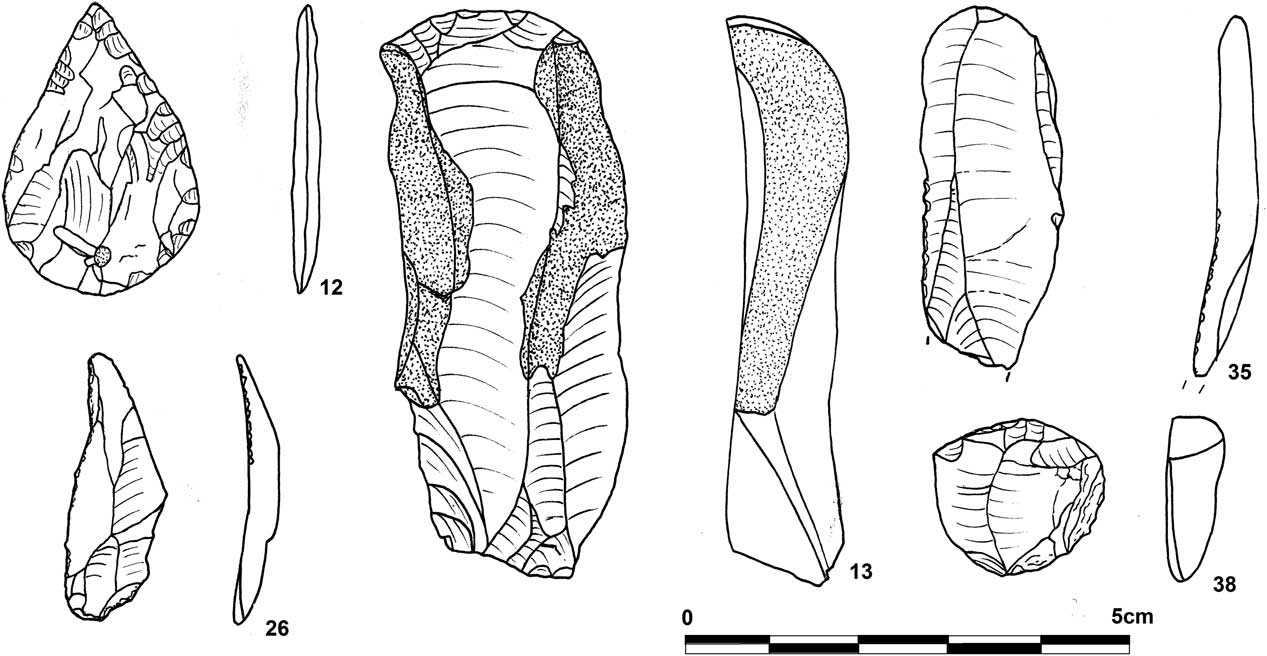
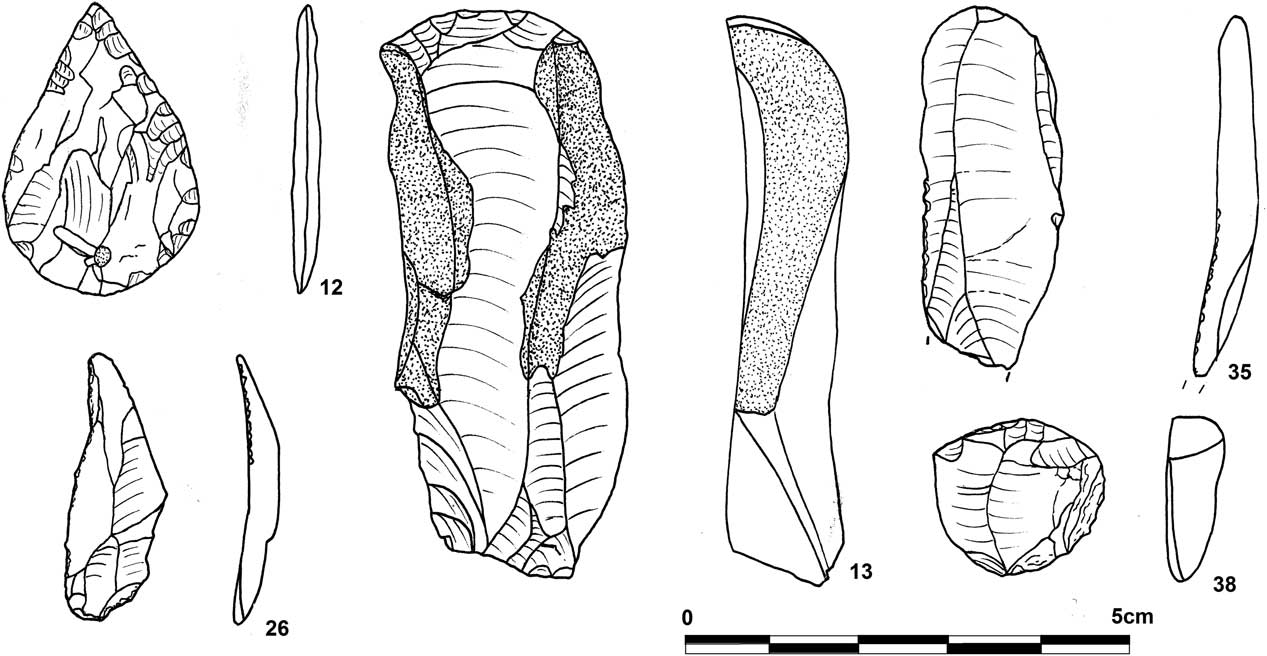
Ninety pieces of flint and chert came from contexts associated with the Neolithic house. Details are provided in the online appendix (Appx S1). Of these, 58 pieces came from the topsoil and the top of the subsoil including the finely worked leaf-shaped arrowhead (Fig. 10, No. 12); the remainder came from the bedding trenches of the house (16 pieces and 9 of burnt unworked flint), post-holes (5), and other contexts (2).
Flint artefacts from the house excavations: 12: leaf-shaped arrowhead; 13: end scraper; 26: Mesolithic burin; 35: serrated blade; 38: ‘button’ or ‘thumbnail’ scraper
The material from the bedding trench comprises debitage (flakes, chips, pieces of irregular waste), a retouched flake, a single possible scraper fragment, and nine pieces of burnt unworked flint. This material includs two of pieces of chert. The flakes are mainly small and just under half of them are broken; burning was recorded on three flakes and a chip.
A bladelet, a core fragment, and a serrated blade (Fig. 10, No. 35) were recovered from post-hole [105]. A flake came from each of post-holes [112] and [114]. All of these pieces are broken and one (from post-hole [112]) is burnt. The core has some blade scars and had at least two platforms. One area of battering on its cortex indicates that it may have been used as a hammerstone. The serrated blade is very worn; gloss was noted on parts of both edges indicating use on silica-rich materials (Unger-Hamilton Reference Unger-Hamilton1988). Although not particularly diagnostic, this assemblage is consistent with an Early Neolithic date and it is probable that these few flints are contemporary with the use of the house and that they may have been accidentally incorporated into the fills of the post-holes and bedding trench.
The bulk of the assemblage from the house was recovered from the topsoil and top of the subsoil (including the surface of the track); the latter being less productive than the topsoil. Again, debitage dominated but a number of scrapers and possible scraper fragments as well as a finely worked leaf-shaped arrowhead were recovered (Fig. 10. No. 12). Some Mesolithic activity is indicated by the recovery of a geometric microlith (small scalene triangle of later Mesolithic date cf. Saville Reference Saville1981, fig. 7), a burin (Fig. 10, No. 26) and a bladelet from the subsoil. A blade from the topsoil may be part of this group, as may a small ‘button’ scraper from the track [119] (Fig. 10, No. 38). Many of the flakes are small and squat. This may reflect the raw materials available but the lack of cores and core fragments precludes any detailed discussion. Nevertheless, larger blanks must have been available as the end scraper from the topsoil (Fig. 10, No. 13) was made on a long blank (58 mm). The arrowhead is a very well made example, extensively retouched over both faces, comparable to Green’s type 3A (Reference Green1980, 71, fig. 28). No obvious signs of firing damage were noted so this may be a chance loss. The other retouched pieces indicate domestic activities – mostly scrapers but a retouched flake may have been used for a number of processing tasks.
Discussion
Records of Mesolithic flint are known from the vicinity of the henge (HER SD996 658; SD96NE50) and larger assemblages have been recovered from nearby sites such as Grassington Moor (HER SE06NW12). The small quantity of Mesolithic material from the excavations is therefore further evidence of this activity, but the small size of the assemblage precludes any further detailed discussion.
The bulk of the assemblage came from the overlying topsoil and the surface of the subsoil. Apart from the small Mesolithic element from this area, there is nothing that would be inconsistent with an earlier Neolithic date although, as noted above, much of the debitage is undistinguished. A range of raw materials indicates connections to East Yorkshire, Lincolnshire, and possibly Derbyshire. The assemblage from the house is essentially domestic in character being the residue of knapping and a range of processing activities. The rather scrappy nature of this material perhaps accords with the idea that the house was kept relatively clean (cf. Bradley in prep.).
CHARCOAL ANALYSIS
(Dana Challinor)
Ten samples from the excavations of the Yarnbury house were assessed and found to contain variable quantities of charcoal. Most of the samples came from the bedding trench and post-holes, from which 15 litres of soil per context were sampled apart from Pit [122/125] which was sampled in its entirety. The primary aim of the analysis was to characterise the taxonomic composition and nature of the wood types found in the assemblages, in order to study the utilisation of structural timbers from the construction of the house.
Methods
An initial assessment of the flots revealed that diversity was quite low in the samples. A sample of 30 fragments, randomly selected from three sieve sizes (8 mm, 4 mm, and 2 mm) was considered adequate to characterise the charcoal assemblages. All of the sieved fractions, including the finer (2–0.5 mm) fractions, were scanned at low magnification (×10–×45) for the presence of non-wood charred plant remains. Only fragments of hazelnut shell were identified. This also afforded the opportunity to determine, to an extent, how dominant oak was in the samples (since oak fragments along its large rays in a distinctive manner).
The charcoal was fractured and sorted into groups based on the anatomical features observed in transverse section at ×7–×45 magnification. Representative fragments from each group were then selected for further examination using a Meiji incident-light microscope at up to ×400 magnification. Data relating to the character of wood utilisation (woodland management, cropping regimes, etc) were also collected, where possible. A total of 380 fragments were examined. Identifications were made with reference to Schweingruber (Reference Schweingruber1990), Hather (Reference Hather2000) and modern reference material. Classification and nomenclature follow Stace (Reference Stace1997). Identifications are provided to the highest taxonomic level possible according to the native British flora, i.e. where there is only a single native species, this is named, but where there are several native species, the genus or subfamily is given.
Results
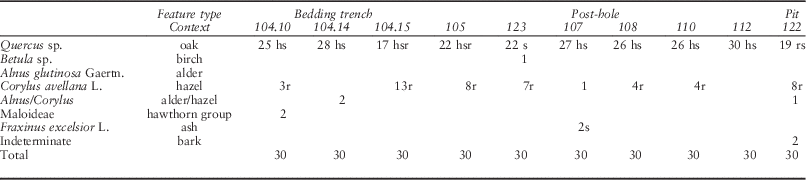
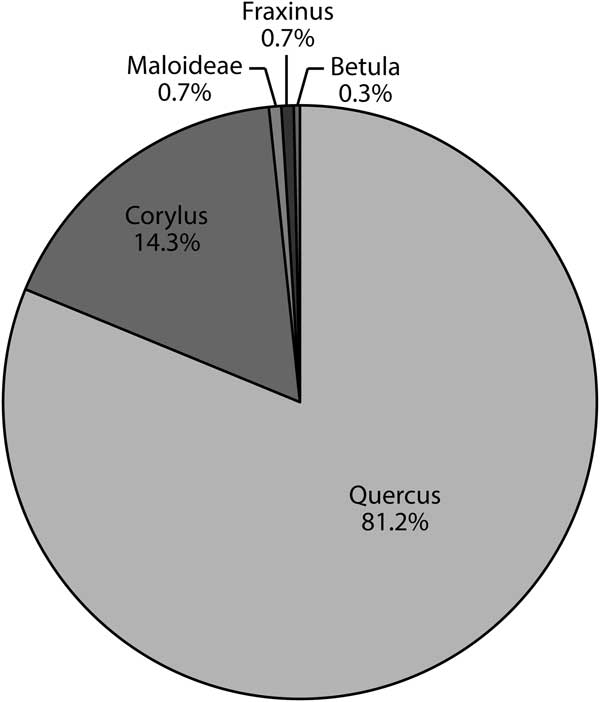
The condition of the charcoal was generally good, with large (>8 mm) and clean charcoal, though some of the material was encrusted with sediment. Six taxa were positively identified; Quercus sp. (oak), Betula sp. (birch), Alnus glutinosa (alder), Corylus avellana (hazel), Maloideae (hawthorn, apple, pear, rowan, etc), and Fraxinus excelsior (ash) (Table 2). Both oak heartwood and sapwood were recorded in most samples, and most of the oak charcoal derived from trunkwood or large branchwood as there was only rare evidence for ring curvature. No tyloses were observed in the ash fragments and there was no ring curvature noted. In contrast, much of the hazel charcoal derived from roundwood of narrow diameter; although there were few fragments with pith and/or bark preserved, there was clear evidence for strong or moderate ring curvature. Some of the alder (but not all) also exhibited roundwood characteristics.
RESULTS OF THE CHARCOAL ANALYSIS (BY FRAGMENT COUNT)
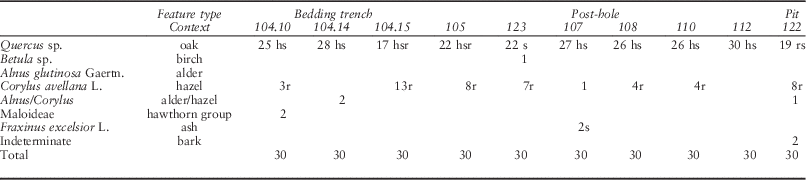
h=heartwood; s=sapwood; r=roundwood
Another characteristic of the assemblage was the frequent observation of slow growth, especially in the oak from the bedding trench. This was attested by the absence of visible late wood pores (one ring comprising mainly the large pores of spring growth) and the calculation of mean average ring width of ≤1 mm/year.
Moderate to high levels of vitrification were recorded in occasional fragments. Vitrification refers to the glassy appearance (and possible fusion of cells) which probably relates to the condition of the wood prior to burning (Marguerie & Hunot Reference Marguerie and Hunot2007, 1421), and/or the burning process, although it is no longer considered to be commensurate with high temperatures (McParland et al. Reference McParland, Collinson, Scott, Campbell and Veal2010, 2686). Insect tunnels were observed in fragments of hazel from post-hole [105]. The shape of the tunnels was not particularly diagnostic, but the presence of any wood boring beetles indicates that the dead wood had been inhabited prior to burning. No such tunnels were recorded in the oak, however, which suggests that the whole building was neither infested nor substantially decayed before it was destroyed.
No charred seeds were found in any of the samples but a number of samples produced charred hazelnut shell, mostly in small quantities.
Discussion
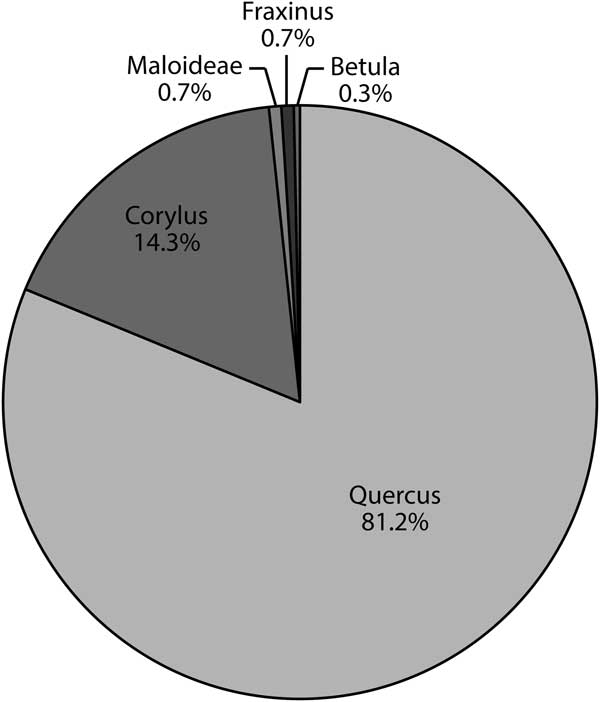
The analysis of the whole assemblage revealed an overwhelming dominance of oak and hazel, representing almost 90%, with the other taxa combined accounting for only 10% (Fig. 11). This dominance is corroborated by ubiquity analysis, whereby oak was present in 100%, and hazel in 92% of the samples.
Taxonomic composition of early Neolithic charcoal, based upon fragment count (N=328, excludes bark fragments)
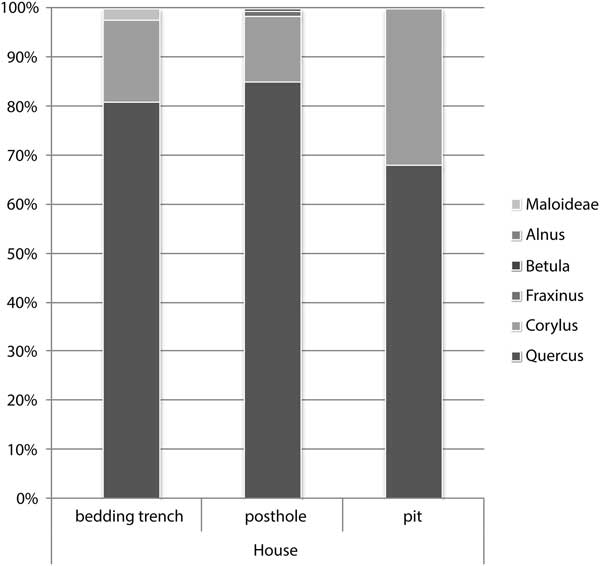
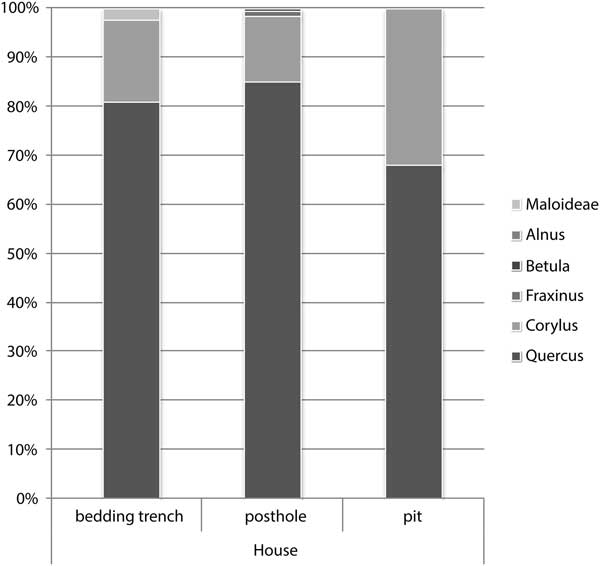
The dominance of oak and hazel is unsurprising, given the nature of the contexts from which the samples originate (Fig. 12). The geophysical survey and excavation of the Neolithic house suggested that the building had burnt down and that the charcoal from most of the samples, therefore, represents burnt structural remains. The evidence from the charcoal suggests that large oak timbers were used for the main posts, with smaller calibre hazel roundwood used for wattle panels or other infills between the main timbers. The use of mature oak is indicated by three main factors. First, the presence of heartwood, that is usually laid down when the tree is more than 20 years in age (Gale Reference Gale2006, 114); secondly, the frequent evidence for slow growth (even in sapwood), since mature trees tend to grow more slowly than young ones (Thomas Reference Thomas2014); and thirdly, the absence of ring curvature that indicates that trunkwood (rather than branches or young coppice) had been utilised.
Charcoal by feature type, based upon fragment count (N=328)
This does not infer that woodland management had not been practised, but any cropping regime must have taken place on a relatively long cycle of more than 20 years. It may be, however, that the timbers had been supplied from the felling of over-storey trees, rather than the oak being regularly coppiced. Indeed, some slow-grown fragments exhibited more than 30 years growth, without, or with little, ring curvature. The hazel, in contrast, came from much younger trees, with no fragment exhibiting more than 10 years growth. The strong ring curvature and occasional presence of cambial edge or pith shows that stems or branches of narrow diameter had been utilised.
Any discussion of the local woodland environment is limited by the selection processes which would have influenced the taxa that were utilised. The choice of wood for structural requirements would have been more constrained and different to the selection practices for fuelwood. In any case, the site falls within a region dominated by oak-hazel woodland in prehistory (Rackham Reference Rackham2006, 84), and it is clear that this was exploited for the construction of the Early Neolithic building. Birch and ash are both colonising taxa, which flourish in an open landscape, and alder would have grown alongside the River Wharfe or in a similar riverside habitat.
The excavation of Early Neolithic buildings is rare, and the preservation of charcoal within them even rarer. The results from Yarnbury are notably consistent with those from a burnt down Neolithic rectangular building at Lismore Fields, Buxton in Derbyshire (Challinor in prep.): both indicate that large oak posts, sourced from mature trees, were utilised, along with smaller hazel poles for infill panels. There was no positive evidence for woodland management at Yarnbury, and although it cannot be ruled out, it is also plausible that adequate supplies of mature oak and appropriate sized hazel stems could be readily sourced from the locally available oak-hazel woodland.
RADIOCARBON DATING
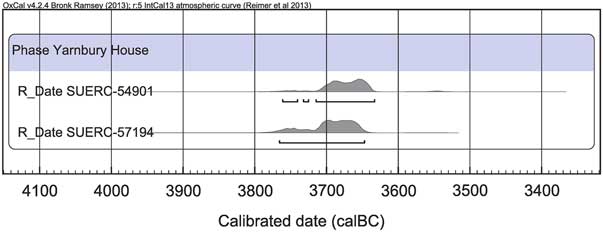
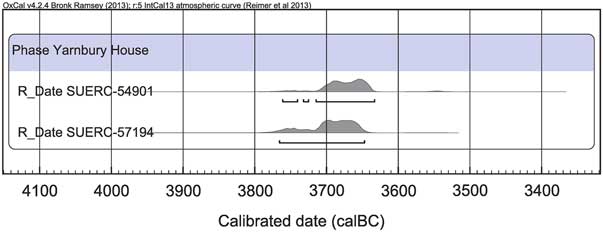
Two samples of hazelnut shell from post-holes [107] and [108] were submitted to the Scottish Universities Environmental Research Centre for radiocarbon dating. The results (Table 3, Fig. 13) were obtained and have been calibrated using the University of Oxford’s OxCal 4.2.4 (Bronk Ramsey 2013) using the curve of Reimer et al. (Reference Reimer, Bard, Bayliss, Beck, Blackwell, Bronk Ramsey, Grootes, Guilderson, Haflidason, Hajdas, Hatt, Heaton, Hoffmann, Hogg, Hughen, Kaiser, Kromer, Manning, Niu, Reimer, Richards, Scott, Southon, Staff, Turney and Plicht2013).
Calibrated radiocarbon determinations from the Yarnbury Neolithic house
RADIOCARBON DATES FROM THE YARNBURY NEOLITHIC HOUSE

Although from different samples, these dates are statistically similar (X2-Test: df=1 T=0.518 (5% 3.841)) and are capable of being combined to produce a date range of 3709–3646 cal bc (95.4%) and probably 3694–3656 cal bc (68.2% probability - Agreement n=2 Acomb=117.6% (An= 50.0%)). Even without this combination (given the different samples) these near identical date ranges clearly place the construction and early use of the structure in the first half of the 37th century cal bc.
ARCHAEOMAGNETIC DATING
(Cathy Batt & David Greenwood)
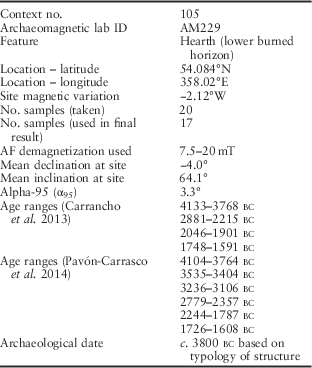
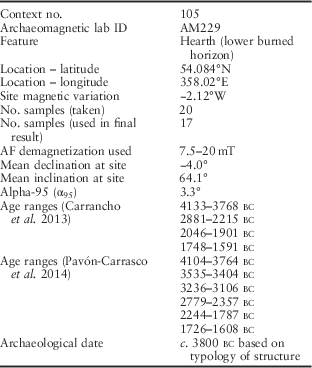
Twenty archaeomagnetic samples were obtained from context [120/121] using the disc method (Linford Reference Linford2006). These all retained a measurable and stable magnetisation, indicating that the material was burnt in situ and recorded the geomagnetic field at the time of last heating. If associated with the house, as seems likely, the hearth [120/121] pre-dates the current British archaeomagnetic calibration curve (Zananiri et al. Reference Zananiri, Batt, Tarling, Lanos and Linford2007) and so attempts were made to date the characteristic remanent magnetisation recorded using two methods: by comparison with the first European directional palaeosecular variation curve (PSV) for the Neolithic (Carrancho et al. Reference Carrancho, Villian, Pavón-Carrasco, Osete, Straus, Vergès, Carretero, Angelucci, González Morales, Arsuaga, Bermúdez de Castro and Carbonell2013) and by comparison with the SHA.DIF.14 k global geomagnetic field model (Pavón-Carrasco et al. Reference Pavón-Carrasco, Osete, Torta and De Santis2014). Both these approaches have limitations (Greenwood & Batt Reference Greenwood and Batt2015) but a number of possible broad date ranges were obtained (Table 4) some of which are consistent with the archaeological evidence. Both methods give a possible date range between 4140 bc and 3760 bc, but also allow for a number of more recent dates. The number of date ranges mainly arise from the limited number of magnetic measurements for this period altogether, and the fact the much of what there is, is located a significant distance from the UK. As more UK data are added for this period to the UK archaeomagnetic calibration curve it will become possible to improve the reliability and precision of archaeomagnetic dating in this period. The data from Yarnbury, with the associated radiocarbon dates, will contribute to the improvement of this dataset. Detailed magnetic measurements and a description of the methodology are available in Greenwood and Batt (Reference Greenwood and Batt2015).
SUMMARY OF ARCHAEOMAGNETIC INFORMATION FOR AM229
DISCUSSION
The Yarnbury house has been dated by radiocarbon and archaeomagnetism to the first half of the 37th century cal bc. The archaeomagnetic date is important as it is one of the first to be obtained from the British Neolithic and, with supporting radiocarbon dates from short-lived samples, will help establish UK archaeomagnetic dating for this period. The structure is one of an increasing number of small, irregularly rectangular timber structures dating to the earlier Neolithic. Smyth (Reference Smyth2014) has documented over 90 such houses in Ireland belonging to an equally narrow chronological period and in 1996 Darvill recorded the then known Neolithic houses in England and Wales, whilst Barclay (Reference Barclay1996) undertook a similar task for Scotland. More houses have since come to light in Britain, principally as a result of developer-funded archaeology such as Whitehorse Stone, Kent (Booth et al. Reference Booth, Champion, Foreman, Garwood, Glass, Munby and Reynolds2011), Parc Bryn Cegyn and Llanfaethlu, Gwynedd (Kenney Reference Kenney2009: Rees & Jones Reference Rees and Jones2015), and the halls of Claish, Stirling (Barclay et al. Reference Barclay, Brophy and MacGregor2002), Crathes, Aberdeenshire (Murray et al. Reference Murray, Murray and Fraser2009), and Lockerbie Academy, Dumfries & Galloway (Kirby Reference Kirby2011). The data have been admirably summarised by Smyth (Reference Smyth2014) and need little elaboration here.
Comprising negative features, and occasionally flimsy, these buildings are unlikely to survive in areas of intensive arable agriculture (Gibson Reference Gibson2003) and we rely on protected contexts for their preservation. The structures beneath cairns such as Gwernvale, Brecknock, or Ascot-under-Wychwood, Oxfordshire (Britnell & Savory, Reference Britnell and Savory1984; Benson & Whittle Reference Benson and Whittle2007; Morigi et al. Reference Morigi, Schreve, White, Hey, Garwood, Robinson, Barclay and Bradley2011, 232) or below hillwash and alluvium such as Whitehorse Stone, Kent (Booth et al. Reference Booth, Champion, Foreman, Garwood, Glass, Munby and Reynolds2011), or Yarnbury, Oxfordshire (Morigi et al. Reference Morigi, Schreve, White, Hey, Garwood, Robinson, Barclay and Bradley2011) being cases in point. The long established pastoral economy in large parts of Ireland also provides such protection. As a result, our distribution of such sites is always likely to be skewed by such factors as preservation and detection as well as by the propensity of large-scale developer funded excavation.
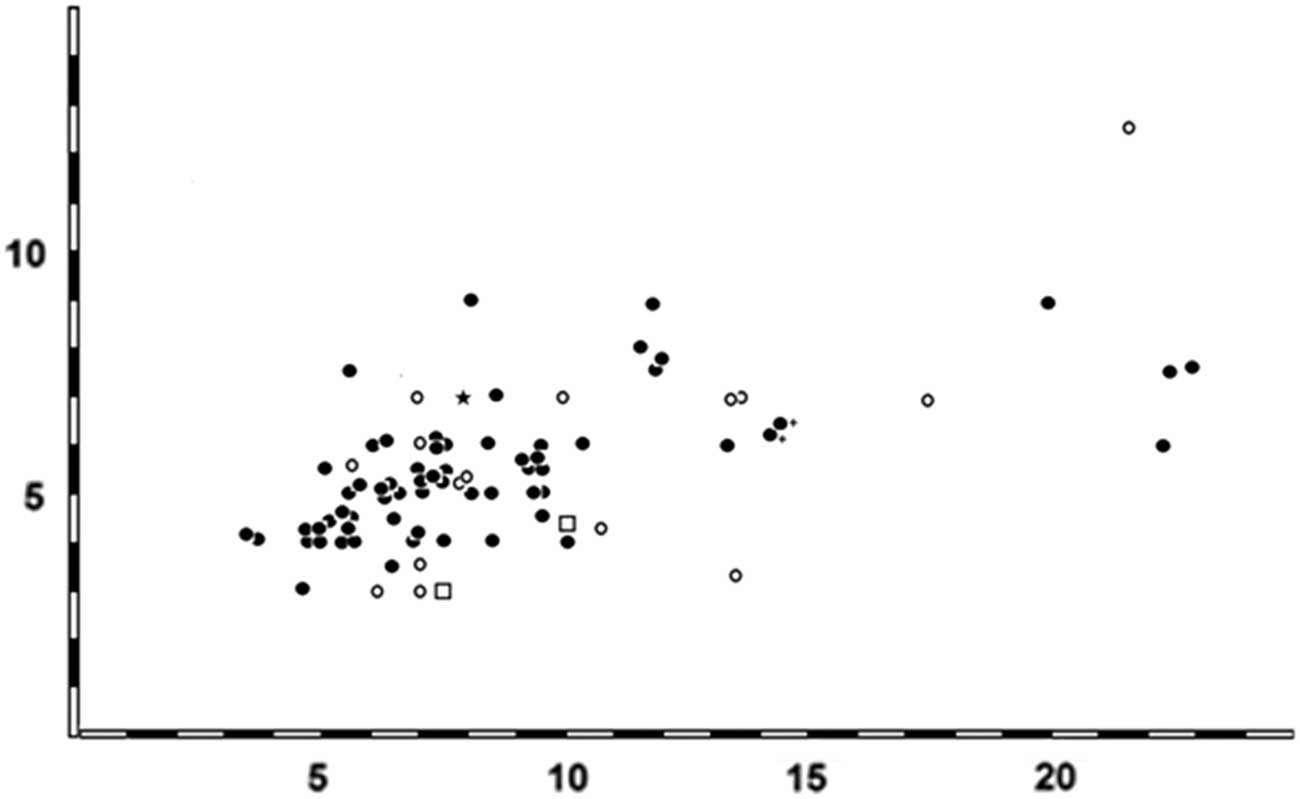
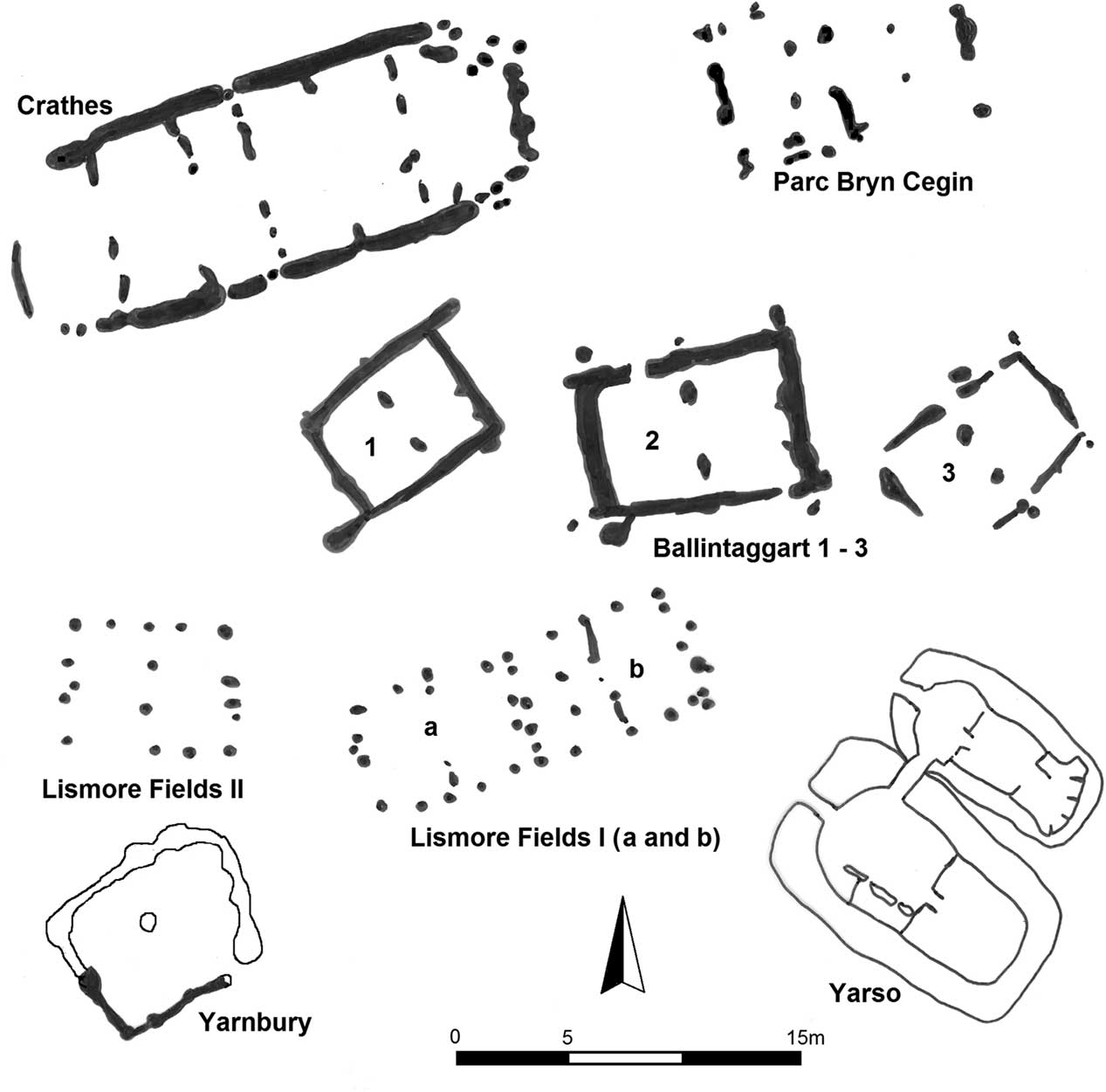
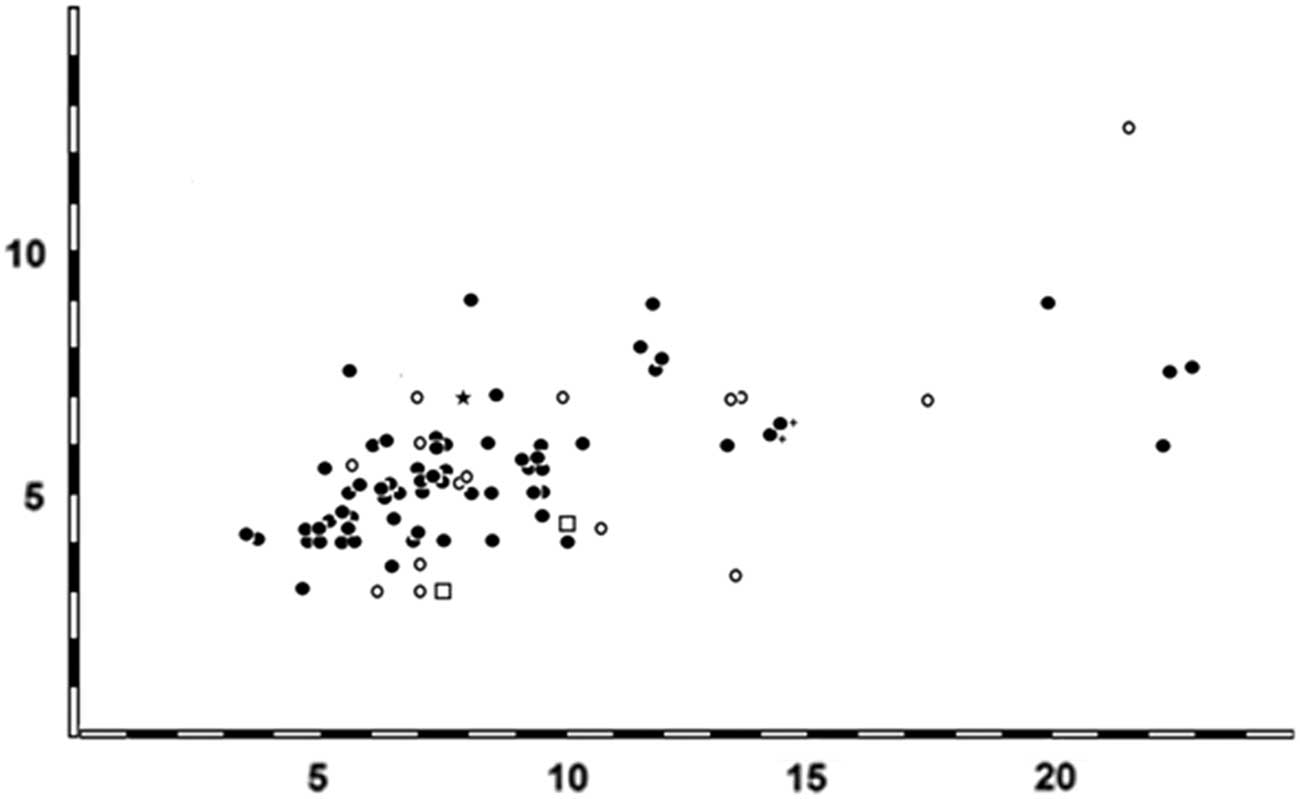
The Early Neolithic houses so far discovered in Britain and Ireland have been rectangular, often irregularly so, and usually under 10 m in length although there are some notable exceptions such as the ‘halls’ of Claish, Balbridie, and Crathes which belong to a smaller group of buildings over 12 m long. Yarnbury fits perfectly within the smaller size cluster (Fig. 14). Apsidal ends and extensions are also encountered, as at Claish and Lockerbie or at Balleygalley 1 in Antrim (Simpson Reference Simpson1996). The walls of these Early Neolithic structures generally comprise bedding trenches or individual post-holes though the method of construction does not seem to affect their dimensions with large and small structures being found in both major techniques (Fig. 15). Many houses, including at the smaller end of the size spectrum, have internal post-holes or bedding trenches suggesting internal partitions (Smyth Reference Smyth2014, 28–9) and, from the magnetometry evidence, this would seem to also be the case at Yarnbury (Fig. 2) though the excavation did not reach this far into the structure. The layout of the Yarnbury structure very much resembles the three structures from Ballintaggart, Co. Down (Smyth Reference Smyth2014, 28) which have bedding trench wall construction and two internal posts dividing the long axis into two more or less equal parts (Fig. 16). This internal division is also notable in the stone-built houses at the Knowe of Yarso, Orkney (Barclay Reference Barclay1996, 68) which also fall within the smaller cluster (Figs. 14 & 16). Their stone-built walls give the two conjoined Knowe of Yarso buildings a very different superficial appearance to the timber constructions but in size and internal lay-out they bear a strong comparison.
Dimensions of Early Neolithic Houses. Filled circles = bedding trench construction, open circles = post-hole construction, square = stone-built, star = Yarnbury. += ground plan incomplete
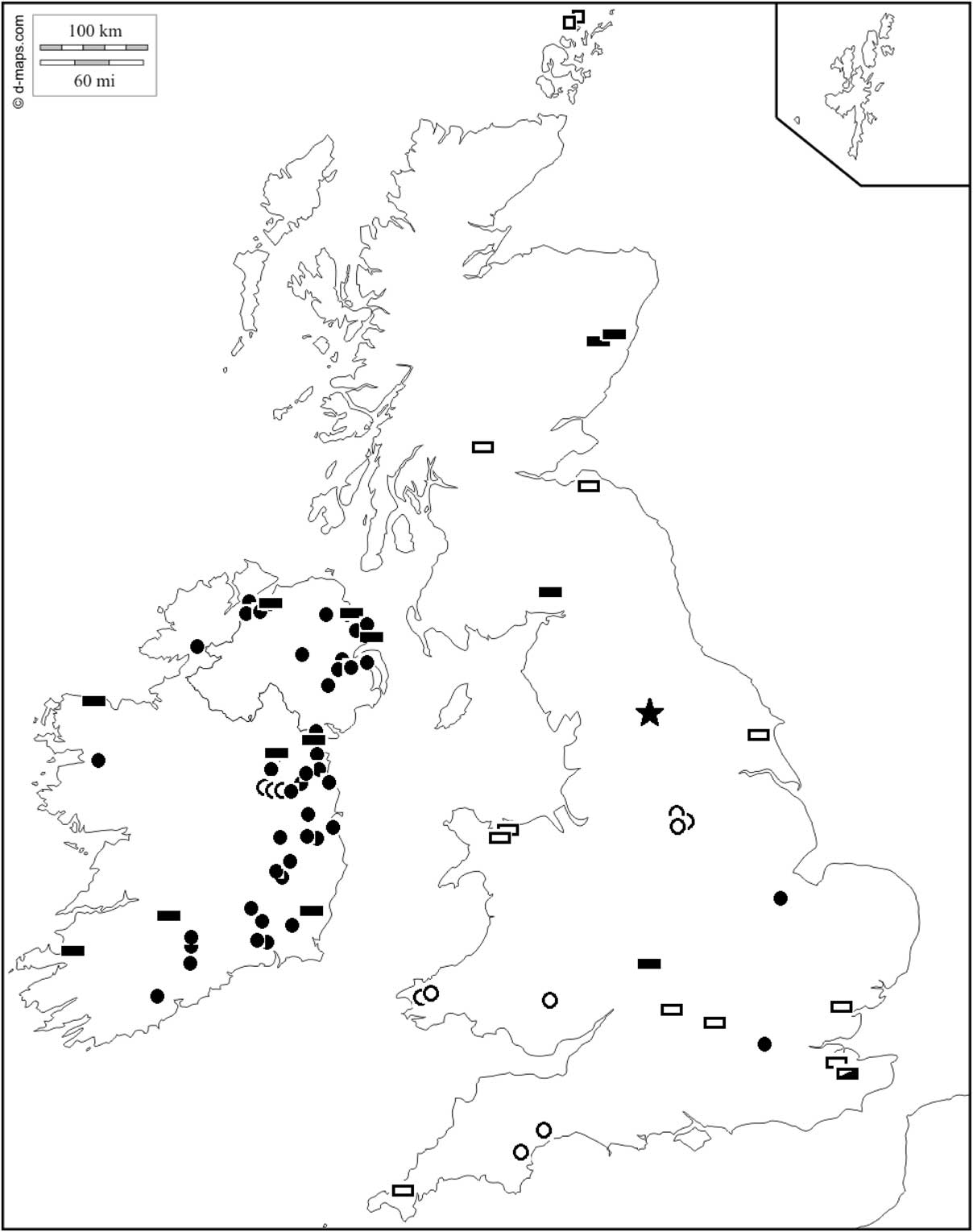
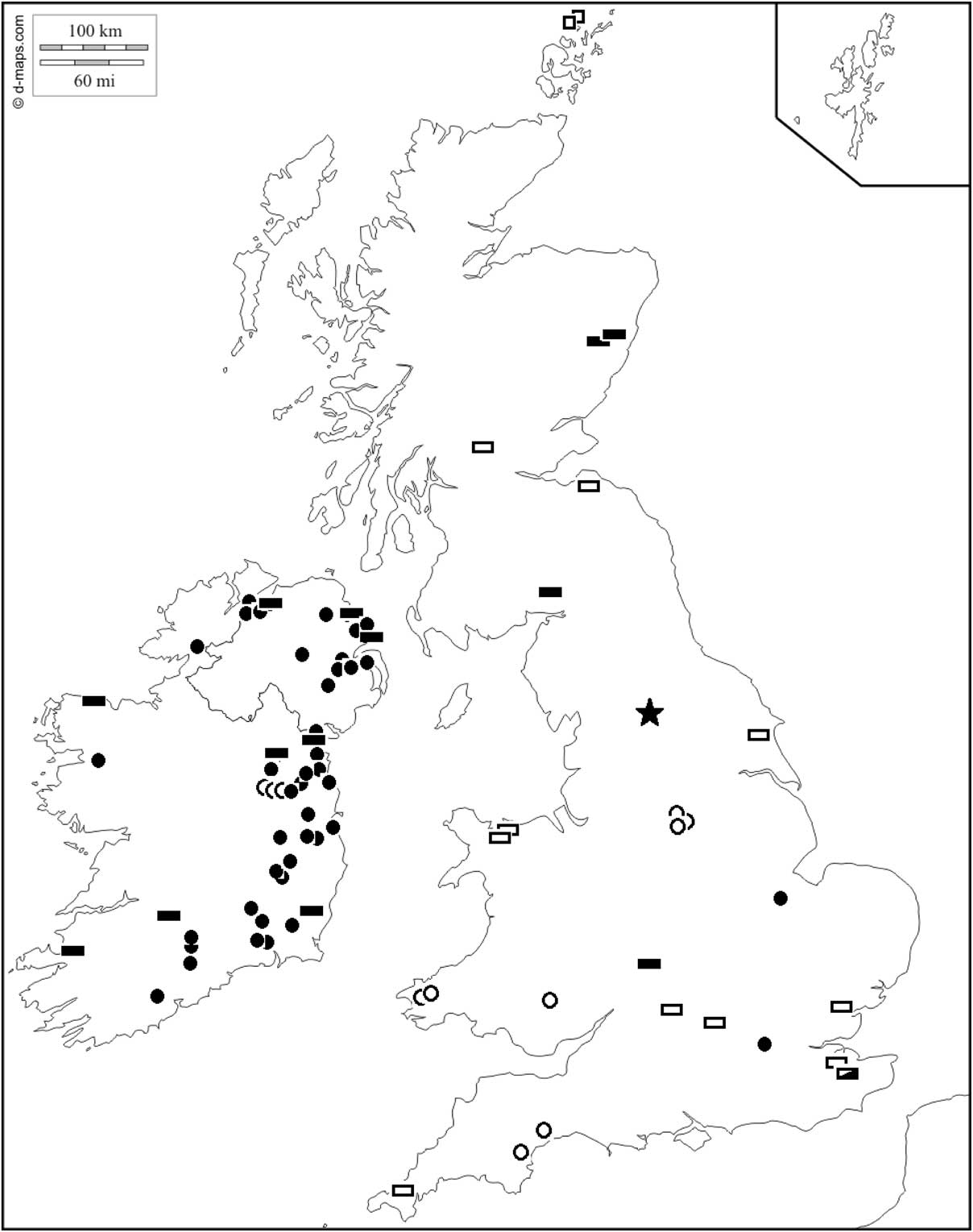
Early Neolithic Houses based largely on Smyth (Reference Smyth2014) and Darvill (Reference Darvill1996) with additions. Filled symbols=bedding trench construction, open symbols=post-hole construction. Circles=structures <12 m long, rectangles = structures >12 m long. Star=Yarnbury
Yarnbury and comparable sites mentioned in the text. Crathes after Murray et al. (Reference Murray, Murray and Fraser2009), Bryn Parc Cegyn after Kenney (Reference Kenney2009), Ballintaggart after Smyth (Reference Smyth2014), Lismore Fields after Garton (Reference Garton1991), Yarso after Barclay (Reference Barclay1996)

Despite the preponderance of bedding-trench-defined sites over post-defined structures, there are instances where the two techniques are combined as, for example, at Lockerbie Academy, Whitehorse Stone and, to a lesser extent, at Claish. This may be in part due to agricultural attrition as the two exterior wall techniques do not seem to be so combined in Ireland. Despite this observation, Smyth (Reference Smyth2014) has pointed out that construction techniques within the bedding trenches are varied. Large structural posts are encountered at the vast majority of sites with the intervening spaces filled with a variety of plank walling, smaller post-holes, or wattle and daub panelling, as seems to have been the case at Yarnbury. Some sites, such as Kishoge, Co. Dublin, for example, had areas of linear plank walling, post construction, and plank uprights and that at Barnagore, Co. Cork, combined post and stake uprights, wattle and daub, and planking (Smyth Reference Smyth2014, 36). Smyth suggests that the different wall construction techniques may well be deliberate to distinguish different areas of the structures though no unequivocal spatial patterning is observable. In the excavated section of the Yarnbury structure, the carbonised wood remains suggest substantial post (log) uprights with wattle fill. Furthermore, the posts appear to be on the inside of the bedding trench suggesting (but by no means proving) that wattle was attached to the outside of the posts presenting a fairly uniform external appearance. It is worth noting that no traces of daub or fired clay were recovered from the excavated area, however the burning of the house seems to have been localised (in the area of section 8–8a) and does not seem to have been intensive, in which case the heat may not have been intense enough to convert the daub to ceramic.
When discussing roofing, Smyth again notes that various arguments have been proposed for roof construction based on the size and packing of post-holes, the presence of external (presumed) eave supports, and the positioning of some internal posts. The post-packing argument is pertinent for Yarnbury as the corner post [107] and the presumed gable post [105/123] were the only post-holes to have contained substantial amounts of packing material suggesting that they may well have been load-bearing. The greater depth of [105/123] and the duplication of the post may well suggest greater height and that the roof was indeed pitched.
Regarding the distribution of Early Neolithic structures, those so far discovered in Britain tend to be larger than the majority of Irish examples and they also favour post-hole construction (Fig. 15). We should, perhaps, not read too much into this apparent structural difference as it may reflect available resources, geology, later land-use, or, indeed, a combination of the three. For example, short lengths of bedding trench are also found as part of structures constructed mainly from post-holes such as at Gwernvale or Parc Bryn Cegyn and Whitehorse Stone also combines both construction techniques. It is more in the arrangement of internal partitions that these large structures bear closer similarities (Fig. 16) once again combining post-hole and bedding trench techniques as, for example, at Claish, Crathes, Lockerbie Academy, Lismore Fields Buildings I and II, Derbyshire (Garton Reference Garton1991), and Campsie, Derry (McGonigle Reference McGonigle2013).
Lismore Fields Building I is worthy of note as it appears to be formed of two mirrored components, each being similar in ground plan to the smaller Building II (Fig. 16). The central row of post-holes that form the short axis of Building 1 also appear to be duplicated: the only apparent duplication at the site. It may well be that this structure, in fact, comprises two similar and smaller structures placed end to end as originally suggested by the excavator (Garton Reference Garton1991). This may represent two structures of slightly different date, an extension to an existing building, or a tradition of modular construction. A similar scenario has been considered for Whitehorse Stone which also appears to have two mirrored halves though, in this, case there does not appear to be the duplication of the central post-holes. Figure 16 clearly shows the similarity in modular construction encountered in these early structures. Ostensibly different in scale, the Crathes Hall nevertheless seems to represent an elaboration or duplication of smaller structures such as Ballintaggart 2. The illustrated structures also appear to have central aisles respected by internal partitions (Fig. 16) and this may also be the case at Yarnbury. Made of stone, the Yarso houses also seem to follow this plan with internal cross-partitions respecting central access points to the internal rooms.
The dating of the Irish structures, based on short-lived samples, has been modelled by a number of independent authors to have started probably between 3715–3680 cal bc (68% probability) and lasted until 3635–3615 cal bc (68% probability) (Smyth Reference Smyth2014, 48 for a resumé). This has become known as the ‘house horizon’ lasting for roughly 50 to 100 years but is in common with the construction of other major monuments in the Neolithic (Whittle et al. Reference Whittle, Healy and Bayliss2011). Parc Bryn Cegyn, a post-hole constructed site, may have started slightly before this horizon or at least at the very start of it at 3760–3700 cal bc (Kenney Reference Kenney2009). Whitehorse Stone and Yarnton, both larger structures and of largely post-hole construction, suggest an earlier date of construction probably in the 41st–39th centuries cal bc (Whittle et al. Reference Whittle, Healy and Bayliss2011). The Scottish ‘halls’ have been modelled to have started in the 38th century but carbonised grain from Lockerbie Academy may suggest a date as early as the 40th–38th centuries cal bc (Kirby Reference Kirby2011, table 1). Admittedly, more dates from more sites are needed but it may be possible to suggest that the larger post-built structures of southern England are considerably earlier than the smaller bedding-trench-defined constructions of western Britain and Ireland but only slightly earlier than the larger hall constructions in eastern Scotland. The Yarnbury house was in use at exactly this time of change to smaller structures and can justly be said to belong to this house horizon.
Whilst cereal remains and processing artefacts such as grinding stones have been found at the Irish sites with which Yarnbury finds comparison, it is interesting to note that no cereal remains were found amongst the charcoal flot samples and the lithic finds did not include saddle querns or similar crop-processing artefacts. It must be remembered, however, that only 25% of the house interior was excavated and crop-processing may have taken place in specific areas as seems to have been the case at Corbally, Co. Kildare (Smyth Reference Smyth2014, 31). The absence of cereal remains is, however, worthy of note and it might be expected that, were grain being processed on site, some seeds may have been accidentally charred when the house was burnt, though it must be remembered that the burning at the house appears to have been localised and not intensive. This presupposes that grain preparation took place on site and this is also by no means certain. The presence of hazelnut shells indicates the exploitation of wild resources commonly found on Neolithic sites throughout Britain and Ireland but too much importance should not be read into this evidence. It is natural that wild, ‘free food’ would be exploited to supplement diet but this exploitation does not demonstrate reliance. Furthermore, the hazelnut shell is a robust by-product that has little use other than as a fuel. The by-products of cereals are far less resilient and may also be fed to livestock. Absence of evidence for cereal production cannot be regarded as evidence of absence and it has been noted that cereal pollen appears before 3500–3100 bc in the cores from Braithwaite Wife Hole near Ingleborough, 30 km to the north-west of Yarnbury (King & Simpson Reference King and Simpson2011), whilst in the pollen records for Malham Tarn (12 km to the west), it is not until the Iron Age that cereal pollens are visible (Smith Reference Smith1986, 12).
The Yorkshire Dales have long been seen as an empty space in many distribution maps of Neolithic Britain from Piggott (Reference Piggott1954) onwards. The upland pasture regime has not seen the 19th century land improvements that prompted much of Mortimer’s work in the Yorkshire Wolds (Mortimer Reference Mortimer1905). The area was also largely untouched by the avid collector William Greenwell who worked on the eastern Wolds and in Northumberland and Durham (Greenwell Reference Greenwell1877) though he did re-open a barrow containing an Early Bronze Age oak coffin at Rylstone, 8 km south-west of Grassington, where he found traces of textile within the coffin (ibid., 375–7; Melton et al. Reference Melton, Montgomery, Roberts, Cooks and Harris2016). Bateman (Reference Bateman1848) concentrated his barrow opening in the Peak District in the Southern Pennines. Antiquarian activity is, of course, recorded in the Dales (eg, Harker Reference Harker1892; Hill Reference Hill1907) but not on the scale of that found in the east of the county or elsewhere in Britain.
In contrast to survey work on the later prehistoric axial field systems (inter alia Curwen Reference Curwen1928; Raistrick & Chapman Reference Raistrick and Chapman1929, Raistrick Reference Raistrick1938; Fleming Reference Fleming1998; Laurie et al. Reference Laurie, Mahaffy and White2011), concerted research on the Neolithic and Early Bronze Age archaeology of the Yorkshire Dales is overdue. King’s (Reference King1970) popular booklet devotes only 14 pages to the entire period and White’s (Reference White2002) introduction also highlights gaps in knowledge and demonstrates the lack of active fieldwork and research on this period of the Dales’ archaeology. The Assessment of the Archaeology of Yorkshire (Manby et al. Reference Manby, Moorhouse and Ottaway2003) further laments the lack of research into this period in this area devoting little more than a page to the specific subject (103–5) and even that including speculative dating (Maiden Castle). This is in stark contrast to the treatment of and detailed information from eastern Yorkshire (Roskams & Wyman Reference Roskams and Wyman2005). There is clearly great potential for ground-breaking research in the Yorkshire Dales as questions are being asked, local projects are being mounted, and there is considerable grass-roots enthusiasm for local archaeology. The time may be right for a specific Research Assessment and Framework for this potentially important but neglected area.
Neolithic and Bronze Age artefacts are recorded as stray finds and as parts of scatters on the HER such as the Cumbrian stone axe-heads from Long Preston and South House or indeed the Mesolithic to Bronze Age lithics from Yarnbury. A Tievebulliagh polished axe-head from Antrim found at Langcliffe in Ribblesdale suggests distant (Western) connections (King Reference King1970) as does the Kirkby Lonsdale jadeite axe-head in Craven Museum most likely originating from the Mont Viso area of northern Italy (Sheridan & Pailler Reference Sheridan and Pailler2012, 1082). Middle Neolithic and Beaker material is known from many of the cave sites (King Reference King1974) and associated human burials and domesticated faunal remains date from the earliest Neolithic until the Early Bronze Age (Leach Reference Leach2015; Taylor Reference Taylor2011). The recent redating of the Rylestone log coffin burial to the Early Bronze Age is intriguing (Melton et al. Reference Melton, Montgomery, Roberts, Cooks and Harris2016). Artefact scatters including Neolithic pottery are documented at Lea Green, to the west-north-west of Yarnbury within the area of axial field system (Manby in Cherry Reference Cherry1998) and at Conistone to the north-west (Cherry Reference Cherry2014).
Long mounds have recently been the subject of a landscape study (Luke Reference Luke2013) though none has been tested by modern excavation. Other round cairns and barrows, may also prove to have had a Neolithic origin given the considerable evidence for this in the Yorkshire Wolds. Fieldwork in the Dales by Yvonne Luke (pers. comm.) is also identifying a number of large undated round to oval mounds similar to Duggleby Howe and Wold Newton (Gibson & Bayliss Reference Gibson and Bayliss2010a; Reference Gibson and Bayliss2010b) and which therefore may also potentially be Neolithic in origin.
Rock art in the form of cup and ring carvings, most likely Early–Middle Neolithic in date, is rare in the Dales despite its abundance in middle Wharfedale, particularly on Rombalds Moor (Brown & Brown Reference Brown and Brown2008). Concentrations are known in Swaledale and the distribution may well be related to geology though this requires further contextualised research. Some recently recorded panels, though still falling within the cup and ring style, incorporate intricate designs (Brown & Brown Reference Brown and Brown2011). Rock art in the Passage Grave style is currently unknown in the area.
Potential Neolithic enclosures have not been dated. Maiden Castle, Grinton, has been considered a later prehistoric hillfort though its situation on a terrace is not obviously defensive and its long external avenue with attendant large round cairn may suggest an earlier date being broadly comparable, in shape and avenue at least, to the Meldon Bridge type palisaded enclosures of the later Neolithic (Gibson Reference Gibson2002). The class 1 henges at Castle Dykes, Wensleydale (Harding & Lee Reference Harding and Lee1987, No. 205, 306–7), Kilnsey (at the Wharfe Skirfare confluence), and Yarnbury in Wharfedale (Martlew Reference Martlew2004) remain to be dated and, as mentioned above, their topographical situations are unusual. The paired class I and II henges recently surveyed at Threshfield (Gibson Reference Gibson2014) are classic in form and bear comparison with those of the Ure Valley (Harding Reference Harding2013) complete with a narrow second outer ditch. Such classic monuments as these indicate ‘mainstream’ rather than peripheral Neolithic activity in the Dales.
Palaeoenvironmental studies in the Dales are also few and the well-drained limestone soils are not conducive to the preservation of pollen. During the Late Mesolithic, there appears to have been some deforestation above 400 m OD with the tree cover replaced by hazel shrubland. This deforestation may have been a deliberate attempt to create clearings as possibly anthropogenic oak ash and charred nuts have appeared in palaeoenvironmental samples (Davis Reference Davis1966). This deforestation may have created areas of upland heathland in the Neolithic (Smith Reference Smith1986) which continued into the Early Bronze Age since pollen evidence from below cairns suggests open landscapes at the time of their construction (King Reference King1970). Woodland may well have survived in considerable patches particularly on the lower slopes and valley floors (Walker Reference Walker1956).
The distribution of arrowheads in the uplands of Upper Wharfedale suggests fertile hunting land (Richardson et al. Reference Richardson, Richardson and Thorp2002) and this, combined with other artefact studies, points to active exploitation, if not settlement, of the valley sides in the Neolithic and Bronze Age (Cherry Reference Cherry1998; Reference Cherry2014) as well as contemporary connections with other areas (Lynch Reference Lynch2008).
The discovery of an Early Neolithic house at Yarnbury is therefore of considerable importance to the region and points to permanent settlement rather than casual or seasonal visiting. The cutting of the substantial oak posts and the construction of oak and hazel panelling would have involved considerable effort and investment suggesting permanent occupation rather than seasonal visitations. The presence of the hearth, and the degree to which the subsoil was heat-affected also suggests long-term occupation. The increasing evidence for Neolithic activity in the form of artefact scatters and the ritual use of caves suggests that the house at Yarnbury was not alone in the Dales and further large-scale geophysical prospection may well locate more.
Acknowledgements: In addition to the specialists mentioned in the text, the writer is extremely grateful to the British Academy for funding the Yarnbury Survey and to Prof. Dr Wolfgang Neubauer, Director of the LBI, for committing staff time and resources to the project. Miles Johnson and Robert White (Yorkshire Dales National Park Authority) have been supportive of the project throughout and have facilitated access to the YDNPA HER. I am grateful to Mr & Mrs T. Kitching for allowing access to the Yarnbury survey area and for putting up with changing timetables as a result of weather conditions and staff availability. Phil and Pat Carroll rallied members of the Upper Wharfedale Heritage Group to help with the molehill survey which could not have been done without their help in all weathers. The writer is grateful to Dr Roger Martlew for sharing his local knowledge at the start of the project. Debbie Hallam helped with the technicalities and logistics of the molehill survey and supervised during the excavation. Lynne Fynes, Rebekah Hart, and Jyoti Stuart, students from the School of Archaeological Sciences, University of Bradford, spent a considerable amount of their free time helping with the post-excavation processing, including the sieving of samples and the cleaning of finds. Thanks also to Belinda Hill, technician in the School of Archaeological Sciences, for her help with the sieving. Dr Sonia O’Connor conserved the pottery and Prof. Carl Heron examined the sherds for lipid residues. Some of the post-excavation analysis was funded by the Olicana Local History Society through their May Foster Pickles Memorial Research Award and their support is greatly appreciated. Special thanks are also due to John Cruse.
Supplementary materials
To view supplementary material for this article, please visit https://doi.org/10.1017/ppr.2016.15