

Introduction
It is well understood that the pursuit of peace takes time and requires good timing (the implementation of the right policies at the right time), and the tensions between the short-termism of policy mandates and the long-term needs of communities are also well recognised. Despite this, the direct engagement with the conceptualisation and enactment of time has been remarkably absent from the study of peacebuilding. This is particularly striking when we turn to the critical peacebuilding literatures, which have sought to foreground emancipation through the privileging of the local and the politics of the everyday. While the shift away from state-centric approaches to peacebuilding, underway since the mid-1990s, has been embraced by both academic and policy communities, we are concerned with the second generation of localisation scholarship, which understands localisation not simply as a tool of peacebuilding, but as fundamental to an emancipatory peace. In this context, the emphasis on local agency is crucial to resistance.Footnote 1 Implicit within this framing is a recognition that the lived experiences of individuals and communities are distinct from those of states and elites. However, this emphasis on localisation has been the subject of significant critique.
A central concern is that the local turn may serve to erase difference by obscuring the internal power dynamics of communities, and by potentially romanticising the local, reproducing old colonial tropes. This has been recognised by the proponents of critical peacebuilding who call for emancipatory politics that move beyond rhetoric and ethnocentric arguments. This requires that we take local complexities to heart through a deep engagement ‘with the local context, culture, history, needs as well as rights and institutions’.Footnote 2 In order for us to be able to successfully rise to this challenge, it is essential that we recognise that time is fundamental, particularly in terms of how it is tied into power dynamics through the ability of statist and Western timescapes to regulate what is seen as possible and correct. However, in doing so, it is also vital for us to highlight how alternative understandings of time can shape local expectations and forms of resistance. By emphasising chronopolitics, the politics of time, and how time is prefigured in politics, we are able to better appreciate how differing timescapes both structure and delimit localisation, and crucially how the variability of local timescapes provides a more complex understanding of the local everyday, which in turn is essential to emancipatory peacebuilding.
Over the course of a range of fieldwork interviews conducted between 2016 and 2018 in Bosnia and Herzegovina (BiH)Footnote 3 and Cambodia, on the topic of local empowerment in peacebuilding, interviewees consistently raised the thematics of timeframes, timelines, long-term investment, and intergenerational peace. In each instance these were noted as barriers to the enactment of local ownership and the achievement of a sustainable peace for communities. This emphasises the importance of the issue of temporality to the conduct of peace, particularly in relation to bottom-up processes that prioritise community engagement as a prerequisite for the successful establishment of an emancipatory peace.
This article, drawing on historical institutionalFootnote 4 and critical international relationsFootnote 5 literatures on time, provides a framework to understand how three distinct timescapes impact on the pursuit of emancipatory peacebuilding conducted by civil society actors.Footnote 6 The first, which we label ‘Policy Time’, focuses on how the institutionalisation of particular timescapes shapes donor practices, framing the time horizon of peacebuilding activities. The disjuncture between the timescapes of donors and those of local communities severely restricts local emancipatory practices. The second, ‘Liberal Political Time’, relates to the manner in which peace agreements and peacebuilding policies are informed and limited by temporal logics. This timescape will be shown to privilege the narratives of elites at the expense of local communities’ experiences, through the privileging of linear statist time. The final category, ‘Intergenerational Time’, relates to the occlusion within peace initiatives of how the unfolding of time can lead to new problems between generations, and distinct peacebuilding needs. Through the privileging of the experience of time, and of the dominant narratives of past conflicts, peacebuilding initiatives may serve to erase generational differences and distinct politics of the everyday.
This article makes three distinct contributions to ongoing debates about peacebuilding. In the first instance, we advance a novel approach to establish how we can integrate thinking about temporality into the discourse and practice of emancipatory peace. Secondly, we assert that a sophisticated understanding of the local and everyday politics demands that we foreground chronopolitics, and that this is a crucial component both of local resistances and of impediments to emancipatory aims. Finally, we provide empirical contributions to literatures on peacebuilding in BiH and Cambodia.
This article focuses narrowly on how time impacts on formal civil society organisations, and specifically on non-governmental organisations (NGOs), as a mechanism of local empowerment.Footnote 7 This is not, however, to claim that NGOs are, or should be, the main actors in emancipatory peacebuilding endeavours.Footnote 8 The article first provides an overview of how temporality is being framed as a means of analysing peacebuilding. The article then turns to a brief overview of how time is currently incorporated into peacebuilding theory and practice, focusing first on liberal frameworks, and then on the emancipatory endeavours of critical peacebuilding. This provides the basis for the subsequent empirical discussion of three timescapes within the cases of BiH and Cambodia. The article then concludes with a brief discussion of the impacts of this analysis and identifies potential new avenues of research.
The temporal turn
Time has been a central concern within international relations. Wrapped up in discussions of progress, of human nature, and historical structures, notions of time are at the heart of political analysis. This, however, has manifested primarily as a concern with history, where scholars have paid attention to the question of whether the past is a viable source of understanding for the present. As Christopher McIntosh illustrates,Footnote 9 while history is rife within the study of international relations, the notion that time might be an independent object of analysis is largely absent. ‘Equally important, they leave the dominant representation of time unquestioned, as well as the epistemological values based upon that representation’, as Simon Bulmer puts it.Footnote 10 This is beginning to be redressed through the broad temporal turn in political analysis.
While assessing the breadth of emerging work on temporality is beyond the scope of this article, there are two dominant strands of analysis that inform this study. We have, on the one hand, the historical institutionalist literatures focusing on process,Footnote 11 which are broadly constrained to comparative politics and which have largely but not exclusively focused to date on the European Union.Footnote 12 The other dominant approach is found within critiques of international relations, which have been led by a broad grouping of scholars that have drawn variously on postcolonialFootnote 13 and poststructural analyses.Footnote 14 The critical scholarship is interested in how temporality is constitutive of politics and the dynamics of power. Far from working at cross-purposes, these approaches in combination highlight how chronopolitics have structured peacebuilding policies, often to the detriment of critical emancipatory goals. Crucially, a foregrounding of chronopolitics can facilitate emancipatory endeavours by emphasising the local complexities of peoples and their communities, and how varying timescapes shape experiences and expectations, as well as framing their resistances to power imbalances.
The process and historical analysis literatures have been interested in a broad range of issues, which start from the basic premise that the passage of time is fundamental to understanding politics. This analysis is, according to Paul Pierson:
historical because it recognizes that political development must be understood as a process that unfolds over time. It is institutionalist because it stresses that many of the contemporary political implications of these temporal processes are embedded in institutions – whether formal rules, policy structures, or norms.Footnote 15
There is thus a focus on the revelation of ‘timescapes’, which sociologist Barbara Adam defines as ‘a cluster of temporal features, each implicated in all the others, but not of equal importance in each instance’.Footnote 16 The range of issues that can be analysed as temporal categories is extensive,Footnote 17 and includes such matters as temporal location (when something occurs), the ordering or sequencing of actions, the quickness of actions and effects, and how long things take to happen.Footnote 18 The focus here, following Klaus Goetz and Jan-Hinrik Meyer-Sahling, is on the provision of coherent explanations of events, and on understanding how time impacts upon politics:
Where aspects of time – be they terms, time budgets, time horizons, time rules in decision-making or temporal properties of policy – are used to explain something else, their effects can often only be detected through observation over longer periods of time.Footnote 19
Goetz and Meyer-Sahling further point out that historical institutional studies into time tend to distinguish between ‘polity, politics and policy dimensions’.Footnote 20 In this division, ‘polity’ relates to the mechanisms of governance, including such issues as how government terms, budgets, and planning horizons shape and are shaped by the passage of time. The politics component relates to how time is a resource and a constraint on decision-making, where the literature focuses in particular on legislation. Such literatures use political time as:
a convenient shorthand for a very diverse range of rules, norms, conventions and understandings that relate to time as a resource and constraint for political institutions and actors; in political decision-making; and in the structuring of public policies.Footnote 21
The third category, which is policy time, pertains to the effects of time on the design, implementation, and impact of public policy.
To date, the abovementioned literature has focused extensively on internal processes, exploring the temporal components on the European Union, for example, and how they shape dynamics and outcomes within the institution and its member states. The literature has not explored temporality and processes on international policies external to the organisations. Secondly, the focus has been on democracies, with little attention being paid to the dynamics of time on democratising or authoritarian states.
Drawing on the analysis of the interviews with Bosnian and Cambodian NGO representatives, the first dominant narrative of how timescapes impede the establishment of a sustainable peace is consistent with the historical institutionalist account. The first timescape, which we label Policy Time, emphasises how peacebuilding practices are regulated and limited due to the bureaucratic clock-time, shaping project budgets, time horizons, and time rules in the design and implementation of peacebuilding policies and practices. As will be discussed in greater detail, this presents significant impediments to emancipatory aims by enforcing timeframes that are disconnected from the everyday experiences of communities.
In contrast to the temporal analysis focusing on processes and outcomes, the critical analysis project is a fundamentally normative engagement where the analysis of time is mobilised, according to Andrew Hom, ‘as a means of destabilising hegemonic foundations – the international system, the logics of modernity, rationalist social science, to name a few’.Footnote 22 The works within this school of thought share an interest in understanding how time constitutes the international system, and how it serves to (re)produce relations of power.Footnote 23 For Kimberley Hutchings,Footnote 24 the temporal turn provides a crucial mechanism to understand and critique assumptions of a singular unified temporality, emphasising the impacts of statist time or ‘clock-time’, which presume a linear, unidirectional flow that is independent of human experience. Sitting alongside this analysis are approaches embedded within postcolonial analysis that highlight how ‘chronopolitical’ narratives of universal progress serve to justify and reproduce relations of power, stressing tropes such as ‘left behind’.Footnote 25 This linkage of time with progress is clearly embedded within a Western narrative of economic and political development, and is starkest in Francis Fukuyama's ‘end of history’ thesis.Footnote 26
This provides the conceptual grounding for the second dominant narrative timescape that arose in the interviews, which we label Liberal Political Time. This Western statist time assumes a particular linear history that fundamentally shapes the interpretation of politics, the framing of what is politically possible, and privileges particular agents’ time subjectivities over others. This emphasises the ways in which Western liberal norms and understandings about peacebuilding and democratisation serve to structure peacebuilding policies.
Following the critical temporal turn, particularly as advanced by Tarja Väyrynen,Footnote 27 we assert that the Liberal Political Time is central to the identity construction of postconflict states, and that peacebuilding practices serve to (re)enforce specific articulations of time, in particular linearity, that shape nations’ constructions and (re)productions. Väyrynen emphasises the ways in which postwar states often seek to construct a ‘[n]ational history [that] works to secure for a contingent nation the false unity of the national subject evolving through time.’Footnote 28 Here, Väyrynen uses temporality to highlight the ways in which memory construction needs to be continually rearticulated to defend an artificial linear national past. ‘In short, creating a symbolic grammar for war and violence and writing postwar history is as much about forgetting as it is about remembering’, Väyrynen concludes.Footnote 29 While working from a different theoretical framework, over forty years ago Marvin Soros emphasised how temporality is a crucial framework within which experiences of violence are understood and articulated.Footnote 30 In discussing the importance of understanding generational time in relation to peace, Soroos distinguished between the needs of intragenerational peace and intergenerational peace where the latter relates to the connections ‘between parents and children or between parents and grandchildren’.Footnote 31 Peace research ‘has focused almost exclusively upon intragenerational, latitudinal … types of relationships’.Footnote 32 His analysis of why scholarship has not engaged with intergenerational peace remains pertinent today:
First, until recently, there has been a prevailing assumption that human progress was inevitable and that each generation left an enriched legacy for future generations … Second, research and education have been oriented almost exclusively towards describing and explaining the past, thereby failing to foster future consciousness. Thus, there has been little general concern for, and even awareness of, the ways in which decisions made at one point in time affect the options available to others in the more distant future.Footnote 33
While firmly rooted within problem solving, the resonance of the concept of intergenerational peace with later critical scholarship on identity formation, power, and coloniality is stark. Following from the interview data, we have adopted Intergenerational Time as the third timescape affecting localisation in peacebuilding. Focusing on intergenerational time attunes the study of peacebuilding to how it is not simply a question of how different generations may have distinct needs, but how temporality is crucial to framing past and future events, potentially opening up the possibility that addressing the expressed needs of one generation may not serve the goals of emancipatory peacebuilding for others. It further highlights the ways in which narratives of the ‘everyday’, which are treated as crucial to emancipatory endeavours, need to more clearly appreciate that the everyday is a timescape of its own, which varies substantially from one community to the next. Furthermore, by running up against Policy and Liberal Political timescapes, this is indicative of the ways in which distinct systems of meanings operate within a particular state, but where those of the state and international actors are privileged.
This brief overview of the temporal turn in politics and international relations has provided three avenues for the examination of the effectiveness of the pursuit of localisation as a central mechanism of a sustainable, emancipatory peace. These are Policy Time, Liberal Political Time, and Intergenerational Time, each of which helps us to focus on how the perception and experience of time can open up different needs and expectations with respect to peacebuilding. An appreciation of time is crucial to the success of broader emancipatory projects. In keeping with critical scholarship, the shift to the local as the means of emancipation requires a sophisticated understanding of what constitutes the local (and crucially, what constitutes the local in a way that rejects a universalist tendency). Pierson notes that a failure to be attenuated to the slow unfolding of time can result in analysts ignoring the role of sociological variables. As such, a refusal to foreground temporality may obscure ‘important questions of politics because the relevant outcomes happen too slowly and are therefore simply off their radar screens’.Footnote 34 More importantly, following the critical literatures, chronopolitics shapes how time is used both to preserve, but also to challenge systems of order.Footnote 35 By foregrounding temporality, it is possible to ‘recover political possibility from sovereign historical logics’.Footnote 36 Hom, building on the work of HutchingsFootnote 37 and of Tom Lundborg,Footnote 38 states that this ‘direct[s] attention away from hegemonic statist times towards the marginalized, oppressed, and otherwise forgotten times of global politics’.Footnote 39 A focus on time thus provides crucial depth to the understandings of forms of existence and pockets of resistance, but also of the ways in which the formulation and enactment of chronopolitics can limit and foreclose these resistances.
We are not seeking to foreclose the ways in which an examination of chronopolitics can provide important insights into peacebuilding but have rather used these as a means of making sense of apparent failings in achieving meaningful localisation in peacebuilding through the privileging of the everyday.
Peacebuilding and time
Far from being absent from peacebuilding, time is woven into the very fabric of peacebuilding practice, though its presence has been remarkably under explored. The first way in which time is integrated into the peacebuilding literature is through the articulation of peacebuilding as a process rather than an endpoint. Peacebuilding as a process accounts for time by seeing its unfolding as a progression of events, as the result of ‘dynamic processes’ that unfold over time.Footnote 40 Thus, peacebuilding is not so much a fixed state or set of targets to be achieved in the sense that one might claim that they are ‘building peace’. Rather, it is a process that, in any given environment, takes place over a time period characterised by significant international investment. Time is thus important in this respect as the field within which the events unfold, but the ways in which time itself shapes politics is largely occluded. While the articulation of peacebuilding as a process highlights how practices must be ongoing and responsive to changing circumstances, there is scant engagement with how time shapes the processes themselves as well as their outcomes. This builds upon the observation that even scholarship that is interested in sequencing or norm transmission rarely explicitly engages with temporal dynamics in a direct fashion.Footnote 41
The second manner in which time is expressed as a concern is articulated along the lines of short-term versus long-term peacebuilding. There is widespread understanding that a long-term approach to peacebuilding is necessary if efforts are to be successful and the peace is to be sustainable.Footnote 42 Jonathan Goodhand and David Hulme emphasise the importance of understanding its long-term nature, stating that ‘peace requires social transformation and must be done slowly’.Footnote 43 Yet, the continued prevalence of short-termism in peacebuilding practice mitigates against the adoption of long-term policies. This, Timothy Donais argues, inhibits the chances of a locally owned, long-term peace.Footnote 44 The result is that there is far more institutional knowledge available about how to build peace through short-term initiatives, for the short-term, and much less on longer-term approaches.Footnote 45 And there is a genuine tension between these two imperatives: between short-term results on the one hand and long-term sustainability on the other.Footnote 46 However, such formulations, while highlighting the indeterminate nature of peacebuilding, and how it should be seen as a series of events rather than a specific goal, do not pay sufficient attention to how different conceptions and experiences of time are central to how peacebuilding is enacted, and its viability as an emancipatory process.
Finally, critical peacebuilding studies have engaged with the problematic notion of progress that is deeply embedded within the practice of peacebuilding. From the outset, peacebuilding has historically been a liberal project, entailing both economic and democratic liberalism as core mechanisms to redress the causes of violent conflict.Footnote 47 Within this articulation, time is clearly present insofar as there is a clear teleological articulation of an ideal endpoint of the progress, as expressed within Fukuyama's end of history thesis. This normative valuation of progress, defined with respect to the positionality of Western states, has been rightly shown to erase difference, and to (re)enforce power dynamics to the detriment of subaltern communities. However, the critiques of peacebuilding have tended to focus on the impacts of such narratives, focusing on their intersection with power rather than foregrounding how this liberal political time impacts upon, disciplines, and is resisted by communities.
It is from the standpoint of critical peacebuilding that we seek to understand the role of chronopolitics. The critical literatures on peacebuilding have sought to foreground emancipation, by defining ‘who peace is for, and what it means’.Footnote 48 Following Roger Mac Ginty and Oliver Richmond (2016), we link emancipation with the need to look at the everyday nature of a sustainable peace, and the requirement for peace to be culturally relevant and centred around the everyday lived experiences of people. Mac Ginty and Richmond explain that, ‘[in] everyday terms, emancipation treads a fine line between respecting autonomy and difference and improving rights, needs, law and institutional frameworks for the organisation of politics (meaning the distribution of material resources)’.Footnote 49 This entails a move away from formal institution building to focus more on the formal and informal societal dynamics of people's everyday experiences.Footnote 50
It is within the broad set of commitments set out above that we have chosen to examine the processes of localisation as a core mechanism of an emancipatory peace. While noting Mark Duffield's critique that this shift to the local can be understood as a shifting of blame onto the subaltern,Footnote 51 we nevertheless consider the shift to be crucial to empowering communities and marginalised groups and redressing their needs.
As with the liberal literatures, the critical engagements with peacebuilding do talk about time, and recognise that its passage is vital in both shaping and understanding social practices. The notion of the everyday suggests a different temporal rhythm to other articulations that focus on grand progress – rather, by treating the repetitive processes of life as a location of politics, one can highlight sites of politics. In this way, emphasising different temporalities is potentially ‘politicising’ as it serves, per Hom's line of argumentation,Footnote 52 to disrupt hegemonic discourses of time that serve to shape policy, to silence communities, and to limit possibilities for peacebuilding.
Methods
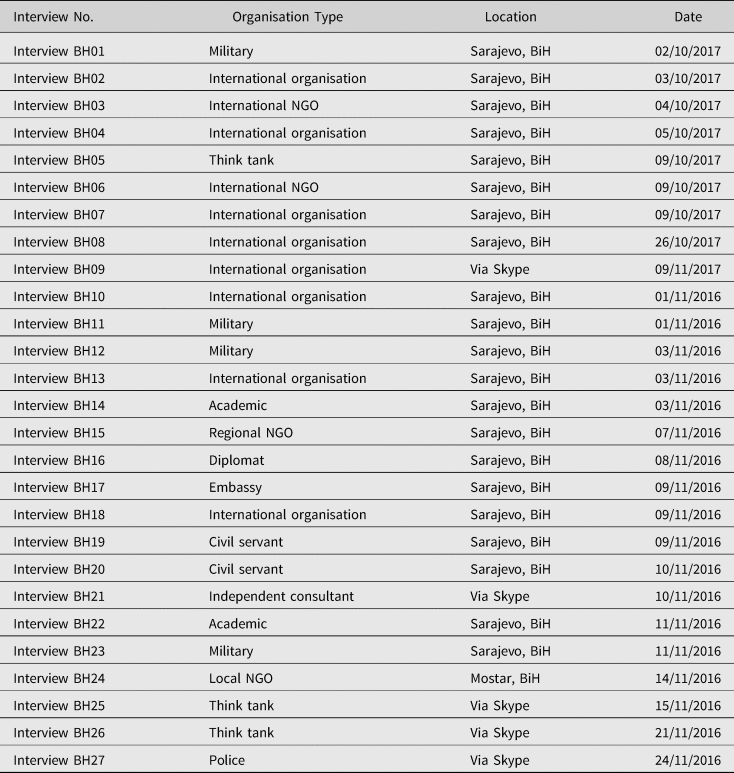
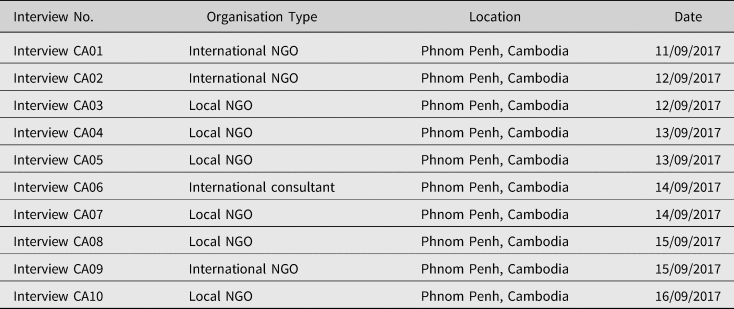
This article embraces a mixed methods approach, drawing on 37 formal interviews (using open and closed questions) conducted in BiH and Cambodia in 2016 and 2017 (see Appendix for the list of interviews). The questions included in the qualitative interviews were developed following an extensive review of the extant literatures on localisation and peacebuilding and were designed to identify how localisation was understood in particular circumstances, and what were perceived as conceptual and practical barriers to its success in promoting peacebuilding. These involved open-ended questions and the conversations with the interviewees were in part led by the responses. The authors both have experience in researching peace processes in the given countries, and substantial ties into their respective NGO communities. The interviewees were all involved, in one way or another, in peacebuilding, and included representatives of local and international NGOs, think tanks, donor organisations, the EU and other international institutions, as well as academics and embassy personnel. All interviews were recorded by writing in note form and/or audio recorded, then were subsequently transcribed in full by the authors.
The topic of time was an indirect line of questioning during the interviews, raised in relation to the sustainability of peacebuilding. This article has emerged as a result of an inductive process arising from the common issues of time that were mentioned by the interviewees. The discussion below follows from the coding of the transcribed interviews whereby three clusters of common discourses related to timescapes were identified. Conceptual literatures were then used to make sense of these narratives. It is important to note that we were focused predominantly on the narratives of effectiveness and limitations of localisation practices provided by civil society and donor representatives (see Appendix), and it is within this context that discourses of time emerged. What this largely occludes is the array of local conceptions of temporality.
Policy Time and peacebuilding
As stated, Policy Time emphasises the ways in which the timeframes that are assumed and applied in state policy decisions privilege the needs of bureaucracies, which in turn structures and limits the pursuit of local peacebuilding initiatives. As such, Policy Time is regulative, framing and reproducing power relations between donors, states, civil society actors, and communities. The most common concern raised by the representatives of NGOs in BiH and Cambodia with respect to the topic of time related to the impact of changing funding priorities and structures. As was noted above, this is a point that has long been recognised in both academic and policy circles. The concern here is not related to the specific policies per se, or to the contention that a long-term approach is superior. Rather, more crucially our concern is over the fact that the imposition of the statist Policy Time enforces Western chronopolitics, that is statist time, that in turn forces narratives of conflicts, and policies for their resolution, to fit within the bureaucratic timeframes. This erases the complexities of local contexts. In particular, interviewees pointed to the interconnected ways in which funders’ Policy Time shapes peacebuilding initiatives and occludes other temporalities, which then negatively impacts on the viability of localisation of peacebuilding, as it (re)produces divisions between the interests of donors, the resultant actions of civil society actors, and the everyday timescapes of communities.
While the funding format of donors, limited to relatively short-term projects, is understandable as it provides a means for states to reorient their policies and to provide oversight of funding, it nevertheless locks organisations into short-term planning cycles generally not lasting for more than four years.Footnote 53 And in BiH, some funding for peacebuilding was limited to a maximum project lifespan of a single year.Footnote 54 The short-termism of donors is also evident in an apparent lack of interest in the potential follow-on work from projects, and whether they are able to have a sustainable impact. This was noted by one Cambodian interviewee who stated that the donors’ focus on the narrow remit of a project's lifespan means that once a programme of funded work is completed, donors no longer pay any attention to the project or the organisation. This results in a perception that donors ‘don't have a long-term commitment to strengthen the capacity of local actors. [NGOs] often fail after the short-term funding ends.’Footnote 55 This runs counter to the explicit logic of localised peacebuilding, which is based in large part on the presence of a robust civil society. This was also explicitly stated by interviewees in BiH, who emphasised the restrictiveness of the timeframes set by donors, who gave preference to programmes promising quick but potentially unsustainable or misleading results, and who were unwilling to fund multi-year programmes.Footnote 56
So basically, this is the problem: if you have one-year projects, you can't do anything strategically. A one-year project is just for that year, and all of the donors are looking for really big impact. And that's okay, but you can't have strategic impact with a one-year project.Footnote 57
The second constraint arising from donor processes is that programmes are in large part ‘locked in’ at the outset of a project. The establishment of an agreed programme of work, with clearly articulated deliverables and milestones, mitigates the prospects of projects being altered during their lifespan. Organisations are unable to respond to changing dynamics on the ground to alter their target communities, the broad mechanisms that are used to achieve stated aims, or for that matter to shape the endpoint to reflect the changes in the broader sociopolitical environment. In short, the passage of time is only relevant to the donors insofar as projects are expected to unfold as anticipated; how the flow of time can bring about unanticipated change is not thinkable while constrained by Policy Time.
The third constraint to the long-term viability of NGOs engaged in peacebuilding activities, broadly conceived, is the intersection of an ongoing shift of funders’ priorities towards project funding, which is consistent with the broader policy timescape, with a movement away from the direct funding of civil society (USAID's shift in this regard in Cambodia was noted as indicative of the broader sector). As one NGO representative stated: ‘[With] regard to the donors, I think that, yeah, the challenge is that they're very project-based, they're limited.’Footnote 58 This shift towards the support of individual programmes of work is intended to ensure that development funds are able to reach the intended beneficiaries, but the impact on the civil society actors has been acute. During the interviews there was a continual refrain that the lack of overhead funding has put the viability of organisations at risk over the long term. The lack of support for the daily running of organisations has put significant pressures on their staff structures, forcing the downsizing of core staff, the loss of expertise in management and financial oversight, and the introduction of inefficiencies as NGOs are compelled to downscale and find small additional sources of funds to simply ‘keep the lights on’. Additionally, the constant pursuit of project funding has fostered an environment wherein organisations often dramatically shift their areas of work, moving away from erstwhile priorities related to peacebuilding in order to sustain their organisation.
The final, and perhaps most critical, area in which donors are failing to engage with the issue of time and peacebuilding relates to the manner in which donors’ attention to peacebuilding erodes over time and shifts instead to other issue areas.Footnote 59 As one international actor in BiH put it: ‘So, for us the biggest challenge was, like, working with these partners, convincing them that they should stick to these programmes, that in the long term it will pay off in regard [to] impact and in terms of being rewarded for their work.’Footnote 60 One Cambodian interviewee asserted there is a lack of a long-term outlook towards redressing conflict and building peace: ‘Peacebuilding is no longer sexy here, now, for donors. Some local NGOs are reframing what they do as a result [to acquire funding for their activities].’Footnote 61 Another Cambodian interviewee was also explicit on this account, stating that continued funding for peacebuilding in places like Cambodia is crucial for a sustainable democracy, while noting that the changing donor priorities have eroded the local capacity to engage in peacebuilding.Footnote 62 The Cambodian case is demonstrative of the way in which donors shift their attention away from conflict resolution relatively quickly after the cessation of violence, and critically after the end of formal peace operations.
While international funding continues following the end of violent conflict, donors rapidly shift to new priorities, focusing particularly on issues related to economic development in a broader sense. The result is that peacebuilding initiatives are effectively pushed aside in favour of other development priorities. Rather than this being the result of poor decision-making by donors, it highlights how policy timescapes regulate peacebuilding practice, breaking up donor initiatives into discrete blocks of time, disconnected from the local chronopolitics. As such, the local experiences of time, which are discrete from donor timescapes and manifest in complex economic, social, and political dynamics, are misread or ignored by donors, which in turn has the effect of silencing the needs of marginalised communities. This is in part resisted by local civil society actors who opt to report on their activities in accordance with what was promised in their project proposals, but who pursue their chosen activities with an element of flexibility within the provided timeline. One NGO representative in BiH stated: ‘But none of these donors actually put, to be honest, any agenda or instructions that we have to follow during the implementation of these activities.’Footnote 63 While the policy timescape is resisted, it nevertheless limits the activities aimed at local emancipatory endeavours, as the resistances themselves are forced into the requirements of donors.
Clearly, many of the programmes that are funded by donors are intended to impact upon the broader political terrain, and to change existing dynamics, be they social, political, or economic. Yet, the projects are treated by donors as if they are being implemented in an ahistorical space, where the potential for change in the broader environment is not effectively accounted for during the lifespans of individual projects. As a result of the policy timescape, the capacities of civil society actors to contribute to emancipatory peace initiatives are restricted. This is depoliticising and limits local capacities to shape and sustain any initiatives. It further detaches the operational timescape of peacebuilding activities from lived everyday timescapes, thus mitigating emancipatory goals.
Liberal political time and peacebuilding
The second timescape derives from the liberal political project and its faith in linear progress, or Western liberal clock-time. As will be demonstrated, this temporality has profound effects on the design and implementation of local peacebuilding initiatives. The assumption of linearity leads to the presumption that, following a peace agreement, a given conflict is now ‘in the past’, that the gains obtained during that peace process will be maintained, and that further democratisation will subsequently be obtained. If these are not achieved promptly and in this order, the given state is described as backwards and primitive, and considered to be unwilling to accept progress. This is particularly evident in the ways in which donor investments in peacebuilding quickly wane as policymakers and politicians in funding states shift their attentions away from concerns over conflict and towards traditional development projects. What is effectively occluded in this is the possibility that, over the years following the cessation of formal peacebuilding initiatives, the environment conducive to a sustainable peace may erode, and the localisation of peacebuilding might not gain traction. This narrative of a linear past and present serves to reproduce narratives favourable to international and state authorities to the effect that conflicts are in the past, the effect of which is to overwrite and silence communities that may have very different everyday experiences.
In both BiH and Cambodia, interviewees consistently decried the waning attention of donors to peacebuilding activities following democratic elections. While determining the precise extent of the shift of funding away from peace funding is difficult (DAC data for recipient states does not allow for this disaggregation), civil society representatives continually raised the erosion of funding for peace initiatives. While Policy Time shapes the delivery of programming, it is the Liberal Political Time that shapes the expectations of peace, frames how local dynamics are perceived, and how states enact authority.
The dominant Liberal Political Time serves to force interpretations of events within postwar states through a linear history that presumes the existence of pre- and post-peace moments. The complexities of the local political contexts, and changing political landscapes within the states, are thus largely erased, and the possibility of the synchronicity of time is dismissed. In practice, the focus of peacebuilding funding on transition periods, corresponding with formal peace missions, affords little appreciation to the long-term processes, which can contribute to the erosion of political rights. More importantly, from a critical peacebuilding perspective, the statist clock-time subsumes communities, renders invisible the alternative perceptions of time with respect to violence and political relations, and erases or misrepresents local forms of resistance. These dynamics were clearly expressed within both BiH and Cambodia.
On the surface there is significant evidence that Cambodia has been progressing in a manner consistent with Liberal Political Time. The war is consistently described as being ‘in the past’, and its economic future is seen as promising. The state has avoided a slip back into civil war, has held numerous elections mostly labelled ‘free and fair’, and the state has sustained high levels of GDP growth over the past decade. However, these indicators of success obscure endemic problems within the country, particularly in relation to marginalised communities that have seen little if any substantive improvement in their quality of life, let alone in empowerment. The assumption of linear time thus obscures the operation of power, and the way in which elites can (re)entrench their authority is enabled in part by Liberal Political Time. Over the past five years there has been a steady erosion of the space for civil society, and relatively little progress on achieving a functional judiciary that operates independently of the interests of elites, or of a political environment were marginalised populations are able to effectively articulate their needs without fear of political reprisals. The situation in Cambodia today, over two decades following the end of the United Nations Transitional Authority in Cambodia peacebuilding mission, is one where there is a growing concern among civil society actors over the closing down of the political space.Footnote 64 This has been undertaken in Cambodia in large part through quasi-legal processes where the state has passed statutes that have been subsequently used to limit the power of civil society actors working narrowly on topics that may challenge the state.
The adoption of an ‘NGO Law’ in Cambodia was singled out by some civil society representatives as having a chilling effect. While legislation to govern the charity sector is to be expected in a fully functioning democracy, the manner in which the law has been designed and implemented is arguably orientated around asserting control and limiting critique, rather than ensuring transparency and guaranteeing that NGOs can effectively operate as charities for the good of the population. The government has shown an increasing willingness to use the courts to silence dissent. The media has likewise come under significant scrutiny by the state, with The Cambodia Daily, an English language news service that is widely considered to be critical of the government, having been shut down within Cambodia by the government in 2017. Moreover, the position of marginalised communities is particularly problematic in this regard. ‘With minority groups it is even more difficult as they have to register first as a minority community through the Ministry of Interior’, one interviewee explained.Footnote 65 This was echoed by another interviewee who stated that it is now more difficult to support local groups (both formal and informal). The government does not even want to support organisations doing social change work.Footnote 66
This use of the NGO Law arguably forms part of a broader drive to close down political space in Cambodia, and to limit the ability of any potential opposition to the government to operate. The government has long been suspicious of the NGO sector in this regard, with Prime Minister Hun Sen reportedly stating that there were two governments in Cambodia: the elected government and the NGO sector. One NGO representative stated that the government ‘always treat NGOs as being in favour of opposition parties. Our work with communities has been accused as counter-revolutionary. But we follow international human rights.’Footnote 67 Another NGO representative stated that ‘Mostly [sic] importantly the government labels us as the opposition.’Footnote 68 Other NGO representatives expressed serious concern over the shrinking of the political space, stating that alongside the NGO Law, the state appears to be monitoring organisations, which in turn constricts the ability of civil society to represent the needs of the population. ‘I assume that there is a government watch list, primarily because of our work in Prey Long, and because of our outspoken local partners’, one interviewee explained.Footnote 69 An international NGO representative further decried the shrinking of the political space, and the ability of civil society organisations to operate in Cambodia. The individual noted in particular the increased burden on organisations to acquire visas for international staff, and that there is more intense auditing of groups’ activities and outputs (such as publications). ‘This all serves to close down civil society’, the individual concluded.Footnote 70
The pressure described above was noted by numerous NGO representatives working broadly on issues pertaining to human rights, indigenous communities, forestry issues, and land rights, all of which potentially challenge the entrenched interests of elites within the state. In discussing the barriers put in place by the government, a local NGO representative stated that local authorities would come to their organisation's offices and observe meetings, and that Ministry of Interior officials would attend public fora and take notes. What went unstated in this response, but was implied, was that such activities were intimidating. ‘Even Tuol Sleng prevents us from having meetings when we talk about history’, the individual said.Footnote 71 This all effectively limits the ability of civil society organisations to work with local communities, to articulate their interests and to redress sources of conflict at the local level. As such, the chances of successfully achieving the goal of a sustainable peace, underpinned by a localisation of peacebuilding practices through civil society actors, are being eroded over time. However, the ability of donors to pursue and adopt policies in relation to these dynamics is constrained by the broader liberal timescapes of the unfolding of democratisation and peacebuilding. This Liberal Political Time, by enforcing a linear tale of progress, erases the ongoing political dynamics, and demonstrates how time can be used by states as a means of reifying power over subaltern communities.
The liberal timescape was similarly evident in BiH, where policies appeared to be driven by an assumption of a linear move of a state from warfighting, to postwar conditions, to the gradual concretisation of a liberal peace, resting upon a particular rendering of the conflict being as ‘in the past’, even if there is a concern that it might be returned to. This concern might seem at first paradoxical, but the postwar condition often has many, if not all, of the features of a prewar environment. These include a poor economy, high levels of unemployment and poverty, corruption, discrimination and structural violence, and ethnically defined nationalist politics, to name just some of the conditions. One interviewee explained:
There are lots of local NGOs – victims’ associations, also. But they are mostly involved in instigating conflict, rather than conflict resolution. Their views are all, of course, one-sided, and they promote hatred and fear. In every way we are progress-dependent. And if you look at the conflict cycle, we have passed the postconflict long ago and we're well into the preconflict phase. So, I think it's about time that the international community lifts up its head and engages with the big picture.Footnote 72
Rather than an outbreak of war, the primary concern was that the structural violence would worsen the prevailing negative peace.Footnote 73 While donor organisations’ representatives did recognise this issue, the programmes funded by donor organisations were not actively working to counteract the cycles of hatred and fear articulated in the above interview. A foregrounding of liberal political time serves to highlight how the discourses and practices of donors occlude the fact that the passage of time does not immediately erase underlying drivers of conflict.
Peacebuilding was viewed by locals and internationals alike as something that took place in a linear form, with the narrative of progress being raised in a number of interviews. The EU was the symbol of that development (with a linear path leading towards that aspiration): ‘We've been looking at the path that other EU members have gone through, and the pattern was generally security first and then development, in which NATO stands for security, and then the EU stands for development and progress’, a military officer explained.Footnote 74 This was also put across in terms of present BiH practices being dated: ‘The integrated border management strategy was out of date; it wasn't compliant with EU and international best practice’, one EU actor said.Footnote 75 Meanwhile, if EU integration failed, a relapse into war was feared,Footnote 76 and interviewees perceived attempts by other EU states to leave the EU as being moves towards older, outdated systems of governance.Footnote 77 Important in this was the idea that the EU was the future, and one that was moving still at a fast pace that BiH had to keep up with,Footnote 78 a message that was institutionalised and reinforced in EU progress reports,Footnote 79 which in turn gave ‘advice, recommendations and what to do if we want to be, you know, one step closer to the European Union’.Footnote 80 External actors saw this from a different perspective, however, suggesting that BiH was somewhat jumping ahead of the process; one EU representative stated that BiH ‘passed police reform to the EU whilst the reform was still in progress’.Footnote 81
Integration with both NATO and the EU was highlighted as a move forward for BiH, and therefore satisfying their requirements was taken as an allegory for progress,Footnote 82 and this was frequently mentioned alongside references to peacebuilding and democratisation.Footnote 83 But even where not associated with democratisation, integration with regional organisations was explained in a linear fashion.Footnote 84 Interviewees referring to integration also used roads and speed as metaphors, for example mentioning efforts to ‘fast track discussions’Footnote 85 or discussing ‘Bosnia's possible road towards European integration and accession’Footnote 86 and ‘steps towards EU integration’.Footnote 87
Interviewees in BiH pointed to the ‘common understanding among the political elite that EU integration is a good thing’, while noting that even Republika Srpska, which is a majority Serb area of BiH that is heavily influenced by Belgrade with regards to EU membership,Footnote 88 had no issues with BiH's EU integration ‘because Serbia is [also] going for EU membership’.Footnote 89 Whatever disagreements there were about the past and the present, many of those who disagreed about these matters seemed to agree on the priority for the future – EU integration.
The idea of democracy being something ahead of whatever came before (that is, that it was fit for the present day, and that other governance systems were outdated) was highlighted by a range of interviewees. One interviewee introduced the issue as follows: ‘Part of the overall effort in BiH is to bring the administration, procedures and society overall more in line with what's expected of a modern democracy, and with the regulations that are currently accepted.’Footnote 90 However, as will be addressed in the next section, there was a level of acceptance among interviewees of the opinion that some were much more capable of processing ‘newer’ or more ‘complicated’ ideas of peace, and thus there was a significant intergenerational split in the peacebuilding process. The same individuals were also bearing the severe economic consequences of integration.Footnote 91
The linear historicity of conflict outlined above places the central conflict that led to the peacebuilding intervention as the rupture of progress from which the rebuilding of society begins. The future events are then read against this chosen ‘past’. In the case of BiH and Cambodia, while the future achievement of a broadly liberal peace is a work in progress, it is still in progress.
The liberal timescape continues to shape understandings of peacebuilding and informs policy decisions. This notion of time, pervasive in the narratives and practices of donors and civil society representatives, may serve to deflect attention away from current political dynamics. Following Sean McMahon,Footnote 92 we argue that this liberal timescape, which reproduces a belief that peace will come in the future, may thus serve to regulate society. As we will see in the next discussion, this timescape operates in opposition to the everyday timescapes of subaltern communities and serves to deflect local concerns with promises of what is to come.
Intergenerational Time
The final timescape pertains to the gap that opens up between the experiences of generations. The effect of assumptions of linear time with respect to violent conflict is that the rupture of war comes to be the dominant narrative, written and understood from the perspective of survivors, and it is this history that defines progress and peacebuilding initiatives. Conceptions of time within a given generation are inextricably linked to perceptions and orientations towards peace. This is of crucial importance to emancipatory peacebuilding as it highlights that what constitutes the everyday is embedded in particular timescapes, and that distinct generations can have profoundly different politics. While there are potential benefits to this separation of experiences, not the least of which is an ebbing of the memory of violence and trauma, this also poses potential risks to a sustainable emancipatory peace. In particular, one organisation working on this theme stated that this runs the risk of opening up intergenerational conflict as the needs of different portions of society increasingly differ from one another.Footnote 93
Unsurprisingly, given the dearth of attention to the passage of time on peacebuilding, there is presently relatively little academic work available on intergenerational peace.Footnote 94 Yet if peacebuilding is treated as a process rather than an outcome then we must accept that it remains an ongoing concern that must be continuously redressed by societies. We would normally expect this to take place through embedded societal processes, such as education and family socialisation, supported by a state that works to redress the needs of communities.
Cambodia is now in a position where the majority of its population has no lived memory of the genocide, and where anyone aged 25 or under has grown up after the formal cessation of the UN peacebuilding mission. As such, the experiences of different generations vary substantially from one to the next, while the attention of both the state and the international community to this inconsistency of experiences is minimal. An intergenerational divide has thus emerged in Cambodia. It was stated that there was a significant portion of Cambodian society that was willing to simply get on with life, and that public interest in peacebuilding was waning. The concern that then arose was that there would be less engagement either in identifying sources of potential conflict, or in fostering mechanisms for their peaceful resolution. However, it was noted in two interviews that the Cambodian youth were upset with the situation,Footnote 95 and that they did not feel well served either by the state or by civil society organisations.Footnote 96 This, as an international consultant in Cambodia argued, highlights the issue of intergenerational conflict, and of the potential for future violent conflict if the political and economic aspirations of the youth are not met.Footnote 97
The need to address intergenerational peace in Cambodia is pressing. One Cambodian organisation focuses on intergenerational dialogue between postwar groups who hardly believe what happened during the Khmer Rouge era (and afterwards), on the one hand, and the survivors, on the other. During an interview with a representative of this organisation, it was indicated that a substantial gap had opened up between the experiences and expectations of distinct generations, and that these were hampering the possibility of identifying and redressing causes of conflict (and therefore ultimately limiting the extent of transitional justice).Footnote 98 This narrative of distinct priorities across generations was further echoed in another interview where the challenge was identified as a significant barrier to sustainable peace.Footnote 99
The recognition of generational divides highlights how the passage of time opens up different demands made by various generations. Here it is crucial to highlight how the differing experiences of each generation may result in each operating under a very different temporal framework, each of which in turn shapes that generation's needs and expectations around peacebuilding. Generations that directly experience violence may ground their interpretations of events in relation to the past, while more recent generations may focus more on current affairs or future horizons. As such, the manner in which groups experience and react to policies is shaped by their temporal frameworks. This intergenerational time is largely ignored by donors and is relatively absent from academic analyses of peacebuilding.
While the situation in BiH differs substantially from that in Cambodia, the opening up of dramatically different perceptions of the past and future, and of broader sociopolitical processes, was also highlighted by interviewees in BiH. While BiH is in a postwar stage, the violence of the 1990s and the lasting impacts of the 1995 Dayton Agreement are part of the lived experience of the majority of the population.Footnote 100 Indeed, discrimination, structural violence, and ethnically based politics continue to shape the state. The central dilemma highlighted by the interviews there was that young people were seen as the catalyst for change, yet were also easily influenced by nationalist politics, likely to be un(der)employed, and in many cases wanted to leave the country.
All of the interviewees in BiH were of an age that meant they would have experienced violence within their living memory. These individuals attributed a form of legitimacy to the knowledge of those who had lived through violence, while the views of younger generations was not granted the same weight: ‘A lot of young people think conflict just happens, but the analysis of war shows that these logical factors contribute to the likelihood of it occurring.’Footnote 101 Many of those same young people, however, were not interested in this conflict, or the reasons behind it, as alluded by one interviewee: ‘We've got all three sides still existing apart from one another. But politicians aren't moving on, so this is no surprise. Young and middle-aged people, meanwhile, are leaving BiH because they don't have anyone they can vote for.’Footnote 102 It was not just this that was causing young people to leave: a lack of employment was cited as a key reason for the outpouring of young people from BiH to other countries. One interviewee said:
We are a very much-undeveloped country. Maybe not undeveloped in terms of industrialisation, but having over 40 per cent of unemployed people, and mainly young generations, without security and stability we cannot expect investment. And this is what I see as the key issue.Footnote 103
Another interviewee noted that the lack of capacity in BiH related to the fact that ‘all of the young people who are well spoken and well educated are trying to leave the country’.Footnote 104 No matter how much training was available for the younger generation, ultimately without employment, there was no sustainable future for them in BiH. One interview put this simply:
you can have thousands of workshops, stories, promotions, but if no one has a chance to get a decent job and afford an apartment, house or piece of land, some prospect for twenty to thirty years for himself or herself, and for the next generation, then nobody is coming back to live and work here.Footnote 105
Although one firm in Sarajevo had actively hired ten well-educated young people in response to this problem, this move did not address the overall lack of capacity, and the same interviewee, who was also from BiH, noted that when speaking to these ten employees, ‘It felt like we were speaking to the only ten competent, intelligent young people in BiH.’Footnote 106
What was argued to be particularly problematic was that, while the youth could not remember the war, they were nevertheless segregated: ‘We have new generations who don't remember war, but we have segregation in schools which is still causing the same problem.’Footnote 107 Similarly, another interviewee suggested:
I think if you're able to produce relatively strong platforms including for those who are disadvantaged and marginalised and stationary, so that they can begin to engage with policy, that is a good start to a generational conflict resolution mechanism.Footnote 108
But these efforts were not forthcoming. And as one interviewee explained, ‘the training of young democrats is great, but if you recognise that social democratic parties are the same ones that cause corruption and gridlocks, you can see there are still issues to resolve’.Footnote 109
Because elite politicians have had significant control over BiH's political environment, their collective role in influencing the population has been important. One interviewee highlighted the intergenerational aspect of this: ‘Since the end of the war we've seen the level of nationalism and ethnic hatred is even higher than it was compared to ten years ago. We have young people who've grown up in their own communities not knowing about their neighbours.’Footnote 110 This left them particularly at risk of being influenced by chauvinist politicians. Interviewees highlighted ‘constant abuse by leading politicians of past conflicts by keeping them alive, stirring up these past conflicts’, which served to undermine capacity building efforts.Footnote 111 This meant that even those born in the mid-to-late 1990s, who would not have any clear memory of war-fighting and who are today in their early twenties, were being encouraged to embrace divisive nationalist ideals. The result of this was therefore also the ethnic polarisation of politics within BiH, to the point where ‘the liberal people are leaving the country … [leaving behind] only those who are okay with ethnic division’.Footnote 112 As such, the population, too, was becoming increasingly interested in speaking to politicians about ethnic issues.Footnote 113 Members of the youth who were more liberal were, unsurprisingly, further encouraged by this polarisation to leave the country.Footnote 114
Meanwhile, multi-ethnic political parties in BiH did not command enough political support among the electorate to stand a chance of governing.Footnote 115 The prospect of EU accession unified the views of some, and the youth vote was perceived to be vital for this aspiration to be realised:
What is problematic with this is that we are still divided on issues like the EU. The opinions of new generations are very important for the EU accession. So, it's good to get events organised with students, bringing in experts on the rule of law and so on.Footnote 116
Again, the idea of the younger generation being a facilitator of peace was salient here, and was reflected in the idea that the focus of educational and capacity building initiatives (particularly those related to European integration) should be focused on young politicians from all political parties,Footnote 117 and that young people should be encouraged to attend donor and civil society networking events.Footnote 118 This idea that the younger generation was a cohort of change makers was echoed by another interviewee who referred to having ‘the pleasure of working with younger, sharper, more technically savvy Bosnians. We've mentored them in order to assist them in making their country better.’Footnote 119
None of this is to suggest that young people in BiH did not contribute to peacebuilding. Youth organisations were instrumental in peacebuilding efforts including through youth courts dealing with transitional justice and via youth initiatives addressing hate speech.Footnote 120 However, where youth organisations were involved in peace programmes, their contributions were at times stunted by international influence: ‘We work with some youth organisations, too. But most of the problem is that these programmes are externally driven, so you don't have any peacebuilding programmes that are locally owned in BiH.’Footnote 121 Domestically, too, young people faced challenges with legitimacy among older generations, while young people's issues were frequently handled by those same older generations:
The result of [one recent] approach [to including young people in peacebuilding] was that the panels [they organised] talking about youth issues were all composed entirely of males aged forty and over. Why not have people from the community? This is why grassroots organisations are vitally important – you could get those representatives’ views instead. When you raise these points with people, they are, to be fair, quite open to changing their opinions. At thirty years of age, however, I'm not considered wise enough, especially because I look young and care about [young] people's issues.Footnote 122
The same interviewee elaborated: ‘If you're not an old man in this sector, it's very difficult to enter the conversation and not be “mansplained” to. I am obviously a man, but I'm young, so even I'm vulnerable to it.’Footnote 123 This demonstrates the ways in which the experiences of time, and the ways in which time privileges particular generations, reproduces one narrative of history at the expense of others. Time has the effect of limiting the practice of politics and silencing younger generations. The concern, expressed within both BiH and Cambodia, is that this can both open up new cleavages within society with the potential of a return to violence, and simultaneously depoliticise those excluded from public debate, thus removing crucial voices from political discourse and potentially delegimitising the state in the eyes of future generations.
Conclusion
In integrating an attention to time into the analysis of peacebuilding, this article has highlighted the ways in which the goals of an emancipatory peace that privileges the local and politics of the everyday are not being well served by current practices. Working within this broad framework, we have then sought to identify how representatives of civil society organisations articulate the barriers to peacebuilding that have a time component. A clear disconnect is apparent between, on the one hand, the identified longitudinal issues that impact upon the sustainability of peacebuilding measures, and on the other hand, the policies of the donor community that support and enable formal civil society organisations’ engagement with peacebuilding. This represents a significant shortcoming in current peacebuilding policies that will have far-reaching implications beyond the specific cases of BiH and Cambodia that we have focused upon in this article.
In both of the empirical cases studied during the process of writing this article, the interviewees consistently raised issues of time in various ways in describing what they saw as limitations or impediments to localisation. In some instances, particularly in relation to funding structures, this was couched within critiques of a lack of long-term vision on the part of international actors and donors. An attenuation to temporality highlights that such policy shortcomings are not simply a question of a failure of imagination on the part of donors, but that there is a deeper logic that informs such actions. In this respect, simply extending or shifting the time horizons of policymakers is unlikely to be sufficient. While this might address some issues related to the sustainability of funding, it is unlikely to break down the disparate timescapes between donors and local actors. Likewise, the liberal timescape emphasises the ways in which the temporal logics of international actors, inherent in liberalism, shape understandings of the nature of conflict and peace, favouring statist timeframes that further marginalise and exclude the everyday in both BiH and Cambodia. It is the intergenerational timescape that focuses attention on how we need to recognise that a foregrounding of the everyday demands that we focus on the distinct timescapes of different generations in order to see how this can open up very different political demands. The privileging of the historical experiences of particular generations occludes and perhaps ignores emerging concerns. As the comparison between BiH and Cambodia illustrates, postwar generations, with their distinct historical frames, cannot be simply understood from the perspective(s) of their elders’ or their states’ timescapes.
By focusing narrowly on the impact of temporal politics on localisation through NGOs, this article has highlighted that the under-explored features of timescapes emphasise how the impediments to peacebuilding are more complex than would be suggested by traditional tropes to the effect that policies need to take a ‘long-term’ view. In this article we have also emphasised the need to better integrate the experiences of locals. This pushes us beyond John Cockell's arguments that ‘[s]ustainable peace can only be founded on the indigenous, societal resources for intergroup dialogue, cooperation and consensus.’Footnote 124 Rather, we assert that to achieve such ends, it is essential to create a disruption that draws attention to how privileged timescapes associated with states and the international community obscure local chronopolitics (and how communities can themselves have multiple, disparate timescapes).
In assessing the impacts of the passage of time on peacebuilding endeavours, we have identified three timescapes articulated by civil society representatives. The first, Policy Time, serves to illustrate how timeframes inform and limit policymaking. While the impact of short-termism seen in the erosion of long-term capacities in peacebuilding is well recognised, if we foreground the temporal logics, we are forced to confront how the resulting NGO activities can run counter to everyday experiences of communities and their own temporalities. This implies that simply adjusting policymaking to enable longer-term projects is insufficient to redress the underlying logics that serve to privilege policy time over local time. This has important implications for policy recommendations as it reveals the inherit limits in seeking to change the project timelines and suggests a need for much more radical changes to be made to the funding of project work. Simply extending funding horizons or resequencing reporting requirements cannot redress the disjuncture between donors, projects and communities. Rather, we suggest funding that mechanisms need to be identified and enacted that reconnect those mechanisms to local timescapes, which means being removed from the regulative requirements of donors, and making a shift to open-ended funding.
The second area, Liberal Political Time, highlights the ways in which liberal temporality affects how peacebuilding projects, and broader development initiatives, continue to be implemented. Deeply embedded assumptions about progress frame the policy decisions of states and international actors. This teleology then situates the narratives of development and ‘progress’ in such a way that means that deviations from expected norms continue to be seen as ‘reversals’ and ‘slippages’ from liberal ideals, despite the appreciation of hybridity. As with Policy Time, this timescape operates in a manner that privileges Western states and international actors, while occluding how local political timescapes may result in very different political needs. Without an appreciation of this potential – and this is reflected in the decline of available funding with a deliberate peacebuilding framing – the ability to build a sustainable peace that meets the needs of marginalised communities can be eroded. This is further enacted by the manner in which the statist linear rendering of time privileges the development states and their elites who leverage liberal chronopolitics to entrench authority. This is exacerbated in situations where economic growth and the availability of alternative sources of international assistance decrease the pressure on entrenched authorities to nominally protect civil society actors and subaltern groups.
The final timescape, Intergenerational Time, highlights how the requirements of distinct generations can deviate from one another, how programmes designed for one generation may therefore have little relevance to the next and, importantly, how intergenerational divides may ultimately erode positive peace. As Ian Klinke notes, ‘collective identities are produced as much through temporal boundaries as they are through spatial ones’.Footnote 125 While this emphasises the ways in which the timeframes of distinct generations can open up substantially different understandings and needs related to peacebuilding, it also points to the requirement to foreground temporality in our understandings of the ‘everyday’.
This article started from a position that asserts that achieving a sustainable emancipatory peace requires peacebuilding activities to be locally sensitive, responding to the needs emanating from communities, rather than to the imposition of priorities and solutions from outside. This, however, is not simply about replacing one chronopolitics with another. Instead it is essential to appreciate synchronicity, and how conceptions and experiences of time are complex, overlapping and contradicting one another, as well as how this serves to regulate what is seen as possible and which positions are privileged. Peacebuilding must be more attuned to the ways in which the passage of time can open up radically different perceptions of political dynamics between groups and between generations. Time's passage draws attention to these differences and can fundamentally alter or (re)enforce power dynamics within states. To be effective and sustainable, peacebuilding must respond to these dynamics and ensure that intergenerational differences are appreciated and accounted for in peacebuilding initiatives.
A critical attention to chronopolitics within peacebuilding provides a crucial and under-explored understanding of how distinct timescapes potentially work against achieving an emancipatory peace. This attention to time should not be taken as depoliticising. Rather, in revealing the countervailing logics of time, and doing so in a way that seeks to emphasise the chronopolitics of the local everyday(s), we are better placed to work towards local empowerment in peacebuilding.
This article derived from an analysis of the narratives of time imparted by representatives of local and international NGOs, think tanks, donor organisations, the EU and other international institutions, as well as academics and embassy personnel. We have suggested in our analysis that these accounts collectively point to the existence of disparate timescapes within local communities that run up against the distinct linear timescapes of policymaking and liberalism. Further research is required to explore the local timescapes in postwar settings, and this research should pay far greater attention not just to intergenerational divides, but also to exploring how cultures and gender, for example, further shape and are shaped by timescapes that in turn impact upon the politics of the everyday.
Acknowledgements
This article was funded by the European Horizon 2020 project ‘EU-CIVCAP’ (grant no. 653227). The project lead, Professor Ana E. Juncos Garcia, provided invaluable encouragement and support for this work. Crucially, we would like to thank the interviewees, all of whom were generous with their time. Without their contributions and support this article would not have been possible. Finally, we would like to extend our gratitude to the anonymous reviewers who provided critical advice that has greatly improved the article.
Dr Ryerson Christie is a Senior Lecturer at the University of Bristol in the School of Sociology, Politics, and International Studies. His work has been driven by a normative commitment to the empowerment of marginalised communities in relation to peacebuilding, natural disasters, and human security. In particular, his work has focused on the intersections of civil society, security experts, and the state. His research has drawn on extensive fieldwork in Cambodia, Ecuador, Mexico, and Dominica. His current focus is on the barriers to local capacities, and on how technocratic policies related to resilience, local empowerment, peacebuilding, and Disaster Risk Reduction are experienced, used, and resisted by communities. He is currently leading a large interdisciplinary working group on Natural Hazards and Disasters at the University of Bristol's CABOT Institute.
Dr Gilberto Algar-Faria is a Senior Research Associate at the University of Bristol in the School of Sociology, Politics, and International Studies. He holds a PhD in Politics from the same School. His current ESRC-funded postdoctoral fellowship project, ‘Local International’, examines state-society relations and international-local interactions in postwar states, drawing on fieldwork in Bosnia and Herzegovina, Cambodia, Kosovo, and Sri Lanka. He was previously the Project Officer for the Horizon 2020 funded project ‘EU-CIVCAP’ (grant no. 653227), under which the fieldwork included within this article was conducted. He has published on EU capacity building as well as in the wider area of critical conflict, peace, and security studies.
Appendix: List of interviews
Numbered list of interviews – Bosnia and Herzegovina.

Numbered list of interviews – Cambodia.