Introduction
Protospirura numidica criceticola Quentin, Karimi and Rodriguez de Almeida, is a large nematode of the Spiruridae family which parasitizes the stomach and small intestine of Neotropical cricetid rodents (Quentin et al., Reference Quentin, Karimi and Rodríguez de Almeida1968). It has also been found parasitizing carnivores such as coyotes and foxes (Butler & Grundmann, Reference Butler and Grundmann1954; Stein et al., Reference Stein, Suriano and Novaro1994). It is widespread throughout the Neotropics, occurring from North to South America, from the Atlantic cost to the Andes and from humid to desert regions (Grundmann, Reference Grundmann1957; Grundmann & Frandsen, Reference Grundmann and Frandsen1960; Quentin et al., Reference Quentin, Karimi and Rodríguez de Almeida1968; Sutton, Reference Sutton1989, Reference Sutton1994).
As a spirurid nematode, P. n. criceticola has an heteroxenous life cycle that includes an arthropod intermediate host. The definitive host becomes infected when ingesting arthropods harbouring infective third-stage larvae encysted in its haemocoel. P. n. criceticola becomes sexually mature after the fourth and fifth moults, occurring in the stomach of the definitive host, approximately 1 month after infection (Quentin et al., Reference Quentin, Karimi and Rodríguez de Almeida1968). The infection pattern of P. n. criceticola in rodents may be influenced by the population dynamics of both the intermediate and definitive hosts (Grundmann, Reference Grundmann1957; Healey & Grundmann, Reference Healey and Grundmann1974). On the other hand, the population dynamics of arthropods and rodents are usually influenced by climate, and this may influence the infection pattern of P. n. criceticola in rodents.
In the Great Salt Lake Desert region of Utah (USA) P. n. criceticola shows a seasonal infection pattern in rodents, with prevalence values that increase through spring, approaching 100% by late September, and with the absence of adult forms before late July (Grundmann, Reference Grundmann1957). In contrast, infection rates are low, not exceeding 15.2% in any month, in humid environments of the same region (Derrick, Reference Derrick1971). The pattern of annual infection by P. n. criceticola has not been studied yet in South American rodents.
The pampean grassland mouse Akodon azarae (Fischer) is a sylvatic cricetid rodent, widely distributed from southern Brazil to central Argentina (Gómez Villafañe et al., Reference Gómez Villafañe, Miño, Cavia, Hodara, Courtalon, Suárez and Busch2005). It is one of the most abundant species in the north-east of Buenos Aires province (Argentina), and the most captured rodent on poultry farms in the same region (Miño et al., Reference Miño, Cavia, Gómez Villafañe, Bilenca, Cittadino and Busch2001). It is a natural definitive host of P. n. criceticola in South America (Sutton, Reference Sutton1989). However, the relationship between P. n. criceticola and A. azarae has not yet been studied from an ecological aspect. In this region, rodent communities also include the cricetids Calomys laucha, C. musculinus, Oligoryzomys flavescens and Oxymycterus rufus (Mills et al., Reference Mills, Ellis, McKee, Maiztegui and Childs1991; Busch & Kravetz, Reference Busch and Kravetz1992; Bilenca & Kravetz, Reference Bilenca and Kravetz1995; Miño et al., Reference Miño, Cavia, Gómez Villafañe, Bilenca and Busch2007), species that have never been recorded as hosts of P. n. criceticola.
For more than a century, the main human activities in the north-east of Buenos Aires province have been agriculture and cattle raising. However, since the mid-1980s, commercial poultry farming has increased and became another important industry. The region is characterized by a sub-humid climate (Cabrera & Willink, Reference Cabrera and Willink1980). In rural habitats, A. azarae shows seasonal population dynamics, with higher abundance in autumn and winter, and low numbers in spring and summer (Zuleta et al., Reference Zuleta, Kravetz, Busch and Percich1988). It has a highly diversified diet, which includes insects, leaves and seeds, and varies seasonally according to fluctuations of these items in the environment (Bilenca et al., Reference Bilenca, Kravetz and Zuleta1992; Bilenca & Kravetz, Reference Bilenca and Kravetz1998; Ellis et al., Reference Ellis, Mills, Glass, McKee, Enria and Childs1998).
This paper contributes to our knowledge of the helminth fauna of South American rodents, by focusing on the ecology and infection patterns of P. n. criceticola in A. azarae captured on poultry farms of central Argentina.
Materials and methods
Rodents were obtained on commercial poultry farms in the county of Exaltación de la Cruz (34°S, 59°W), Buenos Aires province, Argentina (Miño et al., Reference Miño, Cavia, Gómez Villafañe, Bilenca and Busch2007; Miñarro, unpublished). Exaltación de la Cruz is located in the Pampean region, Rolling Pampa subdivision (Soriano, Reference Soriano, León, Sala, Lavado, Deregibus, Cauhépé, Scaglia, Velásquez, Lemcoff and Coupland1991), which is characterized by a gentle slope, good water drainage and a temperate climate. Mean monthly temperature in the warmest month ( January) is 23°C, while in the coldest month ( July) it is 13°C. The average annual rainfall is 1000 mm (Cabrera & Willink, Reference Cabrera and Willink1980; Soriano et al., Reference Soriano, León, Sala, Lavado, Deregibus, Cauhépé, Scaglia, Velásquez, Lemcoff and Coupland1991).
Poultry farms usually include a variable number of poultry sheds (modal = 3) and a human house, all of them surrounded by fencerows covered by spontaneous vegetation usually more than 20 cm in height (Gómez Villafañe et al., Reference Gómez Villafañe, Bilenca, Cavia, Miño, Cittadino and Busch2001). The rodent species most captured in sheds is the murid Mus musculus, while A. azarae is the most captured in fencerows (Miño et al., Reference Miño, Cavia, Gómez Villafañe, Bilenca and Busch2007). This study includes only individuals of A. azarae.
Of a total of 132 specimens of A. azarae, 115 came from seasonal samplings carried out from July 1998 to July 2000 on different farms, encompassing a total of 30 farms (Miño et al., Reference Miño, Cavia, Gómez Villafañe, Bilenca and Busch2007). The other 17 specimens were removed from two poultry farms in March 2001 (Miñarro, unpublished). In both cases, rodents were sacrificed in the field and immediately fixed in 10% formalin.
The digestive tract and associated organs and glands of every rodent were examined in search of helminths. The small intestine was divided into ten portions of equal length, in order to determine accurately the location of the helminths. Collected helminths were preserved in 70% ethanol. Nematodes were cleared with Amman lactophenol, taxonomically identified and counted. Individuals of P. n. criceticola subspecies were measured and classified as: third-stage larvae (L3), fourth-stage larvae (L4) or adult worms, according to Quentin et al. (Reference Quentin, Karimi and Rodríguez de Almeida1968). Specimens were deposited at the Helminthological Collection of the Museo de Ciencias Naturales de La Plata, Buenos Aires, Argentina (MLP 5581 to MLP 5590).
The frequencies of infected and non-infected individuals of A. azarae were registered. Ecological terminology and quantitative parameters of prevalence [Pr = (number of hosts infested with a particular parasite species/number of hosts examined) × 100], mean intensity (MI = total number of parasites of a particular parasite species in the sample/number of hosts infected with that parasite), abundance (A = number of individuals of a particular parasite in a single host) and mean abundance (MA = A/total number of hosts) were calculated according to Bush et al. (1997), while the dominance [D = (number of individuals of a particular parasite species in a host species/total number of parasites in this host species) × 100] was estimated following Morales & Pino (Reference Morales and Pino1987).
The relation between the abundance of A. azarae and prevalence was analysed by a non-parametric Spearman's rank correlation (Zar, Reference Zar1996). Abundance data for A. azarae were obtained in Miño (Reference Miño2003). Abundance data of A. azarae in autumn 2001 were not included because a different trapping schedule was used (Miñarro, unpublished). The frequencies of infected and non-infected individuals of A. azarae were compared between spring–summer and autumn–winter (by grouping data from the 3 years) using the two-tailed Fisher exact test (Zar, Reference Zar1996).
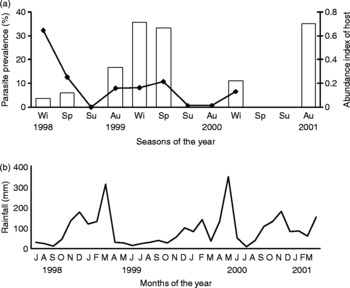
Monthly rainfall data of the locality of San Pedro (located in the Rolling Pampa at 80 km from the study area) between July 1998 and March 2001 are shown in fig. 1b. These data were provided by the Instituto Nacional de Tecnología Agropecuaria (INTA) of Argentina.
Seasonal variation in the prevalence of Protospirura numidica criceticola in Akodon azarae in relation to (a) the seasonal variation in the abundance of A. azarae and (b) monthly rainfall. Abundance data of A. azarae in autumn 2001 were not included because a different kind of rodent trapping was used. Rodents were not sampled in spring 2000 and summer 2001. Abundance data of A. azarae were obtained from Miño (Reference Miño2003). Open bars, prevalence of P. n. criceticola; ♦, abundance of A. azarae; Wi, winter; Sp, spring; Su, summer; Au, autumn. Rainfall data were provided by the Instituto Nacional de Tecnología Agropecuaria (Argentina).

Results
A total of 6102 helminths were collected from the 115 specimens of A. azarae captured between 1998 and 2000 on 19 of the 30 poultry farms sampled for rodents. Nematodes represented 99.4% of all the helminths, out of which 0.4% were P. n. criceticola, and the remaining 0.6% were cestodes. From the 17 specimens of A. azarae captured in autumn 2001 on two farms, a total of 255 helminth specimens were found. There were specimens of A. azarae infected with P. n. criceticola on 9 out of 21 poultry farms where A. azarae was captured. Ninety-eight per cent of the parasites were nematodes, with P. n. criceticola representing 11.6%; the other 1.6% were cestodes. Ninety-two per cent of the specimens of P. n. criceticola were located in the stomach, and the other 8% were located in the small intestine (4% in the first portion and 4% between the third and tenth portions). The mean length of adult specimens of P. n. criceticola was 27.4 mm (males 20.6 mm; females 31.5 mm), with females reaching 42 mm and males 28 mm.
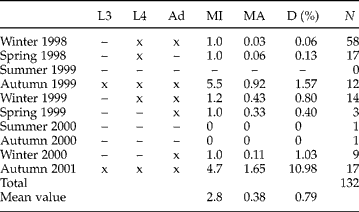
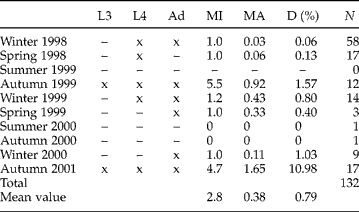
Specimens of P. n. criceticola were recovered from A. azarae in autumn, winter and spring. Only one specimen of A. azarae was captured in summer (year 2000) and it was not infected with P. n. criceticola (table 1). Adults and L4 of P. n. criceticola were found from March to December (autumn, winter and spring), while L3 were only found in March and June (autumn) (table 1). The occurrence of L4 specimens on 21 March confirms that larval stages (L3 and L4) were also present within the rodents in summer.
Presence (x) and absence (–) of the third-stage (L3) and fourth-stage larvae (L4) and adult worms (Ad); and mean intensity (MI), mean abundance (MA) and dominance (D) for the three stages (L3, L4 and adults) of Protospirura numidica criceticola isolated from Akodon azarae in different seasons, on poultry farms of central Argentina.
N, number of specimens of A. azarae examined.
Prevalence ranged from 0 to 35.71% (mean prevalence 13.64%) and it appeared to show a cyclical biannual fluctuation with maximum and minimum values in different seasons in each year (fig. 1a). There was insufficient evidence to conclude that variation in prevalence among seasons was correlated with the fluctuation in the abundance of the host (r s = 0.37, P = 0.37, N = 8) (fig. 1a). Prevalence did not seem to be related to rainfall either (fig. 1b). The frequency of individuals of A. azarae infected with P. n. criceticola did not differ significantly between spring–summer and autumn–winter periods (two-tailed Fisher exact test: P = 0.74, df = 1, N = 132).
Dominance, mean intensity and abundance ranged from 0% to 10.98%, 0 to 5.50 and 0 to 14 (mean abundance: 0 to 1.65), respectively (table 1). All individuals of A. azarae harbouring three or more specimens of the parasite were trapped in autumn (1999 and 2001), but they represented only 3.8% of all the individuals examined.
Discussion
This study showed that infection of A. azarae by P. n. criceticola occurred all year round on poultry farms of central Argentina. The occurrence of larval stages within the definitive host was confirmed in each of the four seasons. The pattern of infection was not seasonal. Fluctuations in prevalence were not related to the abundance of A. azarae or to rainfall. Variation may have been attributable to fluctuations in the abundance or activity of the intermediate host and/or to fluctuations in the abundance of another definitive host, perhaps a more significant reservoir of this parasite. Although many arthropods, such as beetles, cockroaches, earwigs, grasshoppers and crickets, are cited as intermediate hosts for P. n. criceticola in the laboratory and in other regions of the Neotropics (Crook & Grundmann, Reference Crook and Grundmann1964; Quentin et al., Reference Quentin, Karimi and Rodríguez de Almeida1968; Healey & Grundmann, Reference Healey and Grundmann1974), it is not known which species transmit P. n. criceticola to A. azarae; it may be a single or many species with different population dynamics in the region. The intermediate host should be active in winter, because larval stages were found in every month of this season. In contrast, P. n. criceticola showed an annual cycle, with seasonal fluctuations, in its infection rates in rodents in North America (Grundmann, Reference Grundmann1957; Derrick, Reference Derrick1971). Fluctuations include a decline in winter, which was attributed to the hibernation of the main intermediate host (the dung beetle Eleodes sp.) as well as to the low density of rodent populations during winter (Derrick, Reference Derrick1971). In contrast, in the present study, variation of prevalence appeared to show a biannual pattern, with a phase of increase from winter to winter of one year and a phase of decline from winter to winter of the following year. However, a longer time series would be necessary to substantiate this pattern.
The fluctuation of P. n. criceticola in A. azarae may also be related to the abundance of another cricetid (potential host) that may sometimes increase its abundance in the fencerows of the farms when the abundance of A. azarae declines, thus compensating for the decline in the prevalence of P. n. criceticola in A. azarae at those times. The cricetids C. laucha, C. musculinus, O. flavescens and O. rufus were also captured on farms (Miño et al., Reference Miño, Cavia, Gómez Villafañe, Bilenca and Busch2007; Miñarro, unpublished), although there is no information about any of them as hosts for the parasite or likelihood that they act as reservoir hosts. None these species has ever been found to be infected with P. n. criceticola on farms or other habitats in the region. In Buenos Aires province, P. n. criceticola has been found parasitizing the water rat Scapteromys aquaticus in riparian habitats near the Río de la Plata river (Sutton, Reference Sutton1994), but this rat species has never been captured in the current study area. Thus, A. azarae seems to be a very important host species for the maintenance of P. n. criceticola on farms of the Rolling Pampa.
Although prevalence values fluctuated during the study period, they never exceeded 36%. This pattern of infection differs from the pattern observed in desert habitats of Utah, where the prevalence ranged from 0 to 100% in less than a year (Grundmann, Reference Grundmann1957). The absence of high prevalence values in the present study would be in accordance with the omnivorous behaviour of A. azarae and the climatic characteristics of the Pampean region. High prevalence is expected when the diet of rodents is mainly composed of arthropods, but the diet of A. azarae remains diverse throughout the year because of seasonally varied diverse food resources. Moreover, it is consistent with the pattern of infection observed in the humid habitats of Utah, where adequate plant food for rodents remains abundant in winter and prevalence values of P. n. criceticola never exceed 15% (Derrick, Reference Derrick1971).
In the present study, the infection of A. azarae by P. n. criceticola was also characterized by a low mean intensity, mean abundance and dominance. This could be due to the low probability of survival of the definitive host when carrying a heavy biomass of stomach parasites. However, infections in rodents with species of the Protospirura genus can become very intense, harbouring over 100 worms, which represents biomass levels exceeding 2% of host body weight (Behnke et al., Reference Behnke, Barnard, Mason, Harris, Sherif, Zalat and Gilbert2000, Reference Behnke, Harris, Bajer, Barnard, Sherif, Cliffe, Hurst, Lamb, Rhodes, James, Clifford, Gilbert and Zalat2004). The stomach of A. azarae is around 1.09 cm in length (Rouaux et al., Reference Rouaux, Giai, Fernández, Bianco and De Santis2003), while the mean length for adult parasite specimens in this work was 2.74 cm. Therefore, just one or two specimens of P. n. criceticola would occupy most of the stomach lumen of A. azarae, limiting its feeding capacity. The low parameter values could also be the result of intra-specific competition between parasites. Both hypotheses are not mutually exclusive. Lowrie et al. (Reference Lowrie, Behnke and Barnard2004) found an association between worm abundance and loss of host weight, as well as evidence of parasite density-dependence, in another species of Protospirura (P. muricola), similar in size to P. n. criceticola, which also parasitizes the stomach of rodents.
In the present work, only 3.8% of the individuals of A. azarae examined were parasitized with three or more specimens of P. n. criceticola and they were all found in the autumn. Akodon azarae must maintain high metabolic rates in winter to regulate its body temperature (Antinuchi & Busch, Reference Antinuchi and Busch2000). Different studies suggest that, at the population level, the investment in physiological or reproductive activities occurred at the expense of an investment in defence against parasites (Sheldon & Verhuist, Reference Sheldon and Verhuist1996; Barnard et al., Reference Barnard, Sayed, Barnard, Behnke, Abdel Nabi, Sherif, Shutt and Zalat2003). Hence, it is unlikely that individuals of A. azarae with a high worm burden of stomach parasites would survive in this harsh season, reaching spring only scarcely, compared to unparasitized individuals. The poor sample of rodents trapped in the summer does not allow any firm conclusions about events in this season. Since highly infected rodents were only encountered in the autumn, this may indicate that there is a greater abundance of infected arthropods in this season. Autumn is the season of highest abundance of A. azarae (Zuleta et al., Reference Zuleta, Kravetz, Busch and Percich1988), so if arthropod abundance were also high in this season, contact between the definitive and the intermediate host would be enhanced. However, in winter and spring 1999 prevalence values were higher than in autumn.
This is the first study of the host–parasite relationship of P. n. criceticola in a sylvatic South American rodent under natural conditions. It is also the first study of helminth ecology in a rural environment of the Pampean region of Argentina. The occurrence of P. n. criceticola on commercial poultry farms may not represent a sanitary risk for chickens because they are mainly granivorous and because the parasite is specific to mammals (mainly rodents). However, other domestic mammals such as dogs, cats, pigs, cows, sheep and horses are also frequent on farms and may become infected. In another region of Argentina (Neuquén province), P. n. criceticola has been found to parasitize foxes such as Dusycion griseus and D. culpaeus (Stein et al., Reference Stein, Suriano and Novaro1994). In contrast, it is unlikely that humans become infected because the route of transmission implies the ingestion of arthropods.
Acknowledgements
The author thanks Fernando Miñarro for kindly providing some of the rodents analysed in this study. She also thanks Dr María Busch for her critical reading and advising on the manuscript, Dr Graciela Navone, from Centro de Estudios Parasitológicos y de Vectores (CEPAVE, Argentina), for helping in the specific identification of the parasite subspecies, and the anonymous reviewer for suggesting some very useful bibliography. This work was supported financially by the Universidad de Buenos Aires (UBACyT X098) and the Agencia Nacional de Promoción Científica y Tecnológica (ANPCYT 12 303), Argentina.