Introduction
Patients with Alzheimer's disease (AD) manifest language impairments including deficits of naming, verbal fluency, comprehension, and writing (Lambert et al., Reference Lambert, Eustache, Viader, Dary, Rioux and Lechevalier1996). Among these language disorders, numerous studies on AD have focused on anomia; these show that naming ability deteriorates even at an early stage of the AD process (Appel et al., Reference Appel, Kertesz and Fisman1982; Hodges et al., Reference Hodges, Salmon and Butters1993; Yasuda et al., Reference Yasuda, Nakamura and Beckman2000; Small and Sandhu, Reference Small and Sandhu2008). However, patients with AD may show deficits not only in naming but also in their written language abilities (Groves-Wright et al., Reference Groves-Wright, Neils-Strunjas, Burnett and O'Neill2004). Some studies have reported that writing impairment – agraphia – is also manifested at a fairly early stage of the disease (Cummings et al., Reference Cummings, Benson, Hill and Read1985; Faber-Langendoen et al., Reference Faber-Langendoen, Morris, Knesevich, LaBarge, Miller and Berg1988; Croisile et al., Reference Croisile, Brabant, Carmoi, Lepage, Aimard and Trillet1996). Moreover, they suggest that agraphia is a more sensitive indicator of language deficits in AD than anomia (Cummings et al., Reference Cummings, Benson, Hill and Read1985; Faber-Langendoen et al., Reference Faber-Langendoen, Morris, Knesevich, LaBarge, Miller and Berg1988; Croisile et al., Reference Croisile, Brabant, Carmoi, Lepage, Aimard and Trillet1996).
Writing requires coordinated activities of central and peripheral processes (Ellis, Reference Ellis and Ellis1982; Roeltgen, Reference Roeltgen, Heilman and Valenstein2003). The central processes are involved in generation of spelling that applies to all possible modalities of output (e.g. handwriting, oral spelling, writing with block letters, and typing). These processes are linguistic in nature and they include three potentially independent spelling routes: lexical-semantic route, lexical-nonsemantic route, and non lexical route. Thus, regular, irregular and nonwords are used to test this stage of the writing process. The peripheral processes, on the other hand, are restricted to converting orthographic information into motor commands for writing movements. The process includes the following stages: (1) allographic system where the specific letter shapes are generated in terms of the visuospatial features relative to the case (lower or upper) and style (cursive or print) of the letters; (2) graphic motor patterns that specify the direction, relative size, position and order of strokes; and (3) execution and control of neuromuscular commands.
Most studies on agraphia in AD that have been performed in countries using the Roman-alphabetic system have focused on the central processes of writing and have analyzed agraphia from a linguistic perspective, such as ambiguous spelling and unusual or nonexistent letter combinations (Croisile et al., Reference Croisile, Camoi, Adeleine and Trillet1995; Neils et al., Reference Neils, Roeltgen and Greer1995; Hughes et al., Reference Hughes, Graham, Patterson and Hodges1997; Croisile, Reference Croisile1999; Luzzatti et al., Reference Luzzatti, Laiacona and Agazzi2003; Groves-Wright et al., Reference Groves-Wright, Neils-Strunjas, Burnett and O'Neill2004; Carthery et al., Reference Carthery, Mattos-Pimenta-Parente, Nitrini, Bahia and Caramelli2005; Lambert et al., Reference Lambert, Giffard, Nore, de la Sayette, Pasquier and Eustache2007). In these studies, researchers used word-level stimuli (e.g. regular, irregular, and nonwords) and attempted to explain error patterns by identifying components that may have been disrupted in the underlying central process of writing.
Compared to the central processes, the peripheral aspects of writing in AD had received less attention. There were few studies on this aspect of writing describing errors such as upper and lower case substitution of a letter, letter formation, and stroke placement (Hughes et al., Reference Hughes, Graham, Patterson and Hodges1997; Neils-Strunjas et al., Reference Neils-Strunjas, Shuren, Roeltgen and Brown1998; Luzzatti et al., Reference Luzzatti, Laiacona and Agazzi2003; Forbes et al., Reference Forbes, Shanks and Venneri2004; Lambert et al., Reference Lambert, Giffard, Nore, de la Sayette, Pasquier and Eustache2007). However, these findings could not be applied to all written language systems.
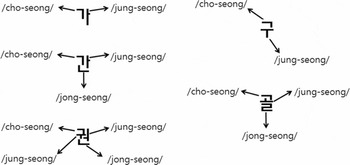
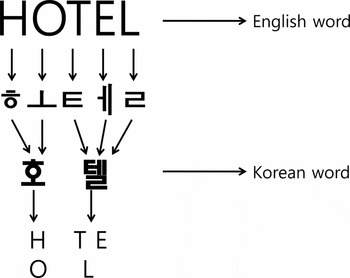
There are some unique aspects of the Korean written script that could affect the patterns of agraphia in AD patients at the peripheral stage of the writing processes, when compared to those using Roman scripts. In order to look into these different aspects in detail, we will first compare English with Korean writing systems. From a linguistic perspective, both of these written scripts are based on phonograms. A slight difference is that, orthographically, English is less transparent than the Korean writing system. Therefore, English could be considered a better written script to study the central aspects of agraphia by employing word-level analyses to identify patterns of spelling deterioration. However, from the peripheral aspect, especially the visuocontructional perspective, there are remarkable differences between the two writing systems. Roman alphabets may require less visuoconstructional ability because the letters are composed of one to three strokes and are written in a linear fashion. In contrast, the Korean alphabet, Hangul, is unique with regard to combination and construction. The special feature of Hangul is that syllables are typically made up of an initial consonant-grapheme (/cho-seong/), followed by a vowel-grapheme (/jung-seong/), and then an optional coda, another consonant-grapheme (/jong-seong/). That is, each syllable contains at least one consonant-grapheme (cho) and one vowel-grapheme (jung), with the final consonant-grapheme (jong) being optional (Figure 1). These graphemes are arranged in a square pattern and a combination of these syllables form a word ( ) (Figure 2).
The written construction of Hangul syllables. Initial consonant-, medial vowel-, and final consonant-graphemes are named cho-seong, jung-seong and jong-seong, respectively.

Letters in English words are written in a linear fashion, while graphemes in Korean words are arranged in a square pattern.

Patients with AD may exhibit writing errors with respect to visuoconstructional aspects as well as linguistic aspects because AD is a disease that can result in both visuoconstructional and language dysfunction due to bilateral involvement of the tempo-parietal areas. Moreover, the visuoconstructional aspect of writing errors may be more prominent in early onset AD (EOAD) than in later onset AD (LOAD) patients because they demonstrate more hypometabolism extending into the frontal region as well as a more severe degree of hypometabolism in the parietal regions (Kim et al., Reference Kim2005), which are known to be involved in processing visuoconstructional function (Lezak, Reference Lezak1985).
Thus, since Hangul is a written language system that could better reflect the visuoconstructional aspect of writing, and EOAD is a disease that involves both the right and left temporal parietal areas to a certain extent, we hypothesized that Korean patients with EOAD might exhibit both visuoconstructional and linguistic errors in Hangul writing and would show more diverse visuoconstructional errors compared to the writing samples in AD patients that use the Roman alphabet.
In order to test our hypothesis, we investigated the errors of a writing task in Korean patients with EOAD. In addition, previous studies have demonstrated that writing requires integration of multiple cognitive domains including frontal executive function, attention, and memory as well as language and visuoconstructional abilities (McNeil and Tseng, Reference McNeil, Tseng and Lapointe1990). Thus, we also evaluated the relationships between Hangul writing and neuropsychological variables and severity of dementia in order to verify these previous findings.
Methods
Participants
We consecutively recruited 40 patients diagnosed with EOAD at the Memory Disorder Clinic in the Samsung Medical Center in Seoul, Korea between September 2006 and August 2007. AD patients fulfilled the criteria for probable AD as proposed by the National Institute of Neurological and Communicative Disorders and Stroke and the Alzheimer's Disease and Related Disorders Association (NINCDS-ADRDA) (McKhann et al., Reference McKhann, Drachman, Folstein, Katzman, Price and Stadlan1984). Onset age of dementia was determined on the basis of the information obtained from family members at the time of the patient's first visit to our clinic; all onset ages were below 65 years (range: 42–67). AD patients were excluded from the study if: (i) they had received less than six years education because they might have difficulty writing Hangul in the premorbid state; (ii) they showed abnormal findings in laboratory tests that included a complete blood count, blood chemistry, vitamin B12/folate, syphilis serology, and thyroid function tests; (iii) they showed territorial cerebral infarctions, brain tumors, and other structural lesions on MRI; (iv) they had mild bradykinesia and rigidity that can affect writing ability; and (v) they refused to complete the experimental testing. Four patients were excluded for refusing to complete the experimental testing, and one patient exhibited mild bradykinesia and rigidity and so was ultimately excluded. Thirty-five patients were eventually included in the study.
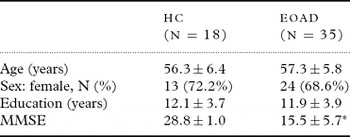
In order to assess performances on writing tests, we recruited 18 age- and education-matched healthy controls (HC) among caregivers from the same memory disorder clinics in our hospital. These subjects had no history of neurological or psychiatric illnesses. The demographic features of the 35 EOAD patients and 18 HCs are presented in Table 1. All subjects were right-handed and spoke the standard Korean language and reported no histories of writing disturbances before diagnosis. This study was approved by the Institutional Review Board of the Samsung Medical Center.
Demographic variables for the HC and EOAD groups

Mean ± SD.
HC = healthy control; EOAD = early onset Alzheimer's disease; MMSE = Mini-Mental State Examination.
*P < 0.05.
Neuropsychological tests
Of the 35 participants, 26 underwent neuropsychological testing using a standardized neuropsychological battery, the Seoul Neuropsychological Screening Battery (SNSB) (Kang and Na, Reference Kang and Na2003); nine patients either refused to be tested or the time between the date of the test and the Hangul writing test was over six months. The battery contains tests for attention, praxis, four elements of Gerstmann syndrome, visuospatial function, verbal and visual memory, frontal/executive function, and the Clinical Dementia Rating (CDR). Among these, the scorable tests contained digit span (forward and backward), the Rey-Osterrieth Complex Figure Test (RCFT; copying, immediate and 20-minute delayed recall, and recognition), the Seoul Verbal Learning Test (SVLT; three learning-free recall trials of 12 words, 20-minute delayed recall trial for these 12 items, and recognition), the phonemic and semantic Controlled Oral Word Association Test (COWAT), and the Stroop Test (word and color reading of 112 items over two minutes). Age-, sex-, and education-specific norms for each test based on 447 normal subjects are available (Kang and Na, Reference Kang and Na2003). According to the normative data and criteria, the scores of these scorable cognitive tests were classified as abnormal when they were below the 16th percentile of the norms for the age-, sex-, and education-matched normal subjects.
Language test
All patients completed the Korean version of the Western Aphasia Battery (WAB) (Kim and Na, Reference Kim and Na2004) composed of subtests such as spontaneous speech, auditory comprehension, repetition, naming, reading, and writing. Patients with EOAD exhibited a mean aphasia quotient of 72.9 and a language quotient of 66.2 (maximum score = 100).
Writing task
The basic construction of the Hangul script is the “syllable” consisting of three parts: cho-seong, jung-seong, and jong-seong (Figure 1) as mentioned above in the Introduction, and a combination of syllables form a word (e.g.  consists of three syllables). The main focus of our study was to analyze the peripheral aspect, especially the visuoconstructional aspect of the errors. Thus, we preferred analyzing only single syllable characters instead of complete words because the single syllables are simple and more suitable for investigating the visuoconstructional aspect of writing errors. Furthermore, another reason for using syllable targets was to exclude the central processes in the error analyses. So, in order to prevent the effects of the central processes in writing our target syllables, in addition to the fact that these syllables are in one-to-one grapheme to phoneme correspondence, all of the syllables were selected from parts of words (e.g. ‘
 ’ (/ka/) of ‘
 ’ (/ka-wi/)(scissors)), so the patient could use either the phonological route or the lexical route.
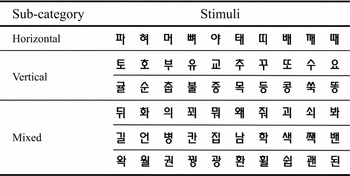
The writing task consisted of 60 single syllable characters with four or fewer graphemes that had one-to-one phoneme-to-grapheme correspondence. To make the task less complicated, we considered word frequency when selecting syllables. Words were selected from the high frequency words identified in the Learner's Dictionary of Korean (Seo, Reference Seo2006). The stimuli used in experiments are provided in Figure 3.
Hangul syllable stimuli.

Experimental procedure
All subjects performed the Hangul writing task. For this, the stimuli were presented in a random order, with randomization performed using Microsoft Office Excel (Microsoft Corporation, USA). Each Hangul stimulus was presented verbally to the patient with a word cue; for example, “please write the syllable ‘ ’ (/ka/) of ‘
 ’ (/ka-wi/).” The subject was asked to repeat the target stimulus verbally before writing it to ensure that the stimuli were correctly understood.
The writing test was performed in a carpeted room with an ambient noise level. We requested the subjects to write on the touch pad of a tablet PC. In order to collect patient responses, we devised a simple computer program that records the writing performance of patients and stores the writing performance as a PNG image file. The subjects were instructed to write each syllable in a block style as accurately as possible within the 8×8 cm frame of the tablet PC.
Writing error analyses
The number of syllables that were incorrectly produced was counted to determine the total number of erroneous responses. If the subject responded “I don't know” or gave no response it was considered incorrect. As such, only one error per syllable could be counted. The maximum possible number or errors was 60 and the minimum was 0.
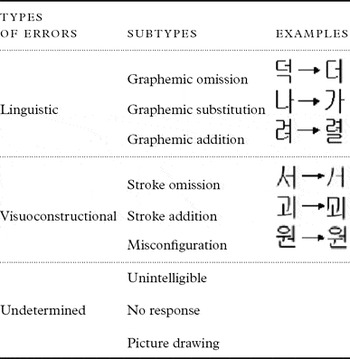
In terms of analyzing subtypes of error, we designed new criteria by consulting other studies (Table 2) (Kwon et al., Reference Kwon, Lee, Chin, Lee, Kim and Na2002; Maeshima et al., Reference Maeshima2003; Law, Reference Law2004).
Criteria for error analysis

As already mentioned (in the writing task section above), the central processes involved in the linguistic errors are the main focus of this paper; thus, for the linguistic errors, the graphemic errors (excluding spelling errors) within the target syllable were counted. More specifically, the linguistic errors consisted of graphemic omission, substitution, and addition which changed the target syllable to a different syllable. The visuoconstructional errors consisted of awkward shaping and impossible configurations of Korean graphemes or syllables such as stroke omission, stroke addition, and misconfiguration. Stroke omission errors were defined as deleting one part of the grapheme. Stroke addition was defined as an error that added redundant strokes to an original grapheme. Errors of misconfiguration implied a non-existing formation. These visuoconstructional errors within a stroke level may render a syllable unintelligible and meaningless.
Overall, the writing errors could be considered either linguistic, visuoconstructional, mixed (linguistic plus visuoconstructional), or undetermined (i.e. unintelligible responses, picture drawing, or no response). Hence, more than one error could be documented per syllable.
Reliability of error analyses
Two speech-language pathologists (JHY and MKS) analyzed patient writing performances based on the aforementioned criteria. To determine inter-observer agreement, we randomly chose four patients (~ 10%) from the patient group. The rate of agreement between the two raters was 97.9% and a consensus was used in cases of discrepancy.
Statistics
A t-test was conducted to confirm the differences in the total numbers of error responses between the EOAD and HC groups. One-way analysis of variance and post hoc Bonferroni correction were conducted to identify differences according to disease severity within the EOAD group regarding the number of erroneous responses. To evaluate the relationship between neuropsychological or language results and Hangul writing in the EOAD group, partial correlation analysis was conducted after adjusting for age, sex, and duration of education.
Results
Number of writing errors
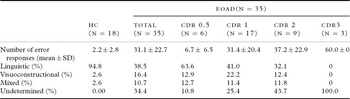
The HC group exhibited a smaller number of writing errors. When the total erroneous responses between the EOAD and HC groups were compared, the performance of the EOAD group (mean 31.1; SD 22.7) was significantly worse than that of the HC group (mean 2.2, SD 2.8; P < 0.001) (the total number of errors was 60). Within the EOAD group, the number of total error responses significantly differed according to CDR (P = 0.004) (Table 3). By comparing the mean number of erroneous responses among the patient groups, there were significant differences between CDR 0.5 and CDR 1, CDR 0.5 and CDR 2, CDR 0.5 and CDR 3 and CDR 1 and CDR 3. No differences were observed between CDR 1 and CDR 2 and CDR 2 and CDR 3. Error subtypes were analyzed in the EOAD group only because the number of errors was small in HC group. Table 3 also shows the rates of error subtypes according to CDR. CDR 0.5 and CDR 1 yielded more linguistic and visuoconstructional errors, while CDR 2 and CDR 3 demonstrated more undetermined errors.
Frequency of error subtypes in the EOAD group

HC = healthy control, EOAD = early onset Alzheimer's disease, CDR = Clinical Dementia Rating, N = number.
The relationship between results of neuropsychological or language testing and the performance of the writing task
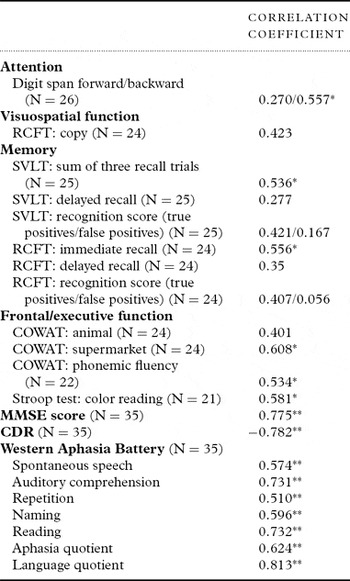
The number of correct responses in the writing task was correlated with the scores for backward digit span, SVLT (immediate recall), RCFT (immediate recall), COWAT (supermarket and phonemic), Stroop Test, MMSE, and CDR. In addition, the number of correct responses in the writing task was correlated with all subscores of the WAB. The results are provided in Table 4.
Partial correlations between the subscores of neuropsychological and language testing and the number of correct responses in Hangul writing

RCFT = Rey-Osterrieth Complex Figure Test; SVLT = the Seoul Verbal Learning Test; COWAT = Controlled Oral Word Association Test; MMSE = Mini-Mental State Examination; CDR = clinical dementia rating; N = the number of patients who performed the subtests.
*significant at p < 0.05.
**significant at p < 0.01.
Discussion
The results of the present study suggest that patients with EOAD demonstrate not only linguistic errors but also visuoconstructional or undetermined types of errors of agraphia that can be observed even in the early stages of EOAD. We also found that agraphia for Hangul writing was associated with cognitive impairments in multiple domains such as attention, language, immediate memory, and frontal executive function.
As expected, patients with EOAD demonstrated errors more frequently than controls. Within the EOAD group, as the CDR stage increased so the frequency of the total number of errors also increased. Our findings are in line with those of previous studies, suggesting that the deficits of writing processes worsen with progression of the disease (Lambert et al., Reference Lambert, Eustache, Viader, Dary, Rioux and Lechevalier1996; Hughes et al., Reference Hughes, Graham, Patterson and Hodges1997).
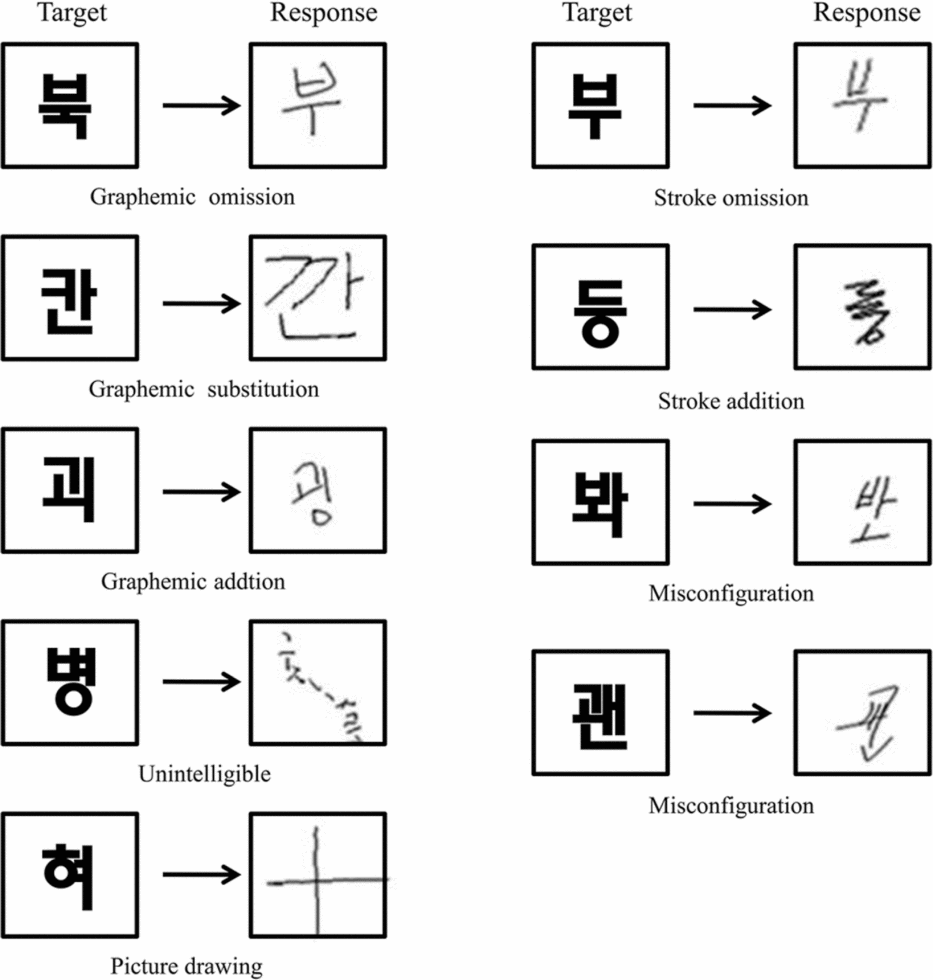
Our first major finding was that patients with EOAD showed not only linguistic errors but also visuoconstructional errors. The EOAD group exhibited linguistic errors such as graphemic substitution, addition, and omission – a finding that was in line with those of many previous Western studies (Rapcsak et al., Reference Rapcsak, Arthur, Bliklen and Rubens1989; Croisile et al., Reference Croisile, Camoi, Adeleine and Trillet1995; Neils et al., Reference Neils, Roeltgen and Greer1995; Penniello et al., Reference Penniello1995; Lambert et al., Reference Lambert, Eustache, Viader, Dary, Rioux and Lechevalier1996; Croisile et al., Reference Croisile, Brabant, Carmoi, Lepage, Aimard and Trillet1996; Graham, Reference Graham2000; Forbes et al., Reference Forbes, Shanks and Venneri2004; Carthery et al., Reference Carthery, Mattos-Pimenta-Parente, Nitrini, Bahia and Caramelli2005). We also found that the EOAD group revealed a diversity of visuoconstructional errors (Figure 4). In the previous Western studies, visuoconstructional errors related to allographic errors, and ill-formed or illegible letters have been reported (Hughes et al., Reference Hughes, Graham, Patterson and Hodges1997; Neils-Strunjas et al., Reference Neils-Strunjas, Shuren, Roeltgen and Brown1998; Luzzatti et al., Reference Luzzatti, Laiacona and Agazzi2003; Forbes et al., Reference Forbes, Shanks and Venneri2004; Lambert et al., Reference Lambert, Giffard, Nore, de la Sayette, Pasquier and Eustache2007). Among these errors, ill-formed letters and illegible errors were analogous to our errors, while misconfiguration errors of graphemes within a syllable (Figure 4) were only observed in our patients.
Examples of errors.
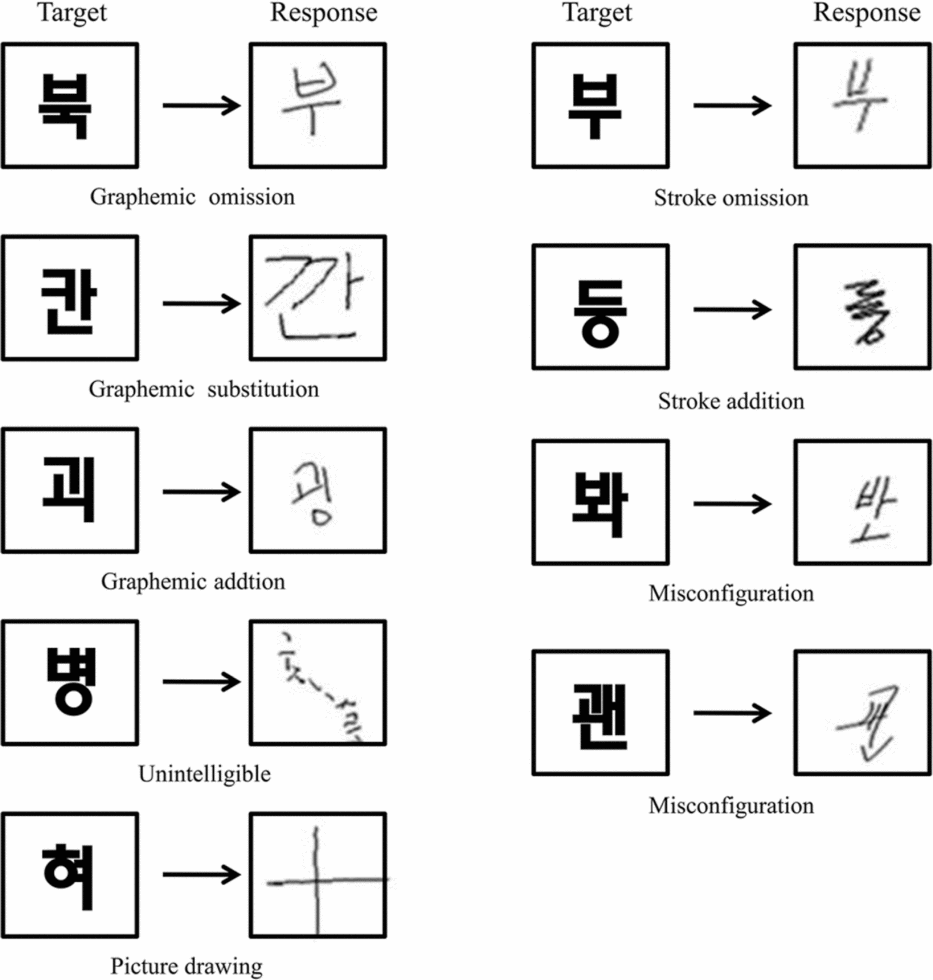
This discrepancy between our findings and the previous reports could be explained by the visuoconstructional nature of the Hangul script. Each grapheme of Hangul has its own allocated space within a square structure (Figures 1 and 2), unlike the visuoconstructional features of most alphabet-based languages, in which graphemes are arranged in a horizontal linear fashion to form words. In English, a slight shift in a letter such as the “r” in the word “rain” would not change its meaning. However, a slight shift of a grapheme might make a syllable unintelligible (Figure 4). Given this, constructing a syllable in Hangul, which requires combining each grapheme, demands greater spatial and constructional skills. In addition, whereas graphemes of English alphabets usually consist of 1 to 3 lines and/or curves, Hangul characters are much more complicated in that they require more lines and/or curves in diverse dimensions. In other words, at the level of the grapheme itself, Hangul demands more constructional aspects than the English alphabet. Based on our results, we may be able to suggest that the visuoconstuctional errors in Hangul are diverse, and thus are qualitatively different from the ones already described in other populations. However, future studies that directly compare other patient groups who use other written language systems will be necessary to show this discrepancy.
Our patients showed visuoconstructional errors even in the early stages of disease, which is inconsistent with the findings of a previous study (Croisile, Reference Croisile1999). In that study, Croisile suggested that visuospatially disorganized handwriting appears later than linguistic abnormalities in the progression of the disease. Specifically, other previous studies (Lambert et al., Reference Lambert, Eustache, Viader, Dary, Rioux and Lechevalier1996; Hughes et al., Reference Hughes, Graham, Patterson and Hodges1997; Croisile, Reference Croisile1999; Graham, Reference Graham2000) reported that deficits of central writing extend to graphic difficulties and alterations in the spatial organization of handwriting with disease progression. In severe stages, patients experienced more problems with letter formation and stroke placement (Platel et al., Reference Platel, Lambert, Eustache, Cadet, Dary and Viader1993; Hughes et al., Reference Hughes, Graham, Patterson and Hodges1997; Neils-Strunjas et al., Reference Neils-Strunjas, Shuren, Roeltgen and Brown1998; Forbes et al., Reference Forbes, Shanks and Venneri2004). These contrasting findings may be explained by differences in patient samples. Previous studies have shown that LOAD patients exhibit hypometabolism in the medial temporal lobe and lateral temporal region in the early stages while patients with early stages of EOAD exhibit hypometabolism in the frontal and parietal regions that is responsible for visuoconstructional dysfunction (Kim et al., Reference Kim2005). Moreover, McNeil and Tseng (Reference McNeil, Tseng and Lapointe1990) reported that the parietal lobe processes visuospatial and constructional functions in writing. Thus, according to these previous findings (Kim et al., Reference Kim2005), our patients, who might experience more frontal and parietal dysfunction than later-stage patients, might have produced more diverse errors, including visuoconstructional errors, in the early stages of disease.
With respect to error patterns according to the CDR scores, the CDR 0.5 and 1 groups showed more linguistic errors while the CDR 2 and 3 groups produced more undetermined errors. This result might reflect the fact that trends in error patterns differ according to disease severity. In the initial stages of the disease, patients can write plausible syllables even if they demonstrate linguistic errors. However, since the ability of writing plausible syllables was impaired in the patients with CDR 2 and 3, later-stage patients might produce illegible errors instead of writing the syllable legibly. Forbes et al. (Reference Forbes, Shanks and Venneri2004) demonstrated that patients with severe disease tend to rely upon more simplistic writing forms of print. As such, our CDR 3 patients might be expected to produce simplistic picture-like form errors (e.g. circles and loops) of Hangul syllables.
Another major finding is that cognitive impairments in multiple domains such as language, attention, immediate memory, and frontal executive function were significantly correlated with the performance of Hangul writing, which is consistent with the findings of a previous study (McNeil and Tseng, Reference McNeil, Tseng and Lapointe1990). The severity of agraphia was associated with other linguistic domains such as fluency, comprehension, naming, repetition, and reading. Some studies have reported similarities in the ability to produce oral and written language (Hughes et al., Reference Hughes, Graham, Patterson and Hodges1997; Kavrie and Neils-Strunjas, Reference Kavrie and Neils-Strunjas2002). Functions of attention and immediate memory might aid in the writing process by interacting globally with other processes such as semantically stored knowledge, lexically stored knowledge, and graphemic buffers. Thus, impaired attention and memory might be involved in the entire writing process and could result in letter substitution and omission errors (Hillis and Caramazza, Reference Hillis and Caramazza1989; Neils et al., Reference Neils, Roeltgen and Greer1995). Frontal executive function, which includes subcategories such as planning, organizing behavior, disinhibition, and initiation (Baddeley, Reference Baddeley1986) might also add to the complexity of the writing process. A patient with frontal lobe dysfunction could have difficulty maintaining the effort required for writing (Ardila and Surloff, Reference Ardila and Surloff2006). Given our expectations, RCFT that focused on visuospatial abilities was not associated with agraphia. The mean score of RCFT (copy) was 8.41 (SD 6.97) (maximum score = 36) and the scores of 15 out of 26 patients were below 10, which is regarded as poor performance. Therefore, this negative result might be affected by a floor effect due to the difficulty of the test.
In conclusion, our findings suggest that Hangul has both linguistic and visuoconstructional characteristics and that the nature of Hangul writing might be particularly vulnerable to the impaired writing ability that often accompanies EOAD. This study is noteworthy because it is the first attempt to describe features of agraphia in Korean patients with EOAD. However, the limitation of this study is that our study only focused on the peripheral processes of writing and did not consider the central processes that could be involved in this patient population. Further studies will be needed to clarify lexical-semantic aspects and graphemic buffer deficits in the writing processes, in addition to the underlying mechanisms involved in specific brain regions and Korean syllabic writing. With respect to sample size for correlation analyses, the number of subjects was not large enough to allow safe conclusions to be drawn, so future studies are needed to confirm the results.
Conflict of interest
None.
Description of authors' roles
Ji Hye Yoon designed the study, wrote and revised the paper. Mee Kyung Suh designed the study, revised and proofread the paper. Yong Jeong designed the software program and proofread the paper. Hyun-Jung Ahn was responsible for the statistical design of the study and for carrying out the statistical analysis. So Young Moon collected the data and proofread the paper. Juhee Chin collected the data. Sang Won Seo designed the study, supervised the data collection, revised and proofread the paper. Duk L. Na designed the study and supervised the data collection.
Acknowledgment
This work was supported by a National Research Foundation of Korea grant funded by the Korean government (NRF-2009–327-H00032).