Implications
Traditional breeders keep animals for multiple purposes and have complex breeding objectives. We used choice experiments (CEs) to identify breeding objectives of smallholders and pastoral sheep breeders in different agro-ecologies. Results demonstrated that breeders’ preferences include tangible attributes (production and reproduction traits) such as milk yield, size, twinning, lambing interval, mothering ability, as well as intangible attributes (cultural traits) such as tail type, coat color and horn/horn type and so on. Thus, CE can be a useful tool to reveal objective traits that would be incorporated into breeding plans especially under traditional production systems where recording practices have not been in place.
Introduction
Sheep is the second most important livestock species in Ethiopia, estimated at 26 million (Central Statistical Agency (CSA), 2008). There are diverse breeds and ecotypes distributed from cool alpine climate of the mountains to the arid pastoral areas of the lowlands. To date, there are nine known breeds of sheep characterized through phenotypic and molecular methods (Gizaw et al., Reference Gizaw, van Arendonk, Komen, Windig and Hanotee2007). In Ethiopia, the livelihood of smallholder households depends to a great extent on livestock, and sheep contribute substantial amounts to income, food (meat and milk) and non-food products such as manure, skins and wool. They also serve as a means of risk mitigation during crop failures, property security, monetary saving and investment, in addition to many other socioeconomic and cultural functions (Tibbo, Reference Tibbo2006). However, sheep productivity is constrained by lack of technical capacity, scarce feed, diseases, insufficient infrastructure and market information resulting in inadequate utilization of the indigenous genetic resources. The average annual off-take rate and carcass weight per slaughtered animal for the years 2000 to 2007 are 32.5% and 10.1 kg, respectively (Food and Agriculture Organization (FAO), 2009), the lowest even among sub-Saharan African countries.
Institutionalized sheep genetic improvement efforts begun in 1944 when animals of the Merino breed from Italy were imported to be crossed with indigenous Arsi sheep at Agarfa, south central Ethiopian highland. Following this, Blue du Maine from France, Rambouillet from Spain, Romney and Corriedale from Kenya, Hampshire from the United Kingdom, Awassi from Israel and Dorper sheep from South Africa were imported at different times for genetic improvement through crossbreeding. In 1977, the national agricultural research system started on-station phenotypic characterization and genetic improvement of largely indigenous sheep types in various parts of the country. However, such efforts failed to impact the traditional and extensive sheep production systems that are owned and managed by resource-poor smallholders. Among many reasons, the limited involvement of relevant stakeholders particularly smallholder farmers/pastoralists in the planning and implementation of sheep improvement endeavors contributed to such failures. This was particularly pronounced in the imported breeds, as smallholders rejected most crossbreds except the Awassi crossbreds when distributed for further breeding purposes because of phenotypic unlikeness to the indigenous ones (Tibbo, Reference Tibbo2006).
On the other hand, owing to the country's strategic geographic location, market opportunities are promising as evidenced by increased volume of export trade. Moreover, urbanization and growing population resulted in increased domestic demand for sheep meat, which also offers significant incentive for market-oriented production.
There is a new thinking that local communities and institutions must be involved and that focus has to be given to indigenous genetic resources in order to bring about the desired change. Sustainable strategy needs to be tailored to the specific goals of the targeted communities and production systems/environments as no single strategy fits all situations. The prevailing production conditions largely determine the breeding or production purposes, suitability of breeds and breeding methods. There are distinct breeds and breed groups suitable for diverse purposes in the different production environments/ecological zones. Furthermore, farmers in different production systems may have different trait preferences (Roessler et al., Reference Roessler, Drucker, Scarpa, Markemann, Lemke, Thuy and Valle-Zarate2008) and they may also follow as diverse strategies as the agro-environments within which they perform (Reece and Sumberg, Reference Reece and Sumberg2003). Understanding farmers’ trait preferences provides insights into which traits are particularly important in their agro-ecosystem and how these can be incorporated in the design of sustainable breeding programs. Cognizant of this, International Center for Agricultural Research in the Dry Areas (ICARDA), International Livestock Research Institute (ILRI) and Austrian University of Natural Resource and Applied Sciences (BOKU) in partnership with national and regional agricultural research systems in Ethiopia are designing community-based sheep breeding programs for four breeds in four different regions of Ethiopia.
Hypothetical choice experiment (CE) is one of the numerous tools used to identify preferences of the subjects under consideration. The technique has been widely used in other disciplines especially in the transportation industry (McFadden, Reference McFadden1974 and Reference McFadden2001; Train, Reference Train2009). In agriculture, particularly in the livestock sector, there is a recent boom in published reports. For instance, Tano et al. (Reference Tano, Kamuanga, Faminow and Swallow2003) quantified farmers’ preferences for cattle traits in West Africa and Scarpa et al. (Reference Scarpa, Ruto, Kristijanson, Radney, Drucker and Rege2003a), Wurzinger et al. (Reference Wurzinger, Ndumu, Baumung, Drucker, Okeyo, Semambo and Sölkner2006), Ouma et al. (Reference Ouma, Abdulai and Drucker2007) and Kassie et al. (Reference Kassie, Abdulai and Wollny2009) investigated farmers’ preferences for cattle traits in East Africa. Scarpa et al. (Reference Scarpa, Drucker, Anderson, Ferraes-Ehun, Gomez, Risopatron and Rubio-Leonel2003b) evaluated preferences of pig traits by Mexican backyard and smallholder farmers, and Roessler et al. (Reference Roessler, Drucker, Scarpa, Markemann, Lemke, Thuy and Valle-Zarate2008) identified pig trait preferences in Vietnam. Values of cattle breeds in South Ethiopia and North Kenya were also estimated by Zander and Drucker (Reference Zander and Drucker2008). Producers’ preferences for goat and sheep traits were only analyzed by Omondi et al. (Reference Omondi, Baltenweck, Drucker, Obare and Zande2008a and Reference Omondi, Baltenweck, Drucker, Obare and Zander2008b) in North Kenya, respectively. However, to the best of our knowledge, there has not been any attempt to design breeding plans based on the results of such studies. The objective of the current study was to identify breeding objective traits under different production environments to be used as an input in the design of alternative breeding plans targeting four Ethiopian indigenous sheep breeds.
Material and methods
Study area and sheep production systems
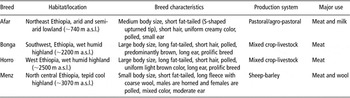
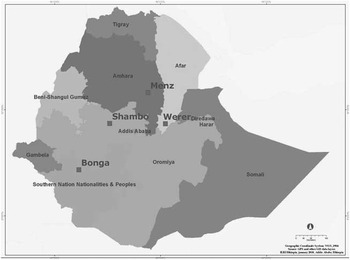
Four locations, Afar, Bonga, Horro and Menz, representing different production systems and agro-ecologies that are habitat to four indigenous sheep breeds were identified for the current study. Following a synthesis of information from the respective bureau of agriculture and rural development and diagnostic surveys, two communities per location consisting of 60 households each were identified. The following criteria were used to select the communities: sheep population (⩾420 breeding ewes), presence of communal grazing land, accessibility and willingness of the community to participate in the sheep improvement project. Households with at least four breeding ewes were considered as a community member. Description of the study locations, breed characteristics, production systems and major use of the four indigenous sheep breeds are shown in Table 1. Furthermore, study locations are indicated in Figure 1. Briefly, the different production environments and sheep production systems are separately described below.
Location, breed description, production system and major use of the four indigenous sheep breeds of Ethiopia

Study areas.

Afar is located in Afar National Regional State, northeastern part of Ethiopia, sharing international borders with Eritrea and Djibouti. The project location is situated at about 250 km east of Addis Ababa on the highway to Djibouti. Pastoral production system is practiced in most parts of the Afar region, except along the Awash River where cotton cultivation is practiced. The Afar sheep breed is fat-tailed with an unusual tail shape (shield shaped and descends to the hocks, with a short S-shaped upturned tip) with no wool. It is a hardy breed adapted to arid and semi-arid areas of the middle Awash valley, which includes the coastal strip of the Danakil depression and the associated Rift Valley in Ethiopia (Galal, Reference Galal1983; Wilson, Reference Wilson1991). The breed is used for milk and meat. The annual precipitation of the area is about 600 mm and mean daily temperature is about 28°C, with a maximum approaching 38°C in June and a minimum of 15°C in November (Getachew, Reference Getachew2008).
Bonga is situated in the Southwestern part of Ethiopia (7°34′N latitude and 37°6′E longitude), in the Southern Nations, Nationalities and Peoples Regional State at a distance of about 450 km from Addis Ababa. The predominant production system of the area is mixed crop-livestock system. Bonga sheep, long fat-tailed breed, are highly valued for their meat production. The area has one major rainy season that extends from May to October and the dry season lasts from October to April (Edea, Reference Edea2008). The annual precipitation of the region is about 2300 mm, with mean maximum and minimum temperatures of about 24 and 12°C, respectively (Denboba, Reference Denboba2005).
Horro is located at about 315 km from Addis Ababa (9°34′N latitude and 37°6′E longitude) in the Oromia National Regional State, West Ethiopia. Mixed crop-livestock agriculture is the main stay of the farming communities. The breed (and its ecotypes) is the most dominant sheep in the Southwestern areas of the country. Horro sheep have the following identifying features: a solid tan to dark brown color, short smooth hair, a triangular fat tail with a relatively narrow base and the pointed end hanging downward or with a slight twist. Often, the rams have a mane between the head and the brisket and above the neck (Galal, Reference Galal1983). The breed is mainly kept for meat. The area has one long rainy season extending from March to mid-October, with a mean annual precipitation of about 1800 mm (Olana, Reference Olana2006).
Menz is located in the Amhara National Regional State at about 280 km North of Addis Ababa, Ethiopia. The area is characterized as a low-input sheep-barley production system. The Menz sheep breed is fat-tailed, medium-sized (30 to 35 kg), predominantly black, brown or white in plain and patchy coat color pattern. The breed is raised for its meat and coarse wool (used for weaving traditional blankets and carpets). The area is characterized by a bi-modal rainfall pattern where the main rainy season is from June to September and erratic and unreliable short rainy season in February and March (Getachew, Reference Getachew2008), with mean maximum and minimum temperatures of 18°C and 7°C, respectively.
CE
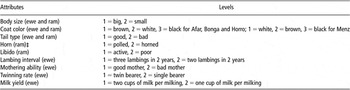
Smallholder sheep owners priority attributes used in the choice sets were identified through an in-depth production system study conducted from December 2007 to March 2008 by Edea (Reference Edea2008) in Bonga and Horro and Getachew (Reference Getachew2008) in Afar and Menz areas. As part of the survey, sheep owners were asked to select from an exhaustive list of traits, those that they would use for ram and ewe selection for breeding, and then rank them in order of importance. The proportion of respondents selecting a trait as first, second and third was used to calculate indices that represented a weighted average of all rankings of a particular attribute. The index for a particular attribute was derived as ((3 * proportion of respondents that ranked a trait as first + 2 * proportion of respondents that ranked a trait as second + 1 * proportion of respondents that ranked a trait as third for a particular attribute)/sum of (3 * proportion of respondents that ranked a trait as first + 2 * proportion of respondents that ranked a trait as second + 1 * proportion of respondents that ranked a trait as third for all variables in question)). Depending on the breeds and production systems, the highest four or five attributes for rams and six or seven attributes for ewes were used to design choice sets with different profiles in order to capture results that mimic real life of the different communities. The attributes and levels chosen for the sheep profile are indicated in Table 2.
Ewe and ram attributes and levels included in the choice experiment
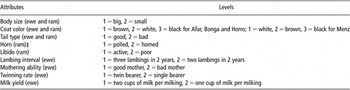
‡ Not used for Horro.
In this study, coat color was assumed as ordinal variable based on the survey results and thorough observations made in the areas. Color ranks within breeds were as follows: 1 = brown, 2 = white and 3 = black for Afar, Bonga and Horro; and 1 = white, 2 = brown and 3 = black for Menz. Black color is the least preferred color in all locations.
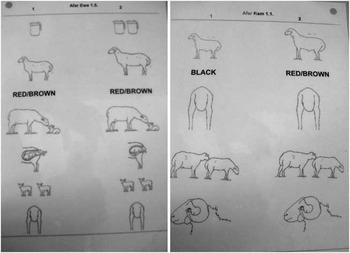
Considering the total number of attributes with either two or three levels, the design with the full factorial would result in combinations of 24 (23 * 31, i.e., three with two levels and one with three levels), 48 (24 * 31), 96 (25 * 31) and 192 (26 * 31) for the four, five, six and seven attributes used, respectively. Fractional factorial designs can be implemented to limit the total number of profiles in the analysis while still permitting the main effects and first-order interaction effects to be estimated independently. SAS macro MktEx (Kuhfeld, Reference Kuhfeld2005) was used to generate a fractional factorial design that resulted in a randomized selection of 48 sheep profiles (24 choice sets) for each sex, which were further grouped into four blocks with six choice sets each. Attributes and attribute levels were represented using carefully designed sketches or words as indicated in Figure 2.
Sample choice cards.

Surveys of the CE were conducted from May to September 2008. Data were collected from the 120 member households per location. The interviewee was introduced to the choice task using test cards (i.e. cards before factorial combinations are made where the alternative levels of attributes are separately listed for a given choice set) and then he/she was presented with a sequence of six choice sets for rams and ewes each using the actual experimental cards (i.e. cards after factorial combinations are made). A local languageof the respective community was used to administer the questionnaires. If neither of the alternatives was found satisfactory, there was an option of not choosing any of them (an opt-out option) in order to avoid forced choice.
Analytical methods
The application of CEs has its roots in the crucial hypothesis of Lancaster (Reference Lancaster1966), which states that goods possess or give rise to multiple characteristics in fixed proportions and that it is these characteristics, not goods per se, on which the consumer's preferences are exercised. According to the random utility model, an individual n facing a choice among j alternatives would obtain a certain level of utility or profit from each alternative (McFadden, Reference McFadden1974 and Reference McFadden2001). The utility that an individual n obtains from alternative j is Unj, where j = 1, … ,J. Utility can be decomposed into a part labeled Vnj, which is known to the investigator up to some parameters (representing the deterministic portion that depends on the attributes of the alternatives), and an unknown part labeled εnj, which is the stochastic or random term. Thus,

The logit model is obtained by assuming that each εnj is independently, identically distributed extreme values. The density for each unobserved component of utility is

In his Nobel lecture on microeconometric analysis of choice behavior of consumers, McFadden (Reference McFadden2001) indicated that consumers seek to maximize their self-interest. A logical extension of this idea entails that sheep breeders strive to maximize the productivity of their sheep by focusing on alternatives they perceive most important under the prevailing production circumstances. Thus, the probability that an individual n chooses alternative i over j can be expressed as

As εnj is unknown, the choice probability is the integral of Pni|εnj over all values of εnj weighted by its density f(εnj). Therefore,

Algebraic manipulation and rearrangement of this integral result in a closed-form expression, which is the logit choice probability:

Representative utility is usually specified to be linear-in-parameters: Vnj = β ’xnj where xnj is a vector of observed variables relating to alternative j. Then, the logit probabilities become

A sample of N decision makers is used for estimation, and as the logit probabilities take a closed form the traditional maximum likelihood procedures can be applied (Train, Reference Train2009). The probability that an individual n choosing the alternative s/he was actually seen choosing can be expressed as  , where yni = 1 if n chooses i and 0 otherwise. Assuming that each individual's choice is independent of other individuals, the probability of each person in the sample choosing the alternative is
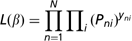
where β is a vector containing the parameters of the model. The log-likelihood function is then
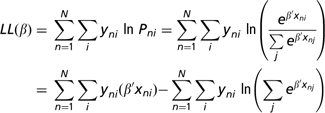
The estimator is the value of β that maximizes this function.
PROC LOGISTIC regression in Statistical Analysis System (SAS, 2002) was used to analyze the data. PROC LOGISTIC uses a cumulative logit function if it detects more than two levels of the dependent variable, which is appropriate for ordinal (ordered) dependent variables with three or more levels (Elkin, Reference Elkin2004).
Results
Stated trait preferences of smallholders
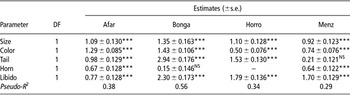
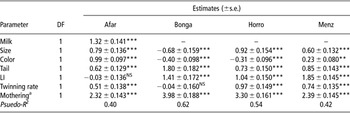
Analysis of the maximum likelihood estimates (MLE), along with their standard errors, and associated statistics are summarized in Tables 3 and 4 for rams and ewes, respectively. The pseudo-R 2 ranged from 0.29 to 0.56 for rams and 0.40 to 0.62 for ewes.
Maximum likelihood estimates (±s.e.) and their level of significance for ram traits

DF= degree of freedom.
*** = P < 0.001; NS = P > 0.05.
Maximum likelihood estimates (±s.e.) and their level of significance for ewe traits

DF= degree of freedom; LI = Lambing interval.
aMothering ability.
***P < 0.001; **P < 0.01; NS = P > 0.05.
The MLE of the parameters for rams exhibited the expected signs. The estimates were also significant (P < 0.001) with the exception of horn in Bonga and tail type in Menz sheep breeds. Libido was the most preferred attribute for breeding ram selection in Horro and Menz sheep breeds and the second most preferred trait in Bonga next to tail. In Afar, ram attributes influencing breeding candidates’ selection were color, body size, tail type and libido in that order. Tail type and color were the least preferred traits in choosing breeding rams in Menz and Horro sheep breeds, respectively.
Ram attribute preferences across the different production systems are heterogeneous as can be seen from Table 3. The first two attributes with higher utility values were coat color and body size in the pastoral/agro-pastoral community, tail and libido in the mixed crop-livestock system, and libido and body size in the sheep-barley system. The importance of body size, however, was evident across all systems with nearly comparable coefficients.
The MLE of the parameters for ewes were significant (P < 0.001) except lambing interval in Afar and twinning rate in Bonga. Attributes with unexpected signs were lambing interval in Afar; body size and twinning in Bonga; and color in Bonga and Horro ewes. In all breeds, mothering ability was the most preferred trait. The second important attribute for breeding ewe selection was milk yield in Afar, tail type in Bonga and lambing interval in Horro and Menz.
Comparison of trait-level preferences
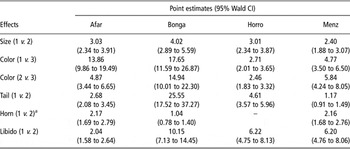
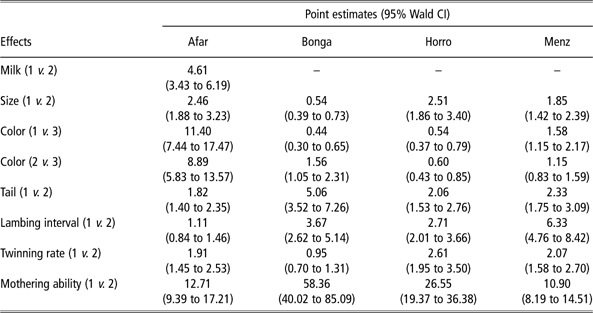
Tables 5 and 6 present results of ram and ewe attribute-level preferences of the communities. For both breeding rams and ewes, results are heterogeneous except for rams’ libido in Horro and Menz. The odds of choosing large v. small-sized rams ranged from 2.40 to 4.02. In the pastoral production system, due attention is given to coat colors of both breeding rams and ewes selection favoring brown and white colors over black. However, this attribute (with similar phenotype as that of Afar) was considered only in breeding rams selection in mixed crop-livestock and the sheep-barley systems giving less or no weight to color of breeding ewes. The attribute levels good tail type, brown/white color and active libido of rams appear to be exceptionally important in Bonga compared with the remaining attributes.
Odds ratio estimates of the different attribute levels against their reference categories and their confidence intervals for ram traits

CI = confidence interval.
Size (1 = big, 2 = small); color (1 = brown, 2 = white, 3 = black for Afar, Bonga and Horro; 1 = white, 2 = brown, 3 = black for Menz), tail (1 = good, 2 = bad); horn (1 = polled, 2 = horned); libido (1 = active, 2 = poor).
a2 v. 1 for Menz rams.
Odds ratio estimates of the different attribute levels against their reference categories and their CIs for ewe traits
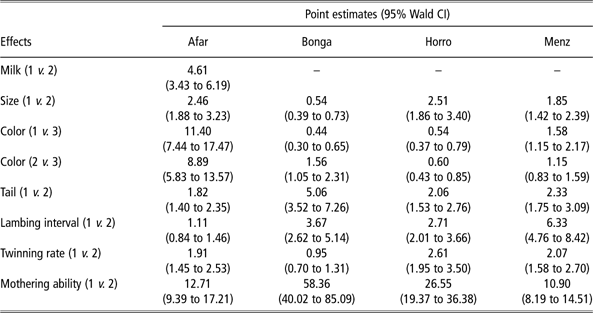
CI = confidence interval.
Milk (1 = two cups/milking, 2 = one cup/ milking); size (1 = big, 2 = small); color (1 = brown, 2 = white, 3 = black for Afar, Bonga and Horro; 1 = white, 2 = brown, 3 = black for Menz), tail (1 = good, 2 = bad); lambing interval (1 = three lambings/2 years, 2 = two lambings/2 years); twinning rate (1 = twin bearer, 2 = single bearer); mothering ability (1 = good mother, 2 = bad mother).
Polled rams are preferred to horned ones in pastoral/agro-pastoral and the mixed crop-livestock production systems and vice versa in the sheep-barley system. Relatively high milk-producing ewes had a chance of more than fourfolds of being preferred to the poor ones in Afar.
Large-sized ewes were more preferred than their counterparts in Afar, Horro and Menz sheep breeds but with less magnitude compared with rams. In Bonga, it appears that less emphasis was given to ewe body size as indicated by the odds of selecting large-sized ewes v. small ones. In contrast, as mentioned above, large-sized rams were highly favored than small ones (Table 6). Short lambing interval was given more weight in Bonga, Horro and Menz compared with long lambing interval, whereas twinning was favored in Afar, Horro and Menz.
Discussion
In the current study, the models’ overall explanatory powers are good with a pseudo-R 2 ranging from 0.29 to 0.56 for rams and 0.40 to 0.62 for ewes. Well-fitted models occur with likelihood ratio index or pseudo-R 2 greater than 0.2 (Hoyos, Reference Hoyos2010).
The importance of body size was evident for breeding ram selection across all systems, with nearly comparable coefficients indicating homogeneous preferences. It is intuitive that rams with a large body size are highly demanded on market for breeding, as well as meat, and hence command premium price. To our knowledge, similar studies are not available so far in sheep. However, high utility values for body size were reported from results of other discrete CEs conducted elsewhere (e.g. Kassie et al., Reference Kassie, Abdulai and Wollny2009 in cows in central Ethiopia; Zander and Drucker (Reference Zander and Drucker2008) for bulls in southern Ethiopia and bulls and cows in southern Ethiopia and northern Kenya; Ouma et al. (Reference Ouma, Abdulai and Drucker2007) for bulls and cows in central Ethiopia and northern Kenya; Omondi et al. (Reference Omondi, Baltenweck, Drucker, Obare and Zande2008a) for bucks in Kenya; and Roessler et al. (Reference Roessler, Drucker, Scarpa, Markemann, Lemke, Thuy and Valle-Zarate2008) for pigs in Vietnam). Therefore, sheep breeders in the production systems studied would undoubtedly benefit from incorporation of body size in any sheep genetic improvement schemes.
Results indicated that lambing interval in Afar, body size and twinning in Bonga and coat color in Bonga and Horro ewes had negative coefficients. A positive coefficient of MLE signifies that sheep keepers derive a positive utility from the attributes, whereas a negative coefficient signifies that they derive a negative utility from those attributes (Zander and Drucker, Reference Zander and Drucker2008). Lambing is usually synchronized with season of feed availability in the Afar pastoral/agro-pastoral system and it is quite logical that short lambing interval is less favored in selecting ewes for breeding. In this region, breeders manipulate the timing of birth of lambs (e.g. Getachew, Reference Getachew2008) by tying the prepuce of breeding ram so as to divert the penis during mating. It is also reported in the literature (Balasse et al., Reference Balasse, Smith, Ambrose and Leigh2003) that birth seasonality of an animal is an important element of pastoralists’ subsistence economies. Such controlled breeding normally results in longer lambing intervals than are found when breeding is allowed year round (Wilson, Reference Wilson1986). With regard to body size in Bonga ewes, although it might be difficult to provide concrete explanation, it may likely be that the respondents gave more weight to mothering ability. However, in the production systems study that preceded the current work, body size as a trait of ewes ranked first with a weighted index value of 0.28 (Edea, Reference Edea2008). The other important attribute for Bonga ewes was tail type, which they usually associate with beauty (physical attractiveness) and better body condition. For this purpose, farmers cut female lambs’ tail tip a week or two after birth with a hot sharp knife. Although twinning rate in Bonga exhibits a negative sign, the figure is close to zero and statistically non-significant. With regard to coat color in Bonga and Horro, the results are inconsistent with our expectations that brown or white coat color types are preferred to black as usually the latter is undesired on market (Ayele et al., Reference Ayele, Jabbar, Teklewold, Mulugeta and Kebede2006) and as revealed by the production systems study (Edea, Reference Edea2008). About 40% of the Bonga ewe population is of mixed coat colors (creamy white, white and black mixture, brown and white or brown and black or dark brown) and this might have undermined selection for solid coat color types. For Horro ewe population, about 85% was reported as uniform in coat color (brown, creamy white or tan), implying that coat color is not a constraint for the community. Respondents in both areas also argue that coat color is largely inherited from the sire and not from the ewe.
In the current study, high utility value was attached to mothering ability of ewes as evidenced from the MLE values ranging from 2.32 to 3.98 (Table 4). Moreover, the attribute had a pseudo-R 2 of 23%, 52%, 45% and 26% for Afar, Bonga, Horro and Menz sheep breeds, respectively, when fitted into the model alone. Ewe mothering ability as a trait represents a wide aspect like maternal behavior that allows proper bonding to take place between mother and offspring, nursing behavior, responsiveness and attentiveness towards the lambs, and protectiveness of the lambs from predators.
Horned rams are preferred to polled ones in the sheep-barley system and vice versa in the pastoral/agro-pastoral and the mixed crop-livestock production systems. In the sheep-barley system, presence, size and orientation of horns matter in the tradition of breeding ram selection. Big twisted horns that grow lateral, downwards and then slightly turned upwards are the most valued horn types. Rams with such horns are said to be graceful and have high market demand in Menz area.
Relatively high milk-producing ewes had a chance of more than fourfolds of being preferred to poor ones in Afar, indicating that the pastoral communities depend on livestock and livestock products, mainly milk, for their survival. In the Afar community, goat and sheep milk is frequently used for immediate consumption, especially for children and preparation of ‘hoja’, a traditional beverage made of dried coffee leaves or coffee haulms boiled with milk. Normally, ewes that produce milk that is sufficient only for the lambs are not considered worthy.
Short lambing interval was given more weight in Bonga, Horro and Menz, whereas twinning was favored in Afar, Horro and Menz. These two traits are important for reproduction provided they are accompanied with good mothering and management. The odds of choosing good mothers as opposed to bad mothers were conspicuously high in all four locations. It is evident that breeders in these areas attempt to combine reproductive traits as optimally as possible to maximize benefits from their sheep. However, in harsh environments like Afar (dry arid) and Menz (cool, tepid highland) where feed resources are scarce and highly variable both in quantity and quality among seasons and years, and where supplementing is not feasible, it is unlikely that genetic improvements in twinning rate would bring about benefits economically.
Using the results of this study and other studies, ICARDA, ILRI and BOKU in partnership with national and regional agricultural research systems in Ethiopia have designed alternative community-based sheep breeding plans for the four indigenous sheep breeds in their production environments that came into effect since May 2009 with the participation of eight communities in four different locations.
Acknowledgments
We are grateful to the communities of the different regions for the unreserved cooperation and support. Our heartfelt thanks go to the staff of Bako, Bonga, Debre-Berhan and Werer agricultural research centers for the support and collaboration. The study was financed by the Austrian Development Cooperation (ADA). Our heartfelt gratitude goes to Dr. Girma T. Kassie for his helpful comments and Dr. Luis Escareno for the carefully designed sketches of the different sheep breeds’ attributes.