Introduction
Coffee farms are located throughout tropical agriculture-forest mosaics within some of the world's most biodiverse regions. More than 10 million hectares are devoted to its production and the ways these human-dominated landscapes are managed may influence flora and fauna diversity, provision of ecosystem services, environmental health and human livelihoods on a large scale. Conservation ecologists are gaining more insight into the reciprocal relationship between landscape and farm-level influences. Not only can management decisions by coffee farmers impact the surrounding landscape, but in return, the way that adjacent lands are managed can impact coffee farms.
As one of the world's most valuable export commodities, employing more than 25 million people worldwide, coffee production is significant economically as well as ecologically (O'Brien and Kinnaird, Reference O'Brien and Kinnaird2003). Bee diversity and abundance can contribute to the success of coffee production (Roubik, Reference Roubik2002a; Ricketts, Reference Ricketts2004; Klein et al., Reference Klein, Vaissiere, Cane, Steffan-Dewenter, Cunningham, Kremen and Tscharntke2007). Arabica coffee (Coffea arabica), the species typically grown in Costa Rica and throughout Latin America, is self-pollinating but bee pollination can increase coffee yield by a range of 10–50% (Ricketts et al., Reference Ricketts, Daily, Ehrlich and Michener2004; Klein et al., Reference Klein, Vaissiere, Cane, Steffan-Dewenter, Cunningham, Kremen and Tscharntke2007; Bravo-Monroy et al., Reference Bravo-Monroy, Tzanopoulos and Potts2015). Furthermore, supporting a diversified pollinator community can help sustain provisions of pollinator services within the farm for both the coffee plants and native tree species (McCann, Reference McCann2000; Kremen et al., Reference Kremen, Williams and Thorp2002; Ricketts, Reference Ricketts2004; Jha and Vandermeer, Reference Jha and Vandermeer2010). It is therefore in the best interest of the farmers to cultivate a hospitable habitat to maintain abundant and diverse pollinators within their coffee farms.
Several factors related to farm management practices have been shown to have varying impacts on bee populations within farms. Generally, it has been shown that there is a positive relationship between pollinator diversity and coffee farms that are floristically diverse and structurally complex. Vergara and Badano (Reference Vergara and Badano2009) found richness and relative abundance of pollinator species to be highest on such coffee farms that also displayed low-impact management systems. Similarly, Jha and Vandermeer (Reference Jha and Vandermeer2010) found that tree richness and percent canopy cover are the most critical habitat variables positively affecting bee abundance and that flowering tree species richness is one of the most important factors in determining bee richness within coffee farms in Chiapas, Mexico. Bravo-Monroy et al. (Reference Bravo-Monroy, Tzanopoulos and Potts2015) also found that canopy cover has a positive effect on stingless bee richness, whereas shade tree density and variety of flowering tree species have a negative effect on pollinator richness. These studies indicate that there are a variety of factors that influence pollinator diversity, but the exact mechanisms are not consistent or yet fully understood.
Successful pollination of coffee crops also relies on landscape characteristics such as the quality of adjacent habitats and proximity to forest (Klein et al., Reference Klein, Steffan-Dewenter and Tscharntke2003a; Bravo-Monroy et al., Reference Bravo-Monroy, Tzanopoulos and Potts2015). Tropical forest fragments in close proximity to coffee farms enhance pollination activity at the farm level (e.g., Klein et al., Reference Klein, Steffan-Dewenter and Tscharntke2003a; DeMarco and Coelho, Reference DeMarco and Coelho2004; Ricketts, Reference Ricketts2004). Ricketts (Reference Ricketts2004) found that bee richness, visitation rates and pollen deposition were higher in coffee farms located <100 m from forest fragments compared with those further away. Bravo-Monroy et al. (Reference Bravo-Monroy, Tzanopoulos and Potts2015) found that close proximity to natural forest fragments enhanced pollinator activity in conventional farms. However, organic farms supported diverse pollinator communities regardless of distance to forest.
Studies have explored the relationship between coffee's proximity to forest and pollinator communities, while others have looked at farm level management effects on pollinators. However, few have examined the interaction between these two spatial scales. Our study aims to quantify the influence of both shade management and distance to contiguous forest on pollinator communities. We have three main objectives for this study: (1) understand the difference in pollinator diversity and abundance between shaded and sparsely-shaded management systems; (2) gain insight into the influence that proximity to forest has on pollinators within those systems; and (3) provide management practice recommendations to enhance pollinator diversity and abundance within coffee farms. We would expect to find higher pollinator diversity in shaded systems than unshaded systems; that pollinator diversity increases as distance to forest decreases; and that shaded systems closest to the forest would have the highest pollinator diversity, while unshaded systems furthest from forest would have the lowest.
Materials and Methods
Our study took place from February to April 2015 in the Coto Brus region of southern Costa Rica (8°54′N and 82°47′W) in the state of Puntarenas. This area lies near the edge of La Amistad National Park with contiguous moist premontane to alpine paramo forest in the Talamanca mountain range (Janzen, Reference Janzen1983). There has been a long history of agricultural land use in this region. The conversion of premontane forest to agriculture took place with European settlement in the 1960s (Brosi et al., Reference Brosi, Daily, Shih, Oviedo and Durán2008), although pollen records show indigenous people deforested the area and practiced agriculture 3000 years prior to that (Clement and Horn, Reference Clement and Horn2001). The surrounding area is now dominated by sun coffee monoculture plantations and cow pastures (Brosi et al., Reference Brosi, Daily, Shih, Oviedo and Durán2008).
Study sites
The study was conducted on a large Arabica coffee (Coffea arabica) farm that has been certified organic since the mid-1980s and is surrounded by protected contiguous tropical forest. The farm and reserve comprises more than 23,500 acres with 95% natural forest reserve and 5% coffee production dispersed in patches throughout the reserve (personal communication, farm owner). Management regimes are consistent throughout the farm in terms of agrochemical use, pest management and weed control. However shade levels, which are managed by pruning shade trees, vary throughout the farm. We chose this site to block for impacts related to agrochemicals as well as to isolate the shade management techniques and landscape parameters.
We selected eighteen 10 × 10 m2 sites, with nine in the shaded portion of the farm (mean canopy cover 54 ± 8%) and nine in the sparsely shaded or sun portion (mean canopy cover 14 ± 4%). The treatments (shade versus sun) were located approximately 780 m from one another. Each treatment had three replicate ‘semi-transects’, which were arranged in the following distance classes relative to the forest: 0, 50 and 150 m from forest edge. All sites were located at least 50 m apart with a mean distance between sites of 73 ± 10 m. Tree diversity throughout the farm is similar and both shade and sun sites were surrounded by tropical forest on three sides. No honey bees (Apis mellifera) are managed on the farm but feral honey bees are abundant in the area (Butz Huryn, Reference Butz Huryn1997; Roubik, Reference Roubik2002a).
Bee sampling
We observed 36 plants per day for bee activity between 0800 and 1400 during peak bloom for 3 days in all 18 sites. Sampling order for each site was shuffled daily and all sites were surveyed three times once in the early morning, once in mid-morning and once in the afternoon. In each site, we randomly selected areas of coffee plants with approximately 100 flowers (average flowers observed 117 per plant) and recorded bee activity for 15 min (see Kearns and Inouye, Reference Kearns and Inouye1993; Ricketts, Reference Ricketts2004). We conducted observations on two plants in each site simultaneously and counts were pooled for analysis. We recorded the number of bees, number of flower visits and noted if the visitor was a honey bee. A ‘visit’ was defined as a bee landing on the flower, collecting resources and contacting the reproductive parts of the flower. After each observation period, bees were caught by sweep netting inside the plot for 5 min for species identification. Bees were also collected in elevated white pan traps placed in the center of each plot for the duration of peak bloom and checked daily. Bees were identified to the finest taxonomic level possible by Dr Paul Hanson, University of Costa Rica, San Jose.
Environmental characteristics
For each observation and collection period, we recorded five variables that could affect bee activity: time of day, percent sun (percentage of full sun as opposed to cloud or haze cover), temperature, wind speed and relative humidity. Additionally, the floral density of coffee plants, weeds and trees in flower within the 100 m2 site was rated on a scale from zero (no flowers) to five (all plants in full flower).
Habitat characteristics
The vegetation at each site was measured for habitat characteristics that could influence bee composition and activity. We measured the percent canopy cover of the shade trees with a convex spherical densiometer. We counted all coffee plants within each site and measured the height for a random subset of 10. We identified each tree species and measured the height using ocular estimation. We used two 10-m line intercepts to categorize the sub-canopy structure at each site. At each decimeter, we recorded the presence of vegetation at three levels: mid-strata defined as understory plants and shrubs >1 m tall; lower strata defined as weeds, grasses, other herbaceous plants and understory shrubs from 5 cm to <1 m tall; and ground cover defined as grasses and weeds <5 cm tall. We recorded basal area of shade trees using a 10 factor wedge prism. We noted the geographic coordinates, elevation and habitat type for each site.
Data analysis
Analysis of variance (ANOVA) models
We used ANOVA models to determine any significant differences in the means of the dependent variables (bee abundance (overall, native and honey bee), diversity and visitation frequency (overall, native and honey bee)) per site with respect to the treatment levels of shade and sun coffee and separately the distance categories of 0, 50 and 150 m from forest edge. Data were transformed using ln(x) or x 2 as required to meet the conditions of normality. Multiple comparisons were assessed with Fisher's Protected Least Square Difference (Cramer and Swanson, Reference Cramer and Swanson1973).
Regression models
We used Poisson log-linear regression models to determine the effects of the measured habitat and environmental characteristics on the observed bee abundance and activity. All independent variables were included in each model and those shown not to be significant were removed one at a time by backwards elimination. We examined variance inflation factors for each independent variable but there was no evidence of multicollinearity. Overdispersion in the data was adjusted by scaling for deviance. We used SAS Statistical Software version 9.3 (SAS Institute, 2010) for all statistical analyses.
The dataset for the Poisson regression models was created from averaged or pooled data from the observations per site (n = 18). Dependent variables were bee abundance and visitation frequency for all bees together, only native bees and only honey bees. The independent variables for this dataset were the measured habitat characteristics and the average floral density as follows: ground cover, lower strata, mid-strata strata, percent canopy cover, shade tree basal area, shade tree species richness, shade tree density, tree height, coffee plant height, coffee plant density and density of coffee, weed and tree flowers. We also examined the diversity of bees per site calculated as the Shannon index of diversity.
Community metrics
We created individual-based abundance data per shade category and distance class to develop rarefaction accumulation curves to compare species richness among these categories using EstimateS Version 9.1.0 (Colwell, Reference Colwell2013). The accumulation curves were extrapolated to the highest number of individuals in each treatment. The values of the estimated species richness with 95% confidence intervals were plotted for the curves. We calculated the Morisita-Horn index of similarity also with EstimateS to assess the species composition across treatment categories.
Results
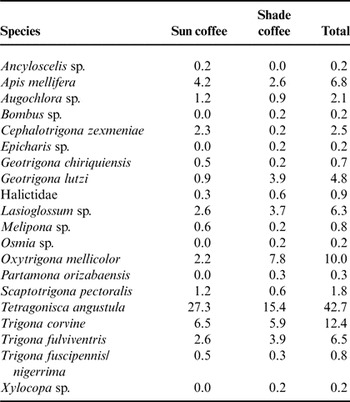
For all sites combined, we captured a total of 645 individuals representing at least 20 species and 17 genera (Table 1). The mean bee abundance per site was 35.8 ± 5.9 (SE) with a mean native bee abundance of 33.5 ± 5.9. Bee visitation frequency per site was 183.8 ± 20.8. Coffee plant height was consistent throughout the farm with a mean of 2 ± 0.05 m and mean shade tree canopy cover of 34 ± 6.5% for the shade and sun sites combined (Table 2). The majority of our captures were native bees at 93% of all individuals. Eighty-three percent of captures were stingless bees, 10% carpenter and other solitary bees, 7% honey bees and <1% bumble bees. The most abundant species trapped was Tetragonisca angustula with 43% of all captures. Native bees had higher overall visitation rates, with honey bees accounting for 14% of all pollinator visitations.
Percent of total abundance of bee species captured in 2015 pollinator study in sun and shade coffee sites in a large organic coffee farm surrounded by forest in southern Costa Rica.

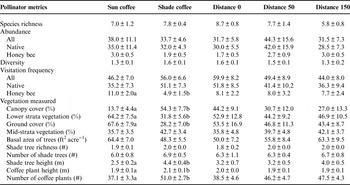
Average pollinator metrics and vegetation measurements (±SE) per site within habitat types of sun and shade coffee and of distance to forest edge at 0, 50 and 150 m from 2015 pollinator study in a large organic farm in southern Costa Rica.

Letters indicate significant difference (P ≤ 0.05) of median of vegetation measurements between habitat categories per Fisher's Protected LSD test of multiple comparisons.
ANOVA models
We examined the difference in means among the treatment categories for bee abundance (overall, native and honey bee), diversity and visitation frequency (overall, native and honey bee) per site using ANOVA after the data were transformed to normal (Table 2). We found no significant differences with proximity to forest for these dependent variables (distance ranging from 0 to 150 m from forest edge). The only variable found to be significantly different between sun and shade habitats was the visitation frequency of honey bees, which was higher in the sun sites than the shade sites (F = 6.15; P = 0.025). However, when we examined the distances within shade sites and the sun sites separately, we found that there was significantly higher bee diversity in sun coffee sites at the forest edge compared with sites 50 and 150 m away from the forest, whereas there were no such differences in the shaded sites (F = 4.21; P = 0.019). In fact, the sun sites at the forest edge were not significantly different than the shade sites at each distance category in terms of bee diversity found there. No significant differences were found among treatment categories for abundance and visitation frequency variables.
From examination of the measured vegetation characteristics, we found that the sun sites had significantly higher amounts of low vegetation cover (<1 m) (F = 13.05; P = 0.002) and herbaceous ground cover (<5 cm) (F = 15.40; P = 0.001) than the shaded sites. Additionally, the shaded sites were significantly higher than the sun sites in the following vegetation characteristics measured: shade tree height (F = 24.25; P < 0.001), coffee plant height (F = 7.96; P = 0.012), number of coffee plants (F = 10.02; P = 0.006) and canopy cover (F = 23.81; P < 0.001). There were no significant differences among the vegetation variables for the distance categories.
Regression models
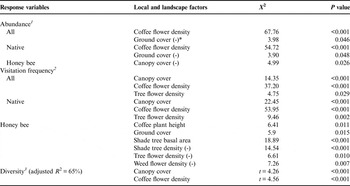
We used log-linear Poisson models to examine the relationship between the dependent bee variables (bee abundance and visitation frequency for all bees, native bees only and honey bees only) with the measured habitat per site (n = 18) (Tables 3 and 4). Overall and native bee abundance were both higher in sites with greater proportions of coffee flowers (overall: X 2 = 67.76, P < 0.001; native: Χ 2 = 54.72, P < 0.001) and lower amounts of ground cover (overall: Χ 2 = 3.98, P = 0.046; native: Χ 2 = 3.90, P = 0.048), while the abundance of honey bees was higher in sites with less canopy cover (Χ 2 = 4.99, P = 0.026). Both overall and native bee visitation frequency increased in sites with higher amounts of canopy cover (overall: Χ 2 = 14.35, P < 0.001; native: Χ 2 = 22.45, P < 0.001) and greater proportions of both coffee (overall: Χ 2 = 37.20, P < 0.001; native: Χ 2 = 53.95, P < 0.001) and tree flowers (overall: Χ 2 = 4.75, P = 0.029; native: Χ 2 = 9.46, P = 0.002). Honey bee visitation frequency was higher in sites with greater amounts of ground cover (Χ 2 = 5.90, P = 0.015) and shade tree basal area (Χ 2 = 18.89, P < 0.001), taller coffee plants (Χ 2 = 6.41, P = 0.011), lower density of shade trees (Χ 2 = 14.54, P < 0.001) and lower proportions of weed (Χ 2 = 7.26, P = 0.007) and tree flowers (Χ 2 = 6.61, P = 0.010). We examined bee diversity per site using linear regression models and found that diversity was higher in sites again with greater amounts of canopy cover (t = 4.26, P < 0.001) and greater proportions of coffee flowers (t = 4.56, P < 0.001).
Results of regression analysis for dependent variables of abundance, visitation frequency and diversity of bee pollinators and the independent variables of the measured habitat characteristics and floral density within each site from 2015 pollinator study on a coffee farm in southern Costa Rica.

1 Defined as number of individuals captured per site.
2 Defined as number of flower visitations observed per 100 flowers.
3 Shannon index of diversity.
* (-) denotes a negative relationship.
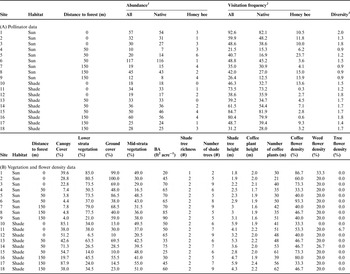
Data collected on 18 sun and shade coffee sites for (A) abundance, visitation frequency and diversity of bee pollinators and (B) measured habitat characteristics and floral density from 2015 pollinator study on a coffee farm in southern Costa Rica.

1 Defined as number of individuals captured per site.
2 Defined as number of flower visitations observed per 100 flowers.
3 Shannon index of diversity.
Community metrics
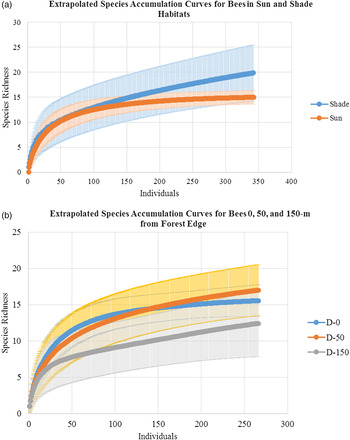
The species composition was highly similar across all treatment levels. Eighty-seven percent of species were shared between sun and shade categories according to the Morisita-Horn similarity index. For the distance categories, the Morisita-Horn similarity indices are as follows: 91% for 0 and 50 m from forest edge, 89% for 0 and 150 m from the forest, and 95% for 50 and 150 m from forest. Examination of the extrapolated richness curves for each of these treatments confirms this finding (Fig. 1) as there was no significant difference between the species richness for the sun and shade treatments, nor any of the distance categories. We calculated both the estimated species richness and the Chao1 richness estimator for comparison and both yielded the same results.
Species accumulation curves with 95% confidence intervals for bee pollinators within habitat types of sun coffee and shade coffee (a) and for proximity to forest at 0, 50 and 150 m (b) for the 2015 pollinator study on a large organic farm in southern Costa Rica.

Discussion
This study aimed to quantify both the landscape and plot-level influences on pollinator diversity within coffee farms. Overall, pollinator diversity and activity were neither significantly different between the shade management types nor among the sites 0, 50 or 150 m from the forest edge, contrary to our original expectations. Pollinator diversity, however, did vary with proximity to forest within the sun sites. When we examined the distance classes within each shade treatment separately, we found that pollinator diversity was highest at sun coffee sites near forest (0 m) compared with further sun sites, whereas shade coffee treatments showed no differences in diversity with regard to forest proximity. In fact, bee diversity at the sun coffee sites closest to the forest edge was not significantly different than that of any of the shade sites. This same trend was also reflected in the visitation frequency, although it was not statistically significant due to high variability in the data. The shaded area of the farm may have provided resources for pollinators regardless of proximity to forest edge, whereas pollinators preferred sites near the forest edge within the sparsely shaded sections of the farm, which may not have provided the same quality of resources as the shaded sites.
Unlike similar studies conducted on coffee farms, native bees dominated the composition of pollinators within sites on this farm. Honey bees were present at our sites but their abundance and visitation frequency were low relative to native bees. Honey bees comprised only 7% of individuals captured and the observed honey bee visitation frequency made up 14% of total observations. In contrast, many coffee studies report that honey bees dominate pollinator composition and visitation activity. Veddeler et al. (Reference Veddeler, Olschewski, Tscharntke and Klein2008) found that honeybees accounted for more than 40% of all individual on a farm where fertilizers and agrochemicals were not applied. Honey bees accounted for almost 75% of total bee observations and 82% of bees on flowers in a study conducted in Panama near our study site (Roubik, Reference Roubik, Kevan and Imperatriz Fonseca2002b). Vergara and Badano (Reference Vergara and Badano2009) also found that honeybees accounted for more than 80% of pollinator assemblages in their study. The high percentage of native bees in our study may be due to both the proximity and configuration of the native forest surrounding the farm as well as the organic management of the farm. Bravo-Monroy et al. (Reference Bravo-Monroy, Tzanopoulos and Potts2015) had similar findings that support this hypothesis. They found that honey bee abundance increased with a greater distance from forest (85 m away) and that conventional farms had higher visitation rates of honey bees, whereas organic farms had a higher richness of stingless bees. Ricketts (Reference Ricketts2004) found honey bees to be the predominant pollinator for sites farther than 300 m from native forest, while native bees were more abundant in sites near forest patches.
Maintaining a diverse population of bees within agriculture may stabilize long-term pollination services by buffering against declines in single species and ultimately increasing coffee yields (McCann, Reference McCann2000; Kremen et al., Reference Kremen, Williams and Thorp2002; Ricketts, Reference Ricketts2004). Klein et al. (Reference Klein, Steffan-Dewenter and Tscharntke2003b) stress the importance of a diverse bee community for the pollination success of coffee as bee diversity has been linked to increased fruit sets for Arabica coffee. Native bees may be particularly important for coffee pollination because they have higher cross-pollination rates than honey bees based on their foraging behaviors and can deposit higher amounts of pollen than honey bees (Ricketts et al., Reference Ricketts, Daily, Ehrlich and Michener2004). Klein et al. (Reference Klein, Steffan-Dewenter and Tscharntke2003c) also found that cross pollination leads to a higher fruit set compared with spontaneously self-pollinating flowers. Additionally, Jha and Vandermeer (Reference Jha and Vandermeer2010) found that native bees provide essential pollination services for native tropical trees that may be found on coffee farms.
Farm management such as agrochemical use and shade management has been shown to play an important role in supporting pollinator communities. Intensive agriculture may reduce the diversity and abundance of native bees and isolate pollinators from critical floral and nesting resources (Kremen et al., Reference Kremen, Williams and Thorp2002). While our study did not find significant differences between the sparsely shaded and shade sites overall, we did find that vegetation structure within the coffee farm is significantly associated with pollinator communities. Greater amounts of coffee flowers within each site increased bee abundance and flower visitation frequency, which is consistent with findings from Klein et al. (Reference Klein, Steffan-Dewenter and Tscharntke2003a). Less ground cover in sites is also associated with higher bee abundance, possibly due to the preference of ground nesting bees for open soil as nest sites (Cane, Reference Cane1991). Sites with more trees in flower and greater amounts of shade cover were found to have increased pollinator activity and diversity. These findings are consistent with other studies that have measured specific vegetation characteristics within coffee farms (i.e., Klein et al., Reference Klein, Steffan-Dewenter and Tscharntke2003a; Jha and Vandermeer, Reference Jha and Vandermeer2010; Bravo-Monroy et al., Reference Bravo-Monroy, Tzanopoulos and Potts2015). In addition to shade cover and number of trees in flower, Jha and Vandermeer (Reference Jha and Vandermeer2010) also found that tree species richness was positively associated with abundance and species richness of pollinators. It should be noted that our study site had little variation in tree species richness, therefore it is not surprising that this variable was not significant in our statistical models.
There are varying results pertaining to the influence of proximity of native forest on pollinator communities from landscape level studies conducted within coffee farms. Ricketts (Reference Ricketts2004) found that bee species richness, overall visitation rates and pollen deposition rates were higher in coffee sites closer to forest. Klein et al. (Reference Klein, Steffan-Dewenter and Tscharntke2003a) found the same for pollinator diversity of social bees near forest. Ricketts noted that it is important to maintain native habitat, particularly for native bees that may be constrained by limited foraging ranges. Jha and Vandermeer (Reference Jha and Vandermeer2010) and Vergara and Badano (Reference Vergara and Badano2009), however, did not find that proximity to forest played a role in pollinator diversity. However it should be noted that the sites in Jha and Vandermeer's study had a high level of tree species richness (11.5–18 tree species per ha) that may have provided sufficient in-farm resources. While other studies such as ours have mixed results, Briggs et al. (Reference Briggs, Perfecto and Brosi2013) found that euglossine bee abundance was higher near forests, but species richness and community composition did not change with distance to forest. Bravo-Monroy et al. (Reference Bravo-Monroy, Tzanopoulos and Potts2015) found that honey bees were less abundant near forests while stingless bee richness and visitation frequency increased near forest. While there is no doubt that preserving native forests within coffee landscapes is important for habitat conservation, there may be confounding factors within these studies that impact the results such as land use history, farm-level management, local species composition and pollinator variables measured.
Our study design allowed us to gain insights into the interactions of both proximity to forest and coffee management techniques and showed the importance of taking into account farm level and landscape parameters in coffee agroforestry. Based on our results, we suggest that coffee farmers include flowering shade trees that provide high levels of canopy cover to increase pollinator activity and diversity within their farms. We also recommend maintaining or re-establishing forested areas within or surrounding coffee farms, which could be particularly important for farms with sparsely-shaded crops.
As this study compared sites within organic coffee, future work could include coffee farms that are managed conventionally (i.e., chemical inputs) to compare with organically managed farms, keeping vegetation structure within management types constant. Future studies could also incorporate sites with higher degrees of shade tree diversity as tree diversity was similar throughout our study site. Longer term studies would also be beneficial as pollinator communities may vary with time. Finally, the configuration of our study site only allowed for the furthest distance from forest is 150 m away; studies with similar treatments that could accommodate further distances from forests could also be instrumental in elucidating the farm level and landscape characteristics that influence pollinator communities within coffee landscapes.
Diverse pollinator communities in coffee landscapes provide important pollination services. The maintenance of native habitats adjacent to farms and resources within coffee farms may foster increased coffee yields and longevity of pollination services provided by diverse bee communities. However, more research that examines the pollination success and resulting fruit set from native and non-native bees within coffee is needed. We hope that this study provides further insight into the factors that influence pollinators and how best to support the local pollinator communities in coffee landscapes.
Acknowledgements
We would like to thank Roberto Montero Zeledón for his participation in the study and allowing us access to his farm and Finca La Amistad staff for their support and assistance during the study. This study would not have been possible without the hard work of the field assistants: Julia Brokaw, Dejeanne Doublet and Kristian Moore. We would like to thank Dr Paul Hanson for identifying the specimens at his laboratory. Additionally, we would like to thank the anonyms reviewers for their valuable comments. SAC received financial support from the Smithsonian Migratory Bird Center.