Introduction
Globally, depressive disorders affect ~5% of the population.Reference Ferrari, Somerville and Baxter 1 The burden of depression on individuals, societies and health systems is staggering. Depressive disorders are one of the leading causes of disability adjusted life years and years of life lost due to premature mortality.Reference Ferrari, Charlson and Norman 2 , Reference Ferrari, Charlson and Norman 3 Further, depression is a significant contributor to the global burden of mental illness, one that is estimated to result in a $16 trillion loss in global gross domestic product over the next 20 years.Reference Whiteford, Degenhardt and Rehm 4 , Reference Bloom, Cafiero and Jané-Llopis 5 As such, there is a need to examine early factors that mitigate risk, improve course of illness and reduce healthcare costs.Reference Andrade, Caraveo-Anduaga and Berglund 6 , Reference Kessler, Berglund and Demler 7 Research in general population samples suggests that better cognitive functioning during childhood may serve as a protective factor, reducing the risk of mood and anxiety disorders in adult life.Reference Barnett, McDougall and Xu 8 – Reference Zammit, Allebeck and David 14 Cognitive abilities include overall intelligence, commonly measured as intelligence quotient (IQ); fluid intelligence, encompassing processing, problem-solving and abstract reasoning abilities; and verbal intelligence, including language comprehension.Reference Deary and Batty 11
In these general population samples, it has been estimated that for every standard deviation increase (i.e. 15 points) in IQ, the odds of developing depression decreases by ~20%.Reference Koenen, Moffitt and Roberts 10 This area of epidemiological research suggests that more cognitive reserve, marked by superior cognitive functioning and performance, may decrease susceptibility to later psychopathology.Reference Koenen, Moffitt and Roberts 10 , Reference Stern 15 Cognitive reserve may be protective against mental disorders via biological pathways, influenced by genetics and physiological integrity; social pathways, via safe familial environment, early socioeconomic advantage and educational attainment; and behavioural pathways through the consequences of good health choices.Reference Deary and Batty 11 , Reference Stern 15
However, most studies that have examined associations between early cognition and adult psychopathology rely on IQ as the primary indicator of cognitive ability, even though overall intelligence may mask dysfunction in other, more specific cognitive areas that could influence the onset of psychiatric disorders.Reference Aylward 16 , Reference Margolis, Bansal and Hao 17 As well, a number of studies have relied on male-only samples of military conscripts, and few prospective, population-based cohorts exist to study these links.Reference Koenen, Moffitt and Roberts 10 Due to their retrospective nature, work in this area typically uses hospital records to define depression, which introduces a selection bias toward inclusion of the small sub-sample of individuals with the most severe forms of depression. Lastly, the majority of the literature to date has only focused on general population samples; comprehensively studying the influence of childhood cognition in less typically developing and more vulnerable populations provides an opportunity to determine how early biology, social circumstance and health behaviours may be protective against depression onset and improve course of illness.
Every year, ~10% of all infants are born preterm or at low birth weight, known risk factors for developing depression later in life.Reference Wolke, Strauss and Johnson 18 Advances in neonatal care have increased survival rates among those born at extremely low birth weight (ELBW, <1000 g), the birth weight group most at-risk for psychiatric disorders.Reference Van Lieshout, Boyle, Saigal, Morrison and Schmidt 19 It is well established that ELBW survivors suffer from poorer childhood cognitive abilities than their normal birth weight (NBW) counterparts (⩾2500 g);Reference Baron and Rey-Casserly 20 – Reference Johnson, Hennessy and Smith 22 however, it is unclear if ELBW individuals also benefit from the protective effects of cognitive reserve as this has never been studied. Accordingly, we examined the influence of cognition at age 8 on the development of depression in Canadian ELBW survivors and NBW comparison participants up to the fourth decade of life. It was hypothesized that given their exposure to significant perinatal adversity, ELBW survivors would not benefit from the protective influence of cognitive reserve and that greater childhood cognitive ability would not protect against major depression in this group.
Method
Participants
The studied cohort was comprised of primarily Caucasian ELBW survivors and NBW individuals born between 1977 and 1982 in central west Ontario, Canada. In total, 397 ELBW infants were recruited at birth, with 179 infants surviving to hospital discharge. The ELBW group had longitudinal assessments of physical, mental and social health outcomes at ages 3, 5, 8, 14, 22–26 and 29–36 years. Ten additional children subsequently died, resulting in 169 survivors at 8 years of age. At 8 years of age, 143 of the 169 ELBW survivors participated in data collection, which included the assessment of cognitive skills. At 22–26 years of age, 142 survivors participated in data collection and were eligible to participate in the current adult sweep (age 29–36 years). In all, 84 of the 142 ELBW participants (59.2%) participated in the current data sweep and provided information on depression risk. Six eligible ELBW individuals refused to partake in the current assessment and the remaining non-participants could not be contacted or were unable to attend the psychiatric diagnostic interview.
At 8 years of age, 145 NBW individuals matched for age, sex and parental socioeconomic status (SES) were recruited from a random sample of students in the Hamilton Ontario Public School System. These comparison participants have also been followed at ages 14, 22–26 and 29–36 years. At 22–26 years of age, 133 NBW individuals participated in data collection and were eligible. Of these 133 NBW individuals, 90 (67.7%) participated in the current (29–36-year old) assessment and provided information on lifetime depression risk. Nine eligible NBW individuals refused to participate in the current assessment and the remaining non-participants could not be contacted or were unable to attend. Written informed consent was received from all participants in adulthood and from their parents during childhood assessments.
Assessment of childhood cognition
At 8 years of age, cognition was assessed using the Wechsler Intelligence Scale for Children, Revised (WISC-R), Raven’s Coloured Progressive Matrices and the Token Test. These tests were selected as they measure general, fluid and verbal intelligence, respectively, and have been validated in children. Details on assessment procedures in the cohort have been described previously.Reference Saigal, Szatmari, Rosenbaum, Campbell and King 23
The WISC-R consists of ten subtests, each with a mean of 10 and s.d. of 3. Combining these subtests creates Performance IQ, an assessment of fluid intelligence evaluating visuospatial abilities, alertness to detail and processing speed; and Verbal IQ, an assessment of verbal intelligence. These two IQ scores are then combined to calculate Full-Scale IQ (mean 100 and s.d. of 15), an assessment of overall intelligence.Reference Wechsler 24
Raven’s Coloured Progressive Matrices is a test of fluid intelligence and problem-solving abilities that assesses non-verbal reasoning, visuospatial abilities and information recall in children ages 5–11.Reference Raven 25 The test consists of 36 questions asking the child to select a pattern which completes a picture. The test consists of three sets of 12 questions, increasing in difficulty.Reference Raven 26
The Token Test is a measure of receptive language ability. This test consists of tokens in different colours, shapes and sizes, in which the child is instructed to touch the appropriate token. The test consists of 62 questions, divided into five sections that increase in difficulty with a mean of 500 and s.d. of 5.Reference DiSimoni 27
Assessment of lifetime major depressive disorder
Lifetime major depressive disorder was assessed at age 29–36 years using the Mini International Neuropsychiatric Interview (MINI), a validated structured psychiatric diagnostic interview.Reference Sheehan, Lecrubier and Sheehan 28 The psychiatric assessment provided by the MINI aligns with the Diagnostic and Statistical Manual of Mental Disorders, Fourth Edition and the International Classification of Diseases, 10th Revision. Each participant was interviewed privately in a room within the Psychology Department at McMaster University. The MINI was administered by two trained graduate student interviewers blind to participant birth weight status.
Covariates
Variables known to be associated with poor cognitive function, low birth weight, adult depression and attrition of participants were included in statistical models. These variables included childhood SES, educational attainment, age, sex and marital status.Reference Batty, Mortensen and Osler 13 , Reference Van Lieshout, Boyle, Saigal, Morrison and Schmidt 19 , Reference Thompson, Syddall and Rodin 29 Childhood SES was assessed using Hollingshead’s classification criteria and self-reported by participants’ parents at 8 years of age. At the current assessment, educational attainment was assessed via self-report and calculated by summing the years of education each cohort member had successfully completed up to the time of testing. Marital status was also self-reported by participants at the 29–36-year old sweep and was defined as those who were married or living common-law with a partner v. those who were not.
Statistical analysis
All data analyses were performed using IBM SPSS version 20. Descriptive statistics of ELBW and NBW groups including cognitive measures and depression prevalence were computed and compared using χ2 and independent sample t-tests.
Given their exposure to significant perinatal adversity, we expected that ELBW survivors would be less protected by their cognitive abilities, and so decided a priori to analyze data separately for ELBW and NBW groups. Using logistic regression stratified by birth weight, we examined whether each cognitive measure at age 8 predicted major depressive disorder at age 29–36 years. Cognitive predictors were defined as each standard deviation increase in Full-Scale IQ, Performance IQ and Verbal IQ, and each one point increase on Raven’s percentile and Token score, as this is how these tests are commonly reported in literature.Reference Koenen, Moffitt and Roberts 10 , Reference Raven 25 , Reference Paradiso, Hermann, Blumer, Davies and Robinson 30 Lastly, logistic regressions were then adjusted for all covariates previously mentioned. We examined our findings for those with complete data and also performed a multiple imputation analysis to account for missing covariate data. As no significant differences in results were seen in multiple imputation regressions, we report results only for participants with complete data. Results from logistic regressions are presented with odds ratios (OR) and 95% confidence intervals (CIs). All statistical tests were two-tailed with a 0.05 significance level.
Results
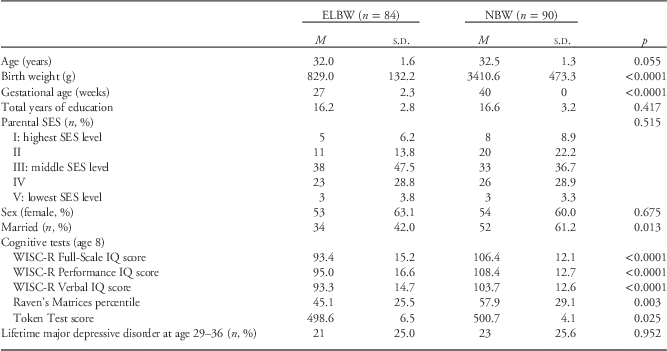
The characteristics of the 84 ELBW survivors and 90 NBW participants can be found in Table 1. The average age of both groups was ~32 years. Birth weight (P<0.0001) and the number of participants that were married or in common-law relationships (P=0.01) was greater in the NBW group. No differences were seen between the ELBW and NBW participants in their educational attainment, childhood SES or sex. The ELBW participants scored significantly lower on all cognitive tests in childhood compared with the NBW participants at age 8. In total, 21 of the ELBW survivors and 23 of the NBW participants met diagnostic criteria for lifetime major depressive disorder as per the MINI (P=0.95).
Participant characteristics

ELBW, extremely low birth weight; NBW, normal birth weight; SES, socioeconomic status; WISC-R, Wechsler Scale for Children-Revised; IQ, intelligence quotient.
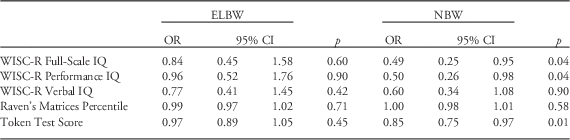
Table 2 highlights the results of unadjusted associations between childhood cognitive test scores and lifetime major depressive disorder in both the ELBW and NBW groups. In unadjusted models, no childhood cognitive measure was associated with lifetime major depressive disorder in the ELBW survivors. However, among the NBW individuals, for every standard deviation increase in WISC-R Full-Scale IQ, the odds of having a lifetime major depressive episode was reduced by 51% (95% CI=0.25–0.95). This was nearly identical for WISC-R Performance IQ score (OR=0.50, 95% CI=0.26–0.98). Moreover, for every one point increase on the Token Test, the odds of developing depression in the NBW group decreased by 18% (95% CI=0.75–0.97). The WISC-R Verbal IQ and Raven’s Matrices score were not significant predictors of lifetime depression.
Unadjusted odds ratios (OR) between childhood cognitive function and lifetime depression at 29–36 years of age in extremely low birth weight (ELBW) survivors and normal birth weight (NBW) individuals

WISC-R, Wechsler Scale for Children-Revised; IQ, intelligence quotient.
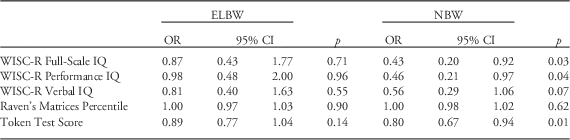
After adjustment for childhood SES, educational attainment, sex, age and marital status, no childhood cognitive measure was associated with the presence of a lifetime major depressive episode in the ELBW survivors (Table 3). However, the odds of developing depression were 57% less for every standard deviation increase in overall IQ in the NBW cohort (95% CI=0.20–0.92). A similar trend persisted for the WISC-R Performance IQ (OR=0.46, 95% CI=0.21–0.97). The association between the Token Test score and later depression remained in fully adjusted models, in that every point increase on the Token Test was associated with an approximate decrease of 25% in the odds of lifetime major depression (95% CI=0.67–0.94).
AdjustedFootnote a odds ratios (OR) between childhood cognitive function and lifetime depression at 29–36 years of age in extremely low birth weight (ELBW) survivors and normal birth weight (NBW) individuals

WISC-R, Wechsler Scale for Children-Revised; IQ, intelligence quotient.
a Estimates adjusted for parental socioeconomic status, educational attainment, sex, age, and marital status.
Discussion
As depression is one of the most common mental disorders and greatly affects individual functioning and quality of life, there is a need to examine early factors that might mitigate risk, improve course of illness and reduce healthcare costs in populations known to be at increased risk for mood disorders. This is the first study to examine the influence of childhood cognition on the lifetime risk of major depression in ELBW survivors through the fourth decade of life. Data supported our hypothesis that better childhood cognitive function was not protective against depression in the ELBW survivors. In the NBW comparison group, our results suggest that better cognitive functioning in childhood is associated with reduced depression risk. Specifically, every standard deviation increase in overall intelligence (as measured by the WISC-R Full-Scale IQ), and in fluid intelligence (as measured by the WISC-R Performance Scale) at 8 years old was associated with 57% and 54% reductions in the odds of lifetime depression. Lastly, receptive language ability defined as a one point increase on the Token Test was associated with a 25% reduction in the odds of lifetime depression. These findings persisted despite adjustment for confounding variables.
Comparison with other studies
Our results support previous work that has shown that individuals born at NBW with greater childhood cognitive abilities are less susceptible to depression later in life.Reference Barnett, McDougall and Xu 8 – Reference Koenen, Moffitt and Roberts 10 , Reference Hatch, Jones and Kuh 12 – Reference Zammit, Allebeck and David 14 Indeed, data from a large general population sample born in New Zealand in the early 1970s showed that every standard deviation increase in overall intelligence was associated with roughly a 20% reduction in the odds of developing depression.Reference Koenen, Moffitt and Roberts 10 Moreover, Zammit et al.Reference Zammit, Allebeck and David 14 showed that a 1 s.d. increase in general IQ was associated with a 16% reduction in the odds of depression in Swedish military conscripts. In a study that examined depressive episodes in the British Birth Cohort, it was found that increased childhood intelligence (encompassing reading comprehension, pronunciation, vocabulary and non-verbal reasoning) was associated with fewer depressive symptoms at age 53 as assessed by the 28 item General Health Questionnaire (GHQ-28) in women.Reference Hatch, Jones and Kuh 12
Potential mechanisms
Cognitive abilities are typically classified as overall intelligence (IQ), encompassing specific-domain-related abilities including our fluid intelligence (i.e. problem solving) and verbal abilities.Reference Deary and Batty 11 As the WISC-R Full-Scale IQ is an assessment of overall intelligence and encompasses all cognitive abilities, it is not surprising that higher IQ was a strong predictor of reduced depression risk among the NBW participants. 31 However, fluid intelligence is also critical to consider for depressive episodes as it provides us with the ability to solve problems and adapt our behaviours to changing environments. We included two measures of fluid intelligence in our analyses, the Raven’s Coloured Progressive Matrices and WISC-R Performance IQ. Although both the Raven’s Matrices and WISC-R Performance IQ assess non-verbal reasoning and visuospatial abilities, the WISC-R Performance IQ may place more emphasis on processing speed, which perhaps is why it was a significant predictor of later depression, whereas the Raven’s score was not. In a recent meta-analysis examining the influence of different cognitive domains on the severity of depression, processing speed was found to be associated with depression severity, whereas visuospatial abilities were not.Reference McDermott and Ebmeier 32 Enhanced processing abilities may positively influence how children socially connect with their peers, teachers and parents, as well as successfully adapt to their changing social environments through childhood, adolescence and young adulthood.
The ability to adapt to new environments beginning in childhood may also be strongly tied to verbal comprehension skills. The Token Test, an assessment of receptive verbal comprehension, was the strongest predictor of depression risk in the NBW participants. This may be because verbal comprehension powerfully influences how we understand and communicate thoughts.Reference Haeffel and Grigorenko 33 Children with the ability to understand their families, teachers and peers may feel more socially accepted and integrated into their social environment, resulting in better academic performance and the confidence to confide in their social support network about their emotions when they encounter problems. Consequently, individuals with impaired receptive language may struggle throughout childhood with understanding their teachers, peers and families, which can result in feelings of social isolation or rejection and poorer academic performance.
Although not statistically significant, results of logistic regressions in the ELBW survivors were in the same direction as the results for the NBW individuals, in that higher cognitive functioning in childhood was associated with decreased lifetime depression risk. Apart from methodological explanations (i.e. reduced statistical power), there may be additional reasons why the ELBW survivors’ risk for depression may not be as strongly linked to childhood cognitive difficulties. First, as adverse pre and postnatal environments are known to affect brain development, the neural pathways affecting cognitive functioning in those born at ELBW may differ from those born at NBW. The latter half of gestation is the time when much neural cell differentiation and synapse formation occurs, and early delivery and stresses during this time may lead to differences in the structure and function of neural pathways associated with coping skills and adaptation to different social environments. Altered neural pathways and decreased brain volume in ELBW survivors (e.g. in the prefrontal cortex, subgenual cingulate cortex, hippocampus and amygdala) Reference Baron and Rey-Casserly 20 , Reference Ressler and Mayberg 34 – Reference Colman, Ataullahjan, Naicker and Van Lieshout 36 may change how they perceive, process and recall negative emotional experiences as compared with those born at NBW, thus weakening the association between poorer cognition and depression risk.
Second, perhaps the ELBW survivors, particularly those with reduced cognitive functioning, had increased access to health and educational services in childhood and adolescence that might have served to improve cognitive functioning and/or reduce the negative influence of poorer cognitive ability. Research on parental bonding in low birth weight cohorts suggest that mothers of ELBW survivors use a more protective and supportive parenting style,Reference Pyhälä, Räikkönen and Pesonen 37 and this protective parenting may have helped to buffer the negative effects of cognitive dysfunction. Lastly, apart from poorer cognitive functioning, ELBW survivors are known to be more socially reticent, have more attention difficulties, as well as elevated levels of physical health problems.Reference Baron and Rey-Casserly 20 , Reference Doyle and Anderson 38 All of these risk factors together may result in increased overall allostatic load, and therefore weaken associations between individual risk factors (e.g. cognitive function) and psychiatric risk.Reference Wilkinson and Goodyer 39
Strengths and limitations
Our study extends previous research on the protective effects of cognition on psychopathology risk. We assessed multiple domains of cognition, providing a broader examination of how childhood cognition affects depression risk in later life. Unlike many previous studies, we assessed both men and women. Major depressive disorder was assessed in all participants using a structured and validated diagnostic interview, thereby decreasing sampling and classification biases, which may arise from using registry data to define depression. Lastly, our cohort of ELBW survivors is the oldest, longitudinally followed cohort known, which permitted us to examine the influence and strength of cognitive predictors on adult depression in individuals exposed to significant perinatal adversity.
Our study is not without limitations. Participant attrition over the past 30 years has reduced our cohort size and statistical power, which may have played a role in our ability to detect associations between cognition and depression among the ELBW survivors. However, we attempted to minimize the impact of differential attrition by adjusting for predictors of dropout and completing a five iteration multiple imputation bootstrap analysis which did not differ from the results presented. Due to our small participant size, we did not examine subgroups of the ELBW survivors (such as ELBW survivors with and without neurosensory impairments), in which different levels of cognitive function may differentially influence the onset of depression. As such, we recommend that future studies using larger samples examine how early cognitive abilities may influence psychiatric disorders in different subgroups of high-risk paediatric populations. Another potential factor to consider is the place and time that the ELBW and NBW participants were born and raised. Both the majority of the ELBW and NBW participants are Caucasian and generally grew up in middle SES families in central west Ontario in the 1980s and 1990s. Access to universal healthcare and high-quality public education may contribute to associations between childhood cognition and later depression that may differ from other settings with different socioeconomic landscapes. Finally, as a number of neonatal advances have occurred since 1982, our findings will need to be replicated in larger, more contemporary cohorts. However, it has been found that ELBW survivors in the 1990s have similar cognitive abilities to those in our cohort.Reference Bhutta, Cleves, Casey, Cradock and Anand 21
Conclusions
Our findings suggest that the protective effects of cognition may operate differently in ELBW and NBW adults. This may be due to differences in neurodevelopmental pathways, environmental risk exposure and how cognitive reserve is affected in each group. Further research is required to replicate our results in other low birth weight cohorts, as well as to further explore the influence of problem-solving abilities and receptive language abilities on depression risk. This is the first study to examine early cognitive abilities as a predictor of psychiatric health in a high-risk paediatric population. Due to their increased risk of cognitive impairments, continuing to explore how cognitive reserve may protect mental and physical health in ELBW survivors is imperative for quality of life across the life course in this vulnerable population.
Acknowledgements
The authors thank the many participants and their families for their continued participation in the study.
Financial Support
This work was supported by a Canadian Institutes of Health Research Team Grant (L.A.S., grant number 2009H00529); the Canadian Institutes of Health Research (S.S., grant number MOP42536); the National Institute of Child Health and Human Development (S.S., grant number 1-RO1HD40219); and the Hospital for Sick Children Foundation (grant number ESPM85-201).
Conflicts of Interest
None.
Ethical Standards
The authors assert that all procedures contributing to this work comply with the ethical standards of the relevant national guidelines on human experimentation as per McMaster University’s Health Sciences Research Ethics Board and with the Helsinki Declaration of 1975, as revised in 2008, and has been approved by the institutional committees at McMaster University.