In deciphering text, readers are sometimes faced with the task of disambiguating lexical units or pathways (Rayner and Pollatsek, Reference Rayner and Pollatsek1989). When encountering ambiguous letter strings such as “lead” (in English) several interpretations are possible; however, the local context in which the word appears can rescue the more appropriate meaning and/or role (Koriat, Greenberg and Goldshmid, Reference Koriat, Greenberg and Goldshmid1991; Moravcsik and Healy, Reference Moravcsik and Healy1995; Saint-Aubin and Poirier, Reference Saint-Aubin and Poirier1997; Saint-Aubin, Klein and Roy-Charland, Reference Saint-Aubin, Klein and Roy-Charland2003). Homographic ambiguity occurs not only within a language, but across languages sharing the same alphabet. Thus, a word such as “pour” is usually a verb in English and a preposition meaning “for” in French. A phenomenon that rests in good part on the role of letter string in text is the missing-letter effect (MLE). This widely studied effect has repeatedly demonstrated that the ability to detect a letter in a word placed in connected text will be affected, in large part, by the role played by that word in the text, and this effect has been demonstrated for intra-lingual homographs across a wide variety of languages and alphabets including Hebrew (Koriat and Greenberg, Reference Koriat and Greenberg1991), French (Saint-Aubin et al., Reference Saint-Aubin, Klein and Roy-Charland2003), and German (Muesseler, Koriat and Nisslein, Reference Muesseler, Koriat and Nisslein2000). Hence, the word “on” acting as an adjective in the context “on switch” produces significantly less detection errors for its letter “n” than does the same word acting as a preposition, e.g., “on my way”.
More recently, this same letter detection pattern has been observed for bilingual readers confronting inter-lingual homographs such as the aforementioned “pour”. Thus, in a French passage in which “pour” has a structural role as a preposition, it engenders fewer letter detections of a target letter, i.e., “r” than when “pour” appears in an English passage as a verb. The present investigation extended the earlier work by examining inter-lingual letter detection in various passage environments. Here we considered whether differential letter detection patterns for inter-lingual homographs requires that these targets appear in a homogeneous language environment (non-switching), or whether such patterns arise in response to local language context (sentences), although the larger text environment is heterogeneous in which the competing languages unpredictably switch from sentence to sentence (switching). Specifically, when readers were forced to process inter-lingual homographs in passages of mixed languages, does the MLE hold, or does the alternating activation of languages keep both meanings/roles sufficiently activated long enough to quash the MLE?
According to the Bilingual Interactive Activation (BIA) model (Dijkstra and Van Heuven, Reference Dijkstra, Van Heuven, Grainger and Jacobs1998, Reference Dijkstra and Van2002) recognition of a target word is affected not only by the target language's entries, but by the non-target language's entries as well (integrated lexicon hypothesis). Dijkstra, Van Heuven and Grainger (Reference Dijkstra, Van Heuven and Grainger1998) postulated an integrated lexicon in which words from both languages are secured. Presumably, then, activated lexical entries from both languages compete and thus for inter-lingual homographs both meaning are activated initially (Dijkstra, Van Heuven and Grainger, Reference Dijkstra, Van Heuven, Grainger and Jacobs1998). However, this “non-selective” activation of lexical alternatives of a homograph can be mediated by experimental circumstances (Dijkstra, Reference Dijkstra2005). As noted by Altarriba and Gianico (Reference Altarriba and Gianico2003), when task demands or linguistic constraints promoted a single meaning, the bilingual lexicon is capable of rapidly suppressing the inappropriate language. Thus, when an inter-lingual homograph is embedded in a passage, the language of that passage including its syntax and semantic attributes should rapidly suppress any early semantic/syntactic activation supported by the competing language.
Given that the MLE responded to the context-determined role of an ambiguous letter sequence, it was assumed that the lexical activation of the target word is largely determined post-lexically and presumably later rather than earlier in word identification. In the present case that involved language switching within a passage, what would happen to the MLE? The predictions we made were based on the assumptions of integrated lexicon and a letter detection process that is largely, although not exclusively, post-lexical (see Greenberg, Healy, Koriat and Kreiner, Reference Greenberg, Healy, Koriat and Kreiner2004 for evidence supporting this contention). Assuming that post-lexical processing affects letter detection, it was predicted that even in a mixed language context the more appropriate meaning for the embedded local context should eventually emerge preserving the MLE. However, if it is assumed that language switching raised the activation levels of all lexical entries, both appropriate and inappropriate (see Meuter, Reference Meuter2005), then with both languages relatively active, the MLE would vanish. Moreover, the impact of the alternative language's presence should be particularly encouraged if both languages were used equally often and in a non-predictable manner in a mixed language passage (Chan, Chau and Hoosain, Reference Chan, Chau and Hoosain1983). Thus, the present experiments examined several words, in mixed language passages, that have a function role in one language and a content role in a second language. Bilingual participating readers were familiar with both languages in which these target words appeared. The critical issue was whether the letter detection disadvantage for function words is observed under conditions in which language switching occurs within a text.
Much of that research on inter-lingual homograph processing has studied these items in isolation, i.e., not in the context of connected discourse (see Meuter, Reference Meuter2005). The value of assessing their processing as it relates to MLE is that it advances our understanding of non-specific activation and subsequent suppression of the inappropriate alternative in the more natural setting of connected discourse. Letter detection work while somewhat different from normal reading, since it requires performance of a secondary task, nevertheless requires much of the same processes as normal reading. Healy (Reference Healy1994) has argued why the letter detection task should adequately capture ongoing reading processes, and more recently Greenberg, Inhoff and Weger (Reference Greenberg, Inhoff and Weger2006) as well as Roy-Charland, Saint-Aubin, Klein and Lawrence (Reference Roy-Charland, Saint-Aubin, Klein and Lawrence2007), comparing eye movement patterns for text processing with and without letter detection, supported Healy's assessment. Greenberg et al. (Reference Greenberg, Inhoff and Weger2006) found that whereas letter detection added time to gazes and reduced word skipping, it did so in an additive fashion. Of particular relevance to the present work, was the finding that the differences in eye movement measures between function and content words, including gaze times, skipping and regressions, during reading remained relatively constant when letter detection was added to reading. This finding suggested that while reading may be slowed by detection, differential analysis of the content and structural elements of text is unaltered, consistent with the notion that letter detection did not alter the processing patterns essential to comprehension.
Greenberg and Saint-Aubin's (Reference Greenberg and Saint-Aubin2004) work, upon which the present study was based, focussed on the response of bilingual readers to inter-lingual homographs in different homogeneous language passages, either French or English. In the first experiment, target inter-lingual homographs “pour” and “or” generated more errors in the language context in which they were function words supporting text structure than when they had content roles (“or” can mean “gold” in French). English monolinguals showed no such switching pattern with “or”, consistently generating higher error rates for “or” than “pour” regardless of language. Clearly, for monolinguals the language of the text (understood or not) was less relevant. The monolingual response indicated that the different letter detection patterns found for bilinguals across different language texts was not an artefact of the passage manipulation. In addition, the first experiment demonstrated that language fluency has an impact on letter detection in inter-lingual homographs. English-dominant bilinguals made more errors on “or” in English text than did French-dominant bilinguals. This latter result was consistent with a non-selective model of bilingual representation, since the relative activations of the two meanings in response to readers' fluency was consistent with the notion that although both languages are potentially activated the resting levels for the respective languages is determined by fluency (see Dijkstra and Van Heuven, Reference Dijkstra, Van Heuven, Grainger and Jacobs1998).
In a second experiment in that study, the new outcome was that the scrambling of a formerly coherent French text vastly reduced the function word disadvantage of “pour” for French dominant bilinguals relative to its disadvantage in a normal text. This finding reinforced the notion that the MLE for inter- as well as intra-lingual homographs is in large measure routed in syntactic/semantic role of the word in text. The final experiment further supported that understanding by systematically holding frequency constant across sets of target words and still showed that detection patterns depended upon word role, although certain comparisons also revealed a contribution of frequency to the MLE.
As noted earlier the present study took the examination of inter-lingual homographs in a letter detection task a step further by considering whether the MLE can survive language switching. Research generally suggested that there is some measurable cost to a bilingual when switching from one to another language (Kolers, Reference Kolers1966; Dalyrymple-Alford, Reference Dalyrymple-Alford1967, Reference Dalyrymple-Alford1985; Macnamara, Krauthammer and Bolgar, Reference Macnamara, Krauthammer and Bolgar1968; Clyne, Reference Clyne1980). Although, subject to some methodological criticism (see Grossjean, Reference Grosjean1997; Meuter, Reference Meuter2005), it is generally acknowledged that reading or conversing with two languages takes more time than doing so with one (Meuter, Reference Meuter2005).
Responding to two languages, however, can be as efficient as handling one when the situational clues allowed readers or listeners to anticipate language change, and under such conditions bilingual responses may not even differ from that of monolinguals. In Macnamara et al., overall bilinguals read intermixed lists more slowly than lists in a single language, but much less so when the intermixing occurred in a predictable rather than random fashion. Chan et al. (Reference Chan, Chau and Hoosain1983) found that Chinese–English bilinguals read entire Chinese passages equivalently fast to passages where naturally occurring English words were inserted. However, inserting random English words slowed reading. Amrhein (Reference Amrhein1999) also showed that even when bilinguals need not use a second language in picture–word translation task, their responses are slower when picture and word stimuli are intermixed than are the responses of monolinguals. Amrhein indicated that the mixing of stimuli (with pictures) apparently created uncertainty that prevented suppression of the alternative symbolic system. Meuter (Reference Meuter2005, p. 362) observed that “when in an almost exclusively monolingual setting (strikingly, even when the situation is confined to a block of trials embedded in a bilingual experimental setting), the other language does not appear to affect the selection process. The default value is to set generalized activation for the predominantly required language for that block only” [emphasis in the original – SNG&JSA].
In totality, the evidence would appear to suggest that letter detection for inter-lingual homographs embedded in mixed language passages could have been compromised. However, if switching occurs across sentence boundaries, this local context could provide sufficient constraint (given that the sentence is a stand alone semantic/syntactic unit) to suppress the influence of the other language, thereby encouraging a MLE for inter-lingual homographs. Random mixing of sentences in a passage, though, could have delayed inhibition of the second language, particularly when sentence languages alternate. Thus, despite the linguistic integrity of each sentence, generalized activation of a single language ought to be somewhat compromised at a sentence level when the greater context, in this case a passage, keeps refreshing the activity of both languages. The question remains open as to whether suppression of an inter-lingual homograph's language inappropriate meaning will remain sufficiently active in a mixed passage so as to compromise the inter-lingual homograph MLE.
Two experiments were conducted to assess the impact on letter detection for inter-lingual homographs of mixing text in an unpredictable manner within the same passage. The first experiment examined the effect for two inter-lingual homographs, son and on, for which sentence roles change across language contexts, English and French. A comparison was made between subjects who were familiar with both languages in which the target words appeared, and for those who understood these words in only one context, English. A second experiment evaluated the pattern observed with bilinguals for two additional inter-lingual homographs to determine whether the pattern observed in the first experiment generalized across inter-lingual homographs. Moreover, in the second experiment the inter-lingual (French/English) homograph pour was evaluated so it could be compared directly to patterns obtained with pour in an earlier study (Greenberg and Saint-Aubin, Reference Greenberg and Saint-Aubin2004) in which pour was embedded in French-only and English-only passages. The samples used in both the present and the earlier study were drawn from the same participant population so a comparison could be fairly made.
Experiment 1
Method
Participants
Thirty native-English speakers from Union College (24 women and 6 men) composed the monolingual group and 36 native-French speakers from Université de Moncton (23 women and 13 men) composed the bilingual group. Monolingual participants were recruited from a subset of students that had no familiarity (either reading or speaking) with the French language. The bilingual participants indicated in a survey question that they were native-French speakers and that French was used at home. Nevertheless, all bilingual participants scored with a percentile rank of 50 or higher (mean = 85) on the comprehension scale of the Nelson-Denny Reading Test (form G) with norms for ninth graders indicating good English reading skills.
Materials and design
Two prose passages were written. The on text comprised 1,450 words and included 40 occurrences of the critical homograph on. Twenty occurrences of the homograph on were embedded in French sentences and 20 were embedded in English sentences. In English, on assumes a function role and has a frequency count of 6,742 occurrences per million (Kučera and Francis, Reference Kučera and Francis1967), whereas in French, on assumes a content role as a third person singular personal pronoun with a frequency count of 5,306 occurrences per million (Baudot, Reference Baudot1992).
In the other prose passage, comprising 1,401 words, 20 occurrences of the homograph son were embedded in English sentences and 20 were embedded in French sentences. In English, son assumes a content role and has a frequency count of 166 occurrences per million (Kučera and Francis, Reference Kučera and Francis1967), whereas in French, son can assume either a content role as a noun meaning sound with a frequency count of 71 occurrences per million for this usage or a function role as a possessive adjective with a frequency count of 10,127 occurrences per million (Baudot, Reference Baudot1992). In the text used here, son in French was always used as a function word.
For text construction, the following rules were applied to both prose passages. Overall, the prose passage constituted a coherent story. The French and the English sentences alternated in a non-systematic way, but with the constraint that every 12 sentences, there were an equal number of French and English sentences. In addition, in each block of 12 sentences, there were 8 filler sentences with no homograph, and 2 English and 2 French sentences with the homograph. Consequently, for each text, overall there were 60 French and 60 English sentences. In addition, there was never more than one occurrence of the homograph per sentence, the homographs were never at the beginning or the end of a sentence or a line, and they were never adjacent to a punctuation mark. The homographs were also never preceded or followed by a word with the target letter n. Finally, there were 120 and 121 occurrences of the target letter n in non-critical words in the on and the son text respectively.
A 2 × 2 mixed-design was used with group based on bilingualism status as the between-participants factor and prose passage was the within-participant factor. Presentation order of the two texts was completely counterbalanced across participants with half the monolingual and half the bilingual participants reading the on passage first and the remaining half of each group beginning with the son passage.
Bilingual participants were also administered the comprehension scale of the Nelson-Denny reading test (form G) (Brown, Fishco and Hanna, Reference Brown, Fishco and Hanna1993). The comprehension scale consists of seven prose passages and 38 multiple-choice questions. The extended-time administration procedure was used. Accordingly, participants were given 32 minutes to read the passages and answer the questions.
Procedure
Participants took part individually in a private room in one session lasting approximately one hour for bilingual participants and 20 minutes for monolinguals. All participants undertook the letter search task first. For the letter search task, participants received a stapled packet with an instruction sheet on the top. The instructions were printed in French for the bilingual group and in English for the monolingual group. The instructions encouraged the participants to read the text for comprehension at their normal reading speed. As it is usually done in missing-letter effect studies, to promote reading for comprehension, participants were informed that after each text, they would have to answer three multiple-choice comprehension questions about the text. Questions simply test knowledge of simple facts well described in the text and there were three alternative choices for answers. Participants were further instructed that whenever they came across an n (either in lower- or uppercase) they were to circle it. They were warned not to slow down their reading speed to detect all the ns, and not to backtrack to circle an n that they had missed. They were informed that some sentences were in French and others in English. The English monolingual participants were further told that even if they did not know any French, they should attempt to read for meaning. After reading the first text, and answering the comprehension questions about it on the next page, the second text was presented in the stapled packet followed by a page with three comprehension questions about it. Participants read silently the instruction sheet and the experimenter answered all their questions. For the bilingual group, the Nelson-Denny comprehension scale was then administered.
Results
Results are organized in two sections. First, performance on the comprehension questions is presented. Second, the omission data are presented as a function of group based on bilingualism status, sentence language and prose passage (on vs. son text).
Analysis of response accuracy to comprehension questions
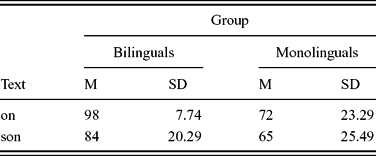
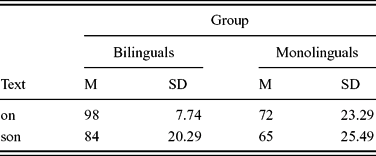
In missing-letter effect studies, accuracy data for answered questions are usually not analyzed because their psychometric properties are not documented. However, although the questions were not developed to achieve a fine grain assessment of reading performance, they can provide useful information about the reading comprehension of the two groups based on bilingualism status. In fact, in previous studies with children learning to read, similar questions were successfully used as reading ability indices and results showed that the size of the missing-letter effect varied accordingly (see, e.g., Drewnowski, Reference Drewnowski1981; Saint-Aubin, Klein and Landry, Reference Saint-Aubin, Klein and Landry2005). As can be seen in Table 1, bilingual participants were more accurate than unilingual participants. In addition, both groups of participants were more accurate on the on text than on the son text, but the advantage of the bilingual group was of about the same magnitude for both texts. A 2 × 2 mixed-design ANOVA, with group as the between-participants factor, and text as the repeated factor, confirmed those trends. In all analyses, the .05 level of significance was adopted. There were significant main effects of group, F(1,64) = 33.26, MSE = 489.92 and text, F(1,64) = 11.23, MSE = 308.59, but the interaction did not reach significance, F = 1.38.
Means (M) and Standard Deviations (SD) for percentage of correct answers to the three comprehension questions as a function of text and language group.
Omission data
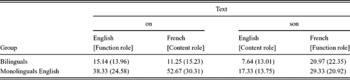
Mean percentages of omission errors for target letter n embedded in the homographs on and son are presented in Table 2 as a function of sentence language, group based on bilingualism status, and target text (on vs. son text). These percentages were computed for each participant and each condition by dividing the number of omissions by the number of occurrences and then by multiplying the result by 100. Inspection of Table 2 reveals that bilingual participants made more omissions on the function role of son (French) than on its content role (English). Although of smaller magnitude, a similar pattern of results was observed for on with more omissions for its function role (English) than for its content role (French). For monolinguals, the pattern of results is different: They always made more omissions on the French sentences than on the English sentences. Most importantly, for both English and French sentences, monolinguals always showed the usual missing-letter effect from an English perspective. Specifically, more omissions are made when the target letter is embedded in on which is a function word in English than in son which is a content word in English, regardless of local context, i.e., English or French.
Means and Standard Deviations in parentheses for percentage of omission errors as a function of target word, sentence language, language of the preceding sentence, and language group.

Omissions were analysed separately for monolingual and bilingual participants. For bilingual participants, a 2 ×2 repeated measures ANOVA with text (on vs. son) and sentence language as factors revealed a significant effect of sentence language, F(1,35) = 12.43, MSE = 64.56, and of the interaction, F(1,35) = 23.55, MSE = 113.37, but the main effect of text did not reach significance, F < 1. The interaction was further explored with simple main effect tests that revealed significantly more omissions for the target letter n when on assumed a function (English) than a content (French) role, F(1,70) = 11.38, MSE = 88.97. The same pattern of role influence was observed for the son text with more omissions of the target letter n in son when it assumed a function (French) rather than a content (English) role, F(1,70) = 19.12, MSE = 88.97. For the English monolingual participants, the 2 × 2 repeated measures ANOVA with text (on vs. son) and sentence language as factors revealed that there were significantly more omissions on the French than the English sentences, F(1,29) = 22.43, MSE = 231.87, and for on than for son regardless of context, F(1,29) = 40.39, MSE = 364.97, but the interaction did not reach significance, F < 1. Thus, irrespective of the sentence language, monolingual participants always made more omissions when the target letter was embedded in on than in son.
Experiment 2
Results of Experiment 1 clearly established that it is possible to observe a MLE inter-lingual homograph effect when language switching occurs randomly across sentences. Given the theoretical importance of this finding, it warranted replication. The need for replication is further emphasised by previous findings in the MLE field revealing that some words such as the in English sometimes produced a unique pattern of results that did not generalize in a straightforward manned to other words (e.g., Koriat and Greenberg, Reference Koriat and Greenberg1993). In addition, the MLE has been shown to vary with target letter and its position (e.g., Schneider and Healy, Reference Schneider and Healy1993; Saint-Aubin and Poirier, Reference Saint-Aubin and Poirier1997; Assink and Knuijt, Reference Assink and Knuijt2000). Consequently, it was important to determine whether the effect would stand up with new homographs and new target letters. Consequently, two new homographs were used (an and pour), with two new target letters (a and r) and target letter position within those words varied by being the first for an and the last for pour.
The second aim of Experiment 2 was to directly investigate the effect of varying the sentence language at random on the size of the MLE inter-lingual homograph effect. The inter-lingual homograph pour was introduced to address this issue. The homograph pour was selected because it was used previously by Greenberg and Saint-Aubin (Reference Greenberg and Saint-Aubin2004) for assessing the MLE for inter-lingual homograph in homogeneous language passages. All critical methodological elements of Greenberg and Saint-Aubin's second experiment were the same as those implemented here. Consequently, if there was some cost for switching from one to another language, the size of the MLE should be smaller than what was reported by Greenberg and Saint-Aubin. However, if responding to two languages can be as efficient as handling one, then the size of the MLE should be the same as that observed by Greenberg and Saint-Aubin for the same homograph.
Method
Participants
Thirty native-French speakers from Université de Moncton (23 women and 7 men) volunteered to participate in the experiment. Participants indicated in a survey question that they were native-French speakers and that French was used at home. Nevertheless, all participants scored with a percentile rank of 50 or higher (mean = 82) on the comprehension scale of the Nelson-Denny Reading Test (form G) with norms for ninth graders indicating good English reading skills.
Materials, design and procedure
Two new prose passages were written. The an text comprised 1,984 words and included 40 occurrences of the critical homograph an. Twenty occurrences of the homograph an were embedded in French sentences and 20 were embedded in English sentences. In English, an assumes a function role and has a frequency count of 3,747 occurrences per million (Kučera and Francis, Reference Kučera and Francis1967), whereas in French, an assumes a content role as a noun meaning year with a frequency count of 1,171 occurrences per million (Baudot, Reference Baudot1992). There were also 680 occurrences of the target letter a in non-critical words. In the other prose passage comprising 1,779 words, 20 occurrences of the homograph pour were embedded in English sentences and 20 were embedded in French sentences. In English, pour assumes a content role and has a frequency count of 9 occurrences per million (Kučera and Francis, Reference Kučera and Francis1967), whereas in French, pour assumes function role as a preposition meaning for with a frequency count of 7,982 occurrences per million (Baudot, Reference Baudot1992). There were also 442 occurrences of the target letter r in non-critical words.
Presentation order of the two texts was completely counterbalanced across participants with half participants reading the an passage first and the remaining half beginning with the pour passage. All other aspects of the procedure were the same as those used for the bilingual group in Experiment 1.
Results
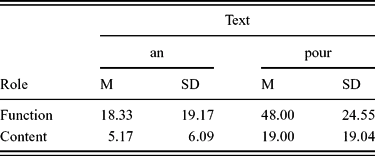
Comprehension questions were well answered with an average proportion of correct answer of 87% for both texts. Mean percentages of omission errors for target letter a embedded in the homographs an and for the target letter r embedded in the homograph pour are presented in Table 3as a function of sentence language and target text (an vs. pour text). Inspection of Table 3 revealed that overall participants made more omissions on the function role of an (English) than on its content role (French), and on the function role of pour (French) than on its content role (English). A 2 × 2 repeated measures ANOVA with text (an vs. pour) and sentence language as factors revealed a significant effect of sentence language, F(1,29) = 15.74, MSE = 119.43, of text, F(1,29) = 60.07, MSE = 236.27, and as predicted of the interaction, F(1,29) = 70.85, MSE = 188.23. The interaction was further explored with simple main effect tests that showed significantly more omissions for the target letter a when an assumed a function (English) than a content (French) role, F(1,58) = 16.90, MSE = 153.83. The same pattern of role influence was observed for the pour text with more omissions of the target letter r in pour when it assumed a function (French) rather than a content (English) role, F(1,58) = 82.01, MSE = 153.83.
Means (M) and Standard Deviations (SD) for percentage of omission errors as a function of target word and sentence language.
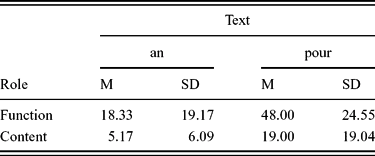
An additional analysis was computed to compare the size of the inter-lingual homograph effect observed here with pour when language changed at random across sentences with the pattern reported by Greenberg and Saint-Aubin (Reference Greenberg and Saint-Aubin2004) with homogeneous language passages. To this end, data of Greenberg and Saint-Aubin's bilingual group reading the text displayed normally in Experiment 2 was used here for the comparison. Greenberg and Saint-Aubin's bilingual group was composed of 24 students from Université de Moncton and they had a mean percentile rank of 83 on the comprehension scale of the Nelson-Denny Reading Test which was very similar to the mean of the current sample's 82 on the same test. The text used by Greenberg and Saint-Aubin was also very similar to the current one except that they were homogeneous language passages with one passage in English and one in French. There were 8 instances of pour in each language. The mean omission rate for the target letter r embedded in pour was 26.56% for the French normal prose passage and 15.10% for the English normal prose passage. A 2 × 2 mixed-design ANOVA with text as the between-participants factor (homogeneous prose passages used by Greenberg and Saint-Aubin vs. current text) and language (English vs. French) as the repeated-measure factor was computed. Results revealed a significant main effect of text, F(1, 52) = 6.17, MSE = 692.92, with more omissions in the current text than in the 2004 prose passages, of language, F(1,52) = 48.52, MSE = 225.90, with as predicted more omissions for the French function word usage than for the English content word usage, and a significant interaction, F(1,52) = 9.08, MSE = 225.90. The interaction reflected that the MLE inter-lingual homograph effect in the current study was actually larger than that observed in the 2004 study in which homogeneous language passages were used. Simple main effect tests revealed that the effect of language was indeed significant for both Greenberg and Saint-Aubin's sample, F(1,52) = 6.97, MSE = 225.90, and the current sample, F(1,52) = 55.84, MSE = 225.90, however. In addition, there were significantly more omissions in the current sample for the French function usage of pour than in Greenberg and Saint-Aubin's sample with respectively 48.00% and 26.56% of omissions, F(1,104) =13.34, MSE = 459.41, but there was no difference for the English content word usage of pour, F < 1.
Discussion
Experiment 2 provided strong support for the generalizability of an inter-lingual homograph MLE in the context of mixed passages. Importantly, a comparison of the present study's pour target with the same target in homogeneous passages (Greenberg and Saint-Aubin, Reference Greenberg and Saint-Aubin2004) showed that even against a homogeneous baseline, intermixing of languages did not moderate the impact of different lexical roles for this homograph. Thus, at least for this target it was clear that language switching did not make the late selection of the homograph's appropriate interpretation less efficient. In fact, somewhat surprisingly, the pattern with the mixed passage was apparently stronger than with homogeneous passages. Nevertheless, it is important to note that the MLE was still significant in the homogeneous context of the earlier study.
The somewhat stronger effect in the intermixed context might have captured a more active attempt on the part of readers to suppress the alternative inappropriate meaning. Assuming, as we have, based on a variety of patterns observed in the earlier work (see Greenberg and Saint-Aubin, Reference Greenberg and Saint-Aubin2004), that letter detection reflects a relatively late post-lexical selection process, this more pronounced difference may not be that surprising. Specifically, routine switching within a passage may not only have raised activation levels of both languages more so than in homogeneous text, but also served as cue to actively suppress the inappropriate language's lexical entry. In homogeneous passages, readers may have been less conscious of the alternative activated meaning of the inter-lingual homograph, and thus no conscious effort was made to inhibit that meaning (although unconsciously this was clearly the case), and thus processing proceeded until a relatively late point when the heretofore activated alternative entry fell below threshold (e.g., Dijkstra, Reference Dijkstra2005). We speculated that with mixed passages the repeated cueing of competing languages engaged readers in a somewhat more strategic attempt at suppression. Together with the less conscious inhibition, the strategic process led to a cumulative and more efficient suppression of the alternative meaning than had been observed with pour in homogeneous passages. Indeed, lexical activation effects appeared more robust in lexical decision tasks that allow for conscious expectations to help guide strategic processing (Neely, Reference Neely1977). Again, according to this hypothesis, it is assumed that the alternating use of languages either reminded the reader of the competition, or perhaps informed the lexicon (maybe unconsciously) that competitive meanings were possible.
Conclusions
The present findings elaborated on the results of Greenberg and Saint-Aubin (Reference Greenberg and Saint-Aubin2004). Again it was observed that suppression of a competing language's inappropriate meaning occurs rapidly, although post-lexically, in a letter detection task performed while reading. The inter-lingual MLE obtained for bilinguals was not found for monolingual subjects in Experiment 1, indicating that the bilingual response pattern was not a result of the peculiarities of target word placement, but rather issued from the bilingual's dual familiarity with inter-lingual representations of these target homographs. Recent work by Greenberg, Inhoff and Weger (Reference Greenberg, Inhoff and Weger2006) demonstrated that although letter detection slows reading, it does not alter the normal pattern of processing differences between function words supporting text structure and content words filling out meaning (see also Roy-Charland et al.,Reference Roy-Charland, Saint-Aubin, Klein and Lawrence2007; Saint-Aubin and Klein, Reference Saint-Aubin and Klein2001). Experiment 2 produced a nearly identical set of data for different letters, words and target positions. Presumably, then, the patterns that emerged here capture the changes in processing of inter-lingual homographs as a function of their changing roles across different languages when reading. Taken together, it appeared that the inter-lingual MLE is robust in the context of mixed passages suggesting that local context arouses late selection of an appropriate target in the face of competing language activation.
Importantly, single sentences were sufficient to move the suppression process along efficiently enough to produce an appropriate interpretation. The task as explained in our earlier work is most likely tapping into relative late post-lexical activation (Greenberg and Saint-Aubin, Reference Greenberg and Saint-Aubin2004) and thus the present findings furthered the notion of a non-selective processing of language by bilinguals (Dijkstra and Van Heuven, Reference Dijkstra, Van Heuven, Grainger and Jacobs1998, Reference Dijkstra and Van2002).
The pattern of letter detection in a homogeneous passage suggested that both meanings were initially available, but also that the inappropriate alternative is efficiently eliminated (Greenberg and Saint-Aubin, Reference Greenberg and Saint-Aubin2004). Current results revealed that this process survived the language intermixing manipulation and was even stronger than what was found with homogeneous texts. Whereas, the impact of mixing languages has been widely demonstrated in reaction time studies involving naming of concepts (e.g., Meuter and Allport, Reference Meuter and Allport1999), those studies that involved reading sentences (e.g., Clyne, Reference Clyne1980) failed to capture the impact of switching on the processing of individual words (Meuter, Reference Meuter2005). Here, though, we had the opportunity to test whether frequent language switching, at sentence junctures, affected the process of sorting out the correct meaning and role. Apparently, switching languages by itself did not significantly compromise late suppression, since the MLE in a broad sense survived the mixed language presentations.
In Meuter and Allport's work, it was found that responses in the same language sped up with successive responses with that language, and while a switch cost emerged immediately following a language switch, it did not persist past initial words. Perhaps, had the target words here not been embedded in the middle of sentences, but instead appeared at the beginning of the sentences, the MLE might have dissolved. However, in this study participants processed conceptually connected sentences instead of random word sequences (see Meuter and Allport, Reference Meuter and Allport1999), and the connected text with distinct meaning units might modify the impact that the language switch point has on the words that immediately follow the switch. Finally, it is worth recalling that as suggested by some earlier studies, the impact of language switching could be dampened when language switching is more systematic and hence predictable (Macnamara et al., Reference Macnamara, Krauthammer and Bolgar1968; Chan et al., Reference Chan, Chau and Hoosain1983), but here language order was unpredictable.
In sum, the inter-lingual homograph MLE can survive language switching within a cohesive passage. Moreover, comparison with earlier work indicated that there might be some strategic control of the late suppression process that also underlies the inter-lingual MLE.