Children and adults living with moderate or complex congenital heart disease require periodic evaluation by a cardiologist throughout life.Reference Warnes, Liberthson and Danielson1–Reference Wernovsky, Rome and Tabbutt3 Unfortunately, loss to follow-up is common in the congenital heart disease population and begins in childhood.Reference Mackie, Ionescu-Ittu and Therrien4, Reference Reid, Irvine and McCrindle5 Lack of continuity of care throughout the lifespan, and specifically at the time of transfer to adult cardiology care, may delay recognition of new or evolving cardiac problems, which in turn may result in life-threatening complications.Reference Warnes6, Reference Yeung, Kay and Roosevelt7 However, patient, health-care provider, and system-related factors that predict loss to follow-up are poorly understood. Therefore, the objective of this study was to identify risk factors for loss to follow-up among children, adolescents, and young adults with congenital heart disease followed at a university-based congenital cardiology clinic.
Methods
Study design
We conducted a mixed methods study using a sequential explanatory design.Reference Plano Clark and Creswell8 The quantitative component described the sample and used a matched case–control design. Cases and controls were matched with respect to two non-modifiable risk factors, namely year of birth and type of congenital heart disease. Qualitative data were collected through telephone interviews conducted by a trained nurse interviewer. The purpose of the qualitative analysis was to elicit potential reasons for children and youth being lost to follow-up, which were not captured by chart review.
Study population
We identified Cases and Controls from the Western Canadian Children's Heart Network database. The inclusion criteria for the cases were congenital heart disease of moderate or great complexity as defined by Warnes et al;Reference Warnes, Liberthson and Danielson1 born before January 1, 2001; evaluated in the ambulatory or satellite clinics of the Stollery Children's Hospital, Division of Cardiology – a tertiary care programme providing full cardiology and cardiac surgical services – or at the affiliated Northern Alberta Adult Congenital Heart clinic; and no return visit to a cardiology clinic for a minimum of 3 years, that is, no visit after May 1, 2006 as data collection began in May, 2009. The exclusion criteria were death of the patient; patient moving out of the area stated in the chart; or recommended next follow-up appointment more than 3 years after the last visit.
Controls met the same criteria, except that they were seen one or more times between May 1, 2006 and May, 2009. All controls with the same year of birth, plus or minus 1 year, and the same primary congenital heart disease lesion were identified. We randomly selected three controls for each case. This 3:1 ratio optimises statistical power, but does not pose an excessive burden of time or cost.Reference Gail, Williams and Byar9
Measurements
Data were collected from the Western Canadian Children's Heart Network database, which included the records of all paediatric and adult congenital heart disease interventions and clinic visits; cardiology clinic charts; and by telephone interview.
Database and chart review
A paediatric cardiologist (ASM) extracted data from echocardiogram reports and images. A research assistant extracted all the other data with re-extraction of 10% of subjects by ASM to ensure accuracy. Complete double data entry was performed and data entry mismatches were reconciled by review of forms, the database, or chart.
Telephone interviews
A subset of cases and controls participated in digitally recorded and fully transcribed interviews with a nurse interviewer. Data included reasons for the lack of follow-up – among cases only; awareness of the need for ongoing cardiac care and knowledge of the cardiac condition – for example, name of the lesion; sources of information about the heart – for example, Internet, pamphlets, cardiologist, nurse, friends/relatives; use of cardiac medication; independence with medical care – for example, scheduling/attending medical visits alone, managing medication; and use of infective endocarditis prophylaxis. We piloted the interview guide with one case parent and one case teen, resulting in minor changes to two questions. The revised interview guide is provided (Appendix). Patients who were 13 years or older were interviewed. For patients 12 years of age or younger, the parent was interviewed. Observations made during the interview that would not be captured in a transcript – for example, mood – were recorded as qualitative field reflections.Reference Richards and Morse10 Consent and assent forms were mailed with a stamped, self-addressed envelope and reviewed at the beginning of each interview.
Contacting cases
The study clinics routinely contact patients by phone, within 24 hours after a missed appointment. In addition, we contacted all cases by mail to facilitate a return appointment and to request consent for a telephone interview. Cases who did not reply were sent a second mail 1 month later. The study team telephoned those cases who did not respond. Simultaneously, the clinic contacted referring physicians by mail, encouraging a re-referral to the cardiology clinic.
Predictor variables
Potential predictors of loss to follow-up from chart and database data were:
Access to medical care included the distance from hospital and the median family income, both of which were determined using the postal code of the last known residence.11 Canadian postal code coordinates are an accurate proxy for location of residenceReference Bow, Waters and Faris12 and socio-economic status.Reference Southern, Faris and Knudtson13 Driving distance from the clinics was determined using Google Map.14 Median family income was determined using Statistics Canada census data, tracked by postal code, for the year 2006.15
Patient complexity factors included comorbid condition, defined as one or more of Trisomy 21, other chromosomal abnormality or syndrome, neurodevelopmental delay, seizure disorder, attention deficit disorder, asthma, growth failure, diabetes, obesity, or hypertension; cardiac surgery within the past 5 years; cardiac catheterisation within the past 5 years; residual haemodynamic problem at the last echocardiogram, defined as one or more of moderate–severe atrioventricular valve regurgitation, semilunar valve regurgitation, ventricular inflow or outflow obstruction, ventricular dilation or dysfunction, a moderate–large residual left-to-right shunt, or arch obstruction with a Doppler gradient greater than 30 millimetres of mercury; use of medications other than warfarin; use of warfarin; any prior history of failing to attend (“missed”) cardiology appointment(s); presence of pacemaker or implantable defibrillator.
Provider factors included patient's cardiologist; documentation in the medical record of the need for cardiology follow-up at last visit; recommended time until the next clinic visit; location of the last visit – tertiary care hospital site versus satellite clinic.
Statistical analysis
Numerical summaries – frequencies, means, standard deviations – described predictor variables by group. Following bivariable analyses, variables associated with the outcome (p < 0.2) were entered simultaneously into a multivariable conditional logistic regression model. Variables were dropped or added based on significance testing and model fit. The Akaike information criterion and residual diagnostics were used for model assessment.Reference Akaike16 On the basis of the fact that 10 patients were required per predictor variable,Reference Peduzzi, Concato and Kemper17 the sample size allowed for seven predictor variables. Odds ratios with 95% confidence intervals were reported. All analyses were performed using the SAS version 9.1.3 (SAS Institute).
Analysis of interview data
Transcriptions of the first 10 interviews were compared with the recorded interview to ensure accuracy. All transcribed interviews were reviewed in their entirety to identify overall impressions of each interview itself, and then contrasted with other interviews as data collection progressed.Reference Morse and Field18 Each interview was analysed for common topics; code categories were determined and applied in subsequent data analysis.Reference Richards and Morse10 Thematic content analysis was employed to determine common themes and patterns among and between the case and control participants.Reference Morse and Field18 Directed content analysisReference Hsieh and Shannon19 for specific interview topics – for example, sources of information about the heart – facilitated comparisons between cases and controls. We used the qualitative data management software, NVivo 8 (QSR International).
Results
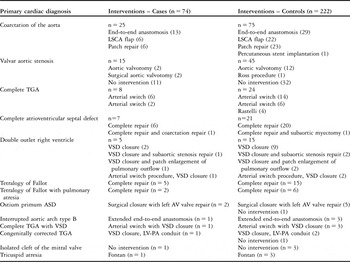
A total of 76 cases met the inclusion criteria. Of these, two were excluded – one patient was deceased and one patient was advised to return more than 3 years after the last visit. The remaining 74 cases were matched to 222 controls. The median year of birth among cases was 1990 (ranging from 1983 to 2000) compared with 1991 (1983 to 1999) among controls. The mean age at last visit to the cardiology clinic was 12.88 years (standard deviation 5.15) among cases compared with 16.82 years (standard deviation 4.25) among controls (p < 0.0001). Of the 74 cases, 49 (66%) were male compared with 136 of 222 controls (61%; p = 0.43). Table 1 summarises cardiac diagnoses and interventions.
Cardiac diagnoses and interventions.

ASD = atrial septal defect; AV = atrioventricular; LSCA = left subclavian artery; LV = left ventricle; PA = pulmonary artery; TGA = transposition of great arteries; VSD = ventricular septal defect
A total of 35 cases returned to the cardiology clinic as a result of being identified through this study. Families of 14 cases agreed to a telephone interview. For three families, both the patient and a parent were interviewed, resulting in 17 interviews. A total of six interviewees were in the age group of 13–17 years, three interviewees were 18 years or older, six were mothers, and two were fathers. In all, 28 interviews were conducted among 27 controls. A total of five interviewees were in the age group of 13–17 years, six interviewees were 18 years or older, 14 were mothers, and three were fathers. For one family, both the patient and a parent were interviewed.
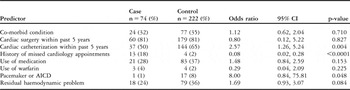
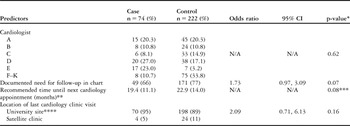
Postal code-derived median annual family income was lower among cases ($64,435, standard deviation $23,203) than controls ($76,460, standard deviation $29,681; p = 0.001). The median distance from the hospital was 18.0 kilometres – with a range of 2.4–676.0 – among cases and 26.7 kilometres – with a range of 1.1–1090.0 – among controls (p = 0.34). Tables 2 and 3, summarise the analyses of patient and provider factors, respectively.
Bivariable analysis of patient factors.

AICD = automatic implantable cardiac defibrillator; CI = confidence interval
Variables with p-values <0.2 were entered simultaneously into a multivariable conditional logistic regression model
Bivariable analysis of provider factors.

*Cochran–Mantel–Haenszel test
**Mean (standard deviation)
***Likelihood ratio test
****University site = Stollery Children's Hospital/Northern Alberta Adult Congenital clinic
Using multivariable conditional logistic regression analysis, a history of one or more missed cardiology appointments was predictive of loss to follow-up (odds ratio 13.0, 95% confidence interval 3.3–51.7). Variables associated with a reduced risk of loss to follow-up were higher median family income (odds ratio 0.87 per increase in annual salary of $10,000, 95% confidence interval 0.77–0.98), cardiac catheterisation within the past 5 years (0.2, 0.1–0.6), and chart documentation of the need for cardiology follow-up (0.4, 0.2–0.8).
A total of three interview themes distinguished cases from controls. First, controls repeatedly articulated the importance of follow-up and described either their ease in securing an appointment or their persistence in obtaining follow-up appointments. Regarding the importance of follow-up, one mother stated: “We go every year. There is no choice. It's not whether you want to or not. It just has to happen and I didn't want him [son with congenital heart disease] to think, ‘Oh well, I don't have to go.’ ” Some parents persisted to secure an appointment as described by this mother from the control group: “I would call and sometimes I would have to pass the gatekeeper, call around to different people and some who were more helpful than others.” In contrast, the lack of persistence and awareness about the importance of follow-up was evident in the data from cases and their parents. A teenager in the case group said, “I think after that year, I just didn't think I needed to go again. So we just never, we kind of forgot about it.” Second, controls had a system for remembering appointments. Mothers described making notes on a calendar, or linking annual appointments with other annual events such as birthdays or summer holidays: “I make sure we get in. … In my head … when spring comes around, it's time.” Finally, cases were more likely to identify family physicians or paediatricians as their primary source of cardiac information, whereas controls attributed this role to their cardiologist. Neither group reported negative experiences with the cardiology clinics or cardiologists.
Discussion
This mixed method study investigated the risk factors for loss to follow-up among children and adults with moderate or complex congenital heart disease. We considered patient factors, characteristics of health-care providers, and access to medical care. For the 74 cases and 222 matched controls, a history of one or more missed cardiology appointments was the strongest predictor of loss to follow-up for 3 years or more. There were also factors that protected against loss to follow-up, such as higher median family income, cardiac catheterisation in the past 5 years, and medical record documentation of the need for cardiology follow-up. Interviews revealed that understanding the importance of follow-up and therefore persisting with obtaining appointments, having a systematic way of remembering to schedule appointments, and viewing the cardiologist as the primary source of information about the heart were characteristics of the controls, but not the cases.
Although it may seem intuitive that failure to attend a scheduled cardiology appointment leads to loss to follow-up, the two are not synonymous. We defined “missed appointments” as any history, since diagnosis, of not attending a cardiology appointment(s). However, this occurred in only 18% of cases, and 2% of controls. Other factors were responsible for cases being lost to follow-up for 3 years or more, as revealed by our telephone interview data. Lack of awareness of the need for follow-up and not having a systematic way of remembering to book appointments meant that for some cases, a follow-up appointment was never booked at all. Although this does not reflect well on our programme, it is not unique to our situation. Lack of patient awareness about follow-up has been described by others as the most common reason for a lapse in care.Reference Yeung, Kay and Roosevelt7 Locally, we have addressed these problems by removing barriers to booking appointments, by increasing awareness among cardiologists, and by requiring that patients have a cardiologist-determined time to next appointment, which is documented in the medical record after every clinic visit.
Implications of missed appointments have been addressed in adolescent medicine clinicsReference Chariatte, Michaud and Berchtold20–Reference Sawyer, Zalan and Bond24 and in paediatric subspeciality clinics including oncology,Reference Maeda, Horibe and Kato25 sickle cell disease,Reference Crosby, Modi and Lemanek26 and child psychiatry.Reference Gordon, Antshel and Lewandowski27 Consistent with our findings, previously missed appointments were a risk factor for failure to attend subsequent adolescent clinics.Reference Chariatte, Berchtold and Akre21 In our programme, there is no immediate consequence for missed appointments, that is, there is no fee charged, which may be a contributing factor. Chariatte et alReference Chariatte, Michaud and Berchtold20 reported that a policy requiring payment for missed appointments did not decrease the no-show rate, but resulted in more cancelled appointments. A theme emerging from our interviews was having a method for remembering appointments. Appointments timed around meaningful family/patient events increased the likelihood of them being remembered.
Telephone reminders increase attendance at hospital-based adolescent clinics when provided 1–2 days before the clinic date.Reference O'Brien and Lazebnik23, Reference Sawyer, Zalan and Bond24 During the period of this study, our centre used only letter reminders 1 month before the appointment. Given that adolescents describe “forgetting” as the most common reason for not attending,Reference Sawyer, Zalan and Bond24 a reminder close in time to the appointment may be more effective than a reminder one month before the appointment.
Patients with a lower socio-economic status were more likely to be lost to follow-up. Irwin et alReference Irwin, Millstein and Ellen22 also reported that adolescents of lower social class were less likely to attend an outpatient clinic in a large American centre. Perceived barriers to attendance included interference with a job, transportation problems, or financial concerns in over one-third of adolescents,Reference Irwin, Millstein and Ellen22 which supported the observation that youth with fewer financial resources were less likely to attend medical appointments. Access to medical care is correlated with socio-economic status in other medical conditions.Reference Maddison, Asada and Urquhart28, Reference Heslop, Miller and Hill29 In Canada, there are no direct costs for the visit; however, there are likely transportation costs and loss of income for parents/patients who must miss work to attend appointments. Lower income jobs may have less flexible working hours to allow attendance during regular clinic hours.
Cardiac catheterisation within the past 5 years was associated with a lower likelihood of loss to follow-up. However, residual haemodynamic problems were not associated with loss to follow-up. Together, these findings suggest that recent invasive procedures may remind patients and parents of the importance of follow-up, possibly because of communication with health-care providers around the time of the procedure, or memories of the procedure itself. Reid et al5 found that young adults with congenital heart disease were more likely to attend an adult congenital heart disease clinic if they had had more paediatric cardiovascular surgeries, and reasons for this observation may have been similar.
Documentation of the need for cardiology follow-up in the medical chart was associated with a lower likelihood of loss to follow-up. This finding may reflect the impact of cardiologists’ explanations on patients’ and parents’ understanding of the importance of follow-up. Reid et alReference Reid, Irvine and McCrindle5 also found that documentation of the need for adult congenital heart disease follow-up was associated with a greater likelihood of young adults attending an adult congenital heart disease clinic. Through telephone interviews, we found that controls understood the importance of follow-up and identified their cardiologist as their primary source of information about the heart and cardiac care, which supports the notion that clear communication from providers is an important tool to prevent lapses in care.
A high prevalence of loss to follow-up among children and adults with congenital heart disease was reported by Mackie et alReference Mackie, Ionescu-Ittu and Therrien4 in a population-based study in Quebec that used administrative databases. Failure to attend a cardiology appointment in early adulthood was more likely among male patients, those with a history of follow-up outside a university-hospital setting, patients with no history of cardiac intervention, and simple shunt lesions. The current study builds upon this previous work by restricting the sample to those with moderate-to-severe congenital heart disease and using alternative data sources, namely clinical records and patient and parent interviews. This mixed method approach comprehensively identified not only the factors related to loss to follow-up, but also the salient, explanatory patient and family experiences, priorities, and other relevant nuances from the direct perspective of these young people and parents.
We located only one published study describing the clinical impact of loss to follow-up in patients with congenital heart disease. Yeung et alReference Yeung, Kay and Roosevelt7 described the outcome of a lapse in medical care of 2 years or more for adults referred from a paediatric cardiology clinic. For 63% of the patients who had a lapse of more than 2 years, there was a 3.1-fold increased likelihood of requiring an urgent cardiac intervention. The most common reason for a lapse was that the patient understood there was no need for follow-up (32% of patients). This is consistent with our finding that documentation of the need for follow-up in the medical record distinguished cases from controls. Interview data also indicated that patients who lacked such discussion with the health-care provider did not understand the need for follow-up. Patient education is important for preventing lapses in care in this population.
One benefit of the current study was that 35 of 74 (47%) cases returned to the clinic, ending their lapse in care. We are currently evaluating their cardiac morbidity at the time of reassessment. However, many cases could not be reached or did not respond to our mail and telephone call. Patient relocation and/or telephone number changes may be risk factors for loss to follow-up. Our programme encourages patients to contact us when they relocate, so that ongoing cardiology care can be facilitated in their new environment. We did exclude subjects if there was documentation in the medical record that they were relocating.
Limitations
Our study design (case–control) does not allow us to determine the incidence of loss to follow-up. We could not evaluate whether risk-taking behaviours, such as smoking were associated with loss to follow-up, as these behaviours were poorly documented. Although interviews shed light on family dynamics, we did not evaluate whether family dysfunction or psychological dysfunction were factors. However, the ability of control families to mentally link appointments to other annual events may be a proxy for their overall level of organisation and functional capacity relative to case families. We do not know exactly how patients and parents were counselled by their cardiologist regarding the importance of follow-up, and relied on medical record documentation of the need for follow-up as a surrogate for what was said. However, our interview data reflect a lack of awareness of the importance of follow-up among cases, consistent with the lack of chart documentation in this group. Family income was not evaluated directly, but rather with postal code-derived median family income. However, the latter is a strong surrogate of socio-economic status.Reference Southern, Faris and Knudtson13 The educational level of the families was not known, a factor that may be important in understanding the need for ongoing care. The role of primary care providers in counselling their patients and ensuring cardiology follow-up could not be determined. The definition of “lost to follow-up” has not been clearly delineated in the literature and ideally should consider patient-specific factors such as age, cardiac diagnoses, and comorbidities. The definition used in this study was 3 years, which may underestimate the number of patients truly lost. We chose this conservative definition to avoid incorrect labelling of patients as being lost to follow-up when they had not attended the clinic merely because of scheduling difficulties, an acute illness, or other transient challenges.
In summary, among children, adolescents, and adults with moderate or complex congenital heart disease, a history of one or more missed appointments was associated with a strong likelihood of loss to follow-up for 3 years or longer, whereas higher family income, cardiac catheterisation within the past 5 years, and chart documentation of the need for follow-up were associated with a lower likelihood of loss to follow-up. Relative to patients lost to follow-up, controls were more likely to understand the importance of ongoing cardiology care and had systematic ways of remembering appointments. Interventions directed at health-care providers, patients and their families are required to reduce loss to follow-up in this population. Given the young age of those who were lost to follow-up (mean age 12.88 years at their last visit), family education about the need for life-long cardiology care should begin early, before adolescence, and continue through adulthood. To the extent that loss to follow-up can be effectively mitigated, outcomes for persons with congenital heart disease have the potential to be improved.
Acknowledgement
This study was supported by a Women and Children's Health Research Institute Innovation Grant that was funded by the Stollery Children's Hospital Foundation.
Appendix 1: Interviewer's guide: interviews of adolescents and young adults (age 13 or older)
1. What's a typical day like for you right now? [Warm-up question. Probes: What kinds of things do you enjoy doing? How's school? Do you enjoy your friends? How are things in your family? Are you easy to live with?]
2. On a typical day what sorts of things do you do that might set you apart from your friends? Do you think this is related to your heart condition? Tell me how?
3. What has it been like growing up with CHD? [Probes: Teens growing up with CHD have been described as having a life that is “not ordinary”. How would you respond to that description? Has having CHD affected you feel about yourself?]
4. What's the name of your heart condition? Do you think you will need surgery again at some point? (If the reply is “No” to the latter question: Do you think anything could change with your heart in the future?) Where do you go to get information on your heart? (parents, cardiologist, nurse, Internet, friends?)
5. Do you take medications for your heart? (If “Yes”: What's the medication called? How many times a week do you forget to take it?)
6. Are you supposed to take antibiotics when going to the dentist? When was the last time you went? Did you take the antibiotics?
7. Did you realise it's been a long time since you last saw your heart specialist? (cases only) Why do you think that happened? Did you skip an appointment, or was an appointment never made? How often do you think you should go for appointments? Did you have a bad experience in the clinic during the last visit?
8. Have you moved (are you living somewhere new) since the last time you went to the heart specialist?
9. Have you gone to a doctor's appointment on your own, let's say an appointment with your family doctor? Do you ever think about going to a doctor's appointment by yourself – without your mom or dad?
10. Some young people get involved in things that their parents might not approve. We are going to ask about some of these things and want to assure you that your responses will be strictly confidential, and not shared with your parents. Do you smoke? Do you drink alcohol (If “Yes”, do you drink to the point of getting drunk?) Do you use street drugs?
11. Do you have any other points that you would like to make, or any questions for me?
Appendix 2: Interviewer's guide: interviews of parents (for children aged 6–12)
1. What's a typical day like in your family right now [Warm-up question. Get an idea of who is doing what and when. Probes: work, children, school, leisure.
2. How has having CHD affected your child? [Probes: physical activity level, school functioning, self-esteem.]
3. What has it been like having a child with CHD? How have other family members been affected? How have relationships within your family been affected?
4. What's the name of your child's heart condition? Do you think he/she will need surgery again at some point? (If the reply is “No” to the latter question: Do you think anything could change with your child's heart in the future?) Where do you go to get information on your child's heart? (cardiologist, nurse, Internet, family, friends?)
5. Does your child take medications for his/her heart? (If “Yes”: What's the medication called? How many times a week do you forget to give it to him/her?)
6. Is your child supposed to take antibiotics when going to the dentist? When was the last time your child went? Did he/she get the antibiotics?
7. Did you realise it's been a long time since your child last saw his/her heart specialist? (cases only) Why do you think that happened? Did you skip an appointment, or was an appointment never made? How often do you think your child should go for appointments? Did you have a bad experience in the clinic during the last visit?
8. Have you moved (are you living somewhere new) since your child's last visit to the heart specialist?
9. Do you have any other points that you would like to make, or any questions for me?