I. INTRODUCTION
Inconel 718, a nickel–iron base superalloy, has been extensively used throughout the petrochemical, aerospace, oil, and gas industries for its good properties, such as unique high temperature, strength, and toughness. Aside from that, excellent oxidation resistance and corrosion resistance, easiness to forging, and decent weldability are also the advantages of Inconel 718. Reference Cao, Rivaux, Jahazi, Cuddy and Birur1,Reference Rao, Kumar, Srinivas and Sarma2
The precipitation of intermetallic phases in Inconel 718 has been intensively studied, it has been found that the major phases include (i) γ′-phase having a composition Ni3(Ai,Ti) and a cubic (L12) crystal structure, (ii) metastable γ″-phase having a composition Ni3Nb and a body centered tetragonal (DO22) crystal structure, (iii) equilibrium δ having a composition Ni3Nb and an orthorhombic (DOa) crystal structure. In addition, discrete MC cabide particles are dispersed in the superalloy 718. Reference Huang and Langdon3 The γ″-phase precipitates from the matrix at temperatures range from 600 °C to 900 °C, Reference Azadian, Wei and Warren4 while δ emerges at temperatures from 750 °C to 1020 °C. Reference Lin, Deng, Jiang, Wen and Liu5 The γ″ → δ transformation occurs when the alloy is heat treated at temperatures between 700 °C and 900 °C. Reference Azadian, Wei and Warren4,Reference Slama and Abdellaoui6,Reference Sudararaman, Mukhopadhyay and Banerjee7
It has been recognized that the precipitation kinetics of γ′-phase, γ″-phase, and δ-phase can be influenced by cold rolling. Reference Liu, Xiao, Yao, Chen, Jiang and Wang8–Reference Burger, Biederman, Couts and Loria10 At 910 °C, the effect of cold rolling on the precipitation behavior of δ-phase was studied and the result showed that the precipitation of δ-phase could be promoted by cold rolling. Reference Liu, Xiao, Yao, Chen, Jiang and Wang8 Singh et al. Reference Singh, Hyzak, Howson, Biederman and Loria9 have studied the influence of cold rolling on the precipitation kinetics of γ″-phase and δ-phase at temperatures below 900 °C by means of scanning electron microscopy (SEM) observation. Their results showed that the precipitation of γ″-phase was more favorable than the precipitation of δ-phase for the 30 pct cold-rolled Inconel 718 alloy; and the precipitation of δ-phase was more prevalent than the precipitation of γ″-phase for the 50 pct cold-rolled Inconel 718 alloy, it was suggested that the slip bands formed during cold rolling might serve as potential nucleation sites for the δ-phase precipitation, which in turn reduced the content of γ″-phase owing to the same composition of δ-phase and γ″-phase. Burger et al. Reference Burger, Biederman, Couts and Loria10 examined the microstructure of the samples that were solution treated and either aged directly at 816 °C or 20 pct cold-rolled and then aged at 816 °C. It was speculated that cold rolling promoted the nucleation of γ″-phase. Liu et al. Reference Liu, Chen and Yao11 found, by x-ray diffraction (XRD) techniques, that cold rolling promoted the precipitation of δ-phase at 910 °C and above, at which δ-phase precipitated directly from the austenitic matrix; whereas cold rolling promoted not only the precipitation of γ″-phase but also the γ″ → δ transformation below 910 °C, at which δ-phase was preceded by the γ″-phase precipitation in the cold-rolled Inconel 718.
Apparently, many previous researches have not yet come to any unanimous conclusions on the effect of cold rolling on the precipitation behavior of γ″ and δ phases. Moreover, there are few reports to data concerning the effects of cold rolling on the microstructure of Inconel 718 alloy and the morphology of δ-phase. In the present investigation, to address the deficiencies mentioned above, quantitative information on the precipitation behavior of δ-phase is provided as well as the nature of the relationships between the microstructure, the appearance of the δ-phase particles, the aging temperature, and the degree of cold rolling.
II. EXPERIMENTAL PROCEDURES
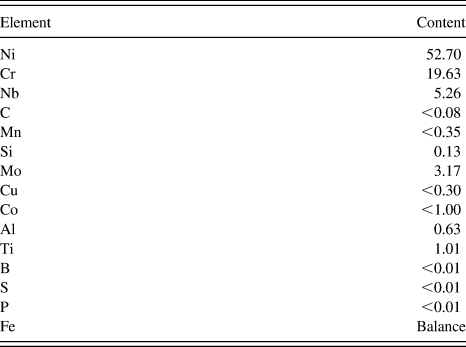
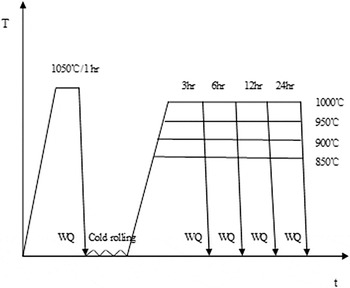
The chemical composition of Inconel 718 alloy used in the present investigation is given in Table I. The as-received material was a hot rolled bar with 50 mm in diameter and 200 mm in length. Four sheets from the bar material were machined flat to a thickness of 10 mm. These sheets were fully solution treated at 1050 °C for 1 h followed by quenching in water. Subsequently, these 10 mm thick sheets were cold-rolled to 0 (not cold-rolled), 25, 40, and 55 pct reductions in thickness via multiple passes. Small specimens were sectioned from the center of the rolled strips. Finally, the specimens were treated at 850, 900, 950, and 1000 °C for various time intervals to precipitate δ-phase and then quenched into water from the desired aging temperatures. Figure 1 illustrates the heat treatment program of the Inconel 718 alloy samples adopted for present investigation.
Chemical composition of the investigated Inconel 718 superalloy (in wt%).

The adopted heat treatment program.

Metallographic observation was conducted for the Inconel 718 alloy specimens after experiencing the heat treatment procedures. The surfaces used for metallographic observations were parallel to the axis of cold rolling. Samples were mounted with epoxy in a 25 mm diameter cylinder, then were ground and polished using conventional metallographic preparation techniques. The microstructure was detected via an optical microscope (OM) and a SEM equipped with an energy-dispersive x-ray spectrometry (EDS) system. The samples for the OM and SEM observations were etched chemically with a solution consisting of 5 g CuCl2 + 100 mL HCl +100 mL C2H5OH.
Quantitative information about δ-phase and grain size (measured as mean grain diameter by the linear interception method) were calculated by the Media Cybernetics Image-Pro Plus image analysis software. These measurements were carried out using a SEM, recording more than ten fields for each sample under different aging conditions at a magnification of 2000 and then further increasing contrast of these micrographs when transferring to the image analyzing system. It was estimated that the deviations associated with the measurements of quantitative information about δ-phase and grain size were within the acceptable error range, thereby permitting a reliable estimate of the δ-phase area fraction and grain size.
III. RESULTS AND DISCUSSION
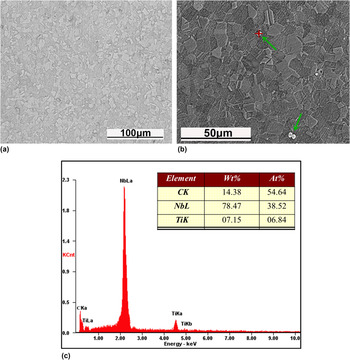
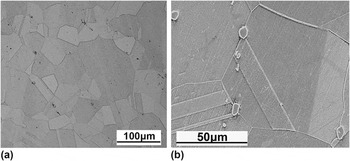
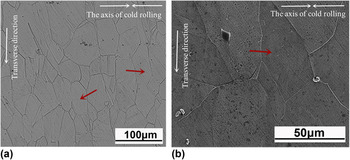
The initial microstructure of the investigated Inconel 718 alloy is presented in Fig. 2. The OM micrograph displays a fine equiaxed grain structure with an average size of 20 µm [see in Fig. 2(a)]. The SEM micrograph reveals the presence of carbides that are uniformly dispersed in the microstructure [marked by arrows in Fig. 2(b)]. The carbides are NbC type carbides, which are rich in Nb and Ti verified by EDS results presented in Fig. 2(c). Following the solution treatment at 1050 °C for 1 h, a heterogeneous equiaxed grain structure is obtained with an average grain size of 65 µm [see in Fig. 3(a)]. Compared with the as-received sample, carbides have grown up after experiencing the heat treatment procedure, as shown in Fig. 3(b). Moreover, numerous extensive annealing twins are observed in the microstructure after the solution treatment. Figure 4 illustrates the representative microstructure of the cold-rolled samples. It shows that after 25 pct cold rolling, deformed grains appear in place of equiaxed grains and the microstructure is considerably homogeneous except that carbides are distributed in the microstructure as before, which indicates that no phases precipitate from the austenitic matrix during cold rolling. In other words, the microstructure of the unaged cold-rolled samples remains the same as the solution treated sample except for the grain deformation. In addition, the extent of the grain deformation increases as the degree of cold rolling increases.
Microstructures of as-received Inconel 718 alloy sample (a) OM image, (b) SEM image, and (c) EDS of the carbides.

Microstructures of the explored Inconel 718 alloy sample after solution treatment at 1050 °C for 1 h (a) OM image (b) SEM image.

Microstructures of the explored Inconel 718 alloy sample after cold rolling for 25 pct (a) OM image (b) SEM image.

A. Recovery and recrystallization
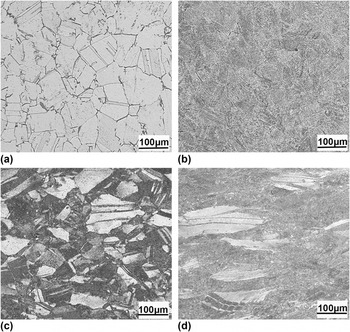
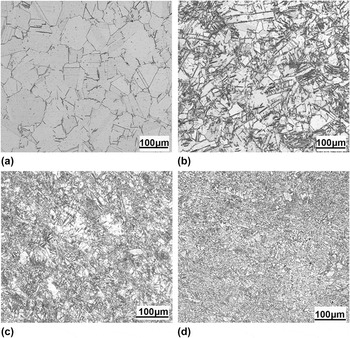
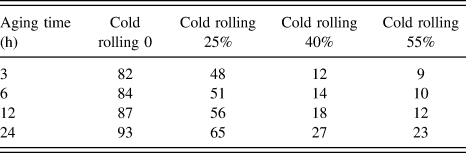
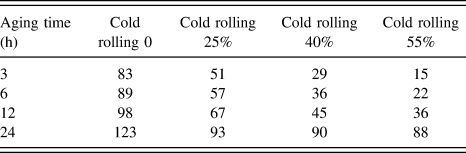
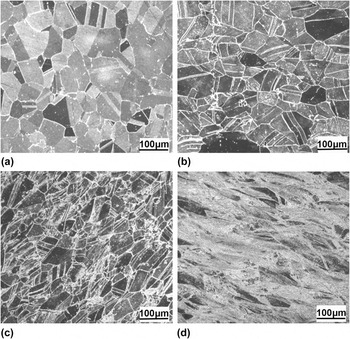
Recovery and recrystallization are primary processes which govern microstructural evolution in cold-rolled metallic systems during high temperature exposure. The recrystallization of cold-rolled Inconel 718 alloy has been studied by Liu et al. Reference Liu, Yao and Chen12 Their observations showed that recrystallization can be completely finished within 150 s at 960 °C and the volume fraction of recrystallized austenite is a function of the aging time at a temperature of 910 °C. In the present investigation, recovery and recrystallization take place in the cold-rolled samples during aging. The experimental results indicate that the mechanism of the microstructural change is recovery for cold-rolled samples aged at temperatures of 850 and 900 °C, while recrystallization occurs for cold-rolled samples aged at 950 and 1000 °C. Figs. 5(a)–5(d) show optical micrographs of 0, 25, 40, and 55 pct cold-rolled samples aged at 900 °C for 6 h. It is obvious that grains are present in form of the large deformed grains, which indicates a high density of dislocations within the grain; furthermore, grains are elongated on a larger scale with the degree of cold rolling increasing. The behavior can be rationalized based on a low velocity of recovery process in this alloy. Due to a low stacking fault energy of Inconel 718, gliding or climbing of the dislocations is difficult and static recovery proceeds so slowly that grains remain deformed regardless of a long-time aging. Reference Praveen, Sastary and Singh13 As shown in Figs. 5(c) and 5(d), it is interesting to note that δ-phase (black features in the figures) appears in a banded structure while the white areas are free of δ-phase particles, which indicates that δ-phase precipitates unevenly in the microstructure; similar microstructure is observed in the hot worked Inconel 718 alloy. Reference Huang and Langdon3 Figs. 6(a)–6(d) show the optical micrographs of the 0, 25, 40, and 55 pct cold-rolled samples aged at 950 °C for 12 h. In contrast to the microstructure in Fig. 5, the microstructure is characterized by fine equiaxed grains as a result of recrystallization. Besides that, grains become finer as the degree of cold rolling increases. The determined grain sizes of the cold-rolled samples aged at 950 and 1000 °C are gathered in Tables II and III, respectively.
OM photographs of the various degrees cold-rolled Inconel 718 alloy samples aged at 900 °C for 6 h (a) 0 pct (b) 25 pct (c) 40 pct (d) 55 pct.

OM photographs of the various degrees cold-rolled Inconel 718 alloy samples aged at 950 °C for 12 h (a) 0 pct (b) 25 pct (c) 40 pct (d) 55 pct.

The grain size of the cold-rolled samples aged at 950 °C (unit: µm).

The grain size of the cold-rolled samples aged at 1000 °C (unit: µm).

B. Effect of cold rolling on the precipitation behavior of δ phase
The dark-field OM photographs of 0, 25, 40, and 55 pct cold-rolled samples aged at 850 °C for 6 h are illustrated in Fig. 7. Based on the figures, it is found that the content of δ-phase (white particles in the figures) increases rapidly with the increase in the degree of cold rolling. Figure 7(a) represents that δ-phase particles are on a small scale and mainly located at the grain boundaries, which results in a necklace grain structure. As shown in the Figs. 7(b) and 7(c), δ-phase starts to precipitate within the grains and the density of the δ-phase particles increases with the increase in the degree of cold rolling. Under even heavier cold rolling, the distribution of the δ-phase becomes more uniform. Similar result is obtained for the cold-rolled samples aged at 900 °C for various periods. Thus, it can be concluded that for samples aged at low temperatures, cold rolling promotes δ-phase precipitating within the grains during aging and the δ-phase particles become more uniformly distributed as the degree of cold rolling increases.
OM (dark-field) photographs of the various degrees cold-rolled Inconel 718 alloy samples aged at 850 °C for 6 h (a) 0 pct (b) 25 pct (c) 40 pct (d) 55 pct.

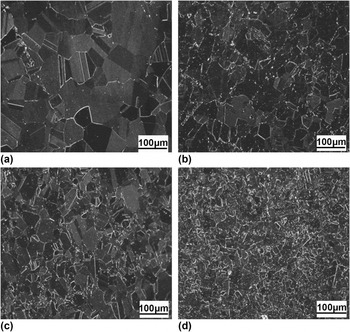
The dark-field OM photographs of 0, 25, 40, and 55 pct cold-rolled samples aged at 1000 °C for 6 h are presented in Fig. 8. Compared with Fig. 7, the amount of δ-phase is much less since 1000 °C is close to dissolving temperature of δ-phase. As shown in Fig. 8, the identical experimental result is achieved that cold rolling promotes the precipitation of the δ-phase during aging. The same result is observed for all cold-rolled samples aged at 950 °C. Furthermore, Fig. 8 presents that the grain size gradually decreases as the degree of cold rolling increases because of the recrystallization behavior, which is depicted in the cold-rolled samples aged at 950 °C (see in Fig. 6).
OM (dark-field) photographs of the various degrees cold-rolled Inconel 718 alloy samples aged at 1000 °C for 6 h (a) 0 pct (b) 25 pct (c) 40 pct (d) 55 pct.

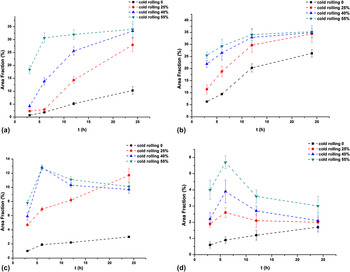
The curves of area fraction of δ-phase versus aging time for different cold-rolled Inconel 718 alloy samples aged at various temperatures are plotted in Fig. 9. For a given time and temperature, the area fraction of δ-phase increases with the degree of cold rolling increasing and this is consistent with previous observation via OM. As depicted above, recrystallization occurs when cold-rolled samples are aged at high temperatures while recovery dominates for cold-rolled samples aged at low temperatures. Considering different microstructural changes for cold-rolled samples at the low and the high aging temperatures, two distinct mechanisms are introduced to interpret the variations in the content of δ-phase for the Inconel 718 alloy samples at the low and the high aging temperatures, respectively.
Area fraction versus aging time for the various degrees cold-rolled Inconel 718 alloy samples aged at (a) 850 °C (b) 900 °C (c) 950 °C, and (d) 1000 °C for different periods, respectively.

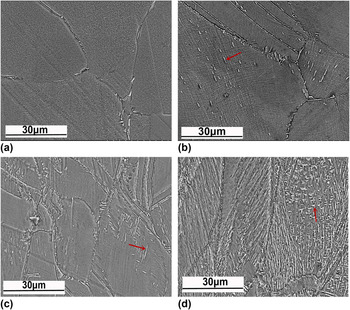
According to the studies by transmission electron microscopy, Reference Paulonis, Oblak and Duvall14–Reference Sundararaman, Mukhopadhyay and Banerjee18 δ-phase precipitates mainly in the matrix and minority of δ-phase precipitates around twin and grain boundaries at temperatures below 900 °C. Within the grain, parallel arranged dislocations and the geometric stacking faults within pre-existing γ″ particles act as ideal nucleation sites for δ-phase. Reference Kirman and Warrington15,Reference Lee and Hou19 Since the precipitation of δ-phase is a process of nucleation and growth, the content of δ-phase is mainly controlled by the nucleation rate and the diffusion rate of the necessary atoms of Nb. For 0 pct cold-rolled samples aged at 850 and 900 °C, due to low density of dislocations in the grain interiors, δ-phase mainly nucleates in the geometric stacking faults of γ″ particles and grows at expense of γ″-phase. In other words, the precipitation of δ-phase involves a structure alteration, from DO22 (γ″-phase) to DOa (δ-phase), which requires a high activation energy, Reference Sudararaman, Mukhopadhyay and Banerjee7,Reference Kirman and Warrington15 so it is difficult for δ-phase to precipitate and grow in the grains. Thus, as shown in Fig. 9(a), the area fraction of δ-phase of the 0 pct cold-rolled samples aged at 850 °C remains quite low even for a long-time aging, the values recorded in the figure represent the content of the δ-phase around twin and grain boundaries because of too little δ-phase to be detected within the grain. For 0 pct cold-rolled samples aged at 900 °C, the area fraction of δ-phase is higher than that of 0 pct cold-rolled samples aged at 850 °C for the same aging period, this is attributed to the fact that a higher temperature results in a faster velocity of atoms motion, which makes the structure change easier and diffusion rate of the necessary Nb atoms faster. Firstly, cold rolling creates dislocations and the density of dislocations increases as the degree of cold rolling increases. Reference Kirman and Warrington15 As mentioned in Sec. III. A, the high density of dislocations of the cold-rolled Inconel 718 alloy samples can be maintained even after a long-time aging because of the slow recovery process. So, the nucleation rate of the δ-phase increases as the degree of the cold rolling increases because δ-phase can nucleate near the dislocations. Secondly, γ″ → δ transformation involves a structure alteration, from DO22 (γ″-phase) to DOa (δ-phase), which requires a high activation energy, and the fact that the ordered structure of γ″-phase is partly destroyed by cold rolling makes the structural change from DO22 (γ″-phase) to DOa (δ-phase) easier, which is beneficial for γ″ → δ transformation. Reference Mei, Liu, Liu, Li, Yu, Guo and Li20 Finally, cold rolling creates not only massive dislocations but also excess vacancies, which is favorable to diffusion of Nb atoms and accelerates the nucleation and growth of δ-phase. All these factors contribute to the increase of the δ-phase content for the cold-rolled Inconel 718 alloy samples. In a word, cold rolling promotes δ-phase precipitating within the grains when samples are aged at 850 and 900 °C. The analysis above is confirmed by Figs. 9(a), 9(b), and 10. As shown in Figs. 9(a) and 9(b), it is obvious that for a given aging time and temperature, the area fraction of δ-phase increases with the increasing degree of cold rolling. Moreover, it has been found that area fraction of δ-phase reaches the saturation value of approximately 32 pct for 40, 55 pct cold-rolled samples aged at 850 °C for 24 h, whereas area fraction of δ-phase for 25, 40, 55 pct cold-rolled samples aged at 900 °C for 24 h reaches the saturation value of approximately 34 pct. By carefully comparing each curve of Figs. 9(a) and 9(b), it is also found that the slopes of each curve, which are on behalf of the precipitation rate of δ-phase, decrease with the prolonging aging time, this can be attributed to the increasing difficulty of Nb diffusion for continuous consumption of Nb. The discussions above are also supported by the pictorial evidence in Fig. 10, that the cold rolling promotes δ phase precipitating within the grain. As shown in Fig. 10(a), the 0 pct cold-rolled sample aged at 850 °C for 6 h is free of δ-phase in the matrix, and only some plate-like δ-phase is located at the grain boundaries. In Figs. 10(b)–10(d), plate-like δ-phase (marked by red arrows) is present within the grain and the amount of δ-phase is apparently increased ranging from 25 pct to 55 pct cold rolling.
SEM photographs of the various degrees cold-rolled Inconel 718 alloy samples aged at 850 °C for 6 h (a) 0 pct (b) 25 pct (c) 40 pct (d) 55 pct.

The curves, as shown in the Figs. 9(c) and 9(d), indicate the same experimental result that for a given aging time and temperature, the area fraction of δ-phase increases with the degree of cold rolling increasing and the content of 0 pct cold-rolled samples aged at 950 °C or 1000 °C remains low even if a long-time aging is implemented. According to the previous investigations, in the high-temperature range (above 900 °C), δ-phase precipitates directly from the austenite Reference Cai, Zhang, Nie, Liu and Yao21 or it precipitates by nucleation at grain boundaries followed by the growth extending into the grains. Reference Azadian, Wei and Warren4 In the present study, on one hand, the high density of dislocations within the grain formed during cold rolling are annihilated because of recrystallization of cold-rolled samples aged at 950 and 1000 °C; on the other hand, δ-phase has a dissimilar structure with the face-centered cubic γ austenite. These two factors make δ-phase prefer to precipitate at grain boundaries rather than precipitate directly from the austenite. As mentioned in Sec. III. A, recrystallized austenite grains become finer as the degree of cold rolling increases, this means that more grain boundaries are obtained as the degree of cold rolling increases. Liu et al. Reference Liu, Chen and Yao11 found that the start time of δ-phase precipitation was markedly longer than the finish time of recrystallization. So δ-phase precipitates preferentially at the boundaries of the freshly recrystallized grains and finer recrystallized grain provides more nucleation sites for δ precipitation. As a consequence, the content of δ precipitation is larger with a higher degree of preaging cold rolling for the same aging conditions. Besides, the area fraction of δ-phase in Figs. 9(c) and 9(d) is much lower compared to that of Figs. 9(a) and 9(b). This can be explained by the fact that the equilibrium concentration of δ-phase at 950 and 1000 °C is lower than that at 850 and 900 °C. In Fig. 9(c), the area fraction of 40, 55 pct cold-rolled samples aged at 950 °C for 6 h reaches the peak value of approximately 13 pct, and then decreases as the aging time prolongs. Similarly, as shown in Fig. 9(d), the area fraction of 25, 40, 55 pct cold-rolled samples aged at 1000 °C for 6 h reaches respective peak values, and then decreases as prolonging the aging time. The reason for the decrease in the content of δ-phase may be attributed to the growth of the recrystallized grains and migration of the grain boundaries, which results in the dissolution of the δ-phase at grain boundaries.
C. Effect of cold rolling on the morphology of δ phase
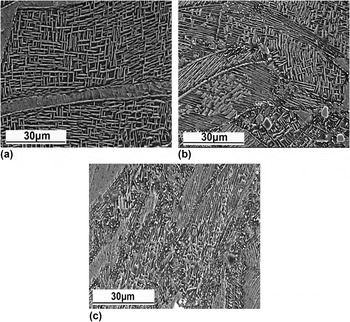
The present study shows that it is apparent, for a given aging time and temperature, that the δ-phase particles become more blocky or globular and less plate-like or rod-like as the degree of cold rolling increases. Regardless of the same alteration in the appearance of δ-phase particles for the cold-rolled samples aged at both low and high temperatures, two completely different mechanisms are also introduced to undertake the explanation of this evolution process. As exhibited in Fig. 11, for cold-rolled samples aged at 900 °C for 12 h, the content of plate-like or rod-like δ-phase particles decreases while the content of blocky or globular δ-phase particles increases with the increase in the degree of cold rolling. Desvallees et al.
Reference Desvallees, Bouzidi, Bois, Beaude and Loria22
reported that the stable morphology of the δ-phase particles was mainly determined by the temperature such that for heat treatments below 930 °C the steady morphology was rod-like, whereas spherical δ-phase particles were formed as the temperature is increased. Sundararaman et al.
Reference Sudararaman, Mukhopadhyay and Banerjee7
found that when δ-phase precipitated in the grains, δ-phase yielded the crystallographic orientation relationship between γ and δ phases; the orientation relationship could be expressed as:
 ${\left( {010} \right)_\delta }//{\left\langle {111} \right\rangle _\gamma }$
,
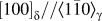 ${\left[ {100} \right]_\delta }//{\left\langle {1\bar 10} \right\rangle _\gamma }$
. In the present study, for the 0 pct (undeformed) cold-rolled samples aged at 850 and 900 °C, δ-phase is normally in the stable plate-like morphology, keeping the crystallographic orientation relationship. For cold-rolled samples, the matrix is deformed, which results in the destruction of the ordered structure of the matrix to some extent and a higher strain energy. As a consequence, a loss of the orientation relationship between γ-phase and δ-phase takes place due to the destruction of the ordered structure of the matrix, promoting the precipitation of globular δ phase which has a less crystallographic orientation relationship. Moreover, to reduce the strain energy created by cold rolling, there is a tendency for δ phase to be in the form of blocky/spherical particles which have a smaller surface energy than the rod/plate δ-phase. Based on the analysis, it is suggested that a larger cold rolling will produce more spherical δ-phase particles for the cold-rolled samples aged at 850 and 900 °C. The same result that a larger cold rolling will produce more spherical δ-phase particles is observed at high temperatures (950 and 1000 °C), which is verified by the microstructure presented in Fig. 8. The valid explanation is related to the migration of a high-angle boundary of recrystallized grains through the δ-phase particles which may lead to a dissolution of majority of the plate/rod δ-phase particles, the loss of their orientation relationship with the matrix for any small amount of remaining plate/rod δ-phase, followed by the growth of this remaining phase into a globular δ-phase. As mentioned above, a smaller recrystallized grain size is obtained by a heavier cold rolling. The finer grains have a larger dissolution rate of the plate/rod δ-phase particles because of a shorter grain boundary with a higher velocity of the migration during aging. This indicates that a higher degree of cold rolling results in a larger dissolution rate of the plate/rod δ-phase and a larger formation rate of the spherical δ-phase. The fact that the finer grains have a larger dissolution rate of the plate/rod δ-phase can be confirmed by the curves in Fig. 9(d), which exhibits a steeper decline of the curves as cold rolling ranging from 25 pct to 55 pct extending aging time from 6 h to 24 h.
SEM photographs of the various degrees cold-rolled Inconel 718 alloy samples aged at 900 °C for 12 h (a) 25 pct (b) 40 pct (c) 55 pct.

IV. CONCLUSIONS
Based on the results obtained in the present study, dealing with the effects of cold rolling on the microstructure, the precipitation behavior and the morphology of δ-phase in Inconel 718 alloy, the following conclusions can be formulated:
-
(1) No phases precipitate from the austenite matrix during cold rolling.
-
(2) For the cold-rolled samples aged at low temperatures (850 and 900 °C), recovery is the main mechanism of the microstructural changes and the recovery undergoes slowly due to the low stacking fault energy. While recrystallization prevails for the cold-rolled samples aged at high temperatures (950 and 1000 °C) and a smaller recrystallized grain size is obtained as the degree of cold rolling increases.
-
(3) For the cold-rolled samples aged at low temperatures, cold rolling promotes δ-phase precipitating within the grains and δ-phase particles become more uniformly distributed as the degree of cold rolling increases, which is related to the density of dislocations within the grain at low aging temperatures. While the precipitation of δ-phase at the twin and grain boundaries is involved in the increase of the grain boundaries, which results from recrystallization behavior at high aging temperatures.
-
(4) For cold-rolled samples aged at all tested temperatures, the morphology of δ-phase particles turns more equiaxed as the degree of cold rolling increases. δ-phase appears in a more globular shape to reduce the strain energy at low aging temperatures; whereas at high aging temperatures, δ-phase particles are spherical as a result of the dissolution of the rod/plate δ-phase particles induced by the migration of the newly recrystallized grains.
ACKNOWLEDGMENTS
The authors are grateful to the China National Funds for Distinguished Young Scientists (Grant No. 51325401), the National High Technology Research and Development Program of China (No. 2015AA042504), the National Natural Science Foundation of China (Grant No. 51474156) and the Natural Science Foundation of Tianjin City (Grant No. 12JCYBJC11800) for grant and financial support.