Whether the human mind computes numerical information by creating uniform abstract representations of magnitude or by making reference to distinct modality- and notation-specific representations is an important theoretical question. Similarly to Cohen Kadosh & Walsh (CK&W), we favor the latter view, but we also propose the notion of “simulation” to further clarify the quality of such representations. Ambiguity in defining “abstractness” leads to attribution of several features (e.g., automaticity, implicitness/explicitness, and generalizing power) to number representations without explaining how they are related hierarchically and functionally. Without this elaboration, specific predictions and implications for non-abstract theories of numerical cognition may also remain ambiguous.
The simulation theory of cognition (e.g., Barsalou et al. Reference Barsalou, Santos, Simmons, Wilson, De Vega, Glenberg and Graesser2008) avoids such ambiguities. Simulation in this view is “the re-enactment of perceptual, motor and introspective states acquired during experience with the world, body and mind” (Barsalou Reference Barsalou2008, p. 618). We agree with the idea that simulation is the principle diagnostic feature of non-abstractness and propose a further distinction between grounded, embodied, and situated conceptual simulations. The resulting hierarchy helps to clarify the empirically testable implications of this view for human cognition in general and explain the wide range of features specific to numerical representations. In the following, we first describe this hierarchy and then provide empirical support.
A cognitive representation is grounded when its structure reflects the properties of the Euclidean world. This is the most fundamental aspect of non-abstract representations. Next, a cognitive representation can be embodied if it is bound by the experiential (e.g., perceptual or motor) constraints imposed by the human organism. Not all cognitive representations are embodied (e.g., some dreams). Finally, a cognitive representation can be situated when it is sensitive to the context in which it is generated.
The experimental study of number processing provides ample evidence for a simulation view of numerical cognition. Specifically, we think that the spatial biases known to accompany number processing (SNARC effect; see Figure 1 of the target article) systematically highlight the features of non-abstract number representation. Grounding, for example, is revealed in the association of larger numbers with upward positions and smaller numbers with downward positions (Schwarz & Keus Reference Schwarz and Keus2004; see also Fischer & Campens Reference Fischer and Campens2008). The embodiment of number processing is evident from effects of finger counting habits on adult number processing (Fischer Reference Fischer2008) and from the spontaneous modulation of grasp aperture by task-irrelevant number magnitudes (Andres et al. Reference Andres, Ostry, Nicol and Paus2008). Finally, situatedness of numerical cognition is indicated by the range-dependence of the SNARC effect that shows that we take into account (or simulate) the current relative meaning of numbers (see Fischer Reference Fischer2006, for evidence and discussion). CK&W correctly point out that such context-dependence is especially evident in the cognitive representation of negative numbers (Fischer Reference Fischer2003; Fischer & Rottmann Reference Fischer and Rottmann2005). Understanding non-abstract representations as cognitive simulations along the dimensions of grounding, embodiment, and situatedness provides a theoretical platform for real-life number representation. The proposed hierarchy of features of number representation allows us to interpret observed effects within an interconnected model.
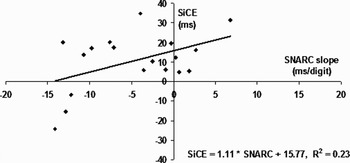
Participants with a typical SNARC (left side of the graph) tend to have a weaker size congruity effect (SiCE). This suggests a conflict between attention to physical and semantic aspects of numbers.

A recent study of both SNARC and size congruity effect (SiCE; see sect. 6 of the target article) illustrates how features of non-abstract number representation interact. In a speeded binary classification task, 18 participants indicated whether single digits were more or less than 5. Digits 1, 4, 6, and 9 were randomly shown in either 12- or 60-point font size. In addition to the typical SNARC (p < .01) and SiCE (p < .01) effects, we found a positive correlation between the two (p < .05; see our Fig. 1): Participants with a strong SiCE tend to have a weaker SNARC. This interaction between SiCE and SNARC indicates that features of number representation compete for the same cognitive resource. One possible interpretation of this novel result from the perspective of cognitive simulation theory is that attending to irrelevant physical attributes of digits grounds their cognitive representation. This may, in turn, prevent their embodiment by inhibiting their mapping onto space. Further studies of the task-dependence of number simulation will clarify to which extent SiCE and SNARC can be situated (Platenburg et al., in preparation).
A re-analysis of recently published data supports the view that number representations can be simulated on-line. In a pointing task (Pinhas & Fischer Reference Pinhas and Fischer2008), adults located the results of addition or subtraction problems on a visually presented line with flankers 0 and 10 on a touch screen. They located the same number more rightward during addition (e.g., 4 + 2) than during subtraction (e.g., 8 − 2). This suggests a simulation of addition as rightward movement along a mental number line and a simulation of subtraction as leftward movement. A congruency effect in pointing times supports this interpretation and shows that our task evoked grounded, embodied, and even situated number representations. We next tested the prediction of CK&W's processing model that non-abstract effects are more prevalent for fast compared to slow responses. To do this, we split each participant's response times in the zero problems (e.g., 4 + 0, 4 – 0) along the mean of their distribution into fast and slow responses. The spatial simulation effect was significant for fast responses, t(13) = 2.66, p < .02, but not for slow responses, t(13) = 1.65, p > .12. This result supports CK&W's proposal (see their Fig. 5) that automatic number processing precedes intentional processing. It is worth noting that this outcome is actually in conflict with Barsalou et al.'s (Reference Barsalou, Santos, Simmons, Wilson, De Vega, Glenberg and Graesser2008) suggestion that situated simulations always follow abstract (language-based) representations.