Introduction
What the general public perceives as the reasons for poverty is generally considered to be an important aspect of a country's welfare culture, since it seems to be related to the design of its welfare system and to determine the legitimacy of its specific welfare programmes. As early as in 1908, in his essay on Der Arme [The Poor Person] Georg Simmel argued that the generosity of welfare and poor relief programmes was directly dependent upon the degree to which the poor are seen by the public as being responsible for their deplorable situation (Simmel, Reference Simmel and Simmel1908). Similar views are still held – for example, by Kluegel et al. (Reference Kluegel, Csepeli, Kolosi, Örkény, Neményi, Kluegel, Mason and Wegener1995) and Jordan (Reference Jordan1996) – who suggest a relationship between the selective and less generous character of the British and, especially, American welfare state, and the liberal tradition of these countries, which locates the main cause of poverty in the individual and their morals and behaviour. The more universal and generous character of the Western European welfare states is explained from a ‘patriarchal’ (Kluegel) or ‘continental’ (Jordan) tradition, in which societal or structural explanations of poverty – external to the individual – prevail. The central position that this difference in popular explanations of poverty occupies in the normative underpinnings of both welfare approaches is stressed again in recent comparisons of American and European welfare state models and policies (Lockhart, Reference Lockhart2001; Alesina and Angeletos, Reference Alesina and Angeletos2002). Also, within individual welfare systems, people's beliefs about the reasons for poverty and need have implications for the legitimacy and viability of specific types of social policy. Kluegel and Smith (Reference Kluegel and Smith1986), for instance, argue that, in the USA, the belief that ultimately all people are individually responsible for their own economic fate is a strong barrier for policies that – like affirmative action for black people and women, or adequate benefits for the non-working poor – try to undo or compensate for the structural factors that induce poverty. And it is generally acknowledged that in the US blaming the poor for their ‘laziness’ prevents them from being seen as deserving of welfare protection (Gans, Reference Gans1995; Gilens, Reference Gilens1999). Also in Europe, many studies have shown that the social legitimacy of welfare benefit schemes is closely related to the degree to which the members of a scheme's target group are seen as being personally responsible for their neediness (for example, Forma, Reference Forma1997; Blekesaune and Quadagno, Reference Blekesaune and Quadagno2003; Mau, Reference Mau2003; Albrekt Larsen, Reference Albrekt Larsen2006; van Oorschot, Reference van Oorschot2006).
Although most of the literature points to the possible implications of popular perceptions for policy-making, some argue that governments may (also) manipulate perceptions in order to induce legitimacy for their policies (for example, Taylor-Gooby, Reference Taylor-Gooby1983; Zaller, Reference Zaller1992; Kuran, Reference Kuran1995; Burstein, Reference Burstein1998). This, however, opens up a wider discussion of factors which – like the media (for example, Golding and Middleton, Reference Golding and Middleton1982; Kennamer, Reference Kennamer and Kennamer1994; Lemert, Reference Lemert and Kennamer1994; Tipton, Reference Tipton and Kennamer1994; Gilens, Reference Gilens1996, Reference Gilens1999; Clawson and Trice, Reference Clawson and Trice2000; Bullock et al., Reference Bullock, Wyche and Williams2001) – play a role in the processes of perception formation. While such a discussion is pertinent to the understanding of public attitudes towards the poor, it falls beyond the scope of this article.
All in all, it seems that the public's views on the poor and the reasons for poverty provide important insights into the legitimacy of social and economic inequality, as well as the legitimacy of collective responses to it in the form of institutionalised welfare systems and anti-poverty policies. Curiously, however, in the midst of studies on poverty per se – its measurement, dynamics, causes and consequences – research on popular perceptions of the poor and lay attributions for living in need appears relatively infrequent. Moreover, much of the existing studies seem to suffer from considerable limitations. Many studies apply a simplified three-tier typology of explanations; most neglect human proneness to ambiguity and inconsistency; and the majority rely on a generic, i.e. undifferentiated rather than ‘target-specific’ conceptualisation of poverty.
In this article, we review the existing studies in the light of the above critique. We point to the complexity of public beliefs and question the customary classification of lay poverty attribution into structural, individual and fatalistic beliefs; draw attention to the compound nature of public perceptions and the existence of composite explanations; and comment on the problematic generic treatment of poverty and the poor in the mainstream of studies. Our critique is interwoven into the discussion of the two most common approaches to studying lay poverty attributions: the factor analytical approach and the forced-choice-question approach.
Typologies of poverty explanations: is there a consensus?
A dominant tradition of empirical studies on popular poverty attributions builds upon the early work by Feagin (1972, 1975). In this tradition, factorial analyses are applied to a (varying) series of items tapping explanations for poverty in order to elicit basic types of popular poverty attributions.Footnote 1 While this approach sheds considerable light on popular beliefs about the causes of poverty, it fails to capture the complexity of popular attributions and, above all, proves inadequate to determine the actual types of explanations.
The US study by Feagin (Reference Feagin1972) was the first to examine systematically lay beliefs about the causes of poverty. On the basis of pre-test interviews and prevailing public discussions, Feagin developed a list of 11 possible explanations for destitution, which he categorised into three main types: individualistic, which attributed responsibility for poverty to the poor themselves (for example, lack of thrift, lack of effort, loose morals); structural, which held responsible the external and economic forces (for example, low wages, no good schools, absence of jobs, prejudice and discrimination); and fatalistic, which accounted for factors beyond the control of individuals, yet did not charge the society (such as bad luck, illness or lack of ability). The validity of this three-tier classification was confirmed in a 1969 survey, in which US respondents were asked to rate the importance of each of the reasons (Feagin, Reference Feagin1975).
Feagin's list of 11 causes was replicated, with minor adjustments, in subsequent studies of poverty attributions both in the US (Kluegel and Smith, Reference Kluegel and Smith1986) and abroad (for example, Feather, Reference Feather1974). In most cases the original a priori classification into individualistic, structural and fatalistic explanations was verified and sustained, even when a more robust analysis of data was performed (for example, Feather, Reference Feather1974). At the same time, studies that notably extended or modified the original list of explanations produced less unequivocal results. Although their authors claimed that the findings generally supported Feagin's three-tier categorisation, when examined with more scrutiny the results indicate that the three classes of poverty attributions, and especially the structural explanations, may not be exhaustive and be subject to further categorisation. For instance, a series of studies by Furnham (1982a, 1982b) and Payne and Furnham (Reference Payne and Furnham1985), in which various groups of British and West Indian respondents were asked to rate 15 reasons for destitution from all three categories of explanations (Feagin's list of 11 causes supplemented by four items derived from pilot interviews conducted in England), produced mixed results. While the first analysis yielded three factors that more or less matched the a priori categorisation, the other two resulted in the emergence of four factors instead of the expected three – the additional factor being structural.Footnote 2 The presence of the second societal factor led the authors to plea for a more refined treatment of societal explanations, which, in future questionnaires, should be ‘broken down into finer units’ (Payne and Furnham, Reference Payne and Furnham1985: 224). The study by Morçöl (Reference Morçöl1997), which tested the applicability of Feagin's typology of explanations in Turkish society, indicated that such a recommendation may indeed be valid. The principal component analysis of responses to ten items tapping poverty explanations resulted in the emergence of five factors – two individualistic, two structural and one fatalistic. The two structural factors differed in their level of abstractness – with one representing more abstract or macro-level explanations (socio-economic system and income distribution), preferred by the non-poor, and the other related to more tangible or concrete explanations (unemployment and lack of education), favoured by poorer respondents. The two individual components, on the other hand, were distinguished by the level of personal blame, with one of them referring to alleged personality flaws (laziness and lack of entrepreneurial spirit) and the other pointing to behaviours of the poor (having many children and migration), which, according to Morçöl, might ‘be interpreted as consequences of social and cultural conditions’ (1997: 731). The emergence of five components led Morçöl to believe that Feagin's original dimensions must have had sub-dimensions.
The reasons for the incongruities between the results obtained by Feagin and those by other authors may stem from cross-cultural differences (the studies were conducted in different societies) or they may reflect time difference and the possible historical change (time-lag). However, they may also suggest that Feagin's original list of items, and therefore his typology, is not exhaustive. Among the items listed by Feagin, none accounted for community and/or family-related causes of destitution and hence indicate a more ecological or cultural type of poverty explanations; neither were there reasons that would try to combine the structural and the individual (Smith and Stone, Reference Smith and Stone1989). However, studies that introduced such extra explanations indicated considerable public support for alternative perspectives.
Nilson (Reference Nilson1981), for instance, analysed the US Americans’ ratings of 12 poverty explanations, encompassing individual, structural and ‘in-between’ institutional causes and indicated the importance of the latter. According to Nilson, institutional explanations (including insufficient education in poor neighbourhoods, a seniority system in companies that works against the poor and trade unions that block the opportunities for the poor) could potentially ally either individual outlooks (the poor fail to take advantage of the opportunities provided) or structural outlooks (the poor are discriminated against in the process of allocating opportunities). Hence, the fact that these explanations stood alone and formed a distinct factor was a sign of their unique yet synthesised quality. By attributing poverty to discrimination in the middle-level institutions, the institutional explanations offered a compromise ‘that rests on ideological inconsistencies – accepting and rejecting both opposing ideologies at the time’ (Nilson, Reference Nilson1981: 545). As emphasised by Nilson, it was this hybrid character – the inherent ambiguity of institutional explanations, the non-obligation to commit oneself to either of the ideological camps – which generated broad public support, independent of major social cleavages (ibid.).Footnote 3
The existence and significance of alternative poverty explanations was also noted by Smith and Stone (Reference Smith and Stone1989), who confronted their US respondents with 38 specific causes of poverty and wealth emanating from four theoretical perspectives on socio-economic inequalities: individualism, culturalism, structuralism/situationalism, and fatalism. In their interpretation of the results, the authors emphasised the pluralism of causal explanations endorsed by the public and pointed to the relative weight of what they called ‘cultural’ reasons, such as having too many children, not being motivated because of welfare, living in broken families, being born inferior, being born with low IQ, being forced to attend bad schools, or being victims of government that is insensitive to their plight. The latter finding seems of particular importance in the light of the comprehensive nature of the cultural theoretical perspective as conceptualised by the authors. To Smith and Stone, the cultural perspective blends the elements of individualism with structural considerations and points to mutual reinforcement of social structure and personality traits.
Cultural explanations also emerged as an important addition to individual and structural attributions in a study by Cozzarelli et al. (Reference Cozzarelli, Wilkinson and Tagler2001). Contrary to the authors' expectations, a principal component analysis of poverty explanations produced results that failed to account for fatalistic reasons, yet yielded a component that reflected culture-of-poverty beliefs. The presence of such a component (encompassing items such as the breakdown of the nuclear family, being born into poverty) suggested, according to the authors, that respondents ‘see a distinction between a lack of economic opportunity and being part of a subculture of poverty’ (ibid.: 222). At the same time, a moderate and positive correlation between structural and cultural explanations, but no correlation between either individualistic and structural, or individualistic and cultural attributions indicates that the culture-of-poverty explanation might be a variation of the structural component. This partly corroborates the findings of Nilson (Reference Nilson1981), who noted moderately positive correlations between structural and institutional beliefs, as well as negative correlations between individual and structural factors and between individual and institutional factors. Most importantly, however, both – the institutional factor found by Nilson and the culture-of-poverty factor found by Cozzarelli et al. – display a hybrid in-between character that suggests the presence of a category of explanations that falls between strictly structural and purely individual attributions, yet is still somehow closer to the external reasons for poverty. This, in turn, points to some inclination on the part of the public to see the poor as active agents yet entangled in a web of social constraints.
Although not as widely discussed, the treatment, relevance and relative importance of fatalistic explanations of poverty seem problematic as well. While present and tested in almost all studies on lay poverty perceptions, individual fatalistic attributions (such as bad luck) do not generate consistent results either in terms of their relative importance or in terms of their place in the overall constellation of poverty perceptions. Researchers tend to: (a) note low adherence to fatalistic causes in general (Smith and Stone, Reference Smith and Stone1989); (b) draw attention to uneven support for various fatalistic causes, with some fatalistic explanations being much more popular than others (Feagin, Reference Feagin1975; Smith and Stone, Reference Smith and Stone1989); (c) report the mixed character of a fatalistic set of beliefs (factors) yielded by various analytical procedures (Furnham, Reference Furnham1982a, Reference Furnham1982b; Payne and Furnham, Reference Payne and Furnham1985); or (d) account for a failure to extract a fatalistic set of beliefs as a distinct category in poverty explanations (Cozzarelli et al., Reference Cozzarelli, Wilkinson and Tagler2001). Most interesting as to the typology of poverty attributions is (c): the mixed nature of fatalistic factors identified in various studies. While in some studies individual fatalistic items load on a factor together with societal explanations, such as a failure of the society to provide good schools, or prejudice and discrimination against the poor (Furnham, Reference Furnham1982a; Payne and Furnham, Reference Payne and Furnham1985; Bullock, Reference Bullock1999), they may also load with familial attributions (Morçöl, Reference Morçöl1997). The emergence of such mixed factors may indicate that in the public mind the poor are unlucky not, or not only, in an individual sense but rather, or also, as victims of societal processes that cannot be easily compensated for. Unfortunately, the existence of a ‘social fatalistic’ type of explanation for poverty has not been systematically investigated. The only factor analytical study that included items tapping ‘social fate’, such as ‘world-wide recession and inflation’ or ‘the introduction of widespread automation’ concerned in fact the attributions for unemployment (Furnham, Reference Furnham1982c) and failed to produce a clear-cut pattern of responses.
Summing up, then, a thorough literature review indicates that the three-tier typology of poverty explanations that dominated most of past research might be inadequate. It does not exhaust the list of potential types of attributions and blurs differences within explanations labelled by Feagin as structural and fatalistic. It seems that in addition to the customary structural, individualistic and fatalistic attributions, some sub-type and/or composite explanations (that is, explanations that embrace elements of various types of causal beliefs) could perhaps be distinguished. Moreover, the typology itself seems rather erratic – reformulating the original explanations or adding more ambiguous attributions leads to a reshuffling in the existing classification or emergence of an alternative one. Taken a step further, this may cast doubt on the usefulness of the factor analytical approach in determining the actual types of popular poverty attributions. It seems that the number of factors elicited in an analysis and their subsequent interpretation depend quite strongly on the actual list of items used in the survey: that is, they depend on the number, the character and the specific formulation of explanations put forward to respondents. While this appears a serious drawback, existing research does not seem to offer an optimal alternative.
Need for compound attributions
Alongside the factorial approach, an alternative tradition has developed, especially in Europe, in which respondents are asked to react to a specific standard set of four reasons for poverty. This tradition builds upon a Eurobarometer survey carried out in the mid 1970s, where respondents were asked the following (Riffault and Rabier, Reference Riffault and Rabier1977):
Why do you think there are people who live in need?
Here are four opinions: which is the closest to yours:
Because they have been unlucky
Because of laziness and lack of willpower
Because there is a lot of injustice in our society
It is an inevitable part of the way the modern world is going
(None of these)
(Don't know)
Although seemingly straightforward and customarily used in all Eurobarometer surveys on poverty and social exclusion as well as – in a slightly modified version – in the European Values Study (EVS) and the British Social Attitude (BSA) survey, the question constitutes quite a challenge when it comes to interpreting its specific categories. Van Oorschot and Halman (Reference van Oorschot and Halman2000) suggest that the four explanations reflect a typology of poverty attributions in which two dimensions are crossed: an individual–societal dimension, referring to whether the causes of poverty are seen to operate at the level of the individual or the society, and a blame–fate dimension, referring to the degree to which poverty is seen as the (intended or unintended) result of agency. The individual-blame type (cf. Feagin's individualistic type of explanation) is seen to be reflected in the item on laziness and lack of willpower; the item on unluckiness signifies some type of individual-fate (cf. Feagin's fatalistic type of attribution); the item on social injustice represents the type of societal-blame (cf. Feagin's structural type of explanation); and the item on modern world suggests some type of societal-fate. The issue of agency is present also in the conceptualisation by Albrekt Larsen (Reference Albrekt Larsen2005), in which the four categories have been collapsed and dichotomised into an internal control (laziness) versus external explanations (the other three causes). In Gallie and Paugam's interpretation, however, the explanations have been conceived as ‘factual’ (unluckiness and modern world) that pass no judgement at all, and ‘ideological’ (laziness and social injustice) that imply some criticism of either the poor or the society, with the latter construed as ‘contrasting opinions whose ideological and political orientation are obvious to all’ (Gallie and Paugam, Reference Gallie and Paugam2002).
The obviousness of the above interpretations can, however, be questioned. As discussed in the previous section, factor analytical research conducted in various countries and among different social groups resulted in quite dissimilar clusters of explanations labelled by authors as structural, individual or even fatalistic. It seems, therefore, rather arbitrary to treat the attributions included in the Eurobarometer question as self-evident, especially as little has been done to establish what is behind the four categories of explanations in terms of public perceptions.
This interpretative confusion can be partly solved by reference to the additional opinion data from the Eurobarometer 40.1 from 1993.Footnote 4 Exceptionally, this particular edition of the Eurobarometer survey includes not only the standard forced-choice question on the four general reasons for poverty, but also an additional question which presents respondents with a series of 16 more specific causes of poverty, of which they can choose the three most common. By combining the answers to both questions, we can identify the meanings that respondents from 12 European countries attach to the general attributions. While by doing this we cannot resolve all the interpretative queries, we can shed new light on the lay understanding of the four general explanations and thus help future interpretations of findings based on this widely used question.
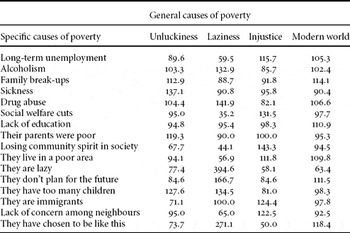
In the Eurobarometer 40.1, in addition to the standard forced-choice question quoted above, the respondents were asked to indicate which three of the 16 specific causes of poverty they considered most common: social welfare cuts, lack of concern amongst neighbours, sickness, family break-ups, their parents were poor, losing community spirit in our society, alcoholism, long-term unemployment, they live in a poor area, drug abuse, they don't plan for the future, lack of education, they are lazy, they have too many children, they are immigrants, they have chosen to be like this. They could also opt for don't know. Table 1 shows index figures which indicate to what degree the group of people opting for either one of the answers to the standard question about the four general causes of poverty mentioned a specific cause more or less often than this cause was mentioned by the whole sample. A score below 100 indicates that the people opting for a general cause opt less than average for a specific cause at issue. Scores above 100 indicate higher-than-average choice for a specific cause.
Specific causes of poverty by general poverty explanations in 12 European nations in 1993 (indices*)

Notes: *Results are indexed as a percentage of the average response rate (example: 56.8% of all respondents picked unemployment as a specific cause of poverty; yet of those who attribute poverty to bad luck 50.9% did so; hence if 56.8% = 100, 50.95 = 89.6). Cell frequencies range between 6238 and 6240.
Source: Eurobarometer 40.1 (1993).
Results presented in Table 1 indicate the existence of a regular pattern. People who select laziness and lack of willpower as the single most important general cause of destitution mention laziness as the most common specific reason for poverty, too. They are also more likely than other groups to associate poverty with addiction (alcoholism, drug abuse), having too many children, lack of future planning, and many of them see living in (material) need as a deliberate choice. Not surprisingly, this group of respondents is less likely than others to see poverty as a result of welfare cuts, loss of community spirit or unemployment: that is, (social) factors which are clearly beyond the control of the poor themselves. We could thus conclude that those who choose laziness and lack of willpower as the single most important reason for living in need, associate poverty with (moral) weakness (addiction, no planning) and personal (ir-)responsibility (laziness, choice), and see it as self-inflicted.
Similarly straightforward, although slightly more complex, is the interpretation attached to social injustice. Our results indicate that respondents who select social injustice as the main general cause of living in poverty typically associate destitution with factors external to those inflicted. Interestingly, they focus on two dimensions: socio-economic causes in the form of welfare state retrenchment (cuts) and the failure of the state to take care of the most vulnerable groups (long-term unemployed, immigrants) and socio-cultural causes manifested in the rupture of social bond (lack of neighbours' concern, loss of community spirit). This group of respondents is also more likely than others to attribute poverty to social ecology (living in a poor area) and, not surprisingly, least inclined to see destitution as a matter of choice or a result of laziness.
More perplexing is the popular interpretation of individual fate. Those who pick unluckiness as the single most important cause of poverty are more likely than other respondents to associate poverty with sickness on the one hand, and family-related issues (family break-ups, poor parents, having too many children) on the other. The fact that being sick is commonly seen as a manifestation of unluckiness and something beyond an individual's control raises hardly any queries. It is interesting to note, however, that people's family background is also considered a matter of individual fate. Particularly interesting here are the interpretative ambiguities related to the choice of having too many children as one of the three most common causes of poverty. Having too many children is associated with unluckiness by one group of respondents, yet with laziness by another. Apparently, there are competing views on whether having too many children is something which simply happens to (poor) people, and for which they cannot be blamed, or whether it is something people can plan, but which the poor are typically not willing or able to do.
Most confounding, however, is the pattern of responses associated with the belief that poverty is a part of the way the modern world is going. The belief is associated with quite a mixture of specific poverty explanations, including social background (lack of education, living in a poor area), family history (family break-ups), possible self-infliction (choice, lack of future planning, addiction) and long-term unemployment: that is, explanations which are favoured by people who attribute poverty to unluckiness, laziness or social injustice. In our view, this indicates the all-embracing character of the modern world category. This peculiar inclusiveness is further reflected in the fact that people who opt for this general cause do not explicitly reject any specific causes in a very decisive manner, except for laziness only.
All in all, a cross-tabulation of responses to both questions tapping poverty attributions points towards the existence of a regular pattern. It shows certain consistency in the choice of poverty explanations on the part of the European public and answers – to a certain extent – the question about the kind of interpretations that Europeans attach to general poverty attributions. Laziness and lack of willpower is most often associated with own choice and self-infliction and can be therefore interpreted quite literally. Social injustice, on the other hand, appears associated with a variety of social processes, from those related to the state of the economy (long-term unemployment) and/or the operations of the (welfare) state (cuts), to those linked to the issues of social ecology and stratification (poor area, immigrants), through to those touching upon the weakening of social bond and dwindling social solidarity. While unluckiness seems most frequently associated with factors beyond the control of the individual (sickness, family background), it seems slightly confounded with attributions that touch on individual agency (having too many children, addiction). Most interesting, however, is the impossible task of attaching a clear interpretation to the category of modern world. This type of attribution seems to constitute an all-inclusive grouping that blends elements of the individual, structural and fatalistic reasoning. As such, it implies some confusion on the part of the public, ambiguity inherent in their beliefs and/or their reluctance to opt for a single more tangible explanation.
Essentially, our findings cast doubt on the adequacy of dichotomising the four Eurobarometer (and, by extension, EVS and BSA) attributions along the lines of factual–ideological (Gallie and Paugam, Reference Gallie and Paugam2002), individual control versus external (Albrekt Larsen, Reference Albrekt Larsen2005) or individual–social and blame–fate (van Oorschot and Halman, Reference van Oorschot and Halman2000). What makes all these dichotomies particularly problematic is the element of individual agency evident in the modern world category, which questions the validity of classifying modern world as a fully ‘external’, ‘factual’ (where factual implies lack of moral judgement) or even ‘social’ attribution.Footnote 5 Indeed, it seems much more meaningful, although methodologically more cumbersome, to analyse the question as it is: that is, considering all four categories of explanations as distinctive attributions. Even then, however, the interpretation of the results with respect to modern world category commands special caution. Problematic here is not only the all-inclusive character of modern world explanation but also – or in particular – the difficulty in discerning the public motivation for choosing it.
On the one hand, the public need for such a compound belief can be interpreted in the light of the split-consciousness thesis (Kluegel et al., Reference Kluegel, Csepeli, Kolosi, Örkény, Neményi, Kluegel, Mason and Wegener1995), according to which people – prone to inconsistency and ambivalence – are likely to adhere simultaneously to very different, even conflicting, views and formulate outlooks which might be logically incoherent. Indeed, evidence of split-consciousness in beliefs about poverty can be traced in studies conducted in the US (Kluegel and Smith, Reference Kluegel and Smith1986; cf. Lee et al., Reference Lee, Jones and Lewis1990; Hunt, Reference Hunt1996), as well as in European societies (Kluegel et al., Reference Kluegel, Csepeli, Kolosi, Örkény, Neményi, Kluegel, Mason and Wegener1995; Kreidl, Reference Kreidl2000). On the other hand, a preference for this type of compound explanation might be seen as a sign of a very sophisticated and realistic view of the poor on the part of the general public, who perceive different segments of the destitute (for example, the homeless, single mothers, the working poor) to be affected by different causes. This possibility brings to the fore the issue of validity of research that relies on a ‘generic’ – that is, undifferentiated – conceptualisation of poverty, and thus precludes the possibility that the public might offer different explanations for different types of material destitution.
What types of poverty?
In the main stream of research on lay explanations of poverty, the concept of poverty is treated generically: that is, respondents are asked to indicate their reasons for ‘poverty’ as a general phenomenon. However, critics draw attention to the many faces of poverty and note that ‘when employed as general stimulus, “poverty” may call up very different images, including welfare mothers, the homeless or the migrant labourers’ (Lee et al., Reference Lee, Jones and Lewis1990: 254–255). By confronting survey respondents with ‘the poor’ as an undifferentiated whole, the generic approach fails to account for the dissimilar images interviewees may have in mind when answering the questions (Castell and Thomson, Reference Castell and Thompson2007). Moreover, the generic approach rules out the possibility that different types of poverty evoke different causal interpretations (Castell and Thomson, Reference Castell and Thompson2007; Lee et al., Reference Lee, Lewis and Jones1992; Wilson, Reference Wilson1996). Yet, in a study on public beliefs about the causes of homelessness, Lee et al. (Reference Lee, Jones and Lewis1990) found that the US public is more inclined to attribute this form of poverty to structural and fatalistic, rather than to individualistic causes, which is quite at odds with the results of the generic studies of poverty explanations (cf. Lee et al., Reference Lee, Lewis and Jones1992). Similarly, Wilson (Reference Wilson1996) found that US respondents attribute homelessness to structural and fatalistic causes, yet apply predominantly individualistic attributions to explain poverty of welfare dependents, and both structural and individualistic explanations to account for poverty of migrant labourers. Wilson attributed those differences to the perceived racial composition of the specific groups of the poor (homeless – white, welfare recipients – black, migrant labourers – Latino) and/or dissimilar media coverage on each of them (emphasising individual blame in case of welfare recipients and structural causation in case of the homeless).
Empirical evidence that different poverty explanations account for the situation of different categories of the poor was provided also by Furnham (Reference Furnham1982b), who noted that in British society of the 1980s ‘low wages in some businesses and industry’ were in general regarded as a more important cause of poverty for working-class black people than for working-class white people, whereas ‘high taxes and no incentives’ as well as ‘lack of thrift and proper money management’ were generally considered more relevant to account for poverty of middle-class and working-class white people rather than working-class black people. As concluded by Furnham, the special circumstances of different groups of the poor, and especially their class and race, evoke different poverty explanations, with some explanations becoming salient for some categories of the poor but not others.
Further arguments against the generic approach to studying perceptions of poverty and the poor can be derived from opinion research, which shows that a change in the wording of questions about poverty generates quite a different response pattern. While being negative about welfare recipients, suspicious about their honesty and integrity, and eager to cut down on welfare programmes, the US Americans display strong support for groups of the poor that are considered deserving or sympathetic, such as ‘poor children’ or ‘the homeless’ (cf. Shapiro et al., Reference Shapiro, Patterson, Russell and Young1987; Smith, Reference Smith1987; Weaver et al., Reference Weaver, Shapiro and Jacobs1995; Shaw and Shapiro, Reference Shaw and Shapiro2002; for similar findings with respect to British society, see Orton and Rowlingson, Reference Orton and Rowlingson2007; Park et al., Reference Park, Phillips and Robinson2007). Such a drastic shift in opinions in response to an alteration in how a question is worded is, according to Will, ‘an example of problems that arise when respondents are presented with global questions or asked about issues . . . about which they may have no information or no specific details’ (Will, Reference Will1993: 316).
It seems clear then that the particular images people have in mind when asked about the reasons for poverty influence their choice of possible explanations. Since the composition of the group of the poor and the salience of various images may differ between countries and also within countries over time, this may, in addition to differences in items lists, account for the dissimilarities in factor outcomes and – eventually – discrepancies between the various typologies of explanations. It may also account for the all-inclusive character of the Eurobarometer's modern world explanation demonstrated in the previous section. Undoubtedly, findings from studies on lay explanations of poverty would gain precision and validity if they included information on the specific images of the poor that respondents (might) have in mind when answering survey questions. Ideally, the researchers should specify to their respondents the group of the poor whose poverty they are considering when responding to specific survey items.
Conclusions and discussion
Popular explanations of poverty are an important element in a country's welfare culture. They seem to have implications for the legitimacy of the general welfare state approaches as well as the more particular types of welfare programmes. Yet, curiously, studies on popular perception of and attribution for poverty are relatively infrequent. Moreover, a considerable part of the research on the social construction of poverty seems conceptually and/or methodologically flawed. Of the two dominant empirical approaches to studying lay poverty explanations – factor analytical approach and forced-choice-question approach – neither succeeds in determining the actual types of poverty attributions nor gives justice to the complexity of public perceptions.
Our review of empirical studies conducted in the factorial tradition indicates the inadequacy of the Feaginian three-tier typology of beliefs and the arbitrariness of the customary classification of poverty attributions into structural, individualistic and fatalistic. Least controversial appears the Feaginian individualistic explanation, which attributes poverty to the personality and behaviour of the poor. Slightly more problematic is the fatalistic type of explanation, which – frequently grouped together with structural and situational attributions – seems to call for a more refined treatment of human misfortune. Most fractions in the typology occur, however, with respect to structural reasons. It seems that the structural explanation, as it was originally understood and presented by Feagin, might be in fact multidimensional. Particularly interesting here is the existence of ‘hybrid’, in-between attributions, such as ‘institutional’ or ‘cultural’, that combine individual blame with structural reasons and see the poor as active agents who operate in a web of social constraints.
Our interpretation of the categories of ‘forced-choice’ explanations included, for instance, in the Eurobarometer survey also points to the insufficiency of the existing typologies. On the one hand, our results confirm the existence of an individualistic type of poverty explanation, which blames poverty on the poor themselves, and structural type of attribution, which pertains to broadly understood societal and structural constraints. On the other hand, our analysis shows the complexity of an individual fatalistic explanation, which encompasses family background and might be in fact interpreted as a compilation of fate, social determinism and individual agency. Finally, our findings point to the existence of an all-embracing modern world attribution that encompasses fatalistic, structural and individualistic explanations. The interaction between the various causal mechanisms suggested in the modern world attribution draws attention to what some writers in the factorial tradition refer to as a cultural type of explanation. At the same time, it questions the interpretations – typical for the forced-choice-question approach – according to which modern world attribution can be conceived as external to the poor: that is, as one that locates the responsibility for poverty entirely outside those inflicted. The element of individual agency detected in it, in our analysis, clearly precludes any such interpretation.
The reason why the existing approaches fail to capture the actual types of popular poverty attributions might be in essence methodological. The forced-choice-question approach used in Eurobarometer (and also other surveys, including EVS and BSA) seems to engage in trimming the public mind to match the pre-conceived ideas, whose meanings are blurred and the origins vague, perhaps owing to the failure of Riffault and Rabier (Reference Riffault and Rabier1977) to elaborate on the theoretical and/or empirical work from which the four categories were initially derived. Moreover, considering the sensitive and morally biased nature of the question about the causes of poverty, it might be the forced-choice-design itself that stimulates the preference for the highly ambiguous modern world category. As discussed by Dhar and Simonson (Reference Dhar and Simonson2003: 147), forced choice in a situation of preference uncertainty can produce conflict and psychological discomfort and induce the selection of options which – like modern world – do not connote ‘hard choices’ and reduce the likelihood of error. Nonetheless, the factor analytical approach is not methodologically faultless either. It seems to depend very strongly on the actual list of items used in the survey. Modifications in the number of items put forward to respondents, their character or even specific formulation, clearly affect the number, content and the subsequent interpretation of the typologies extracted.
However, a failure to determine the actual types of popular poverty explanations in past research might be (also) related to its conceptual inadequacy. Regardless of their actual number, the various explanations of poverty – although competing – are not mutually exclusive. As already mentioned, inconsistency and proneness to logically incoherent outlooks is essentially human and it might very well explain the reshuffling of poverty attributions from categories that appear logical, at least by researchers' standards, into grouping of seemingly contradictory (composite) explanations.
All in all, the complexity of public beliefs calls for such a formulation of survey items that would allow the respondents to express their ambiguity and also make it easier for the researcher to detect the subtleties of public views. This may involve, for example, an inclusion of a long list of items (factor analytical approach), reference to some sort of additional information from respondents regarding their images of the poor to facilitate the interpretation of the survey items (forced-choice question), or turning to alternative approaches to studying poverty attributions, such as, for example, vignettes (Will, Reference Will1993) or discursive analysis (Harper, Reference Harper, Carr and Sloan2003). Above all, it should involve the non-generic conceptualisation of poverty that would allow capturing the alleged connection between the dominant images of the poor and poverty attributions endorsed.
In more general terms, it seems that in order to avoid scientific artefacts, research into public explanations for poverty should first and foremost focus on developing better tools for measuring the various types of poverty attributions. In doing so, it should not only account for the complexity of public beliefs and their compound nature, but attend as well to the possibility that public attributions might differ according to groups of the poor.