In savanna ecosystems, mound-building termites are recognized as ecosystem engineers (Dangerfield et al. Reference DANGERFIELD, MCCARTHY and ELLERY1998) and often promote the development of diverse woody plant assemblages through mound building and foraging activities (Eldridge et al. Reference ELDRIDGE, LEPAGE, BRYANNAH, OUEDRAOGO, Tongway, Valentin and Seghieri2001, Sileshi et al. Reference SILESHI, ARSHAD, KONATE and NKUNIKA2010). The structural features of termite mounds provide refuges for plants; for example, their elevated topographies may provide safe havens from seasonal flooding (McCarthy et al. Reference MCCARTHY, ELLERY and DANGERFIELD1998) and wildfires (Groen et al. Reference GROEN, VAN LANGEVELDE, DE VIJVER, GOVENDER and PRINS2008).
These positive effects on savanna vegetation have been identified in comparisons between sites on and off termite mounds. Within-mound variation in vegetation, however, has received little attention even though mound soil hardness, status (termites active or not) and micro-topography promote variability in the configuration of plant assemblages growing on mounds. Glover et al. (Reference GLOVER, TRUMP and WATERIDGE1964) and Yamashina (Reference YAMASHINA2010) suggested that active termite constructions may suppress plant establishment by developing soils that are hard and impervious. Arshad (Reference ARSHAD1982) and Pomeroy (Reference POMEROY1983) showed that the central portions of mounds are bare of vegetation and that grass productivity is elevated on outwash pediments and surrounding areas.
This study tested two hypotheses: (1) species composition, richness and abundances of woody plants vary within and between mounds, between active and inactive mounds, and between sites on and off mounds; and (2) if vegetation is differentiated in this manner, then soil hardness, mound status (active or not) and mound micro-topography (conical portions or pediments) are likely determinants of vegetation structure. To explore these hypotheses, woody plants’ species composition and abundances, and soil hardness were examined at different sites within mounds, on active and inactive mounds, and at sites on and off mounds in a savanna landscape. Testing these hypotheses will hopefully elucidate the functional ecology of termite mounds in savanna ecosystems.
Field research was conducted in the Muyako community forest (17.88°S, 24.4°E, c. 1000 m asl) in the Caprivi Region of Namibia. The research periods were October–December 2009, and June, July and December 2010. Annual precipitation (mean ± SD) for the period 2004–2007 was 733.5 ± 64.5 mm (Namibia Meteorological Service); most precipitation fell between October and March. Average temperature was 20–22 °C. The local vegetation was classified as mopane (Colophospermum mopane) woodland by Werger & Coetzee (Reference WERGER, COETZEE and Werger1978).
In total, 70 termite mounds wider than 1 m were selected by accessibility. These mounds were classified as active or inactive based on signs of new structures on the mounds or the presence of termites after rainfall in 2009. The interiors of unidentified conical mounds were checked and termites were found in 10 of them. Termite samples were collected from two mounds. Each of the samples contained numerous soldiers and workers identified as Macrotermes michaelseni (Sjöstedt) by a termite expert.
To explore the effect of mound micro-topography on vegetation, active mounds were classified into those with conical parts surrounded by pediments formed from the deposition of material freed by erosion and mounds with conical parts only, i.e. without pediments. Inactive mounds were not classified in this manner because the boundaries between conical parts and pediments were indistinct. Dangerfield et al. (Reference DANGERFIELD, MCCARTHY and ELLERY1998) and McCarthy et al. (Reference MCCARTHY, ELLERY and DANGERFIELD1998, Reference MCCARTHY, HUMPHRIES, MAHOMED, LE ROUX and VERHAGEN2012) suggested that islands in the Okavango Delta originated as mounds built by M. michaelseni, with subsequent expansion of the original structures through accumulation of minerals in ground water (as a result of transpiration in plants growing on the mounds). After classification, large, inactive mounds were therefore analysed as structures that had developed sequentially from conical, active mounds.
Soil hardness was measured with a Yamanaka soil tester (Fujiwara Sci. Co., Tokyo, Japan) in 24 plots. Separate measurements were made on the cones and pediments of four active mounds, on nine inactive mounds, and on seven plots in the savanna. Measurements were made at five positions per plot where the substratum was dry and without grass cover; average values were used in subsequent analyses. Percentages of grass cover (at 5% cover intervals) were determined in the same plots using a 1-m2 quadrat. The measurements were conducted at the beginning of the rainy season in 2009 (October–November.). Species composition and the abundances of mature woody plants (height ≥1.3 m and dbh ≥1 cm) were recorded on the 70 mounds and in 13 quadrats (each 20 × 20 m) located in the savanna at least 50 m distant from the mound perimeters. Plant species nomenclature follows van Wyk & van Wyk (Reference DEAN, MILTON and JELTSCH1997).
Tukey's HSD tests were used for multiple comparisons to test for differences in soil hardness, tree species richness and abundances among active mounds with and without pediments, inactive mounds and locations off mounds. Grass cover values were compared with non-parametric Steel–Dwass multiple comparison tests because discrete measures were analysed. The relationship between soil hardness and grass cover was examined by calculating Spearman's rank correlation coefficients after testing for normality. All statistical analyses were performed using R software (version 2.14.1 for Windows, R Foundation for Statistical Computing, Vienna, Austria) at a 5% significance level.
Of the 70 mounds surveyed, 33 were active and 37 inactive. Among the active mounds, 16 had distinct pediments that surrounded active cones; the remaining 17 mounds did not have pediments. The heights (mean ± SD) of active mounds without and with pediments, and inactive mounds were 2.4 ± 1.0, 3.1 ± 1.0 and 2.4 ± 0.8 m, respectively. The diameters (mean ± SD) of active mounds without and with pediments, and inactive mounds were 2.7 ± 2.2, 14.1 ± 5.6 and 16.9 ± 8.2 m, respectively.
Soil hardness was significantly higher (more than six-fold) on the conical parts than on pediments and inactive mounds (Table 1). Grass cover was lower on the cones of active mounds than on inactive mounds (Table 1). Overall, grass cover was negatively correlated with soil hardness (Spearman's rank correlation; ρ = −0.57, P < 0.01, n = 24).
Soil hardness and grass cover (mean ± SD) on active mounds, inactive mounds and off mounds in north-eastern Namibia. Different superscripted letters in rows indicate statistically significant differences among site types at P < 0.05 (Tukey's HSD test or Steel–Dwass tests). The measurements were made at the beginning of the rainy season in October and November 2009. n, number of surveyed plots.

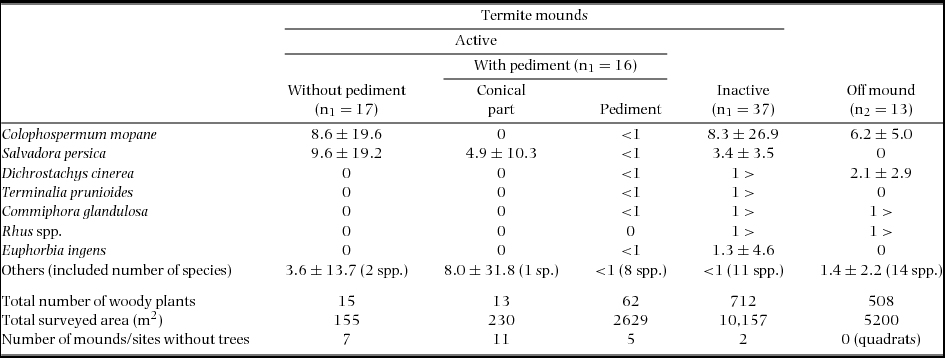
In total, 11 of 33 (33%) active mounds (including both cones and pediments), 18 of 33 (54%) active cones and two of 37 (5%) inactive mounds lacked trees. In total, 1310 woody plant specimens were identified to 30 species. Species composition and richness varied between on and off mounds and within mounds. Colophospermum mopane dominated off mounds (Table 2). Salvadora persica was limited to mounds (Table 2), occurring on 14 of 32 (42%) active mounds and 32 of 37 (86%) inactive mounds. Few tree species grew on conical parts, but S. persica was a typical component of cone vegetation and was very abundant on the cones of active and inactive mounds, though less so on pediments (Table 2). Species richness per mound (mean ± SD) was higher on inactive mounds (4.4 ± 2.7) than on active mounds with (2.0 ± 1.8) (P < 0.01) and without pediments (0.6 ± 0.6) (P < 0.0001). Tree abundances per mound (mean ± SD) was also higher on inactive mounds (19.4 ± 18.8) than on active mounds with (4.6 ± 6.6) (P < 0.01) and without pediments (0.9 ± 1.1) (P < 0.01).
Mature tree density per 100 m2 (mean ± SD) by species on active mounds, inactive mounds and off mounds in north-eastern Namibia. Average tree densities of less than one per 100 m2 are indicated by <1. Seven highest ranked species present on more than 40 trees appeared in total. n1, number of termite mounds, n2, number of quadrats.

Soil hardness affected vegetation. The species richness and occurrence ratios of woody plants were lower on the conical parts of active mounds than on pediments and inactive mounds. The conical parts of mounds had higher soil hardness compared with pediments and inactive mounds. Therefore, elevated soil hardness is proposed as a putative factor suppressing the establishment of plants on mounds; this hypothesis is corroborated by the negative correlation between soil hardness and grass cover.
The negative influence of mound soil hardness on vegetation may be maintained over decades or longer due to the longevity of termite colonies and the long-term persistence of their mounds. For example, queens of Macrotermes sp. live 11–19 y (Keller Reference KELLER1998), and mounds are estimated to survive for about 10 y in Uganda and the colonies for 4 y on average (Pomeroy Reference POMEROY1976). Abandoned mounds become favoured sites for recolonization by new termite colonies, and as this process repeats, the mounds grow larger (Dangerfield et al. Reference DANGERFIELD, MCCARTHY and ELLERY1998). Thus, active mound hardness probably suppresses plant establishment for at least decades, although plants may obtain footholds on mound pediments, which form gradually and are less hard than cones (Table 1). This view is consistent with the higher species richness on cones and lower species richness on pediments (Table 2). After abandonment by termites, whole mounds become susceptible to plant encroachment. Thus, more diverse woody plant assemblages are formed on abandoned (= inactive) mounds compared with off-mound sites (Table 2).
While diverse woody plants occurred on pediments and inactive mounds, S. persica occurred nearly exclusively on cones, despite the hardness of the soil there. Seed dispersal patterns may account for the establishment of S. persica on active mounds. Salvadora persica, which has fleshy red fruits that are about 5 mm long, is a bird-dispersed species. During the fruiting season from October to December 2010, many birds were observed feeding on the fruits. Isolated trees (Dean et al. Reference DEAN, MILTON and JELTSCH1999) and rocky outcrops (Carlucci et al. Reference CARLUCCI, DUARTE and PILLAR2011) in open areas like savanna act as perch sites, below which an elevated seed rain is carried by bird droppings. Thus, seeds of S. persica are probably preferentially dispersed to mounds by birds and other animals that use the conical structures of the mounds as perch sites in the sparse mopane woodland. Also, particular traits of S. persica, including features of its roots and plant's germination and establishment processes, may account for this species’ preference for termite mounds as habitat, but as yet there are no data from north-eastern Namibia to support this premise. Although C. mopane was sometimes found on active mounds without pediments (Table 2), these trees were thought to have been present before the mounds were built around them; thus, these trees were half-buried in the mounds and were relatively tall and thick.
This study demonstrated that vegetation varies among termite mounds, depending on soil hardness, mound status (termites active or not) and micro-topography. Empirical testing of factors that may influence the dispersal and establishment process of plants on mounds is a crucial next step towards a fuller understanding of the development processes that promote diverse vegetation patches on termite mounds.
ACKNOWLEDGEMENTS
This research was financially supported by a Grant-in-Aid from the Japan Society for the Promotion of Science (JSPS) Fellows (No. 21-4226). I am grateful to Associate Professors K. Mizuno, G. Yamakoshi (Kyoto Univ.) and three reviewers for valuable suggestions. I thank Professor Y. Takematsu for termite identification. I especially thank Mr J. Mulofa and all villagers in the study area for their hospitality and cooperation.