1. Before the Phoenicians?
The cultivation of the (hermaphrodite) vitis vinifera vinifera from its wild (dioecious) ancestor v.v. sylvestris, originatesReference McGovern, Glusker, Exsner and Voigt1, Reference Ramishvili2 in Neolithic times in a region that includes today's North-Western Iran, Armenia, Azerbaijan, and Russian Georgia. The oldest chemical and archaeological proof of winemaking to date comes from Hajji Firuz Tepe, a Neolithic site in North-Western Iran dated 5000–5400BC. The shape of the grape pipsReference Leonard3 found at the site proves that hermaphrodite (cultivated) vines were used. The oldest known wine-making setup is in Southern Armenia at a siteReference Barnard, Dooley, Areshian, Gasparyan and Faull4 called Areni-1, not very far north of Hajji Firuz Tepe. It is dated 4100BC. The wine-making involved crushing clusters of grape, probably by foot. The juice would flow into buried clay jars for fermentation. Here again, the shape of the pips provides evidence of vine cultivation.
Viticulture had to be imported into the Iberian Peninsula since v.v. sylvestris is not native to the region. It is well established that, almost 3000 years ago, the Phoenicians brought vine cuttings and knowledge of viticulture and winemaking to Southern Spain. However, it is not known if the local population (referred to as ‘celtiberians’) cultivated grapes before that time. A decorated fourth century BC clay drinking cup (Figure 1) was found in a tomb in the Ribera del Duero region. This is before any Roman influence. This is also far away from the coast and from direct Phoenician influence. The chemical analysis of the residue in the cup (tartaric acid and phenolic compounds) proves that it did contain wine.
(Colour online) Replica of the fourth century BC wine-drinking cup (left) from Ribera del Duero (courtesy Eduardo Cano, Consejo Regulador de la Denominacion de Origen Ribera del Duero) next to a modern glass (photo: SKE).

2. From Phoenician Times to the Moors
The PhoeniciansReference Caven5, 6 from Tyre establish Gadir (‘walled city’, now Cádiz), Xera (now Jerez), Malaka (‘salt’, now Málaga), and other settlements in Southern Spain, most probably starting around 800BC. The often quoted7 date of 1100BC is not supported by archaeology. The oldest Phoenician artefact found in the region is dated around 800BC.
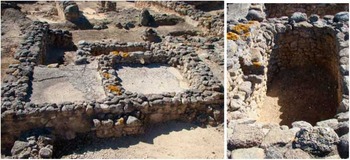
The oldest part (c. 600BC) of the archaeological site at Castillo de Doña Blanca, located between Jerez and Cádiz, includes (Figure 2) what is best described as a Phoenician lago (lagar in Portuguese): a flat area where grapes are trodden by foot and the juice collected in amphorae for fermentation. The Phoenicians took advantage of the warm and dry climate to make sweet and strong (white) wines along the coast of Southern Spain and in Málaga, much of it for trade.
(Colour online) Phoenician lago (left) in the oldest part (c. 600BC) of the archaeological site of Castillo de Doña Blanca. An amphora would be placed in the deeper hole (right) to collect the grape juice for fermentation (photo: SKE).

These early Phoenician settlements fall under the sway of Carthage and expand around 500BC. In 270BC, Hamilcar Barca, the father of Hannibal, establishes his capital at Cartago Nova (now Cartagena) and founds Barcelona (Barcino, after his name8).
A comment about the birth of Carthage: Princess Elissa is forced to flee Tyre after the death of her father, King Mattan. In 814BC, she and her companions arrive in today's Tunisia and request from the local population as much land as can fit within the skin of one bull. This is granted. The legend says that the clever Elissa cuts the skin into a very thin ribbon and then stretches it to encompass the hill on which Bysra is built. It is said that ‘bysra’ refers to a bull's skin in Ancient Greek. After some decades of successful trade, the settlement grows in population and power, and an addition located north of Bysra is constructed. They call it Qart-hadasht, ‘new city’: Carthage. The name sticks. Thus, Hamilcar's Cartago Nova literally means ‘new new city’.
But the days of the Carthaginians are numbered as the power of Rome grows. The first Punic war (264–241BC) gives the Romans control over Sicily and much of the maritime trade in the central and western Mediterranean. The second Punic war (218–201BC) starts with Hannibal rampaging across all of Italy and severely defeating multiple Roman armies. Surprisingly, he decides not to attack Rome itself. The Romans switch to guerrilla tactics and, in 206BC, send Scipio (later known as Africanus) to Spain to cut off Hannibal's supply lines. Scipio conquers much of Spain. This marks the end of Phoenician rule in the Iberian Peninsula and the beginning of about six centuries of Roman rule. The Third Punic war (149–146BC) consists of the complete destruction of the city of Carthage and the brutal end of the Phoenician Empire.
In 138BC, Scipio (Aemillianus) pacifies the south of Spain. Gadir becomes Gades and Xera becomes Ceret (later Seris and then Jerez). The making of vinum ceretensis involves boiling must to concentrate the sugars and adding some of the concentrate to the wine. This allows the fermentation to continue until the alcohol level is high enough to kill the yeast (possibly 14–15%, but this depends on the type of yeast) and the wine still contains residual sugar. This type of wine – powerful, sweet, and capable of ageing – is highly valued in Rome. By the turn of the first Millennium, large quantities of Spanish wines are exported throughout the Roman Empire.Reference Fleming9
The Romans establish settlements throughout Hispania, from the Mediterranean all the way to the Atlantic coast near Coimbra and in the north of Spain in Lagroño (Vareira). They produce wine almost everywhere they settle. Vinum terraconensis from Tarragona, south of Barcelona, has a good reputation. The Greek historian, geographer and philosopher Strabo (c.64BC – AD24) mentions10 the wine from Spain but does not comment on its quality. The Roman poet Ovid (43BC – AD17/18) suggests11 that Spanish wines are strong and expensive:
You can get the keeper under, however prying he may be, by giving him a good stiff drink; and even if you have to give him Spanish wine, it's worth it.
Evidence that wines from Spain are shipped throughout the Roman Empire also comes from marked amphorae, such as a fragmentReference Fleming9 with the label ‘LQS’ (Figure 3) found near Hadrian's Wall at the northern edge of the Roman Empire. The initials are those of Lucius Quintus Secondus the Elder, a wine dealer from Southern Spain.
(Colour online) Seal of Lucius Quintus Secondus the Elder (AD80–130), a wine dealer from Southern Spain, on an amphora fragment found near Hadrian's Wall (courtesy of S.J. Fleming).

During some 1200 years of Phoenician (c. 800BC – 206BC) and Roman (206BC – AD409) rule, sufficient quantities of Spanish wines of recognized quality are produced for export throughout the Roman Empire. This comes to a halt with the collapse of the Western Roman Empire. I am not aware of any records documenting exports of Spanish wine from the fifth to the 12th century, when Henry I of England (reigns 1100–1135) trades wool for ‘sherish’ wine.
The collapse of the Western Roman Empire is better described as slow erosion than sudden death. Yet, two dates are often mentioned as marking the event. The first, 410, is the (rather gentle) sack of Rome by the Visigoth Alaric. The second, 476, is the (rather gentle) deposition of the last western Roman Emperor, Romulus Augustulus, by Odoacer, king of the Scyrian, an otherwise minor Germanic tribe. But the presence of ‘barbarian’ tribesReference Bury12, Reference Jones13 throughout the Empire is well documented long before these events and alliances between Rome and various tribes are common.
The two most important invaders of the Iberian Peninsula are the Vandals (from 409 to 429) and the Visigoths (from 429 to 711). But they are not alone. In 409, the Hasdingi are in today's Galicia, the Silingi in Andalusia, and the Alans in Portugal. These tribes do not mix with the local population and are by far not numerous enough to impose their customs and lifestyle. None of them has much of an influence on Spanish culture, architecture, language, or wine. The exception is Visigothic law, which remains in use for several centuries.
The Vandals cross into Spain from the north in 409, challenging Roman rule. Emperor Honorius encourages the Visigoths to reclaim Hispania for Rome with a land grant, from Bordeaux to Toulouse, and gives his half-sister Galla Placidia in marriage to king Ataulf.
The Visigoths move their capital from Toulouse to Toledo. By 415, they push the Vandals south to a region now known as Andalusia, probably ‘Vandalusia’ at the time. In 429, the Vandal king Gaiseric moves his people from Spain to North Africa where they are very successful (until of course they are crushed by Justinian's general Belisarius in 533).
The Visigoths rule the Iberian Peninsula until 711, using a Roman-type administration. In 654, they adopt the Fuero Jurgo, a charter of liberties and privileges established by king Reccesuint, which also codified decentralization. Originally, they are Christians, but of the Arian kind. The Arians believe that since Christ is the son of God, then God had to be there first and is superior since a father has authority over a son. On the other hand, the Catholics place the entire Holy Trinity – Father, Son, and Holy Spirit – on an equal footing. It is amazing how many perfectly good people have suffered and died over heresies of this nature. As Arians, the Visigoths are very tolerant of Catholics and Jews, but they start to persecute and enslave the Jews after convertingReference Wolff14 to Catholicism in 589.
Justinian is the last Byzantine emperor to attempt to rebuild the former Roman Empire, and this includes Hispania. His very successful general Belisarius re-conquers Cádiz in 550. But the Iberian Peninsula is too far away from Constantinople, especially after Justinian's plagueReference Rosen15 ravages its population (and army). The Visigoths reclaim Cádiz in 572.
As far as wine is concerned, I am not aware of any development worthy of comment during the Vandal and Visigoth periods. A good assumption is that the production and consumption of wine remains local, using Roman-style vinification techniques (fermentation in barrels or amphorae), but involves little or no long-distance trade. No major scientific or technological achievement occurs during these three centuries. But wine does not have enemies either.
3. Islamic Spain
Islamic SpainReference Glubb16–18 begins in 711. The Berber Tariq ibn Ziyad crosses from North Africa into Spain at a spot now called Gibraltar (Jabal Tariq means ‘mountain of Tariq’; Gibr Tariq means ‘rock of Tariq’). He defeats the Visigoth Roderic at Guadalete, not far from Jerez. Tariq, the first Emir of Al-Andalus, is sent to Damascus in 712. He is replaced by his commander, Musal bin Nusair (also a Berber, Musal means ‘Moses’) who expands the territory under his control.
By 732, Al-Andalus includes all of South and Central Spain and Portugal, up to the Duero River in Spain and the southern half of the city of Coimbra in Portugal. The Muslim armies even enter France but their presence north of the Pyrenean Mountains is short-lived.19 Christians and Jews are not Muslims but nonetheless ‘People of the Book’. Their property is protected, and taxed.
In 740, an Arab army sent from Damascus to quell a Berber rebellion is badly beaten on its way across North Africa. The survivors find refuge in Al-Andalus. Arabs and Berbers in Spain will be hostile to each other for centuries.
All the territories under Islamic rule, including Al-Andalus, are governed by a Caliph, the ‘ruler of the Islamic world’. In the early eighth century, the Umayyad dynasty governs from its centre of power, Damascus. In 750, the Abbasids brutally overthrow the Umayyads and move the Caliphate to Baghdad.Reference Kadri20 The influence shifts from the Arabs to the Persians. The only Umayyad survivor, Abd al-Rahman, makes his way to Al-Andalus. He unites Arabs and Berbers (battle of Guadalquivir) and becomes Emir of Cordoba.
From 755 to 1031, the Umayyads reign in Cordoba, a period remembered as the golden age of Islamic Spain. The apogee occurs under the fair-skinned, blue-eyed Emir Abd ar-Rahman III: his mother and paternal grandmother are Christians. Cordoba hosts the largest library in the medieval world. Abd ar-Rahman claims the title of Caliph in 912, which creates some commotion in the Islamic world. In 927, he crushes the Muwallad rebellion – led by a Visigoth-descended family.
At the death of Abd ar-Rahman's son, Al-Hakam II (961–976), his grandson Hisham II is only ten years old. Vizier Al-Mansur takes charge. He grows the army and unsuccessfully attacks the small Christian kingdoms21 in the North of Spain. By 1009, his lack of success and the cost of these campaigns result in a civil war (mostly Arabs versus Berbers).
In 1031, Cordoba falls and the Caliphate breaks up into small ‘kingdoms’, the Taifas. There are 33 of them in the 11th century, 22 in the 12th, and 10 in the 13th. They compete with each other, sometimes even forming temporary alliances with Christian Kings.
In 1060, Pope Alexander II begins the push for the Reconquista, which intensifies as the spirit of the crusades engulfs Europe. Alfonso VI of León-Castile conquers Toledo in 1085, pushing the Christian border south to the river Tagus. Alfonso himself welcomes different religions and Toledo becomes a major cultural centre, but his spirit of tolerance22 does not last.
Alarmed by the Christian successes in the north, the King of the Taifa of Seville asks the Almoravids for help in 1091. This Berber–Muslim dynasty is centred on Marrakesh. The Almoravids are appalled to see Jews, Christians and Muslims coexist in Al-Andalus and even consume alcohol. Their brand of Islam is of the fundamentalist type. Tolerance toward Christians and Jews quickly disappears.
The Almoravids are overtaken by the Almohads23 in 1147. They are just as fanatic. Neither the Almoravids nor the Almohads are militarily successful against the Reconquista. Saragossa falls to Ramiro (Aragon) in 1118 and Lisbon to Afonso I (Dom Afonso Henriques, Portugal) in 1147, with the help of some crusaders.Reference Saramango24 Alfonso VIII (Castile) takes Cuenca in 1177. A major victory by a united Christian army (Sancho VIII of Navarre, Alfonso VIII of Castile, Afonso II of Portugal, and Peter II of Aragon) over the Almohads at Las Navas de Tolosa in 1212 is the point of no return.25 James I (Aragon) takes Majorca in 1229–1230 and Valencia in 1238; Cordoba (1236) and Sevilla (1248) fall to Ferdinand III (Castile); Alfonso X (Castile) takes Jerez in 1264 (he owns vineyards in the region, and wine production increases); James I (Aragon) takes Murcia in 1266 on behalf of Castile.
And then the Reconquista stops for over 200 years. Jerez marks the frontier between Christian and Islamic Spain, hence ‘Jerez de la Frontera’. Most of the Peninsula is under Catholic rule. The only Taifa left is Granada, where many Muslims and Jews find refuge. It stretches all the way to Gibraltar. Grenada is geographically difficult to conquer, the Catholic Kings need to repopulate the territories they have already gained, and the Black PlagueReference Ziegler26, 27 substantially reduces the size of the Christian army (and of the population). Further, Granada poses no immediate threat. The onset of the Little Ice AgeReference Fagan28 at the beginning of the 14th century has a big impact on Northern and Central Europe, but it is not clear how much it affects Spain.
Isabel of Castile marriesReference Bown29 Ferdinand of Aragon in 1469, uniting the two most powerful Christian kingdoms.Reference Mallett30 In 1478, Pope Sixtus IV allows them to establish a special branch of the InquisitionReference Green31, Reference Murphy32 placed under the control of the Crown of Spain, not of the pope. Tomas de Torquemada, the confessor of Isabel, is appointed Grand Inquisitor in 1480.
Muhammad XII (Boabdil) of Granada seeks prestige by attempting to invade Castile. He is taken prisoner at Lucena in 1484 and held prisoner until 1487. He is released after consenting to hold Granada as a tributary kingdom under Ferdinand and Isabel. On 2 January 1492, Boabdil abandons Grenada to Ferdinand and Isabel (and their army). The Reconquista is over.Reference Fernández-Armesto33 Torquemada writes the Edict of Expulsion: all Jews must convert or leave Spain by 1 July 1492. Later that year, under the patronage of Isabel, Columbus ‘discovers’34 America. The Spanish Empire is born.
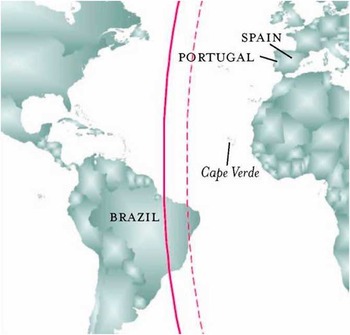
In 1494, Ferdinand and Isabel ratify the Treaty of Tordesillas,Reference Bown29 which amends the division of the world between Spain and Portugal first envisioned by Pope Alexander VI (Rodrigo Borgia, a Spaniard) in the Bull Inter Caetera. This division (Figure 4) is further contested and revised, in particular by the treaties of Madrid (1750), El Pardo (1761), and San Ildefonso (1777). The treaties of Madrid and El Pardo impact the history of the Jesuits and, indirectly, the history of wine, in unexpected ways.
(Colour online) The Treaty of Tordesillas divides the world between Spain (west of the line) and Portugal (east of it). The Portuguese object to an earlier division (dashed line) which gives them too little of Brazil. This raises the question of how much they really knew about the New World in 1494. Further treaties alter the map of Brazil (map: Jo Layne Skillman).

3.1. Wine in Islamic Spain
It is commonly believed that Islam imposes an absolute ban on wine and other alcoholic beverages. The reality is more subtle. The Qur'anReference Pickthall35 mentions wine and strong drinks at least seven times, but only two verses forbid the consumption of alcohol: Surah 5.90 ‘Strong drink and games of chance and idols and divining arrows are only an infamy of Satan's handiwork. Leave it aside in order that ye may succeed.’; Surah 5.91 ‘Satan seeketh only to cast among you enmity and hatred by means of strong drink and games of chance, and turn you from remembrance of Allah and from worship.’
Four verses are more nuanced: Surah 2.219 ‘They question thee about strong drinks and games of chance. Say: in both is great sin and (some) utility for men; but the sin of them is greater than their usefulness…’; Surah 4.43 ‘ Draw not near unto prayer when ye are drunken, till ye know that which ye utter, not when ye are polluted save when journeying upon the road, till ye have bathed…’; Surah 16.67 ‘And of the fruits of the date-palm, and grapes, whence ye derive strong drink and [also] good nourishment.’; Surah 83.25 ‘They are given to drink pure wine, sealed.’.
But Surah 47.15 is the most revealing. It describes the gardens of paradise, promised to those who fulfil their duties to Allah: ‘A similitude of the Garden which those who keep their duty are promised: Therein are rivers of water unpolluted, rivers of milk whereof the flavour changeth not, rivers of wine delicious to the drinker, and rivers of clear-run honey.’ The believers who reach these gardens are rewarded with rivers of wine clearly intended to be drunk. How could a sinful activity become a reward in the gardens of paradise? A number of Islamic poets celebrate wine and drinking.36
The practical reality is that wine (mixed with water) is a safe drink. Travellers normally carry wine with them simply because water easily becomes polluted, and the alcohol in wine kills bacteria. This shows up in the exception in Surah 4.43 ‘… save when journeying upon the road…’.
Islamic Spain has no problem with viticulture and wine. Muslims and non-Muslims alike are fond of nabibi, a sweet wine made with raisins. But public intoxication is punished by prison until sober and then public whipping. When vizier Al-Mansur orders the uprooting of vineyards near Jerez (for religious reasons), the winegrowers successfully argue that they produce raisins for the troops going to jihad. Only about one-third of the vineyards are uprooted.
Wine is continuously produced during the ∼800 years of Islamic Spain, but very little of it is exported – maybe to the enlightened Roger II of Sicily, but probably neither to Catholic Europe nor to other Islamic lands.
3.2. Wine in Christian Spain
In the 10th century, the Palomino family owns vineyards and produces wine near Jerez. Today's dominant sherry grape, the Palomino fino, is named after them. In the early 1100 s, Henry I of England trades wool for ‘sherish’ wine. The famous 1150 map of Europe and North Africa (now at the Bodleian library at Oxford University) by Al Idrisi, cartographer for Roger II, shows Seris, (Jerez) between Kadis (Cádiz) and Isbilia (Sevilla).
In the Christian North of Spain, improvements in winemaking and wine technology arrive with the CisterciansReference Leroux-Dhuys and Gaud37 who expand their networks of Abbeys throughout Europe from their home bases in Burgundy. The word ‘Cistercian’ probably comes from the French cistelle, a reed common in the marshes near the monastery of Cîteaux. The first Cistercian monasteries, established in the late 11th and early 12th centuries, are Molesme, Cîteaux, Pontigny, Clairvaux, and Morimond. Each of them generates a network of ‘daughter-abbeys’ in France and then all over Europe.
The numbers are staggering: two Abbeys in 1098, 300 in 1150, 500 in 1200, 650 in 1250, and 697 in 1300. These numbers exclude hundreds of convents. This growth stops at the onset of the Little Ice Age in the early 1300 s, as massive famines sharply reduce the size of the population.
In Spain and Portugal, the Cistercians are expected to help the Reconquista through prayers of course, but also financially and in-kind. They are given generous grants of land on which they build, cultivate grain and fruits, and plant vineyards. Veruela (filiation of Morimond) in Vera de Moncayo (Aragon) is established in 1146; Alcobaça (filiation of Clairvaux) in Estremadura (Portugal) is established in 1148 on land given by Dom Afonso Henriques, the first king of Portugal; Poblet (filiation of Clairvaux) in Vimbodí (Catalonia), is founded in 1150; Santes Creus (filiation of Clairvaux) in neighbouring Aiguamurcia (Catalonia) is founded in 1150–1158. The list goes on.
The Cistercians are credited with establishing that wine should be macerated for a long time to extract colour and tannin from the skin of the fruit, that barrels must be kept full in order to slow down the oxidation of the wine, and that wines must be kept at a relatively constant temperature. They build the first true wine cellars. They are also very careful about selecting the best soil and exposure before planting vines, and work hard at improving viticulture and wine-making techniques.
In the 1340 s, large quantities of wine from Jerez are exported to the court of Edward III (reigns: 1327–1377) in England. Without a doubt, this ‘sherry’ wine is very different from the one we know today. It is probably sweet and powerful (natural fermentation), but neither fortified nor matured under flor.
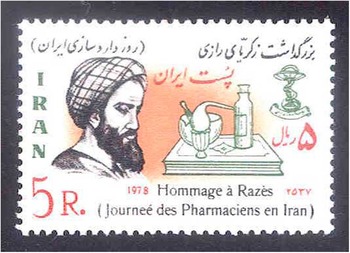
The Persian Muhammad ibn Zakaryiya’ al-RaziReference Al-Hassani, Woodcock and Saoud38 (865–925, Figure 5) discovers the art of distillation of wine. He is a poet, mathematician, astrologer, alchemist, and physician. He improves the design of the alembic (al-anbiq, invented by Jabir Ibn Hayyan) in order to separate alcohol (al-kuhl) from wine. This requires a rather accurate temperature control.
(Colour online) This 1978 Iranian stamp shows Zakaria Razi and a basic alembic similar to the one he used to extract alcohol from wine for medicinal purposes (photo: SKE).

Razi realizes that almost pure alcohol is a remarkable antiseptic. It is in fact the most powerful antiseptic since the dawn of mankind until penicillin becomes available.39 Razi saves many lives. His reputation as a physician is so widespread that he is still celebrated today in Iran: 27 August is ‘pharmacist day’ or ‘Razi day’.
One cannot rule out the possibility that the art of distillation makes its way from Teheran to Al-Andalus, but the Persian presence there is minimal, at best. Further, it is one thing to distil a small amount of wine for medicinal purposes and quite another to produce sufficient quantities of alcohol for the systematic fortification of large volumes of wine. I found no evidence of such production in Spain until well past Islamic rule.
The art of distillation arrives in Europe around 1100 at the medical school in Salerno (Italy) as crusaders return from the Near East with Persian and Arab knowledge and technology. But large-scale distillation is not documented until the 14th century in Armagnac (southern France). It is only in the 1600s that the Dutch begin to systematically add alcohol (distilled wine) to wine in order to strengthen and stabilize it for shipping. This is most probably the period when the wines from Jerez are first fortified. But fortification as an enological technique arrives later in Jerez, possibly during or shortly after the Napoleon era (see below).
In 1345, Don Juan Manuel rules over Peñafiel (Ribera del Duero). He issues 69 ordinances, 22 of which refer to the care and cultivation of vineyards and seven to the wine trade. For example, Ordinance 11 states that anybody who steals cuttings from a vineyard will be fined half a dinero per cutting; Ordinance 14 imposes a fine of 5 maravedies upon anyone entering a vineyard on horseback between 1 May and harvest time. Other regulations impose deadlines on the harvest and regulate specific aspects of viticulture and wine-making.
Starting in the 1400 s, new vineyards are planted farther away from city walls, suggesting that safety is becoming less of an issue. Winemakers are now looking for the best, rather than the safest, locations for their vineyards. Some of today's best Spanish vineyards are first planted at that time.
In 1435, the Minutes of the Jerez town council first refer to exported wine as sacas. The English ‘sack’Reference Jeffs40 comes from the Spanish sacar (to draw: wine drawn from barrels). The word is then used for any export wine: Malaga sack, Canary sack, Sherry sack… ‘Sherry sack’ changes to ‘sherry’ in the late 17th century.
On 12 August 1483, the English, French, and Flemish merchants impose rules on viticulture and winemaking in order to guarantee a supply of wine of predictable quality. The ‘Rules of the Guild of Raisin and Grape Harvesters of Jerez’ describe the harvesting, the characteristics of butts (botas), and the ageing. The storing of wines of different vintage years is discouraged (forbidden?) and referred to as a ‘speculative practice’. These rules prevent winemakers from mixing wines from different vintage years, a practice at the heart of today's Solera y Criadera system, established early in the 19th century. The restrictive rules are abolished in 1775.
4. Hapsburg Kings
In 1496, the second daughter of Ferdinand and Isabel, Juana,41 marries Philip the Handsome, Duke of Burgundy and son of Maximilian I, a Hapsburg. Philip I becomes the first Hapsburg king of Castile (1478–1506). In history books, this counts as Philip I of Spain. He is succeeded by Juana herself.
In 1507, Martin Waldseemüller and Matthias Ringmann publish an astonishing world map, Universalis Cosmographia, which includes the first-ever mention of the word ‘America’. The map shows a remarkably accurate west coast of the Americas.Reference Hessler42 Waldseemüller and Ringmann know that there is an ocean between America and Asia, that Central America is narrow, and that there is an angle between the coasts of Chile and Peru. Even the Rocky Mountains appear to be sketched! Yet, it is commonly believed at the time that America is connected to Asia. It is only in 1513 that the Spaniard Vasco Núñez de Balboa crosses Panama (by foot) and sees an ocean. In 1520, the Portuguese Ferdinand Magellan sails around South America and names the Pacific Ocean. The mysteries43 of Waldseemüller's map is still unresolved.
In 1509, Catherine of Aragon, another daughter of Ferdinand and Isabel, marries Henry VIII of England. The relations between Catholic Spain and Catholic England are good for a while. In 1533, Henry divorces Catherine and, in 1536, declares himself the supreme head of the Church of England. The relations between Spain and England change from good to bad, and remain more often bad than good for centuries.
On 22 January 1510, King Ferdinand signs a decree that initiates large-scale slave trading across the Atlantic.44, Reference Eltis and Richardson45 He sends a shipment of 50 slaves to work in ‘his’ gold mines on the island of Hispaniola. These are not the first slaves crossing the Atlantic. But this is the first large shipment of slaves used for purely economic reasons.
In 1516, the eldest son of Philip and Juana inherits Spain (as Charles I), much of Italy, and the Netherlands. In 1519, he also becomes Holy Roman Emperor (as Charles V). Charles's rule is marked by his poor relations with Francis I of France. They positively hate each other. This renders numerous conflicts much more complicated. The Protestant reformation causes wars as well. Spain becomes involved in these conflicts because Charles is involved. The Spanish economy is weak and the country increasingly depends on silver and gold from its Empire in the Americas.
Charles abdicates in 1556. His brother Ferdinand succeeds him as Holy Roman Emperor while his son Philip (II) gets Spain and its Empire, but also the troubled Netherlands. Ten of the Dutch provinces are Catholic, but the seven northern ones become Calvinist after 1567. They resent being ruled by a Catholic monarch and despise the Inquisition. In 1579, they band together, form the Union of Utrecht, and turn against Spain by declaring themselves independent.46 With few natural resources, the Dutch turn to trade. They are very good (and very aggressive) at it. The Dutch fat ships, known as ‘flyboats’, hold twice as much cargo as English ships, their closest competitors. Within a century, the Dutch colonies stretch from North America (where they establish New Amsterdam, today's New York) all the way to New Zealand, including the Cape, India and Ceylon. In Europe, they dominate the wine trade.
In 1587, Martin Frobisher of Francis Drake's fleet burns some of the Spanish fleet in the bay of Cadiz, sacks the region for three days, and steals some 3000 sherry pipes (Drake still inspires fear among children in southern Spain: El Draque is the boogeyman). Sherry becomes popular in England. More importantly, the theft impacts the Spanish fleet. When Philip II launches his ill-fated Armada against England in 1588, his ships transport foods, water, and gun powder in new – not seasoned – barrels. New barrels tend to leak, spoiling their content, and gun powder gets wet.
Spain is then hit by a massive plague (1596–1602) during which over 1 million deaths are recorded. Philip II dies in 1598 and his son Philip III (reigns 1598–1621) inherits a troubled country. Spain begins an economic and military decline. Miguel de Cervantes publishes Don Quixote in 1605 (Part I) and 1615 (Part II). The lasting legacy of Philip III is the expulsion (1609–1614) of the Moriscos (‘little Moors’), mostly to North Africa. These are former Muslims converted (sometimes forcibly) to Catholicism. Spain loses 4–5% of its most active population, with widespread negative economic consequences.
The size of the Spanish Empire culminates under Philip IV (reigns 1621–1665): over 12 million km2. But the situation at home is bleak. Spain increasingly relies on gold and silver from mines in Central and South America.
The last Hapsburg King of Spain, Charles II (reigns 1665–1700) is best known for his physical, emotional, and psychological disabilities. He is nicknamed El Hechizado, the bewitched. Yet, he (or his ministers) should be credited with the abolition of slavery for the Indian natives in Chile in 1683 (black slaves are freed in 1823). Another century will pass before further progress is achieved against slavery. Charles II dies without heir, but names a Bourbon, Philip Duke of Anjou (a grandson of Louis XIV), as his successor. This paves the way for the War of Spanish Succession.
4.1. Wine in Hapsburg Spain
Before the arrival of the Europeans, no v. vinifera grows outside of Europe and the Near East. More than a dozen species of wild vines are native to the Atlantic coast of North America (v. labrusca, v. rupestris, v. riparia, etc.) but no wild vines bearing grapes grow in Central and South America. The journeyReference Jan de Blij47 of v. vinifera from Europe to Central and South America begins in Mexico, continues in Peru, Bolivia, Chile, Argentina, Uruguay, and Brazil. This takes time. For several decades, much of the wine in the Americas is imported from Spain. These exports become an important source of income for Spain as early as the early 1500 s.
By 1510, wine is allocated one-third of the cargo space on Spanish ships to the Americas. In 1519 Magellan buys 417 wineskins and 253 kegs of Jerez wine for the first trip around the world.
Investment in vineyards and wineries in other parts of Spain are made. Codorníu (in Penedès, West of Barcelona) is established in 1551. The wines from Malaga and the Canary Islands are also known at the time.Reference Latham and Matthews48 But wines produced far from a coast are difficult to export.
The production of wine in Rioja gains economic importance. In the 1500 s, even though wine is kept in barrels (Figure 6, left) some bodegas in Rioja transport it in wineskins (Figure 6, right) to Bilbao and Santander for export via Dutch and English merchants. Local regulations guarantee the quality by restricting the production of ‘Rioja’ wine to grapes produced locally.
(Colour online) Left: A 16th century wine barrel at the Codorníu estate in Penedès. The design includes a large ‘window’ near the top, suggesting that the wine was not destined for aging or transport (photo: SKE). Right: A wineskin exhibited at the Wine Museum in Peñafiel, Ribera del Duero (photo: SKE).

Exports of Spanish wine to England plummet following the Armada debacle. Due to shortages of sherry, James VI and I (reigns 1603–1625) limits the consumption at his table to a meagre 12 gallons per day. We can only shiver at the extent of his suffering.
In the 1600s and 1700s, an increasing number of English, Irish, Scottish, and then French merchants establish their headquarters in Jerez in order to benefit from preferential tariffs when exporting wines: Fitz-Gerald (1682), O'Neale (1691), Murphy (1730), Gordon (1754), Laurie (later: Domecq, 1730), and others.
In medieval times typical wines survive one year at best. Most wines are light, have low alcohol and low tannin. The constant shaking and temperature fluctuations during transport by ship often cause the wine to oxidize or even turn to vinegar. Sweet and fortified wines are more resilient and fetch higher prices.
Thus, the Dutch – the largest wine dealers in the world at the time – encourage the production of late-harvest wines as well as any innovation that helps wines survive longer. One innovation is fortification, which consists in adding grape alcohol to the wine. If done before the end of the fermentation, the added alcohol kills the yeast, and any residual sugar in the wine makes it sweet as well. Another innovation is the use of sulphur to kill fungi and bacteria in the barrels before they are filled.
The Dutch promote the distillation of some wines to produce the alcohol needed for fortification. The region of Armagnac has produced distilled wine since the 14th century. Under Dutch influence, wine is first distilled in Cognac in 1624. Distilleries start operation in Southern Spain at about that time. By 1675, some 17,000 pipes of fortified sherry are exportedReference Phillips49 to England.
In the 1600s, many wineries operate in Central and South America. Their production exceeds the local needs. They begin to export their product to Spain, to the dismay of Spanish producers. In 1699, Charles II becomes concerned over this unwanted competition. He prohibits new wine production in the American Colonies, unless the wine is for church use. What a great loophole this is. The prohibition is widely ignored but is not officially lifted until Mexico gains independence from Spain in 1821.
5. From Bourbon Spain to the Napoleon era
The war of Spanish succession begins in 1701 and partly ends with the Treaty of Utrecht in 1713. Many disputes linger. For example, Spain and Portugal remain formally at war until the Treaty of Madrid in 1750. This treaty partitions Spain's European possessions and redraws the political map of Europe and of some territories in the New World. Louis XIV's grandson Philip, Duke of Anjou (a Bourbon) is finally recognized as King Philip V of Spain (as stipulated in Charles II's will) but he must renounce any right to the French throne. The other descendants of Louis XIV must renounce any claim to the Spanish throne. The Netherlands and Spanish Italy go to Charles VI, Holy Roman Emperor. Portugal increases its territories in Brazil. Great Britain, which captured Gibraltar in 1704, keeps it in perpetuity.50
Philip V begins the unification of Spain by placing the country under the laws of Castile (Decretos de Nueva Planta, 1715). He creates a centralized administration in Madrid and imposes Castilian as the language of the government. He abdicates in 1724 in favour of his son Louis (I), who dies seven months later. He returns to power as his second son Ferdinand is only 11 years old. Philip V dies in 1746.
Ferdinand VI (1713–1759) modernizes the navy and takes measures to stimulate the trade with the Americas. He is succeeded by Charles III (1759–1788), another son of Philip V, who gives up the Kingdom of Naples to become King of Spain.
The Lisbon earthquake of 1 November 1755 destroys most of Lisbon and smaller cities along the coast of Portugal. Sebastião de Carvalho e Melo,Reference Shrady51 the future Marquês of Pombal, takes charge. He ultimately transforms Portugal from a medieval theocracy to a modern state, but steps on a lot of toes in the process. He takes on the Catholic Church, especially the Jesuits. The Portuguese Inquisition is too powerful, even for him. Today, he is still admired by some and hated by many. His story is fascinating. It involves the Jesuit ‘kingdom’ in Paraguay, the Guarani War, and a clever pamphlet52 translated and disseminated on behalf of Carvalho.
The Jesuits are expelled from Portugal in 1759. This expulsion generates a domino effect. They are expelled53 from France in 1762 (following a financial scandal), and then from Spain and all her territories in 1767. It is not completely clear what triggers Charles III to expel the Jesuits, but this has consequences for the history of wine. Indeed, the Jesuits had established several missions in Baja California (Low California in New Spain, today a part of Mexico). Their expulsion creates a vacuum that is filled by the Franciscans, and then by the Dominicans. Father Junipero Serra moves north and establishes the first eight Franciscan missions in Alta California (High California, today's California), starting in San Diego.Reference Yenne54 The California missions develop into major centres, which include vineyards and wine cellars. But they depend on the financial and material support of Spain. This support disappears when Napoleon invades the Peninsula in 1808.
Charles III is involved in several conflicts against Britain and its interests in the Americas and the Philippines. In particular, he supports the future United States during the Revolutionary War (1775–1783), despite the threat US independence poses to the Spanish colonies in the Americas. Indeed, a successful revolution against one colonial power encourages revolutions against other colonial powers.
Charles III dies in 1788. His son Charles IV becomes king. He is physically strong but much more interested in wrestling and hunting than in governing. Following the troubled years of the French Revolution and Terror, power in Spain rests in the hands of Charles's wife, Maria Luisa, and her (very close) friend Manuel de Godoy. Charles IV's lack of leadership combined with the rise of Napoleon in France has serious consequences for Spain.
The slow movement toward the abolition of slavery gains momentum. Sebastião de Carvalho e Melo abolishes it in mainland Portugal and in Portuguese possessions in India (1761), and then in Madeira (1773). Ten years later, the Society for the Abolition of the Slave Trade is established in Britain, leading to the abolition of the slave trade (Figure 7). But huge financial interests are at stake. Further, it is much easier to abolish slavery at home than in a far-away colony. In the Americas, Haiti declares independence and abolishes slavery (1804). Slavery is abolished in Central and South America within a few decades, following the revolutions and the establishment of Constitutions.
(Colour online) A British coin commemorating the 1807 abolition of the slave trade (photo: SKE).

A major blow for Spain is the defeat of the Franco-Spanish fleet at Trafalgar in 1805. This affects not only the alliance between Spain and France, but also weakens the ability of Spain to defend its Empire in the Americas and the Far East. Spain begins to lose large segments of her Empire. The Louisiana Territory is French until 1763, and then becomes Spanish until 1800, but Napoleon reclaims it and sells it to the United States in 1803.
In 1808, Charles IV abdicates in favour of his son Ferdinand (VII), who sought an alliance with Napoleon against Godoy. Ferdinand quickly discovers that it is a mistake to assume that the strong man next door is your ally. French troops are already present in Spain. Ferdinand VII is deposed. Napoleon's brother Joseph becomes king of Spain as José I, until 1813. He is nicknamed Pepe Botella for his love of the bottle (more accurately, of its contents).
Joseph's reign is dominated by the Spanish revolt against Napoleon: the Peninsular War, also known as the War of Spanish Independence (from France). It is the first guerrilla war in modern times and turns into a nightmare for Napoleon's armies. Napoleon also fights against the secular power of the Church, in particular the Spanish Inquisition. The Inquisition is abolished under Joseph, only to be restored55 by Ferdinand VII in 1814. Spanish support for the Franciscan missions in California disappears.
During the Peninsular War, the Spanish partisans call for a Cortes (the Spanish national legislative assembly) to establish a government that would have legitimacy against Napoleon's claims. The Cortes meets in 1810 in Cádiz – under the protection of the British – and includes delegates from most provinces of the Spanish Empire. In 1812, it adopts a very liberal Constitution, which establishes universal (male) suffrage, freedom of the press, land reform, free enterprise, and limits the power of the Church (especially the Inquisition) and of the nobility. The king should govern through ministers under parliamentary control. The 1812 Constitution, the first of seven, is never fully implemented but becomes a lightning rod for decades of political and social unrest.
Following the successful US War of Independence against England, and because of Spain's troubles at home, many regions under the control of Spain in Central and South America seek independence. In the second decade of the 19th century, revolutions occur in Paraguay, Uruguay, Argentina, Chile, and then Peru, Mexico, and Central America. Simon Bolívar establishes Gran Columbia in North and parts of Central America. Florida is sold to the US in 1819. By the middle of the 19th century, only Cuba and Puerto Rico remain under Spain's control in the Americas.
In 1814, Joseph leaves Spain for the Americas, with some of Spain's crown jewels. Ferdinand VII reclaims his throne (until 1833). He promptly repudiates the 1812 Constitution. Several decades of political and social unrest follow.
5.1. Wine in Spain from 1700 to 1814
The early 1700s are marked by war, and this affects wine production and trade. Relations with England – the major wine importer as she produces very little wine herself – are poor. By 1754, only nine sherry shippers are still in business in Jerez.
The old ‘Rules of the Guild of Raisin and Grape Harvesters of Jerez’ are repealed following the so-called ‘extractors action’ (merchants, extractores, versus producers, productores) which begins in 1775 and lasts for a decade or so. Sherry wines can now be aged. This is probably the time when maturing sherry under flor (see below) becomes important.
It is likely that some flor was present in the barrels much earlier and that sherry wines had already acquired some of its characteristic flavour. But keeping wine under flor on purpose probably dates back to this period. The late 1700s is also when the fortification of sherry becomes an oenological technique: up to 15–16% alcohol allows the growth of the flor, more than 17–18% prevents its development.
In the 1780s, Don Manuel Quintano from Burgos introduces oak-barrel aging in the Rioja region of northern Spain for the first time, following a trip to the French Bordeaux wine region. This improves the quality of wine in Rioja, but also adds substantially to its cost. Since the local government dictates the price of wine in the region and keeps it very low regardless of production costs, barrel aging in Rioja is abandoned for almost a century.
The Criaderas y Solera system in Jerez is first mentioned in 1849. Its aim is to produce wines of uniform quality. The word solera has nothing to do with the sun (Latin: sol, Spanish: sol) but refers to the floor or ground (Latin: solum, Spanish: suelo). As for criadera, it means ‘nursery’ in Spanish. A ‘solera’ consists of several layers of sherry pipes (Figure 8). The lowest layer is the proper solera, and the layers of barrels stacked above it are the first, second, third, etc, criadera, respectively. Three to four criaderas are typical, but it can go up to eight.
(Colour online) Left: a four-layer solera at Lustau's bodega in Jerez (photo: SKE). These barrels are neatly labelled for tourists. Sherry pipes belonging to a solera can be kept anywhere in the cellar, and their markings are much more sophisticated. Right: A bottle of amontillado from an 1830 solera, close to when the Criaderas y Solera system was developed (photo: SKE).

A few times a year, wine is drawn from the solera, filtered, and bottled. The solera is then replenished with sherry from the first criadera, which itself is replenished with wine from the second criadera, and so on until new wine is added to the top criadera.56 Some claim that this allows the older wine to gain ‘energy’ from the younger, and the younger wine to get ‘wisdom’ from the older. More importantly than energy and wisdom, the process provides food to the flor, thus keeping it alive. The cycle can keep going for decades, sometimes a century or longer.
5.2. Wines Grown under Flor
The yeast growth that develops on top of some wines is known in Spain as the flor and in France as the voile (Figure 9). This phenomenon is well known in the case of sherry (manzanilla, fino, amontillado – but not oloroso) and of the ‘vin jaune’ in the Jura region of France. But a few other wines also develop under flor, notably in Eastern Hungary. The flor is thickest in the spring and fall, and its development slows down during the summer and winter months.
(Colour online) The flor develops on top of the wine and protects it from oxygen and from the vinegar bacteria. The thickness of the flor varies with the season. The solera system allows the flor to thrive as long as new wine added from time to time. This picture actually shows a barrel of vin jaune. It could as well be a barrel of sherry (photo: SKE).

The common yeast (saccharomyces cerevisiae, type ellipsoidus or bayanus) performs the alcoholic fermentation: it transforms sugars into alcohol (ethanol) and carbon dioxide. The same yeast is also used for baking and brewing. The flor yeasts are saccharomyces beticus, s. mineuliensis, s. cherensiensis, and/or s. rouxii (the latter two are not always present). Different types of yeast dominate at various stages of development and/or under different cellar conditions.
The flor develops on the finished (dry) wine. It feeds on glycerol, trace amounts of sugar, and some aromatic acids. It slowly oxidizes the wine in the process. This is not an oxidation by addition of oxygen but by removal of hydrogen. Indeed, the yeast facilitates the transformation of ethanol (CH3-CH2-OH) into ethanal (CH3-CHO), an aldehyde, which can be toxic to the brain in large amounts. The flor also produces tiny amounts of other chemicals, in particular sotolon (C6H8O3). Ethanal and sotolon are responsible for (most of) the unique flavour of the sherry and of the French ‘vin jaune’ (which is made with the savagnin grape and is not fortified). The flor also prevents the development of acetobacter aceti, the vinegar bacteria. Wines grown under flor never turn to vinegar. Sherry vinegar is not made from sherry matured under flor.
It is not known when sherry first developed the flor and gained its characteristic flavour (certainly, by accident). However, since the 1483 Rules prevented wines from being kept longer than one year, it is most likely that the use of the flor as an oenological tool dates back no earlier than the late 18th century. In contrast, the vin jaune in the Jura has been matured under flor for a very long time. The earliest published57 description of the flor in the Jura dates back to 1592. But anecdotal evidence, suggesting that some special process renders this wine virtually indestructible, dates back to the ninth century.
6. The End of the Empire, Wars, and Dictatorships
Spain remains united as long as Napoleon's army and brother are in the country. But the divisions within Spanish society reappear shortly after Ferdinand VII returns to power and rejects the 1812 Constitution. An army rebellion in 1820 forces him to accept this Constitution and Spain is under liberal rule for three years (Trienio Liberal). And then, the French intervene again and Ferdinand regains full authority.
Spain is broke. Ferdinand is forced to sell Florida to the USA (for $5 million). By the time of Ferdinand's death in 1833, Spain has lost most of its colonies in the Americas. But an even more problematic issue is his succession. Ferdinand's very conservative brother Carlos expects the crown, but it goes to Ferdinand's three-year-old daughter Isabel (II) instead. The Regent is her mother Maria Christina. Carlos flees to Portugal, builds military support in the North of Spain and invades his home country. This is the first of three ‘Carlist Wars’. They deepen the divisions in Spain and distract from the much more serious economic and social problems.
Isabel II is an incompetent and highly unpopular ruler. Spain bounces from one emergency to another. She goes into exile (in Paris) in 1866, leaving anarchy in charge of the country. The Cortes picks a new king for Spain, the liberal Amadeus of Savoy – son of Victor Emmanuel II of Italy. He quickly realizes that Spain is an ungovernable kingdom, and leaves. Spain becomes an ungovernable republic.
In 1874, the army pledges allegiance to Isabel II's son,58 Alfonso (XII). This restores some stability to the country, but Alfonso dies prematurely in 1885. He is succeeded by his posthumous son Alfonso XIII. But now the king is much less relevant. Spain loses the Spanish-American war of 1898, and must give up Cuba, Puerto Rico and the Philippines. These losses bring back to Spain some foreign investment, which provides a temporary boost to the economy.
Spain remains officially neutral during the First World War, as the Left favours the allies while the Right and the Catholic Church support Germany. The economy improves during the war, as Spain is able to supply both sides of the conflict.
The post-First World War years involve some form of alcohol prohibition in many countries – but neither in France nor in Spain. However, the Great Depression hurts everybody. Alfonso XIII delegates power to his minister Miguel Primo de Rivera, who becomes the first military dictator of Spain (1923–1930). His son José Antonio founds the fascist Falange party, and his daughter Pilar the women's section of the Falange. Miguel Primo de Rivera improves the infrastructure of the country. Social and political tensions mount, and Alfonso flees Spain in 1931, without abdicating.
The second Spanish Republic (1931–1936) is unable to unify the country, which is deeply divided between the anarchists–socialists and the Carlist–Fascist groups dominated by the right-wing Falange. This culminates with the Spanish Civil WarReference Payne59–Reference Beevor61 (1936–1939).
Francisco Franco emerges as the unchallenged leader of Spain. Despite Franco's strong dedication to Hitler and Mussolini, Spain remains officially neutral during the Second World War. Thirty-six years of reactionary dictatorship prevent Spain from emerging scientifically.62 The economic recovery begins with the 1953 treaty with the United States and also as a result of tourism. Franco rules with an iron fist until his death on 20 November 1975. King Juan Carlos (a Bourbon) then leads the transition to today's multi-party Constitutional Monarchy. A new Constitution is approved in 1978.
6.1. Wine in Spain from 1814 to the End the Franco Regime
The story of wine in Spain from 1814 to 1975 includes issues unrelated to the political and military events that shake the country. Starting in 1855, a series of natural plagues hit vineyards all around the world, albeit not everywhere at the same time nor with the same intensity. Powdery mildew (a fungus), phylloxera (a root-chewing aphid), and then downy mildew (another fungus), arrive in Europe from the North-East of the United States. And then a series of man-made disasters impact the wine industry: the First World War and the Russian Revolution, Prohibition and the Great Depression, and then the Second World War.
In the early 1800s, winemakers go about their business with as much disregard for the political and economic chaos as possible. The first railway in Andalusia (and the third in Spain) links Jerez to Puerto de Santa María in 1854. In the region of Rioja, new railways link Lagroño to Bilbao and to Madrid. These railways greatly help exports.
The region of Rioja sees substantial technological developments in the 1840s and 1850s. Luciano Murrieta is a Spaniard born in Peru in 1822, just about the time of Peru's independence. He returns to Spain and fights on the losing side of the Carlist war. He then finds himself in London for some years, but returns to Rioja and embraces the wine business.
Murrieta first spends four years (1848–1852) in the region of Bordeaux, learning winemaking techniques. Following his return to Rioja, he introduces large vats for crushing and fermentation, replacing the traditional stone lagos that are used outdoors. Grapes crushed in a lago experience too much heat and too much oxidation, which affects the quality of the wine. He also champions the use of the small (∼250 litres) oak barrels that were first introduced 80 years earlier by Don Manuel Quintano. Murrieta becomes the Marques de Murrieta in recognition of his work to improve the quality of wine in Northern Spain, and then purchases the Ygay estate in 1878. The Marques de Riscal already produces noted wines in Rioja since 1858.
Modern viticulture also emerges in nearby Ribera del Duero. In 1864, Eloy Lecanda purchases some 18,000 cuttings of Cabernet Sauvignon, Malbec, and Merlot, plants them at the Vega Sicilia estate (founded by his father Toribio) and establishes a distillery. His brandies win awards both in Spain and at the 1876 Philadelphia Fair. In 1904, Domingo Garramiola Txomin uses Bordeaux techniques to produce quality red table wines. The first ‘Vega Sicilia’ and ‘Valbuena’ are produced in 1915. Vega Sicilia eventually becomes famous for its red wines (Figure 10).
(Colour online) The 1976 Vega Sicilia indicates ‘Cabernet Sauvignon, Malbec, Merlot, Tinto fino (Tempranillo) y Labile’, in that order. Bordeaux varietals still dominated in the region at the time. Today's Vega Sicilia contains at least 75% Tinto fino, with some addition of Bordeaux varietals from the old (and precious) vineyards (photo: SKE).

The stories of Quintano, Murrieta, and Lecanda show that exchanges between Bordeaux and Rioja or Ribera del Duero exist well before phylloxera devastates Bordeaux (1875–1892). These exchanges greatly increase during the phylloxera years (see below), but are not initiated by the pest.
As mentioned earlier, vitis vinifera is the only wine-producing species of vine in Europe and the Near East. In contrast, some 14 or 15 species of vine are native to North America: v. rupestris, v. labrusca, v. riparia, and so on. None of them produces good wine. On the other hand, v. vinifera cannot survive in the wild in North America because of the presence of fungi, bacteria, viruses, and pests. The various wild American vines evolved ways to resist local threats, possibly resulting in the rich diversity of species. Once Europeans arrive in North America, it is only a matter of time before they inadvertently bring pests and fungi back to Europe and the rest of the world. V. vinifera is unable to survive them.
The problems begin with powdery mildew (oidium), first spotted in England in 1845, and then in France in 1847. This fungus develops on the leaves and fruit of the vine. Wine production in France takes a nosedive. The 1854 vintage is the smallest since the frigid 1788. Mildew arrives in Southern Spain and in Galicia in 1855. It hits Galicia particularly hard, but its impact in Rioja and Ribera is smaller, possibly because of the dryer climate. Powdery mildew is successfully treated by spraying with a mixture of sulphur, lime and water. But many winemakers do not know the details of the mixture, how much to apply, how often, and precisely when. Viticulture acutely suffers from it until 1861. Mildew is still a problem today, especially during wet growing seasons.
Nevertheless, the sherry trade reaches a peak in the 1870s. Spanish brandy, distilled in Jerez and El Puerto de Santa María, is also introduced at that time. In 1872, the first cava wine is bottled at the Codorníu estate in Penedès. The Champagne process has arrived in Spain.
The second and by far the worst American invader is phylloxera.63 It is first noticed in 1863 in Southern France (Côtes du Rhône). It is a tiny but prolific aphid with a complex life cycle. It feeds on the roots of the vine (Figure 11). It lives underground, making it very difficult if not impossible to eradicate. Within a few decades, it hits almost all the vineyards in the world. In France, it destroys 6.2 million acres of vines from 1875 to 1889, and the production drops from 2.2 billion to 600 million gallons.
(Colour online) A vitis vinifera root infested with phylloxera (detail at right. Photo: E. Hellman).

The solution is known: one must graft v. vinifera onto phylloxera-resistant American rootstock. Resistance to phylloxera comes from the ability of certain North American vines to grow a kind of bark on their roots, making it difficult for phylloxera to chew its way through it. Trial-and-error must be used to find out which rootstock works best in different soils and for different cultivars. More often than not, a type of v. ruparia works. The French try everything possible to avoid using American rootstock. In the end, it is the only solution.
Phylloxera hits French vineyards with a vengeance, in particular Bordeaux, from 1875 to 1892. The wine production drops precipitously and forces winemakers to find wine elsewhere. They buy a lot of wine from Northern Spain, in particular from Rioja. This is a period of French investment in viticulture in Rioja. Much of this wine ends up blended with the small volumes of true Bordeaux wine available, and the blend is sold as ‘Bordeaux’. So much Rioja wine is exported to France that the local government in Rioja enforces laws to curb exports: Bodegas producing fewer than 750,000 litres of wine per year are forbidden to export their production. As a result, only the large estates benefit from the latest French technological developments. In particular, the 225 litre barricas replace the much larger old Spanish barrels.
Phylloxera moves from one wine region to another on the sole of man's shoes or in the dirt attached to his tools. Since there are many exchanges between Bordeaux and Rioja, it is surprising that phylloxera does not affect Rioja soon after it hits Bordeaux. But it arrives in Rioja much later, in 1901.
Jerez is hit in 1894. By then, the solution is known and the appropriate rootstock is available. The vineyards are pulled out, new rootstock is planted, the desired v. vinifera cultivars are grafted, and then several years are needed for it to produce a new crop. The bright side is that carefully selected cultivars are used. In the early 1800s, some 100 different cultivars are planted in the region, of which the Palomino de Jerez (or Palomino Basto) dominates. By the time phylloxera strikes, at least 40 cultivars are still in use. After pulling the vineyards, planting new rootstock, and grafting, the superior Palomino fino becomes by far the most common cultivar, followed by the Moscatel and Pedro Ximénez, often abbreviated PX.
Julian Jeff discussesReference Jeffs40 several legends about the origin of the ‘Pedro Ximénez’ name. The most common one revolves around a certain Peter Siemens who would have fought in the armies of Charles I (of Spain). After all, ‘Peter Siemens’ does sound a little like Pedro Ximénez. The vine, originally from the Canary Islands, somehow makes its way to the river Rhine and then Peter Siemens brings it to Southern Spain while serving in Charles's army. But there are many holes in that story and no documentary evidence exists. In another commonly cited story, the vine is named after Pedro Ximénez, bishop of Arcos in the 18th century. This is quite convincing, except that the vine is already mentioned in the 17th century. However, there is an ancient Jiménez family in Andalusia, and there could be a connection, strengthened by the presence of the bishop.
Spain survives mildew and phylloxera relatively well. Viticulture surges,Reference Phillips49 with over 520 million gallons of wine produced in the 1890s. Because of its neutrality during the First World War, business is generally good for the first two decades of the 20th century.
In contrast to the end of the Second World War, with people dancing in the streets, a lot of joy and kissing, the end of the First World War is dark. In Europe, most people do not understand why the war started in the first place, why it ended when it did, why so much destruction took place, and why so many young men had to die. Europe is poor and depressed, and many turn to alcohol for the illusion of relief. Some form of prohibition is put in place in many countries, although not in France or Spain. In the United States, the constitution is amended. The trade in alcoholic beverages goes underground and many markets for law-abiding winemakers disappear.
The price of wine, already low because of poverty, sinks deeper because of prohibition. This forces winemakers to increase production, which often means diluting high-quality wines with low-quality bulk ones of questionable origin. This in turn contributes to lowering the demand, and then prices drop even more. This type of situation results in two reactions. First, winemakers band together and form cooperatives. This allows them to share costs and it reduces competition. Second, the enforcement of regulations leads to guarantees of quality, which in turn stabilizes the prices.
In 1902, a Royal Decree defining the origin of Rioja wines is promulgated. In 1926, during the rule of Primo de Rivera, a Consejo Regulador (Regulating Council) is created in Rioja to define the zone of production and control the use of the name ‘Rioja’. This Consejo Regulador is legally structured in 1945 and becomes officially active in 1953. The DO (Denominación de Origen) system is introduced in 1932.
In 1932, the Consejo Regulador de la Denominación de Origen Jerez-Xérès-Sherry is established. It regulates many aspects of viticulture (geographical areas, pruning) and winemaking (including the percentage of stock that can be sold every year). It also introduces the use of a seal on every bottle, a guarantee of origin and quality. In later years, the Consejo is expanded to include Manzanilla-Sanlúcar de Barrameda, and later Vinagre de Jerez.
The Spanish Civil War is a disaster for the wine industry. The years of the Second World War are more stable in Spain and relatively good for business. But Franco's dictatorship sharply reduces the amount of foreign investment that is needed to modernize the Spanish wine industry and gain access to global markets.
In the 1950s, large wine cooperatives are set up; bulk wines of low quality are common. The reputation of most Spanish wines is low. Many vineyards are uprooted and replaced by wheat for food. Yet, from 1950 to 1978, sherry exports grow dramatically. This growth is fuelled by speculation. The production of sherry (in millions of litres) risesReference Jeffs40 from 18.3 in 1950, to 24.6 in 1955, 33.2 in 1960, 49.4 in 1965, 76.2 in 1970, and 150 at its peak in 1978. This is about twice today's annual production of sherry! But then the bubble bursts and the production crashes.
Much of the blame for the crash is placed on the Ruiz-Mateo empire (RuMaSA). It begins with a small wine business in Rota in 1857, and moves to Jerez in 1930. And then two brothers expand the business. Zoilo stays in Jerez and focuses on wine while José-Maria moves to Madrid and focuses on finance.
Within a decade or so, the business involves banks, insurance companies, real estate, hotels, chemicals, wine shippers, and of course wine. New vineyards are purchased and planted with borrowed money, anticipating infinite demand for sherry. But the quality drops with increased and rushed production. When the bubble bursts, there are vast amounts of unsellable sherry and countless acres of vineyards nobody wants. In 1983, some 31 million litres of sherry are distilled, many vineyards uprooted, and strict shipping quotas instituted.
The year 1970 is a bright spot. First, it is a ‘vintage of the century’ in Rioja, and the reputation of its wines grows substantially. Second, the Regulations for Denominación de Origen are officially approved. A decade of modernization of the wine industry begins, with increased emphasis on the production of quality wine (rather than bulk).
In 1975, the Franco regime comes to an end. In November, 1975, as Franco lies on his deathbed, the police in Barcelona confiscate champagne and cava wines in a futile attempt to prevent the Catalans from celebrating.
7. From 1975 to Today's Spanish Wines
As compared with the previous 2800 years, the political and economic situation in the past 36 years is rather stable as the country moves into a multi-party Constitutional Monarchy. Self-government is established for a number of regions, starting with Catalonia, the Basque Country, Galicia, and Andalusia in the early 1980s. Today's 17 autonomous regions have their own executive, legislative, and judicial powers. Although some degree of independence is important for many, one inevitable consequence is the duplication (sometimes, triplication) of government oversight, regulations, taxes, and fees, which stifle economic growth. This is situation complicates Spain's economic problems.
In 1986, Spain joins the European Economic Community, which becomes the European Union in 1993. This results in economic aid to some less developed Spanish wine regions, in particular Galicia and La Mancha.
In 1996, the restrictions on the irrigation of vineyards are lifted. This has important consequences as irrigation allows for better control over yields, greater densities of vines, and allows the planting of vineyards in water-poor areas.
Today, the impact of global warming is being felt, as grapes ripen much earlier64 now than just a few years ago. Should the temperature continue to increase, some vineyards may have to be replanted at higher altitudes and others abandoned altogether.
The substantial increase in quality of Spanish wines over the past three decades reflects the hard work of many talented individuals. Substantial foreign investment is another important part of this equation. A number of Spanish estates now have international interests, such as Vega Sicilia in Hungary, or Codorníu in California and Argentina.
In some regions, the best wines are made from indigenous cultivars using traditional methods. In other regions, modern styles of wine are being developed.
The traditional wines involve more tannin from the fruit, which often means old vines, low yields, and aging. A red crianza must be aged a minimum of 6 months in small oak barrels (less than 300 litres capacity) and then an additional 18 months in bottles before reaching the market. In the case of a red reserva, the minimum age is 36 months, of which at least 12 is in barrels. Finally, a red gran reserva must age at least 60 months, of which 18 or more is in barrels and 36 or more in bottles. The aging minima for white wines in these categories are shorter. A noted champion of traditional methods is R. López de Heredia in Rioja, but a number of other bodegas preserve these traditions, despite the long wait between the harvest and the sale.
Modern-style wines do not use the crianza, reserva, and gran reserva labelling. They tend to have more fruit and more tannin from oak (new French barrels) than from the grape. These wines are ready to drink much sooner, but do not age as long.
Over 600 cultivars are planted in Spain, but only about twenty are commonly found. In red, the most famous indigenous ones are the Tempranillo and the Garnacha, but a number of wine regions also grow the Cabernet Sauvignon, Malbec, and Merlot. Some of these French cultivars were first planted in the mid 1800s in Rioja and Ribera del Duero, and then more widely during the phylloxera years. In Ribera del Duero, many acres previously occupied by French cultivars are now replanted with the Tempranillo, which performs better in the local microclimate.64 But some precious and now old French vines survive and contribute positively to the blends.
The white Albariño and Verdejo are the best known cultivars associated with Rias Baixas and Rueda, but many others are worthy of consideration such as Treixadura, Godello, Torrontés, or Loureira. Most of the cava is made of Macabeu, Parellada, and Xarel·lo, but the best ones involve Chardonnay and/or Pinot Noir – just like in Champagne. In the Jerez region, the white Palomino fino dominates, but some Pedro Ximenez (and Moscatel) is used to make the Medium and Cream sherries. They are sometimes bottled on their own. This short list of cultivars is far from complete.
The Spanish DO system, established in 1932, is revised in 1970, and adjusted in 2003 to satisfy European rules. All the Spanish wines now belong to one of six categories: Vino de Mesa, Vinos de la Tierra, Vino de Calidad Producido en Región Determinada, Denominación de Origen (DO), Denominación de Origen Calificada (DOCa or DOQ) which rewards regions with a consistent track record of high quality for at least ten years and, since 2003, Denominación de Pago for single vineyards or estates with an international reputation. The Pago wines must be made and bottled at the estate.
Each DO region has its own Consejo Regulador which enforces the rules regarding the type of grapes allowed, maximum yields, minimum time a wine must age, labelling, and other aspects of viticulture and winemaking. It is overseen by the Instituto Nacional de Denominaciones de Origen (INDO) in Madrid.
The Spanish regionsReference Jeffs65 (North-West to South-East, Figure 12) with their DO de Pago, DOCa, and DOs are listed below. The sparkling cava is a ‘style DO’ rather than geographic DO and exists wherever cava is made.
(Colour online) Wine regions in Spain (map: Jo Layne Skillman, 2010). De Long's poster-size Wine Map of the Iberian Peninsula provides a wealth of useful detail.

• Galicia has five DOs: Baixas or Rias Bajas, Monterrei or Valle de Monterrei, Ribeira Sacra, Ribeiro, and Valdeorras. The region is best known for its crisp white wines. Interesting red wines are produced in Monterrei.
• Castilla y León has nine DOs: Arlanza, Arribes, Bierzo, Cigales, Ribera del Duero, Rueda, Tierra de León, Tierra del Vino de Zamora, and Toro. Ribera del Duero produces many of the finest red wines in Spain, mostly from the Tempranillo (known as ‘Tinto de Toro’ in Toro). Bierzo produces wines from the Mencía and Godello. Rueda is best known for its (white) Verdejo, but produces DO red wines since 2001. Legaris produces a Verdejo which does not go through the malolactic66 fermentation. This gives the wine a precious freshness and this ‘green apple’ aftertaste, so characteristic of the South African Steen and some New Zealand Sauvignon Blanc.
• La Rioja is the DOCa Rioja since 1991. It has three sub-regions: Rioja Alta, Rioja Alavesa, and Rioja Baja. The dominant cultivar is the Tempranillo, but one also finds Garnacha, Mazuelo, and Graciano, as well as several French cultivars such as the Cabernet Sauvignon.
• The Basque country has three very small DOs: Chacolí de Alava or Arabaco Txakolina, Chacolí de Getaria or Getariako Txakolina, and Chacolí de Vizcaya or Bizkaiko Txakolina.
• Navarra has three DOs de Pago, Otazu, Prado de Irache, and Señorio de Arinzano, and one DO, Navarra, with five sub-regions: Baja Montaña, Ribera Alta, Ribera Baja, Tierra de Estella, and Valdizarbe. Navarra has long been known for its inexpensive rosé-type wines, but now produces high-quality reds from the Garnacha, Tempranillo, Cabernet Sauvignon, Malbec, and (a little) Graciano.
• Aragón has four DOs: Campo de Borja, Carineña, Calatayud, and Somontano. The Garnacha dominates.
• Cataluña has one DOCa, Priorat, since 2003. It produces remarkable red wines with Garnacha, Cariñena, and various French cultivars. Cataluña also has ten DOs: Alella, Ampurdán-Costa Brava or Empordà, Conca de Barberá, Costers del Segre, Montsant, Plá de Bagés, Penedès, Tarragona, Terra Alta and, simply, Cataluña. About 90% of Spain's cava is produced in Cataluña.
• The Balearic Islands have two DOs: Binisalem and Plá i Llevant.
• Valencia has three DOs: Alicante, Utiel-Requena, and Valencia.
• Murcia has three DOs: Bullas, Jumilla, and Yecla. The red Monastrell is characteristic of the region.
• Castilla-La Mancha has four DO de Pago: Dehesa del Carrizal, Dominio de Valdepusa, Finca Élez, and Guijoso, and nine DOs: Almansa, La Mancha, Manchuela, Méntrida, Mondéjar, Ribera del Júcar, Uclés, Valdepeñas, and Vinos de Madrid. The latter is sometimes associated with ‘Madrid’ rather than ‘Castilla-La Mancha’.
• Extremadura has one DO: Ribera del Guadiana. The Tempranillo and Garnacha dominate.
• Andalucía has five DOs: Condado de Huelva, Jerez-Xérès-Sherry, Málaga, Manzanilla-Sanlúcar de Barrameda, and Montilla-Moriles.
• The Canary Islands have ten DOs: Abona, El Hierro, Gran Canaria, La Gomera, La Palma, Lanzarote, Tacoronte-Acentejo, Valle de Güímar, Valle de la Orotava, and Ycoden-Daute-Isora. In the desertic Lanzarote, each vine is protected by a stone wall to collect and preserve the night moisture.
My final comments deal with the various styles of sherry. Following the harvest, the fermentation of the Palomino fino in huge stainless steel tanks produces wines with 11–12% alcohol. Some flor already develops on the surface of the wine in the tanks. The wines are tasted. The lighter ones are fortified to about 15% and will become fino (in Jerez) or manzanilla67 (in Sanlúcar). The wines with more body are fortified above 17% and will become oloroso.
The wines spend less than one year in small oak barrels, and then are incorporated in a solera. The 600-litre American oak butts are filled to 5/6 capacity. This leaves space for the flor to develop (fino, manzanilla) or the slow oxidation to take place (oloroso). The flor imparts special flavours to the fino or manzanilla. It destroys the glycerol in the wine and prevents oxidation. This resulting wine is fine, nutty, complex, and delicate. The oloroso (which means ‘fragrant’ in Spanish) is richer, smoother (it contains glycerol) and darker because of the oxidation.
The fino (or manzanilla) is drawn from the solera, filtered, and bottled within five or six years. If it remains much longer, it oxidizes, gains a darker colour and becomes an amontillado (or manzanilla amontillada). The oloroso is either bottled dry, or blended with a small percentage of Pedro Ximénez, which produces the Medium (medium-dry) or Cream (sweet) sherry. The rarer Palo Cortado is a style intermediate between an amontillado and an oloroso. If a year is written on the label, it does not refer to a vintage year but to the year the solera was started (Figure 8, right).
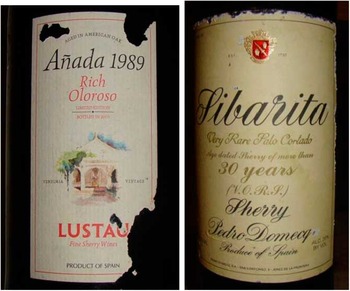
In exceptional vintage years, the government may allow a small volume of sherry to be vintaged instead of going through the solera system. Such a single-vintage sherry is labelled Añada with the vintage year (Figure 13, left). A few sherries are aged for especially long times: 20 and sometimes 30 years (Figure 13, right). The proof of age involves painstaking sampling and analytical verification processes.
(Colour online) Two rare sherries: Lustau's 1989 Añada (left, photo: SKE), a single-vintage sherry, and a 30-year old Palo Cortado by Domecq (right, photo: SKE). V.O.R.S. stands for Vinum Optimum Rare Signatum.

The story of Spanish wines continues…
Acknowledgements
Many thanks to Manuel Cardona, a Prince of Asturias, Janet Pérez, a member of the Real Academia de la Lengua Española, and Allan Kuethe, a member of the Real Academia de la Historia, who patiently read the manuscript, corrected, and advised. Thanks are also due to Cristina and Pepe Ferrer who made the impossible look so easy. The authors are also indebted to Jane Ward, Eduardo Cano, Jorge Bombin Val, Belen Saez Fernandez-Rojo, and Miguel Anguel Benito (at the Museo del Vino in Peñafiel) for most useful discussions, for giving so much of their time, and for sharing so many amazing wines.
Stefan K. Estreicher received his PhD in Physics at the University of Zürich. He is currently a Paul Whitfield Horn Professor in the Physics Department at Texas Tech University. His biography can be found at http://jupiter.phys.ttu.edu/stefanke. One of his hobbies is the history of wine. His book, Wine, from Neolithic Times to the 21st Century was published by Algora (New York) in 2006.