INTRODUCTION
When I first started fieldwork in Wannian, a village in southwestern Taiwan, I stayed in the village leader's house.Footnote 1 At this early stage of the fieldwork, my relationship with the villagers was no more than polite and formal. One afternoon, I heard villagers talking in low and urgent voices about their temple's god statue. When I approached, they fell silent. No matter how I tried to question them about what had happened, they would tell me nothing. In the following days the village atmosphere became ponderous and oppressive, and I felt my presence there becoming increasingly awkward. Thinking that leaving for a while might provide a relief for both the villagers and me, I moved to a neighboring village. Since it was only one kilometer away, the wind brought the sound of the Wannian village loudspeaker. Though they had lowered the volume, I could vaguely hear announcements of preparations for upcoming ceremonies of worship. After a month, I moved back to Wannian, but only several years later did I understand what had happened.
For reasons that will become clear, this event at the outset of my fieldwork led me to ponder how to properly understand god statues. Scholars have usually devalued them as “idols” and given them little attention, but I will argue that they are an important aspect of Chinese religion.Footnote 2 I shall start by examining how the literature has considered Chinese gods, and then turn to my own analysis, drawing on my field materials from Wannian.
Arthur Wolf famously argued that Chinese people think of their gods in terms of a bureaucratic hierarchy (Reference Wolf and Wolf1974), and many anthropologists of Chinese religion have since engaged his model. Emily Ahern took a similar perspective by portraying a parallel relation between Chinese religion and political rituals (Reference Ahern1981). Robert Weller, however, distinguished ideological and pragmatic interpretations of Chinese religion (Reference Weller1987); the ideological part is Wolf's model of ancestors/kin, gods/bureaucrats, and ghosts/outsiders, which is relatively context-free (ibid.: 88), while the pragmatic aspect is bound to experiences of social contexts. Weller later co-edited a collection in which were discussed several kinds of unruly gods who are not governed by the bureaucratic metaphor (Shahar and Weller Reference Shahar and Weller1996).
Many anthropologists have in various ways expressed ambivalence about the bureaucratic understanding of Chinese religion, or have questioned its ability to stand alone. Sangren, for example, tries to go beyond the model and brings in the Chinese structure of value—the mediation of yin and yang—the whole set of religious practices of Ta-chi town, along with other important aspects of religion (Reference Sangren1987). Feuchtwang, on the other hand, while modifying the pantheon into an imperial metaphor, further highlights the militaristic aspect of Chinese religion (Reference Feuchtwang2001 [1991]), and spirit-mediums as a source of religious authority (1993). Wang, using materials from Ming Quanzhou, points out how territorial cults created a strong sense of local place and identity that could resist the central administration (1995).
China historians since the 1990s have displayed similar concerns, albeit from different perspectives. Many have discussed the formation of the Chinese pantheon and have noted a significant transformation that occurred during the Sung dynasty (Hansen Reference Hansen1990; Hymes Reference Hymes2002; von Glahn Reference Von Glahn2004). Hansen, for example, indicated that the appearance of commoner gods, the government's large-scale granting of titles to local gods, and the rise of regional cults were all new religious phenomena in the southern Sung. Although most of Hansen's explanations of these religious changes highlighted economic factors, political considerations, or social processes, some of her explanations were unprecedented.Footnote 3 For example, she pointed out that the emergence of commoner gods was related to the people's sense of local places in the southern Sung. In addition, she vividly described how deities craved images and temples, and how their power increased or declined by gaining or losing them. These observations uniquely illuminated how a deity's power is related to materialized forms, and they offered insights pursued by later studies.
Another ambitious work is Hymes' Way and Byway (2002). He builds on Wolf, but questions whether the bureaucratic metaphor is the only way for Chinese people to understand the pantheon. By comparing the scriptural texts of a Taoist sect, the Celestial Heart, with local records of three Taoist immortals, Hymes argues that two models of divinity have evolved since the southern Sung: the bureaucratic and the personal. According to Taoist scripture, Jao Tung-t'ien founded the Celestial Heart in 994 after he discovered a precious scripture on Mt. Hua-kai in Fu-chou. Although a new sect, the Celestial Heart mostly accepted the original Taoist divine hierarchy, which it presented in bureaucratic terms.
If we look at the local record of Mt. Hua-kai and its related three-immortals cult, another version of Taoism, or “byway,” emerges. Local scriptural and secular sources describe Mt. Hua-kai and the three immortals in depth. It is said that Mt. Hua-kai was so marvelous that it attracted the wandering immortals to settle there, after which they developed direct and personal communications with the local people. As Hymes shows, this local account is characterized by the idea that a single place is special, that deities might attach themselves to it, and that believers could directly ask them for help. In other words, the southern Sung period provides another model of divinity in which deities “are not, for their worshippers, simply in the region: they are of it” (Hymes Reference Hymes2002: 169).
Hymes' two models not only challenge Wolf's single bureaucratic view of the Chinese pantheon but also greatly enrich our understanding of Chinese religion. His view that these religious attributes are still found in contemporary Taiwan is particularly deserving of anthropologists' attention. Indeed, though Hymes is a historian his argument entails a strongly anthropological perspective in which he repeatedly emphasizes that the two models of divinity are not only his own, but of the Chinese people (ibid.: 25, 263).
However, questions remain. Let us start with the data. Hymes uses, on one hand, Taoist texts to build up his bureaucratic model of deities and, on the other, local scriptures and belles lettres collections to construct the personal model of deities. As a result, these conceptual models seem to apply to different categories of people. Although Hymes notes that the two models may coexist, intertwine, or compete, that he does not provide the contexts and forms of their different combinations makes it difficult for us to comprehend the significance of each. Further, from an anthropological perspective, an analytical framework constructed from local records does not necessarily reflect a native conceptual framework. To argue that it does, one must demonstrate how the analytical framework is built upon natives' key cultural concepts.
Therefore, we should carefully reconsider Hymes' two models, particularly the personal model, which has given us profound information about how local people perceived their deities in the Sung. In fact, almost all the above-mentioned anthropologists have considered this issue. If a non-bureaucratic understanding of the supernatural has existed since the Sung period, how has it developed in local society? How do ordinary people understand it today? In what follows, I will use god statues to explore these issues.
Among China anthropologists, Sangren has focused the most on god statues. Applying a Marxist concept of alienation, he argues that these images of Chinese deities are fetishes, alienated representations of the self-reproductive power of social collectivities and individual subjects (Reference Sangren2000 [1991]: 69). The self-reproduction takes place in worship and testimony and is alienated into the form of images (2000: 16). Though Sangren points out that statues are alienated representations of social collectivities and individuals, he has not discussed why the alienation takes place in the form of statues. We must further reflect on specific questions: through what objectified form, and by what symbolic process is a god formed, and how is the god's efficacy created? Answering these questions will allow a better understanding of how Chinese perceive their gods and the nature of their power.
Alfred Gell's work provides fresh insights into these questions. In his analysis of images, he discusses their agency from internal and external strategies (1998: 126–54). The internal strategy entails giving a body, a soul, and other materials to enliven an object in consecration, whereas the external strategy further animates the idol into a social agent, able to embed itself into social contexts and obtain its significance from social interactions. My analysis of the deities' objectification in Taiwanese statues has benefited from Gell's ideas. However, I shall further show how the agency of these statues comes not only from the symbolic process of personification, but also from that of localization, which in Taiwan is encapsulated in ideas about the five spirit-soldier camps.
WANNIAN AND ITS DEITIES
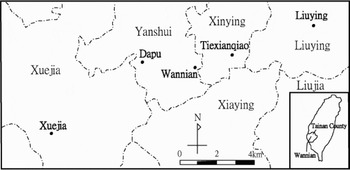
Wannian is a village located in the north of Tainan county (fig. 1). It has seventy households composed of three main surnames: Gao, Li, and Wang. From its early establishment into the present, farming has been the main economic activity, even as the villagers have also undertaken other kinds of manual labor to increase their incomes. There are hardly any records that describe this small village's history, but we do know that Wannian developed into a village in the period 1796–1874 since its name appeared in the book Taiwanfu Yutu Zuanyao (A brief account of Taiwanfu maps) (Taiwanfu 1983 [1796–1874]).Footnote 4
Wannian and neighboring areas.

Although little data exists regarding Wannian's formation, there is a story about how it came into being. It is said that the Li were the first group to come to cultivate land there. They brought with them their ancestral image (H. coo-put; M. zufo) Laoyegong (H. Lau-ia-kong). Later, two brothers of the Gao family, carrying their ancestral deity Dadaogong (H. Tai-to-kong) and wandering from the south in search of farmland, passed by Wannian. They put the deity statue down and rested there, but it subsequently became too heavy for them to lift up again. The brothers therefore stayed on and married into the Li family, and after a few generations the Gao became Wannian's biggest group. Last to arrive were the Wang, who moved from a neighboring village. Other, independent households came later.
When the people settled down and the village developed further, the inhabitants decided to make public (H. phah loh-kong) their respective ancestral images and to worship them as common village deities. The biggest group's deity, Dadaogong, was selected as the main deity. The next in rank was the second Dadaogong, a branch deity of the regional temple in the neighboring town, Xuejia, and according to myth a sworn brother of the first Dadaogong.Footnote 5 The third was the Li family's ancestral deity, Laoyegong, and the fourth was the territorial deity Jingzhugong (H. King-cu-kong). The fifth was a tiger god, Huye (H. Hoo-ia), who people say was cured by Dadaogong and afterward followed him as his mount. These have long been Wannian's five major deities. Around thirty years ago, You Wangye (H. Iu Ong-ia) from Liuying conducted a tour of inspection (jiau-king; raojing) in the proximate area of Wannian. As a result of solicitation by the villagers, a command tablet (ong-ling; wangling) of You Wangye was set up in Wannian to protect the village, and he became Wannian's sixth deity.
The statues and tablet of the six deities are located in the central hall of the only village temple and arranged in order of their hierarchical status, at the center, the left, and the right.Footnote 6 Each has his own spirit medium to transmit his messages. Apart from the six main deities, Guanyin of Liujia, a goddess, appears in village rituals but has no statue. However, villagers plan to make a statue and build a back hall for her when they become richer, since she is the “support” (kho-suann; kaoshan) of all the deities. At present, she transmits her messages through the other deities' spirit mediums. The highest god for the villagers is the Jade Emperor, who has no statue and hardly ever comes to the village. When the villagers worship him, they face the outside of the temple.
This arrangement of gods in Wannian, from village gods, to Guanyin, to the Jade Emperor, does at first glance seem to express a bureaucratic hierarchy as Wolf describes. However, this perspective only reveals a partial truth. The bureaucratic hierarchy is in Wannian actually transformed into a kinship relation. This is evident, first, in the way the deities address each other when they possess their spirit mediums. Dadaogong's medium calls the other deities “brother” (hiann-te; xiongdi), whereas the others address him as “elder brother” (ko-chin; geqin). Guanyin is “elder sister” (cia-cia; jiejie) to them all. Later we shall see how this kinship relationship exists not only among the deities but extends also to the villagers.
The narratives of village formation (e.g., “The Li family carried their ancestral statue to Wannian.” “The Gao brothers decided to stay in Wannian because their Dadaogong statue became too heavy to lift.”) also tell how the deities' statues came and attached themselves to Wannian. I now turn to how the god statues are attached to a place, and their relations to its dwellers.
WHICH KIND OF SPIRITS CAN HAVE STATUES?
Although every household in Wannian has an altar for gods, when I asked villagers (men and women of different ages), “What is god?” or “Where is god?” they usually were unable to explain clearly. Hesitating, some answered:
Others replied in idioms:
While these answers provide little information about gods, they do tell us how hard they are to define. The implication of these statements is twofold: they show that gods are formless, and that they are omnipresent.
If gods are really formless and omnipresent, then why do we see so many god statues (gim-sin; jinshen) in Taiwan?Footnote 7 Villagers answered: “In this way, we can worship them, we can see them.” And “Images are formlessness given form.” Such descriptions show that the god statues are concrete expressions of intangible spiritual beings. However, they also raise new questions: why do people need god statues, and what is the relationship between gods with and without form? Seeking answers, I consulted one of Wannian's important spirit medium interpreters. He explained: “Although a god has many images, they all stem from the same formless root. This is called cit-pun san ban-su (lit. one root spawns a thousand shoots). People make images because they have the nature of tio-siong. Tio means to uphold a principle, so tio-siong means that you have to see the image of the god to believe in it.” He continued to analyze the relationship between people and images of gods: “Everyone respects and prays to gods, but they ‘have no shadows and leave no trace,’ so people carve statues to make the gods settle down where they want them. That means to contain them inside the statues. People should worship the statues, so that a special bond grows between gods and worshippers. If the bond is strong, the spirit won't leave.”
This interpreter's explanation has several implications. To begin with, he assumes that god statues originate in a common human need to see an image in order to believe. Second, god statues are permanent sites for gods to reside in. Gods of course can transform themselves into other objects or attach themselves to other places, but they do so only transiently. Third, although god statues vary from place to place, they all stem from the same root. Finally, the interpreter explains that god statues make the formless omnipresent gods settle down and build a stable connection with the villagers, who worship them in return for protection; this creates a strong reciprocal bond between the villagers and the gods. Therefore, in contrast to the aforementioned formless, omnipresent gods, those with images are bound to their worshippers by reciprocal ties.
The nature of this relationship between god statues and worshippers also helps us to understand villagers' conceptions of ancestors and ghosts. The difference between gods and ancestors lies in the fact that people rarely make statues of their ancestors. Instead, they use wooden tablets to worship them. Some villagers point to the fragile nature of tablets as representing the gradually loosening relationship between ancestors and descendants. Others referred to the folk tale of “Dinglan saved his mother”:
There was once a man called Dinglan, who had a short temper and treated his mother very badly. His mother had to bring his lunch to the field everyday at noon since he liked to eat warm food. If his mother arrived late, he would berate her or even beat her. One day when Dinglan went to work, he saw a lamb kneeling down to suck its mother's milk. He felt ashamed at his un-filial behavior, and decided thenceforth to be obedient to his mother. On that day, his mother brought his lunch to him slightly late. When Dinglan saw his mother approach, sweating and panting, he immediately ran to her to apologize for his harshness. His mother, thinking that he was running to beat her, turned around and fled in fear. Dinglan called after her: “Don't run away! I only want to say sorry,” but she in her panic thought that he was shouting at her in anger. She reached a dead end in the road, and had no option but to jump into the river. Although Dinglan followed her into the river to rescue her, he could not locate her body, but found only a piece of wood. He took it home, carved it into an ancestral tablet, and provided it with food every day in penance.
Dinglan's wife had to prepare food for the tablet each day, and she gradually grew tired of it. One day a chicken came into the house and jumped onto the altar to eat the offering. She was angry and shouted in frustration, “You wooden mother-in-law! You only know how to eat but do not know how to look after the house!” Taking a pin, she pierced the wooden tablet with it. The tablet bled since, having received food every day and gradually having grown blood and veins, it had almost become alive. But the piercing made it impossible for the tablet to take life. That is why we have to ‘dot’ the ancestral tablet, so that the dead cannot become alive again.
This story shows that people treat the tablet like a human body, and after being worshipped it starts to regain its life. However, due to the act of piercing it remains as a tablet. This is very different from the ceremony of “opening the god statue's vision” (discussed below), in which the carver uses a cock's fresh blood to enliven a god statue.
Nobody in Wannian has erected statues for their ancestors, with two important exceptions. One is the deceased son of a spirit medium who caused his family members to be sick as a way to demand a statue of him be set up to “be worshipped by everybody” (hoo ciong-lang pai; gei zhongren bai). The second exception is the soul of a person of a neighboring village who came to Wannian and possessed a villager. In both cases, the villagers asked their main deity to resolve these problems. Dadaogong ordered the spirits to leave since they had not performed any miracles to benefit a large number of villagers. The two spirits defied him and did not want to leave, and finally they had to be removed with help from Guanyin and the Xuejia Dadaogong.
These two cases reveal crucial information about the importance of having a statue. First, the case of the spirit medium's dead son shows that having a statue for an ancestral soul allows it to transcend its house, expand its influence, and establish relationships with more people. Second, having a statue is just a start, for if an ancestral soul does not perform any miracles to exert its influence, it cannot win common recognition. Third, Dadaogong governs Wannian, and any spirit who wants to come and become a god of Wannian must secure the agreement of the village deity. The criterion for being allowed to stay is whether the spirit has performed miracles to benefit all the villagers. In short, having a statue is the major means by which spirits can build up relationships with a certain place and the people of that place, and only when a spirit performs miracles to benefit everyone in a place will they bestow a statue upon it. Finally, if there are conflicts in a locality, people will ask gods of the larger region to help resolve them.
From another perspective, these two failed attempts to set up statues are probably both related to the fact that Wannian's population has changed little over the years: no new neighborhoods have appeared and a single common temple has been maintained. In other places, we sometimes see private statues (su-put-a; sifo) set up in domestic altars; they depend on their ability to perform miracles to attract worshippers and extend their power beyond the house, thus developing into a deity of a neighborhood or village (e.g., Feuchtwang Reference Feuchtwang1993).
As for the wandering spirits outside the village, they have nobody to worship them, and to get offerings they must resort to making people sick. In order to pacify them villagers build a three-piece wall (sann-phinn-piah; sanpianbi) so they have a place to rest. Within this wall, no statues are set for these wandering spirits. Often people give them a name that they write on the wall. Sometimes, people make them a wooden tablet, but there is no ‘dotting ritual’ as for ancestral tablets. Villagers explained: “They are souls owned by no one. Who wants to do the dotting?” And, “Who wants to make a god statue for them? As soon as you do this, you are the one who has to worship them.” These explanations, again, show that erecting a god statue is a way for people to build up relationships with the god, and make them mutually obligated. That villagers do not want to set up statues for ghosts, and do not dot their tablets, illustrates that they want only to pacify ghosts; they desire no further involvement with them.
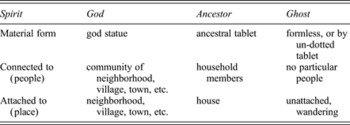
In short, we see that gods, ancestors, and ghosts are materially represented by, respectively, god statues, ancestral tablets, and un-dotted tablets (although ghosts sometimes have no material form at all). These forms further indicate how much they are tied to people and place, as Table 1 summarizes.
Gods, Ancestors, Ghosts: Their Material Forms, and Relationships to People and Places

Still, many questions remain unanswered: Why can the god statue stabilize a god? What kind of relationship is there between deities and their worshippers? I shall discuss these questions by looking at the statue-carving process, its relevant rituals, and the interactions between the god statue and the villagers.
THE CARVING OF GOD STATUES
There are three steps in carving a statue: axe opening, spirit entering, and opening the vision and dotting the eyes.Footnote 8 Since the villagers of Wannian do not have a special preference for any carver, I base the description below on a combination of previous studies and my fieldwork.Footnote 9
Open with an Axe (Khui-poo; Kaifu)
Statues can be made of many materials, including clay, bronze, stone, or wood, but the first three are heavy and thus less popular. Camphor is much the preferred type of wood since it is resistant to bugs and easy to carve (Shi Reference Shi1994b: 117). In Wannian, the deity himself will usually appear to his spirit medium or the village elders and indicate the appropriate size of the statue, where to obtain the material, and how to find a suitable carver.Footnote 10 Even if the deity does not appear, village elders will consult the deity on these questions by using divination blocks.
The actual carving can only start after the rite of “opening with an axe.” An auspicious time is chosen and fruit and flowers, which are necessary for the worship, are prepared. The carver then lights incense and uses a talisman to purify the piece of the wood. After that, the ritual generally consists of using an axe to hack at the four corners of the wood. However, there are different ways of performing this ritual, and they contain different meanings. For instance, some carvers hit five points of the wood at the sites where the head, hands, and feet are located (Li Reference Li1970: 48). Some hack it three and then seven times (Liu Reference Liu1981: 29; Shi Reference Shi1994b: 117), bestowing on the wood three hun and seven po.Footnote 11 There is also a simple rite in which the carver simply glues to the wood a piece of paper on which is written the deity's name (Liu Reference Liu1981).
After the axe-opening rite, the carver can start sculpting the statue. Artistic styles vary according to the deity. For instance, the statue of the earth god usually looks gentle and kind, while Mazu expresses a temperament of female tenderness and elegance (Liu Reference Liu1976: 23–30; Wang Reference Wang1984: 116–20). The people of Wannian provided more information on how statues are shaped. For them, not every statue looks the same. The differences arise because a deity will reveal himself or herself to the carver in dreams during the carving period, creating scenes for him to imagine. Thus, how good a statue looks not only depends on the carver's skills, but also on his imagination. When the carving is finished, the carver glues gold foil to the statue and it thus becomes a real “golden body.”
From this description, we can see how a formless deity is objectified. At the outset, the deity appears to the spirit medium and indicates the size of the statue, and where to get the material for it. In the axe-opening rite, the shape of the body is approximately outlined; later, the god enters the carver's dreams and reveals himself or herself so that the he can sculpt the statue's final shape. The whole process depends on not only the piety of the worshippers and the imagination of the carver but also the deity's willingness to come into the human world.
The Entering of the Spirit (Jip-sin; Rushen)
When the carving is complete, the carver chooses an auspicious day to hold the spirit-entering ritual. A cavity at the back of the image is scooped out for this rite. The objects placed in this hole include incense ashes (hionn-hu; xianghui) or talismans from the root temple, a live hornet, five precious materials (gold, silver, bronze, iron, and tin), five crops (rice, wheat, sesame, and different kinds of beans), and a bundle of five-color threads (red, yellow, blue, black, and white) (Feuchtwang Reference Feuchtwang and Skinner1977: 589; Li Reference Li1970: 49; Liu Reference Liu1981: 30; Shi Reference Shi1994b: 118; Wang Reference Wang1984: 110).Footnote 12 The worshippers have to prepare fruit and flowers and burn incense to invite the deity to come. When the auspicious moment arrives, the carver inserts the above-listed things into the cavity, and plugs it with a piece of wood.
The objects placed in the cavity are important clues regarding how people conceptualize deities. Local inhabitants explained to me that the ashes or talisman symbolize the spirit of the deity, and the living hornet is to increase the deity's power. Some people said the five forms of treasure represent the five organs of the deity, while others said they are simply symbols of the deity's grandeur. The five crops represent the harvest and the bunch of five-color threads is related to the five spirit-soldier camps. Because the following “opening the vision” ceremony further illustrates how people perceive a deity, I shall discuss the meanings in whole after a full description of the carving.
Opening the Vision and Dotting the Eyes (Khui-kong Tiam-gan, Kaiguang Dianyan)
For this ceremony, the carver prepares flowers, fruit, a round mirror, a red brush pen, and a white cock. When the auspicious moment arrives, the mirror is taken outside where the light is sufficient to reflect it into the statue's eyes. Next, the carver goes back to the altar and uses a knife to cut the cockscomb and smear the blood with a red brush-pen. He then starts to chant and dot the deity with the brush-pen, beginning with the center of the forehead and proceeding to the eyes, ears, nose, mouth, heart, navel, feet, toes, fingers and the back (Sung Reference Sung1979: 290; Wang Reference Wang1984: 113–14).
We can infer that in this ceremony the carver at first draws the natural energy into the statue to enliven it. Then, he uses the blood of a white cock, symbolizing purity, to dot and connect the important parts of the body. This makes the statue like a living person with veins in which blood flows without obstruction.
The three stages of the carving process show how the body and power of a deity are created. First, let us consider the body. At the outset, we see how the chosen piece of wood is given the rough shape of a body in the axe-opening ceremony. The formless deity then gradually reveals itself to the carver in dreams to help him imagine the final image and carve it. In the spirit-entering ceremony, five treasures are inserted into the statue to show that it has organs just as human beings do. Finally, in the dotting rite, the blood of the cock connects the eyes, ears, nose, mouth, abdomen, limbs and the back of the statue and it becomes a living organism. The statue is thus internally animated (cf. Gell Reference Gell1998: 126). It is because the ritual emphasizes the concrete body of the deity—its visible appearance and its invisible organs—that the statue is different from other objectified mediums, such as portraits or pictures. Although the latter are sometimes subject to the “eye-dotting” ritual, and possess magic powers, without the concrete body the interaction with the worshipper is much decreased.Footnote 13
Secondly, let us consider the power of the deity. We can see that right from the start the material which the deity assigns for the statue, and the carver's skill and imagination, are the important means by which the power of the deity is created (cf. Gell Reference Gell, Coote and Shelton1992: 44). The hornet further increases its power. The ashes or the talisman indicate that the deity's power has its origin in the root temple. The five-color threads, which are related to the five spirit-soldier camps, are another important aspect of the deity's power that will reappear in later rites.
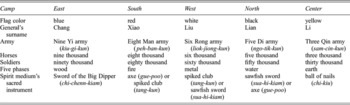
The five spirit-soldier camps (ngo-iann; wuying) comprise the village deities' army and are usually located at the center and the north, south, east, and west borders of the village to guard it and prevent invasions of evil spirits (Jordan Reference Jordan1972: 50–51; Schipper Reference Schipper1985). Every camp has a representative color, a general, an ethnic army, and a certain number of soldiers' horses. Apart from being materialized at the settlement borders, the camps also appear in the spirit medium's chants. Among the five, the central camp is hierarchically highest. The five spirit-soldier camps and their related contents in southern Taiwan can be summarized as in Table 2.
Five Spirit-Soldier Camps and Their Characteristics

Source: Huang 1989: 42.
From the table, we see that concepts of the five spirit-soldier camps are based on the traditional Chinese center-four directions, the five phases (wuxing), and numerological cosmology (Needham Reference Needham1954). Later, these models came to include the five ethnic military troops (yi, man, rong, di, qin), which first appeared in Taoist scripture around the fourth century in southern China (Lee Reference Lee2003). In Fujien province, local people were further incorporated as generals of different surnames (ibid.: 586). Ethnographies also show that the five spirit-soldier camps appeared not only in pre-modern China (Wang Reference Wang1995), but also in parts of contemporary southern China, where they still exist (Dean Reference Dean1993). As most early Taiwan immigrants were from Fujien, the five spirit-soldier camps are still widespread in Taiwan, particularly in the south.Footnote 14 They are the most visible symbolic boundary of many settlements.
Although not every villager knows exactly the content of Table 2, most have a general knowledge of it. They know that the five spirit-soldier camps originate from the souls of the deceased and that they are recruited and trained by the deities. A deity can also ask for more soldiers (chiann-ping; qingbing) from its root temple. In addition, the villagers believe that the spirit-soldiers protect not only the boundary of the village, but also every household. Thus, in front of the main hall of every house, they place grass and water (be-chau-cui; macaoshui) so that the visiting spirit-soldiers and horses can rest and refresh themselves. Once a month, each household also holds a feast in the temple to reward them (sionn-ping; shangbing). After the feast, the spirit medium uses a sacred instrument (for example, the sword of the Big Dipper) to command the spirit troops to stand fast at their sentry posts.
Thus, we can understand the importance of putting the five-colored threads in the statue: it bestows on the deity the power to command the five spirit-soldier camps. From another perspective, it also indicates that the original omnipresent deity has attached itself to a certain place and will begin to develop special relations with the people dwelling there.
THE RITUALS AFTER THE CARVING
After the eye-dotting ceremony, the statue is placed on the altar and receives worship. In many places, a “fire-walking” ritual follows that strengthens the association of the deity with the statue (Li Reference Li1970: 51; Sung Reference Sung1979: 290). Since this article is based on my own fieldwork, I shall discuss the rituals by following the sequence of actions performed by the inhabitants of Wannian: dividing fire, selecting a spirit medium, and fire-walking.
Dividing Fire (Kua-hue; Yihuo) or Scooping Water (Chiann-cui; Qingshui)
As described above, at the beginning of carving, the deity is bestowed with the power to command the spirit-soldiers of the five camps. But where do the soldiers of a new deity come from? In Wannian, the villagers go to the regional or root temples to divide fire (kua-hue) in order to obtain spirit-soldiers.Footnote 15 In this ceremony, they carry the statue and a hionn-tann (M. xingdan), in which an incense burner is placed, to the regional center, Xuejia.Footnote 16 When they reach the temple, they take out the incense burner from the hionn-tann and put it and the statue in the inner sanctum of the temple's central hall, where the root temple's main incense burner is housed. When the auspicious moment arrives, the Wannian villagers scoop up ashes from the temple's incense burner in the inner sanctum and place them in their own incense burner. They then carry out the burner and the statue, and place the burner into the hionn-tann and seal it. When they reach Wannian, they open the hionn-tann and scoop ashes into the main incense burner of the village temple.
In the whole ritual, the hionn-tann is seen as the most mysterious thing. Villagers believe that all the spirit-soldiers they request from the regional temple reside in the incense burner of the hionn-tann. It is said that ghosts or evil powers will come to kidnap the soldiers, and therefore the spirit medium must constantly follow the hionn-tann on the way back in case a lack of vigilance causes the ritual to fail.
If the deity is one who has to deal with the underworld, such as the territory deity Jingzhugong, then he, especially, needs soldiers who can reach the underworld. River rapids, where drowned souls are supposed to gather, are seen as ideal places to find such soldiers, and so the ritual of “scooping water” (chiann-cui; qingshui) usually takes place there. Three days before the ritual, people erect a red flag (cio-kun-ki; zhaojunqi) in the river to call for and recruit soldiers. On the day of the ritual, the villagers carry the statue near to the flag. The spirit medium calls the soldiers and scoops water from the river into a prepared urn. Again, it is tightly sealed and taken back to the village.
Selecting a Spirit Medium (Kuan Tang-ki; Xuan Jitong) and Firewalking (Kue-hue; Guohuo)
The most direct way a deity can exert influence is for it to transmit messages to worshippers via a spirit medium (tang-ki; jitong). In Wannian, the spirit medium for a deity is usually selected one or two years after dotting the eyes.Footnote 17 Since I have discussed the topic of the spirit medium elsewhere (Lin Reference Lin, Chen and Huang2002), I will only summarize relevant aspects of his selection here. The ritual includes three steps: selecting the spirit medium, placing him in confinement, and fire-crossing. In the first step, an appropriate villager from Wannian is chosen. He experiences a symbolic death during the selection process. Later, he is confined for seven days, during which his body is purchased from his ancestors by the deity and he is reborn as the son of the god (kim-kiann; jinzi). Since the spirit medium is selected from all men in the village, and the village supports the entire process of selection and initiation, the spirit medium represents the whole community (cf. Sutton Reference Sutton1990). His status as a son of the god thus symbolizes a kinship connection between the god and all the villagers.Footnote 18 The new spirit medium has to learn how to command the five spirit-soldier camps. He is taught how to control the troops by carrying the sword of the Big Dipper in his right hand and the flags of the five spirit camps in his left.
The last step is the fire-crossing ceremony, which binds completely the god statue, the spirit medium, the villagers, and the village's territory. The spirit medium, possessed by the god, comes out of his confinement and leads villagers, who carry the god statue in a walk across a circle of extremely hot ashes of freshly burnt dry branches. Since the spirit-soldiers from the five camps guard the center and four corners of this fire, it is a symbolic representation of the village. Their safe passage demonstrates not only that they have created a secure boundary, but also that they have thoroughly integrated the deity, statue, spirit medium, local inhabitants, and village territory.
GOD STATUES IN DAILY LIFE
After the dotting ceremony, the statue is placed on the altar to receive worship. During the first year, the villagers prepare red rice-balls (ang-inn; hongyuan) and steamed sponge cakes (huat-kue; fagao) to celebrate rituals of “the first month,” “the fourth month,” and “the first year” for the deity. These same rituals are also carried out to introduce a newborn child to relatives and friends, to announce that the child has become a social person and thus can participate in social life. By the same token, performing these rituals for the god statue implies the incorporation of the deity into daily life, and initiates the process of building up its relationship with the local people. In other words, the god, with its statue, now begins to take on social agency and becomes a “social other” (Gell Reference Gell1998: 117). We can say that as the carving rituals bestow the god with internal agency, so the birth rituals performed by the villagers confer it with external agency (ibid.: 134).
Indeed, after the formless and omnipresent god has a statue, and is thus objectified and grounded in the village, the god actively enters into the villagers' lives. Each morning and evening I saw the local people go to the temple for worship. In the life-cycle rituals of each family, the god statue is always a necessary participant. From a newborn's “one-month” and “one-year” anniversaries, to the wedding ceremony or the house-entering rite, villagers invite god statues to their houses to thank them for their protection and to celebrate with them.
In daily life, deities also heal villagers' illnesses and resolve all kinds of problems and hardships. In the past, when clinics were few, when a family member was ill or had troubles villagers would go to the temple and bring the statue back to their own house. This is called “making offerings to the deity” (hen sin-bing; xian shenming). People say the statue and his soldiers will carefully inspect the house. Once they find the troublesome spirit, they will reveal it to the spirit medium in dreams. The medium will come to the patient's house after dusk and, after being possessed in front of the statue, will declare the cause of the illness and cure it. This face-to-face interaction is how each individual or family experiences the deity's efficacy (ling). As the deity cures more people, its efficacy spreads and expands. It may even gain recognition from the state through bestowal of an official title (Hansen Reference Hansen1990; Watson Reference Watson, Johnson, Nathan and Rawski1985).Footnote 19 Thus, through personal and social networks the singularity of a deity's power gradually emerges (cf. Kopytoff Reference Kopytoff and Appadurai1986).
As a deity's power increases, people come to see the material of the statue itself as efficacious. In the past, the medicine a spirit medium prescribed was sometimes supplemented with “some scraps of camphor from the statue's base” (co-te e cionn-cha) or “red yarn from the head” (thau-ting e ang-sua). People believed these materials from the statue increased the medicine's potency. The base of every Wannian god statue now has a deep hollow from repeated scrapings by the villagers. Even today, it is common for people to invite the god statue home to worship it for protection during a long-distance trip, success in business, a cure from long-term illness, or the reform of disobedient schoolchildren.
Apart from embedding themselves in people's lives, deities are anchored in the village territory and protect inhabitants from the influence of evil spirits. As noted, the five spirit-soldier camps governed by the deity are located at the four ends of the village and its center. If many misfortunes befall the villagers, the deity will renew their spirit-soldier camps and perform the house-purifying ritual to expel the evil power (see also Jordan Reference Jordan1972: 125). In this way, we see that a village god and its locality are inseparably intertwined. For Wannian villagers, an objectified god is not only integrated into their social context but is also grounded in their locality.
PERSONIFICATION AND LOCALIZATION
My concern in this paper is to understand how common people perceive gods through their statues. From the discussion thus far, we can see that personification is the major symbolic process of objectifying a deity. It first gives the deity a body, and enlivens it as a living organism. Later, by practicing birth rituals for the statue and making it into a social person, or more exactly, a kinsman, the personification mechanism bestows on the statue the ability to embed itself into its worshippers' lives. Through frequent interactions with the worshippers, the deity's power is increased and it obtains its singularity.
At the same time, when a deity is given a statue, it is also grounded into the locality. When the five-color threads are place in the statue, the deity gains command over the spirit-troops that define and guard the boundary of the village. Personification and localization are the two symbolic processes of the deity's objectification, and the means through which a god's power is established.Footnote 20
Furthermore, as I have tried to show, the personification is based on the Chinese ideas of the body/soul and the social person in which kinship relations are stressed, whereas localization has roots in the traditional cosmology of center-four directions, five phases, and numerological patterns, and later incorporated the idea of spirit troops.
I can elucidate the concepts of personification and localization through an example of a deity without a statue. All the village deities of Wannian have experienced the just-described ritual process except You Wangye, who came to Wannian thirty years ago. He has neither a statue nor his own spirit medium. The villagers have set up a command tablet to represent his army, and he borrows other deities' spirit mediums to transmit his messages.
To understand this, we have to realize what kind of deity You Wangye is. He is a representative of heaven who inspects places on earth (tai-thian sun-siu; daitian xunshou). Since he is always on his tour of inspection, he does not localize to any place and needs no statue. Even in the place he originally came from, Liuying, there was no statue for him.Footnote 21 The people in Liuying select a spirit medium for him only in the month when the deity is supposed to descend, and the medium does not act except during this period.
From this example, we see that when a deity is not grounded in a particular place, the local people will not set up a statue for it. In Wannian, because the deity has no statue or personal spirit medium, his relationship with the local people tends to be loose and insubstantial.
In Chinese history, the development of Guanyin went through a similar process. Yu's research highlights that it is when Guanyin became connected with certain sites that she truly started to take root in China. Only when Guanyin was firmly anchored in places did she have a chance to develop her own life, history, and iconography (Yu Reference Yu and Weidner1994: 158–59).
THE SEPARATION AND REUNION OF THE STATUE AND SPIRIT
Although the statue can anchor the spirit, it does not mean that the spirit will never leave it, and Wannian is full of stories of spirits leaving their statues. For example, the emigrant villagers once invited the territory god, Jingzhugong, to Kaoshiung, a city in southern Taiwan. After the statue returned, his spirit medium's voice, whole manner of singing, and even way of dancing had completely changed. The Wannian villagers knew that the spirit inside the statue had been exchanged! Their only recourse was to redo the whole set of ceremonies: entering the spirit, dotting the eyes, and so forth.
The most fascinating stories are about Dadaogong, the main village deity. The most widespread early legend is about how he burned the sugar refinery of Chupo, the neighboring village to the north. The source of village vitality, air (khi; qi), is said to come from the northeast. Since some of the northeastern land belongs to the residents of Chupo, the two villages have had many conflicts over land use. The Chupo villagers had wanted to construct buildings to take advantage of the air, whereas the people of Wannian had instead tried to keep their air intact and protect it. They regarded it as the source of life for the whole village. The first conflict happened long ago and knowledge of it has been passed down to the villagers from their ancestors:
The people of Chupo built a sugar refinery to the northeast of Wannian. The Wannian villagers knew that they had built it to obtain the air, so they asked their village gods, Dadaogong and the second Dadaogong, to help them. The two deities said they would burn the sugar refinery on a certain day. In order to defend themselves, the Chupo people also carried the statue of their god, Fazhugong, to guard the sugar plant. Dadaogong then transformed himself into a bird, flew into the refinery, and knocked over Fazhugong's incense burner. A fire spread from the altar through the whole plant. The statue of Fazhugong was completely burnt.
For doing this, and not reporting his action to the Jade Emperor, Dadaogong was imprisoned in the heavenly jail for years. The second Dadaogong then escaped to “the Southern Mountain.” It is said that, without food to eat, he even pawned his spirit-soldiers.
After Dadaogong returned from jail, another unfortunate event occurred. Once, a villager carried his statue home in order to make offerings. On the way he fell down and the armrests of the god statue broke. People say this fall caused the spirit to leave not only the statue but also the place, Wannian. For a long time, Dadaogong was unwilling to return.
When the Japanese army came to Wannian, the villagers were too hurried to escape to carry with them the statue of the fourth god of the temple, Laoyegong. The invading Japanese then burned it and the spirit of Laoyegong fled to Nankunshen, a nearby regional temple. After the villagers returned, the Japanese government still controlled them tightly, so they could not make a statue, but they covertly used an incense ash bag to represent his spirit and continued worshipping him. After the Second World War, when the Japanese left, the villagers wanted to make a new statue for Laoyegong, and asked him to come back, but he had no intention of doing so. Even Guanyin and Xuejia Dadaogong tried to persuade him, to no avail. After hearing that even these senior gods had failed, the wandering Dadaogong felt that he, as the eldest brother, could persuade Laoyegong, and so he volunteered to go to Nankunshen. After listening to Dadaogong's words, Laoyegong asked in reply: “Why do you yourself not go back?” Embarrassed, Dadaogong made an agreement with Laoyegong to return to Wannian together.
Unfortunately, in 1995, during my early stay in the village leader's house, Dadaogong's statue was again seriously damaged by a disturbed child when his father took the statue home to cure his mental illness. This time, the statue was so severely damaged that the villagers had to perform again the whole sequence of rituals. It was this incident that caused the state of perturbation in the village I described at the beginning of this paper, and its repercussions are still being felt. After such a serious hurt, the villagers think Dadaogong will only come back to Wannian when the village holds a big event. As things stand now, he comes and goes at times, but does not stay.
We see from these stories that when a god's statue is damaged, it leaves both its statue and its village locality, escaping to, or imprisoned in, another place. These legends indicate that as long as the statue is injured, the spirit stays away, unable or unwilling to come back, and it even pawns or sells its spirit-soldiers. When the statue is hurt, it also damages the cultural mechanism through which villagers, by making a statue, have grounded the god in the place where they live and have established a relationship with him. The combination of spirit and the statue is dissolved, and the deity no longer identifies itself with the place and the people.
However, as long as the statue still exists, the deity cannot really cut off its relationship with the people. The villagers say, “When Dadaogong was not in the village, and we had problems which required his presence, or when someone was ill and brought his statue home to worship, he (through his spirit medium) always said: ‘Were it not for this rotten piece of wood (au-chha) which makes my heart unable to part from you, I would simply leave.’” These stories of gods leaving their statues and the village not only illustrate the symbolic processes of the statue in reverse, but also convey the significance of the statue in maintaining deity-human relationships.
CONCLUSION
This paper starts with a question: how do ordinary people understand the supernatural? Are deities seen as bureaucrats, as Wolf argues? Many scholars have expressed doubts about this, and have tried to complement this explanation with others. Hymes' book importantly identifies another conceptual model of divinity that embodies an authority that dwells in a place and maintains a personal relationship with the people it serves. My research continues in this general line of inquiry, but approaches it in terms of god statues. I have pointed out that although the bureaucratic metaphor explains certain aspects of the deities in Wannian (as shown by the story of Dadaogong being imprisoned for not reporting to the Jade Emperor), it is unable to account for others, as many examples in this paper have demonstrated. Employing the internal and external strategies of animation developed by Gell (Reference Gell1998), I have uncovered two more crucial symbolic processes—personification and localization—that bestow power and efficacy (ling) upon a god statue.
In some respects, these two symbolic processes accord well with Hymes' model, but I take things a step further. I have shown that the personification process engages the Chinese ideas of the body/soul and the social person, in which kinship relations are stressed, and also that localization is built upon traditional cosmological models, which in Taiwan are encapsulated by the ideas of the five spirit-soldier camps. These cultural concepts are the foundations of the way in which the Han Chinese in Taiwan perceive deities. They show us that ordinary people conceptualize their gods more as intimate kinsmen than as distant bureaucrats. They also show us how people differentiate gods from ancestors, who belong only to the household, and from ghosts, who have no people or places to attach themselves to. It is in terms of these cultural concepts that we see that people have maintained the cosmological models of Chinese civilization, while also incorporating new aspects. They give us a way to understand some fundamental characteristics of Chinese religion, and they show how it has developed through history and in local societies.
Moreover, by considering the internal and external strategies of animation, we see that a god statue's efficacy does not come only from the alienated power of worshippers, either as individuals or collectivities, as Sangren argues (2000). It comes also from the process of its materialization, which includes the material from which it is made, its carving, and the objectified form the god takes.
This research addresses a long-neglected aspect of Chinese religion: the role of god statues. Chinese specialists study belief, rituals, and religious organizations, but by overlooking the statues, they have largely ignored an important and widespread phenomenon. If we examine the lives of the ordinary people of Taiwan, we immediately notice that they adore statues; they crave to touch them and bring them home. The question then becomes: why are god statues so important for Chinese religion? I have shown that they are certainly not an idol in the Judeo-Christian sense, and are more than a mere medium. The statue stabilizes the relationship between the god and the people, and establishes bonds of mutual obligation. Otherwise, they would be independent entities, interacting little with each other. It is the god statue that binds deities and humans together and weaves the rich religious life of both.