Introduction
A few years ago, I spent one year as Director of Studies (DoS) of a language school on the south coast of England, a first job back in the UK after living abroad for 18 years. The job was fine, but one particular responsibility was occasionally stressful: arranging cover for absent teachers at short notice. Sometimes I was free to teach the class myself and happily did so, but there were times when I had other things to do. Sometimes, several teachers would phone in sick at the same time.
Teachers were encouraged to notify me of unavailability to teach as soon as possible. Obviously, the longer there was to make alternative arrangements the better. Would I teach, arrange for a substitute (if one could be found) or combine classes? Teachers generally texted if they knew they were going to be absent, though occasionally phoned. When, at about 7.45 in the morning on a wind/rain-swept walk to work, I heard my phone beep as it received a text message, this usually signalled an urgent need to make alternative plans. If other commitments meant I could not teach the class myself, I would stop by the roadside and start to text and/or phone frantically, looking for a suitable substitute.
A month after leaving this DoS post, I received an ‘inbox full’ message from my mobile phone provider, which prompted me to survey a year of apologetic SMS (Short Message Service) text messages from these teachers. I did so initially with a chuckle or two, and then decided to analyse them more carefully for what they could reveal about how these particular English as a Foreign Language (EFL) teachers informed me (apologetically?) by text about their future non-attendance. How had I reacted to these texts? Had the messages succeeded in fulfilling their goals and what precisely were these goals? Were all the messages apologies or were some simply notifications of absence lacking in politeness features? Were some of the teachers more skilled than others in apologizing in advance by text and was this useful to them? I address such questions after turning to the literature.
Apologies by text message
An apology, according to Goffman (Reference Goffman and Goffman1971: 113) ‘is a gesture through which an individual splits [themself] into two parts, the part that is guilty of the offence and the part that dissociates itself from [it] and affirms a belief in the offended rule’. This definition emphasizes the social role of apologies, as Davies, Merrison & Goddard (Reference Davies, Merrison and Goddard2007: 41) point out: ‘by making an apology, you demonstrate your knowledge, understanding and acceptance of the [broken] rule … [which] reconfirms your membership of the community and your (generally) good standing within it’. Apologizing, besides soothing the feelings of the person ‘wronged’, can therefore be socially beneficial, casting the apologizer in a more positive light. Apologizing may be particularly important in certain cultures, e.g. in ‘oiling’ British society (Hatipöglu, Reference Hatipöglu2004). While apologies have been described as ‘generally post-event acts’ (e.g. Blum-Kulka & Olshtain, Reference Blum-Kulka and Olshtain1984: 206), they can also function pre-event, as Davies, Merrison & Goddard (Reference Davies, Merrison and Goddard2007) remind us. Indeed, the focus of this article is exclusively on their role prior to the potentially offending behaviour, i.e. in advance.
Apologies might be explicit or implicit. If the former, they may include an Illocutionary Force Indicating Device (IFID), one of a set of formulaic expressions, such as ‘apologize’, ‘be sorry’, ‘be afraid’, ‘forgive me’ or ‘unfortunately’, that might vary in strength (Davies, Merrison & Goddard, Reference Davies, Merrison and Goddard2007). Apologies might also be implicit, consisting of ‘accounts’ or explanations that mitigate the damage, though these might also be combined with explicit IFIDs. Other features of apologies that might be present include admissions of responsibility, offers of repair and promises the behaviour will not re-occur (Blum-Kulka & Olshtain, Reference Blum-Kulka and Olshtain1984). After analysing a small corpus of emails from students to lecturers, Davies, Merrison & Goddard (Reference Davies, Merrison and Goddard2007: 58) also identify ‘but-justifications’ as a feature of apologies. These seek to enhance ‘the apologizee's opinion of some aspect of the apologizer's identity’, e.g. in a university context, by demonstrating that the apologizer was a good and not a bad student. Unlike offers of repair, ‘but-justifications’ are not necessarily linked to the behaviour that is the subject of the apology.
The framework outlined above will be used to analyse apologies by SMS text message. This is a mode of communication shaped by the technology (the small screens and keypads used in mobile phones, as well as the widespread limit of 160 characters per message). Highly concentrated communicative conventions and styles associated with SMS text messaging emerged in the late 90s, with abbreviations such as ‘thx’ (thanks), letter-number homophones, e.g. ‘gr8’ (great) and non-standard spelling, e.g. ‘luv’, becoming commonplace (Crystal, Reference Crystal2003). However, as Thurlow & Poff (Reference Thurlow, Poff, Herring, Stein and Virtanen2011: 8) argue, commentators have tended to over-emphasize ‘the “hieroglyphic” unintelligibility’ of textspeak. In different socio-cultural contexts, there might be quite unique pragmatic features for researchers to explore, e.g. a tendency amongst some Italians to respond in elaborate ways as they decline invitations (Spagnolli & Gamberini, Reference Spagnolli and Gamberini2007). The growing body of research into texting has explored its use in different domains, considering variables such as culture, language, gender and age, and examining different relational uses (Thurlow & Poff, Reference Thurlow, Poff, Herring, Stein and Virtanen2011).
However, there has been very limited research into the use of text messaging to apologize. In a random survey of 865 text messages gathered from Norwegians of all ages in 2002, Ling, Julsrud & Yttri (Reference Ling, Julsrud, Yttri, Harper, Palen and Taylor2005: 85) found that fewer than 1% were apologies. Interestingly, though, the genre they identified as most frequent (23%) was ‘middle future coordination’, which involved a discussion of ‘things that would happen in the next hours or the next day’; this covers, of course, ‘notification of future absence’, an element of the current study. As to why people text rather than phone in such circumstances, one reason might be as a way of showing respect to the receiver, as a study of older Japanese texters (Rivière & Licoppe, 2005, cited in Thurlow & Poff, Reference Thurlow, Poff, Herring, Stein and Virtanen2011) suggests, but of course there might be various other reasons too.
The present study
This study focuses on a corpus of 47 SMS text messages received by the researcher between September 2008 and August 2009. The feature they share is that they were all notifications of future absence.
• 33 of the messages were sent early in the morning on the day of the absence, between 5.12 and 8.18am.
• 7 were sent in the evening, between 7.23pm and 12.37am, notifying of absence the following day.
• Of the other 7 messages, 2 were sent on a Sunday afternoon (prior to Monday morning teaching), 2 on weekday afternoons (regarding the following morning) and 3 in mid to late morning (regarding the afternoon).
The messages were sent by seven different EFL teachers employed by the language school where I was DoS (the teachers' line manager); the school also employed other EFL teachers, who were never absent and never needed to text. I have analysed all the texts received that were notifications of future absence. These do not account for all absences, though, as some teachers occasionally phoned rather than texted.
There are various personal and professional reasons why teachers in such a context might wish to maintain a good relationship with their line manager by providing appropriate notifications of or apologies for future absence. These include, unfortunately, limited job security. EFL teaching in the UK is very seasonal and not very well-paid. In fact, the seven teachers in this study were all part-time. The number of hours they taught fluctuated according to the time of year, the number of classes available and how these were allocated by me in my role as DoS.
In many ways, these teachers were fairly typical of teachers working in such a context. They were all British, aged between about 28 and 45, and qualified, with a minimum of degree plus Cambridge or Trinity certificate in English language teaching. Most had taught overseas. Six of the seven were female.
There are various ethical issues to do with using the data they provided. From one perspective, there are issues of ownership. To a certain extent, I (the receiver of them) or the language school I was working for, both ‘victims’ in different ways (Choi & Severson, Reference Choi and Severson2009), could be seen as owning these data (Davies, Merrison & Goddard, Reference Davies, Merrison and Goddard2007). Furthermore, although the participants would never have expected me to analyse their texts and publish the results, they did expect me to act on their words, sharing in the process whatever information I chose to with the school administration (there was never any request for confidentiality). So, the texts cannot be seen as entirely private (Davies, Merrison & Goddard, Reference Davies, Merrison and Goddard2007).
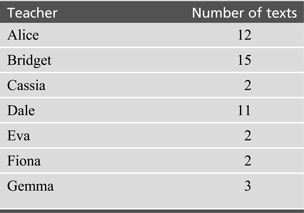
Nevertheless, for ethical reasons, I have anonymized the contributions as much as possible. This is to reduce the very slight risk of causing embarrassment. In the years since these data were collected, all seven teachers have left the unnamed language school, the city or (in some cases) the country (see Table 1, below, for the number of texts contributed by each teacher – pseudonyms used).
Data contributed by each teacher

The data were dealt with in the following way. Firstly, I converted this small corpus of texts into a Word document and noted key details, such as sender, date and time. Next, drawing on criteria suggested by Davies, Merrison & Goddard (Reference Davies, Merrison and Goddard2007), I carried out various analytical procedures, including enumerative ones. The nature of these procedures will become evident in the presentation of results below, which reflect the use of both quantitative and qualitative data (Cohen, Manion & Morrison, Reference Cohen, Manion and Morrison2007). The results are organized around themes.
Results
IFIDs
I was first interested in the presence of explicit IFIDs and highlighted all these in the data. 36 out of 47 messages contain explicit IFIDs. Some contain more than one, e.g.
Hi Mark I'm afraid my cold has gone from bad to worse and kept me awake most of the night. I'll be convalescing at home this morning. My class to start unit 5A of their book. Sorry and thanks (Bridget, 3/2/09, 5.12am)
There are 43 IFIDs in total, with ‘sorry again’ appearing several times. Interestingly, the two teachers most absent apologize the most. In Alice's 12 texts, there are 16 IFIDs; Bridget offers 17 in 15 texts. Eva and Gemma include them, Cassia and Fiona do not. Just under half (5/11) of Dale's texts include explicit IFIDs.
The most used IFID is ‘sorry’ (37 occurrences), sometimes supported by intensifiers (‘really’, ‘very’, ‘dreadfully’, ‘so’), particularly in the discourse of Alice, who contributed 8 out of 12. An example is as follows:
Mark I'm dreadfully sorry to land you in it again but really not up to teaching tomorrow… (Alice, 1/7/09, 10.05pm)
This example is also interesting for ‘sorry’ being followed by the acknowledgement of the imposition, ‘landing’ the receiver of the message ‘in it’. Acknowledging imposition, as a common politeness feature (Brown & Levinson, Reference Brown and Levinson1987), is an oft-cited feature of requests (e.g. Chen, Reference Chen2001), though it has received less attention with regard to apologies. There are other examples in Alice's messages:
Sorry to disturb you on a Sunday (Alice, 21/9/08, 2.42pm)
Sorry to text so late (Alice, 19/10/08, 8.29pm)
Sorry not to give you more notice (Alice, 19/10/08, 8.29pm)
Acknowledging the imposition in this way could be seen as a strategy for demonstrating empathy, so putting the sender of the message in a more positive light. In Bridget's discourse, too, there is a similar pattern, although her acknowledgements of the imposition have a more formulaic quality:
Sorry for hassle (Bridget, 18/12/08, 7.13am; 4/2/09, 6.39am; 13/8/09, 6.30am)
Sorry for the short notice (Bridget, 23/2/09, 7.06am)
Sorry for inconvenience (Bridget, 12/6/09, 7.05am)
Interestingly, none of the other teachers adopt this pattern in acknowledging the imposition so explicitly, although on one occasion Dale writes:
Really sorry about this (Dale, 18/6/09, 7.16am)
Regarding use of other IFIDs, Alice also uses ‘unfortunately’ on two occasions, each time to introduce a second apology within the same text:
Unfortunately I've got the books but students are on 7A…
(Alice, 12/12/08, 7.42am)
Unfortunately I brought reg home as preparing stuff from back…
(Alice, 16/7/09, 7.13am)
Alice seems to have felt these follow-up apologies were necessary as I had specifically requested teachers not to take their class registers (including attendance and records of work) or teaching materials (e.g. teachers' books, audio CDs) home with them in the event of them being unwell overnight and unable to teach the following day. Without these documents and materials the substitute teacher would find it harder to prepare. Interestingly, though, Alice's apologies here are rather matter-of-fact. There is no explicit admission of responsibility nor indeed any promise not to ‘re-offend’; these features of apologies (Blum-Kulka & Olshtain, Reference Blum-Kulka and Olshtain1984) are not present in any of my data. Accounts are in evidence, though, and I turn to these next.
Accounts
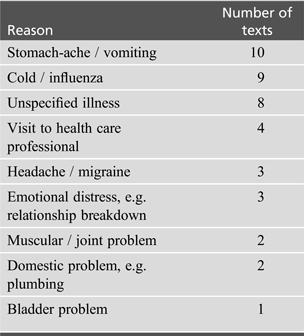
The majority of the texts (42 out of 47) include accounts, and, as Table 2 below reveals, most of these are quite specific.
Accounts provided to explain absence
Interestingly, ‘hangover’ is never offered as a reason, though anecdotal evidence, including conversations overheard in the teachers' room, suggests that alcohol consumption may have been involved in at least some of these absences. Where the illness is unspecified, there is often reference to shared information, e.g.
Really not up to teaching tomorrow. Feeling worse (Alice, 1/7/09, 10.05pm)
I'm still too ill to come in (Dale, 7/5/09, 8.08am)
Not feeling any better (Eva, 10/6/09, 7.23pm)
Usually, though, the teachers go into detail, as these examples from Bridget demonstrate:
I pulled a muscle in my back and can hardly move this morning (8/12/08, 6.55am)
think I have succumbed to vomiting bug, been up sick most of night (18/12/08, 7.13am)
still very choked with lurgy and not sleeping (4/2/09, 6.39am)
have been up most of night with suspected food poisoning (7/5/09, 8.07am)
think I've caught the bug, very sore throat and can't talk (12/6/09, 7.05am)
I was evacuated plus woken in the night by fire brigade (28/7/09, 7.26am)
am still waking up with nasty headache (14/8/09, 7.01am)
Very often in Bridget's discourse, at least two related symptoms or conditions are provided, which has the effect of intensifying the reported suffering (and thus justifying the absence more forcefully). The other teachers who are absent frequently do this as well, e.g.
I've got a cold and feel rough (Alice, 2/12/08, 7.37am)
Have temp and sore throat (Alice, 16/7/09, 7.13am)
woke up feeling really dizzy and sick (Dale, 2/3/09, 7.59am)
I'm coughing and sneezing a lot (Dale, 6/5/09, 7.58am)
i can't walk or stand as can't put any weight on my knee (Dale, 21/5/09, 7.35am)
Interestingly, the teachers who are absent less frequently go into much less detail in accounting for their absence. Gemma provides some detail in reporting:
Sick all weekend (11/1/09, 7.25pm)
Woke up with severe migraine (26/1/09, 6.32am)
However, the other three confine themselves to expressions such as: ‘am quite ill’ (Cassia, 20/7/09, 11pm) or ‘still not well with flu’ (Fiona, 17/4/09, 8.16am).
The teacher who provides the most colourful accounts is Bridget, who is also distinctive in another way, in providing a wide range of reasons for absence. In fact, with reference to the 9 categories of accounts presented above (in Table 2), there are only two that Bridget does not make use of. She never leaves an illness unspecified and she never needs to be absent to see a doctor (or another health care professional).
Offers of repair
Besides accounting for unavoidable absences, many of the text messages (27/47) include offers of repair. Nearly all of the teachers attempt to ‘make things right’ (Davies, Merrison & Goddard, Reference Davies, Merrison and Goddard2007) by suggesting solutions to the problem their impending absence will create.
The main repair strategy is to provide information about what it is the class (either a 3-hour morning class or a 2½-hour afternoon class) should cover, e.g.:
Have left film reviews to be edited by each other in cupboard, with stuff from NEF (Alice, 16/7/09, 7.13am)
Class have to prepare presentation based on case study in Market Leader, unit called ‘CULTURE’, about Chinese businessman visiting their country (Bridget, 18/6/09, 12.37am)
Page 90–91 plus chek hw and collect written work (Cassia, 18/6/09, 6.18am)
The main proponents of this strategy, accounting for 15 of the 17 instances, are Alice and Bridget, the most frequent apologizers. Such information is useful to the substitute teacher for preparation purposes, but should have been available in the school anyway; the regular teachers completed records of work, indicating what had been done in the previous lesson and what they were doing next. These records were kept with their registers, but would usually not be seen by the substitute teacher until fairly close to the time of the lesson. Advance information by text could only help, if it was specific, as above. On one occasion, it was not:
pls any unit in headway ok (Gemma, 26/1/09, 6.52am)
This message raises concerns, as it suggests the syllabus followed by the students may lack coherence. On another occasion, though, the same teacher does apologize to the students for her absence (‘sorry 2u and students’ Gemma, 27/1/09, 7.01am), the only teacher to do so explicitly.
Other than addressing course content, offers of repair sometimes address the issue of who will teach the class. Sometimes there is the reasonable assumption that it will be me, the DoS, or a teacher known to be free (‘Hope Helen ok to cover?’ Alice, 21/4/09, 7.05am), but sometimes combining classes, which is the last resort from my perspective (as it disrupts the students' course of study), is suggested. Perhaps the teacher wishes to make the disruption seem more minor than it is, e.g.:
Anticipating only a few students so maybe elementary classes could merge? (Bridget, 8/12/08, 6.55am)
I anticipate both my classes being small, so hope not too inconvenient. (Bridget, 23/2/09, 7.06am)
Can you arrange cover or maybe combine with the elementary class? I only had 4 on tues (Dale, 6/5/09, 7.58am)
Sometimes, in reality, classes were combined. Dale refers to this having recently happened in a text dated 9/4/09. In fact, the data reveal that on the previous day both he and another teacher (Eva) had been absent, which may have led to resources being over-stretched.
In the texts above, the projected small class size is given as a reason for the disruption being minor. These classes should have held approximately 10 students each (maximum 14), so if only a few were expected this was another cause for concern. In short then, while the teachers were trying to help, some of the offers of repair provide unintended insights into their thinking that are rather worrying.
But-justifications
Sometimes offers of repair almost merge with another characteristic of these apologies, but-justifications. These support teachers' attempts to positively enhance their self-image by allowing them to demonstrate that, regardless of the offence, they are ‘good’ teachers with ‘pious attitudes’ (Davies, Merrison & Goddard, Reference Davies, Merrison and Goddard2007). An example of this is as follows:
Should be in for second lesson, if not earlier (Alice, 14/8/09, 7.28am)
This could be interpreted as an offer of repair. Alice is unable to teach, but will be absent just for the first part of the day (9–10.30am); her second lesson with the same class will start at 10.45am. Therefore, she is minimizing the imposition by scaling down the projected disruption (1½ hours to cover, not 3). However, the last three words (‘if not earlier’) really form a but-justification. Alice is demonstrating a ‘pious’ willingness to get to work as soon as possible. Such a projected conscientiousness is evident elsewhere, e.g.:
I'll do my best to come in this afternoon (Alice, 2/12/08, 7.37am)
will try to get to meeting if better (Alice, 12/12/08, 7.42am)
Will try to get in for afternoon classes if I'm better (Bridget, 7/5/09, 8.07am)
I will email you report for Kris (Bridget, 12/6/12, 7.05am)
i could be in at 1 to take care of Thais (Dale, 8/4/09, 8.15am)
Interestingly, teachers absent less often appear to use but-justifications rarely. For example, referring to a student report, such as the one on Kris above, which she would subsequently prepare, Cassia writes simply: ‘Hav not riten report’ (20/7/09, 11pm).
This is actually how the message ends. Interestingly the teachers absent more often never conclude so abruptly. If the explicit IFID is not reiterated, there is sometimes a closing salutation carrying a positive relationship-maintaining message, e.g.:
Call you later (Alice, 28/5/09, 11.23am)
C U tomorrow (Bridget, 13/8/09, 6.30am)
Will ctcu 2day (Gemma, 27/1/09, 7.01am)
Moreover, to convey a friendly attitude, Alice usually (11/12) signs off with her name or initial. Bridget sometimes (7/15) does this; Fiona and Gemma do. Furthermore, Alice, Bridget and Gemma also always start with a greeting (‘Hi Mark’ or ‘Mark’). Dale does this occasionally (4/11); the others do not.
Summary
So what conclusions, then, can we draw from this analysis? Firstly, it is evident that these teachers are resourceful in apologizing for future absence by SMS text message. All 47 messages contain explicit IFIDs and/or implicit accounts, usually both. Explicit IFIDs are strengthened by intensifiers and acknowledgements of imposition; accounts are often richly descriptive, complex and varied. Offers of repair, but-justifications (Davies, Merrison & Goddard, Reference Davies, Merrison and Goddard2007) and other devices that demonstrate a respectful, pious attitude, e.g. closing salutations, are also present.
It is also evident, though, that some of these teachers are more expert than others in apologizing, with those who do so very often particularly skilled in blending a range of appropriate features into an apology by text, e.g.:
Mark I'm dreadfully sorry to land you in it again but really not up to teaching tomorrow. Feeling worse. Copies of NEF on desk. Lots of leisure linked activities in folder on desk. Wouldn't do this if I didn't feel so wiped out. Sorry again. Alice (1/7/09, 10.05pm)
In contrast, the messages of teachers who are absent less often tend to be much less complex, e.g.:
I am still not well so will not be coming in today. Fiona (16/3/09, 8.02am)
It is debatable whether a message such as this is actually an apology, as defined by Goffman (Reference Goffman and Goffman1971). All it contains is a notification of absence, together with a brief account referring to shared information; for it to function as an apology, ‘still’ needs to do a lot of work. There is no explicit IFID, but it can be argued this is not strictly necessary if other features are developed (Davies, Merrison & Goddard, Reference Davies, Merrison and Goddard2007). The message below, for example, differs primarily in providing a richer account of the teacher's suffering. This helps it function as an apology:
Hi i think i've got some kind of stomach bug. I've been really sick all day and it only seems to be getting worse. I won't be able to come in tomorrow (Dale, 14/6/09, 8.52pm).
As to my response to these apologies by text, I did accept them. Not every DoS might be so tolerant, though, either of the texts that were a little abrupt or of the frequency of the need to arrange cover. The trouble that Alice, Bridget and, to a lesser extent, Dale went to, to apologize carefully for future absence by text, hints at the insecurities of working as a part-time, hourly-paid EFL teacher in the UK, in a culture where apologies are expected (Hatipöglu, Reference Hatipöglu2004).
Conclusions
Evidence from this small-scale study, set in a unique socio-cultural context, does suggest that Davies, Merrison & Goddard's (Reference Davies, Merrison and Goddard2007) framework for analysing apologies can be applied to other settings. Of particular interest is that the but-justifications these authors identified were present in the data. Curiously, though, one feature of apologies described by Blum-Kulka & Olshtain (Reference Blum-Kulka and Olshtain1984) that might have been expected, a promise that the offending behaviour would not re-occur, was not in evidence, and there may be various reasons for this. Firstly, it could relate to the nature of the teachers' relationships with me. Would the apologizing teachers have felt such a promise might sound too formal (when they clearly also wished to downplay the offence)? Or would they have felt such an undertaking was unrealistic (as they expected to re-offend)? Only use of an additional research method (e.g. stimulated recall interviews) could perhaps uncover this. An alternative explanation for the lack of promises the behaviour would not re-occur might relate to the limitations of the data size and the opportunistic sampling of a small number of contributors. Broad conclusions cannot be drawn from such a small-scale study, though it can furnish insights.
 DR MARK WYATT is a Senior Lecturer at the University of Portsmouth, where he teaches various modules relating to the history of English, communication theory and research methods. He supervises MA and PhD students and co-convenes a research group. Mark's research has been published widely, e.g. in International Journal of Research and Method in Education and ELT Journal. Earlier in his career, he worked in Thailand, Nepal and Oman, teaching and running teacher education courses, trying to inspire and motivate. Email: dr.markwyatt@gmail.com