Implications
Rolled linseed improved the fatty-acid composition of intramuscular lipids towards a healthier profile, by promoting the deposition of polyunsaturated fatty acids and by improving the n-6:n-3 ratio, either alone or together stoned olive cake. In the last case, a reduction in the feeding cost may also be achieved. Finally, compared with a conventional cereal-based concentrate diet, the inclusion of up to 35% of stoned olive cake in the diet did not have detrimental effects on the growing and slaughtering performances and had minor effects on the intramuscular fatty-acid composition.
Introduction
The fatty-acid composition of intramuscular lipids from intensively reared lambs is characterized by high levels of saturated fatty acids (SFA) and low levels of unsaturated fatty acids (especially polyunsaturated fatty acids (PUFA)) (Berthelot et al., 2010). These characteristics are because of the biohydrogenation activity of rumen bacteria, which saturate most of the dietary PUFAs. Moreover, as the diet of fattening lambs is constituted mainly of cereals and other grains rich in n-6 fatty acids, the ratio n-6:n-3 in fat depots of lambs is often unbalanced, reaching values higher than the threshold of 4:1 suggested by the World Health Organization in relation to the fat intake in the human diet (WHO, 2003). According to the WHO dietary guidelines, the total intake of SFA should be lowered, whereas the intake of n-3 fatty acids should be enhanced to reduce the risk for cardiovascular diseases. On the basis of the above-mentioned characteristics, the intake of meat from ruminants is often reduced by consumers without considering its overall nutritional value as a source of high biological value proteins, vitamins, minerals and for its content of other potentially bioactive substances such as conjugated linoleic acid (CLA) and branched-chain fatty acids (McAfee et al., Reference McAfee, McSorley, Cuskelly, Moss, Wallace, Bonham and Fearon2010). On the basis of the increasing request by consumers for food that is safe and healthy, in the last few years, several feeding strategies, mainly based on the dietary supplementation of unsaturated vegetable oils such as linseed, sunflower and soya bean, have been proposed to improve the fatty-acid composition of lamb meat (Shingfield et al., Reference Shingfield, Bonnet and Scollan2013). In particular, several papers demonstrated that the inclusion of linseed at a percentage higher than 4% (as oil or seed) in the diet of lambs allowed to obtain an increase in the content of n-3 fatty acids (especially 18:3 n-3 and 20:5 n-3), CLA, vaccenic acid and other intermediates of the fatty-acid rumen biohydrogenation process and a decrease of the n-6:n-3 ratio below the 4:1 value (Sinclair, Reference Sinclair2007; Moloney et al., Reference Moloney, Kennedy, Noci, Monahan and Kerry2012). Previous studies reported that dietary PUFA and their biohydrogenation products were selectively incorporated into membrane lipids or into neutral lipid fraction of the intramuscular fat (Jerónimo et al., Reference Jerónimo, Alves, Alfaia, Prates, Santos-Silva and Bessa2011). As some effect on human health may depend on the fatty-acid composition of membrane lipids assumed with the diets, an increasing interest has been devoted to the characterization of polar and neutral lipids in animal food, especially with regard to the trans fatty-acid content (Smith et al., Reference Smith, Robinson, Nam and Ma2009).
The use of agro-industrial by-products as alternative feed resources may be a feasible strategy to reduce feeding cost in ruminant nutrition and, at the same time, to positively influence the quality of the milk and meat, especially in the case of by-products that contain appreciable amounts of vegetable oils and plant secondary compounds, which may contribute to improve the fatty-acid composition and the antioxidant power of meat from ruminants (Vasta and Luciano, Reference Vasta and Luciano2011). In the Mediterranean area, olive cake is the main by-product of the olive oil industry. Until now, the use of olive cake in the ruminant nutrition has been limited by the high content of lignin, which worsens the digestibility of organic matter (Molina-Alcaide and Yáñez-Ruiz, Reference Molina-Alcaide and Yáñez-Ruiz2008). Modern extraction technologies diffused in Italy are based on a three-phase extraction system at a low level of water addition that may include the preventive stoning of the olives to improve the quality of the oil. This technology allows to better control the activity of the peroxidase enzyme, which is mainly concentrated in the seed, otherwise virgin olive cake can be stoned after oil mechanical extraction. Finally, coupling the three-phase extraction with a total or partial removal of seeds (stoning) allows to obtain an olive cake containing low levels of lignin and remarkable levels of residual oil and antioxidants, such as tocopherols and retinol, and bioactive phenols, such as secoiridoids and lignans (Servili et al., Reference Servili, Esposto, Taticchi, Urbani, Selvaggini, Di Maio and Veneziani2011). Therefore, the use of stoned olive cake in substitution to a quote of the cereal in the diet of lamb could be a strategy to reduce the feeding cost and, at the same time, to introduce a source of oleic acid and of substances with antioxidant properties, which could contribute to improve the quality of meat (Molina-Alcaide and Yáñez-Ruiz, Reference Molina-Alcaide and Yáñez-Ruiz2008).
In the present research, the effect of stoned olive cake supplementation, alone or in combination with rolled linseed, on the fatty-acid composition of polar and non-polar intramuscular lipids from the longissimus dorsi muscle of intensively reared lambs was evaluated.
Material and methods
Stoned olive cake production and polyphenols determination
Fresh olive cake was obtained after oil extraction was performed using an RCM Rapanelli three-phase decanter (Rapanelli Inc., Perugia, Italy). After oil extraction, virgin olive cakes were stoned and dried using a fluid-bed dryer. The initial temperature of the flow drying air was 120°C and did not exceed 45°C to prevent from oxidative deterioration (Servili et al., Reference Servili, Esposto, Taticchi, Urbani, Selvaggini, Di Maio and Veneziani2011). The extraction of phenolic compounds from olive cake was performed according to Dal Bosco et al. (Reference Dal Bosco, Mourvaki, Cardinali, Servili, Sebastiani, Ruggeri, Mattioli, Taticchi, Esposto and Castellini2012). Briefly, 10g of the sample were homogenized with 100ml of a solution containing 20mg/l of sodium diethyldithiocarbamate in methanol; the extraction was performed in triplicate. After methanol removal, the aqueous extract was used for phenol separation by solid phase extraction (SPE) technique. The SPE procedure was applied by loading 1ml of the aqueous extract into an Extraclean high-load C18 cartridge (Alltech Italia S.r.l., Milano, Italy) and eluting with methanol. After solvent removal under vacuum at 30°C, the phenolic extract was recovered and then dissolved in methanol. The HPLC analysis of the phenolic extracts was performed according to Dal Bosco et al. (Reference Dal Bosco, Mourvaki, Cardinali, Servili, Sebastiani, Ruggeri, Mattioli, Taticchi, Esposto and Castellini2012).
Animals and diets
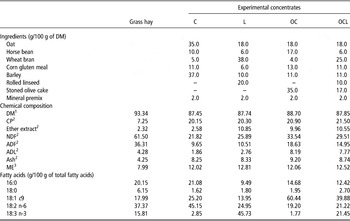
The study was carried out at the Experimental Station of the Department of Applied Biology at the University of Perugia (Italy) on 32 Appenninica male lambs that immediately after weaning (40±5 days old, weighing 17.8±1.6kg) were randomly distributed into four groups of eight lambs each. After 20 days of adaptation, each group was kept in multiple pens (eight lambs for each pen) and was allowed one of the following dietary treatments for 40 days: a concentrate with a low level of lipids and a high content of non-structural carbohydrates (diet control, C); a concentrate containing 20% on a dry matter (DM) basis of rolled linseed (diet L); a concentrate containing 35% on DM of stoned olive cake (diet OC); and a concentrate containing a mixture of rolled linseed (10% on DM) and stoned olive cake (17% on DM; diet OCL). All the concentrates were pelleted by a pelleting machine (CMS IEM; Colognola ai Colli, Verona, Italy), the pellet diameter was 3mm and the pelleting temperature ranged from 35°C to 40°C. Diets were balanced according to energy and protein content to obtain isoenergetic and isonitrogenous treatments. The concentrates were administered together with grass hay according to the ratio 20:80 forage:concentrate, on the basis of the expected DM intake. The composition and the chemical characteristics of the diet are reported in Table 1. Feeds offered and refused were daily recorded per group and orts collected and mixed. Each week feed samples and orts were collected and stored at −30°C before the analysis.
Ingredients, chemical composition and fatty acids of the experimental concentrates and of the hay administered to the lambs

C=control concentrate containing neither linseed nor olive cake; L=concentrate containing 20% of rolled linseed; OC=concentrate containing 35% of stoned olive cake; OCL=concentrate containing 17% olive cake and 10% rolled linseed; DM=dry matter; ME=metabolizable energy.
1 Expressed as g/100 g of fresh weight.
2 Expressed as g/100 g of DM.
3 Expressed as MJ/kg of DM.
CP, ether extract and ash were determined in feeds according to AOAC (1990) methods. Fibre fractions were analysed according to the method described by Van Soest et al. (Reference Van Soest, Robertson and Lewis1991). The metabolizable energy content of the experimental concentrates was estimated according to Cornell Net Carbohydrates and Protein System for sheep (Cannas et al., Reference Cannas, Tedeschi, Fox, Pell and Van Soest2004).
Lambs were weighed at the beginning of the experiment and every 10 days until the day before slaughter. At the end of the experiment, lambs were slaughtered and carcasses were immediately weighed to obtain hot carcass weight and kept at 4°C for 24h. Samples from the longissimus dorsi muscle were removed between the 2nd and the 13th rib, vacuum-packed and stored at −80°C until further analysis.
Fatty-acid analysis
Total intramuscular lipids (TL) were extracted by means of a chloroform/methanol solution (2:1, v/v), according to Serra et al. (Reference Serra, Mele, La Comba, Conte, Buccioni and Secchiari2009a). Polar (PL) and neutral (NL) lipids were separated according to Juaneda and Rocquelin (Reference Juaneda and Rocquelin1985) using Sep-Pak® silica cartridges (Waters, Milford, MA, USA).
For each lipid fraction (i.e. TL, PL and NL), fatty-acid methyl esters (FAME) were prepared by the base-catalysed trans-methylation (Christie, Reference Christie1982). Before methylation, 9:0 and 23:0 FAME were added together as internal standards. The FAMEs were determined by a GC 8000 Top ThermoQuest (Milan, Italy) gas-chromatograph apparatus equipped with a flame ionization detector (FID) and a high-polar fused silica capillary column (WCOT-fused silica CP-Select CB for FAME Varian, Middelburg, the Netherlands; 100m×0.25mm i.d.; film thickness 0.25μm). Helium was used as the carrier gas at a flow of 1ml/min. The split ratio was 1:80. The oven temperature was programmed at 150°C and held for 1min, then increased up to 175°C at a rate of 0.8°C/min, held for 14min, increased up to 188°C at 2°C/min, held for 18min and then increased up to 230°C at a rate of 2°C/min, held for 13min. The injector and detector temperatures were set at 270°C and 300°C, respectively. The identification of individual FAME was based on a standard mixture of 52 Component FAME Mix (Nu-Chek Prep Inc., Elysian, MN, USA) and 77 individual FAME standards (Larodan Fine Chemicals, Malmo, Sweden). The identification of 18:1 and 18:2 isomers was based on commercial standard mixtures (Larodan Fine Chemicals) and on chromatograms published by Kramer et al. (Reference Kramer, Hernandez, Hernandez, Kraft and Dugan2008) and Alves and Bessa (Reference Alves and Bessa2007). For each FA, response factors to FID and inter- and intra-assay coefficients of variation were calculated by using a reference standard butter (CRM 164, Community Bureau of Reference, Brussels, Belgium). Fatty acids were expressed as g/100g of fatty acids.
With regard to feed samples, fat was extracted according to the method described by Folch et al. (Reference Folch, Lees and Stanley1957). Fatty acids were esterified according to Christie (Reference Christie1982) with 19:0 as the internal standard, and were identified using the same procedure described above for fatty acids of meat samples. The fatty-acid composition of the four experimental concentrates is presented in Table 1.
Statistical analysis
Data were analysed by means of one-way analysis of variance (SAS, 1999), including diet as a fixed factor. Individual animals were considered experimental units for all the variables included in the statistical analysis and reported in the tables. Multiple comparisons of means were made using the Tukey’s adjusment. Main effects and differences were considered significant when P≤0.05.
Results and discussion
Chemical composition of experimental diets
The chemical composition of olive cake is highly variable according to cultivar, oil extraction and stoning system applied (Molina-Alcaide and Yáñez-Ruiz, Reference Molina-Alcaide and Yáñez-Ruiz2008). In the present trial, the olive cake was obtained by a three-phase extraction system coupled with a stoning system after the oil extraction. The values of NDF, ADF, ADL and CP content were higher than those found by Vera et al. (Reference Vera, Aguilar, Lira, Toro, Barrales, Pena, Squella, Pérez, Quenaya, Yutronic and Briones2009) in stoned olive cake obtained from two-phase system, whereas ether extract was lower (Supplementary Table S1). As expected, the fatty-acid composition of olive cake was high in c9-18:1 (more than 75% of total fatty acids). The low temperature used in the drying system determined that total polyphenol content was higher than that reported by Molina-Alcaide and Yáñez-Ruiz (Reference Molina-Alcaide and Yáñez-Ruiz2008) in their review, concerning the potential use of olive oil extraction by-products in animal nutrition. The most abundant polyphenols were 3,4-dihydroxyphenylethanol-elenolic acid di-aldehyde (3,4-DHPEA-EDA, also known as oleuropein-aglycone di-aldehyde) and verbascoside (Supplementary Table S1). Similar results were reported by Dal Bosco et al. (Reference Dal Bosco, Mourvaki, Cardinali, Servili, Sebastiani, Ruggeri, Mattioli, Taticchi, Esposto and Castellini2012). The effect of olive cake polyphenols on the oxidative stability of lamb meat has been reported in a previous paper (Luciano et al., Reference Luciano, Pauselli, Servili, Mourvaki, Serra, Monahan, Lanza, Priolo, Zinnai and Mele2013).
The inclusion of both rolled linseed and olive cake in the L, OC and OCL concentrates resulted in a higher content of fat, compared with C concentrates (Table 1). Furthermore, the inclusion of olive cake in the concentrates (OC and OCL treatments) increased the NDF, ADF and ADL content, compared with the C and L diets. The inclusion of olive cake in the OC and OCL diets resulted in a high content of c9-18:1, whereas the supplementation with rolled linseed (L and OCL diets) increased the levels of 18:3 n-3.
Animal performance and carcass characteristics
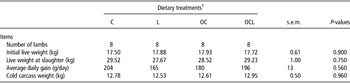
The growth performance of lambs was not affected by the dietary treatments (Table 2), as a consequence of the similar nutritional characteristics of the four diets that allowed to obtain very similar values of DM intake (944.2, 914.4, 968.3 and 939.1g/day of DM, for group C, L, OC and OCL, respectively).
Effect of stoned olive cake and rolled linseed in the diet of intensively reared lambs on growth performance and carcass composition

C=containing neither linseed nor olive cake; L=containing 20% of rolled linseed; OC=containing 35% of stoned olive cake; OCL=containing 10% of rolled linseed and 17% of stoned olive cake.
1 The dietary treatments consisted of grass hay and the experimental concentrates at a 20 : 80 forage : concentrate ratio.
In a previous study, Mioc et al. (Reference Mioc, Pavic, Vnucec, Prpic, Kostelic and Susic2007) reported no adverse effects of the inclusion at 15% on DM intake of whole dried and whole olive cake in the diet of finishing lambs, respectively; although when olive cake was added at 30% on DM intake, an adverse effect on the average daily gain was found. In the present study, the OC diet contained nearly 25% of olive cake. This amount of olive cake had been proposed as the upper limit in the diet of sheep (Molina-Alcaide and Yáñez-Ruiz, Reference Molina-Alcaide and Yáñez-Ruiz2008). However, the lack of negative effects on the growing performance suggested that the stoning process could have improved the digestibility of the diet as already observed by Sadeghi et al. (Reference Sadeghi, Yansari and Ansari-Pirsarai2009), using experimental diets containing 20% of stoned olive cake. The dietary treatment did not affect slaughtering performance according to previous studies that included comparable amounts of stoned olive cake or vegetable fat in the diet of finishing lambs (Mioc et al., Reference Mioc, Pavic, Vnucec, Prpic, Kostelic and Susic2007; Berthelot et al., 2010; Noci et al., Reference Noci, Monahan and Moloney2011).
Fatty-acid composition of intramuscular fat
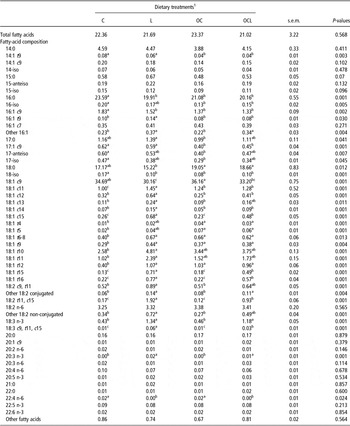
As a consequence of the similar growth rate of lambs, the content of intramuscular fat in the Longissimus dorsi muscle was not affected by the dietary treatment (3.82, 3.80, 3.93 and 3.61 for C, L, OC and OCL diet, respectively, P=0.96; data not shown). Therefore, the content of total fatty acids and the proportion between polar and neutral fatty acids did not differ between treatments (Tables 3 to 5). This result allowed to avoid confounding effects of total fatness on meat fatty-acid composition (Noci et al., Reference Noci, Monahan and Moloney2011). Therefore, differences in fatty-acid composition were mainly because of the diet and the selectivity of individual fatty acids for polar and neutral lipids.
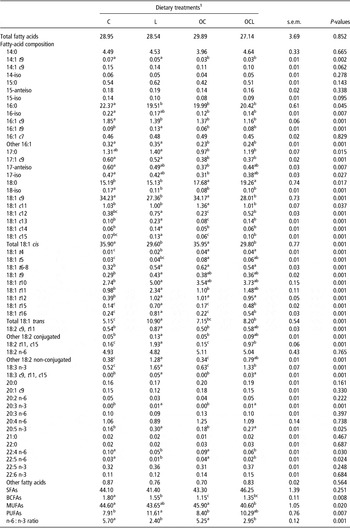
Effect of stoned olive cake and rolled linseed in the diet of intensively reared lambs on the concentration of total fatty acids (mg/g fresh muscle) and on the fatty-acid composition (g/100 g of fatty acids) of total lipids in the Longissimus dorsi muscle

C=containing neither linseed nor olive cake; L=containing 20% of rolled linseed; OC=containing 35% of stoned olive cake; OCL=containing 10% of rolled linseed and 17% of stoned olive cake; SFA=saturated fatty acid; BCFA=branched-chain fatty acid; MUFA=monounsaturated fatty acid; PUFA=polyunsaturated fatty acid.
a–cWithin a row, values with different letters are significantly different (P≤0.05).
1 The dietary treatments consisted of grass hay and the experimental concentrates at a 20:80 forage:concentrate ratio.
Effect of stoned olive cake and rolled linseed in the diet of intensively reared lambs on the concentration of total fatty acids (mg/g fresh muscle) and on the fatty-acid composition (g/100 g of fatty acids) of polar lipids in the Longissimus dorsi muscle

C=containing neither linseed nor olive cake; L=containing 20% of rolled linseed; OC=containing 35% of stoned olive cake; OCL=containing 10% of rolled linseed and 17% of stoned olive cake.
a–cWithin a row, values with different letters are significantly different (P≤0.05).
1 The dietary treatments consisted of grass hay and the experimental concentrates at a 20:80 forage:concentrate ratio.
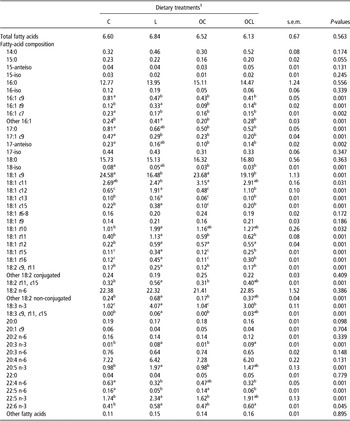
Effect of stoned olive cake and rolled linseed in the diet of intensively reared lambs on the concentration of total fatty acids (mg/g fresh muscle) and on the fatty-acid composition (g/100 g of fatty acids) of neutral lipids in the Longissimus dorsi muscle

C=containing neither linseed nor olive cake; L=containing 20% of rolled linseed; OC=containing 35% of stoned olive cake; OCL=containing 10% of rolled linseed and 17% of stoned olive cake.
a–cWithin a row, values with different letters are significantly different (P≤0.05).
1 The dietary treatments consisted of grass hay and the experimental concentrates at a 20:80 forage:concentrate ratio.
As expected, the inclusion of rolled linseed in the L and OCL diets resulted in an increase of 18:3 n-3 content in intramuscular total lipids, which was threefold higher in meat from the L lambs and more than twofold higher in meat from the OCL lambs, compared with that from lambs fed C and OC diets (P<0.01 in all cases). The content of long-chain PUFA n-3 was also enhanced, with the exception of 22:5 n-3 and 22:6 n-6. In particular, the 20:3 n-3 was detected only in total lipids of meat samples from the L and OCL lambs and, as the other long-chain PUFAs, was preferentially incorporated into the polar lipid fraction (Table 4). The presence of this fatty acid only in the intramuscular fat from lamb fed with linseed suggested a possible role of 20:3 n-3 as a marker of linseed supplementation. Moreover, dietary linseed enhanced the content of 20:5 n-3 in both intramuscular fat and polar PL from the L and OCL lambs, but not the content of 22:6 n-3, confirming what was reported in previous studies, about the long time needed to complete the elongation process from 18:3 n-3 to 22:6 n-3 (Scollan et al., Reference Scollan, Hocquette, Nuernberg, Dannenberger, Richardson and Moloney2006; Sinclair, Reference Sinclair2007). The overall effect of the L diet and, to a lower extent, of the OCL diet, was to increase the degree of unsaturation of the polar lipids of muscle cell membranes (Table 4). Although the content of 18:3 n-3 in the L diet was double than that in the OCL diet, the transfer of this fatty acid from diet to intramuscular fat was not proportional to the dietary intake, suggesting a lower apparent transfer of C18:3 n-3 from the L diet, when compared with the OCL diet (Table 3). This phenomenon was also confirmed by the polar lipid composition (Table 4). This result did not agree with Bas et al. (Reference Bas, Berthelot, Pottier and Normand2007), who observed a linear increase in 18:3 n-3 content in intramuscular fat with the increase of extruded linseed in the concentrate from 0% to 9% on DM basis. As the results of the present study did not allow to assess whether this trend was because of an interactive effect between stoned olive cake and rolled linseed, further studies are needed to examine the effect of olive polyphenols on the rumen biohydrogenation of 18:3 n-3. In fact, previous studies reported that some kinds of plant polyphenols might influence rumen microbe metabolism, affecting the biohydrogenation process of the dietary unsaturated fatty acids (Vasta et al., Reference Vasta, Mele, Serra, Scerra, Luciano, Lanza and Priolo2009; Buccioni et al., Reference Buccioni, Minieri, Rapaccini, Antongiovanni and Mele2011; Jerónimo et al., Reference Jerónimo, Alfaia, Alves, Dentinho, Prates, Vasta, Santos-Silva and Bessa2012).
Despite the high amount of rolled linseed included in our study on the L and OCL concentrates (20% and 10% of the concentrate, respectively), the enrichment of intramuscular fat with 18:3 n-3 was not as high as expected. Bas et al. (Reference Bas, Berthelot, Pottier and Normand2007) obtained similar levels of enrichment in the intramuscular fat of lambs fed a concentrate with 9% of extruded linseed (1.52/100g of fatty acids), whereas Berthelot et al. (Reference Berthelot, Bas and Schmidely2010) reported higher levels of 18:3 n-3 (more than 2.2/100g of fatty acids), by feeding lambs with a concentrate containing 10% of extruded linseed. However, it is not easy to compare different feeding studies because the composition of the basal diet or the nature of the dietary fat source may significantly affect the biohydrogenation process of PUFAs in the rumen (Shingfield et al., Reference Shingfield, Bonnet and Scollan2013). A higher duodenal flow of 18:3 n-3 and its biohydrogenation intermediates have been observed when extruded linseed or pure linseed oil have been compared with rolled linseed in the cow diet (Doreau et al., Reference Doreau, Laverroux, Normand, Chesneau and Glasser2009). Moreover, when lamb carcasses were very lean, as in the case of the study by Berthelot et al. (Reference Berthelot, Bas and Schmidely2010), the contribution of those fatty acids, which are selectively incorporated in the polar lipids (such as 18:3 n-3 and 18:2 n-6, Jerónimo et al., Reference Jerónimo, Alves, Alfaia, Prates, Santos-Silva and Bessa2011), increased.
The n-6:n-3 ratio significantly decreased in the meat samples from the L and OCL lambs reaching values below 3, which is considered an optimal value for human nutrition, although recent insights suggest that absolute amounts of n-3 and n-6 PUFA are more useful than the n-6:n-3 ratio as indices for cardiovascular diseases (McAfee et al., Reference McAfee, McSorley, Cuskelly, Moss, Wallace, Bonham and Fearon2010).
The content of c9,t11,c15-18:3 and t11,c15-18:2, which represent the first two intermediates of 18:3 n-3 rumen biohydrogenation, proportionally increased with increasing content of linseed in the concentrate. The content of t11,c15-18:2 was higher in neutral lipid than in polar lipids of L and OCL samples (Tables 4 and 5), confirming a higher affinity of this fatty acid for neutral lipids, as previously reported by Jerónimo et al. (Reference Jerónimo, Alves, Alfaia, Prates, Santos-Silva and Bessa2011).
The content of trans-18:1 fatty acids in the intramuscular fat decreased with a reduction in the degree of unsaturation of the dietary fat. In fact, the muscles from the L-fed lambs showed the highest level of trans-18:1 (P<0.001), followed by the muscle from lambs in the OCL, OC and C groups (Table 3). In all cases, t10-18:1 was the major isomer, representing 55%, 45%, 49% and 45% of total trans-18:1 fatty acids for C, L, OC and OCL treatments, respectively. High levels of t10-18:1 in the intramuscular fat have been previously reported in intensively reared lambs fed with a forage:concentrate ratio similar to that applied in the present study, especially when unsaturated fat has been added to the diet (Daniel et al., Reference Daniel, Wynn, Salter and Buttery2004; Bas et al., Reference Bas, Berthelot, Pottier and Normand2007). All trans-18:1 isomers were preferentially incorporated in neutral lipids, where they represented 5.06%, 10.89%, 7.49% and 8.57% of the total fatty acids for C, L, OC and OCL treatments, respectively (Table 5). On the contrary, trans-18:1 fatty acids in polar lipids ranged from a minimum of 2.15% (C treatment) to a maximum of 4.92% (L treatment) (Table 4). Two isomers (t4- and t5-18:1) were detected only in neutral lipids. The higher affinity of trans fatty acids for neutral lipids was previously reported, especially when the lambs were fed a diet enriched with 18:3 n-3 (Jerónimo et al., Reference Jerónimo, Alves, Alfaia, Prates, Santos-Silva and Bessa2011; Noci et al., Reference Noci, Monahan and Moloney2011). According to the pattern of trans-18:1, the biohydrogenation of dietary c9-18:1 contained in the O and OL diets resulted in an accumulation of t5-18:1 t6-8-18:1, t9-18:1, t10-18:1 and t12-18:1, whereas the content of t11-18:1 did not significantly vary when compared with C treatment. Previous in vitro studies demonstrated that the biohydrogenation of c9-18:1 may produce a large spectrum of trans fatty acids from 6 to 16 double-bond position (Mosley et al., Reference Mosley, Powell, Riley and Jenkins2002; Buccioni et al., Reference Buccioni, Antongiovanni, Petacchi, Mele, Serra, Secchiari and Benvenuti2006), but with a lower efficiency in the case of t11-18:1 (Mosley et al., Reference Mosley, Powell, Riley and Jenkins2002). In total lipids, the content of c9-18:1 did not differ between the OC- and C-fed lambs, suggesting an intensive biohydrogenation of dietary c9-18:1 in the case of the OC treatment. As a consequence, the level of 18:0 (the end product of biohydrogenation) in the intramuscular fat of the OC lambs was significantly higher than that of the C lambs. The lack of a significant effect of dietary olive cake on the c9-18:1 content in the intramuscular total lipids did not agree with previous studies on dairy sheep. Often, in fact, the inclusion of crude olive cake in the diet of dairy sheep resulted in an increase of c9-18:1 in milk fat (Molina-Alcaide and Yáñez-Ruiz, Reference Molina-Alcaide and Yáñez-Ruiz2008). This result may be partly explained by the different composition between intramuscular and milk fat and by the different affinity of c9-18:1 to polar and neutral lipids. Milk fat is mainly composed of neutral lipids, whereas the intramuscular fat contains appreciable amount of polar lipids, which can significantly contribute to the fatty-acid composition of total intramuscular lipids.
Although t10-18:1 was the predominant isomer among trans fatty acids, the content of t10,c12-CLA, which is the precursor of t10-18:1 in the biohydrogenation process, was negligible (data not shown). In the present study, the highest levels of t10-18:1 was found in the intramuscular fat from the L lambs, as a consequence of the biohydrogenation of 18:3 n-3. High levels of t10-18:1 were previously reported as effect of the inclusion of unsaturated vegetable oils in concentrate-rich diets (Shingfield et al., Reference Shingfield, Bonnet and Scollan2013). However, as stated above, t10-18:1 may also originate from the biohydrogenation of c9-18:1 contained in the OC, as confirmed by the high levels of t10-18:1 also in intramuscular fat from the OC and OCL lambs (Table 3). The c9,t11-CLA was the predominant CLA isomer, representing from 86% to 90% of total CLA (Table 3). The highest content of c9,t11-CLA was detected in the intramuscular fat from the L lambs, followed by the OCL lambs, which showed an intermediate concentration between the L and C and OC lambs (Table 3). A similar trend was observed in the neutral lipid fraction and, to a lower extent, in the polar lipids (Tables 4 and 5). The trend observed for the levels of c9,t11-CLA can be associated with the content of t11-18:1, because the Stearoyl Co-A desaturase enzyme converts t11-18:1 to c9,t11-CLA in lamb tissues (Palmquist et al., Reference Palmquist, St-Pierre and Mc-Clure2004). According to this pattern, the inclusion of linseed in the diet resulted in an increase in t11-18:1, which, in turn, led to an increase in CLA content in the intramuscular fat, especially in the neutral lipids. Similar results have been previously obtained by feeding lambs diets supplemented with linseed oil (Noci et al., Reference Noci, Monahan and Moloney2011). The CLA and t11-18:1 are considered potential bioactive compounds for human health (Mele and Banni, Reference Mele and Banni2010) and the use of linseed in the diet of lambs may be a feasible strategy to enrich meat with these fatty acids. However, till now the optimal level of enrichment has not been well defined, although some recent data on dairy products seem to indicate a beneficial effect of CLA on human lipid profile when the daily intake exceeds 500mg (Pintus et al., Reference Pintus, Murru, Carta, Cordeddu, Batetta, Accossu, Pistis, Uda, Elena Ghiani, Mele, Secchiari, Almerighi, Pintus and Banni2013). As the CLA selectivity is higher for neutral lipids than for polar lipids (Jerónimo et al., Reference Jerónimo, Alves, Alfaia, Prates, Santos-Silva and Bessa2011), the overall content of intramuscular fat may significantly affect the total content of CLA. For instance, Berthelot et al. (Reference Berthelot, Bas and Schmidely2010) reported very low levels (<0.2/100g of fatty acids) of CLA in the muscle fat in response to a concentrate-based diet supplemented with 10% of extruded linseed, as a consequence of the very lean muscles obtained in that trial (<2/100g of muscle). Nevertheless, previous studies on the fatty-acid composition of suckling lambs reported very high levels of CLA in the intramuscular fat from very lean carcasses (Serra et al., Reference Serra, Mele, La Comba, Conte, Buccioni and Secchiari2009a, Reference Serra, Macciotta, Mele, Nudda, Conte and Secchiari2009b), which highlights that the incorporation of CLA in the lipid fraction may also be affected by individual, breed and physiological factors.
The level of SFA was poorly affected by the dietary treatment. In particular, the C diet resulted in a higher level of 16:0, whereas the OC and OCL diets, which included olive oil, resulted in a higher content of 18:0. Meat from the lambs in the L group tended to have the lower content of SFA, in particular 16:0. This pattern was particularly appreciable in the neutral lipid fraction (Table 5), where the SFAs are selectively esterified (Jerónimo et al., Reference Jerónimo, Alves, Alfaia, Prates, Santos-Silva and Bessa2011).
The branched-chain fatty acids (BCFA) originate from the metabolism of branched-chain amino acids in the rumen and their content in milk fat has been proposed as a marker of rumen metabolism (especially for volatile fatty acid and methane production) and as predictor of rumen acidosis (Fievez et al., Reference Fievez, Colman, Castro-Montoya, Stefanov and Vlaeminck2012). Some rumen microorganisms (especially fibrolytic bacteria) are sensitive to the presence of unsaturated fatty acids and their growth may be significantly inhibited by diets enriched with vegetable or fish oil (Shingfield et al., Reference Shingfield, Bonnet and Scollan2013). In the present study, meat from the L or OC lambs contained significantly lower amounts of C16 iso, C17 iso, C17 anteiso and C18 iso than meat from the C lambs (Table 3), probably as an effect of the higher level of unsaturated fatty acids in the L and OC diet. This effect is more evident in neutral lipids, where BCFA were preferentially incorporated, than in polar lipids (Tables 4 and 5). However, the content of BCFA in meat from the OC lambs was lower than that in meat from the L lambs (P<0.01), whereas the level of BCFA in meat from the OCL lambs was intermediate (Tables 4 and 5). This pattern could be because of an additive effect of polyphenols and olive oil contained in the cake. Previous in vitro and in vivo studies, in fact, demonstrated a significant effect of dietary polyphenols on the rumen bacterial community, which resulted in a decrease of BCFA content in both rumen liquor and intramuscular fat (Vasta et al., Reference Vasta, Mele, Serra, Scerra, Luciano, Lanza and Priolo2009; Buccioni et al., Reference Buccioni, Minieri, Rapaccini, Antongiovanni and Mele2011).
Conclusions
The use of rolled linseed at 20% concentrate DM allowed to modify the fatty-acid composition of intramuscular lipids towards a healthier profile, by increasing the unsaturation degree of both membrane lipids and NL. In particular, the ratio n-6:n-3 reached values below 3, which is considered an optimal value for human nutrition. This positive effect was also observed, to a lower extent, when rolled linseed was included at 10% of concentrate DM in combination with stoned olive cake. However, the level enrichment of 18:3 n-3 obtained in the intramuscular fat from the OCL lambs was higher than expected, considering the level of rolled linseed in the diet (when compared with the OC and L treatments), suggesting a putative synergic effect of stoned olive cake with linseed. Further studies are needed to assess the role of olive polyphenols in the C18:3 n-3 biohydrogenation. The use of high amount of stoned olive cake in the concentrate (35%) did not affect the growing performances of lambs and only marginal effects were observed on the fatty-acid composition of intramuscular fat, as a consequence of the intense biohydrogenation of oleic acid contained in the olive cake. In conclusion, the use of rolled linseed to improve the fatty-acid profile of intramuscular fat of lambs may be combined with stoned olive to decrease the feeding costs, without any detrimental effect on growing performances.
Acknowledgements
Research was funded by the University of Pisa under the research project: Progetto di Ricerca di Ateneo ‘Improvement of nutritional and dietetic properties of beef and lamb meat: an interdisciplinary approach’.