Introduction
Social interaction is difficult in dementia because of the nature of the disease. This neurodegenerative disorder involves nerve cell lesions in the brain. These lesions cause cognitive disorders and psychological and behavioral changes with an impact on functional abilities and everyday life. These disorders also affect communication processes and interfere with the maintenance of social interactions. Some people with dementia report alterations in their interactions after the diagnosis (Parson-Suhl et al., Reference Parsons-Suhl, Johnson, McCann and Solberg2008) while others do not think the disease has changed anything (MacRae, Reference MacRae2011). People with dementia may not invest in social interaction in order to avoid the negative response of others due to their cognitive disorders (Snyder, Reference Snyder2001).
The preconceived ideas of lack of activity and social interaction of patients with dementia in institutions are confirmed in some studies. Bowie and Mountain (Reference Bowie and Mountain1993) observed that social engagement represented only 5.5% of all videos recorded in their study. Ward et al. (Reference Ward, Vass, Aggarwal, Garfield and Cybyk2008) noted that communication took up only 10% of a day and that interactions with residents and care staff were task-centered in 77% of cases, with only 15% of interactions being more friendship-oriented. However, most people with dementia still want to have social interactions with others (Ward et al., Reference Ward, Vass, Aggarwal, Garfield and Cybyk2008; Rousseaux et al., Reference Rousseaux, Sève, Vallet, Pasquier and Mackowiak-Cordoliani2010), to develop and maintain social ties and social relations, and to try to communicate as best they can with their cognitive resources, especially when they are with other residents and with care staff (Saunders et al., Reference Saunders, Medeiros, Doyle and Mosby2012). In these institutions, people have not met and known each other before their admission and often stay until their death, for several years, mixing with other residents. People do not have a representation of such institutions as social places, or of people with dementia as communicating individuals. Moreover, there has been no focus on the nature of social interactions between residents in nursing homes and between residents and care staff.
Social interaction can be defined as “an interpersonal process by which individuals in contact temporarily change their behaviours towards each other by a continuous mutual stimulation. The social interaction is the fundamental behavioural mode of a group” (Doron and Parot, Reference Doron and Parot2011, p. 392). A social interaction is a verbal and/or non-verbal (e.g. gestures, facial expressions) act of communication between two or several individuals, regardless of whether it is positive (mutual exchange) or negative (refusal to interact). Social interactions always begin with the intention of communicating with others and include self-centered behaviors accompanying the interaction.
Current studies focus on social interactions between people with dementia and care staff but not directly on those between people with dementia. Some instruments using direct observation have been developed to measure activities, communication abilities and social interactions with care staff: the Lille Communication Test (TLC, Rousseaux et al., Reference Rousseaux, Demacourt, Wyrzykowski and Lefeuvre2001), the Quality of Interaction Schedule (QUIS, Dean et al., Reference Dean, Proudfoot and Lindesay1993), the Short Observation Method (SOM, MacDonald et al., Reference Macdonald, Craig and Warner1985), the Patient Behavior Observation Instrument (PBOI, Bowie and Mountain, Reference Bowie and Mountain1993), and the Dementia Care Mapping (Innes and Surr, Reference Innes and Surr2001). Direct observation has rarely been used in the context of dementia because it is a time-consuming and demanding method. It was first adopted in ethology and was later extended to the field of developmental psychology, in order to understand the nature of communication between babies and their mothers (Canter Kohn and Nègre, Reference Canter Kohn and Nègre1991). Thus, this method was developed for populations who cannot yet speak or who present language impairments. Direct observation should be used more often, despite being demanding, because it is especially relevant in the field of gerontology to study communication between people with dementia who are impaired in their access to language.
It is very important to know more about the social interactions of people with dementia in order to promote a social environment that stimulates such interactions between residents in their daily routine and to help them cope with social isolation and loneliness. The aim of this study is to investigate spontaneous interactions between people with moderate to moderately severe dementia placed in a controlled social situation, and to identify components of their behavior through the validation of a social interaction observation grid.
Methods
Sample
This study was conducted in a French nursing home from 2011 to 2014. The nursing home was chosen for feasibility reasons: (1) the first author in charge of this study is a psychologist who works in this nursing home, (2) the director of the home agreed to the study and was interested in its aim, and (3) the nursing home can accommodate 500 residents, which made it possible to include residents who did not know each other. Inclusion criteria were residents with a medical diagnosis of dementia and a Mini-Mental State Examination score (MMSE, Folstein et al., Reference Folstein, Folstein and McHugh1975; Kalafat et al., Reference Kalafat, Hugonot-Diener and Poitrenaud2003) between 9 and 20, indicating moderate to moderately severe dementia. Exclusion criteria were: residents who had spent less than six months in the institution; visual or hearing impairment; phasic disorders preventing any meaningful communication; significant behavioral disorders that could disrupt the meeting, such as agitated, aggressive, and delusional behaviors, or wandering; and lack of verbal fluency in French.
All residents gave their oral consent twice to participate. An information letter and a written consent form were sent to each family referent or guardian to obtain their agreement. All the required ethical authorizations were obtained: a declaration to the CNIL (French National Commission of Informatics and Liberties) and consent to the right to analyze images and video data.
Study design
The psychologist in charge of the study reviewed the computerized medical files of 492 residents living in the nursing home. Ninety-four residents met the criteria for inclusion, and were accordingly invited to participate in this study. Eighteen of them were excluded: fifteen residents declined to participate and three families refused to give their consent. The remaining 76 residents were assigned to a total of 14 groups; these were composed of residents from different living units to avoid interference from pre-existing social ties. Since a homogenous group might facilitate the communication, each group was balanced in terms of gender, age (over or under 85 years) and MMSE (upper or lower 15 years). These three variables were considered objective, obvious, and easily available for use. The MMSE is one of the key diagnostic instruments in dementia, and same age and gender are considered to ease communication among equals. Other characteristics, such as similarity in educational background, might also ease communication but this concordance is less common and we had to restrict the number of variables. The final sample was composed of 56 residents. Twenty were withdrawn from this study: eight residents no longer wished to participate after initially agreeing, seven presented medical problems before the meeting, four experienced a decline in cognitive functioning as indexed by the MMSE score observed during the assessment one week before the meeting, and one resident arrived after the beginning of the meeting.
Conduct of the meeting
Residents were told that they were going to participate in a speaking meeting with other residents. The schedules of the meetings were from 11.20 am to 12 noon or from 4.20 pm to 5 pm so as not to interfere with caregiving in the morning and entertainment activities in the afternoon. The psychologist in charge of the study led the meetings. These took place in a dining room and lasted 40 minutes. The psychologist and care staff entering the room for their work did not initiate a conversation with the residents but could interact when a resident spoke to them directly.
Data collection
Sociodemographic and clinical characteristics
Data on the age, gender, length of stay in the nursing home, educational level, and marital status of the residents were collected. One week before the meeting, cognitive status was assessed with the MMSE (Folstein et al., Reference Folstein, Folstein and McHugh1975; Kalafat et al., Reference Kalafat, Hugonot-Diener and Poitrenaud2003), functional abilities with the Instrumental Activities of Daily Living (IADL, Lawton and Brody, Reference Lawton and Brody1969; Barberger-Gateau et al., Reference Barberger-Gateau, Commenges, Gagnon, Letenneur, Sauvel and Dartigues1992), depression with the Cornell Scale for Depression in Dementia (CSDD, Alexopoulos et al., Reference Alexopoulos, Abrams, Young and Shamoian1988; Camus et al., Reference Camus, Schmitt, Ousset and Micas1995), psychological and behavioral disorders with the care staff version of the Neuropsychiatric Inventory (NPI, Cummings et al., Reference Cummings, Mega, Gray, Rosenberg-Thompson, Carusi and Gornbein1994; Sisco et al., Reference Sisco2000), and quality of life with the proxy scale Alzheimer's Disease Related Quality of Life (ADRQL, Rabins et al., Reference Rabins, Kasper, Kleinman, Black and Patrick1999; Di Notte et al., Reference Di Notte, Ylieff and Fontaine2000). The assessment of the residents took place in their room. Proxy scales were administered to a member of the care staff knowing the resident.
Social behaviors
An ethogram of direct observation was used to collect all the spontaneous social behaviors of the residents placed in a social controlled situation. This methodology was originally developed in ethology to understand interactions in non-human species and has since been used in developmental psychology. Observation categories must be objective (clear and specific definition), exclusive (a behavior occurs in only one category), homogeneous (behaviors of the same category must be of the same level and account for this category), exhaustive (all behaviors must be collected including those not listed in the grid), and relevant (to the research objective) (Beaugrand, Reference Beaugrand and Robert1988). We decided to apply this methodology to the field of dementia to observe both verbal and non-verbal behaviors. The structure of the ethogram was based on the method used in developmental psychology to study mother–baby interactions, and is presented in Canter Kohn and Nègre (Reference Canter Kohn and Nègre1991).
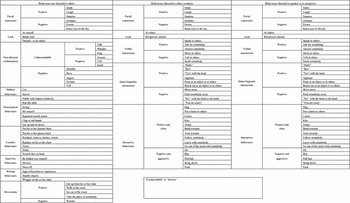
First, an initial version of the ethogram was constructed with behaviors that we expected to observe in residents placed in a social situation. It was modified after a pre-study observation of the workshops in the nursing home, which were conducted by the entertainment staff of the nursing home, to assess the relevance of the choice of behaviors. During this pre-study observation, the psychologist in charge of the study recorded all behaviors observed during the workshops. The ethogram of observation consisted of 126 behaviors assigned to four categories: social interactions with other residents or with care staff (facial expressions, looking, verbal interactions, quasi-linguistic interactions, and interactive behaviors), self-centered behaviors (facial expressions, looking, non-directed verbalizations, sadness behaviors, stereotypical behaviors, comfort behaviors, inactivity behaviors, waiting behaviors, and movements) and unclassifiable behaviors. In order to collect as much information as possible about all behaviors in a social context, the ethogram focused not only on behaviors directed at others but also on self-centered behaviors. The grid is presented in Figure 1.
Presentation of the observation grid.

Social behaviors were videotaped by two cameras, each filming three residents of each group of six, to capture all behaviors in a social context. Each group was filmed once. With the two points of view of the two cameras, it was possible to know at whom the behavior was directed. The maximum distance between residents was two meters. The meeting was filmed in its entirety but only the 8 minutes before the beginning of the meeting were analyzed. Before considering this measure, 1.30 minutes were not analyzed to control the time of installation of the residents. The video data were viewed on a computer but analyzed by eye rather than by an electronic program. As soon as a behavior on the grid was observed, the rater stopped the video and marked it on a paper version of the ethogram. Half of the video data collected were analyzed by two independent raters to assess the inter-rater fidelity: one of these (the psychologist in charge of the study) knew the residents; the other (a Master's student in psychology) did not. The time of occurrence of each behavior was taken into account to see if the two raters observed the same behavior at the same time. A score of agreement was calculated according to the κ formula (Cohen, Reference Cohen1960): (number of common observed behaviors X 2/sum of behaviors observed by rater 1 + sum of behaviors observed by rater 2). A score between 0.61 and 0.80 is considered satisfactory (Landis and Koch, Reference Landis and Koch1977).
Statistical analysis
SPSS 17 (Statistical Package for the Social Sciences) was used for the statistical analysis. Sociodemographic and clinical characteristics were presented in a descriptive way and analyzed with Pearson Chi-Squared (χ²) tests for nominal variables and with F-tests for numeric variables in order to compare all the groups. Observational data were analyzed in terms of frequency of occurrence. Using SIMCA P+ version 12.0 (Eriksson et al., Reference Eriksson, Johansson, Kettaneh-Wold, Trygg, Wikström and Wold2006), a PCA was performed to validate the grid, using a PLS (Partial Least Squares) approach with the NIPALS algorithm.
Results
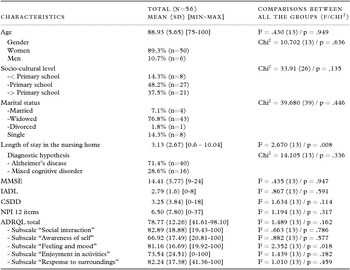
Sociodemographic and clinical characteristics (Table 1)
The sample was composed of 89.3% women (n = 50) and the mean age was 88.93 (SD = 5.65). The majority of the residents had a primary school level of education (48.2%) and were widowed (76.8%). The mean MMSE score was 14.41 (SD = 3.77). On average, residents were dependent, not depressed and did not have significant psychological and behavioral disorders. No difference was observed between the 14 groups except for two variables: the length of stay in the nursing home showed a significant difference (F = 2.092 (13)/p = 0.033) but a Bonferroni post-hoc analysis showed no difference between specific groups; and the subscale “Feeling and mood” of the ADRQL (F = 2.596 (13)/p = 0.35) with a difference between one group and two other groups (p = 0.046 and p = 0.026). However, these two significant differences can be attributed to sampling error.
General characteristics of the sample

Social behaviors and social interactions
Score of agreement
The agreement score between the two raters was satisfactory with an average score of 0.79 [0.71–1]. Only the observations of the principal investigator were used in the analysis of the data.
Descriptive observation
Fifty-six videotapes totaling about 7 hours of data were analyzed. Of the 126 behaviors listed in the ethogram, 61 were observed at least once. Sixty-four behaviors, mostly negative, were never observed. The total number of occurrences of observations in the first 8 minutes of each meeting of the 14 groups was 2,670. Two residents did not show any behavior, two residents did not present self-centered behaviors, five residents did not show behaviors directed at others, seven residents did not show behaviors directed at other residents and 25 residents did not show behaviors directed at care staff. The proportion of self-centered behaviors was 47.83% and the proportion of behaviors directed at others was 50.90%. Most of the behaviors directed at others were directed at other residents (80.80%) while the behaviors directed at care staff represented 19.20% of the behaviors directed at others. 1.28% of behaviors were considered unclassifiable. The number of behaviors did not appear to differ according to the severity of the disease (MMSE < 15 vs. MMSE > 15), age (<85 and >85 years old), the type of dementia, level of education, marital status, the time of the meeting (morning or afternoon), or gender.
Amongst the non-directed behaviors, the following were more frequently observed: “blank stare” (80.6%), “looking outside or at an object” (80.4%), “comfort behaviors” (78.6%) “looking at oneself” (64.3%), and “inactivity behaviors” (58.9%). Three behaviors directed at others were more frequently observed: “looking at others” (87.5% at residents and 53.6% at care staff), “positive verbal interaction” (48.2% with residents and 30.4% with care staff), and “mutual stare” (42.9% with residents and 19.6% with care staff). There was no correlation between sociodemographic and clinical characteristics and the nature of the observed behaviors except for the subscale “enjoyment in activities” of the ADRQL, which was negatively correlated with the total number of self-centered behaviors (r = −0.268; p = 0.046).
Components of behaviors
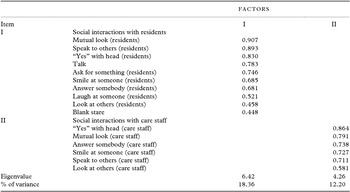
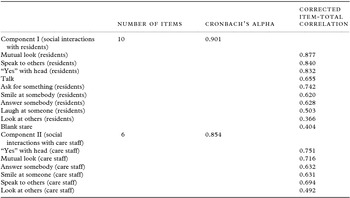
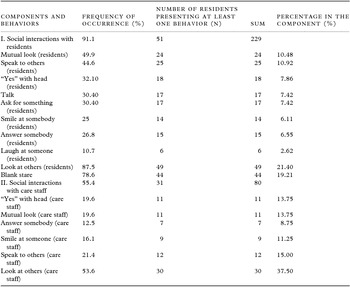
As for the distribution of the raw data in each variable, some variables have very few active subjects. We thus decided to keep relevant variables with five active subjects, which resulted in deleting 91 variables. The PCA methodology was chosen because this was an exploratory pilot study and we had no hypothesis about the link between all the variables. The sample size of 56 subjects was above the minimum level and the ratio to the number of variables was below the required level for PCA. However, in this pilot study with direct observation, our aim was to explore components of behaviors so a PCA was carried out on the observed behaviors using a PLS approach. This algorithm is robust in situations where the number of subjects is low with regard to the number of variables (Wold et al., Reference Wold, Esbensen and Geladi1987). The principle was to launch the PCA within the observed behaviors to see whether behaviors of the same category or of different categories were grouped together and how. The Kaiser–Meyer–Olkin index (KMO) produced a mediocre score of 0.537. Our data also failed Bartlett's sphericity test, and χ² = 11156.321 (595)/p = 0.000 was not good. This is unsurprising given the nature of our variables. In fact, Bartlett's sphericity test tests the normality of the variables and our variables are observations of behaviors that do not necessarily follow a normal law. Despite this, the cross-validation index led us to retain the two first components (Q² > 0.05, Eastment and Krzanowski, Reference Eastment and Krzanowski1982), which explained 30.56% of the total variance. Moreover, they were clearly interpretable and presented robust psychometric properties. Behaviors with an associated factor loading of 0.40 or more were selected to specify the interpretation of each component. If a behavior was present with an associated factor score of 0.40 or more in several factors, only the highest score was retained. The first component explained 18.34% of the total variance and represented social interactions with other residents and behaviors of positive expectations of social interactions. The second component explained 12.20% of the total variance and represented social interactions with care staff and behaviors of positive expectations of social interactions. The detailed presentation of the behaviors in every component is given in Table 2. The analysis of the internal reliability of each component showed good internal consistency with a Cronbach's α of more than 0.70, and in each component, all corrected item-total correlations were more than 0.35 (Table 3). In each component, the items exhibited positive correlations with some exceeding 0.50. These results show that the grid reports different profiles of behaviors, validating this new tool at a statistical and psychometric level. The description of frequencies of occurrence and the sum of the detailed components are presented in Table 4. With one exception, we found no significant correlation between the two components and the ADRQL scale. In particular, there was no significant correlation with the “social interaction” subscale. The one exception was a significant correlation between the first component (“social interaction with residents”) and the total score of the ARDQL (0.296/p = 0.027). There were no significant correlations between the different components.
Behaviors and associated factor values for each component resulting from the PCA

Internal consistency of the two components

Frequency of occurrence of the two components and associated behaviors

Discussion
This study aimed to investigate by direct observation the social interactions between people with dementia who meet for the first time. The results and the validation of the SOBRI indicate that residents with moderate to moderately severe dementia exhibit social behaviors with other residents they do not know and with care staff. These results are in line with previous studies reporting that people with dementia are still engaged and engage themselves in social interactions (Ward et al., Reference Ward, Vass, Aggarwal, Garfield and Cybyk2008; Rousseaux et al., Reference Rousseaux, Sève, Vallet, Pasquier and Mackowiak-Cordoliani2010) and develop social ties with others (Saunders et al., Reference Saunders, Medeiros, Doyle and Mosby2012). Within 8 minutes, which is a very short time, residents presented a wide range of spontaneous social behaviors. These were positive, adapted, and oriented to their peers and to the care staff. The variety of behaviors raises the question of possible patterns of behavior. The PCA highlighted two components of behaviors: social interactions with other residents and social interactions with care staff. The SOBRI presents good psychometric characteristics with a good internal consistency and with satisfactory all corrected item-total correlations. There was no correlation between the two components; they are independent and measure different domains of social behavior. Social interactions do not only involve behaviors directed at others. Some self-centered behaviors are present in the SOBRI: “blank stare” and “talk” for the component “social interactions with other residents”. Thus, social interactions involve a combination of behaviors directed at others and non-directed behaviors that are part of and accompany interaction.
No negative behaviors were observed. People with moderate to moderately severe dementia placed in a social context do not show behavioral disorders. Residents included in this study did not present significant behavioral disorders. The results indicated some ability to adapt to a new situation with new people and with positive social conventions. They also revealed that there was no difference in terms of the observed behaviors between residents with an MMSE < 15 and with an MMSE > 15.
The SOBRI can be considered a new tool for analyzing the social behaviors of residents with dementia and for investigating: (1) how the behavioral patterns evolve during the progression of the disease; (2) the evolution of social behaviors in an intra-individual process and thus the possible changes in components before and after any psychosocial intervention or clinical care management. To facilitate the use of such a scale in daily practice without the need for a camera, a scoring in terms of the presence or absence of a behavior would provide information about the level of engagement in social interaction of residents in their living units, in common places and during activities and specific interventions.
We have no norms for social interactions between elderly people, or between adults who meet for the first time in a waiting situation. It would be interesting to compare the present results with similar ones for the elderly without cognitive disorders, to see whether there are differences between the two populations in terms of social interactions.
Direct observation is a time-consuming and specific method, requiring thought about the arrangement of the place of observation, the positioning of cameras and the data analysis technique. The aim is to collect behaviors in the most natural conditions without guidance from the observer. We tried to solve these different methodological difficulties: the chosen room was a quiet place; the psychologist and the care staff entering the room were asked not to initiate social interactions with the residents; half of the video data were analyzed by two independent raters. It would have been better if the cameras had filmed all the residents to have an overall perspective of social interactions but we decided to focus one camera on no more than three residents to have a better view of facial expressions.
This study had some limitations. First, it took place in only one nursing home. This has consequences for the generalizability of the results as this nursing home is probably not representative of all the nursing homes in France. For example, it is large and situated in a big city. However, this nursing home has the advantage of being multicultural. Some residents come from different cities of France and have spent their life in cities or in rural areas while other residents come from countries of Eastern Europe or North Africa. The majority of the residents are of Jewish faith but other faiths are also present. In principle, the cultural differences between countries and between rural and urban areas could have an influence on social interactions, but the mechanisms of interaction are very common. Nevertheless, this study and others need to be carried out in different nursing homes in France and in other countries using larger samples to validate the tool. Indeed, our sample size is critical regarding the required sample level to launch a PCA, but the satisfactory psychometric values we found provide a promising basis for future research with a larger sample size.
Second, interpersonal differences in the frequency of behaviors were observed among the selected residents. Some presented more behaviors than others, which raises the issue of each resident's personality factors. This variable is difficult to control in such a study but behaviors were spontaneous without any direct stimulation. Furthermore, these results were found in people with dementia who still have some communication abilities. However, how many social behaviors residents had could not be defined. It is therefore necessary to apply the grid to people with severe dementia with more phasic disorders to check social behaviors in this population and to develop a specific methodology for the population.
Third, the kind of dementia and the medication could also influence social interactions. Residents included in this study presented a diagnosis of Alzheimer's disease or of mixed cognitive disorders. It might be relevant in future studies to compare different kinds of dementia, for example people with frontotemporal dementia who present a decline in social and interpersonal behaviors in the early stages of the disease. Medication such as anxiolytics, antidepressants, and especially antipsychotics drugs were not controlled in this study. These may have an influence on behaviors and social interactions. It will be necessary to include this kind of medication as a controlled variable in future studies.
Finally, the observed behaviors might have been influenced by the fact that the residents were told that they were gathered for a speaking group and were waiting in an unfamiliar room for the start of the discussion. Moreover, care staff might have spoken about this meeting to residents beforehand and encouraged them to participate actively. Residents’ behaviors may not have been as spontaneous as in their living unit. It would be interesting to observe how such residents spontaneously interact with each other in an ecological context. However, our methodology was able to capture the basics of social behavior in a controlled social situation. There was no correlation between the two components and the “social interaction” subscale of the ADRQL scale. This subscale does not have the same measurements between spontaneous observations and questionnaires. Spontaneous observations may give more formal and direct information than questionnaires – which represent information in an overall way – or than a long period of indirect observation. This would provide direct evidence of social behaviors of people with dementia at different stages of the disease without using various assessment tools that are biased and show reversal problems – such as self-assessment – which is difficult or impractical in advanced stages of the disease, or proxy evaluation, which does not directly reflect behaviors, attitudes or thoughts of people with dementia. However, there was a positive and significant correlation between the component “social interactions with residents” and the total score of the ADRQL. The more residents interact between themselves, the more care staff evaluate their quality of life as positive. Social interactions seem to be an important factor in the quality of life perceived by others.
Conclusion
People with dementia living in a nursing home interact with other residents they do not know and with care staff. Denying the existence of such social interactions inhibits social inclusion and exacerbates loneliness. It is essential to point out that even if residents forget that they have had social contact with others, the most important thing is the immediate benefits. Maintaining and/or increasing social interactions can be seen as one of the best forms of cognitive stimulation as it can slow or compensate cognitive impairment (Amieva et al., Reference Amieva, Stoykova, Matharan, Helmer, Antonucci and Dartigues2010). Finally, these data might be useful for designing and offering programs or interventions promoting social inclusion in people with dementia living in nursing homes. The SOBRI can be used to analyze and assess the social behaviors and social interactions of people with dementia living in nursing homes and to gauge the effect of psychosocial interventions on social inclusion.
Conflict of interest
None.
Description of author's roles
JB. Mabire designed the study, supervised the data collection, and wrote the paper. MC. Gay and M. Vernooij-Dassen supervised the study design and wrote the paper. P. Vrignaud was responsible for the statistical design of the study and for carrying out the statistical analysis. C. Garitte supervised the adaptation and the construction of the observation grid.
Acknowledgments
We are grateful to the residents who agreed to participate in this study and to the management of the nursing home who allowed its development, to Coralie Octave-Rolland (Psychology Master's student) for her help in the double analysis of half of the video data, and to the “Fondation Mederic Alzheimer” for its financial support through a doctoral fellowship and for advice in the development of this study.