Introduction
There has recently been increasing interest in the effects of otosclerosis itself and otosclerosis surgery on the utricle and saccule. Data on this issue are scarce.
Otosclerosis may affect the vestibular system in several ways. The mechanism may be: accompanying endolymphatic hydrops, accompanying benign paroxysmal positional vertigo, otosclerotic inner-ear disease, utricular dysfunction or saccular dysfunction.Reference Saka, Seo, Fujimori, Mishiro and Sakagami1 In theory, lytic enzymes of the otosclerotic foci may disperse inside the labyrinth and affect any part of the vestibular system at certain levels, even subclinical levels.Reference Derks, De Groot, Raymakers and Veldman2 Some histopathological studies have shown invasion and degeneration of the vestibular nerve and Scarpa's ganglion, which may be related to vestibular symptoms.Reference Amali, Mahdi, Karimi Yazdi, Khorsandi Ashtiyani, Yazdani and Vakili3
Small fenestra stapedotomy with piston prosthesis insertion is a surgical procedure, wherein the immobile part of the stapes is bypassed through a small hole, into which a prosthesis is inserted, in order to overcome conductive hearing loss. There is a possibility that even an uneventful operation may affect otolith function because the distance between the membranous labyrinth and the stapes footplate is so close. Furthermore, the change in hearing mechanism after the stapedotomy may also affect the saccule and utricle. The close relationship between the membranous labyrinth and the stapes footplate can cause otolith dysfunction during stapes surgery.Reference Akazawa, Ohta, Tsuzuki and Sakagami4,Reference Mukherjee, Uzun-Coruhlu, Curthoys, Jones, Bradshaw and Pohl5
In an effort to find a new method for evaluating vestibular end organs, Colebatch and Halmagyi described vestibular-evoked myogenic potentials testing.Reference Colebatch and Halmagyi6 There are two pathways associated with vestibular-evoked myogenic potentials recording. While cervical vestibular-evoked myogenic potentials are associated with the vestibulocollic reflex pathway and the saccule, ocular vestibular-evoked myogenic potentials are associated with the vestibular–ocular reflex pathway and the utricle.Reference Colebatch, Halmagyi and Skuse7,Reference Brantberg8 The saccule is mainly related to postural adjustment, and the utricle has a role in eye movements.Reference Felipe and Kingma9
Vestibular-evoked myogenic potential responses can be elicited by both air- and bone-conducted stimuli.Reference Ogawa, Otsuka, Inagaki, Nagai, Itani and Kondo10 However, in cases with conductive hearing loss, such as otosclerosis, vestibular-evoked myogenic potential responses cannot be obtained because the air-conducted stimulus fails to pass the middle-ear conduction system. In order to overcome this handicap, bone-conducted stimuli are used in vestibular-evoked myogenic potentials testing.Reference Yang and Young11 Therefore, this study aimed to determine the effect of stapedotomy and otosclerosis on air- and bone-conducted vestibular-evoked myogenic potentials.
To the best of our knowledge, no study has investigated the effect of both stapedotomy and otosclerosis itself on cervical and ocular vestibular-evoked myogenic potentials. This is the first review in the literature to compare the results of both air- and bone-conducted stimuli on ocular and cervical vestibular-evoked myogenic potentials.
Materials and methods
All the procedures were performed in accordance with the Declaration of Helsinki and were approved by the Ethics Committee (approval number: 19/69).
This retrospective study included 16 otosclerosis patients (11 females and 5 males) and 18 healthy control participants (13 females and 5 males). The patient group's mean age was 42.72 ± 7.2 years (range, 30–55 years). The control participants’ mean age was 32.9 ± 11.3 years (range, 19–55 years). All the operated patients had undergone a standard small fenestra stapedotomy, followed by the insertion of a piston prosthesis that was 5 mm long and 0.6 mm in diameter. The operations were straightforward, with uneventful post-operative periods.
Thirty-two ears of 16 patients with otosclerosis were divided into 2 groups based on whether the ear had been operated on or not (operated ears vs unoperated contralateral ears), in order to investigate the effects of otosclerosis and stapedotomy on vestibular-evoked myogenic potentials. Three of the patients had been operated on bilaterally. All patients were asymptomatic at the time of testing. Tests were performed in the third post-operative month at the earliest. The four-frequency air- and bone-conducted thresholds were 25.26 ± 12.2 dB HL and 16.84 ± 9.11 dB HL, respectively, in operated ears, and were 44.62 ± 21.93 dB HL and 19.13 ± 11.90 dB HL, respectively, in unoperated ears. Control ears had thresholds up to 20 dB HL.
All patients and subjects underwent air- and bone-conducted ocular and cervical vestibular-evoked myogenic potentials testing. Vestibular-evoked myogenic potentials were recorded at least three months after surgery. All tests used 500 Hz tone burst stimuli. Vestibular-evoked myogenic potential tests were performed using an Interacoustics Eclipse EP15 device (Assens, Denmark) in a quiet room specifically insulated for evoked potentials testing. Surface electrodes (Neuroline 720; Ambu, Copenhagen, Denmark) were used. The impedance level of the electrodes was set below 5 kΩ.
For the bone-conducted ocular vestibular-evoked myogenic potential test, tone bursts at 500 Hz were delivered via a bone conductor vibrator (B71 model; RadioEar, Eden Pairie, Minnesota, USA). The stimulus intensity was kept at 50 dB nHL. The stimulus rate was 5.1 per second. The analysis window was set to 40 ms. Polarity of the stimuli was of the rarefaction type. A total of 100 stimuli were averaged. Rise/plateau/fall times of tone bursts were 2/6/2 ms. Electromyography (EMG) potentials were bandpass filtered between 10 Hz and 1200 Hz.
For the air-conducted vestibular-evoked myogenic potential test, 500 Hz tone burst stimuli were used at an intensity of 100 dB nHL via insert calibrated headphones (E-A-RTone ABR 3A; 3M, Indianapolis, Indiana, USA). The stimulus duration was 9 ms. The stimulus rate was set to 5.1 per second, analysis time to 55 ms, and polarity to the rarefaction type. A total of 250 stimuli were averaged. The EMG was amplified (10 000×) and bandpass filtered (10–1200 Hz).
Tests were repeated three times before deciding on ‘no response’. The N1 latency, P1 latency and P1–N1 amplitude of vestibular-evoked myogenic potentials were measured. Operated, unoperated and control ears were compared in terms of vestibular-evoked myogenic potentials obtaining rate (response rate), N1 latency, P1 latency and P1–N1 amplitude of vestibular-evoked myogenic potentials.
Data were analysed with the statistical software R 3.6.2. The packages used were: ‘psych’, ‘summarytools’, ‘nortest’, ‘dplyr’, ‘car’, ‘PMCMRplus’, ‘agricolae’, ‘onewaytests’, ‘rcompanion’, ‘desctools’, ‘vcr’ and ‘janitor’. Distribution of the results was analysed using the Shapiro–Wilk test. Homogeneity of variances was tested with the Levene test. Analysis of variance (ANOVA) was used to test the three groups in cases where normal distribution and homogeneity of variances were observed. The Kruskal–Wallis test was used to compare groups without a normal distribution. The post-hoc Conover test was used for pairwise comparisons. The Fisher's exact test was used to compare nominal data.
Results
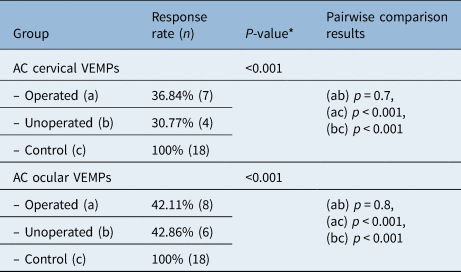
Response rates of bone-conducted ocular vestibular-evoked myogenic potentials were 100 per cent for all groups. Response rates of air-conducted cervical vestibular-evoked myogenic potentials were 36.84 per cent (n = 7), 30.77 per cent (n = 4) and 100 per cent (n = 18) in the operated group, unoperated group and control group, respectively. Overall comparison revealed a significant difference among the groups (p < 0.05, Fisher's exact test). This arose from differences between both operated and unoperated groups and the control group (p < 0.05, Fisher's exact test).
The response rates of air-conducted ocular vestibular-evoked myogenic potentials were significantly different among the groups (p < 0.05, Fisher's exact test). The rate was 42.11 per cent (n = 8), 42.86 per cent (n = 6) and 100 per cent (n = 18) in the operated normal hearing group, unoperated group and control group, respectively. Similar to air-conducted cervical vestibular-evoked myogenic potentials, this arose from differences between both operated and unoperated groups and the control group (p < 0.05, Fisher's exact test). Either being operated on or having otosclerosis was associated with lower response rates of air-conducted cervical and ocular vestibular-evoked myogenic potentials (p < 0.05, Fisher's exact test) (Table 1).
Air-conducted cervical and ocular VEMP response rates

*Fisher's exact test. VEMP = vestibular-evoked myogenic potential; AC = air-conducted
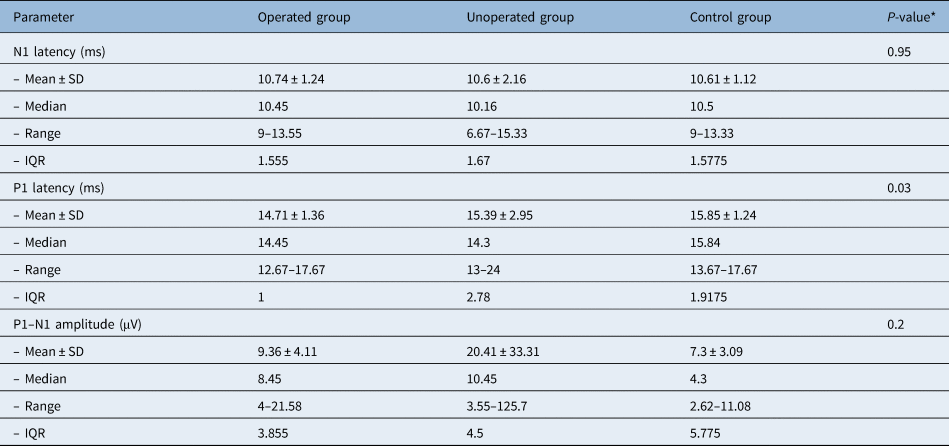
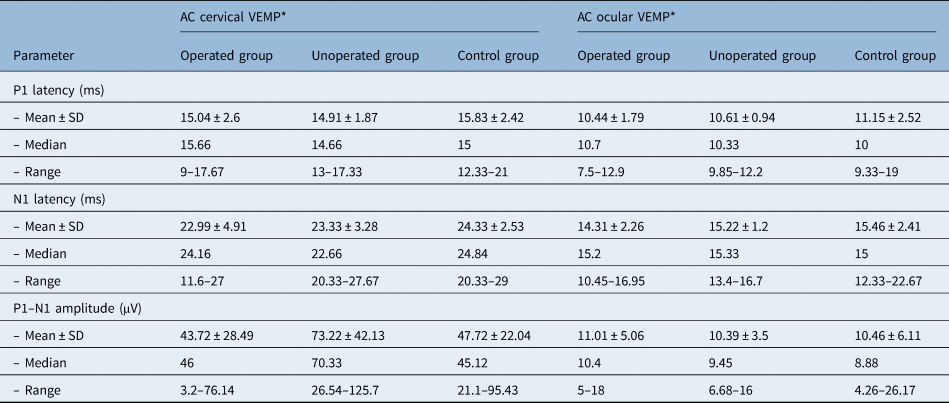
There were no significant differences in bone-conducted ocular vestibular-evoked myogenic potentials between the operated, unoperated and control groups in terms of N1 latency (p > 0.05, ANOVA test) and P1–N1 amplitude (p > 0.05, Kruskal–Wallis test). The P1 latency of the operated group was significantly shorter than that of the control group (p < 0.05, Kruskal–Wallis test and Conover test). Descriptive statistics of bone-conducted ocular vestibular-evoked myogenic potentials are given in Table 2. Descriptive statistics of air-conducted cervical and ocular vestibular-evoked myogenic potentials are shown in Table 3.
Bone-conducted ocular VEMP descriptive data for operated, unoperated and control groups

*Kruskal–Wallis test for P1 latency and P1–N1 amplitude, and analysis of variance test for N1 latency. VEMP = vestibular-evoked myogenic potential; SD = standard deviation; IQR = interquartile range
Air-conducted cervical and ocular VEMP descriptive data for operated, unoperated and control groups

*As the sample size is small for this parameter, the descriptive data are given without statistical significance values. VEMP = vestibular-evoked myogenic potential; AC = air-conducted; SD = standard deviation
Discussion
One of the complications of stapes surgery is vertigo or dizziness, reported with rates ranging from 30.8 per cent to 37 per cent in the literature.Reference Birch and Elbrønd12,Reference Koizuka, Sakagami, Doi, Takeda and Matsunaga13 While searching for the most appropriate point for a safe stapedotomy, Pauw et al. discovered a closer distance between the stapes footplate and the utricle/saccule in otosclerosis patients than in normal subjects.Reference Pauw, Pollak and Fisch14 Bearing in mind this close relationship between the stapes footplate and the otolith organs, the current study aimed to observe changes, if any, in vestibular-evoked myogenic potentials resulting from otosclerosis itself and from stapedotomy. The use of bone-conducted stimuli enables us to overcome concerns of limited sound transmission in patients with conductive hearing loss.
The study design allowed us to separately investigate the effects of otosclerosis itself and those of otosclerosis plus stapedotomy on vestibular-evoked myogenic potentials. Whereas comparison between unoperated and control groups points to the effect of otosclerosis on vestibular-evoked myogenic potentials, comparison between operated and control groups reflects the effects of both otosclerosis and surgery on vestibular-evoked myogenic potentials. Furthermore, comparison between operated and unoperated groups with reference to the control group implies differential effects of surgery on vestibular-evoked myogenic potentials.
The most striking finding of the study is the varying response rates of vestibular-evoked myogenic potentials among the groups. The absence or presence of vestibular-evoked myogenic potentials is of primary importance in terms of reflecting the severity or degree of involvement, and determining whether a given condition affects the otolith organs. Comparisons of the latency and amplitudes of vestibular-evoked myogenic potentials are of secondary importance because those findings were obtained from individuals who had some degree of vestibular-evoked myogenic potentials.
The significant difference in response rates of air-conducted cervical and ocular vestibular-evoked myogenic potentials between either the operated or the unoperated group and the control group implies that otosclerosis (30 per cent vs 100 per cent) and otosclerosis plus surgery (36 per cent vs 100 per cent) have some effects on vestibular-evoked myogenic potentials. The fact that the response rate of air-conducted cervical vestibular-evoked myogenic potentials is higher in the operated group than in the unoperated group points to the positive effect of improved hearing on obtaining vestibular-evoked myogenic potentials. Even though the higher percentage in the operated group's response rate (which increased from 30 per cent to 36 per cent) shows a trend, this difference failed to reach significance. However, absent air-conducted cervical vestibular-evoked myogenic potentials in the remaining (64 per cent) operated ears means that the underlying otosclerosis might prevent the generation of vestibular-evoked myogenic potentials in these ears. Further evidence comes from the unoperated group, where absent air-conducted cervical vestibular-evoked myogenic potentials were observed in a slightly higher percentage (70 per cent) of the ears.
To the best of our knowledge, only a few articles have investigated vestibular-evoked myogenic potentials in stapes surgery,Reference Akazawa, Ohta, Tsuzuki and Sakagami4,Reference Singbartl, Basta, Seidl, Ernst and Todt15–Reference Catalano, Cammaroto, Galletti, Freni, Nicita and Azielli18 with inconsistent results. Upon observing the reappearance of bone-conducted cervical vestibular-evoked myogenic potentials after stapes surgery, Singbartl et al. suggested that otosclerosis might affect saccular receptors and decrease the elicitability of vestibular-evoked myogenic potential responses.Reference Singbartl, Basta, Seidl, Ernst and Todt15 Akazawa et al. found that there was no deterioration of bone-conducted cervical vestibular-evoked myogenic potentials in operated otosclerosis patients, and suggested that otosclerosis had no effect on otolith function.Reference Akazawa, Ohta, Tsuzuki and Sakagami4 Trivelli et al. proposed that reduced elicitability of the cervical vestibular-evoked myogenic potentials was caused by air–bone gap and inner-ear impairment.Reference Trivelli, D'Ascanio, Pappacena, Greco and Salvinelli16
Winters et al. investigated bone-conducted ocular vestibular-evoked myogenic potentials in pre- and post-operative otosclerotic ears.Reference Winters, Klis, Kool, Kraaijenga, Tange and Grolman17 They included 26 healthy subjects and 27 patients with otosclerosis. The patients were divided into four groups: normal, otosclerotic, primary surgery and revision surgery. The authors found no significant difference between any of the groups in terms of P1 latency, N1 latency and P1–N1 amplitude at 500 Hz. Pre- and post-operative values did not differ either.Reference Winters, Klis, Kool, Kraaijenga, Tange and Grolman17
Catalano et al. (2017) investigated the effect of otosclerosis surgery on air-conducted cervical vestibular-evoked myogenic potentials from the perspective of post-operative vertigo.Reference Catalano, Cammaroto, Galletti, Freni, Nicita and Azielli18 They found a significantly lower P1–N1 amplitude in the vertigo group.
One of the interesting findings in our study is the fact that bone-conducted ocular vestibular-evoked myogenic potentials were obtained in all the operated, unoperated and control ears tested. Absent air-conducted ocular vestibular-evoked myogenic potentials along with present bone-conducted ocular vestibular-evoked myogenic potentials may imply that the utricle is intact. Another explanation is that the bone-conducted stimulus is stronger than the air-conducted stimulus in eliciting vestibular-evoked myogenic potentials. Considering this high response rate for bone-conducted ocular vestibular-evoked myogenic potentials in operated and unoperated ears, we may propose that otosclerosis and stapedotomy have no effect on the elicitability of bone-conducted ocular vestibular-evoked myogenic potentials or on utricular receptors, which are further away from the stapes footplate than the saccule.
Our results can be interpreted as meaning that otosclerosis is more likely to involve the saccule than the utricle. The response rate of air-conducted ocular vestibular-evoked myogenic potentials was higher than that of air-conducted cervical vestibular-evoked myogenic potentials. This is an expected finding because the utricle is further away from the fissula ante fenestram than the saccule. Even in temporal bone studies, the absence of utricular and saccular otoconia, and involvement of the otolith organs with otosclerotic focus, were documented in otosclerotic specimens.Reference Sando, Hemenway, Miller and Black19,Reference Ghorayeb and Linthicum20
Stapes surgery is expected to increase the elicitability of air-conducted vestibular-evoked myogenic potentials by reducing the air–bone gap and improving transmission of the sound to the inner ear. Trivelli et al. stated that the absence of air-conducted vestibular-evoked myogenic potentials in otosclerosis might result from conductive hearing loss, because the response rate for air-conducted vestibular-evoked myogenic potentials rose from 21.4 per cent to 26.2 per cent post-operatively.Reference Trivelli, D'Ascanio, Pappacena, Greco and Salvinelli16 In this circumstance, the question arises as to why air-conducted cervical vestibular-evoked myogenic potentials cannot still be elicited when the air–bone gap is closed. One may propose that otosclerosis affects cervical vestibular-evoked myogenic potentials not only via hearing loss, but also by some other mechanisms that are yet to be elucidated.
Even though hearing loss recovers after surgery, vestibular-evoked myogenic potentials can be elicited in only some individuals, which implies that otosclerosis might affect cervical vestibular-evoked myogenic potentials elicitability regardless of hearing loss. We propose the following statement to explain this condition. A fluoroplastic piston prosthesis used in surgery has enough strength to stimulate hearing, but it does not have enough strength to transmit the necessary vibration to the saccule, which is essential to obtain robust vestibular-evoked myogenic potentials. There is an obvious difference in strength and capability of vibration transmission through the perilymphatic fluid between normal stapes and a piston prosthesis. In the case of normal stapes, the entire stapes footplate as a hard material transmits the full extent of vibration to the saccule, as opposed to small fenestra stapedotomy, where a relatively soft fluoroplastic piston prosthesis transfers the vibration through the small opening into the perilymphatic fluid. In normal anatomy, the whole stapes footplate is in contact with the perilymphatic space with a wide surface of 3.2 mm, versus a prosthesis with a shaft of 0.6 mm diameter touching the perilymph at a small point after the stapedotomy. In the one case, the whole stapes footplate vibrates; in the other, only the slender shaft of the prosthesis vibrates. Furthermore, the softness of the material would increase the absorption of some of the vibratory energy that is expected to be transmitted via the prosthesis. Another reason would be a subclinical involvement of the inner ear or otolith organs with otosclerosis.
Based on the proposed arguments and our findings, one can state that having otosclerosis, whether operated on or not, is associated with a reduced response rate of air-conducted ocular and cervical vestibular-evoked myogenic potentials. For a given otosclerosis patient, having undergone stapedotomy might increase the possibility of obtaining cervical vestibular-evoked myogenic potentials.
• Otosclerosis and stapes surgery may have some effects on elicitability of air-conducted vestibular-evoked myogenic potentials (VEMPs)
• Having otosclerosis is associated with lower response rates for air-conducted ocular and cervical VEMPs, regardless of whether operated on
• Having been operated on does not significantly increase response rates
• Using bone-conducted stimuli allowed us to overcome the concern of limited sound transmission in conductive hearing loss patients
The main limitations of this study are its small sample size and the lack of pre-operative vestibular-evoked myogenic potential data.
Conclusion
Otosclerosis and/or stapedotomy may have some effects on elicitability of vestibular-evoked myogenic potentials via not only hearing loss but also some other mechanisms that are yet to be elucidated. Having otosclerosis or undergoing stapedotomy is associated with lower response rates of air-conducted cervical and ocular vestibular-evoked myogenic potentials than those of control ears. Bone-conducted ocular vestibular-evoked myogenic potentials appear not to be affected by either otosclerosis or stapedotomy. Our results showed limited benefit of improved air–bone gap (stapedotomy), with inadequate statistical significance in obtaining air-conducted cervical vestibular-evoked myogenic potentials.
Competing interests
None declared