


What is the effect of mobilized dissent on government repression? Scholarly consensus suggests authorities repress to control dissent (e.g., Carey Reference Carey2006; Reference Carey2010; Davenport Reference Davenport1995; Reference Davenport1996; Reference Davenport2007b; Earl, Soule, and McCarthy Reference Earl, Soule and McCarthy2003; Lichbach Reference Lichbach1987; Moore Reference Moore2000; Nordås and Davenport Reference Nordås and Davenport2013; Regan and Henderson Reference Regan and Henderson2002), and real-world examples abound. Dictatorial Middle Eastern governments responded to protests during the Arab Spring with rights violations ranging from media censorship to extrajudicial killing. Repressive responses to protest also occur in democracies. Allegations of police abuse of Occupy Wall Street protesters arose in New York City in 2012, and nonviolent demonstrations on U.S. college campuses evoked repressive responses during the height of the movement. That governments respond to popular dissent with repression is so well accepted that it has been called the Law of Coercive Responsiveness (Davenport Reference Davenport2007a) or Threat-Response Theory (Earl, Soule, and McCarthy Reference Earl, Soule and McCarthy2003). This straightforward relationship is an assumption that forms the basis of many studies of human rights violations, social movements, domestic political conflict, and authoritative action.
Although scholars agree that repression is a response to dissent in theory, there is surprisingly little empirical support for the proposition that mobilized action leads to rights violations.Footnote 1 This lack of evidence occurs in part because repression and dissent are endogenous: governments and dissidents choose their actions in anticipation of the other’s behavior (Pierskalla Reference Pierskalla2010; Ritter Reference Ritter2014). Citizens who expect to be repressed may decide not to dissent, foregoing the risk and remaining at home (Fearon and Laitin Reference Fearon and Laitin2003; Hibbs Reference Hibbs1973; Moore Reference Moore1995), precluding observation of either behavior. Authorities repress some groups before they mobilize, such that repression is observed without actual dissent (Danneman and Ritter Reference Danneman and Ritter2014; Nordås and Davenport Reference Nordås and Davenport2013). Empirical analyses largely fail to account for these endogenous, unobservable processes determining domestic conflict, leaving scholars either unable to predict the effects of dissent on rights violations or potentially drawing incorrect conclusions as to these effects.
We argue that the effect of dissent on repression is a function of two strategic censoring processes. Governments may engage in preventive repression—for example, curfews and prohibitions on assembly—to undermine mobilization. Dissidents who mobilize despite obstruction are systematically different than groups thwarted by preventive actions. Because the government’s best response to resolute groups is unclear given the failure of preventive action, actualized dissent in this context does not meaningfully predict responsive repression. Put differently, when authorities repress in expectation of dissent, most dissent will not occur, and that which does will not be observably related to subsequent repression. In the absence of preventive repression, dissidents are not tested by direct government intervention, but they may self-censor in expectation of a repressive response. Groups that do dissent in this untested context represent a potentially conquerable threat to authorities. As such, governments who did not engage in ex ante repression will be quite likely to do it ex post.
We estimate the effect of dissent on repression using an instrumental variable (IV) approach to model the effects of unobservable censoring processes. Recent scholarship in American politics uses rainfall as an exogenous predictor of variance in voter turnout (Hansford and Gomez Reference Hansford and Gomez2010); we build on this work, as well as research connecting precipitation patterns to political violence (e.g., Collins and Margo Reference Collins and Margo2007; Hendrix and Salehyan Reference Hendrix and Salehyan2012), and contend that rainfall can be used as an exogenous instrument for mobilized dissent. Individuals are less prone to join a protest, strike, or riot if it is raining. In November 2012, for instance, an antigovernment rally that was predicted to bring tens of thousands of people to the streets of Bangkok yielded a lower turnout due to tropical downpours (“Thai Protest Fizzles Amid Heavy Rains,” Wall Street Journal, November 24, 2012). Although rainfall can dissuade dissenters from challenges, we argue that rainfall is exogenous to repression. Repression is carried out under authoritative orders to contain threat (Mitchell Reference Mitchell2009; Poe Reference Poe2004), regardless of the weather, and is only related to rainfall through rain’s effect on dissent.
Using rainfall to identify exogenous variation in observed dissent, we examine its relationship to repression in two very different contexts. The Social Conflict Analysis Database (SCAD) and the Dynamics of Collective Action (DCA) Data Project report subdaily information on dissent and repression events in Africa and the United States, respectively. We pair these conflict data with daily recorded rainfall for each province in Africa from 1990 to 2012 and each state in the U.S. from 1974 to 1995 to empirically assess the canonical Law of Coercive Responsiveness. When we use an IV approach to account for endogeneity, observed dissent fails to have a statistically or substantively significant effect on repression when governments are likely to preventively repress. Dissent is positively associated with repression only when governments are not expected to use repressive tactics to prevent dissent.
Our empirical analyses suggest that the effect of dissent on repression is strategic—observed repression is not only caused by realized dissent but also by anticipated dissent. Straightforward analyses of observational data alone cannot account for this data-generating process. Governments are not simply making decisions to repress in response to ongoing challenges, but are instead involved in complex strategic interactions that should form the basis for future research on domestic conflict. In this article, we articulate a set of theoretical mechanisms that potentially underlie the empirical relationship in which stochastic dissent is—or is not—met with repression. Additionally, we present an instrument for identifying exogenous conflict relationships (and suggest a number of alternative approaches) using observational data. Our work suggests that scholars interested in domestic conflict should consider orienting theoretical and empirical work away from decision-theoretic examinations of repression and dissent and toward conceptualizing the strategic framework that produces endogenous outcomes.
THE RELATIONSHIP BETWEEN DISSENT AND REPRESSION
Repression is any realized or threatened limit or coercive action taken by state authorities to control or prevent challenges that could alter the status quo policy or distribution of power.Footnote 2 Any behavior (legal or illegal, violent or nonviolent) used to prevent people within the state from participating in their own governance can be considered repression, with the goal being either to reduce their capacity to threaten the government (Nordås and Davenport Reference Nordås and Davenport2013; Sullivan Reference Sullivan2015) or to establish conditions under which they lack the will to do so (Galtung Reference Galtung1969).Footnote 3 Either authorities order repressive actions to be carried out by agents, or authorized agents engage in repression under the auspices of carrying out other orders, such as collecting information or maintaining order (Conrad and Moore Reference Conrad and Moore2010; DeMeritt Reference DeMeritt2015; Mitchell Reference Mitchell2009; Rejali Reference Rejali2007).
Dissent occurs when nonstate actors within the state's jurisdiction collectively threaten to or actually impose costs on the ruling entity to incentivize the government to change a status quo policy, treatment, power allocation, resource distribution, etc.Footnote 4 Individuals dissatisfied with the status quo follow entrepreneurs or otherwise overcome collective action problems to take unified coercive action against the status quo (Lichbach Reference Lichbach1998). These actions impose costs that can endanger the leader’s hold on power. Violent and nonviolent behaviors including riots, strikes, nonviolent protests, and boycotts damage state resources, whether by actually destroying state property or disrupting normal interactions in society. Aside from needing resources to please supporters who keep them in power (Bueno de Mesquita et al. Reference Bueno de Mesquita, Smith, Siverson and Morrow2003), demands for change to the status quo outside of state-sanctioned political interactions can signal to interested observers that the regime lacks legitimacy (Davenport Reference Davenport1995). To prevent or stop a group from imposing costs that threaten the authorities’ hold on power, the government can either give in to the dissidents’ demands to alter the status quo or repress them (cf. Pierskalla Reference Pierskalla2010; Ritter Reference Ritter2014).
These definitions inform scholars’ expectations as to how repression is related to dissent: governments are more likely to engage in repressive practices or enact repressive policies as dissent becomes more violent, more multidimensional, more unusual, more organized, or more directly threatening (e.g., Davenport Reference Davenport1996; Reference Davenport2000; Gartner and Regan Reference Gartner and Regan1996; Poe et al. Reference Poe, Tate, Keith and Lanier2000). The idea that authorities use repressive tactics to control dissent is so widely accepted that it has been referred to as the “Law of Coercive Responsiveness” (Davenport Reference Davenport2007a, 7) or “Threat-Response Theory” (Earl, Soule, and McCarthy Reference Earl, Soule and McCarthy2003). Some studies provide empirical support for this relationship, finding that an increase in dissent leads to an increase in repression generally (e.g., Davenport Reference Davenport1995; Reference Davenport1996; King Reference King1998) or conditionally depending on characteristics of the interaction such as sequencing or institutions (Carey Reference Carey2006; Reference Carey2010; Moore Reference Moore2000; Shellman Reference Shellman2006). Even when it is not directly modeled in empirical analysis, scholars recognize the need to account for dissent and approximate for predictors of dissent in models of repression, including inequality, economic growth, and population size (e.g., Hafner-Burton Reference Hafner-Burton2005; Henderson Reference Henderson1991; Neumayer Reference Neumayer2005; Poe and Tate Reference Poe and Tate1994). Nearly all theoretical and empirical studies of repression assert a basic relationship: as dissent increases, repression will increase.
The Endogeneity of Conflict
Although realized dissent often leads to increases in repression, repression also affects the occurrence of dissent in ways that complicate observational inferences about cause. Repression and dissent are outcomes of interactions between strategic players who anticipate one another’s decisions. State authorities frequently engage in preventive repression, enacting policies or practices that undermine or restrict groups’ abilities to dissent; in such a case we may observe repression without dissent. By contrast, groups may self-censor when they expect a repressive response, opting not to dissent when the consequences would be too great. Although we may observe neither dissent nor repression in these circumstances, the threat of each underlies the data-generating process and muddles our ability to draw inferences from observational data.
Preventive Repression
Studies often suggest that repression is a response to domestic challenges, but authorities also violate rights to prevent challenges. Repression can prevent citizens from mounting challenges by fulfilling two objectives (Davenport Reference Davenport2007b, 47). Repressive practices can damage dissidents’ capacity to mount a coercive threat: restrictions make it difficult to assemble groups or plan dissenting actions, and invasive or covert policies or behaviors can undermine group challenges before they take place (Sullivan Reference Sullivan2015; Tilly Reference Tilly1978). Curfews, surveillance, limits on assembly, preventive arrests of leaders, and infiltration restrict and cripple dissent activities. Rights violations can also cow citizens into quiescence by attacking their willingness to challenge the state; states use physical integrity violations such as disappearances, targeted arrests, violent policing, or torture to make would-be dissidents fear joining a movement and/or challenging the government (Galtung Reference Galtung1969).Footnote 5 Repressive policies and actions weaken those who would protest against the state (Lichbach Reference Lichbach1987), often preventing its actualization. Recent studies find explicit evidence that governments repress to prevent dissent before it occurs, as when there are youth bulges in the population (Nordås and Davenport Reference Nordås and Davenport2013), civil conflict in neighboring states (Danneman and Ritter Reference Danneman and Ritter2014), and organizational activities that precede collective action (e.g., the distribution of information, solicitation of funds, and recruitment) (Sullivan Reference Sullivan2015). If repression successfully undermines dissent, we may observe repression, but not the threat of dissent that caused it in the first place.Footnote 6
Groups that persist beyond preventive government repression differ systematically from groups that are obstructed—they have greater resolve and reveal themselves as such. Such groups are willing to incur the costs of dissent and repression in the effort to alter the status quo, while others that could have dissented are not. Conflict scholars refer to the willingness to accept the costs of fighting, or the preference to fight despite the certain or probable costs, as resolve; an actor’s resolve may be inferred from her behavior, but is otherwise unobservable as a preference (cf. Fearon Reference Fearon1995; Morrow Reference Morrow1989). By the same logic, groups’ preferences over domestic conflict outcomes are not directly observable, but can be inferred in part after the fact by their behavior. Groups that endure preventive repression and nonetheless dissent are likely to have higher resolve than nondissenting groups, meaning that they have more extreme values for altering the status quo and/or are more resistant to the costs incurred from repression.
When government repression fails to prevent mobilized dissent, the state’s optimal response is unclear. The government could repress again, but it failed the first time. More severe repression could be the strategic best response, as the state attempts to match the efforts of the group (Ritter Reference Ritter2014). Alternatively, the state may be better served by switching tactics, substituting repression with accommodation (Moore Reference Moore2000). Scholarship suggests there is no consistent, bivariate relationship between manifest dissent and repressive responses when dissent has endured prior preventive repression; some governments will repress while others will accommodate, and the reasons for choosing one or the other are a function of the state’s (unobservable) beliefs and expectations. The presence of accommodation in the observed responses to dissent makes it difficult to find a statistically meaningful relationship between dissent and repressive responses in this context. This discussion leads us to posit the following hypothesis:
Hypothesis 1. When a government has engaged in preventive repression, an increase in manifest dissent will not be associated an increase in responsive repression.
Strategic Self-Censoring
In many situations, the expectation of repression keeps citizens at bay, rendering both popular challenges and repression unobservable, even though the government would not hesitate to repress any dissent that would occur. Some scholars account for this implied repression, labeling such threatening circumstances as repressive even if dissent is prevented and little repression is actually observed (e.g., Galtung Reference Galtung1969; Gupta, Singh, and Sprague Reference Gupta, Singh and Sprague1993; Muller Reference Muller1985; Regan and Henderson Reference Regan and Henderson2002; Schnakenberg and Fariss Reference Schnakenberg and Fariss2014; Stohl et al. Reference Stohl, Carleton, Lopez and Samuels1986). A few game theoretic studies model the strategic interaction between the state and the population, predicting the conditions under which the threat of repression leads a group to reduce its challenging efforts ex ante, resulting in censoring (e.g., Hollyer and Rosendorff Reference Hollyer and Rosendorff2011; Lichbach Reference Lichbach1987; Pierskalla Reference Pierskalla2010; Ritter Reference Ritter2014). Ritter (Reference Ritter2014) argues that states in which both actors would expect repression levels to be severe are least likely to experience either repression or dissent. In other words, there is sometimes an unobserved process in which increased dissent might lead to responsive repression, but groups self-censor in expectation of being repressed.
Although many groups self-censor out of the observable population in this strategic interaction, others nonetheless dissent in expectation of repression. As in the preventive mechanism of selection, citizens or groups who make the decision to dissent in anticipation of likely repression differ systematically from those who do not. Group differences in the willingness or capacity to dissent when others would be deterred (and thus censored from observability) arise due to unobservable processes. Dissidents who take action expecting repressive responses have preference orderings that enable them to overcome collective action problems; groups that envisage repression and still dissent are likely to have higher resolve than those that opt out of the conflict. Their higher value for altering the status quo and/or greater resistance to repression influence their decision to challenge the state, making them a different type of group than those types who would be deterred by the same threat of repression. Notably, the resolve of groups who are not deterred by the threat of repression need not be nearly as high as those who endure through actual, preventive repression, because overcoming expectations of as-yet unrealized repression can be quite a low bar to cross in many cases.
The nonrandom difference between dissenting and nondissenting groups means that the government’s response to realized dissent should differ systematically from repression used after preventive dissent has failed. Though the failure of repression to prevent dissent leaves authorities with few clear responses, repression has not been tested against groups that dissent in the absence of preventive repression. While authorities know that a group dissenting after preventive repression has the mettle to withstand it and will not likely be deterred by more repressive responses, this information is lacking in groups that have not been so tested. As discussed above, authorities often consider repression to be a cheap, efficient, and often effective way to put down challenges, making it a natural response to groups that have not yet incurred repression. Governments facing dissent under the latter conditions, expecting the groups they face to have higher resolve than those who select out of the interaction, will therefore respond with repression. Put differently, sometimes there is an observable relationship between actualized dissent and repression, though that relationship is still partially determined by unobserved predictors of self-selection.
Hypothesis 2. When a government has not engaged in preventive repression, an increase in manifest dissent will be associated with an increase in responsive repression.
In sum, the observable and unobservable processes that influence whether a group will dissent influence expectations as to whether we can draw meaningful inferences about when a state will respond to dissent with repression. If a government engages in preventive repression, groups that emerge to actively dissent will be of the toughest sort, with high levels of resolve that enable them to overcome the state’s efforts. Facing groups not compromised by preventive repression, the government’s likely response is conflicted and unclear. Thus, we do not expect to find a meaningful increase in the likelihood of a repressive response (Hypothesis 1). If, however, groups self-censor based only on their expectations of repression, the state will likely repress in order to halt the challenges of less resolved groups and identify others as more resolute for further action, having not used repression in a preventive manner. Once we model the self-selection process, we expect that interactions that do not involve preventive repression will yield a positive relationship between manifest dissent and repressive responses (Hypothesis 2).
Previous Empirical Work on Dissent and Repression
Unfortunately for scholars, characteristics that determine the likelihood of realized dissent are (a) endogenous to repression and (b) unobservable. It may be that increases in dissent would lead to increases in repression in the equivalent of an experimental lab, but if repression affects the likelihood of dissent—whether directly via preventive repression or indirectly via strategic expectations—we cannot use straightforward linear analyses of observational data to draw meaningful inferences about causal effects (cf. Arena and Joyce Reference Arena and Joyce2015). Unobserved and observed processes combine to establish treatment assignment and the outcomes, yet we attempt to draw inferences from observed outcomes alone. How can we estimate the effect of dissent on repression with observational data, which do not account for unobservable expectations?
Prominent studies of human rights violations often build straightforward linear or maximum likelihood estimations of repression, but instead of accounting directly for dissent, they use exogenous variables meant to approximate the conditions that predict dissent. These include measures of population size, economic inequality, infertility rates, ethnic heterogeneity, or low economic growth (e.g., Abouharb and Cingranelli Reference Abouharb and Cingranelli2009; Hafner-Burton Reference Hafner-Burton2005; Henderson Reference Henderson1991; Melander Reference Melander2005; Neumayer Reference Neumayer2005; Poe and Tate Reference Poe and Tate1994).Footnote 7 This approach attempts to solve the problem of endogeneity by using independent variables that predict dissent and are (perhaps) exogenous to repression. By doing so, these models omit dissent from the equation, thus omitting a key and dynamic-shifting variable and potentially introducing bias to the estimates. Most importantly, because potential or actual dissent could have a positive or a negative effect on repression, the direction of the omitted variable bias is not predictable.
Another common estimation technique is to use vector-autoregressive (VAR) models of interactions between groups and states: the researcher estimates an equation that regresses repression on prior repression and dissent simultaneously with one that regresses dissent on prior repression and dissent, with errors correlated across the two equations (e.g., Carey Reference Carey2006; Moore Reference Moore1995; Reference Moore2000; Shellman Reference Shellman2006). This modeling technique allows the researcher to estimate “feedback” or reinforcing effects, where realizations of repression and dissent in the past impact the outcomes of each in the present. Shocks that affect the error term of one will simultaneously impact the other, building on previous values of each variable (Enders Reference Enders2004, 264–75). Although this technique explicitly accounts for the endogeneity of repression and dissent, it includes only their realized values. When anticipated repression prevents actors from dissenting, these behaviors are implied but not observed; this approach cannot account for the selection or censoring aspect of the data-generating process. It cannot help us understand what it is about the difference between unrealized and realized dissent that affects government repression.
RAINFALL, DISSENT, AND REPRESSION
The censoring and unobservable characteristics of the relationship between repression and dissent suggest there are two equations generating observational data of these behaviors: one capturing the likelihood that dissatisfied individuals will dissent and the other describing the likelihood that the government will use repression in response. Regressing repression on dissent assumes that dissent is exogenous—that the elements that determine the likelihood of manifest dissent are unrelated to the data-generating process of repression. We argue that not only are these two equations related, but that they are related according to whether the process is preventive action on the part of the state or strategic self-censoring on the part of the group. As such, the error term of the dissent equation is correlated with the error term of the repression equation, and it is not clear in what direction or by how much. To draw causal inferences as to the behavioral relationship between repression and dissent, we need an approach that allows us to correct for this unobserved correlation.
We propose the use of an instrumental variable (IV) approach to analyze the effect of dissent on repression. IV regression analysis is designed to correct for the statistical problems of using an endogenous independent variable: including an independent variable that is partially correlated with unobserved elements that influence the value of the dependent variable biases the estimates of the relationship between the two variables (Dunning Reference Dunning2008). The method allows us to model the assignment of dissent, essentially replacing values of the endogenous variable with estimates of its exogenous counterpart (Sovey and Green Reference Sovey and Green2011), so that we can examine the effect of a variable that echoes a random treatment.Footnote 8 Doing so provides us with consistent coefficients as to the effects of exogenously given dissent on repression, having modeled and corrected for the part of dissent correlated with unobserved predictors of repression.Footnote 9
Given the existence of a technique that can produce consistent estimates of the effects of an endogenous variable, our main task is to identify an appropriate instrument for dissent. An instrument that fulfills proper identification of the estimating equation must be (a) independent of potential outcomes, (b) partially correlated with (and thus predicts variance in) the endogenous variable, and (c) exogenous to the dependent variable (Imbens and Angrist Reference Imbens and Angrist1994; Wooldridge Reference Wooldridge2002). To our knowledge, no such instrument has been identified in studies of repression and dissent. Scholars have used measures of poverty, inequality, and other grievances as exogenous proxies for dissent, but repressive government policies are frequently the cause of such adverse outcomes. Following recent work on voter turnout in American politics (Hansford and Gomez Reference Hansford and Gomez2010), we turn to the weather to identify an instrument that meets our criteria.
First, rainfall is an exogenous predictor of dissent onset, meeting the key criteria for the instrumental analysis to allow for causal inference. In the first place, it is independent of potential outcomes; the presence of rain cannot be determined by either dissidents or government agents and so is distributed as if randomly. Although rainfall is not randomly assigned to observations by the equivalent of the researcher’s coin flip (Keele and Morgan Reference Keele and Morgan2015), the units experiencing high levels of rain in our samples are balanced on observed covariates when compared with the units experiencing low levels of rain.Footnote 10
Second, heavy rains lead people to stay home rather than go out, representing a significant source of variation in the observation of dissent. Scholars have shown that rainfall systematically decreases voter turnout (Gomez, Hansford, and Krause Reference Gomez, Hansford and Krause2007). Voting is a political action plagued by collective action problems, in that the costs of voting are frequently considered higher than the individual benefit of potentially influencing the outcome of an election (e.g., Downs Reference Downs1957; Leighley Reference Leighley1995; Palfrey and Rosenthal Reference Palfrey and Rosenthal1985; Riker and Ordeshook Reference Riker and Ordeshook1968). Fence-sitters deterred by these low costs need institutional or entrepreneurial pushes to drive them to the polls (e.g., Rosenstone and Hansen Reference Rosenstone and Hansen1993; Shachar and Nalebuff Reference Shachar and Nalebuff1999). Dissent suffers from a similar collective action problem, in that individuals who might join a movement against the state can be daunted by personal costs and risks and must be pushed or pulled into joining the group (Lichbach Reference Lichbach1998). The occurrence of dissent is vulnerable to small increases in costs (such as a day of heavy rain) that can deter individuals on the margins of participation, reducing the likelihood of group formation and collective dissent.
Numerous examples demonstrate that both dissidents and authorities recognize that heavy rain can limit turnout for protests, riots, and other dissent. Occupy Wall Street protests were often limited by expectations of weather conditions or dispersed as a result of changes in the weather.Footnote 11 Severe downpours in Moscow were blamed for the dispersion of an anti-Kremlin protest in June 2012, so much so that Ilya Ponomaryov, a Russian opposition leader, accused Vladimir Putin of using silver iodide to cause the rainfall.Footnote 12 As outlandish as this accusation may seem, authorities may indeed attempt to replicate conditions of severe weather to disperse dissidents. Collins and Margo (Reference Collins and Margo2007, 16) point out that the U.S. Army calls for the creation of rainlike conditions to deal with civil disturbances (FM 3-19.15), suggesting that authorities use sprays of water as “a high-trajectory weapon, like rainfall” to disperse crowds, particularly when the temperature is low. Collins and Margo (Reference Collins and Margo2007) use rain patterns as an instrument in a working paper examining the effects of riots on property values, finding rain to have a significant impact on the likelihood that a riot does or does not occur in areas where it otherwise might.Footnote 13 Although the nonrelationship of the instrument to the dependent variable (the exclusion restriction) can only be established with theory, the relationship between values of the independent variable and the instrument can be established with a simple regression (Sovey and Green Reference Sovey and Green2011, 190), which we show in our Online Appendix.
Third, we do not expect rainfall to be correlated with repression. Human rights violations are the result of a principal-agent relationship, with the state or military leader (principal) making the executive decision to order or allow violations to prevent or halt dissent and police or military members (agents) carrying out those decisions (e.g., Butler, Gluch, and Mitchell Reference Butler, Gluch and Mitchell2007; Conrad and Moore Reference Conrad and Moore2010; DeMeritt Reference DeMeritt2015; Mitchell Reference Mitchell2009). The principal uses positive and negative incentives to induce agents to put effort into limiting dissent. The separation between the leader giving orders and the agents carrying them out means that the decision to repress will have little to do with the weather in which it would be executed—because the decision-maker is not the one getting wet. The agents who engage in repression will do so regardless of the weather as a result of the incentives to follow orders.Footnote 14 The threat of the popular challenge dictates when the agents must engage in repression on behalf of the principal, either preventively or in response to dissent, and weather will not stop the military or police from carrying out orders.Footnote 15 During protests at the 2008 G8 summit in Ottawa, Canadian police carried out the ordered “soft response” despite the rains that eventually dispersed the crowds.Footnote 16 Police still turn out in large numbers to control protests in downpours, taking advantage of their own numbers to outmaneuver those who do brave the storm, as reported in Bangkok in 2012 (“Thai Protest Fizzles Amid Heavy Rains,” Wall Street Journal, November 24, 2012).
To further show the appropriateness of our instrument, we must argue that the distribution of the effect of rainfall on dissent is the same as the effect of other meaningful but uncaptured variation on our endogenous variable using theory (Dunning Reference Dunning2008). There are some citizens who will not dissent, regardless of any weather or other uniformly distributed benefits and costs of taking the action, and others who will dissent under any condition, as a result of their preferences over the status quo and the costs of mobilization. An instrument helps us to explain the decision of “fence-sitters,” or those who might like to dissent but the costs and benefits of doing so are unclear, on parity, or who could be pushed in either direction by shifts in the various unobserved marginal costs and benefits of dissent that are distributed uniformly.
The way in which rainfall changes the likelihood of dissent must also be similar to the way in which other changes in the costs and benefits of dissent affect its relationship to repression (Dunning Reference Dunning2008). We assume the likelihood of rain on the same day of a dissent action affects the costs of turning out to protest, but these costs are distributed uniformly and exogenously to the likelihood of protest—dissidents cannot cause the rain to start or stop. Even when affected by rain, the expectation of dissent should have a causal effect on repression. In comparison, changes in the information environment that signal the likelihood of repression should also affect the expected costs and likelihood of dissent (Pierskalla Reference Pierskalla2010). These changes are not uniformly distributed, as reporting is often influenced by the expectation of repression. Since we can expect that the marginal costs of the expectation of getting wet has a similar effect on the causal relationship between dissent and repression as changes in information from the media when it comes to fence-sitters, we believe rainfall satisfies Dunning’s (Reference Dunning2008)) call for a consistent role for instruments in the underlying model of the causal relationship.
Rainfall is therefore an ideal instrument for identifying the causal relationship between dissent and repression. Precipitation meaningfully affects the likelihood of individuals acting collectively to dissent and does not affect the likelihood of repression given any particular expectation of dissent. It is worth noting explicitly that rain may affect the likelihood of repression, but only because it depresses dissent. Expecting rain to make dissent smaller in scope or less likely to occur, the government may send fewer agents, leading to fewer instances of repression. Such a decrease does not reflect a change in the effect of dissent on repression (i.e., the slope of the relationship remains the same). Rain has no direct effect on repression—it has no effect other than through its effect on dissent. If there is a true relationship in which instances of exogenous dissent lead to increases in repression, using IV techniques with this instrument should allow us to identify it in observational data.
EMPIRICAL ANALYSIS
Our expectation is that the relationship posited in the Law of Coercive Responsiveness is actually a function of two strategic censoring processes by the state and dissident groups. When the state anticipates challenges and takes action, preventive repression impedes dissent by many groups, but dissent that occurs despite state obstructions reveals a group’s high resolve. The state’s best response to resolute groups is unclear given the failure of preventive action, such that observed dissent in the context of preventive repression will not be a meaningful predictor of either an increased or decreased likelihood of responsive repression. Once we account theoretically for the state’s strategic action, a statistical correction for the unobservables determining the joint relationship should reveal no statistically distinguishable interconnection (Hypothesis 1). In the absence of preventive repression, dissidents will include groups who would have been screened out by preventive repression, and so who could fall to repressive responses. Thus, state authorities who did not engage in ex ante repression will be more likely to do it ex post. Once we correct for endogeneity due to resolve and information, we expect an increases in dissent to lead to increases in responsive repression (Hypothesis 2).
We analyze contentious events using daily time-series, cross-sectional data on mobilized dissent and government repression in two very different contexts. First, we estimate the likelihood of repressive responses to dissent in 1159 provinces across 54 African countries from January 1, 1990 to December 31, 2012 using conflict data from the Social Conflict Analysis Database (SCAD).Footnote 17 We then turn to a similar analysis with a focus on dissent and state repression in the 48 contiguous U.S. states from January 1, 1974 to December 31, 1995 using data on dissent and repression from Dynamics of Collective Action Data Project. In each analysis, we use daily rainfall data to predict the likelihood of dissent in the first stage of an IV analysis before examining the corrected estimated effect of dissent on repression.Footnote 18
Operationalization and Specification
Our data are structured by the province-day in Africa and the state-day in the United States. The choice of spatial and temporal intervals is critical because we expect (1) rain to depress dissent and (2) dissent to lead to an independent increase in repression. If we were to aggregate information on rain and contentious events to the year, the analysis would imply that rain occurring in January—or worse, November—has a meaningful effect on the likelihood of dissent in June. Examining the country creates similar problems, such that rainfall occurring in the east could appear to depress protest in the west when such a relationship should not hold. Disaggregation increases our confidence that any estimated effect of rain on dissent reflects the reality of traveling and other weather-related conditions protesters face on a given day. The dataset used for the main empirical analyses includes rain and conflict events for 1159 African provinces over 8400 days, yielding more than six million observations.Footnote 19
In Africa, we use conflict data from the Social Conflict Analysis Database (SCAD), which contains data on government and nongovernment contentious events in all African states with a population of at least one million from 1990 to 2013 (Hendrix and Salehyan Reference Hendrix and Salehyan2013; Salehyan et al. Reference Salehyan, Hendrix, Hamner, Case, Linebarger, Stull and Williams2012). The focus on Africa allows us to examine how dissent is related to repression, instrumented by rainfall, in 54 countries that vary substantially by institutional environment, climate, conflict patterns, economic success, natural resources, etc. Events are generated using Associated Press and Agence France Presse newswires,Footnote 20 and each event is geocoded as precisely as possible, which allows us to pair conflict events with rain measurements. We operationalize Mobilized Dissent as the total number of the following events occurring in a given province-day: organized and spontaneous demonstrations, organized and spontaneous violent riots, general and limited strikes, and other antigovernment violence. We further generate a count of all events in which the government responds to dissent with repression, regardless of the severity of the action,Footnote 21 to create the variable State Repression.Footnote 22 This count only includes responsive repression; the SCAD coders specifically looked only for responses to particular dissent events. This builds in a particular likelihood that we would find a relationship between dissent and repression, effectively biasing the analysis against confirming our first hypothesis. In instances where a dissent or repression event escalates, we count that as a new event.
We use the Log of Rainfall as an instrument for mobilized dissent. The U.S. National Oceanic and Atmospheric Administration (NOAA) developed a calibrated model to combine information from rain gauges and satellite readings known as Africa Rainfall Estimate Climatology (ARC2).Footnote 23 This model yields daily rainfall data at a very high spatial resolution of 0.1 deg × 0.1 deg per grid cell, updated daily (Novella and Thiaw Reference Novella and Thiaw2012). Using these data for all of Africa from January 1, 1990 to December 31, 2012, we mapped daily rainfall totals to the relevant first-order administrative boundaries as defined annually by the Global Administrative Layers or GAULFootnote 24 dataset.Footnote 25 Because rainfall may only affect dissent to a point—six inches of rainfall may be equally deterrent as eight—we generate estimates using the natural log of the daily total.Footnote 26
Previous work (e.g., Hansford and Gomez Reference Hansford and Gomez2010; Hendrix and Salehyan Reference Hendrix and Salehyan2012) uses rainfall deviations as a key independent variable of interest. Using deviations from the mean allows the researcher to account for variations in weather that is typical across units. Theoretically, we are interested in the extent to which rainfall deters the onset of dissent events, which may occur whether or not the rainfall is “typical”. Rather than using deviations as our instrument, we include as an additional instrument an indicator of what Percent of Annual Rainfall the daily amount represents for a province, capturing seasonality and regional variation.
The concept of preventive repression presents difficulties for operationalization. A measure of observable repression may not only conflate preventive and responsive behaviors together but may also be missing a consequential amount of hidden or covert activity used to prevent dissent. Instead of using a direct measure of preventive repression, we need a variable that captures variance in the extent to which the government is likely to engage in preventive repression. Measures of capacity such as military spending or coup-proofing may indicate whether a state has the resources to repress groups, but these resources could be used equally well for preventive or responsive repression. By contrast, the constraining institutions of a government raise the costs for authorities to repress preventively while allowing for some responsive action. Authorities remain in power by the implied consent of the population, which allows the government to take action to ensure societal welfare under popular approval, but it is not allowed to attack citizens unprovoked (Moore Reference Moore1978). In states that have institutional mechanisms of constraint, authorities face meaningful risk of incurring backlash or other costs should they be caught by the public repressing without clear cause, whereas authorities facing fewer constraints can preventively repress at lower political cost.
We therefore use a measure that operationalizes institutional constraints and popular consent to rule as an approximate measure of the (in)ability to preventively repress. For each observation, we include the state’s mean Unified Democracy Score (Pemstein, Meserve, and Melton Reference Pemstein, Meserve and Melton2010), which draws from ten different indicators to create a measure capturing the latent concept of Democracy.Footnote 27 Our hypotheses suggest different expectations as to how dissent affects the use of responsive repression as a function of the state’s use of preventive repression. We present estimates in which we split the sample into democracies and nondemocracies,Footnote 28 estimating dissent’s effect on responsive repression on each subsample.Footnote 29
Finally, we include an indicator of the Urbanization of each province.Footnote 30 To estimate the effect of rain on dissent and repression, we must consider the geographic area from which a dissent event is likely to draw participants. Rain may be more likely to deter protesters coming from rural areas than those who would travel paved streets. Likewise, it may be a simpler task to administer agents to repressive tasks in a city than in the country. Thus, we include as a control in both equations the percentage of each province that is classified as urban, using coding rules used by the Global Rural-Urban Mapping Project (Schneider, Friedl, and Potere Reference Schneider, Friedl and Potere2009; Reference Schneider, Friedl and Potere2010).Footnote 31
We conduct additional empirical analyses of dissent and repression in the United States for several reasons. First, if results are consistent with the estimates from provinces in Africa, this will suggest the effects that may have resulted from confounders or idiosyncrasies in Africa are actually likely to be the results of appropriate models of the data-generating process. Consistent findings across these very different political contexts should increase assurance in the value of the instrument and the overall theory of dissent and repression. Second, while political scientists studying repression tend to use cross-sectional, time-series datasets of multiple countries in the world, sociologists developed the study of dissent activities and movements with a primary focus on the United States (e.g., Earl, Soule, and McCarthy Reference Earl, Soule and McCarthy2003; McPhail and McCarthy Reference McPhail and McCarthy2005). Should our ideas about strategic censoring and empirical approaches to assessing the relationship between dissent and repression be useful, they should describe patterns of dissent (and responses) in the U.S. as well as in the different countries of Africa.
In the United States, we use conflict data from the Dynamics of Collective Action (DCA) dataset, which codes details—including official responses—on about 17,000 nonviolent and violent protest events in 620 U.S. cities in the 48 contiguous U.S. states at the event level of observation from 1960 to 1995.Footnote 32 The concepts in our U.S. models are consistent with those used in the African province estimates. Our measure of Mobilized Dissent is a daily total of all dissent events that occurred in any city in a given state. State Repression is measured as a daily count of the number of events to which police responded to the dissent with some form of repression.Footnote 33 Preventive repression is assumed to be constant across all states in the analysis; only one country is being assessed here, and the United States is a democracy for the entire period under study.Footnote 34 Being relatively constrained from repressing preventively, per Hypothesis 1, we expect to find dissent to have a positive effect on repressive responses in the U.S.
Rainfall data come from the U.S. Historical Climatology Network (USHCN), a subset of the U.S. Cooperative Observer Network, which is operated by NOAA’s National Weather Service (NWS). In the continental United States, there are over 1,200 USHCN weather stations that collect precipitation (and other weather-related) data. Based on reports from the 138 stations deemed to be the most reliable and consistent, the National Climatic Data Center (NCDC) released daily data from USHCN stations in 1992 (Hughes and Brower Reference Hughes, Mason, Karl and Brower1992).Footnote 35 We paired each protest observation in the DCA data with its nearest weather station (in miles) and used the precipitation reported by the USHCN on that day at that station. The indicator included in our analyses, Log of Rainfall, reports the natural log of the mean estimate of rainfall recorded by all of the weather stations in a given state on a given day. As above, we also include the percentage that the day’s mean rainfall represents of the total annual rainfall recorded for that state. Finally, we control for the Urbanization of a given state using data from Lindquist (Reference Lindquist2007) that report the percentage of the population living in a standard metropolitan statistical area (SMSA).
RESULTS AND DISCUSSION
To estimate the effect of dissent on repression while accounting for its endogeneity, we generate estimates using standard IV regression.Footnote 36 Following Wooldridge (Reference Wooldridge2002), we model the endogenous variable as a linear projection of our exogenous predictors (i.e., control variables) of repression and the instrument (i.e., rainfall).Footnote 37
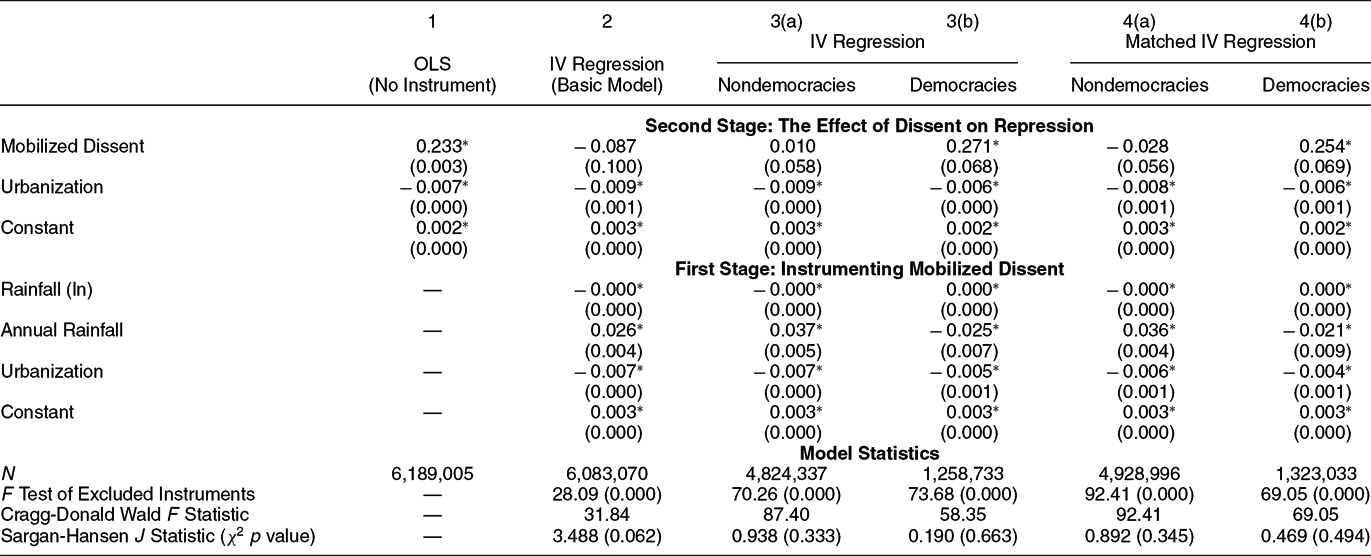
The results from these two-stage least squares (2SLS) estimations are shown in Table 1. Column 1 shows coefficient results using a standard ordinary least-squares model, allowing us to compare the estimates from a standard versus an instrumented approach. Column 2 reports the baseline IV estimates of the effects of dissent on repression without Democracy to illuminate results without considering preventive repression. Columns 3(a) and 3(b) present the IV estimates on the democratic and nondemocratic subsamples, while columns 4(a) and 4(b) are the same models using a matched sample. Democracy and Urbanization are both measured at the state-year level of observation, rather than the province-day. Including these measures implies that institutions change slowly, being fairly consistent across time and applied consistently across provinces. In case the correlation introduced by such slow-moving variables were the root of our results, we use coarsened exact matching to create a sample of province-days that do and do not experience rainfall paired to have balance on all the other covariates; we run IV analysis on this sample, weighting matched observations more heavily than unmatched observations. Beyond improving comparability in general, matching methods improve the plausibility of the as-if-random assignment of the treatment (Keele and Morgan Reference Keele and Morgan2015). Estimates using the U.S. sample are reported in Table 2. Robust standard errors are listed in parentheses.
The Effect of Mobilized Dissent on State Repression in African Province-Days

Notes: *p < 0.05 in two-tailed tests with robust standard errors reported beneath coefficients in parentheses. Parentheses on instrument statistics report their respective p values. All analyses were estimated using Stata 13.1.
The Effect of Mobilized Dissent on State Repression in U.S. State-Days

Notes: *p < 0.05 in two-tailed tests with robust standard errors reported beneath coefficients in parentheses. Parentheses on instrument statistics report their respective p values.
The results from the OLS model presented in column 1 of Table 1 do not correct for strategic censoring and thus assume that observed dissent has a linear and straightforward effect on repression. The results are strongly supportive of the Law of Coercive Responsiveness; Mobilized Dissent is positively and significantly related to State Repression. Yet the positive relationship between dissent and repression does not hold once we account theoretically for the effects of preventive repression on group dissent and use IV methods to correct for unobservable elements that lead to strategic censoring. Using IV regression as reported in column 2, dissent no longer has a statistically significant effect on repression. This basic model combines nondemocracies and democracies without distinction; with almost 80 percent of the sample being nondemocratic, this means most of the sample is likely to experience preventive repression that would reduce the likelihood of repressive responses. To see if this is the reason for the nonrelationship, we separate nondemocracies from democracies in Models 3 and 4.
Consider the split sample models presented in columns 3(a) and 3(b). Once we use IV methods to correct for strategic censoring, dissent has no meaningful relationship to responsive repression in nondemocracies that are more free to repress preventively (column 3(a)). This is consistent with the expectations stated in Hypothesis 1, in that authorities that have already repressed lack a clear best response to dissent that emerges. By comparison, those states that are more constrained from repressing ex ante are more likely to respond to dissent with subsequent repression, consistent with Hypothesis 2. In the sample of democratic states (column 3(b)), dissent has an increasingly positive effect on responsive repression. The results using the matched samples in columns 4(a) and 4(b) are consistent with these findings.
To determine whether rainfall is sufficient to identify the causal relationships, we turn to diagnostics of the first stage regression, which are reported in the bottom section of Table 1. F tests estimate whether the excluded instruments are significant predictors of dissent. Staiger and Stock (Reference Staiger and Stock1997) suggest that an F statistic of 10 is necessary to demonstrate that an IV has sufficient explanatory power to serve as an instrument for an endogenous variable. The F statistics for all reported IV models are well above that mark (p values are reported in parentheses). Aside from considering the strength of our instrument, we conduct Sargan-Hansen tests of overidentifying restrictions. In the Sargan-Hansen test, a rejection of the null hypothesis that the instruments are uncorrelated with the error term casts doubt on the validity of the instruments. We fail to reject the null hypothesis in all of the African IV models, supporting our use of rainfall as an instrument to identify the relationship between Mobilized Dissent and Repression.
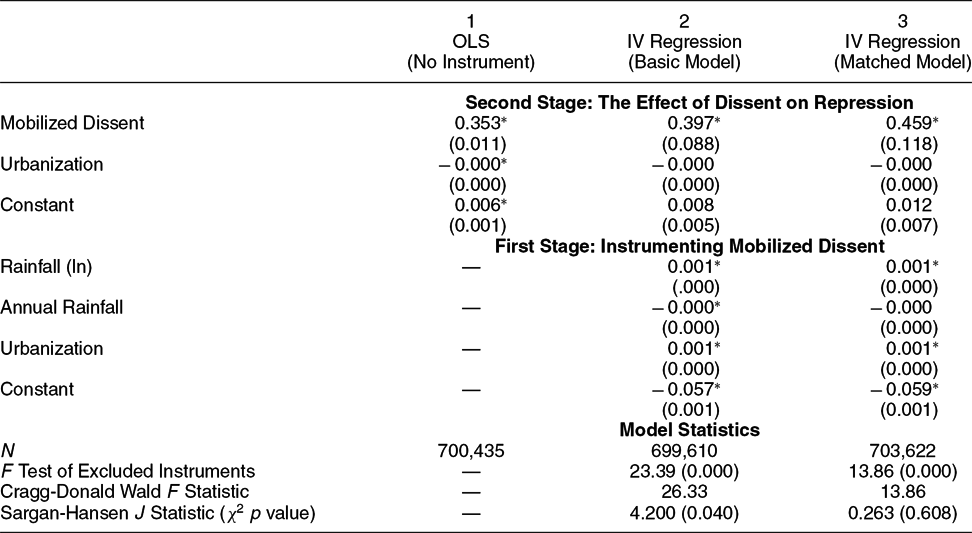
Table 2 reports the effect of dissent on repressive responses in the United States. Once again, the noninstrumented OLS model suggests a positive, statistically significant relationship between Mobilized Dissent and State Repression. The coefficient for dissent in the IV model is also positive and statistically significant at the 95% confidence interval, which is in line with the theoretical expectations of Hypothesis 2. Because authorities in the United States have a relatively high risk of both discovery (with a free media) and punishment (with constraining institutions), police and other authorities will be comparatively less able and willing to engage in preventive repression than many other less democratic states. The IV analysis presented here corrects for strategic censoring that can confound our ability to draw conclusions, and the instrument Log of Rainfall is statistically significant here. The statistical correction leads to a reduction in the estimated substantive effect of dissent on repression, as we would expect, yet the relationship remains. The model reported in column 2 fails the Sargan-Hansen test, but the estimates using the sample with matched weighting in column 3 pass it. All other instrument diagnostics support the use of the Log of Rainfall as an instrument for conflict.
Groups that expect the state to repress them often self-censor. Those that dissent are fundamentally different than those who opt out, being particularly resolute, and repression choices change accordingly. When preventive repression is likely to be the source of censoring behavior, authorities’ best response becomes unclear, and there is no statistically distinguishable way in which observed dissent affects responsive repression. When preventive repression is constrained, some groups self-censor in expectation of repression, yet the state uses repression against those more resolute groups that remain. Once we account for both observable and unobservable processes that influence the selection process of dissent, there is no single, systematic way in which observed dissent affects observed repression.
CONCLUSION
Human rights researchers and practitioners make strong assertions that states violate rights in response to dissent, yet scholars lack convincing empirical support for that assertion. We argue that this lack of support is because dissent is endogenous to repression; the state acts to prevent dissent from ever occurring, and groups often self-censor in the very anticipation of repression. Common approaches note endogeneity in theory but do not account for it empirically. With dissent affecting repression outcomes by both unobserved and observed processes, and in both directions of influence, it is little wonder that scholars have found mixed relationships.
We presented a conceptual framework to simplify the strategic interaction between dissent and repression. We distinguish between repressive actions the state takes to prevent dissent and those it uses to respond to or stop dissent once it has taken place. We proposed a simple yet underutilized approach to estimating how dissent affects repression outcomes given the theoretical issues of strategic censoring. Instrumental variable approaches statistically correct for strategic selection, in that they allow the researcher to estimate the overall effect of realized independent variables on the dependent variable, given the expectation that the values of the dependent variable can influence entrance in the first stage. Extant repression studies have skirted the issue of strategic behavior despite the availability of this easy-to-use approach, primarily because of the lack of a good instrument for estimating dissent that would be unrelated to repression. We built a case for an instrument—rainfall—to make IV approaches possible for repression scholars. Rainfall deters individuals who would otherwise dissent, yet it is exogenous to repression, which occurs by executive order or lack of oversight and so is not responsive to inclement weather. Rain can be used as an instrument whenever a scholar needs to account for the endogeneity of dissent or other collective violence when predicting its effect on an outcome.
Once we consider that some groups will not dissent due to preventive repression, we find that there is no systematic relationship between observed dissent and repression. Even in the relative absence of preventive repression, the threat of responsive repression deters a great deal of dissent, leaving a pretreated sample of groups and behaviors that differ systematically from what dissent would look like if the conditions were randomly distributed. The relationship between realized dissent and repression is a function of elements we are not accounting for in our most common models. The canonical findings of the literature can be seen in the traditional model presented here; once corrected for endogeneity, the strong, positive relationship disappears. We do not interpret these findings to say that expected and realized dissent do not each lead to increased repression but instead to suggest that the strategic interaction between the actors introduces unobservable nuance to the data-generating process that makes it difficult to understand the relationship from observational data alone.
The implications of this research for conflict scholars are not so limited as a requirement to use rain as an instrument for dissent. Future repression and civil conflict studies should seek to more precisely understand the determinants of realized dissent and its relationship to government behavior, using precise theory that make intent clear when possible. The majority of theories predicting repression remain decision-theoretic, assuming dissent to be given while examining how repression will vary based on domestic institutions, international incentives, or behavioral constraints.Footnote 38 But repression is dynamic, with leaders acting preventively and responsively while groups anticipate the potential for conflict (e.g., Ritter Reference Ritter2014). By generating theories that account for the possibility of strategic censorship, scholars can more carefully derive implications of dissent selection without necessarily requiring an instrument to correct for selection bias. While many formal models consider the effect of the possibility of an actor self-censoring (e.g., Arena and Hardt Reference Arena and Hardt2014; Ginkel and Smith Reference Ginkel and Smith1999; Kim, Whitten-Woodring, and James Reference Kim, Whitten-Woodring and James2015; Pierskalla Reference Pierskalla2010; Shellman Reference Shellman2006; Siegel Reference Siegel2011), theories need not be formal to account for the preventive or censoring aspects of repression (e.g., Simmons Reference Simmons2009). Scholars are beginning to predict the conditions under which states will be more (or less) likely to repress to prevent dissent, predicting repression in the absence of dissent, though the state’s anticipation of dissent influences its decision (e.g., Bell, Clay, and Murdie Reference Bell, Clay and Murdie2012; Danneman and Ritter Reference Danneman and Ritter2014; Franklin Reference Franklin2009; Nordås and Davenport Reference Nordås and Davenport2013). Consideration of dynamic expectations allows the researchers to predict both realized repression and guns that don’t fire, deriving clear hypotheses over when repression should be observable in found data.
Although estimating expectations is a significant challenge of nonobservability, it is also possible to estimate the effects of preventive repression with the right data. We have made an argument for why institutional constraints—proxied with a measure of democracy—can serve an indicator for preemptive repression, but democracy is a concept (and indicator) that includes a number of institutions, norms, and practices. The generality of the concept can make clear interpretation of results difficult, even if we are correct that checks and balances limit the use of preventive repression. Yet the nature of preventive repression frequently requires it to be hidden, making it difficult for scholars to use observables as meaningful indicators of the concept. Repressive agents take overt or covert measures to undermine groups, from outlawing particular organizations to political arrests of key members, from intercepting correspondence to infiltration of a group to gain information about its plans (Davenport Reference Davenport2015). The covert nature of these behaviors prevents the revelation of their occurrence in most cases. Scholars are in the process of collecting data that could be used toward this effort once available. The Northern Ireland Research Initiative (NIRI) compiles information from media sources, official government and organizational files, and interviews with victims and perpetrators to examine when and how government actors attempt to undermine dissent and whether it is successful (Sullivan, Loyle, and Davenport Reference Sullivan, Loyle and Davenport2012). Sullivan (Reference Sullivan2015) has coded (as yet unreleased for public use) data on repressive efforts to eliminate or deter overt challenges during the Dirty War in Guatemala, using previously confidential police records that represent a uniquely forthcoming recording of covert behaviors. In short, data are both possible and forthcoming that would allow scholars to assess how repression affects dissent before dissent influences repression.
While selection concerns can require estimators like the instrumental variable models presented here, there are other models that may be more appropriate to model selection into the observed pool without an instrument, depending on the theory of the selection process (cf. Cragg Reference Cragg1971; Ritter Reference Ritter2014; Sartori Reference Sartori2003). A wide range of permutations of a two-stage process is available, first estimating the likelihood that one or both actors in the conflict will take a repressive or dissent action (or self-censor), and then estimating the likelihood of response, the severity of the conflict, etc. When a two-stage model is less appropriate for the theory at hand, scholars can use simulation techniques to model how expectations of a conflictual response in time t + 1 influence the decision-making process at time t. If, for instance, a scholar is interested in the effect of electoral competition on repression, the dependent variable is still a partial function of dissent—the expectation of dissent—which should be included in the empirical model. Regardless of the specific model choice, the multitude of options combined with strategic theory and thoughtful data selection allow scholars to investigate the myriad of causes, constraints, and conflicts related to repression while taking careful account of the strategic process of government and group decision-making.



Comments
No Comments have been published for this article.