Introduction
Napiergrass (Pennisetum purpureum Schumacher) is a perennial C4 monocot originating from Africa that grows in bamboo-like clumps (Anderson et al., Reference Anderson, Dien, Brandon and Peterson2008) and may reach 10 m in height (Boonman, Reference Boonman1997). Valued for its high biomass, perennial nature, high leaf nutritive value and pest resistance (Bhandari et al., Reference Bhandari, Sukanya and Ramesh2006), napiergrass is cultivated for forage worldwide and widely used in South America and Africa (Hanna et al., Reference Hanna, Chaparro, Mathews, Burns, Sollenberger, Carpenter, Moser, Burson and Sollenberger2004). Napiergrass tolerates a wide range of soil conditions, has good drought tolerance, has high photosynthesis efficiency and good water use efficiency (Anderson et al., Reference Anderson, Dien, Brandon and Peterson2008). Furthermore, napiergrass produces more dry matter per unit time when compared with other grasses or legumes (Vincente-Chandler et al., Reference Vincente-Chandler, Abruna, Caso-Costas, Figarella, Silva and Pearson1974). Because of its rapid growth and degradable biomass characteristics, napiergrass also has potential for conversion to alcohol or methane production (Muldoon and Pearson, Reference Muldoon and Pearson1979; Anderson et al., Reference Anderson, Dien, Brandon and Peterson2008).
Napiergrass is an allotetraploid (2n = 4x = 28) and has the genome formula A′A′BB, where A′A′ is homologous to the AA genome of pearl millet (2n = 2x = 14) (Pennisetum glaucum (L.) R. Br.). Because the species exhibits broad morphological variation and cross-pollinates, napiergrass is a valuable source of genetic variation for pearl millet. Although napiergrass forms hybrids with pearl millet, the hybrids are sterile (2n = 3x = 21) and must be vegetatively propagated (Burton, Reference Burton1944). These interspecific hybrids can possess the forage quality of pearl millet and the high dry matter yield of napiergrass and have the ability to produce quality forage in late summer and fall until frost (Hanna and Monson, Reference Hanna and Monson1980; Hanna et al., Reference Hanna, Chaparro, Mathews, Burns, Sollenberger, Carpenter, Moser, Burson and Sollenberger2004). Pollination of cytoplasmic-nuclear male-sterile pearl millet with fertile pearl millet × napiergrass hybrids allowed genes for fertility restoration, stiff stalk, maturity, height and other morphological characteristics to be transferred from napiergrass to pearl millet (Hanna, Reference Hanna1990).
Improvement of napiergrass began with the development of strains resistant to ‘eyespot’ disease caused by the fungus Helminthosporium ocellum Faris (Ritchey and Stokes, Reference Ritchey and Stokes1937; Hanna et al., Reference Hanna, Chaparro, Mathews, Burns, Sollenberger, Carpenter, Moser, Burson and Sollenberger2004), and intraspecific hybridization has been used to select for superior F1 hybrids. A breeding programme in Tifton, Georgia, released a P. purpureum Schum. cultivar Merkeron, derived from an intraspecific cross between a high yielding clone and a dwarf leafy clone, with improved yield and disease resistance (Burton, Reference Burton1989). A selection from progeny of selfed ‘Merkeron’ resulted in Dwarf Tift N75/‘Mott’, a dwarf leafy type (Hanna and Monson, Reference Hanna and Monson1988). As a forage crop, dwarf types are preferable to non-dwarfs as non-dwarfs can become stemmy and unpalatable (Hanna et al., Reference Hanna, Chaparro, Mathews, Burns, Sollenberger, Carpenter, Moser, Burson and Sollenberger2004). Over the last 30 years, over a hundred accessions of napiergrass or napiergrass interspecific hybrids with P. glaucum or Pennisetum squamulatum Fresen. have been produced or collected throughout the world and serve as the basis of the USDA–ARS napiergrass nursery in Tifton, Georgia. Because the pedigree and collection information of many of these accessions is unknown and the tendency for a single cultivar to receive different names in different regions (Hanna et al., Reference Hanna, Chaparro, Mathews, Burns, Sollenberger, Carpenter, Moser, Burson and Sollenberger2004), assessment of the genetic relationships within the collection is needed.
Genetic relationships studies in plant species have been performed using isozymes, amplified fragment length polymorphism (AFLP), random amplified polymorphic DNA (RAPD), simple sequence repeats, restriction fragment length polymorphism and many other types of marker systems. In napiergrass, isozymes were used to classify accessions from India (Bhandari et al., Reference Bhandari, Sukanya and Ramesh2006), and RAPD have been used to examine napiergrass germplasm accessions in the International Livestock Research Institute (Lowe et al., Reference Lowe, Thorpe, Teake and Hanson2003). AFLPs require no sequence knowledge, amplify many markers per primer combination, require small amounts of DNA, are inexpensive and generate mainly dominant markers (Vos et al., Reference Vos, Hogers, Bleeker, Reijans, van de Lee, Hornes, Frijters, Pot, Peleman and Kuiper1995). In this study, the genetic relationships between the accessions in the Tifton napiergrass nursery were evaluated using AFLPs and morphological data. The AFLP data were used to calculate the genetic similarity among accessions, to identify a core set of napiergrass germplasm for conservation, to identify if an association exists with morphological traits or ploidy level and to identify genetic groups for future breeding improvement.
Materials and methods
DNA extraction, AFLP generation and electrophoresis
Shoot apical meristems were collected from 89 accessions from the USDA–ARS, Tifton, GA, napiergrass nursery. The napiergrass nursery is reported to contain napiergrass and interspecific hybrids with P. glaucum and P. squamulatum Fresen. Three meristems from three individuals within each accession were pooled. The pooled meristems were finely sliced with a razor blade and placed in 2 ml microcentrifuge tubes containing small metal beads. Samples were flash frozen in liquid nitrogen, ground using a vortex mixer and then returned to liquid nitrogen to prevent the tissue from thawing. Genomic DNA was then isolated as described (Tai and Tanksley, Reference Tai and Tanksley1990).
AFLP markers were generated using the IRDye infrared dye genomic AFLP kit (Licor, Lincoln, NE, USA). The selective primers used were E-AAG M-CTT, E-ACT M-CTT, E-ACC M-CTT, E-AGG M-CTT, E-ACG M-CTT, E-AGC M-CTT, E-ACA M-CTT and E-AAC M-CTT. Amplified fragments were resolved on a Licor 4300 DNA Analysis System using 25 cm plates and a 6.5% gel matrix. The presence or absence of fragments was determined visually and coded as a ‘1’ for the presence of a band, ‘0’ lack of band for each accession for each marker or ‘9’ for missing data. Duplicates of accessions N7 and N8 were run to ensure reproducibility. Data were entered into a Version 2007 Excel spreadsheet (Microsoft, Redmond, WA, USA) and were imported into NTSYSpc (Rohlf, Reference Rohlf2008). The polymorphic information content (PIC) was calculated for each fragment using the formula PICi = 2f i(1 − f i), where f i is the frequency of marker bands that are present (Roldan-Ruiz et al., Reference Roldan-Ruiz, Dendauw, VanBockstaele, Depicker and DeLoose2000). The PIC value was averaged over the fragments for each primer combination. Resolving power (RP) of each primer was calculated as RP = ΣI b, where I b, which represents fragment informativeness, can be represented as I b = 1 − [2x|0.5 − ρ|] (Prevost and Wilkinson, Reference Prevost and Wilkinson1999). A genetic similarity matrix was generated among all pairs of lines by using the Dice coefficient of similarity (Nei and Li, Reference Nei and Li1979). A dendrogram was created from the similarity matrix by using the unweighted pair group method with arithmetic average (UPGMA) procedure in the SAHN module of NTSYSpc. A cophenetic correlation was performed using the MXCOMP module in NTSYSpc to determine how well the UPGMA clustering summarizes the Dice matrix. Bootstrap resampling was performed using FreeTree (Hampl et al., Reference Hampl, Pavlícek and Flegr2001) with 1000 repetitions, and only bootstraps values greater than 50% are shown. The principal components analysis (PCA) was performed using Dice's coefficient of similarity and using the functions DCENTER, EIGEN and MXPLOT in NTSYSpc.
Morphological data
Plant height was measured from ground to third fully expanded leaf on three separate samples of each entry of the nursery on 12 September 2003, 17 September 2004 and 21 September 2005. Leaf and stem were separated from three whole-stem samples from each entry on 8 November 2005, 9 November 2006 and 8 November 2007. The samples were dried at 40°C for 2 weeks, weighed and its percent leaf dry matter was calculated by dividing by the total leaf and stem sample. Analysis of variance was performed for these traits over years.
To compare the association of AFLP data with phenotypic data, plant height and percent leaf dry matter values were standardized by subtracting the mean of each trait and dividing the resulting number by the standard deviation. Genetic dissimilarity between accessions for the phenotype data was calculated by the SIMINT module using the distance coefficient in NTSYSpc. A dendrogram was created from the distance matrix of morphological data by using the UPGMA procedure in the SAHN module of NTSYSpc. Next, genetic dissimilarity was calculated for each pair of napiergrass accessions for the AFLP data using the SIMGEND module and the distance coefficient NEI72. A Mantel test was performed using the MXCOMP module of NTSYSpc by comparing the genetic dissimilarity matrix for the phenotype data with the genetic dissimilarity data for the AFLP data and using 250 random permutations.
Ploidy level
Fresh tissue (approximately 0.5 cm2) was isolated from field-grown accessions and chopped using a double-edged razor in 600 μl nuclei extraction buffer solution (Partec, Munster, Germany) to release the nuclei. The slurry was poured through a 50 μm filter and 1.6 ml Partec 4′,6-diamidino-2-phenylindole staining buffer was added. The nuclei were analyzed on a Partec Cell Analyzer PASIII flow Cytometer (Partec, Munster, Germany), and at least 5000 fluorescent particles were counted. Mott (2n = 4x = 28 napier), Merkeron (2n = 4x = 28 napier), ‘Tifleaf 3’ (2n = 2x = 14 millet) and PS24 (2n = 8x = 56 squamulatum) were used as controls. Ploidy level was determined based on the G1 peaks relative to the control G1 peaks. To compare the association of the ploidy levels with morphological data and AFLP data, a Mantel test was performed as described above.
Results
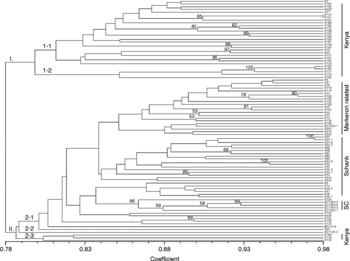
Three hundred and sixty-seven AFLP markers amplified from 89 USDA–ARS napiergrass nursery accessions (Supplementary Table S1, available online only at http://journals.cambridge.org) using eight sets of selective primers were identified and scored. Two hundred and eighteen of these AFLP markers were polymorphic among the napiergrass accessions. Selective primer set E-ACC M-CTT amplified the greatest number of polymorphic fragments (56), whereas primer set E-ACG M-CTT amplified the least number of polymorphic fragments (12). The average number of polymorphic fragments amplified per primer combination was 31. Among the polymorphic fragments, four fragments (3.4%) were unique to one accession (E-ACT M-CTT-170, E-AGC M-CTT-179, E-ACA M-CTT-150 and E-ACA M-CTT-177). The unique fragments amplified in only N131, N168, N71 and SC1125-3, respectively. Between five or less individuals, 11% of polymorphic markers were shared. The PIC values for each primer combination ranged from 0.123 (E-AGC M-CTT) to 0.310 (E-ACA M-CTT) with an average of 0.241 per fragment. The RP of each primer combination ranged from 6.4 (E-AGG M-CTT) to 32.8 (E-ACA M-CTT), and the average RP per primer combination is 13.2. Genetic similarity for the analyzed accessions of napiergrass ranged from 0.695 (N158 against N20) to 0.985 (N147 against N151). Using Dice's coefficient of genetic similarity and the UPGMA clustering method, a dendrogram was created from data of the 218 AFLP markers (Fig. 1). The cophenetic correlation was r = 0.72 (P = 0.0040), which is a moderate representation of genetic similarity by UPGMA clustering. Two main groups were seen when the UPGMA procedure in the SAHN module was used (Fig. 1, groups I and II). Using a genetic similarity cut-off of 0.80, group I could be further subdivided into subgroups 1-1 and 1-2, which contained many accessions from Kenya. Group II could be similarly divided into subgroups 2-1, 2-2 and 2-3 using a 0.80 cut-off value. Subgroup 2-1 contained accessions derived from the cultivar Merkeron, most of the accessions collected by S.C. Schank (University of Florida-Gainsville), many species crosses (SCs) between P. purpureum and P. glaucum and a small group of accessions from Kenya. Subgroup 2-2 contained only SC1125-3, which is a SC between P. purpureum and P. squamulatum. Subgroup 2-3 contained accessions from Kenya and an entry labelled ‘miscellaneous’.
Dendrogram of 89 napiergrass accessions computed from 218 polymorphic AFLP markers using Dice's coefficient of genetic similarity and UPGMA clustering. Bootstrap values greater than 50% are shown.

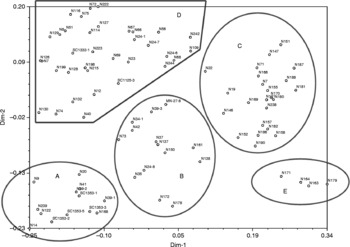
PCA was performed to gain information regarding distances among the accessions and to confirm the clusters seen in the genetic similarity dendrogram (Fig. 2). Congruent with the UPGMA analysis, five main groups were observed. Group A contained many accessions from Puerto Rico as well as SCs between P. purpureum and P. glaucum. Group B contained many accessions from Kenya that clustered in subgroup 2-1 of the genetic similarity dendrogram. Group C contained many accessions from Kenya that clustered in subgroup 1-1 of the genetic similarity dendrogram. Group D contained ‘Merkeron’ accessions and accessions derived from ‘Merkeron’ as well as accessions collected by Schank. Group E contained four accessions all derived from Kenya and corresponds to subgroup 1-2 from the genetic similarity dendrogram.
PCA of AFLP marker data from 89 napiergrass accessions from the USDA–ARS, Tifton, nursery. Dim-1 represents 15.06% and Dim-2 represents 7.54% of the variation.

Accessions with identical AFLP-banding patterns or that were misclassified were identified. Accessions that were identical or nearly identical for the 218 AFLP fragments examined included N147 and N151 (0.985), N163 and N164 (0.980), and N23 and N24-1 (0.979). N147 and N151 were from Kitale, an agricultural town in western Kenya, and were likely clones of one another. N23 and N24-1 have two separate plant introduction numbers and appeared closely related. A few accessions were misclassified and the correct classification was listed in Supplementary Table S1, available online only at http://journals.cambridge.org.
Plant height ranged from 1.19 m, for a dwarf accession (N127) derived from selfing ‘Merkeron’, to 3.93 m for an accession from Kitale, Kenya (Supplementary Table S1, available online only at http://journals.cambridge.org). Percent leaf dry matter ranged from 16.1% for N239 to 58.7% for N116, derived from a cross between N16, an accession from Puerto Rico, and ‘Merkeron’. A moderate regression coefficient (r 2 = 0.584) exists between plant height and percent leaf dry matter. ‘Mott’ and other dwarf genotypes had higher percentage leaf, owing to the negative correlation between plant height and percent leaf dry matter. However, some of the taller genotypes also had relatively high percent leaf (N151 and N163). UPGMA clustering of the distance matrix of morphological data identified two groups (data not shown). The dwarf types, derived from ‘Merkeron’, N75/‘Mott’, N127, N116 and N223 formed one group. Using a Mantel test, no significant correlation (r = 0.00 091, P = 0.4940) could be seen between the distance matrix for the AFLP data and the morphological data.
Ploidy levels were determined to confirm classification and pedigrees. Using a Mantel test, no association was seen between ploidy level and morphological traits or genetic distance as determined with AFLP. Most accessions were 4x but a few accessions, N39-1, N132 and SC1332-1, displayed a 2x ploidy level. Chromosome counts are needed to confirm these accessions are diploids. One accession showed an 8x ploidy level, SC1125-3. SC1125-3 was derived from a cross between ‘Merkeron’ and PS262 (P. squamulatum), and the 8x ploidy level was likely due to fertilization of an unreduced napiergrass egg. Furthermore, SC1125-3 clustered in the ‘Merkeron’-derived group of the PCA analysis (Fig. 2, group D). Accessions SC1353-1, 2, 3 and 5 were reported to be a cross of hexaploid MN27 (N16 × Tift23B) × hexaploid MN4 (Tift23A × N39-2), yet the ploidy level was 4x. The SC1353 accessions cluster in group A along with the reported parent N39-2. It appears that the chromosome number of these clones reverted to the napiergrass genome. Evaluation of the chromosome number and size is needed to determine whether millet chromosomes are present in SC1353 accessions.
Discussion
In contrast to morphological characteristics that can vary between plants of the same genotype due to temperature, soil type, nutrients, insects, etc., the use of molecular markers can provide insight into the genetic relationships that exists within a collection. AFLP markers were used to assess the genetic relationships among the USDA–ARS, Tifton, nursery as they require no sequence information and provide a large number of markers. Genetic similarity estimates, using Dice coefficient of genetic similarity, among napier accessions ranged from 0.695 to 0.985. Thus, variability exists within the collection. This genetic similarity range is larger than the range for the mainly self-fertile kenaf and common wheat cultivars (Tyrka, Reference Tyrka2004; Coetzee et al., Reference Coetzee, Herselman and Labuschagne2008), but the range is smaller than the outcrossing European winter triticale and olive cultivars (Tams et al., Reference Tams, Melchinger and Bauer2005; Ercisli et al., Reference Ercisli, Barut and Ipek2009). Despite the fact that napiergrass is mainly vegetatively propagated, it is a cross-pollinated species that sets little seed (Hanna et al., Reference Hanna, Chaparro, Mathews, Burns, Sollenberger, Carpenter, Moser, Burson and Sollenberger2004). Thus, this self-incompatibility may maintain higher genetic distance than inbreeding species.
In this study, the clustering of napiergrass accessions into five groups, which corresponds to geographical location, is in good agreement with a study that characterized 56 napiergrass accessions using 67 RAPDs (Lowe et al., Reference Lowe, Thorpe, Teake and Hanson2003). Lowe et al. (Reference Lowe, Thorpe, Teake and Hanson2003) differentiated their accessions into five groups (designated East Africa, South Africa, USA1, USA2 and miscellaneous), which also correspond to geographical location. From their study, 25 Kenyan farm clones were collected and these accessions grouped with samples collected from East Africa, USA and South Africa. This was in contrast to our study where the Kenyan accessions form groups mainly with other Kenyan accessions. Only one accession (N75/‘Mott’) was common between the two studies, and we suggest the difference in grouping of Kenyan accessions is from the use of different accessions. The Lowe et al. (Reference Lowe, Thorpe, Teake and Hanson2003) study had accessions from Tanzania, Cuba, Mozambique and Zimbabwe, which were not represented in the Tifton nursery. Similarly, the Tifton nursery has collections from Taiwan, Brazil and Spain, which were not represented in their study. Furthermore, these data from this and the Lowe et al. (Reference Lowe, Thorpe, Teake and Hanson2003) study reveal that, in general, napiergrass accessions group by geographical location is in contrast with an isozyme study using 64 napiergrass accessions (Bhandari et al., Reference Bhandari, Sukanya and Ramesh2006). Bhandari et al. (Reference Bhandari, Sukanya and Ramesh2006) showed that accessions did not group by pedigree or geographical location when data from three isozymes were analyzed. Conflicting data between isozyme studies and DNA-based markers are not uncommon and may be due to the low number of loci examined with isozymes, the isozymes examined may be under selection, isozyme profiles can vary with developmental stage of the plant, and post-translational modifications of isozymes can occur due to environmental conditions (Cullis, Reference Cullis1977; Papov et al., Reference Papov, Urbanovich and Kirichenko2002).
The dendrogram and the PCA revealed that accessions from Kenya can be divided into three groups (groups B, C and E from Fig. 2). As napiergrass is indigenous to sub-Saharan Africa (Lowe et al., Reference Lowe, Thorpe, Teake and Hanson2003), it appears that the USDA–ARS, Tifton, napiergrass nursery has accessions that have captured some of the genetic diversity that exists within Kenya. The clustering of the Kenyan groups as well as the other groups may serve to determine heterotic groups. For example, a genetic diversity study in sorghum using 50 elite parental lines (Menz et al., Reference Menz, Klein, Unruh, Rooney, Klein and Mullet2004) found that sorghum inbreds grouped by working group. In a study of heterotic relationships in sorghum using parents within the Menz groups, the within-group crosses displayed inferior heterotic expression for grain yield and other traits compared with across-group crosses (Krishnamoorthy, Reference Krishnamoorthy2006). Furthermore, genetic similarity estimates for parental line pairs were significantly correlated with specific combining ability and heterosis for yield (Krishnamoorthy, Reference Krishnamoorthy2006). Further research is needed in napiergrass to determine whether these groups, from our study, display heterotic expression for across-group crosses as compared with within-group crosses. Accessions such as N58 (group C) and N20 (group A), which are the most genetically dissimilar accessions evaluated in our study, would be an example of parents to use if two parents from each of the five groups were chosen for diallele crosses to determine whether heterotic expression for yield or disease resistance exists in napiergrass for across-group crosses as compared with within-group crosses. Also the five napiergrass groups may be useful for pearl millet × napiergrass interspecific hybrids. Hanna and Monson (Reference Hanna and Monson1980) found that N23 when crossed with ‘Tift23’ pearl millet displayed greater dry matter yield than a pearl millet hybrid over a 2-year period. N23 was collected in Swaziland and clustered in group D (Fig. 2). Further research is needed to determine whether certain napiergrass groups make better hybrids with pearl millet for biomass or disease resistance.
Shorter, dwarf genotypes such as the cultivar Mott have been released for use as a forage crop (Hanna and Monson, Reference Hanna and Monson1988). The higher percentage of leaf matter is favorable for higher quality forage for cattle. However, tall, high yielding genotypes will be needed as a feedstock for bioenergy. Often these genotypes are high in stem biomass and higher in lignin, which can be less conducive to conversion to ethanol from fermentation. However, biomass quality is dependent on maturity (Anderson et al., Reference Anderson, Peterson, Akin and Morrison2005) or genotype (Anderson et al., Reference Anderson, Dien, Brandon and Peterson2008). Accessions such as N151, which are tall and relatively high in percent leaf, can be useful directly or in breeding as a feedstock in the bioenergy field. Further research is needed to determine morphological and cell wall traits that decrease recalcitrance for conversion to fermentable sugars and reduce inhibitory products.
Using a Mantel test, no significant correlation (r) was seen between the napiergrass AFLP data and morphological data. The lack of correlation between molecular marker data and morphological data has been seen in many plant species (Schut et al., Reference Schut, Qi and Stam1997; Martinez et al., Reference Martinez, Cavagnaro, Masuelli and Rodriguez2003; Spooner et al., Reference Spooner, McLean, Ramsay, Waugh and Bryan2005). This is likely because the traits of interest, e.g. height, are likely controlled by a few genes under selection, whereas molecular data sample many areas of the genome largely at random.
Only a limited number of accessions can be harboured at the Plant Genetic Resources Conservation Unit (PGRCU-Griffin, GA, USA). Thus, genetic similarity of napiergrass accessions in the Tifton nursery is directly useful, as the authors will donate a small set of accessions from each of the five groups to the PGRCU instead of donating all accessions. Furthermore, this study identified many accessions that were donated to the Tifton nursery using an incorrect classification or contained sparse information about the accession (many accessions have only the donators name). Updating this information with the correct classification based on morphology, genetic marker analysis and ploidy level prevents these errors from being passed on to other researchers and provides needed information about these accessions.
Due to the high heterozygosity within napiergrass accessions that produce highly heterogeneous progeny from selfed seed, genetic homogeneity can only be maintained by vegetative propagation. ‘Merkeron’ was distributed and recollected from various countries (N72, N73 and N132), and none of them were genetically identical in this study. In fact, N73 collected by S.C. Schank did not cluster with accessions labelled as ‘Merkeron’ or derived from ‘Merkeron’ in group D of the PCA. Cultivars of napiergrass were seen in all groups of the PCA analysis except group E. Cultivars are quite diverse from one another with the exception of those that are derived from another cultivar (‘Mott’ from ‘Merkeron’). The domestication of napiergrass is in its infancy and the transfer of cultivars by plant propagation is ideal, so comparisons for traits of interest (e.g. yield, digestibility) can be made between researchers.
The use of 218 polymorphic AFLP markers to assess the genetic similarity of 89 napiergrass accessions from the USDA–ARS, Tifton, proved fruitful as variation was seen among the accessions. In addition to the identification of accessions that are very similar, the accessions were clustered into five groups. This information can be useful to determine heterotic groups within napiergrass, for future napiergrass × pearl millet hybrids and for the conservation of napiergrass germplasm.
Acknowledgements
The authors would like to thank Jacolyn Merriman, Dr Andrea Maas, Dr Jeff Wilson and Dr Wayne Hanna for their technical service and advice.