Government formation in multiparty systems is of self-evident substantive importance (especially to political scientists), and it is dealt with in a large and heterodox theoretical literature. Key outputs of the government formation process – for example the partisan composition of the cabinet, the distribution of portfolios among cabinet members, bargaining delays and cabinet durations – are easily and unambiguously observable. This enables a more clear-cut confrontation between theory and data than is typically the case in political science. It has also thrown into sharp relief a puzzle that Warwick and Druckman call the portfolio allocation paradox: a notorious contradiction between (1) predictions of the distribution of cabinet portfolios made by canonical alternating offers models of legislative bargaining and (2) the robust empirical regularity of proportional portfolio allocations that has been characterized as Gamson’s Law (GL).Footnote 1
Empirical models of government formation are necessarily specified ex ante, absent any knowledge of the government that forms.Footnote 2 Empirical models of the distribution of cabinet portfolios are typically specified ex post, given knowledge of the identity of some putative government formateur or of the full partisan composition of the cabinet.Footnote 3 We argue below that this disjunction lies at the heart of the portfolio allocation paradox, and set out to resolve the paradox by specifying and estimating a joint ex ante model of cabinet formation and portfolio distribution. An important feature of such a joint model is that it treats the list of parties outside the cabinet as informative, predicting ex ante which parties will receive zero portfolios rather than taking this as given. Our joint model allows us to conclude that canonical models of legislative bargaining do add to our ability to predict government membership, but that portfolio distribution between government members conforms robustly to a proportionality norm, which supports recent ex ante theoretical models of portfolio distribution.
RESOLVING THE PORTFOLIO ALLOCATION PARADOX
The Paradox
The essential features of the portfolio allocation paradox have been extensively discussed by Warwick and Druckman, among many others.Footnote 4 We confine ourselves here to its bare bones. A long tradition of empirical research linking legislative seat shares to distributions of cabinet positions originates in work published over fifty years ago by the sociologist William Gamson.Footnote 5 This established a strong and non-trivial empirical regularity: GL. Government parties tend to receive cabinet portfolios in strict proportion to the legislative seats they contribute to the government’s aggregate seat total. Gamson did not provide a formal bargaining model that yielded GL as a prediction. Indeed, if party leaders are motivated to maximize Gamsonian (proportional to seats) pay-offs, the government coalition should command the smallest legislative seat total that is also a legislative majority. This is not true empirically, a finding that was first published over forty years ago.Footnote 6 Nonetheless, GL itself has proved extraordinarily robust to replication, even when different cabinet portfolios are assigned very different empirical weights.Footnote 7 On the other side of the paradox we find canonical alternating offers models of legislative bargaining, with an intellectual pedigree traceable to Rubinstein, adapted to legislative bargaining by Baron and Ferejohn.Footnote 8 This approach was applied explicitly to portfolio distribution by Ansolabehere et al., who derive two propositions about legislative bargaining over government formation in multiparty systems:Footnote 9
-
(1) ‘Elementary microeconomic theory teaches that in competitive situations perfect substitutes have the same price … We show that the noncooperative bargaining model of David P. Baron and John A. Ferejohn (1989) leads naturally to the result that expected payoffs are proportional to voting weights’.Footnote 10
-
(2) ‘One key prediction of the model … is that the party that is recognized to form a coalition – the formateur – will receive a share of the cabinet posts that is much larger than its share of the voting weight’.Footnote 11
On the face of things these two propositions seem contradictory: ‘payoffs are proportional to voting weights’ but ‘the formateur gets a payoff much larger than its share of voting weight’. The apparent contradiction arises because the first proposition is stated ex ante, absent knowledge of the identity of the formateur. The second proposition is stated ex post, with knowledge of the identity of the formateur. The propositions are therefore not contradictory because they apply in different settings, but this highlights a critical distinction between ex ante and ex post models of cabinet portfolio distribution.
Over and above the special position claimed for the formateur, Ansolabehere et al. also diverge from typical work on GL by arguing that cabinet pay-offs should be associated with theoretical voting weights, specifically minimum integer weights (MIWs), rather than the ‘raw’ legislative seat shares of each party. Parties’ MIWs are derived from their raw seat shares and the winning threshold for passing votes in the legislature. The list of raw seat shares is used to calculate the list of winning coalitions; the raw seat shares are replaced by the list of smallest integers, one per party, that generates the same set of winning coalitions. These integers are the parties’ MIWs.Footnote 12 Ansolabehere et al. therefore make two simultaneous moves away from traditional research on portfolio distribution: they propose a formateur advantage and they propose using MIWs rather than raw seat shares.
Notwithstanding the empirical findings published by Ansolabehere et al., analyses by subsequent authors show little if any empirical support for either of the two theoretical propositions stated above. In relation to the first –the use of MIWs rather than raw seat shares – Warwick and Druckman’s results, replicated by Laver et al., are ‘clear and strong: cabinet portfolios, in both number and value, are allocated in very close proportion to the seat contributions of cabinet parties, and the bargaining strengths of these parties distort this allocation principle only very slightly (or very occasionally)’.Footnote 13 In relation to the second proposition, on the ex post formateur effect, Warwick and Druckman find ‘the power that ought to come with formateur status appears to yield little in terms of portfolios’.Footnote 14 Laver et al. also show that estimating an ex post formateur effect is compounded by the methodological problem that formateur party status is coded endogenously in relevant datasets as the party of the eventual prime minister.Footnote 15 Thus Golder reports that ‘it is not uncommon for the formateur to fail to form a coalition on the first or even the second attempt. As an example, it took seven different coalition proposals more than 106 days for a government to form after the 1979 Belgian legislative elections’.Footnote 16 None of these failed attempts by formateurs is analyzed by Snyder, et al. or Warwick and Druckman when they estimate the formateur advantage, and only one of 250 formateur parties in the dataset they use was not the party of the eventual prime minister.Footnote 17 The prime ministerial portfolio thus appears on both sides of the relevant regressions, as both one of the key independent variables (formateur status) and as part of the dependent variable (portfolio share). Correcting for this, Laver, et al. find that the empirical formateur effect disappears.Footnote 18
The paradox is therefore both simple and striking. As Carroll and Cox say, ‘all modern bargaining models predict that Gamson’s Law should not hold’.Footnote 19 But as Bassi says, ‘the most important empirical law in government-formation studies is that coalition partners share cabinet portfolios in proportion to their relative seat shares, which contradicts the predictions of the entire theoretical literature’.Footnote 20
Resolving the Paradox
Two theoretical questions underlie this paradox, as we have seen. The first is the claim that there is some formateur in a privileged bargaining position. The second is the claim that parties’ portfolio pay-offs respond to their theoretical voting weights (MIWs) rather than their raw seat shares. We argue above against predicting portfolio pay-offs ex post (after Nature has told us the identity of the randomly chosen formateur but before the government has formed), given the problem of identifying the list of exogenously selected formateurs in a way that is not endogenous to the bargaining outcome, which is compounded by the lack of any measurable effect once this problem is addressed. We therefore address the paradox by predicting portfolio allocation ex ante, absent any knowledge of the formateur, and developing a joint ex ante model of government formation and portfolio distribution.
This leads us to the second question, of whether raw seat shares or theoretical voting weights better predict parties’ observed portfolio shares. Absent knowledge of the formateur, the canonical bargaining models referred to above predict that:
-
∙ pay-offs will be proportional to theoretical voting weights;
-
∙ only minimal-winning coalitions will form (minority cabinets face a majority opposition with both the incentive and the ability to capture all portfolios, while surplus coalitions contain members who are not needed yet are assigned some portfolios);
-
∙ parties with zero MIW will therefore not be part of any government coalition.
Unlike the canonical bargaining models, the GL prediction that portfolio distribution will reflect raw seat shares lacks deep theoretical underpinnings, though several scholars have recently addressed this. Anna Bassi assumes that formateurs are not picked exogenously, but emerge endogenously from negotiations between party leaders. Her model predicts no formateur advantage (in equilibrium, party leaders bargain this away) and Gamsonian pay-offs.Footnote 21 The latter arise because Bassi assumes that any proposed pay-off distribution must satisfy the full set of party legislators, not just a single party leader.Footnote 22 Carroll and Cox model bargaining over government formation that begins before an election. Their argument is that committing to Gamsonian pay-offs in pre-election deals provides incentives for all parties to the deal to expend maximum electoral effort on increasing their legislative seat total, thus increasing the probability that both they and their coalition partners will take office. Falco-Gimenó and Indridason argue that Gamsonian portfolio distributions act as natural ‘focal points’ in a difficult and complex bargaining environment involving complicated policy negotiations and many other matters, thereby taking one piece of complexity off the bargaining table.Footnote 23
Given the theoretical arguments on both sides of the debate, it is helpful to resolve empirically the question of whether parties’ portfolio pay-offs tend to respond to raw seat shares or their theoretical voting weights. Building on the argument of Falco-Gimenó and Indridason, it is also helpful to investigate whether Gamsonian proportional pay-offs become more likely as the bargaining environment becomes more complex. We address both of these questions below.
A Joint a Priori Model of Government Formation and Portfolio Distribution
Until now, all empirical work has predicted portfolio pay-offs given a particular coalition of parties that has already formed.Footnote 24 In other words, existing empirical work has modeled portfolio distribution ex post, conditional on government formation and regardless of whether any model predicted the government that formed. From a theoretical perspective, this is despite the fact that bargaining models predict portfolio distribution as an integral part of a model of government formation, so that (in)ability to predict government membership is highly relevant empirically. In practical terms, ex post modeling of pay-off distributions results in the deletion from the analysis of every party that does not receive a cabinet portfolio. This happens even when the theoretical model under investigation predicts that, on average, many of these parties should receive a positive bargaining pay-off and should (with some positive probability) be members of the government. Selecting on the dependent variable in this way ignores the possibility that there may be complexities in the bargaining process that systematically select different types of parties, which is contrary to the claim that parties should receive portfolio pay-off solely in proportion to their bargaining strength.
We therefore eschew ex post prediction of portfolio distributions and specify an ex ante statistical approach that includes all parties involved in government formation, whether or not they join the cabinet and receive a pay-off, and evaluates joint predictions of government membership and pay-off allocation between government members. This is analogous to an approach developed recently by Chiba et al., who develop a statistical model to evaluate joint predictions of government formation and duration.Footnote 25
STATISTICAL MODEL
Our unit of analysis is a political party in a government formation situation. Our dependent variable is the party’s observed share of cabinet portfolios, which ranges in theory from 0 to 1, and has a point mass at zero in the empirical data. A party with zero cabinet portfolios is by all conventional definitions considered not to be a member of the government; a party with non-zero portfolios is considered to be a government member; a party with all the portfolios constitutes a single-party cabinet. Thus our dependent variable is far from normally distributed. We present the results of ordinary least squares (OLS) regressions in the supplementary materials. But to facilitate comparison with previously published work, our core method involves maximum-likelihood models based on a mixed continuous–discrete distribution. The dependent variable is a proportion and therefore has a limited range. This suggests the choice of a beta distribution, which is flexible enough to suit the problem.Footnote 26 As a continuous function, however, it is not appropriate for modeling large numbers of values that are at a single point, and the dependent variable has a very large number of zeros, which arise whenever a given party is not included in the government. This implies using a mixed distribution. We adopt this approach, following work by Ospina and Ferrari,Footnote 27 and model these data as a mixture between a beta distribution and a degenerate distribution in 0. We thus use a zero-inflated beta model to directly model both the likelihood that a party will enter a coalition and its pay-off in cabinet seats if it does enter. Hence, the likelihood function we maximize is:
 $$L(y;v,\mu ,\sigma )=\prod\nolimits_{i=1}^n {v_{i}^{{1{\minus}I(y_{i} )}} (i{\minus}v_{i} )^{{I(y_{i} )}} \prod\nolimits_{i;y_{i} \in (0,1)} {{{\Gamma (\sigma _{i} )} \over {\Gamma (\mu _{i} \sigma _{i} )\Gamma ((1{\minus}\mu _{i} )\sigma _{i} )}}} y_{i}^{{\mu _{i} \sigma _{i} {\minus}1}} } (1{\minus}y_{i} )^{{(1{\minus}\mu _{i} )\sigma _{i} {\minus}1}} ,$$
where:
 $$v_{i} =\log \left( {{{\beta _{{v0}} {\plus}\beta _{{v1}} \cdot miw\,share_{i} {\plus}\beta _{{v2}} \cdot seat\,share_{i} } \over {1{\minus}(\beta _{{v0}} {\plus}\beta _{{v1}} \cdot miw\,share_{i} {\plus}\beta _{{v2}} \cdot seat\,share_{i} )}}} \right),$$
 $$\mu _{i} =\log \left( {{{\beta _{{\mu 0}} {\plus}\beta _{{\mu 1}} \cdot miw\,share_{i} {\plus}\beta _{{\mu 2}} \cdot seat\,share_{i} } \over {1{\minus}(\beta _{{\mu 0}} {\plus}\beta _{{\mu 1}} \cdot miw\,share_{i} {\plus}\beta _{{\mu 2}} \cdot seat\,share_{i} )}}} \right),$$
 $$\sigma _{i} =\log (\beta _{{\sigma 0}} {\plus}\beta _{{\sigma 1}} \cdot miw\,share_{i} {\plus}\beta _{{\sigma 2}} \cdot seat\,share_{i} ).$$
Link functions were chosen to constrain parameters to the unit interval (in the case of ν i and µ i ) and to be strictly positive in the case of the precision parameter σ i . The parameter ν i has a direct and relevant substantive interpretation: it gives the likelihood of a zero observation, hence the inverse likelihood of cabinet membership. The parameter µ i is the mean for the beta distribution and shows the strength of the relationship between the independent variables and the party portfolio shares; σ i is the precision of the beta distribution. We thereby achieve our core objective of deriving distinct joint estimates of the probability of cabinet membership, v i , and the distribution of cabinet portfolios, µ i .
Weighting Cases
Since our unit of analysis is a political party in a government formation situation, we might ask whether all observations in the data should, as in all previous empirical analyses, have equal weight. Different countries have different numbers of parties, and some have many more governments than others. Italy, for example, had more governments than most other European countries in the post-war era and also tends to have more parties than most other countries. The dataset we describe below covers sixteen countries, but Italy accounts for about 22 per cent of the observations. Italy, Belgium, Denmark and Finland together account for about 55 per cent of all observations. Empirical analyses that ignore this may be biased, and we do not want our ‘cross-national’ analysis of portfolio distribution to be mostly about these four countries. In order to control for the different weights of parties in the estimation due to the differences in party system sizes and the frequency of elections, we calculated a probability for each party to be selected into a subsample of our data. This selection probability is inversely related to the number of parties in parliament. It is calculated as:
 $$\pi _{i} ={1 \over {n_{k} }} \cdot {1 \over K},$$
where n k is the number of parties in a given cabinet k and K is the total number of cabinets in the truncated dataset. Based on the selection probabilities, 80 per cent of observations (1,134 parties) in the truncated dataset are randomly selected in a subsample.Footnote 28 By providing results based on multiple, randomly drawn samples, we mitigate the possibility that one nation exercises undue influence on the results.Footnote 29 In many respects, our sampling strategy functions like the bootstrap. By creating empirical distributions from the data and generating multiple samples (with replacement), we hedge against any single nation (or subset of cabinets) having undue influence on our results.Footnote 30
Estimation Approach
As indicated in the previous section, our estimation method involves creating multiple training sets based on the principle of the empirical bootstrap. We use these training sets to test three different models. The first includes all cabinets and is the main test of whether theoretical voting weights or raw seat shares best predicts outcomes, including both government membership and pay-off distribution. Addressing Falco-Gimenó and Indridason’s argument that Gamsonian pay-offs are a response by party leaders to bargaining complexity, we test two further models using these training data, separating bargaining settings according to their complexity. We categorized ‘simple’ and ‘complex’ settings according to the difficulty of calculating the full set of 2 n −1 coalitions in an n-party system (and therefore of exploring all coalition possibilities) using a natural inflection point in the time taken by our computational algorithm to calculate MIWs. This led us to specify simple settings as those with fewer than eight pivotal parties and complex settings as those with eight or more pivotal parties.Footnote 31 For the full population of cases, as well as those reflecting simple and complex settings, we draw 1,000 subsamples from the dataset, split each subsample into training and test sets, and fit the model. Instead of evaluating our model performance using the training samples, we report results based only on the 20 per cent out-of-sample observations in the test set.Footnote 32 This is a further hedge against the possibility that results could be overfitted to non-systematic elements of the original sample.
Data
Most of our data derive from the Parliament and Government Composition Database (Parlgov), constructed by Döring, Manow and collaborators.Footnote 33 This includes election results and government formation data for all EU members as well as many Organisation for Economic Co-operation and Development countries from 1945 onwards. Our dataset includes data from 1945 until the most recent available Parlgov data on cabinet seats for sixteen parliamentary democracies in Western Europe.Footnote 34 While we rely on Parlgov for data on elections, seat share and party of the prime minister, this source does not include data on the distribution of cabinet seats between parties, which we collected from a reliable online database.Footnote 35
Theoretical Voting Weights
A key independent variable in our analysis concerns parties’ MIWs, which Ansolabehere et al. use to implement their claim that theoretical voting weights (rather than raw seat shares) inform government formation and subsequent portfolio allocation. There is a focused technical literature on MIWs, much of it outside mainstream political science.Footnote 36 Montero has shown, for example, that ex post predicted pay-offs under the canonical alternating offers bargaining protocol are proportional to agents’ MIWs.Footnote 37 The vector of MIWs can be surprisingly difficult to calculate, especially in systems with more than a few parties. Computationally, as Strauss shows, this is because the problem of coalition enumeration is NP-hard, which of course generates problems for real politicians as well as for political scientists.Footnote 38 While Snyder et al. address this by programming a calculator for computing MIWs,Footnote 39 their ‘perfect substitutes have the same price’ argument highlights a theoretical distinction drawn by Freixas and Kurz between simple MIWs and MIWs preserving types. At issue is whether mutually substitutable parties should be given equal voting weights; Snyder et al. argue they should. If so, we should use MIWs preserving types, which are constrained so that parties that are perfect substitutes have the same voting weights.Footnote 40 Following Freixas and Kurz, therefore, we replace MIWs with MIWs preserving types.Footnote 41 Solving for these is an application of linear programming.Footnote 42 We programmed and verified our own algorithm and, assuming a simple majority-winning quota, calculated MIWs preserving types from party seat totals reported in Parlgov.
Single Party Majorities and Minority Governments
When a single political party wins a legislative majority, models of government formation invariably predict that it will form a single-party government and award itself all cabinet portfolios. This is almost always true empirically, and is not an open theoretical question. While we might think of plausible models that treat single-party majority governments as coalitions of party factions, this is neither the focus of the literature with which we are dealing nor our focus in this article. We therefore exclude from our analysis, as uninformative for our purposes, settings in which a single party won a legislative majority.
Minority cabinets pose a more difficult challenge for a joint model of government formation and portfolio distribution. Predicting the formation of minority governments remains a wide-open theoretical question for government-formation models. But models that focus on portfolio distribution predict no minority governments, as we have noted, since a minority government faces a majority opposition that is both willing and able to consume all portfolios. Including minority governments in our analysis would thus include a set of cases in which we know that the models of portfolio distribution we are evaluating make failed predictions, and it is not at all clear what portfolio distributions these models predict in cabinets they deem out of equilibrium. Excluding minority cabinets, however, amounts to selecting on the dependent variable for a model that jointly predicts government formation and portfolio distribution, and including an indicator variable for minority governments on the right-hand side of the relevant regressions violates our objective of ex ante prediction. Since our goal of ex ante prediction is paramount and we do not wish to select on the independent variable, we opt for the lesser of two evils and include all cases of minority coalitions in our analysis.Footnote 43
RESULTS
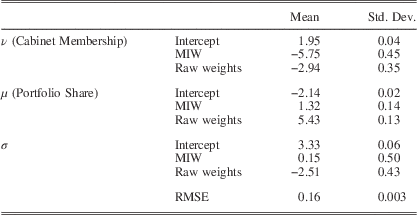
Estimation results are reported in Tables 1–3 below; these exclude observations in which a single party forms the government.Footnote 44 The first parameter of interest is ν, which shows the relationship between the independent variables and a party being out of office (having no portfolio). The second parameter is µ, which shows the relationship between the independent variables and the strictly positive proportion of portfolios allocated to a party. Taking all cases together (Table 1), both the MIW and raw legislative seat share of a party are correlated with its inclusion in government.
Distribution of 1,000 Parameter Estimates and Root Mean Squared Error: Out-of-Sample Predictions for all Cabinets

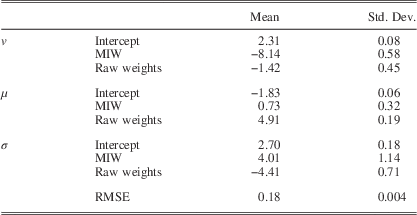
Distribution of 1,000 Parameter Estimates and Root Mean Squared Error Out-of-Sample Predictions for Cabinets with at Most Eight Parties with Non-zero MIWs

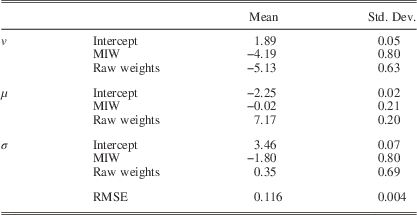
Distribution of 1,000 Parameter Estimates and Root Mean Squared Error Out-of-Sample Predictions for Cabinets with More Than Eight Parties with Non-zero MIWs

The v coefficients demonstrate a negative relationship between exclusion from office for both MIWs and raw seat shares; higher MIWs are more strongly connected with cabinet membership than higher raw seat shares. However, and consistent with Warwick and Druckman’s findings, the µ coefficients in Table 1 show that raw seat shares are far better predictors than MIWs of the share of cabinet portfolios a party receives, conditional on it being in the government at all.
Our analysis therefore yields an unambiguous substantive finding about legislative bargaining. Independently of raw legislative seat shares, parties are more likely to get into the cabinet if they have a higher theoretical voting weight, measured using MIWs. In this sense, theoretical bargaining models add value to predictions about cabinet membership. Once a party is in the government, however, its pay-off, measured as its share of cabinet portfolios, is predicted by its raw legislative seat share and not at all by its theoretical bargaining weight. In this precise sense, the empirical robustness of GL has again been vindicated. While raw seat shares robustly predict portfolio distribution, they do not do so because they are associated with theoretical voting weights.
Comparing Tables 2 and 3, we see that bargaining complexity has a strong effect. In the more complex settings described in Table 3, the v coefficients show that MIWs no longer even predict cabinet membership, which is much better predicted by raw legislative seat shares. Table 2 shows the reverse for less complex settings, bearing in mind that these are the typical settings for post-war Western Europe. Membership of the government is much better predicted by MIWs, controlling for raw legislative seat shares. In both types of settings, however, the µ coefficients show that it is raw legislative seat shares, and not MIWs, that predict portfolio pay-offs.
To facilitate comparison with previously published results, we present estimates derived from OLS regressions in online Appendix 3, with the caveat that these models are mis-specified for reasons we discuss above. The OLS estimates comport with those derived from zero-inflated beta models presented here. Theoretical voting weights predict government membership, especially in the lower-complexity settings with eight or fewer pivotal parties. But raw legislative seats, rather than MIWs, predict distributions of cabinet portfolios within a given coalition.
CONCLUSIONS
Our zero-inflated beta model jointly estimates membership of the government and, conditional on this, the distribution of cabinet portfolios between government members. The results are unambiguous. First, controlling for raw legislative seat shares, the theoretical voting weights used by non-cooperative models of legislative bargaining predict membership of the government emerging from bargaining between parties, especially in settings with fewer than eight pivotal parties (which is typical in post-war Western Europe). Indeed, Table 1 shows that theoretical voting weights predict government membership much better than raw seat shares in this common setting. In a nutshell, controlling for raw seat shares, parties with higher theoretical voting weights are better able to force their way into government coalitions. This is a theoretically significant empirical finding. Secondly, whatever the setting – and conditional on the government that forms – raw legislative seat shares, not theoretical voting weights, predict the distribution of cabinet portfolios between government parties. The latter finding is, in effect, a further replication of the robust GL results using a more sophisticated and appropriate statistical apparatus. Thirdly, Tables 2 and 3 show that, while MIWs predict cabinet membership in simple bargaining settings, they are much less effective than raw seat shares at predicting cabinet membership in more complex settings.
We draw the following conclusions from these findings. First, our findings imply that the scientific community should accept and exploit the robust empirical regularity that raw seat shares (and not theoretical voting weights) predict the distribution of cabinet portfolios in European governments. The theoretical task is not to make this empirical result go away, but to find a rigorous theoretical model of government formation that explains it. Secondly, and newly emerging from our joint modeling of government membership and portfolio distribution, the good news for legislative bargaining models is that theoretical voting weights – more precisely, MIWs preserving types – help to explain government membership.
We see no necessary contradiction between these findings. One way to reconcile them is to infer that the distribution of cabinet portfolios is neither the only, nor even the most important, matter that concerns party leaders who are bargaining over the formation of coalition cabinets. Golder’s analysis of bargaining delays over government formation in Western Europe shows that, in post-electoral settings, these delays range from 86 days on average in the Netherlands though sixty-one days in Belgium to less than three days in Norway.Footnote 45 One recent Belgian government took more than a year to form. Informal press reports of what is happening during these often lengthy bargaining periods suggest that the party leaders are not spending their time bargaining over the distribution of cabinet portfolios, but rather are trying to negotiate a joint policy program for government that reconciles conflicting party manifestos. This is detailed and time-consuming work, and it appears from these reports that party leaders typically turn to the distribution of cabinet portfolios only after a joint policy program has been agreed. For us to go further would require setting out a model of bargaining over government formation that takes into account both portfolio distribution and the need for a joint policy program. This is clearly not our task in this article, though we are exploring it in ongoing work. Our point here is that our twin empirical findings can be reconciled if portfolio distribution is not the only pay-off that concerns party leaders when they bargain over government formation. If it were, then we would expect parties’ theoretical voting weights to predict portfolio distribution, but they do not. Rather, while these voting weights have a significant bearing on which parties get into government, the distribution of portfolios between the parties in government very systematically conforms to a norm of proportionality with raw legislative seat shares.