

Introduction
Smoking amongst people with mental health conditions and users of addictions services in New Zealand is high – for example, 32%–56%, compared to 21% amongst people with no mental health problems in 2006–2007 (Tobias et al., Reference Tobias, Templeton and Collings2008). In addition, smoking prevalence amongst mental health and addictions services staff is high compared to other health professions (Edwards et al., Reference Edwards, Bowler, Atkinson and Wilson2008). There has been an historic acceptance of smoking in mental health and addictions services and an established discourse that it is too hard for service users to stop (Johnson et al., Reference Johnson, Moffat and Malchy2010; Lawn & Condon, Reference Lawn and Condon2006; Reilly et al., Reference Reilly, Murphy and Alderton2006). In this paper we examine the smoking-related perceptions, attitudes and practices of mental health and addictions staff in non-government organisation (NGO) and their service users in the Northern region of New Zealand and seek to address some gaps in knowledge about NGO mental health and addiction services and smoking in New Zealand.
Many hospital-based mental health and addictions services in New Zealand have implemented smoke-free initiatives such as smoke-free premises and the routine provision of support to quit smoking. (Glover et al., Reference Glover, Fraser, Bullen, Wallace-Bell, McRobbie and Hadwen2013; Goldsack, Reference Goldsack2004). There are many reasons community-based mental health and addictions organisations are also well (if not better) placed to support people to be smoke-free. The NZ Smoking Cessation Guidelines (2007) provide a basis for provision of smoking cessation advice and recommend offering brief advice to stop smoking to all users of mental health and addictions services who smoke. The smoking cessation support approach currently adopted within health settings is the ABC approach which involves: Asking all people about their smoking status and documenting this, providing Brief advice to stop smoking to all people who smoke, regardless of their desire or motivation to quit, and making an offer of, and referring to or providing, evidence based Cessation treatment (Ministry of Health, 2007).
A qualitative survey of mental health key informants in New Zealand in 2006 found similar results to overseas studies, that is, negative staff attitudes to becoming smoke-free, poor knowledge of nicotine dependence and smoking-related harm, and poor knowledge and skills regarding cessation options (Glover et al., Reference Glover, Fraser, Bullen, Wallace-Bell, McRobbie and Hadwen2013). From 2010 to 2013, however, many developments in the tobacco control landscape in New Zealand occurred. During this period, a project has been active which has worked to increase the provision of cessation support, train staff in smoking cessation, implement smoke-free systems within organisations and across the NGO sector including: smoke-free contract clauses in the NGO funding contracts and data collection requirements.
Aims
Our study examines staff attitudes following this period of transition in tobacco control policy within mental health and addiction services and nationally. Additionally, it seeks to identify some key factors associated with attitudes to smoke-free and cessation policies in mental health and ways to best support service users and staff to become smoke-free. Finally, it addresses gaps in knowledge identified in the Glover et al. (Reference Glover, Fraser, Bullen, Wallace-Bell, McRobbie and Hadwen2013) study, particularly service user attitudes and attitudes amongst the NGO sector.
Methods
We conducted repeated cross-sectional web-based surveys amongst NGO mental health service staff and service users from the Northern region of New Zealand in 2010 and 2013.
We recruited participants by means of a database of mental health and addictions service NGOs within the Northern region of New Zealand. This database was obtained from the relevant District Health Boards (DHB). In 2010 and 2013, we sent a web-link to the staff survey with an introduction about the research to organisation heads and key smoke-free contact people within organisations. We requested that it be distributed to their staff. Paper-based copies of the survey were also made available to organisations upon request. We sent up to two email reminders to organisations if no response from their staff was received.
The service user participants were recruited in 2010 and 2013 via two main mechanisms: a consumer network organisation forwarded the survey web-link to their email distribution list; and staff from fifteen NGOs facilitated completion and return of paper-based versions. These fifteen NGOs were selected for their diversity across the sector; different geographic locations, service types and clientele.
Questionnaire
Questions to establish smoking status, client contact and service user personal description were asked in addition to a mixture of closed and open response questions exploring attitudes and practice related to smoke-free and cessation support. Further detail of survey questions can be found in the results section of this paper. Cessation training was defined in the question as being through the Heart Foundation, an online learning course, a DHB or as part of a qualification.
Responses related to perceptions, attitudes and practices were generally presented as a scale from 1–5. For example, ‘How important is it that your clients are supported to address tobacco addiction?’ Response options to this question were 1- Not important or 2 or 3 or 4 or 5- Extremely important. The responses were recoded to obtain two groups. One to three responses were combined and the other group comprised fours and fives. A couple of questions had yes, no or unsure response options and these were recoded to give two groups; unsure with no or yes. Two questions prompted participants to estimate a percentage of service users and the response options were 0%–100% in 10% intervals.
We gave respondents to the service user survey a list of smoking cessation support options including nicotine replacement therapy, stop smoking group, staff encouragement, Quitline and one-on-one guidance and support from a smoking cessation specialist. They were asked whether they had used these options, found them useful or whether they would like to be offered them.
Analysis
Recoding and data analysis were conducted using SAS Enterprise Guide 5.1. Descriptive statistics are presented along with chi square probabilities. Associations between variables of interest such as smoking status, survey timing, cessation training on attitudes and practice related to cessation were explored using multivariate logistic regression models.
The open-ended questions were analysed using thematic analysis. This was done by first hand coding for initial and focused codes as discussed by (Saldana, Reference Saldana2012) to establish key themes.
Results
At the time of the surveys there were 63 mental health and addiction sector NGOs in the Auckland and Northland region. We received responses from staff at 41 of these organisations, an institutional response rate of 65%. In the 2010 and 2013 staff surveys, there were 212 and 393 responses respectively. For the service user survey, there were 62 responses in 2010 and 93 in 2013. The estimated number of mental health and addictions NGO service users in New Zealand is about 12,256 so our sample is a very small proportion (Ministry of Health, 2013).
Staff Survey
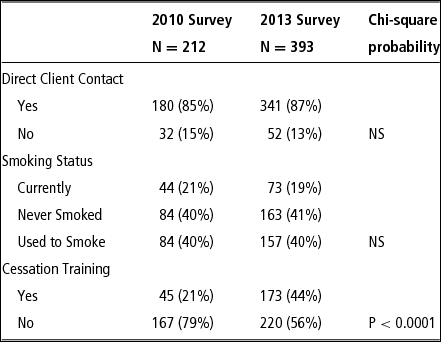
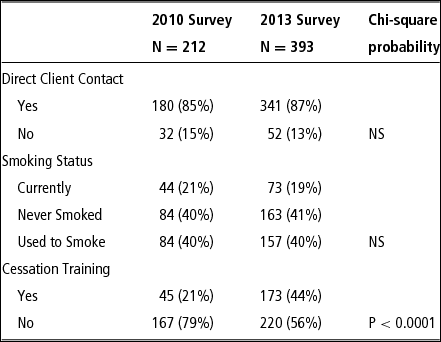
Significantly more staff participating in the 2013 survey had done cessation training (44% vs 21%, Table 1). Although there was still only less than half of the staff who have direct client contact who have had cessation training in 2013. The staff participating in the two different years did not differ significantly by smoking status or whether or not they had direct client contact.
Description of mental health and addictions service staff who responded to the surveys (N = 605)
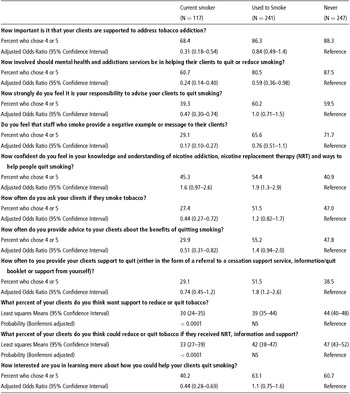
Smoking status was a significant influence on attitudes regarding smoking cessation support and practice (Table 2) after adjusting for timing of the survey, cessation training and client contact. Staff members who were current smokers were less likely to feel it was important or their responsibility to address tobacco addiction amongst clients (Table 2). This attitude was also reflected in their practice because staff members who were smokers were significantly less likely to report a higher frequency of asking about smoking, giving advice about benefits of stopping and providing cessation support. Staff members who formerly smoked were significantly more likely than never smokers to report feeling confident in their knowledge of addiction and how to help people quit smoking. Staff members who smoke were significantly less likely to think that they were a negative example for clients than staff who had never smoked, but staff members who formerly smoked were not significantly different from those who had never smoked. Currently smoking staff also gave significantly lower estimates of the proportion of service users (30% vs 44%) who they believe want support to quit smoking or could reduce or quit smoking (Table 2).
Attitudes and practice of staff to smoking and supporting service users by smoking status. The odds ratios are adjusted for client contact, year of survey and cessation training.

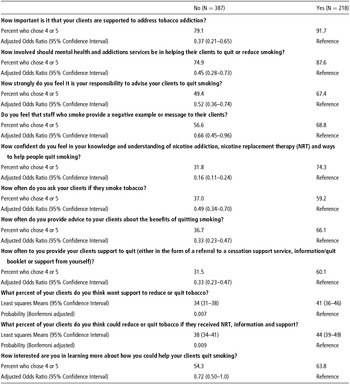
Cessation training was also significantly associated with attitudes and practice in smoking cessation (Table 3) after adjusting for smoking status, client contact and timing of the survey. Those staff members who had completed cessation training were more likely to report that it was their responsibility and very important to help their clients to quit smoking. They were also significantly more likely to report asking about smoking, giving advice about the benefits and providing cessation support often and routinely than those without cessation training. Staff without cessation training also gave lower estimates for the proportion of their clients who wanted support or could reduce or quit tobacco. However there was no significant difference between those with or without cessation training in interest in learning more about helping clients to quit smoking (Table 3).
Attitudes and practice of staff to smoking and supporting service users by cessation training. Odds ratios are adjusted for client contact, smoking status and timing of the survey.

The only outcome to be significantly influenced by timing of the survey was asking about smoking. Staff responding to the 2013 survey, after adjusting for smoking status, client contact and cessation training were significantly more likely to report a higher frequency of asking about smoking than those responding in 2010 (OR 2.7, 95% CI 1.1–7.2, p = 0.01).
A ‘stop smoking group’ and one-on-one guidance and support from a smoking cessation specialist were the two most popular smoking cessation supports. Twenty-two per cent of service users who were current smokers reported that they would like to be offered participation in a ‘Stop smoking group’. One quarter of service users who currently smoke reported that they would like to be offered one-on-one guidance.
There were four key open ended survey questions that staff participants could respond to. Responses are summarised and grouped by the most common themes.
Barriers to quitting or reducing tobacco
The most common barrier to quitting or reducing tobacco identified by staff was the way smoking tobacco was used as a coping strategy and even as a self-medication. Smoking was viewed as a crutch or comfort by many and the lack of alternative ways of coping with stress and anxiety was frequently discussed by staff.
Reliance on tobacco to calm or stabilize themselves - tobacco is often seen by clients to be a way that helps them to self-manage their mental illness.
Many staff respondents expressed concerns for service users of the consequences when trying to quit smoking: fear of isolation, change from ingrained habits, coping, withdrawal, losing a ‘friend’. In particular, respondents expressed a fear of exacerbating a service user's mental illness where tobacco was often seen as a medication that could help reduce stress and anxiety.
The extra stress of trying to quit smoking can have a negative impact on some clients whose mental health is unstable.
Participants felt that smoking plays a significant part in the culture of socialisation and relationship-building within mental health and addictions services. The strong social association of smoking increases the risk of smoking initiation or relapse. It also normalises smoking for those who access mental health and addictions services.
Their social life is built around smoking together.
These people often have fractured relationships and smoking provides them with an opportunity to connect with others in their community.
Boredom was another issue raised by many staff who felt this to be a barrier to quitting.
There's a lack of activities during the day so they smoke to kill time.
Many of our clients don't work and are not involved in many constructive activities during the day. Therefore the act of lighting up a cigarette helps alleviate boredom.
The lack of other things to do is also related to the perceived notions that smoking is one of the few pleasures available to those with mental illness or other addictions, and one of few things they have control over in their lives.
Smoking is the only thing that people with mental illness have complete control over in their lives.
It's also for many clients all they have in their life to look forward to.
Poor self-efficacy and lack of support from others were also issues raised by a number of staff as barriers to their clients quitting smoking.
Often with mental illness comes low self-esteem and just finding the courage within themselves to believe that they can make a change by quitting or reducing tobacco can be a barrier.
We all know how big of a deal stopping smoking is, so to even contemplate it takes energy. Energy which people may not have much of if they are not feeling positive about themselves, or not feeling good generally.
Unwillingness to love themselves enough to improve their life expectancy.
Addressing smoking was also perceived to be a low priority for some clients, who have other important issues to address and manage.
Other barriers less commonly discussed by the staff were: Service users being unwilling and unmotivated to quit, addicted, lacking in knowledge and having poor insight, societal perceptions including low expectations of others and historical norms in relation to smoking behaviours.
Change within an organisation that has influenced one's thinking about smoking
Participants discussed what has changed within their organisation that has influenced their thinking regarding smoking.
Smoke-free commitment at an organisational level (in particular smoke-free policy and premises), changes of an organisation's philosophy and practices as well as training were identified frequently as influential to respondent's thinking regarding smoking. Respondents discussed how an emphasis on healthy lifestyles was apparent as a new organisational focus. Awareness of smoking harms had become heightened within their organisations, and positive role-modelling was important if staff within an organisation were to promote smoke-free direction.
Building smoke-free cultures and having smoke-free properties.
That it has become an important part of our support to the people that we serve.
Others discussed how the provision of cessation support within their services has been a key factor.
It's valuable to be able to offer advice, scripts, etc. on the spot - more of an emphasis on becoming smoke-free rather than acceptance that clients will smoke and there is little we can do about it.
Another factor discussed by many was the new contractual requirements for NGOs. These were seen to be driven by the Government, Ministry of Health and District Health Boards and were evident in data collection and auditing.
Funder (contract) expectations have changed. This has meant we need to rethink how to balance these requirements with the need to ensure clients’ mental health recovery is the number one priority. We have needed to think through how to meet smoke-free contractual requirements whilst respecting and promoting autonomy of clients.
Suggestions of how clients and staff can be best supported to quit smoking tobacco
Respondents discussed the need to have a variety of treatment options available for staff and service users. There was a strong emphasis on group-based therapy options with a peer-led focus, as well as individualised one on one support. Many also supported free access to NRT.
People who want to quit should be given choices, not all people find NRT to be an effective aid to quitting, so alternatives to NRT should be investigated and offered.
Support was felt to be very important, with many describing how support should be non-judgemental, encouraging, patient and on-going.
Clients need to . . . not be pushed in my opinion it is a very sensitive subject and should be treated as such. If people feel pushed and bullied they will go the other way.
We will support and offer help to clients who indicate that they themselves want to give up smoking. I believe it needs to come from them or they won't own the process.
Organisational inputs such as education and training were suggestions, as were smoke-free environments.
Stronger smoking policy, make all services totally smoke free.
Creating an environment which actively promotes healthy lifestyles, where smoking is not singled out but as part of a movement towards health and well-being.
Distractions and alternative activities were suggested as ways to help people quit. This is consistent with one of the main barriers to quitting noted above as boredom.
Give clients more things to do, support with money to go to social hobbies and sports groups.
A number of respondents suggested incentives to help others quit. These incentives included competitions, outings, monetary and gym memberships.
Staff were generally very supportive of addressing smoking.
I am really happy that we are working on this more as it addresses issues of addiction, emotional management and poverty.
However, they also conveyed the views that it was the client's choice to smoke.
So many of our clients have nothing. . .leave them alone.
Whilst some staff felt that this was a reason to not intervene, others felt that their client's choice must be respected and successful quit attempts were to be made when they were ready, and they were there to provide support when that situation arose.
I believe it is impossible to quit smoking unless that person wants to and is ready to.
It is important that the quit smoking message is promoted as a health choice not a moral judgement.
Service User Survey
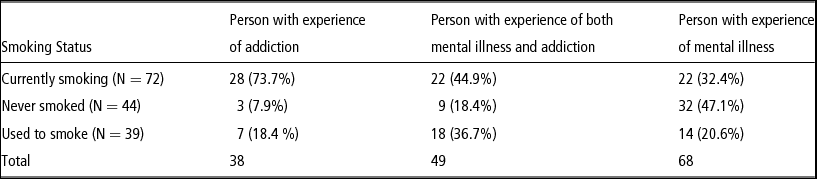
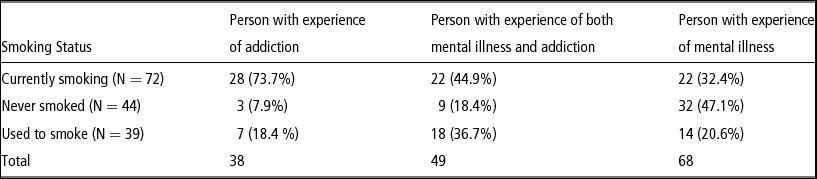
Smoking prevalence amongst mental health and addictions service users was very high and particularly high amongst those reporting personal experience with addiction (Table 4).
Smoking status and personal description of participants who were mental health and addictions service users in the survey (Total N = 155)
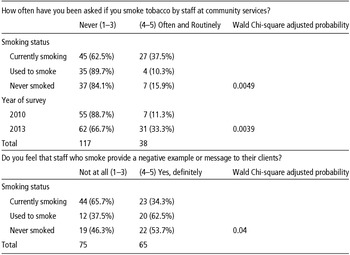
Only 37.5% of current smokers reported being asked about smoking often and routinely (Table 5). However there was a significant increase in the percentage of service users who reported being asked about smoking often and routinely in 2013 compared to 2010.
Attitudes and experience of service users related to smoking cessation

Former smokers were significantly more likely than current smokers to feel that staff who smoked were definitely a negative example for their clients.
Just under half of service users (41.5%) who had never smoked reported that the presence of smoking influenced their access to services a lot. Reasons ranged from immediate unpleasant effects such as the smell of smoke, and smoke aggravating a service user's cough, to concern about the temptation to smoke and the potential for any negative public impressions of service users to be exacerbated when they gathered to smoke in public places.
Participants who smoked were asked if they felt they had been encouraged and supported by staff of community services in making any attempts to quit smoking. Almost two thirds (61.2%) of users who smoked responded positively (with yes) to this question and there was no significant difference between 2010 and 2013. Just fewer than half the service users (41.8%) responded with yes to ‘Would you like support to reduce or quit tobacco?’ Another 28.4% were ambivalent (responding maybe / unsure). Two thirds (66%) of service users expressed regret about their smoking i.e. they said they would not smoke if they had their lives again.
Service users made suggestions about how both service users and staff can be best supported to quit smoking tobacco. They reported wanting positive encouragement delivered in non-judgemental ways.
Be a friend, non-judgmental yet prepared to provide an ear.
They were also supportive of workplace initiatives which will support people to be smoke-free, including smoke-free settings, no smoking with staff and policies demonstrating smoke-free commitment.
Be consistent about the smoke-free policy and ban all outdoor smoking shelters.
There are a significant number of people living in residential support accommodation who are heavily addicted and cannot afford the addiction. The common management is to give them one cigarette an hour. This is controlling and does not address the addiction. Yet this is the primary way that services support staff to cope with this issue.
Participants were invited to make comments about smoking in services, the presence of smoke or smokers influencing their access to services and any other comments.
Many respondents expressed dislike of smoking around services and for some, it aggravated their health conditions and influenced their access to services.
. . .non-smokers should not have to ‘endure’ walking through the smoke at building entrance nor see the butts lying everywhere
Smoking is serious - serious addiction but I don't see why non-smokers should suffer
Smoke-free role-modelling by staff was seen to be important.
I think it would be great role modelling if all staff at support services didn't smoke. My son is currently hospitalised for depression and OCD and he is tempted to start smoking again when others around him smoke.
Several respondents referred to the strong role the service environment plays in smoking initiation and behaviours.
. . .when I was hospitalised, the temptation to smoke in order to join the ‘in crowd’ was pervasive and it took discipline to withstand that temptation.
How many clients have gone into MH services as non-smokers, and come out as smokers?
Discussion
Mental health and addictions NGOs have an important role in supporting their clients and staff to become smoke-free. Whilst experience of mental illness is common, the majority of people with mental illness will not come into contact with inpatient services (Lawrence et al., Reference Lawrence, Lawn, Kisely, Bates, Mitrou and Zubrick2011). Mental health and addictions NGOs also often see clients over a longer time which facilitates ongoing support beneficial for sustained quitting (Hull et al., Reference Hull, Salmon, O’Brien, Chapman and Williams2012). The National Association of Mental Health Services Consumer Advisors (National Association of Mental Health Services Consumer Advisors, 2010) has recommended that ‘smoke-free begins in outpatient/community settings’ and ‘advance directives are made to cope with smoke-free as an inpatient’.
During the study period, changes to the tobacco control landscape included introduction of the Smoke-free Aotearoa 2025 goal (New Zealand Parliament, 2011), display bans in 2012 and four successive tobacco tax increases 25% in 2010 then 10% in 2011, 2012 and 2013. In this study, improvements in the provision of the ABC model for smoking cessation were seen between 2010 and 2013; however the change in the provision of the ‘C’ component (cessation support) was subtle. This is similar to observations within primary care settings where people are being asked their smoking status and offered advice, but the follow through on provision of cessation support (either by the person offering the ABC or referral to another agency) is often lacking (Brinson, Reference Brinson2009). This is an area where more attention needs to be paid for comprehensive support for smokers to come to fruition.
The changes in smoking-related practices of staff seen between 2010 and 2013 are likely to be attributable to the increase in numbers of staff who had had cessation training. Other factors identified were: sector and organisational alterations, implementation of a smoke-free contract clause, awareness raising exercises in addition to training, as well as broader societal transformations and health promotion initiatives. This study is evidence that the necessary transitions identified by (Glover et al., Reference Glover, Fraser, Bullen, Wallace-Bell, McRobbie and Hadwen2013) are occurring in the NGO mental health sector in northern New Zealand albeit slowly.
Responses to the service user survey indicate that about 70% would or may like support to quit, in addition to two thirds who would not smoke if they had their time again. This is consistent with other studies which show that 70–80% of smokers with mental health or addiction problems want to quit or reduce tobacco use (Gleason et al., Reference Gleason, Hobart, Jellison, Seward and Bradley2012). Staff, particularly those who smoke and those without cessation training, underestimated service user desire to quit. This mismatch is a barrier to transition to a smoke-free culture and needs to be addressed in the first instance by broader communication of the results of this service user survey, and secondly by increasing cessation and cessation training amongst mental health staff.
Positive role-modelling of ‘smoke-free’ was also discussed by service users as a factor in facilitating quitting. Smoking prevalence amongst staff respondents was 20.7% in 2010 and 18.5% in 2013. These figures are slightly higher than that of the general New Zealand population at both times points (Ministry of Health, 2012) despite these individuals working in the healthcare field. This finding is supported by 2006 census data of nurses which found that the highest smoking prevalence was amongst psychiatric nurses, and male and female psychiatric nurses had higher smoking prevalence than the overall male and female census population (Edwards et al., Reference Edwards, Bowler, Atkinson and Wilson2008). Smoking status of staff was strongly associated with attitudes and provision of cessation support. Again this highlights the need for provision of appropriate cessation support for staff in mental health services and ‘denormalisation’ of smoking (Chapman, Reference Chapman2008; Ziedonis et al., Reference Ziedonis, Wang, Li, Kim, Tonelli, Li and Kalman2012).
The most commonly noted barriers to quitting by staff and service users were: smoking as a coping strategy; fear of giving up; and smoking as a social activity. Strategies to overcome such barriers can be addressed during training. Furthermore, cessation training can provide an important opportunity for education around myths associated with smoking and mental health. For instance, that quitting smoking exacerbates mental illness and the relationship between smoking and stress relief. Barriers to smoking cessation impact negatively on levels of motivation and self-efficacy (Kerr et al., Reference Kerr, Woods, Knussen, Watson and Hunter2013), so it is important that barriers are recognised and addressed by organisations committing to a smoke-free direction
Boredom is commonly cited in the literature (Bryant et al., Reference Bryant, Bonevski, Paul, O’Brien and Oakes2011; Tsourtos et al., Reference Tsourtos, Ward and Muller2008) as a barrier to quitting and whilst not unique to mental health and addictions settings, boredom can be especially common within this sector due to the low employment rates (Duncan & Peterson, Reference Duncan and Peterson2007) and institutionalisation of many service users. Having strategies to reduce boredom is important to mental health and addictions NGOs irrespective of smoking, but this is especially vital to reduce the influence boredom has on smoking initiation and relapse.
Organisational Opportunities
Organisations play a large part in perpetuating several perceived barriers to quitting found by this research: socialisation, environmental triggers and boredom, and hence have the ability to break down these barriers (Bonevski et al., Reference Bonevski, Bowman, Richmond, Bryant, Wye, Stockings, Wilhelm, Butler, Indig and Wodak2011; Prochaska, Reference Prochaska2011; Ziedonis et al., Reference Ziedonis, Wang, Li, Kim, Tonelli, Li and Kalman2012) By encouraging or mandating smoke-free settings, staff and service users are discouraged from smoking. Smoking offsite is more onerous and less appealing than smoking onsite e.g. gathered around a table on the deck of a residential facility. The authors are aware that some organisations have attempted to reduce the socialisation aspect of smoking by asking their clients to smoke alone, or in pairs, to not talk while smoking and have removed comfort factors such as seats and rooves from gazebos. For non-smokers and previous smokers, having smoking less visible and reducing congregations of smokers may facilitate abstinence (Carter & Tiffany, Reference Carter and Tiffany1999; Conklin et al., Reference Conklin, Salkeld, Perkins and Robin2013; Hamilton et al., Reference Hamilton, Biener and Brennan2008).
Cessation training can help address negative staff perceptions and promote routine provision of support to quit which are vital to service users and staff quitting successfully. Organisations must consider making smoking cessation training mandatory for all staff with direct client contact and repeated regularly (e.g. on at least a two yearly basis) as part of staff induction and a regular training calendar (Kerr et al., Reference Kerr, Woods, Knussen, Watson and Hunter2013). Organisations can make their smoke-free stance clear during recruitment processes and offer intensive quit support to staff who smoke, including financial support for any cessation medication and allow time within work hours to attend related appointments.
Based on service user's feedback about cessation support options, we recommend having different types of cessation support available (i.e. group and one-to-one therapy), either provided in-house or through referral to other agencies, and where possible incorporating sharing of experiences for those quitting or who have quit.
Limitations
Our response rate for the staff survey is an organisational response rate and we do not have an estimate of the number of staff who were invited to participate in the survey or have an estimate of the numbers of staff who work for mental health and addiction NGOs in the Northland and Auckland region. The number of service users who participated in the service user survey is a very small proportion of service users and so limits the generalisability of the results.
In order to preserve confidentiality we did not collect identifying data and therefore a proportion of staff and service users will have participated in both 2010 and in 2013 surveys and we were unable to correct for these repeated measures.
Conclusions
Changes in smoking-related perceptions and practices have been seen between the surveys conducted in 2010 and 2013; however these changes have not been dramatic, which reinforces the importance of sustained input into smoke-free work with the mental health and addictions sector.
Cessation training and smoking status (being a current smoker) are key influences on mental health staff perceptions and practices. Training is pivotal to providing staff the confidence and skills to actively work with clients and to change some of the negative perceptions and myths about smoking which perpetuate throughout and mental health and other addictions services.
Acknowledgements
The preparation of this paper was undertaken as part of the New Zealand's Tobacco Control Research Tūranga: A programme of innovative research to halve smoking prevalence in Aotearoa/New Zealand within a decade. The Tūranga is supported through funding from the Reducing Tobacco-related Harm Research Partnership co-funded by the Health Research Council of New Zealand and the Ministry of Health of New Zealand (HRC grant 11/818).
We thank the Northern Regional Alliance and New Zealand Ministry of Health for the ongoing support of the project.
Financial Support
The primary author received a grant to support data analysis and writing up of the research from the New Zealand Tobacco Control Research Tūranga at the University of Auckland.
Conflicts of Interest
None
Ethical Standards
The authors assert that all procedures contributing to this work comply with the ethical standards of the relevant national and institutional committees on human experimentation and with the Helsinki Declaration of 1975, as revised in 2008.