INTRODUCTION
On 17 September 2007, the Congolese government and a group of Chinese state-owned enterprises signed a bilateral investment and trade agreement (Protocol 2007).Footnote 1 The Chinese committed themselves to constructing a number of roads, railways and hospitals. The value of these infrastructure works, which will be carried out by Chinese companies and financed by loans from the Chinese EXIM bank, is estimated at $6·5 billion. To guarantee reimbursement of these loans, a Congolese/Chinese joint venture with Chinese majority participation will be created to extract and sell Congolese copper, cobalt and gold. Second, the Chinese EXIM Bank is providing a $2 billion loan for the modernisation of the Congolese mining infrastructure (Airult Reference Airult2007).
These agreements are the biggest that China has yet signed in Africa. Their specificity lies both in their scope and in the particular context of the Democratic Republic of Congo, a post-conflict country facing enormous reconstruction challenges. Although the general characteristics, challenges and opportunities of China's engagement in sub-Saharan Africa have already been widely discussed, in-depth case studies of specific agreements are lacking. In this article, we analyse and discuss the recent Sino-Congolese agreements which, in Congo and elsewhere, are provoking intense and contradictory feedback. We will briefly outline these debates in the next section.
Some authors argue that China is behaving like a new ‘imperial’ power, while others believe that China's involvement will assist African states in achieving their development objectives.Footnote 2 We seek to contribute to this discussion by presenting a nuanced and concrete analysis of the Sino-Congolese agreements. The main purpose of this article is to assess the agreements' impact on the development of the country and on its population: is this an equal exchange creating a win-win situation, as its proponents argue, or is it an unequal exchange that reproduces ‘imperialism’ in a specific and different manner? We look briefly at China's recent economic growth and the evolution of its foreign policies, before going on to a detailed analysis of the agreement and its impact on internal development. Finally, the conclusion provides an answer to our main research question.
HEATED DEBATES
Although Power and Mohan (Reference Mohan and Power2008: 35) say that there is very little debate in Africa about the efficacy and impact of China's Africa policy, in Congo at least there is indeed such an internal debate, both in the media and on the political scene. Euphoric reactions come often from the government side.Footnote 3 The lead article in the popular magazine L'Avenir (2007), a government mouthpiece, is clear on this issue:
… for a long time, they [the Congolese] have been oppressed by Western governments and multinationals. … The time has come to break with the traditions and to stand firm against the IMF and the World Bank, because our country has not seen the end of the tunnel yet. On the contrary, the social inequality gap in the DRC is only widening. The great pressure put on the Congolese decision makers by Western actors is a mere consequence of selfishness and bad faith … However, the win-win agreement between the DRC and China is … an example of cooperation … without any hidden agenda of exploitation.
Its proponents put forward three arguments. First, most comments are based on a feeling of frustration about the performance of Western donors and multilateral institutions. These authors feel that Western donors have not lived up to their promises, and welcome the Chinese aid as a new and entirely different partnership: ‘China is finally providing us with the things Europe has always refused to give us’, as one commentator says (Le Potentiel 2007a). The strong Western reactions are even qualified as manifestations of bad will or ‘neo-colonialism’, and civil society opponents are blamed for their anti-patriotic spirit: ‘The masks have fallen off’ (Le Potentiel 2007b; see also Digitalcongo 2007, Kä Mana Reference Kä2008). These commentators deny that the loans would increase the national debt, as for example the IMF argues.Footnote 4 Several commentators use the term ‘Marshall plan’, referring to the comprehensive aid and investment package.Footnote 5 The second argument is rather pragmatic. It says that the Congolese government urgently needs the money for reconstruction, so ‘President Kabila was forced to enlarge the circle of traditional partners’ (Digitalcongo 2007, see also L'Avenir 2008). They had no choice but to accept the Chinese offer. Besides: ‘If you are drowning, you don't look at the hand that is reached towards you, you just grab it’ (Le Potentiel 2007a). Third, some authors build up a balanced argument, for example Tshilombo Wa Nshimba (Reference Tshilombo Wa Nshimba2007), who makes a plea in favour of the barter principle included in the agreement.
Many Congolese have mixed feelings: they seem to welcome the contract, but still express some doubts as to whether the Congolese population will really profit this time (Alterinfo 2008). One commentator wonders whether the Congolese are really aware of the fact that this is a loan, not a grant (Kabwe Reference Kabwe2007). Tshikwenda (Reference Tshikwenda2008) for example acknowledges the opportunities (infrastructure works) that the agreement provides, but has doubts about the feasibility studies, interest rates and tax exemption.Footnote 6 These are aspects that we will discuss later.
Both Congolese and Western actors have pressured the Congolese government to make the contracts public.Footnote 7 In May 2008, the government finally presented them to the National Assembly, provoking a heated discussion. Several opposition members criticised the agreements and asked for a renegotiation (Le Potentiel 2008a, 2008b). The 150 parliamentarians of the Mouvement pour la Libération du Congo (MLC), the main opposition party, even rose from their seats and walked out of the Assembly in protest (Edinger & Jansson Reference Edinger and Jansson2008). R. Kabamba (Reference Kabamba2008), who is critical of the government, comments that ‘the truth has been difficult to hide: the Chinese will benefit most’. According to him, Kabila's only goal is to realise his electoral promises so as to stay in power. The population will have to deal with the consequences of the ‘waste’ (bradage) later. Professor Kirongozi (Reference Kirongozi2008) also argues that the agreement is highly beneficial to the Chinese. Similarly, the juridical analysis by Me Okitonembo (Reference Okitonembo Westhongunda2008) leads to the conclusion that this is an unequal contract (un pacte léonin), which protects only Chinese interests. The author mainly criticises the multiple clauses in favour of the Chinese parties. Mbelu (Reference Mbelu2007) argues that Congo is going to be exploited by the Chinese just as it was during colonisation, that the debt will be a burden for many generations to come, and that the current government is only interested in making quick money. On the other hand, several government officials, such as Pierre Lumbi, Evariste Boshab and Jean-Marie Kamoni Mokota Lissa (2008), have made statements in favour of the agreements, as presenting a ‘new economic model’ and ‘well adapted to the realities of our country’ (Le Potentiel 2008a). They insist that the ‘traditional partners’ will not be pushed out.
Still, the Western opponents have two major concerns: one political and one economic. From an economic point of view, international institutions have warned the DRC that a heavier debt burden can again hamper the reconstruction process and increase ‘the risk of disturbing the macro-economic framework’.Footnote 8 In blunter terms, this expresses the fear of increased corruption and its consequences. Indeed, the Chinese negotiators do not require any ‘good governance’ guarantees. Their cooperation policy, with ‘no strings attached’, opposes the ‘good governance’ policy of the international donor community which attaches considerable conditions to development aid.Footnote 9 This pressure has been effective, to a degree, as long as the African states were dependent on (conditional) international aid. Yet resistance by some within Africa has labelled such conditionalities as hypocritical. African governments and intellectuals have rightly argued that the Western states were neither overly worried about human rights during the era of colonisation, nor all that devoted to democracy during the Cold War. A second concern, expressed in particular in NGOs and academic circles, is that unconditional aid might encourage repressive governments to sustain a policy of corruption and human rights violations (see for example Davies Reference Davies2007; Holslag et al. Reference Holslag, Geeraerts, Gorus and Smis2007; Lancaster Reference Lancaster2007; Taylor Reference Taylor2007).
Investors, of course, have different concerns. At the moment, Western business interests are being threatened by the Sino-Congolese agreements. The following remark by Georges Forrest, a Belgian-Congolese businessman with important mining interests in Katanga,Footnote 10 reveals the geopolitical challenges of China's entry into Africa:
We are the largest foreign investor and the most important private employer in Congo … If we let them [the Chinese] go ahead, they are going to shut us out of Africa. The West talks about good governance and attaches some impossible conditions to its development aid. The Chinese niggle less and they are taking the best parts. (Le Monde 27.3.2008)
China has become a formidable opponent and makes continuous efforts to promote its economic interests. This novel role for China and the West's reaction to it, combined with a growing scarcity of natural resources, may portend an era of new international rivalries and scramble for mineral resources. In this article, we will not go into detail on this point. Let us first of all briefly consider some aspects of China's skyrocketing economic growth and its attendant foreign policy.
CHINA'S ECONOMIC GROWTH AND FOREIGN POLICY
Whereas China's official foreign policies have changed little since the 1955 conference of non-aligned countries in Bandung,Footnote 11 its economic policies have altered completely. Since the opening up of the economy during the eighties, China has been inviting foreign companies to come in and operate on a joint-venture basis, and its economy has been booming. To support this economic growth China will, in any case, need huge quantities of raw materials, which it lacks internally. As Africa still has large unexploited reserves, it is likely to become more and more important to China (and others). Furthermore, most African countries presently lack the physical and human capacity to exploit their own assets, and acutely need to reconstruct ageing infrastructures and weak economies. As Western companies are still reluctant to invest in unstable states, ample opportunities for Chinese economic/commercial involvement arise. On the one hand, China needs natural resources and is offering finance, low-cost skilled labour, technology and cheap consumer goods. On the other, Africa, while possessing, for now, abundant natural resources, needs large-scale infrastructure investments. Thus, a win-win scenario seems inevitable. At the moment, China's growing demand for commodity imports has already had a considerable impact on some African economies, like Angola (see CCS 2007; Tull Reference Tull2006).
On several occasions, China's intensified involvement has been labelled as ‘yellow imperialism’ (Croll et al. Reference Croll, Lebzien and Paes2008), a claim which will be discussed here. At first sight, China's African foreign policy appears nothing like one of territorial conquest and political domination. On the contrary, the country sees itself as a partisan of the world's oppressed and exploited (‘South–South cooperation’).Footnote 12 The principles of respect for national sovereignty and non-interference have remained unchanged since Zhou Enlai invoked them at the Bandung conference (see Davies Reference Davies2007: 37). The same is true for China's international cooperation guidelines, where eight principles were promoted, among others ‘equality and mutual benefit’, which can today be translated as ‘a win-win situation’. Since the end of the Cold War and the changes in its economic policies, China has moved away from a ‘global revolution’ stance towards one increasingly of global capitalism. While some tenets have remained, new realities have changed many old practices. This is true for China's foreign policies regarding Africa (see Alden & Alves Reference Alden and Alves2008; Power & Mohan Reference Mohan and Power2008).
In 2006, a new African policy was adopted (PRC 2006) and the Third Ministerial Conference of the Forum on China–Africa Cooperation (FOCAC) was organised in Beijing. The Chinese proclaimed ‘the establishment of a new type of strategic partnership between China and Africa featuring political equality and mutual trust, economic win-win cooperation and cultural exchanges’ (Davies Reference Davies2007: 24; see also Power & Mohan Reference Mohan and Power2008: 32). In the light of China's growing economic importance, the win-win style of cooperation will definitely come to the fore. As already noted, the international donor community severely criticises this policy, and blames China for undermining its efforts to promote good governance. China is not deaf or blind to these concerns. The Chinese counter such criticisms by emphasising that they never give cash and only support specific projects. During a discussion in the European Parliament, one Chinese diplomat remarked: ‘We don't give budget aid, but money and aid always come in concrete projects. Thus, China avoids budgetary slippages.’Footnote 13
To sum up, Chinese foreign aid policy is guided by principles that remain more or less unchanged and that, at first sight, have nothing to do with the dominating character of colonial and post-colonial relations. However, in the context of China's booming economy, there is an urgent need for commodities and for markets for cheap consumer goods. This is likely to further influence the Sino-African relationship. The new emphasis is on mutual benefits and practical results (see Alden & Alves Reference Alden and Alves2008: 52). Thus, a fundamental question arises: is Congo facing a subtle form of Chinese ‘imperialism’ without domination, or is this a cooperation between two equal partners, and hence a new opportunity for Congo? To better answer these questions, we will first describe the evolution of Sino-Congolese relations. We will then discuss them in detail.
THE SINO-CONGOLESE AGREEMENTS
A Protocol of Agreement (hereafter Protocol) was signed on 17 September 2007 between the Congolese Minister of Infrastructure and Public Works, Pierre Lumbi, and the chief representative of a group of Chinese public enterprises, Li Chiangjin. In financial terms, it is the biggest agreement between China and an African state so far. However, the seven-page document contains only twelve articles. In May 2008, a second document was made public: a Cooperation Agreement (hereafter Convention) between the DRC and a group of Chinese enterprises. Before going into the details of these specific documents, we discuss the recent evolution of Sino-Congolese trade. After that, we analyse the agreements in detail and evaluate their impact on the development of the DRC, a country severely weakened by long-term economic underdevelopment and decline and, more recently, armed conflict.
The evolution of Sino-Congolese trade
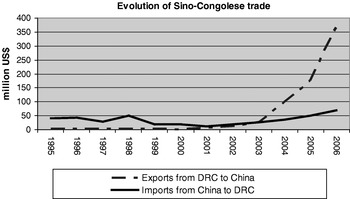
A glance at the trade figures reveals that Chinese economic involvement in Africa has changed significantly over time. Between 1996 and 2005, China's share in Africa's trade surged from 0·8% to 9%, with a trade volume of $32·1 billion in 2005 (Holslag et al. Reference Holslag, Geeraerts, Gorus and Smis2007: 25). In 2006, the trade volume rose to $55 billion (Davies Reference Davies2007: 25). The increase is due mainly to the rise in natural resource exports. In bilateral trade, Angola and Sudan, for example, have a trade surplus with China: raw materials are exported without any value added, and cheap Chinese manufactured products are imported. Figure 1 on the trade between China and Congo shows the same pattern.
Evolution of Sino-Congolese trade.
Source: based on figures provided by Trade Law Centre for Southern Africa, www.tralac.org.

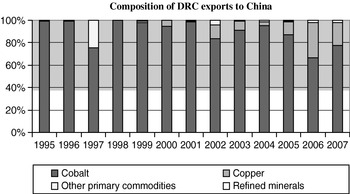
In less than a decade, the importance of bilateral Sino-Congolese trade has increased dramatically. In 1995, it represented only $1·5 million, compared with $368 million ten years later. This makes China the prime importer of Congolese exports. Up to the nineties, Congo had a mere symbolic value for China. The latter tried to maintain friendly relationships with the Mobutu regime by constructing large and prestigious infrastructure projects that no other donor wanted to undertake, such as the ‘People's Palace’ and the Kinshasa football stadium. This ostensibly superficial Chinese investment interest changed, however, into active and concrete involvement. From 1997 on, several engagements for actual and future cooperation agreements have been concluded with Laurent Kabila and his son Joseph Kabila (after 2001).Footnote 14 At present, Chinese companies are particularly active in Katanga. The newly signed Sino-Congolese agreements, however, are different in scope and are guiding the DRC into a more organised, formally structured, industrially and commercially sound exploitation of its natural resources. This is articulated in the comprehensive modernisation of the mining infrastructure and a rehabilitation of the transport routes used for the export of natural resources. From the figure below, it is clear in which products China has an interest. Copper and cobalt represent 98·6% of the total exports to China. With an export value of $151 million in 2005, Congo became China's largest single supplier of cobalt (Holslag et al. Reference Holslag, Geeraerts, Gorus and Smis2007: 28). From the point of view of non-ferrous metallurgic companies, mineral ores are commercially most interesting because the more complex refinery processes permit them to realise substantial value added.
At first sight, the increase in exports, as shown in Figure 2, is beneficial to Congo since it increases its reserves of foreign exchange. Besides, cheap Chinese imports are well suited to the modest incomes of the Congolese population. And as there is no production of manufactured goods within the DRC, Chinese imports do not constitute a competitive threat as they might in other countries.Footnote 15 Nevertheless, this positive effect only holds when Congo receives a price equal or superior to the world market price for its exports. In the opposite case, when the Chinese buy at prices below world market levels, the benefits for Congo fade away. This is exactly the risk when a weak country is negotiating with a strong commercial partner. However, in order to draw any conclusions about this particular point, we have to analyse the agreement in detail.
Composition of DRC exports to China.
Source: based on figures provided by Trade Law Centre for Southern Africa, www.tralac.org

The characteristics of the Sino-Congolese trade agreement
The 2007 Protocol states that China, through the EXIM bank, will grant the DRC a $6·5 billion concessional loan to finance infrastructure works (e.g. new roads, railways and education and health facilities).Footnote 16 Chinese companies will build and/or rehabilitate 3,500 km of tarred roads and 3,200 km of railways. What is more, 32 hospitals, 145 health centres, 2 universities and 5,000 houses will be constructed. Since Chinese companies are known to deliver facilities of reasonable quality on time, the Congolese government has been very eager to proceed. Just after winning the elections, President Joseph Kabila presented his cinq chantiers (five work sites) as the central pillars of his development policy.Footnote 17 The Chinese loans may help his government meet some of the ambitious goals he has set (and on which he will inevitably be judged).Footnote 18 We will come back to this later. One must understand that the agreement represents a loan, not a grant. It must be reimbursed with guaranteed access to natural resources. To this effect, a joint venture will be put in place and the Congolese state will grant the necessary concessions. The first annex to the agreement stipulates the minimum quantities of reserves to be found in those concessions: 8,050,661 metric tons of copper, 202,290 metric tons of cobalt and 372 metric tons of gold. The 2008 Convention specifies the way in which the joint venture between Gécamines and the group of Chinese enterprises will function. This joint venture (in which the Chinese parties hold 68%) gets a guaranteed access to certain reserves of at least 6,813,370 tonnes of copper and 426,619 tonnes of cobalt, and to probable and possible reserves of respectively 3,802,700 and 200,000 tonnes (Annex A). In turn, the presence of these reserves is a condition sine qua non for the execution of the infrastructure works.
This ‘agreement of the century’ is very interesting in several ways. The first noteworthy characteristic is that it encompasses and determines all economic relations between two countries in one text.Footnote 19 It covers commercial relations and investments, development cooperation and financing for a period of about thirty years.
A second feature is the barter principle, which certain Congolese authors have described as a new form of honest cooperation (Tshilombo Reference Tshilombo Wa Nshimba2007). In reality, however, it is nothing more than a way to guarantee reimbursement of the costs incurred during the execution of infrastructure works. In principle, this should not be a disadvantageous arrangement, provided the reimbursements are valued at the world price. Yet with respect to the calculation of the counter value, both documents contain some confusing elements.Footnote 20 The disadvantage of the barter system is its opacity when it comes to exchange. It is practically impossible to know who is winning and who is losing: how can one compare the value of hospitals and roads with copper and cobalt, if not through the price vector?
A third peculiarity of the agreement is the ‘win-win’ principle, so precious to Chinese foreign trade policy. At first sight, the Chinese obtain what they need and the Congolese have their reconstruction works financed and constructed by the Chinese. Nothing seems simpler and more equitable. Whereas Western donors often have hidden agendas and demanding conditions to meet, this agreement is at least unambiguous. The reciprocity is explicit, and there appears to be considerable generosity on the side of the Chinese, as they are willing and prepared to invest a huge amount of money in social, transport and mining infrastructure. Indeed, the Congolese mining infrastructure needs large-scale investments in order to establish economic production capacities, although the amount has not yet been quantified. In any case, the outlays have to be repaid during the first phase of the reimbursement schedule. This brings us to the fourth characteristic of the agreement: the structure of Chinese investments.
The Chinese plan to organise mineral extraction in the DRC in the same way that they organise foreign investments in China, through joint ventures in which China holds a majority interest. The Chinese will have two thirds of voting power in the joint venture board, while the Congolese government will have one third. This is an important point, for it determines the terms of reimbursement, a fifth particularity.
Article 5 of the Protocol and Article 12 of the Convention stipulate that there are three phases for the use of mining profits. During the first phase, ‘the totality of the exploitation results will cover the reimbursement and the repayment of the investments in industrial mining infrastructure, interest included’ (Protocol, Article 5). Thirty percent of the investments in mining infrastructure come in the form of an interest-free shareholder loan. The remaining 70% has to be reimbursed at annual interest of 6·1%. (Convention, Article 12). After total reimbursement of all mining infrastructure, the second stage can be launched. During this phase, reimbursement of the first stage of infrastructure works takes place. Two thirds of the profit will be used for reimbursing the investments at an annual interest rate of LIBOR+100 Basis Points.Footnote 21 In fact, the debt will be settled when the joint venture has produced a certain quantity of raw materials, valued at $3 billion. The remaining 34% of the profit will be ‘proportionally distributed among the parties’. During the third phase, which extends beyond the anticipated production period, production will be partitioned between the partners of the joint venture (two thirds for China, one third for Congo). This is the stage of ‘commercial exploitation’. It includes a second wave of infrastructure works: lower-priority infrastructure works will be executed, ‘in function of the profitability of the mining project’ (Convention, Article 9). These investments (plus interest) will be reimbursed with the taxes paid during the ‘commercial stage’. In brief, the third phase is said to be purely commercial, because it starts after all investments have been repaid. Still, including it is absolutely necessary in order to evaluate the (un)equal character of the deal for two reasons: (1) taxes will still be used for repayment; and (2) guarantees still apply. Remarkably, no time frames are given for the distinct agreement phases. In principle, the joint venture can continue exploitation until depletion of the concession. When calculating the duration on the basis of the envisaged production of copper (200,000 tonnes per year during the first and second year, 400,000 tonnes per year afterwards) and the reserves, the exploitation would continue for twenty-eight years (Convention, Article 7.1).
This brings us to the sixth aspect of the agreement: its extensive duration and the absence of coordination costs. In contrast to Western companies which often have a short planning/operating horizon governed by quick profits and maximised stock values, Chinese companies operate with far longer time horizons and are backed by the state. Moreover, these (entirely or partially) state-owned companies are supposed to serve strategic Chinese objectives, such as guaranteeing long-term access to raw materials. In this way, they are encouraged to take long-term decisions and assume more risks (unlike their Western counterparts), such as investing in fragile states. Nevertheless, they have been trying to limit investment risks by insisting on certain guarantees. This is a seventh characteristic, which is evident in the Convention.
The latter contains multiple clauses in favour of the Chinese. Remarkably, guarantees are given by the Congolese state, while the investments are made by private companies. Thus, Article 13 of the Convention states: ‘if the investments and interest cannot be reimbursed in the 25 years following the creation of the joint venture, the DRC will reimburse the remaining amount in another way’, and if the internal rate of return for the group of Chinese enterprises appears to be below 19%, the DRC will take ‘all measures necessary to improve this’. More importantly, new mining concessions will be allocated to the joint ventures if the current ones are not sufficient to yield the necessary profit to repay debt, and if the feasibility study indicates that the reserves are lower than mentioned in Annex A of the Convention.Footnote 22 Once again, this means that there is a guaranteed access to a minimum quantity of minerals, and that, in turn, this guarantee is a precondition for the infrastructure works to be carried out. Besides, Article 13 (Convention) contains a list of ‘guarantees with respect to concessions and mining titles’, whereas Article 15 sums up the ‘guarantees against political risks’. A juridical analysis (Okitonembo Reference Okitonembo Westhongunda2008) reveals that all suspensive (e.g. feasibility study that guarantees a certain profit level as a precondition to put the agreement into practice) and resolutive conditions (e.g. if the Congolese Parliament doesn't approve a specific fiscal regime for the joint venture within ten months, this is a sufficient reason to dissolve the agreement) are in favour of the Chinese parties. Yet, the clauses applying to the Congolese party cannot be influenced by the action of one of the parties, but are dependent on mere coincidence (conditions casuelles, e.g. financing of infrastructure works will depend on the mining exploitation results, which cannot be calculated beforehand).
Finally, we wish to highlight the extremely liberal fiscal and customs exemptions (or waivers) in the agreement. Article 6 of the Protocol and article 14 of the Convention specify that the joint venture companies will be exempted from all possible taxes during the first and the second stages,Footnote 23 and that taxes collected during the third ‘commercial’ phase will not revert to the Congolese government but to the joint venture (of which the Chinese control two thirds), in order to cover the costs incurred during the second phase of social infrastructure works and the interest (Convention, Article 12). Looking at these stipulations, one wonders where the government income will come from. At the peak of its production capacity (1970–4), Gécamines produced 400,000 to 500,000 tonnes of copper per year. This resulted in $1 billion of public revenues for the Congolese state (representing half of the government's budget at the time, and about 60% of the current budget). As appears from the agreements under discussion, the Congolese state will hardly receive any revenues from the joint venture. Indeed, some agreements with Western mining companies have been criticised because they include an exemption from a whole range of taxes, but those exemptions were never as extensive as they are in this agreement (RDC 2007). This brings us to the evaluation of the agreement's impact.
The impact of the agreement on internal development
According to Kaplinsky et al. (Reference Kaplinsky, McCormick and Morris2007: 2–4), China's impact on sub-Saharan Africa can be gauged in relation to three primary (and interrelated) vectors: (1) trade flows; (2) FDI (Foreign Direct Investment) flows, technology transfer and integration into global value chains; and (3) aid flows. The fact that these flows are interdependent should be especially emphasised in the context of the Sino-Congolese Protocol, since it includes all three vectors in a seven-page document. In each of them, it is possible for Sino-African relations to be either complementary or competitive, complementary being mainly positive and competitive mainly negative. We analyse the impact of the agreement on Congo's future development using this model. Kaplinsky et al. (Reference Kaplinsky, Wild and Mepham2006) have also argued that ‘it is important to understand that China's impact on SSA cannot be seen as purely an economic phenomenon’. One should also focus on wider issues of aid, politics and development. Therefore, we will not only adopt an economic perspective, but also pay attention to issues of political agency and development. Clearly, it is important to take into consideration the Congolese context. After the 2006 elections, the ‘reconstruction process’ was officially launched, while armed conflict is still rampant in the east, and political tensions between government and opposition are palpable.
Trade flows
First of all, we look at the impact of the trade relations established by the agreement. China's reinforced involvement will indisputably have a positive impact on African economies in the short run. The expanding demand and active quest for natural resources will inevitably provoke a rise in world prices. Since natural resources will grow scarcer, rivalries will intensify and prices are unlikely to drop. The current stagnation of growth figures, especially in the West, may temporarily stem the boom in world prices, but the upward trend will probably remain strong in the long run. The Chinese demand for raw commodities already has a positive and direct effect on the growth rates of several African commodities-exporting countries, including Congo. Negative competitive effects are also absent on the import side, as Congo produces no industrial consumer goods. Moreover, Chinese imports are well adapted to the incomes of the bulk of the Congolese population, which is a positive effect as well. Yet, at this point, we may question the way in which China tries to withdraw from international competition and assure itself guaranteed and beneficial access to natural resources. The specific features of the agreement – the suspensive and resolutive conditions, the barter principle that obscures the real price of the commodities, its long duration, the exemptions from taxes, etc. – reveal the true aims of obtaining the lowest commodity prices and subduing a relatively weak partner state. One could argue that some old Western mistakes are being repeated. In contrast to the Chinese discourse, the terms of the Convention thus make clear that China's aim is not to grant concessional loans or aid.
Assessing the exchange: who benefits?
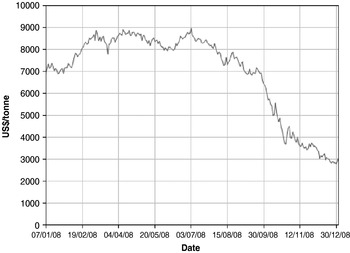
Let us consider the specificities of the exchange in more detail. First of all, the production targets have been set at 400,000 metric tonnes of copper per year from the third year on (Convention, Article 7.1). Gécamines, at the peak of its production, produced and exported a maximum of 500,000 metric tons annually (see Kennes Reference Kennes, Marysse and Reyntjens2005). So, the quantity stipulated in the agreement represents more than twenty years of peak production, thereby exhausting most of Congo's copper and cobalt reserves. At the world market price when the deal was concluded ($7,000/metric ton), the quantity of copper that Congo is supposed to deliver is valued at $56 billion. Next, 372 metric tons of gold will be exported, which, at the gold price at the moment of the deal, is worth $8·9 billion. With respect to cobalt, the 202,000 metric tons are worth $18·3 billion, even if we take the London Metal Exchange price for the lowest content of cobalt.Footnote 24 One might object that these prices, valued at the time when the parties struck the deal, are overestimates in view of the current international financial crisis. Indeed, as a consequence of the current crisis, international commodity prices have fallen dramatically, and are now at the lowest in the last sixty years. Figure 3 compares copper prices at the beginning and the end of 2008.
Copper price, US$/tonne, January–December 2008.
Source: http://www.metalprices.com/FreeSite/metals/cu/cu.asp.

The international financial crisis has already severely hit the Congolese economy, especially in Katanga. The price of copper on the world market dropped by 50%, from $8,770 to $4,350, in the first week of November 2008. In an ensuing meeting with Katumbi, the governor of Katanga, the mining enterprises announced a reduction of their personnel (Katanga Online 2008). Indeed, in December 2008, an estimated 300,000 people had lost their jobs in the mining sector (Katanga Infos 2008a). Forty-four small mining companies have halted their activities (Mediacongo 2008; Les Afriques 2008). Among them are many small Chinese companies (Katanga Infos 2008a).
Whereas prices of copper have fallen during the recent crisis by more than half, gold has maintained its value, while cobalt first fell to a third of its value at the end of 2008, but recovered in January 2009 to its pre-crisis level. However, in order to show a lower and an upper limit to the guaranteed total value of production, and thus get a rough comparative indicator of the equity or ‘win-win’ component of the contracts, we will use the cobalt price at the lowest value in 2008. In Table 1, we thus use two sets of prices representing respectively prices at the moment of the conclusion of the contracts and those after the international economic crisis has set in (December 2008). These two total values representing the guaranteed volumes of production of mineral commodities function as an upper and lower limit.
Monetary valuation of minerals specified in PRC/DRC agreements

Source: Annex 1 of the agreement and http://www.metalprices.com/FreeSite/metals/cu/cu.asp.
Some technical remarks are appropriate at this point. First, at a superficial level, even taking into account the lower limit of prices caused by the international economic crisis, the guaranteed amount of minerals sold on the international market will generate a revenue (or secure supply of minerals for the booming Chinese economy) that more than compensates the $6·5 billion granted as loans.
Second, these calculations are based on present-day prices, so future prices have to be discounted, which would lower the calculated price. On the other hand, the prices of these minerals will probably continue to rise, as these are non-renewable resources and total world reserves in copper and cobalt will be depleted within the next thirty to fifty years depending on the rate of growth in the world economy, thus leading to fundamentally rising prices as reserves depletion gets nearer. This would by far outweigh any mistake made by not calculating the net present value of these quantities of minerals.
Third, on a more fundamental level, can we compare what the Chinese are granting to the DRC ($6·5 billion) and what they get as privileged access to mineral resources (between $39·7 and 83·6 billion)? Indeed the joint venture, led by the Chinese majority shareholder, needs to invest first in the infrastructure, and organise and engage costs for the realisation of the annual production. So in order to be able to evaluate the (in)equity of the contracts, one should compare the surplus realised by that production over and above the cost of production. At first sight, this is a tricky estimate. However, if in line with political economy insights we agree that surplus can be defined as taxes and profits realised by producing goods and services, we have a pretty good historical idea of what this would represent even at levels of prices far lower than those used above. As we have noted, in the heyday of production of Gécamines, over $1 billion a year was generated in taxes paid to the government, thereby securing up to half of the Zairian government budget (see Bézy et al. Reference Bézy, Peemans and Wautelet1984). Since virtually no taxes are paid to the Congolese government during the ‘commercial stage’, the Congolese forego at least, and this is the lowest possible estimate, some $20 billion as missed government income. The profits generated during the third phase will be proportionally distributed between the Congolese (38%) and Chinese (62%) parties. In sum, the whole deal remains an unequal exchange and seems to suggest that the Congolese have been the weaker bargaining party in these contracts, widely heralded as a ‘win-win’ operation.
The Congolese rationale: serving whose interests?
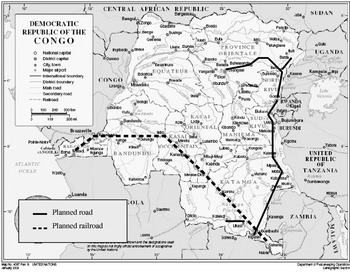
All this raises an important question: what are the motivations of the Congolese government? After all, a simple cost-benefit analysis reveals that, in the long run, the Congolese government will miss out on a lot of revenues (taxes) and the mineral reserves will be exhausted. A plausible explanation would be that the current political elite is not concerned about those long-term effects, but prefers short-term success. Moreover, pressures from within the country may be an important motivation, especially after the intensification of violence in the East. We have already mentioned the five work sites as the central pillars of Kabila's policy. Recently, the president has come under pressure to realise at least some of those electoral promises. By concluding these comprehensive contracts with the Chinese, he can claim to be living up to his promises and actually show some results now that he is already half-way through his term of office. Besides, on several occasions, Joseph Kabila has proved to be very clever in playing off different actors against each other, and protecting his own interests against Western donors.Footnote 25 Thus, the agreement may be considered as a strong signal towards the ‘traditional’ donor community, which has been blamed for not putting its promises into practice. In fact, the question could be raised whether Kabila really had an alternative. While the West has, to some extent, helped to end or control regional conflicts afflicting the DRC and the region by providing (or financing) UN peacekeeping troops, and funding peace talks and elections, it has done little so far to begin a nation-wide reconstruction effort. Bilateral relations with Belgium, for example, have been severely damaged by a discussion on good governance, corruption and sovereignty (see Bavier Reference Bavier2008). Congo has not yet reached the ‘achievement point’ determined by the IFIs, due to bad governance and allegations of rampant corruption. Only IFIs can decide on debt alleviation and call on donors to start investing in the country. The Chinese have taken advantage of this reluctance and consummated a comprehensive ‘aid package’ to finance and execute a very important and visible part of reconstruction. At least this time, the vows are being put into practice with an exceptional speed and firmness. The second annex to the Protocol includes the list of planned infrastructure works: 3 railways, 13 connecting roads and the road system in Kinshasa and in some other towns, 1 hospital in every province, and 1 health centre in every district,Footnote 26 2 universities and 5,000 housing units. The total cost of these investments is estimated at $6·5 billion. Figure 4 gives a rough indication of where the roads and railroads will be built. It is clear that the principal aim is to connect crucial mining areas to other economically important places such as the port of Matadi on the Atlantic Ocean, and further to the Indian Ocean. This is perfectly in line with Chinese economic interests. The eastern part of the country, where the president still has severe problems of territorial control, will be well connected. To sum up, there may be both economic and political strategic reasons behind the current geographical distribution of the infrastructure works.
Planned Chinese infrastructure works.

Investments in infrastructure and aid flows
Let us now systematically consider the impact of the foreseen infrastructure investments on Congo's internal development. Once again, the complementary effects seem to be dominating. Undoubtedly, the infrastructure works are absolutely necessary for post-conflict reconstruction in Congo. Nevertheless, there are some objections to be made. These construction works will be carried out by Chinese companies.Footnote 27 In other words, this is tied aid in spite of the Chinese discourse. The classical disadvantage of such a system is its higher price because there is no competition. One Congolese commentator expressed his concern about the need to engage local firms as subcontractors (Kuediasala Reference Kuediasala2007). The Chinese will probably be the cheapest anyway, as wages for unskilled workers do not exceed $2 a day and social wages are minimal. A Chinese executive earns merely a fifth of what a local Congolese executive working for a Western company can make. In several African countries, people have already protested against working conditions in Chinese companies (Holslag Reference Holslag2007).Footnote 28 At this point, we can identify some negative effects on local development. Clearly, Congolese who work for Chinese firms (and thanks to the Congolese negotiators, more Congolese will be employed than earlier foreseen) will earn no more than the Chinese. Hence, even if there would be a positive effect on employment, the remuneration would not be comparable to what Congolese could earn in other foreign enterprises. Another pertinent question concerns the maintenance of these infrastructures. The agreement does not anticipate this at all. Huge financial and human resources will be needed to maintain the planned roads, railways, hospitals and schools. Nurses, doctors and teachers will have to be paid by the Congolese government, which will be difficult without enough state revenues.
The final point concerns the assessment of aid flows. From the Protocol, one could say that the agreement increases aid flows into Congo, for the interest rates of 0·25% are low and the reimbursement period is long. However, with the second agreement the concessionary features have been totally abandoned, with interest rates up to 6·1%. The aid component has thus been reduced to zero.
To sum up, the DRC seems to have negotiated badly, for it will lose a considerable amount of public revenue in the form of taxes. The Sino-Congolese agreement affects a large part of Congo's mineral reserves (mainly copper and cobalt), on which no taxes will be paid. Although the infrastructure works are necessary, little money will be left for maintenance or for other necessary expenditures. Furthermore, the infrastructure works have to be repaid at commercial interest rates, so that the aid component is reduced.
* * *
The ‘agreement of the century’ has incited lively debate, both within the Congo and among Western donors and international institutions. Our principal question was whether it represents an equal, win-win, or unequal exchange. At first sight, the agreement is a fantastic opportunity for Congo. In contrast to Western bilateral and multilateral donors, who have been reluctant to invest, China comes in with a huge package of investments. Yet those investments have to be repaid with a guaranteed access to mineral resources, and the terms of reimbursement are not concessional at all. In contrast to the Chinese discourse, this indicates that the Chinese government is pursuing its commercial and strategic interests. Clearly, a mining contract is not meant to be ‘humanitarian’,Footnote 29 yet it shows the gap between discourse and practice. Besides, the agreement is not presented as a ‘mining contract’, but as a ‘cooperation agreement’. Had the Congolese government known how to play (and play off) the different interested international investors, it could have significantly increased its returns. President Kabila undoubtedly pursued some strategic interests in negotiating the agreements. Yet there are some instances where Congo may have mortgaged its future development. In this article, we have argued that this is an unequal deal for the following reasons.
First, as already noted, the terms of the agreement are very obscure. In fact, China takes the lion's share of the profits. The barter system, described as an equitable win-win situation, is the exchange of infrastructure for mineral resources, produced by a joint venture in which the Chinese hold two thirds of the votes. To judge whether this exchange is fair, the exchanged goods and services have to be translated into prices, as in our analysis. According to our calculations, the Chinese get privileged access to mineral resources, worth between $39·7 and 83·6 billion. Even taking into account that we have to compare the economic surplus generated by these sales (at least $20 billion in foregone government income) with the money invested by the Chinese as cooperation loans to finance the road and railways infrastructure ($6·5 billion), it is still a very unequal exchange. Possibly even more important than the concrete figures is the guaranteed access to this quantity of copper and cobalt in the context of China's long-term strategic needs.
Second, a number of far-reaching guarantees are given by the Congolese state. The Cooperation Agreement shows that the Chinese have hedged themselves against all possible economic and political risks.
Third, the Chinese have obtained extreme fiscal and custom exemptions. This, to us, is a crucial problem. If the terms of the agreement are complied with, the Congolese state will surrender a huge sum of public revenues. How will the Congolese state finance its public expenses, keeping in mind that Gécamines was providing half of the state's revenues? How will the maintenance of roads and railways be financed? Who will pay for the functioning costs of the public services? Clearly, the Congolese state will not necessarily be reinforced, but may be weakened further.
On these major contractual concerns, the central problem is either the weak bargaining capacity and/or ability of the Congolese state, or the pursuit of short-term interests by the political elite in Kinshasa. In conclusion, we argue that the agreement is likely to result in a win-win situation in the short run, whereby the Congolese population will benefit from the construction works. Yet in the long run, this is a highly unequal exchange and an agreement that is clearly balanced in favour of the Chinese parties. It remains true, however, that the new cooperation may be a big opportunity for Congo's development, if the following strong conditions hold. First of all, Western donors should pursue their pleas and efforts for good governance and reconstruction of the state, and insist on the continuation of democratic processes so that popular control can be exerted on the political elite. Next, China, in line with its long-term interests, would have to endorse this donor-driven strategy for good governance, thereby changing its ‘no strings attached’ policy. However, one can only expect China's commitment if it has a say in the international financial institutions commensurate with its new status as world economic power. There is already some evidence of China's increasing involvement in international institutions.Footnote 30 For example, in March 2008, the World Bank issued a press communiqué saying they had granted a gift of $50 million for rehabilitation and maintenance of 1,800 km of roads to the DRC. As it says: ‘This “Pro-routes” project and the Chinese investments are complementing each other’, and: ‘Donors are working together to obtain results as quickly as possible’ (World Bank 2008). A second example is the Chinese support for the MONUC mission in Bukavu (Ngoie Tshibambe & Kabika Etobo Reference Ngoie Tshibambe and Kabika Etobo2007: 613). So there may be some changes in the making, but overall, we agree with Mohan (Reference Mohan and Power2008: 14) that
China's presence signals more of the same for Africa. Economically China probably will not alter Africa's ‘extroverted’ relationship with the world economy in which it supplies raw materials with little value added local industry. For resource endowed countries the evidence suggests that elites will continue to capture rents with little developmental redistribution. And politically, there is not much evidence that China will, purposefully or not, promote democracy.
TEXTS OF THE AGREEMENTS
Protocol 2007. ‘Protocole d'accord entre la République Démocratique du Congo et le groupement des Entreprises Chinoises’, September 2007, available at: http://www.ua.ac.be/main.aspx?c=.GRALACE &n=65909.
Convention 2008. ‘Convention de collaboration entre la République Démocratique du Congo et le Groupement d'entreprises Chinoises: China Railway Group Limited, SINOHYDRO Corporation relative au développement d'un projet minier et d'un projet d'infrastructures en RDC’, May 2008, available at: http://www.ua.ac.be/main.aspx?c=.GRALACE&n=65909.