Introduction
Space archaeology is defined as the study of “the material culture relevant to space exploration that is found on Earth and in outer space (i.e. exoatmospheric material) and that is clearly the result of human behavior” (Gorman & O'Leary Reference Gorman, O'Leary, Graves-Brown, Harrison and Piccini2013: 409). The aim of space archaeology is to understand the interaction between technology and human behaviour in off-Earth environments. It fits within the larger field of contemporary archaeology (Darrin & O'Leary Reference Darrin and O'Leary2009; Gorman Reference Gorman and Smith2013; Harrison & Breithoff Reference Harrison and Breithoff2017) and adds to the growing literature on the human experience of space (Connors et al. Reference Connors, Harrison and Akins1985; Landfester et al. Reference Landfester, Remuss, Schrogl and Worms2011).
This article presents the methods for the first archaeological study focused on human habitation in outer space (Gorman Reference Gorman2017; Gorman & Walsh Reference Gorman and Walsh2017; Walsh Reference Walsh2017). The International Space Station Archaeological Project (ISSAP) aims to extend the scope of archaeology and to provide critical insights about humanity as it moves into the wider solar system. One of the initial tasks of the ISSAP is to establish the data analysis structure to support the methods described in this article. In turn, this is the first stage of a much longer project, which will offer space agencies and commercial entities evidence-based knowledge about how to design space habitats to promote stable societies, and thus to achieve mission success.
Space archaeology
Research in space archaeology to date has investigated terrestrial infrastructure, such as launch sites, tracking stations and industrial complexes (e.g. Gorman Reference Gorman2005a, Reference Gorman, Frederick and Clarke2016), satellites and orbital debris (Rathje Reference Rathje1999; Barclay & Brooks Reference Barclay and Brooks2002; Gorman Reference Gorman and Joseph2005b, Reference Gorman, O'Leary and Capelotti2015; Fewer Reference Fewer and Schofield2009; Idziak Reference Idziak2013; Walsh Reference Walsh, O'Leary and Capelotti2015), lunar landing sites (Fewer Reference Fewer and Russell2002; Spennemann Reference Spennemann2004; O'Leary Reference O'Leary, Darrin and O'Leary2009, Reference O'Leary, O'Leary and Capelotti2015; Thomas & Walsh Reference Thomas and Walsh2009; Capelotti Reference Capelotti2010; Gorman Reference Gorman, Frederick and Clarke2016; Westwood et al. Reference Westwood, O'Leary and Donaldson2017), and Martian landing sites (Spennemann & Murphy Reference Spennemann, Murphy, Darrin and O'Leary2009). Much of this literature is concerned with defining the field and establishing the potential of space material culture to provide new perspectives on the modern world. Further projects have addressed the heritage values and management of terrestrial and lunar space sites (Butowsky Reference Butowsky1984; NASA 2011; Walsh Reference Walsh2012; Donaldson Reference Donaldson, O'Leary and Capelotti2015; Westwood et al. Reference Westwood, O'Leary and Donaldson2017).
While these studies demonstrate that archaeology can be used to investigate how humans interact with space contexts, so far there have been no substantive analyses of data collected from space sites (Schiffer Reference Schiffer2013; Walsh Reference Walsh, O'Leary and Capelotti2015). The principal obstacle to conducting an archaeological study of a site in space, whether in low Earth orbit or on the surface of another planetary body, is the multi-million-dollar price tag such fieldwork would incur. Only some questions can be answered by remote-sensing. NASA's Lunar Reconnaissance Orbiter, for example, has imaged the Apollo sites from an orbital distance of 50km, but it cannot see fine-grained detail, such as the location of instrument packages or the footprints of astronauts. Archaeologists who want to study sites of human activity in space must therefore develop other approaches.
The International Space Station Archaeological Project
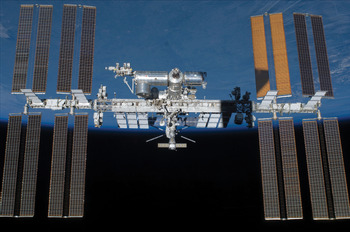
The International Space Station (ISS) is currently the only extant, continuously occupied location in space; it has been inhabited by at least two astronauts at all times since the year 2000 (Kitmacher Reference Kitmacher2015). The first ISS modules entered orbit in 1998 and it has grown to be the largest spacecraft ever built, comprising more than a dozen modules and a habitable volume of approximately 1000m3—often compared by NASA to the equivalent of a five-bedroom house (Figure 1). The ISS has been occupied by groups both large and small, with as many as 13 individuals during a fully crewed Space Shuttle visit, and it hosts an evolving multi-national, multi-ethnic and multi-gendered community.
The International Space Station in 2010 (image courtesy of NASA).

The station's lifespan and decommissioning date are currently undecided and there are moves by NASA to adopt a commercial model of operation (Davis Reference Davis2018). Eventually, however, all the modules will be de-orbited into Earth's atmosphere, with surviving pieces falling into the ‘spacecraft graveyard’ in a remote part of the Pacific Ocean (NASA 1996). Thus, the ISS will not be preserved in its operational form for future study.
The ISSAP is the first project to analyse the social and cultural context of an assemblage relating to the human presence in space. The aim is to investigate how a space culture has emerged and evolved (Capelotti Reference Capelotti, Darrin and O'Leary2009). Archaeology provides a unique perspective on the modern world that no other discipline can encompass, as demonstrated by other projects on contemporary assemblages (Rathje et al. Reference Rathje, Hughes, Wilson, Tani, Archer, Hunt and Jones1992; Zimmerman & Welch Reference Zimmerman and Welch2011; Olsen & Witmore Reference Olsen, Witmore, Olsen and Péturdóttir2014; Ralph & Smith Reference Ralph and Smith2014; De León Reference De León2015). These investigations have illuminated practices that the subjects themselves either cannot or do not wish to articulate. Archaeology can go beyond sociological or anthropological ethnography to interrogate cultural phenomena in space.
Research questions and methods
While sociologists and ‘science, technology and society’ (STS) researchers have discussed human behaviour in space (Battaglia Reference Battaglia2012; Vertesi Reference Vertesi2014; Messeri Reference Messeri2016; CSA 2017; Valentine Reference Valentine2017; Olson Reference Olson2018), the associated material culture has hitherto not attracted significant attention. As Deetz (Reference Deetz1996) pointed out, however, it is often the ‘small things forgotten’ that can illuminate human behaviour for the archaeologist.
Questions that can be addressed through the application of archaeological methods include: how humans adapt their behaviours and tools to the requirements of life in space; how a crew composed of individuals from different nations, with different languages and cultures, uses material culture to build cohesion and manage conflict; gendered use of spaces and objects; identifying spaces and objects associated with work, leisure, rest and privacy; how the sounds, smells, sights, tastes and textures associated with life on the ISS affect crew members; how spaces and time are structured to negotiate surveillance and monitoring by ground staff, and interactions with the public; and how microgravity shapes the development of the station's society and culture.
Without the option to conduct fieldwork, instead we have developed new methods to allow analysis of sociocultural aspects of life on the ISS. These methods are re-imaginings of traditional archaeological practice, which take advantage of the station's status as an actively inhabited installation rather than an abandoned site, blurring the traditional boundaries between past and present (Nativ & Lucas Reference Nativ and Lucas2020). All methods comply with NASA protocols to preserve the privacy and anonymity of the crew. The research programme includes the following components:
1. Image analysis: using machine learning to catalogue associations between crew members, spaces within the station and objects/tools.
2. Interviews and anonymised questionnaires with flight and ground crews.
3. The development of procedures for the ISS crew to perform archaeological surveys on site.
4. The investigation of ISS cargo return (‘de-integration’) activity and analysis of the values and meanings associated with returned items.
5. The investigation and possible excavation of archaeological sites on Earth related to the development, deployment and discard of technology and resources consumed by the crew.
Image analysis
Semiotic analysis of the material culture and a proxemic analysis of embodied space provide rich data for understanding the lived experience on board the ISS. The first phase of the project leverages the documentation, images, video and audio media stored by NASA as a proxy for direct observation of ISS culture. Understanding how individuals and groups use material culture in space stations, from discrete objects to contextual relationships, can reveal intersections of identity, nationality and community.
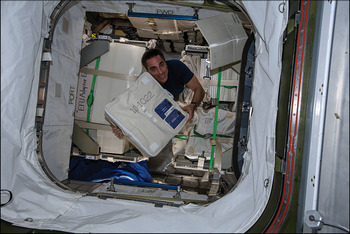
Fortunately for this research, the first occupation of the ISS coincided with the emergence of digital photography. The images include metadata recording the time and date, which become the metaphorical stratigraphy of an excavation, linking the contents of images to moments in time. Given that the crew takes approximately 400 photographs per day, images depicting the station interior now number in the millions. These images should not be taken at face value; the extensive critical literature on the use of historical photosets as documents for social science research demonstrates that they are artefacts in themselves, framed by particular technologies and ideologies. This image dataset will be augmented by other NASA data, including the ISS Inventory Management System (IMS), which catalogues every object sent to the space station and its most recent known location (Figure 2). The IMS records over 332 000 items, of which 77 000 are currently on the ISS (Adams pers. comm. 2020). Videos made to survey the interior surfaces of the entire station every six months for fire-safety purposes will serve as baseline points of comparison with the photographs taken daily by the crew. NASA has made its image archives and the IMS available to the ISSAP for analysis with Institutional Review Board approval, guaranteeing the anonymity of the crew.
Astronaut Chris Cassidy unloading food supplies in June 2020. Note the directional labelling (port, aft, forward) around the hatch, which the ISSAP is using to describe object and crew location within images (image courtesy of NASA).

Recent advances in machine-learning algorithms have opened new directions in the large-scale mining of multimedia data (Resig Reference Resig2014). This is especially true in relation to image recognition and processing, where deep learning with convolutional neural networks continues to transcend previous limitations for the automated classification of imagery data (LeCunn et al. Reference LeCunn, Bottou, Bengio and Haffner1998; Simonyan & Zimmerman Reference Simonyan and Zisserman2014).
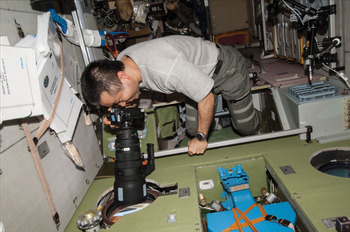
Given the limited number of individuals who have been to the ISS and the size of the station's interior, machine learning can be used to determine whether there are national, gendered, ethnic and other identity-associated patterns of occupation of specific spaces (Figure 3). It will be more complicated for machine-learning algorithms to identify objects, necessitating a significant amount of time for the training component of this work to achieve high-quality results. Machine learning and information retrieval has already been applied successfully to build intelligent models of biological, chemical, physical and medical systems. Space archaeology, however, represents an opportunity to apply these techniques to a domain that has yet to benefit from the power of artificial intelligence.
Astronaut Koichi Wakata in the Zvezda module in 2014. The Soviet modules are characterised by the use of green shades in the interior (image courtesy of NASA).

Interviews of flight and ground crews
The interviewing of flight and ground crews returns to a method employed by the original contemporary archaeology investigation, William Rathje's Tucson Garbage Project (Rathje & Murphy Reference Rathje and Murphy1992), and basic to anthropological ethnography. As we are focusing on the interpretation of photographic evidence, it makes sense to ask both the creators and subjects of these images about their motivations, contents and meanings. We can also ask the crew members other questions about life in space: the adaptations that were needed, the new abilities discovered and the frustrations or limitations encountered. Questionnaires will also be used, but interviews are preferable where possible as their flexibility allows for responses that do not fit preconceived expectations or which open up new avenues of questioning through conversations. We hope also to engage crew members from ISS participant space agencies such as Roscosmos (Russia), JAXA (Japan) and the European Space Agency in these interviews to gain a wider view of life on board. Such interviews, of course, are also interventions in existing communities, which may have unforeseen consequences. As part of the space community ourselves, our concern therefore is to maintain trust with interlocutors via informed consent.
Development of procedures for crew to perform archaeological survey in situ
Astronauts have conducted an extraordinary range of physical science experiments and research aboard the ISS, including studies of genetics, the physics of fire, and mouse anatomy. Not all astronauts have specialist scientific backgrounds, and only rarely does their prior career relate to the research that they conduct in space. Astronauts are expected to be ‘Jills of all trades’ and they receive on-the-job instruction to perform whatever kinds of experiment are required.
As part of our project, we will develop similar experimental procedures for crew members to carry out an archaeological survey of the interior of the ISS. We are particularly concerned to document aspects of life on board that cannot be derived from the image analysis. The latter, therefore, is a crucial stage to be completed prior to the design of the on-board survey strategy.
One potential survey technique is surface sampling for the build-up of dust, hair, skin cells, oil, dirt, food, broken fragments of equipment and other materials. This approach is analogous to soil sampling through excavation or to the Bristol University archaeologists’ excavation of their own dig van (Bailey et al. Reference Bailey, Newland, Nilsson, Schofield, Davis and Myers2009). This method offers opportunities to study the formation of stratified micro-deposits in a microgravity environment, as well as being able to characterise, in situ, the cultural component of the ‘natural’ microbiome of such a highly curated and structured habitation. The ongoing Aerosol Sampling Experiment, which collects samples of the air and particulates on the station, provides valuable baseline data for this component of the study. Other techniques include audio recording to identify levels of ambient sound and the extent to which voices and other sounds carry (compare with previous work such as Aiken (Reference Aiken2014) and Goodman and Grosveld (Reference Goodman and Grosveld2015)); photography to establish lines of sight from various positions, using the full freedom of movement afforded by microgravity; and documentation of specific public spaces, such as eating areas, and, if possible, private spaces such as crew berths.
Observation of items returned from the ISS
Only a limited number of items from the ISS return to Earth. Since the end of the Shuttle programme in 2011, there are only two means of return: small quantities (totalling 50–100kg) with crew members in the Soyuz craft, and up to 3000kg in total on SpaceX's Dragon capsule. All other materials either remain on the ISS or are placed into other types of supply craft, which are destroyed through atmospheric re-entry. Both the Soyuz and Dragon flights happen approximately every four to six months. The returned items are typically scientific samples, broken equipment and personal effects of the crew.
The return of items from the ISS can be interpreted archaeologically as a form of discard process. We requested permission from NASA to observe the handling of cargo from the ISS on the returns of the Dragon CRS-13 and CRS-14 capsules in January and May 2018, respectively. During our observation, we visited work locations in Houston, Texas, and Long Beach, California, where we photographed and video-recorded the handling and documentation of the returned items and interviewed participants in the cargo-return process. Preliminary analysis of the interview transcripts indicates the complexity of the process whereby items enter the inventory and are subsequently dispersed.
Excavation of related archaeological sites on Earth
If items associated with the ISS have been discarded on Earth in soil matrices (rather than incinerated or otherwise destroyed), traditional archaeological excavation techniques could be used to retrieve and analyse them. In an interview with a NASA employee for the cargo de-integration study described above, we learned that the Kennedy Space Center is a likely site of discard for material returned prior to the end of the Space Shuttle programme in 2011. We intend to explore the possibility of excavation in future discussions with NASA and other space agencies.
How gravity shapes society
The methods described here are not the only means by which to enable the archaeological study of space habitats. Other scholars are likely to conceive of different and even more creative approaches in the future. These methods, however, are an important starting point for a subdiscipline that, like its subject matter, is still in its infancy. In combination, the six methods outlined here will enable deep research into a novel archaeological context. From our observations and analyses we expect to identify problems and propose solutions that will improve mission success by promoting harmonious social and cultural interactions in future long-duration spaceflight. Such missions are now closer than ever, with several agencies and private corporations currently planning habitations on the Moon and Mars. It is also likely that the ISS will soon become a much more commercial enterprise, so it is critical to have a baseline of material culture now, in order to assess how privatisation affects life in space. Finally, the development of these methods for space archaeology may also be useful for researchers considering contemporary archaeology projects in other remote locations or hostile environments, such as the deep ocean, polar regions or war zones.
Konstantin Tsiolkovsky, an early twentieth-century adherent of the philosophical and cultural movement of Cosmism, had a particular vision of how space travel would affect human culture. He proposed a correlation between gravity, social forms and the basis of production. In Outside the Earth (Tsiolkovsky Reference Tsiolkovsky and Duttn.d. [1960]) and other works, he argued that microgravity would create a more equal society. With no seasons, pests, droughts or floods, he argued, reliable food crops would grow all year round. Solar energy would be freely available to all and could be used to regulate temperature, removing the need for clothes. The costs of transportation and construction would diminish as the heaviest materials could be moved or manoeuvred with the merest touch. One of the markers of social status of his time, ‘beds and their accoutrements’, would vanish as people could sleep wherever they pleased.
This idyllic version of an egalitarian space society is far removed from contemporary space culture, which is rooted in deep geopolitical divisions between ‘spacefaring’ and ‘non-spacefaring’ nations (Gorman Reference Gorman2019), but it does demonstrate the role of gravity in creating or inhibiting access to resources. The consideration of gravity as an agent of social construction underpins our approach to the archaeology of the ISS. This extends to theorising the nature of the human body and its affordances in different gravity environments. In microgravity, vision, smell and taste are significantly altered, usually in ways considered to be problematic. Other qualities are enhanced, such as speed and strength. While microgravity provides major challenges for Earth-adapted physiology, it also creates opportunities. Eveleth (Reference Eveleth2019) has pointed out that some medical conditions considered to be disabilities on Earth may not constrain individuals in the same way in space. The loss of inner ear function, leading to deafness, for example, can also render an individual immune to space sickness. At present, the population of astronauts is dominated by a particular kind of elite body, which tends to be white, male and military, reinforcing the socially dominant human body type associated with terrestrial gravity. This phenomenon may or may not change in the future, but contextualising the ‘space body’ as a variant rather than an aberration also de-centres terrestrial gravity and opens new avenues for understanding Earthly phenomenology (Gorman Reference Gorman2009). The extent to which the material technologies of everyday life are structured by 1G (Earth) gravity will only become evident in contrast to a situation where they are not. Archaeological analysis of the ISS is an opportunity to make a familiar feature of terrestrial life become unfamiliar (Buchli & Lucas Reference Buchli and Lucas2001), inviting comparison with the ways in which diverse communities on Earth, past and present, use material culture to respond to the constraints and potentials of a particular gravity regime.
Both space and time have to be re-evaluated outside Earth. The ISS travels at a speed of approximately 7km/s, completing an orbit of Earth in about 90 minutes. Once every 45 minutes the crew witnesses a sunrise or sunset. Day and night, light and dark, do not play the same roles in structuring human behaviour as they do on Earth. Against this background, the photographs that are the focus of our study capture a stillness in the midst of perpetual motion. Each image is a digital time slice, a preserved moment that is the embodiment of the ‘Pompeii Premise’ (Ascher Reference Ascher1961) where archaeological relationships are still in their systemic context. Understanding how these moments come to build a structure, a tradition and a society in space is the ultimate goal of the ISSAP. The ISS represents a form of human settlement that is embedded in a broader technological trajectory arising from post-war rocket and satellite development. As the most substantial precursor of future habitats planned for the Moon and Mars, this study takes the archaeology of the contemporary past onto the cusp of an off-world future.
Funding statement
This work was supported by funding from Wilkinson College of the Arts, Humanities, and Social Sciences at Chapman University. The International Space Station Archaeological Project is funded by the Australian Research Council for 2019–2021 (#DP190102747).