Studies of Islam in Senegal have long focused on Sufi brotherhoods (see Coulon Reference Coulon1981; Cruise O'Brien Reference Cruise O'Brien1971; Cruise O'Brien and Coulon Reference Coulon, O'Brien and Coulon1988; Robinson and Triaud 1997) and recently shifted to the discussion of reformist groups (see Loimeier 2000, 2003; Villalón 2004). These studies are mostly political and economic in orientation. The esoteric aspect of Islam in Senegal, such as the production of gris-gris (amulets), remains understudied.
Islamic esoteric knowledge includes notably istīkhara dream interpretations (Arabic: to seek/consult), khalwah prayer sessions (Arabic: retreat), Arabic numerology and astrology, as well as khatt ar-raml divination sessions (Arabic: writing in sand). Khatt ar-raml is documented in virtually every region of Africa (and Europe and the Arabian Peninsula) where Islam has penetrated. Although several Muslim scholars have challenged the Islamic legitimacy of the system, it is identified by both its practitioners and their clients as being a Muslim form of divination (Brenner Reference Brenner2000: 15). In Wolof, the local language most used in Dakar, the above-mentioned services are often called liguee (‘work’). Among French-speaking elite ‘modernists’ and ‘secularists’ in West Africa, the term maraboutage, introduced in colonial times, has become current. It has a negative connotation, however, associated with ‘heterodox’ practices that exploit the gullible and the ignorant (Soares Reference Soares2005: 129). I shall therefore use the encompassing term esoteric knowledge for the above-mentioned services in this article. In this respect, I follow Soares: ‘the term “esoteric sciences” is a convenient way to discuss …various practices …as there appears to be no universally accepted local or regional term that covers all of the kinds of knowledges and practices that can be included under this rubric’ (Soares Reference Soares2005: 127).
Considering the centrality of esoteric practices in the everyday life of West African Muslims, as well as its importance in politics and economics, its neglect by academic researchers is remarkable. These practices are all the more important because they are a local expression of Islam that is not confined to West Africa. Amulets are produced in vast quantities in Senegal and exported to Saudi Arabia where they enjoy great popularity among the population (Loimeier Reference Loimeier2003: 245). Furthermore, experts in esoteric Islamic knowledge – commonly called ‘marabouts’ – travel between West Africa and Europe, the United States and Asia. They offer their knowledge to both a West African diaspora population and a local clientèle that includes non-Muslims. The global success of Islamic esoteric knowledge demonstrates that religious thought is not merely imported into West Africa from Europe and the Middle East; the exchange occurs in both directions. Islamic esoteric knowledge is an especially male-dominated field, and the activities of Senegal's male experts have been described at length (see, for example, Dilley Reference Dilley2005; Graw Reference Graw2006; Sanneh 1989 and 1997). West African women knowledgeable in the subject are considered to be rare exceptions at best, and a contradiction in terms at worst (Brenner Reference Brenner2000: 147; Cruise O'Brien 1971: 85–6; Creevey 1996: 281; Linares 1992: 174; Mommersteeg 1996: 11; Sy 1969: 201–2). With the exception of one or two female relatives of the founding fathers of Sufi brotherhoods, women's activities are not represented in academic studies or in Senegalese media. This article shows that women are indeed active in this field, however, and that their practices complement existing studies of divination practices (Graw, this issue). Without denying the spiritual or esoteric values of divination, I focus on the ways in which two female practitioners present themselves to their clients, and I discuss their individual constructions of an expert status.
Despite dominant presumptions about the general inability of women to actively engage in Islamic esoteric knowledge, I met three such women in Dakar, and heard about several others. On a daily basis, they attend to large clientèles of both men and women who wait their turn in elegantly decorated waiting rooms. In this article, I describe two of these women: Ndeye Meissa Ndiaye and Coumba Keita. Both offered a range of services. As a result of their exceptional position as women marabouts, they faced specific problems in legitimating their work. Not only did they need to convince clients that they were powerful, well-educated, gifted, pious and reliable – the typical challenges that confront every expert in Dakar – but, as women, they also need to possess qualities that are normally associated with men. To name but one example, they must persuade clients that, despite their menstrual cycle, they can use the Qur'an in a ‘pure’ manner at all times. Although I describe here just two cases of female authority in Islamic esoteric knowledge, they form part of a wider public debate on Islam in West Africa. An analysis of the representation of Meissa's and Coumba's work sheds light on the ‘negotiation of true Islam’ as a diffuse process occurring at different levels where the local, supralocal and translocal intersect (Janson Reference Janson2006: 505). My discussion of the ways in which Meissa's and Coumba's authority in Islamic esoteric knowledge is negotiated, legitimated and publicly recognized in Dakar is analysed in relation to Senegal's changing religious climate involving brotherhoods, reformist Muslims and the state. Therefore, I begin this article with an introduction of the term marabout, followed by an overview of current religious developments in Senegal and of the role of women's expertise in Islamic knowledge.
A REAL MARABOUT
The term marabout is an established though somewhat problematic term. One of its meanings, ‘expert in esoteric knowledge’, is the focus of this article. In view of the widespread use of the term marabout and its local equivalents for various types of experts, as well as the similarities in the modus operandi concerning esoteric knowledge of these experts and the overlap of their techniques, I use the terms ‘marabout’ and ‘expert in esoteric knowledge’ as synonyms.
In the Maghreb, a marabout (or female marabouta) is a locally recognized Islamic saint whose tomb is the object of popular veneration. Marabout is also the name of the tomb itself (see Eickelman 1977: 3–28). In West Africa, however, marabout and its equivalents are mainly used as an honorific for both men and women, and in a bewildering variety of situations. The term marabout derives from the Arabic al-murābit (plural al-murābitūn), the monk-soldiers who Islamized the Berbers of the Western Sahara in the eleventh and twelfth centuries (Mommersteeg Reference Mommersteeg1996: 26). It is a corruption of the Portuguese pronunciation, marbuto, of the original Arabic word (Dilley Reference Dilley2005: 222). The term is used regularly by francophone West Africans and Western scholars alike, and can refer to imams, teachers, scholars, preachers and saints, to the leaders of religious ceremony or of Muslim brotherhoods, as well as to any type of specialist in esoteric knowledge including producers of amulets and diviners (see Graw 2005: 28–9). However, even diviners and healers without specific knowledge of Islamic literature, esoteric practices or written Arabic are often referred to as marabouts, or equivalently addressed as serigne (Wolof), thierno (Fulfulde) or mooroo (Mandinka). A neighbour in Dakar, for example, used the term serigne to describe a Christian Diola woman who offered cowrie shell divination services, healing, and protection with plants.
In Wolof, the term most frequently employed for specialists such as the Diola woman is seetkat, meaning ‘someone who sees’ (or ‘divines’). Other terms include the French guérisseur, féticheur, tradipraticien, and the Wolof fajkat (‘someone who uses medicine’). Seetkat mainly offer services in incantations, healing, cowrie shell divination, or divination involving knots in string. Their services also include identifying witches, fighting djinn, providing protection, casting spells, and eliminating the power of bad spells put upon their clients.
The divergences between the different sorts of esoteric practices – despite the occasional blurring of boundaries – are regarded by the local population as highly significant. When afflictions show no signs of improvement, people consult other experts precisely because the techniques differ one from the other (cf. Kirsch 2004: 705). In fact, however, there is no strict division between those experts who use Islamic knowledge and those who do not. Rather, one can speak of a sliding scale with, at one end, specialists who use alcohol in their treatments and, at the other, marabouts who are well versed in reading and copying the Qur'an. In between these two extremes are the many experts who simultaneously employ combinations of leaves, bark, Islamic prayers and prayer beads, and other ingredients. The blending of techniques seems to be further reinforced by the current trend of professionalizing esoteric services in urban centres. Furthermore, all techniques revolve around a similar logical-sequential structure (cf. Schulz 2005: 55).
One informant told me that
Senegalese do not distinguish between a marabout, diviner, or healer. They distinguish between good and bad practitioners. The bad one sits on the street or walks along the street. He is called in Wolof serigne tariaakh or mamane. Mamane means ‘I can do everything.’ We all know that no man can solve every problem, so when a marabout says he can, you know he is a bad one.
The question of how to find a real, powerful expert in esoteric services who can successfully and efficiently solve problems is part of Dakar's daily private and public discourses, and is hotly debated in the media. What is more, various reformist Islamic groups actively preach against those who engage in the practices and against consulting such people.1
I have elaborated elsewhere on discourses about ‘real’ marabouts in Dakar (Gemmeke Reference Gemmeke2008). Here, I present the historical reasons for the fact that, today, women are considered very unlikely to be ‘real’ and powerful experts in Islamic knowledge, as well as the political and religious developments that led to the current moral questioning of their activities, particularly by reformist Islamic groups. This overview outlines the specific developments that make the activities of women like Meissa and Coumba both exceptional and successful.
MARABOUTS, BROTHERHOODS AND REFORMISTS
The widespread presence of marabouts in West Africa was recorded as early as the mid-seventeenth century, when European travellers described their activities in villages throughout the region (Dilley Reference Dilley2005: 34). Islam was spread throughout Senegal in the ninth century by North African traders; but before the eighteenth century only a few local rulers, traders and scholars had converted to the religion. Residents of the Fouta Toro were the exception; there, large numbers in this northern region adopted Islam before the eighteenth century following their contacts with Mauritanians and Moroccans (Callaway and Creevey 1994: 18; Coulon 1981: 18).
Several scholars believe that the magic of writing and manipulating Qur'anic verses is the main reason that Islam was easily accepted by many people in Africa (Abdalla Reference Abdalla1997: 144; Sanneh 1997: 26; Trimingham 1962: 44). To this day, the act of writing Qur'anic verses is in itself magical for many Senegalese. The letters with which God composed the Holy Qur'an are ‘vessels of revelation’ (Schimmel Reference Schimmel1975: 411). Marabouts manipulate the holy Arabic letters of the Qur'an, which can be dissected, divided, rearranged, written forwards, backwards, straight or upside down, and mixed with other signs and symbols. The ability to manipulate Arabic letters in such a way that they can affect people's lives requires long training. The introduction of literacy in conjunction with religion had important consequences for a gendered division in religious roles. According to Ismail Abdalla, it seems that men and women in pre-Islamic Nigeria were equally involved in the profession of healing, as well as in all other matters of religious importance. The art of writing that was introduced was dominated by men, however, to the almost complete exclusion of women. This implied that women were also excluded from the magical-religious knowledge associated with writing (1997: 148). Only male children were sent to religious schools to learn advanced studies of the Qur'an, a pattern that has persisted today. It is fuelled by the assumption that women require only a few Qur'anic verses for their prayers (Bop Reference Bop2005: 1110). Advanced Qur'anic studies include esoteric knowledge. Women learning this knowledge are, consequently, exceptional. Meissa and Coumba, the two marabout women to be discussed, are well aware of common notions on women's expertise in esoteric practices. Later, I will elaborate on the ways in which they present how they acquired their expertise.
As healers, women have long occupied prominent positions within the various communities of the Senegambia. In many cases, their craft would be the same as those of their male counterparts. They were also recognized for their powers as spirit mediums and their skills in dealing with psychological disorders. Today, women are significantly underrepresented in both ‘Western’ healthcare as well as in Islamic esoteric practices. The question of the impact of Islam on the lives of women in Africa has been raised in numerous books and articles (among many others, see Ahmed Reference Ahmed1992; van Santen Reference van Santen, Dijk and Groot1995; Cooper Reference Cooper, Bodman and Tohidi1998; Dunbar 2000). Often, the view is expressed that the spread of Islam in Senegal reduced the public and religious role of women and diminished their direct overt involvement in public decision making. In pre-colonial times, women held important political offices (such as the Queen Mother and the First Lady among the Wolof, the Serer and the Mandinka) as well as significant roles in religious ceremonies connected to the spirits of the brousse [wilderness].
Studies focusing on women and Islam in Senegal, in particular, have long been concerned with the agency women have, or lack, within the brotherhood structure (Bop Reference Bop2005; Coulon Reference Coulon, O'Brien and Coulon1988; Creevey Reference Creevey1996; Callaway and Creevey 1994). Indeed, the Senegal brotherhood structure is quite remarkable. An Islamic brotherhood, also called a Sufi order or Tariqah (Arabic: path), is an organization of mystical and spiritual Islam. The four main brotherhoods in Senegal are Qadiriyya, Tijaniyya, Muridiyya and Layenne. The Layenne are unique in that they believe that the founder of their brotherhood, Seydina Limamou Laye, is the Mahdi. He is the spiritual renewer who, it is popularly believed throughout much of the Muslim world, appears in preparation for the Judgement Day (Villalón 1995: 65); they also believe that his son Issa is the reincarnation of Jesus. Senegalese culamā rejected this as a heresy, but did not practically oppose the Layenne movement (Mbacké 2005: 62). This brotherhood has had an important influence on the work of Meissa and Coumba, as I will show below.
Senegal became a ‘paradise of brotherhoods’ (Cruise O'Brien and Coulon 1988: 30) at the end of the nineteenth century. Initially the leaders of the brotherhoods were opponents of the violence, indoctrination and humiliation perpetrated by French colonials, but soon the relationship between the leaders of the brotherhoods and the French government came to be characterized by pragmatism and cooperation. The Murid brotherhood in particular controlled – and still controls – many political and economic domains. Senegal's brotherhood structure comprises some 90 per cent of the population. It is built on the organization of disciples (talibé) into associations tied to religious centres such as Touba, Kaolack and Tivaouane, led by family dynasties that developed after the deaths of a generation of founding fathers. The associations (daaira) are reinforced and celebrated in numerous ceremonies and pilgrimages (Villalón 2004: 63).
Scholars have repeatedly emphasized the need for research on women's activities within West African Islam (for example, Boyd and Last 1985: 283; Creevey 1996: 269; Evers Rosander 2003: 298; Hutson 1999: 43; Janson 2002: 3). Some authors have written about the invisibility of Senegalese women, who are seemingly powerless in the brotherhood structure (Creevey Reference Creevey1991: 348; Cruise O'Brien 1971: 85; Sy 1969: 201), and scholars were projecting women within the marginalized sphere of ‘traditional religion’ as late as 1997 (Evers Rosander 1997: 7). Already in 1988, however, Coulon observed that ‘women participate in their own way in Islam, manipulating it and accommodating it to their needs. They are active Muslims, even if their practices are informal, hidden, parallel or heterodox; hence it is wrong to relegate the female Muslim universe to this twilight zone where it only appears to belong because of our inability to study it’ (1988: 115). Some scholars have been slow to revise their view of women's roles in Islam in the light of Coulon's remark. In a later publication Creevey did, however, revise her image of the powerless Senegalese woman robbed of her religious and political roles by Islamic brotherhoods. She stated that she regarded ‘the peculiar blindness with regard to women's activities as endemic to those who see through the eyes of the dominant male system’ (1996: 282).
Female Senegalese researcher Bop, however, argues against the current attempt of researchers to assess the presence, visibility and dynamism of Muslim women within the brotherhood structure. She states that while Senegalese women might on occasion creatively manipulate the brotherhood structure, they certainly do not fundamentally change it, thus remaining mere disciples instead of spiritual leaders (Bop Reference Bop2005: 1116).
Yet not all women remain invisible or powerless within the brotherhood structure. In fact, some women have gained international fame and are venerated by thousands of (male and female) followers. A famous example, studied by Coulon and Reveyrand in 1990, is Sokhna Magat Diop. She was a religious leader who appointed imams; owned land cultivated by her followers, and performed ritual prayers. Sokhna Magat Diop was married to a brother of Cheikh Amadou Bamba, founder of the Murid brotherhood. She succeeded her father, a disciple of the founder of the brotherhood, at the age of twenty-six. Her father, who lacked male heirs, had determined prior to his death that she would inherit his charge as shayk (Bop Reference Bop2005: 2001; Coulon and Reveyrand 1990: 4). Other well-known Senegalese examples of marabout women include Sokhna Maïmouna Mbacké (called Sokhna Maï) of the Murid brotherhood and Hadjia Saïda Oumoulkhairy Ibrahim Niasse of the Tijaniyya brotherhood. Sokhna Maï, who died in 2002, was the youngest daughter of Cheikh Amadou Bamba. One of her renowned efforts in the religious domain is the celebration of Laylatoul Khadry (‘Night of Decrees’, when the first sura of the Qur'an descended on earth) during Ramadan. Hadjia Oumoulkhairy is the daughter of Ibrahim Niasse (founder of the Ibrahimiyya Tijaniyya branch) and the wife of the late Cheikh Aboubacar Assimi (Grand caliph of the Niasse Tijaniyya in West Africa). Originally from Senegal and currently living in Niger, she organizes financial and technical support from NGOs and governments for women and girls to have access to Franco-Arab education, maternal and child healthcare, and training in income-generating skills. As will become clear later, the leading ladies of Senegalese brotherhoods such as Sokhna Magat Diop are role models for Meissa and Coumba. Unlike these ladies, however, Meissa's and Coumba's success and authority are certainly not based upon their kinship with the founding fathers of brotherhoods. The focus on Sufi brotherhoods in the discussion on the agency of Muslim women in Senegal, notwithstanding its importance, neglects the significance of Islamic esoteric knowledge in their daily lives. Women such as Meissa and Coumba gain authority – and their livelihoods – by offering Islamic esoteric expertise, thus influencing the lives of many men and women in Senegal and abroad, in cases of overseas consultancies by telephone. They do so individually, outside the elite brotherhoods’ dynasties. While they do use aspects of Sufism in their work, such as the notion of baraka (grace or blessing), explained below, they creatively combine these aspects with aspects of ‘traditional’ healing and even of reformism. This approach reflects some significant current developments in Senegal: while the brotherhood model remains centrally important, it has been increasingly rivalled since the 1980s by reformist or Islamist groups and ideologies (Villalón 2004: 61).
Islamic reform movements are not a new phenomenon in Senegal. As early as 1922, the first nationwide Islamic organization was founded. It was called Union Fraternelle de Pèlerins Musulmans de l'A.O.F. and was led by the Grand Imam of Dakar (Loimeier Reference Loimeier2000: 170). In 1953, Cheikh Touré founded the Ittihad ath-Thaqafi al-Islami (ITI) in Dakar, an organization that struggled against the colonial system, as well as against the marabouts who had collaborated with the colonial power. In 1957, Cheikh Touré aroused considerable unrest and protest among the marabouts by severely attacking a number of practices supported by marabouts, especially the production of and the belief in the power of amulets (Loimeier Reference Loimeier2000: 175). After independence, however, ITI was no longer held together by the need to struggle against the colonial regime. In combination with President Senghor's efforts to bring the group under government control, its influence diminished significantly.
Then, in the 1980s context of economic decline and political unrest, the second generation of Islamic reform movements in Senegal developed. The economic crises and the presidential elections of 1988 compounded the Dakarois sense of disillusionment with the state. Opposition leader Abdoulaye Wade was imprisoned and the incumbent president Abdou Diouf was re-elected. In the years following the post-electoral violence in 1988, the legitimacy of both religious and political authority in Senegal eroded. Throughout the 1990s, the heretofore virtually unassailable dominance of established brotherhoods came into question, challenged both by Islamist alternatives and by new movements from within the orders, which borrowed from these themes. The Jama'at ‘Ibad ar-Rahman (JIR, Servants of the Merciful) turned out to be especially successful; the majority of its founders were former ITI members. Initially, the JIR continued the reformist discourse of the ITI with respect to the so-called ‘un-Islamic’ practices, among them the wearing of amulets. In the late 1980s, however, the JIR realized that the struggle against marabouts was counter-productive on account of their ongoing popularity (Loimeier Reference Loimeier2003: 245). The struggle against the crisis-ridden state seemed to promise greater possibilities of success. Since the 1990s, JIR and the marabouts have collaborated in their common polemic against the secular state, insisting on their unity and solidarity as fellow Muslims. Not surprisingly, the global political developments around the so-called ‘war on terror’, orchestrated rhetorically and militarily by the USA, triggered off popular anger among Senegalese Muslims. Muslim solidarity increased and blurred the distinctions between Sufis, reformists and other Muslims even further (Villalón 2004: 69).
Since the 1980s, then, interrelated political, economic and religious changes in Senegalese society have led to significant changes in the position of experts in esoteric knowledge. Economic decline, political unrest and increased migratory movements seem to have created and continue to create an expanding market for the services of esoteric experts, as well as a crusade against their work. What is more, Sufi and reformist rhetoric is also blurred with the practices of (female) Islamic experts (see Janson 2006). Meissa and Coumba, the female experts in Islamic esoteric knowledge I met in Dakar, are influenced by, as much as they create, the above-mentioned developments. In what follows, I explain how.
Ndeye Meissa Ndiaye
Meissa is Wolof, born in a marabout family in the Diolof, in northern Senegal. She was a small, slim lady in her fifties when I first met her. She lives in a villa with seven bedrooms, an office, and a salon, with several of her brother's and sister's children and some of their children. Her only daughter is married elsewhere. Meissa offers khatt ar-raml divination sessions, khalwah and istikhāra sessions, and amulets and potions in which she combines Qur'anic verses and turabu with ground plants.
Meissa told me that her father, an imam of a village near Louga, taught her all that she knows.
I enjoyed learning and my father stimulated me. I don't know why few women learn to work with the Qur'an. They probably have no time. It takes a lot of time and it is difficult to learn these things. If women had more time, they could learn everything. In earlier days parents were not used to educating their daughters for a long time. But in my family, everybody was well instructed, the boys and the girls alike. Nobody objected to my learning secrets of the Qur'an. My father taught me the Qur'an until I was about fifteen years old and then, until I was thirty, I learned the mystical secrets of the Qur'an. My older sister is a marabout in my hometown Dokhoba, near Linguère. My older brother is the caliph there … . I left Dokhoba when I was about forty years old and had divorced my husband. My father told me to go to Dakar, because Dakar is where money can be found. He blessed me and gave me a big silver ring with a turabu that I always wear. He also gave me one of his jinni. Because of this ring and because of my inherited djinn, all that I do for clients works. I first lived in Yarakh [a neighbourhood of Dakar] with a relative. After a while I had many clients, especially in Cambérène, so the caliph of the Layenne brotherhood gave me a piece of land [to construct the villa on].
Besides her activities in Dakar, Meissa travels internationally: she has visited clients in the Gambia and in Mauritania. Furthermore, clients who have emigrated to Europe and the United States regularly call her for consultation.
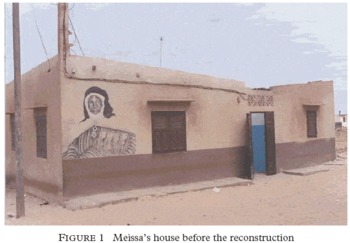
When I returned to visit Meissa in 2006 after two years of absence, her successful career had visibly expanded. She had managed to rebuild her house, adding a roof over the patio and redoing the outer walls of her home. She also refurnished her living room with new armchairs and two sofas. In the hallway, she put a photo gallery of about fifteen pictures, portraying the founders and leaders of the Layenne and the Tijaniyya brotherhoods. The gallery also now features a picture of Meissa herself, wearing a keffiyeh headscarf. Meissa proudly indicated that she had rebuilt her house without any loan or help from her family, but entirely with the money her talibés [followers, in this case] gave her in gratitude for her services. At the time of my last visit, Meissa was learning French and preparing a passport and visa application in order to travel to Europe.
Coumba Keita
Coumba is about ten years younger than Meissa. She is a Bamana, Dakar-born woman. She has light skin, a round face, curvaceous body, and lively manners. Coumba usually wears a white boubou and a white scarf loosely wrapped around her face. She moves with small gestures and speaks in a remarkably soft voice.
When I first met her, Coumba lived in a building typical of the outskirts of Dakar: a twenty-year old, huge apartment complex of several layers surrounding a central hall, where a tap provided the residents with water, paid for by the bucket. Coumba lived on the ground floor in a salon and a bedroom with her second husband and six of her seven children. Two months after our first meeting, Coumba moved to a spacious and light apartment in a neighborhood close by. Coumba started to work as a marabout after she had had visions of Seydina Issa Laye, son of the founder of the Layenne brotherhood. She said:
I started to work as a secretary when I was seventeen years old. I travelled the whole world, working as a secretary for the PNUD [Programme National des Nations Unies pour le Développement], then for UNESCO, then for the Embassy of France. In Niger, when I was thirty-three years old, I started to have visions. I saw Mary. She took my left hand and said: ‘I will bring you into direct contact with my son.’ Mary put my hand in the right hand of Jesus. Jesus told me in French to read the Bible. The next day, I asked my husband to get me a Bible. In one evening I read it. That night, I dreamt Seydina Issa Laye came to me. He said: ‘It is me, Jesus, but in Issa's form.’ The next day, I bought a Qur'an in French translation and I saw that everything is the same: Jesus is Issa and Mary is Mariam. That night, Seydina Issa Laye came to me again, this time dressed in the clothing I recognized from the pictures [widely distributed in Senegal] and sitting on a horse. He told me to go back to my country. I was chosen to help the people there.
I left my first husband and came back with my children to Dakar. I started to do my work. I became famous through a group of students that wanted to emigrate to Spain. That worked. I later married my second husband. He had come to me to get promoted in his work. That happened: his boss fell ill and died, and now he has taken his boss's job as a manager. My husband was so grateful that he asked me to take him to my marabout. My eldest son took him to Alassane Laye [then caliph of the Layenne]. Alassane Laye told my husband to marry me and he did.
Like Meissa, Coumba is popular: whenever I visited her, up to five clients, both men and women, would be waiting for her in her living room. Apparently, Coumba serves a middle-class clientèle. The clients in her waiting room are usually well dressed, and twice I saw an expensively dressed Lebanese woman waiting for her. Coumba also has several clients who migrated to Europe and the United States, who call her for advice. Coumba provides khatt ar-raml divination sessions, istīkhara dream interpretations, khalwah prayer sessions, and she provides amulets and potions made of a combination of Qur'anic verses and plants.
When I visited Coumba two years later, she had moved again. This time, however, she had bought a plot of land and built a spacious villa with three bedrooms, an office, and a living room furnished with an impressive television and DVD set and new furniture. Coumba indicated that her clients, and especially a twenty-five year old Fulani who migrated with her help to Italy, send her money for the house. According to Coumba, she now has many clients in Europe who, because of her, migrated and found work there.
FEMALE AUTHORITY IN ISLAMIC KNOWLEDGE
Meissa and Coumba are largely outnumbered by their male counterparts. In the neighbourhood where they live and practise, for example, I met fifteen marabout men. Unlike these male marabouts, however, Meissa and Coumba do not operate in family networks. The large majority of male experts in Islamic esoteric knowledge in Dakar are members of Jakhanke, Mandinka, and Fula marabout families born in south-eastern Senegal or in Guinea Conakry.Footnote 2 In many of these families, the younger men are sent to Dakar, Europe and the United States. In Dakar, the often family-related male marabouts provide each other with housing and clients. They thus operate within a network of uncles, brothers and cousins who refer clients to each other, organize travel abroad, and care for their respective families in the village (cf. Tall 2004). Despite this landscape of mostly male-dominated marabout family networks, Meissa and Coumba managed to build up a large clientele. Below, I analyse the components that led to their success in the field of Islamic esoteric knowledge.
Purity
Aptitude in learning the Qur'an is, for women and for men, insufficient for becoming a successful marabout. One of the key notions of marabout leadership and esoteric knowledge is baraka, divine grace and/or blessing. It encompasses, for example, the capacity to give blessings that protect against a wide variety of misfortunes (Bop Reference Bop2005: 1113). Baraka is obtained through kinship, teachers and exemplary behaviour. It is associated with wealth, power, knowledge and a strong personality (see also Cruise O'Brien and Coulon Reference Coulon, O'Brien and Coulon1988; Soares 2005). Meissa and Coumba present themselves as powerful, knowledgeable and strong women in a number of ways: by referring to the elite of the Layenne brotherhood, by adopting the clothing style and body language of the leading ladies of Senegalese brotherhoods, and by pointing out that they do not have menses.
Meissa's and Coumba's dress and demeanour is similar. They frequently wear a white scarf around their head and a grand boubou. They speak in remarkably soft voices and often wear glasses. This dress and use of voice and gesture underline their wisdom and self-control, as well as their attachment to Islamic values. Most other middle-aged Dakaroises take fashion seriously. They wear vibrant colours, sometimes in tight-fitting taille basses outfits or synthetic fabric, and headscarves in a turban-type way. Meissa's and Coumba's dress and attitude certainly add to these women's image as charismatic, stable, wise, elderly ladies, who do not have time to keep up with trivial fashion styles of the day. Meissa's and Coumba's appearance resembles those of the leading spiritual female figures in Senegal like Sokhna Magat Diop or Hadjia Oumoulkhairy Ibrahim Niasse of the Murid and the Niass-Tijaniyya brotherhoods, respectively.
While Meissa and Coumba emphasize an ‘Islamic’ femininity in dress, they downplay their feminine side in speech. Menstruation is an important factor in this de-feminization. After telling me that women can learn anything, Islamic esoteric knowledge as well, if only they have time, Meissa was silent for a while. She then added, with a smile:
I will tell you what my secret is. I never menstruated in my whole life. The problem with women is their impurity. How can a woman do a khalwah, which sometimes lasts a month, when she dirties herself? But in my case, the time that my only child was born was the only time I saw blood.
Meissa thus explicitly stressed her pureness. Coumba, like Meissa, said she never menstruated:
I have seven children, two girls and five boys. The last two boys I had with my second husband, after I started to work as a marabout. Before I got pregnant with the next to last child, I bled for forty days. I went to a doctor. He said that I had all my bleeding in one period, and that after these forty days I would never menstruate again. And this is in fact the case.
These claims of purity are reinforced by the two women's exceptional marital status. In Senegal, of all women above forty only 3 per cent are not married (Ndiaye et al. 1992–3). The fact that both Coumba and Meissa are not married strengthens the two women's claims of purity: it is believed that sexual relations can harm the efficacy of esoteric practices.
Authority
Besides dress, attitude, and an emphasis on the lack of menstruation, Meissa and Coumba have several other strategies to present themselves as reliable marabouts. One way is attitude. Most marabout men I met in Dakar talked openly about the downsides of their profession. One openly admitted he was not very good in the casting of spells, others told me they went regularly to other marabouts for advice on how to help their clients, and some marabouts said they rather would have had a French education and started a business instead of working according to family traditions. Meissa and Coumba, on the other hand, emphasized their skills proudly. Meissa said: ‘I have no problem with competition from other marabouts, because I am the only woman. There is no one to compete with.’ Coumba was even more outspoken on the subject than Meissa. She said:
In my work, I am like a man. I am very strict with people. I demand they bring sacrifices, always. Sacrifice is the basis of faith. If someone's door to happiness is blocked, sacrifices will unlock the door. In my relationship with God I am also like a man. I am very direct and I never lie. My feminine side is that I take pity on people.
Other ways of asserting authority include referencing male figures of authority such as khalifs of the Layenne brotherhood, and – discreetly – the Prophet Muhammad and Jesus Christ. Meissa stressed, for example, the age at which she started to work as a marabout: forty years old. Coumba, on her part, asserted that she started to work as a marabout at the age of thirty-three years old. In Senegal, it is common knowledge that Jesus died at the age of thirty-three, and that the prophet Muhammad started preaching at the age of forty. For Meissa and Coumba, then, this is an effective reference to powerful religious symbols.
Furthermore, Meissa and Coumba, both born Tidjiane, underline their affiliation with the Layenne brotherhood. They live in and close to Cambérène, one of the centres of the Layenne (along with the nearby village of Yoff). According to one of Meissa's clients, Meissa's affiliation with the Layenne was purely pragmatic: she was offered a piece of land by the brotherhood on which to build her house. It would be interesting to see if marabout women who live elsewhere employ a similar overt affiliation with this or another brotherhood. The Layenne, in any case, form a remarkable exception in the landscape of Senegalese brotherhoods.
The Layenne brotherhood has a strong ethnic Lebu bias. Its influence is mainly limited to the Cap Vert peninsula, and it is marked by the messianic qualities attributed to its founder and his son, Seydina Limamou Laye and Seydina Issa Rohou Laye. While in all Senegalese brotherhoods followers attribute miracles to their spiritual leader, the Layenne are widely known in Senegal for the extraordinary miracles they attribute to Limamou, Issa, and succeeding caliphs. Limamou is believed to have cured people by blowing on them, to have immobilized others or made them fall on the ground without touching them, and to have made yet others recite the Qur'an spontaneously. The most famous miracle Limamou is said to have performed was tracing a line in the sand near Yoff where the sea had inundated the houses of his followers. ‘The sea will never cross this line,’ Limamou is said to have declared. Fittingly, that place, now called Diamalaye (peace of God), is the site of his enormous mausoleum. Limamou's son Seydina Issa is said to have made paralyzed people walk again, and even to have brought the dead back to life.
The Layenne brotherhood is known for the important place it accords to women. Unlike other brotherhoods, the Layenne encourage women to attend prayers at the mosque, especially on Friday. This is exceptional: Senegalese Muslims generally deny women access to the mosque, particularly before their menopause. The Layenne's openness towards women needs to be nuanced, however. While the Layenne elite do integrate women in the religious ceremonies, they also lay great emphasis on discipline for women. They stress the need for women to be married, occupied in the home, dutiful, dressed decently, and to refrain from the Lebu domain dominated by women: the spirit cult of the rab (Laborde Reference Laborde1995: 97). There are no female figures among the Layenne elite who are, even remotely, comparable to Sokhna Magat Diop or Hadjia Oumoulkhairy Ibrahim Niasse, as discussed earlier.
The visible proof of Meissa's and Coumba's affiliation with the Layenne is apparent in both of their homes. In 2004, an enormous portrait of Seydina Issa Laye was painted on the outer wall of Meissa's house. On the inner wall of the patio, a smaller copy of the same portrait was painted. Meissa's private investment in the paintings of her tutors in Dakar is evident. Her explanation for the paintings was that she had good connections with both the current caliph and his son. ‘They have been very good to me. When they saw I had many clients in Cambérène, they offered me a piece of land. For this I will always be grateful.’ Two years later, however, after the reconstruction of her house, Meissa had decorated the hallway and patio of her house, which form the waiting area for her clients, with portraits of both Layenne and Tijaniyya marabouts. She also added a picture of herself, wearing a checked scarf in the fashion of an Arabian cheikh. In this way, Meissa literally places herself in line with prominent figures of Senegalese brotherhoods, as well as linking herself to men of the Arab world.
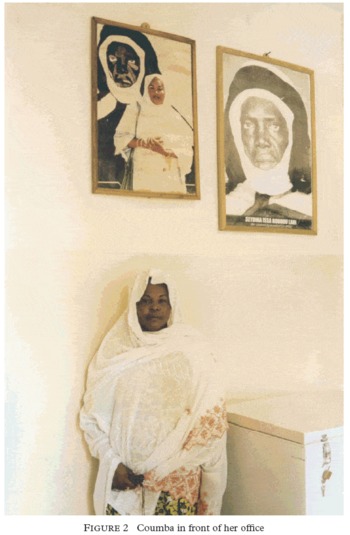
Coumba, for her part, had placed pictures of Seydina Issa Laye in every room of her Guediawaye apartment. In the hallway, a composite photo of Seydina Issa Laye and Coumba decorated the entrance. In her office a portrait of Issa and a calendar portraying all the important figures within the Layenne brotherhood were placed. In the living room, a huge picture of Seydina Issa Laye hung on the wall. Seydina Issa Laye was even more present in her newly constructed house than in her last apartment: Coumba placed four huge framed portraits (each approximately a metre long and half a metre wide) in the hallway and in the living room.
Meissa's and Coumba's flexibility in their brotherhood affiliation is, remarkably, in line with the reformist Islamic viewpoint. One of the most influential changes advocated by reformist movements is the right of women to choose their affiliation of brotherhood. Generally speaking, women automatically belong to the brotherhood of their father or husband. Furthermore, it is worth noting again that Meissa emphasized the education she received from her father in order to legitimate her powers. Possibly, she intended a reference to the emphasis of Islamist reformist groups such as the Jama'at ‘Ibad ar-Rahman on the education (albeit a different education) of women. In these ways, Meissa uses notions typical of reformist rhetoric in her work.
Coumba is not unique in having had visions of Seydina Issa Laye. Followers of various religious backgrounds, especially women, have converted to the Layenne order after having seen Issa in dreams or visions (Laborde Reference Laborde1995; Sylla c. 1990). Coumba seems to be unique, however, in attributing her knowledge of Islamic esoterica to visions of Seydina Issa Laye. With her emphasis on dreams and visions, on her conversion to the Layenne brotherhood, and on the fact that she was chosen, against her will, to become a marabout, Coumba incorporates elements associated with healers in her work. Dreams, visions and spirits (or djinn) have been and still are a major form of religious practice by which women can claim to make statements and have careers that otherwise would be difficult to legitimate (see also Janson 2006).
CONCLUSION
This article demonstrates that women have possibilities to launch a career as a marabout in Dakar, despite notions of purity and of Arabic literacy that prevent them from pursuing a career in Islamic esoteric knowledge.Footnote 3 This article's small sample of two marabout women who offer Islamic esoteric knowledge illustrates the fact that women do have huge difficulties in legitimating their Islamic (esoteric) knowledge. Their exceptionally charismatic characters, their considerable efforts, and their sacrifices in their married lives testify to their struggle to claim authority. They, like other women working in the field of Islamic esoteric knowledge, are well aware of their precarious position. In order to establish and uphold their respectability and credibility, they underline their purity (by denying menstruation), their knowledgeability (in Meissa's case, her father's role in her education), their powers (their inherited djinn), and their credibility (by emphasizing the support of the Layenne elite family). In this way, they cross gender-ascribed boundaries, creatively combining aspects of Sufism, healing expertise, and even reformism in an innovative form of Islamic esoteric knowledge.
As I have tried to show here, Senegalese female experts in Islamic esoteric knowledge are neither exclusively products of a marginalization process caused by Islam or Islamic reformism nor representations of an Islam that has been manipulated to their advantage. They are both, and more. Once they have established a reputation for being knowledgeable in Islamic esoteric practices, this testifies to their strength and assures them of a clientèle, as the examples of Meissa and Coumba have shown. Neighbours told me that it was precisely because Meissa and Coumba, as women, had overcome many prejudices that they were convinced of their strong character and magical powers.
Elsewhere in West Africa, increased access of women to Islamic education since the 1970s has led to a growing number of female public preachers (for Mali, see Schulz 2005) and female religious scholars (for Nigeria, see Umar 2004), challenging patriarchal gender roles. In Senegal, the participation of women in Islamic esoteric authority could be rising too, though on a much smaller scale. Urban areas, and especially Dakar, seem to offer possibilities for women to launch careers as marabouts unprecedented in the countryside, where I did not meet, nor hear of, any marabout women. Dakar, with its huge numbers of people looking for jobs, housing and husbands in a competitive environment, seems to provide a favourable context for creative forms of esoteric knowledge and female claims to authority. Migration, as the stories of Meissa and Coumba highlight, aids women in pursuing a career as a marabout. Their work thus reflects a ‘negotiation of true Islam’ that intersects with processes of urbanization and international migration. Globalization and female emancipation in Islamic esoteric sciences could be two sides of one coin.
ACKNOWLEDGEMENTS
Among others, I would particularly like to thank Amy Diop, Peter Geschiere, Patricia Spyer, Jan Jansen, Benjamin Soares, Geert Mommersteeg, Marloes Janson, Maarten Onneweer, Menno Welling, Victor Igreja, Clara ten Hacken, and Mark Davidheiser for their valuable comments.
Meissa's house before the reconstruction

Coumba in front of her office