


Kurpian, a dialect of Polish spoken in northern-eastern Poland, exhibits a complex pattern of alternations involving labial consonants exemplified in (1). I adopt the convention of representing the data in both Standard Polish orthography and, after a slash, in Kurpian orthography in all instances in which there is a difference between Polish and Kurpian. For example, the entry for ‘dog’ (nom.sg) is pies/pśes, where pies is written in Polish and pśes in Kurpian. The gen.sg form is ps+a in both orthographic systems, so it is simply written ps+a rather than ps+a/ps+a.Footnote 2 IPA transcription is provided for the relevant portions of the examples.
- (1)
(a) Labial stops alternate with stop-fricative clusters: [p b] – [pɕ bʑ]
sklep [p] ‘store’ (nom.sg) – sklepi+e/sklepś + e [pɕ] (loc.sg)
pies/pśes [pɕ] ‘dog’ (nom.sg) – ps + a [p] (gen.sg)
bab + a [b] ‘woman’ (nom.sg) – babi + e/babź + e [bʑ] (loc.sg)
(b) Bilabial nasal alternates with prepalatal nasal: [m] – [ɲ]
bram + a [m] ‘gate’ (nom.sg) – brami + e/brań + e [ɲ] (loc.sg)
Niemiec/Ńëńec [ɲ] ‘German’ (N; nom.sg) – Niemc + a/Ńëmc + a [m] (gen.sg)
(c) Labio-dental fricatives alternate with prepalatal fricatives: [f v] – [ɕ ʑ]
paragraf [f] ‘paragraph’ (nom.sg) – paragrafi + e/paragraś + e [ɕ] (loc.sg)
hufiec/huśec [ɕ] ‘detachment’ (nom.sg) – hufc + a [f] (gen.sg)
sprawa [v] ‘matter’ (nom.sg) – sprawi + e/spraź + e [ʑ] (loc.sg)
pewien/peźën [ʑ] ‘sure’ (short form) – pewn + y [v] ‘sure’ (long form)
(d) Underlying /sfi/ changes to [ɕfɨ] by palatalizing the consonant (s → ɕ) and retracting the vowel (i →ɨFootnote 3), as in świni+a [ɕf'iɲa] (Polish) / śwyń+a [ɕfɨɲa] (Kurpian) ‘pig’
I argue in this article that the patterns exhibited in (1) originate from palatalized labials, either underlying or derived at an intermediate stage of derivation. The driver for the processes in (1) is the markedness constraint *SOFT-LAB that prohibits palatalized [p' b' m' f' v']. Following the Slavic tradition, I refer to palatalized consonants as ‘soft’ consonants and transcribe them with an apostrophe. Non-palatalized consonants are velarized and are called ‘hard’ consonants.
Looking at the data in (1) above, the obedience to *SOFT-LAB invokes a number of disparate repairs.
(2) Insertion of a prepalatal fricative: p' b' → pɕ bʑ
Deletion of a labial consonant: m' f' v' →ɲ ɕ ʑ
Depalatalization: p' b' m' f' v' → p b m f v
Vowel retraction: i → ɨ
The data in (1) and the observations in (2) contribute to the study of phonological systems in two ways. First, palatalization of labials is generally rare cross-linguistically (Bhat Reference Bhat and Greenberg1978) and hence merits attention. Second, the disparate responses to *SOFT-LAB bear on the discussion of the ‘too many solutions’ problem.
In her study of labial palatalization, Bateman (Reference Bateman2010) has explored 117 languages and found that if labial palatalization exists at all, it is of the secondary articulation type, where the consonant is palatalized but its labial place of articulation remains unchanged, as in p → p'. A shift in the place of articulation, which Bateman terms ‘full palatalization’, exists only in two languages: the Moldavian dialect of Romanian (p b → k' g', f v → ʃ ʒ) and Tswana, a Bantu language (p pʰ b Ф → tʃʷ tʃʰʷ dʒʷ (t)ʃʷ). In neither of these languages is palatalization active synchronically, so the evidence for the changes comes from diachronic sources (Bateman Reference Bateman2010).Footnote 4 Kurpian is different in this regard because it has an entirely productive system of full labial palatalization synchronically.
The ‘too many solutions’ problem is a consequence of the fact that Optimality Theory (OT henceforth; McCarthy & Prince Reference McCarthy, Prince, Beckman, Dickey and Urbanczyk1995, Prince & Smolensky Reference Prince and Smolensky2004) has divorced structural change from structural description in linguistic generalizations. The prediction is that many different processes may conspire in order to satisfy a single markedness constraint. The data and the observations in (1) and (2) above illustrate the point: palatalized labials are eliminated by a variety of processes which constitute a phonological conspiracy: insertion, deletion, depalatalization, and vowel retraction. The question debated by some researchers is whether the options afforded by OT as responses to the demands of markedness constraints are actually attested in the world's languages (Steriade Reference Steriade, Hume and Johnson2001, Blumenfeld Reference Blumenfeld2006, among others). For example, Steriade (Reference Steriade, Hume and Johnson2001) and Blumenfeld (Reference Blumenfeld2006) observe that Coda Devoicing (no voiced obstruents in the coda) can be satisfied not only by devoicing the obstruent, /abra/ → [ap.ra], but also in a number of other ways: epenthesis, /abra/ → [a.bə.ra], deletion, /abra/ → [a.ra], metathesis, /abra/ → [ar.ba], to name just a few (the example here comes from Blumenfeld Reference Blumenfeld2006). It appears that of all of these options only devoicing is attested. That is, languages do not insert vowels, delete obstruents or metathesize consonants in order to satisfy Coda Devoicing. This situation is termed a ‘too many solutions’ problem.
There are also researchers (de Lacy Reference de Lacy2006, Baković Reference Baković and de Lacy2007, and others) who question the legitimacy of the ‘too many solutions’ problem. For example, in his study of local assimilation, Baković (Reference Baković and de Lacy2007) demonstrates that AGREE constraints may induce deletion and epenthesis in addition to enforcing assimilation. It may therefore be the case that the ‘too many solutions’ problem does not exist. Rather, what we have is a ‘too few data’ problem.Footnote 5 That is, further exploration of phonological systems of various languages may turn up evidence motivating conspiracies that have been regarded thus far as impossible.
This study of labial palatalization conspiracy is a contribution to the ‘too many solutions’/'too few data' problem. It argues that the response to the *SOFT-LAB constraint involves not only depalatalization, an expected strategy, but also deletion, vowel retraction and insertion or rather decomposition (fission) whereby in order to survive in the surface representation a labial grows a clone that acts as a buffer. Less importantly, this article is a contribution to the debate of whether IDENT constraints can be unidirectional (Pater Reference Pater, Kager, van der Hulst and Zonneveld1999, Rubach Reference Rubach2008a). It is also a study of opacity based on novel data whose analysis supports the tenets of Derivational OT/Stratal OT. Least importantly, this article makes a case for absolute neutralization, where underlying representations need to contain segments (soft labials) that are never attested in surface representations.
The presentation is organized as follows. Section 1 provides a general background for subsequent analysis. Section 2 deals with labial stops. Section 3 addresses the issue of nasal decomposition and simplification (deletion). Section 4 looks at labial fricatives and, finally, Section 5 summarizes the conclusions.
1. Background
This section introduces constraints involved in the process of palatalization and thus prepares the ground for the discussion of soft labials in the subsequent sections. The illustrative material is drawn from Russian. Even though palatalization affects all consonants, the focus is on labials in order to underscore the parallel between Russian and Kurpian.
The facts of Russian are straightforward: soft labials occur as both underlying and derived segments. They are underlying in contexts that do not warrant palatalization, such as the context before a back vowel, as in (3a). Before front vowels, as in (3b), they are derived by a process of palatalization.
(3) Soft labials in Russian
(a) p'at' [p'a] ˈfiveˈ m'aso [m'a] ˈmeatˈ
b'uro [b'u] ˈofficeˈ v'az' [v'a] ˈbondˈ
(b) dub [p] ˈoakˈ (nom.sg) dub+e [b'ε] (loc.sg), dub+ik [b'i] (dimin)
trup [p] ˈcorpseˈ (nom.sg) trup+e [p'ε] (loc.sg), trup+ik [p'i] (dimin)
dom [m] ˈhouseˈ (nom.sg) dom+e [m'ε] (loc.sg), dom+ik [m'i] (dimin)
škaf [f] ˈwardrobeˈ (nom.sg) škaf+e [f'ε] (loc.sg), škaf+ik [f'i] (dimin)
kl'uv [f] ˈbeakˈ (nom.sg) kl'uv+e [v'ε] (loc.sg), kl'uv+ik [v'i] (dimin)
From the perspective of OT, palatalization is expressed as the following two constraints (Rubach Reference Rubach2000a, Reference Rubach2003a):
- (4)
(a) PAL-i
A consonant and a following high vowel agree in backness.
(b) PAL-e
A consonant and a following mid vowel agree in backness.
The job of these constraints, illustrated by the data in (3), is to enforce the change of a hard (i.e. velarized) consonant into a soft (i.e. palatalized) consonant before a front vowel.Footnote 6
Russian, like Standard Polish and Kurpian, exhibits an opposition of hard and soft consonants, such as those in (5).
(5) bukva [bu] ˈletterˈ – b'ust [b'u] ˈbreastsˈ
All consonants are either hard or soft, and there are no neutral consonants. Hard consonants are velarized whereas soft consonants are palatalized. The secondary articulations of velarization and palatalization are expressed by means of the features [+back] and [–back], respectively, which are attached to consonants. Consequently, the change of hard /b/ into a soft [b'] in, for example, dub+ik ˈoakˈ (dimin), /dub + ik/ → [dub'ik], is characterized as a change of [+back] into [–back] on the consonant. This change is an effect of [–back] spreading from the vowel /i/ of the suffix -ik to the preceding /b/ of the root dub. The spreading means that palatalization violates the IDENT constraint that mandates the preservation of [+back] on the consonant.Footnote 7
(6) IDENT-C[+back]
[+back] on the input consonant must be preserved as [+back] on an output correspondent of that consonant.
It appears that the ranking PAL-i > > IDENT-C[+back] can now deliver the desired palatalization effect. The tableau in (7), for /dub + ik/, shows that this need not be the case. The undesired winner is indicated by the left-pointing hand &leftpindex;. The icon &whitefface; marks the desired winner that has lost in the evaluation.
(7) /dub + ik/ → [dub'ik] (failed evaluation)

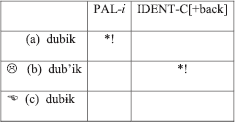
Both (7b) and (7c) satisfy PAL-i, which asks for agreement in [±back] between the consonant and the vowel. Candidate (7b) solves this problem by palatalizing the consonant, so the feature [+back] on the input /b/ is changed into [–back] on the output [b']. However, candidate (7c) is just as successful yielding to the demands of PAL-i. The output [bɨ] satisfies PAL-i since both the consonant and the vowel are [+back]Footnote 8 because the feature [+back] has spread from the consonant to the vowel producing vowel retraction: /i/ → [ɨ]. Vowel retraction violates IDENT-V[–back].
(8) IDENT-V[–back]
[–back] on the input vowel must be preserved as [–back] on an output correspondent of that vowel.
The ranking IDENT-V[–back] > > IDENT-C[+back] derives the correct palatalization effect. The evaluation in (7) is now corrected as follows (the right-pointing hand &rightpindex; indicates the desired winner):
(9) /dub + ik/ → [dub'ik]
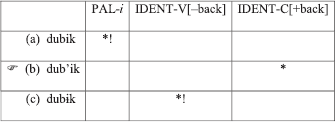
With this background, I turn to the analysis of soft labials in Kurpian. Since the effects of labial palatalization in Kurpian are different with stops, nasals and fricatives, each of these classes of segments is considered in a separate section.
2. Labial stops
Kurpian is a dialect of Polish spoken in Kurpia in northern Poland. Even though Kurpia is inhabited by some 70,000 people, the speakers of the dialect are few in number and are people of the older generation (70 years or older). Therefore, the dialect is on the verge of extinction. However, it should be noted that much effort is now being made to revive the culture and the language of Kurpians.
The literature on Kurpian is minimal. It is limited to one monograph (Friedrich Reference Friedrich1955), one textbook (Rubach Reference Rubach2009) and some brief mentions in books dealing with Polish dialectology, such as Zduńska (Reference Zduńska1965) and Dejna (Reference Dejna1973). Friedrich (Reference Friedrich1955) is a survey of Kurpian as spoken in a number of villages in Kurpia in the 1930s,Footnote 9 when the fieldwork was conducted. The report on the findings contains the basic facts concerning the treatment of soft labials but suffers from the methodology of the 1930s dialectal studies, whereby, among other things, the language is presented by citing isolated examples, with no generalizations or rules that would help construct the grammar. Rubach (Reference Rubach2009) is a textbook of Kurpian, written for Kurpians in order to help them preserve their language. It contains many observations regarding the data but lacks theoretical analysis.
Since the description of Kurpian is incomplete in significant ways,Footnote 10 the primary source of the data for this article is the fieldwork that I conducted over the period of ten years. The dialect under analysis is that of Central Kurpian, spoken in the area extending from Lelis to Myszyniec and Zaręby.Footnote 11
Kurpian exhibits an entirely productive palatalization process illustrated in (10), whereby dental consonants become prepalatal, /s z t d n/ → [ɕ ʑ ʨ ʥ ɲ], and labial stops [p b] change into [pɕ bʑ] before various front vowel suffixes.
- (10)
(a) wagon/wagón [n] ˈcarriageˈ (nom.sg) wagoni+e/wagóń+e [ɲε] (loc.sg)
wagon+ik/wagóń+ïk [ɲi] (dimin)
głos [s] ˈvoiceˈ (nom.sg) głosi+e/głoś+e [ɕε] (loc.sg)
głos+i + k/głoś+ïk [ɕi] (dimin)
właz/włåz [s]Footnote 12 ˈhatchˈ (nom.sg) włazi+e/właź+e [ʑε] (loc.sg)
właz+i + k/właź+ïk [ʑi] (dimin)
sklep [p] ˈstoreˈ (nom.sg) sklepi+e/sklepś+e [pɕε] (loc.sg)
sklep+ik/sklepś+ïk [pɕi] (dimin)
(b) dziad/dźåd [t] ˈold manˈ (nom.sg) dziadzi+e/dźadź+e [ʥε] (loc.sg)
dziadz+in + a/dźadź+ïna [ʥi] (dimin)
chłop [p] ˈmanˈ (nom.sg) chłopi+e/chłopś+e [pɕε] (loc.sg)
chłop+in + a/chłopś+ïn + a [pɕi] (dimin)
bab + a [b] ˈwomanˈ (nom.sg) babi+e/babź+e [bʑε] (loc.sg)
bab+in + a/babź+ïna [bʑi] (dimin)
(c) kwas [s] ˈacidˈ (nom.sg) kwasi+e/kwaś+e [ɕε] (loc.sg)
za + kwas+i/za + kwaś+ï [ɕi] ˈhe makes sourˈ
wóz [s] ˈcartˈ (nom.sg) wozi+e/woź+e [ʑε] (loc.sg)
woz+i/woź+i [ʑi] ‘he transports’
pot [t] ˈsweatˈ (nom.sg) poci+e/poć+e [ʨε] (loc.sg)
poc+i/poć+ï [ʨi] ‘he sweats’
sad/såd [t] ˈorchardˈ (nom.sg) sadzi+e/sadź+e [ʥε] (loc.sg)
sadz+i/sadź+ï [ʥi] ‘he plants’
dzwon/dzwón [n] ˈbellˈ (nom.sg) dzwoni+e/dzwóń+e [ɲε] (loc.sg)
dzwon+i/dzwóń+ï [ɲi] ‘he rings’
za + kup [p] ˈshoppingˈ (nom.sg) za + kupi+e/za + kupś+e [pɕε] (loc.sg)
za + kup+i/za + kupś+ï [pɕi] ˈhe buysˈ
ślub [p] ˈweddingˈ (nom.sg) ślubi+e/ślubź+e [bʑε] (loc.sg)
po + ślub+i/po + ślubź+ï [bʑi] ˈhe marriesˈ
The prepalatal fricatives [ɕ ʑ] in the clusters [pɕ bʑ] and the [ɕ ʑ] derived from /s z/ in (10) are identical. The reason is that native speakers judge the consonant clusters in (11) as containing the same segments [ɕ ʑ], even though the source of these segments is different.
(11) nom.sgloc.sggloss
(a) klaps [ps] klapsi + e/klapś + e [pɕ] ˈsmackˈ
sklep [p] sklepi + e/sklepś + e [pɕ] ˈstoreˈ
(b) kabz + a [bz] kabzi + e/kabź + e [bʑ] ˈpurseˈ
bab + a [b] babi + e/babź + e [bʑ] ˈwomanˈ
The [ɕ ʑ] in [pɕ] and [bʑ] of klapsi+e/klapś+e (loc.sg) and kabzi+e/kabź+e (loc.sg) are related to [s z] while the [ɕ ʑ] in [pɕ] and [bʑ] of sklepi+e/sklepś+e (loc.sg) and babi+e/babź+e (loc.sg) are related to [p b].
The alternations between [s z t d n] and [ɕ ʑ ʨ ʥ ɲ] in (10) are classic instances of palatalization, a process that Kurpian shares with Standard Polish. In contrast, the alternations between [p b] and [pɕ bʑ] are new and specific to Kurpian. The question is how the relationship between [p b] and [pɕ bʑ] should be analyzed.Footnote 13
A referee asks whether labial alternations can be analyzed in terms of epenthesis. Indeed, we appear to be looking at a process of insertion because single segments, [p b], that are not contextually restricted alternate with clusters, [pɕ bʑ], that are contextually restricted to the palatalization environment. Looking at sklep ‘store’ (nom.sg) – sklepi+e/sklepś+e (loc.sg), the scenario for the epenthesis analysis is as follows. The putative epenthetic [ɕ] is a response to two constraints: PAL-e and *SOFT-LAB. PAL-e outlaws the faithful candidate [sklεp + ε] because [p] has not been palatalized by the front vowel [ε]. The palatalization option /p/ → [p'] is closed by the segment markedness constraint *SOFT-LAB, which accounts for the distributional generalization that [p' b' m' f' v'] are not attested in the surface representation in Kurpian.
(12) *SOFT-LAB: Don't be a palatalized labial.
While the combined action of PAL-e and *SOFT-LAB eliminates [sklεpε] and [sklεp'ε] as winners, nothing in the analysis so far excludes [sklεpʨε] that satisfies both of these constraints. The answer lies with syllable structure.
Given the choice between the output candidates [sklε.pɕε]Footnote 14 and [sklε.pʨε], where a dot marks a syllable boundary, the grammar prefers the former to the latter because [pʨ], unlike [pɕ], violates the Sonority Sequencing Generalization. This constraint, first stated by Jespersen (Reference Jespersen1904) and elaborated in Selkirk (Reference Selkirk, Aronoff and Oehrle1982), requires that sonority must decrease as we move away from the nucleus.
(13) Sonority Sequencing Generalization (SSG)
Segments in syllable margins that are closer to the nucleus must have greater sonority than segments that are further away from the nucleus.
SSG gives the syllable structure schema that has stops as the outward consonants:
Stop Fricative Nasal Liquid Vowel Liquid Nasal Fricative Stop
SSG is not one constraint but a family of constraints that regulate the well-formedness of syllable margins (Prince & Smolensky Reference Prince and Smolensky2004). The constraints relevant for this article are stated informally in (14).
- (14)
(a) *SSG(Sonor-Obstr)
Sonorants cannot be further away from the vowel than obstruents.
(b) *SSG(Plateau)
No segments of the same sonority class in a syllable margin.
(c) *SSG(Fric-Stop)
Fricatives cannot be further away from the vowel than stops.
Kurpian, like Standard Polish, maximizes onsets, an effect of NO-CODA (syllables cannot have codas) > >*COMPLEX-Onset (no complex onsets). Consequently words such as dobry ‘good’, butla ‘bottle’, jasny ‘bright’, and łatwy ‘easy’ are syllabified [dɔ.brɨ], [bu.tla], [ja.snɨ], and [wa.tfɨ], respectively. Onset maximization is thwarted by *SSG(Sonor-Obstr), so karta ‘card’ and banda ‘gang’ are syllabified [kar.ta] and [ban.da], respectively, an effect of *SSG(Sonor-Obstr) > >NO-CODA.Footnote 15 In contrast, *SSG(Plateau) and *SSG(Fric-Stop) do not have the power to override NO-CODA, so kaptur ‘hood’, pochwa ‘sheath’, dumny ‘proud’, pusty ‘empty, and kośćce ‘skeletons’ are syllabified [ka.ptur], [pɔ.xfa], [du.mnɨ], [pu.stɨ], and [kɔ.ɕʨtsε], respectively. This generalization is expressed by the ranking: NO-CODA > >*SSG(Plateau), *SSG(Fric-Stop).
Returning to the choice between [sklε.pɕε] and [sklε.pʨε] debated earlier, the candidate [sklε.pʨε] violates *SSG(Plateau) because stops and affricates are in the same sonority class. In contrast, the competitor [sklε.pɕε] has a perfect sonority slope with the fricative being closer to the vowel than the stop and hence is preferred by the grammar.
A further question is what ensures that it is [ɕ] rather than [ʑ] that is inserted in /sklεp + ε/ → [sklεpɕε]. The answer is that [sklεpʑε] is suboptimal from the point of view of Voice Assimilation, which is expressed by a standard AGREE[±voice] constraint that mandates agreement in voicing in obstruent clusters.Footnote 16
The success of the epenthesis analysis with the candidates considered thus far is demonstrated by the evaluation in (15). For this analysis to work, DEP-Seg that penalizes insertion must be ranked low.
(15) /sklεp + ε/ → [sklε.pɕε] (epenthesis analysis)
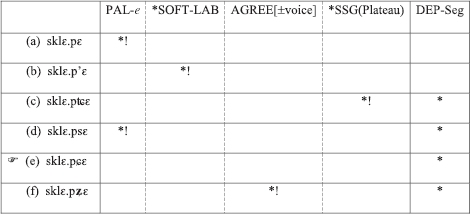
Candidate (15d) has inserted [s] rather than [ɕ], which appears to be a better choice because [s] is less marked than [ɕ]. However, [sklεpsε] fails on PAL-e. In general, the dominant ranking of PAL-e restricts the class of viable epenthetic segments to those that carry the feature [–back] and hence satisfy PAL-e. In Kurpian, this class includes [ɕ ʑ ʨ ʥ ɲ j].Footnote 17
A little problematic for the epenthesis analysis are candidates containing sonorants, such as [sklεpɲε]. They could be eliminated by AGREE[±sonor], but this constraint cannot be motivated independently. AGREE constraints, for example, AGREE[±voice] or AGREE(Place), have a solid basis in spreading operations but the putative AGREE[±sonor] does not. On the contrary, since [±sonor] is part of the Root node in feature geometric representations, it is predicted not to spread in all cases except Complete Assimilation (McCarthy Reference McCarthy1988), as in English /ɪn/ → [ɪl] in il+legal (with further degemination to [ɪ]).
Finally, the question is how the epenthesis analysis can exclude the candidate [sklεɕε] in which /p/ has changed into [ɕ].Footnote 18 A referee suggests that the desired result can be achieved by recruiting MAX(Lab), a constraint of the MAX-Feature family.Footnote 19 MAX-F constraints demand that the feature F must surface in the output candidate but do not specify the segment on which F should surface. The absence of this specification constitutes the main difference between MAX-F constraints and IDENT constraints since the latter mandate that the feature F must be found on a surface correspondent of the input segment.
In the case at hand, MAX(Lab) delivers the correct result because the candidate [sklεɕε] contains no LABIAL and hence is eliminated. Problematic for MAX(Lab) are words containing a labial in a different locus than the one exhibiting an alternation, such as babi+e/babź+e, the loc.sg of bab+a ‘woman’. The desired winner is [babʑε]. The problem is that MAX(Lab) cannot eliminate the candidate [baʑε] which is parallel to the candidate [sklεɕε], the reason being that [baʑε] satisfies MAX(Lab) because [Labial] occurs on the initial segment. I conclude that MAX(Lab) is inadequate and the MAX-F analysis of Kurpian labial alternations is on the wrong track. I argue later that the correct analysis must use IDENT constraints.
The epenthesis analysis runs into analytical difficulties with words such as those in (16).
(16) fem.nom.sgdat.sggloss
szaf + a/saf + a [f] szafi + e/saś + e [ɕ] ‘wardrobe’
traw + a/tråw + a [v] trawi + e/tråź + e [ʑ] ‘grass’
słom + a/słóm + a [m] słomi + e/słóń + e [ɲ] ‘straw’
The problem is that the epenthesis analysis cannot distinguish between the desired winners and a host of the competitors listed in (17).
(17) desired winner undesired winners
[saɕε] [saʑε], [saʨε], [saʥε], [saɲε], [sajε]
[trαʑε] [trαɕε], [trαʨε], [trαʥε], [trαɲε], [trαjε]
[swoɲε] [swoɕε], [swoʑε], [swoʨε], [swoʥε], [swojε]
The undesired winners in (17) as well as the attested outputs all satisfy PAL-e and *SOFT-LAB. They also fare equally well on SSG constraints because the relevant onsets are simple. Further, there is no sense in which AGREE constraints could discriminate between the candidates since the inserted segments are intervocalic and do not occur in clusters.
The correct generalization is that the winners in the output must inherit the features of the source segments in the input. This generalization is readily captured by IDENT constraints but they, by definition, have no jurisdiction over epenthetic segments as such segments do not enter into correspondence relations between the input and the output. I conclude that the epenthesis analysis is incorrect, which raises the question of what underlying representations should be posited for labial palatalization morphemes.
As noted in (1) above, labial palatalization alternations occur not only at morpheme boundaries, as in the examples considered in this section, but also morpheme-internally. To avoid repetitiveness, I discuss stops, nasals and fricatives together because the line of argumentation is the same for all types of labials. I conclude that morpheme-internal alternations present evidence for underlying soft labials /p' b' m' f' v'/. The derivation of surface forms involves absolute neutralization in the sense of Kiparsky (Reference Kiparsky and Fujimura1973) because soft labials never occur phonetically in Kurpian.
Morpheme-internal alternations are caused by vowel deletion.
(18) nom.sggen.sggloss
pies/pśes [pɕεs] ps + a [psa] ‘dog’
hufiec/huśec [xuɕεts] hufc + a [xuftsa] ‘detachment’
owies/łoźes [wɔʑεs] ows + a/łows + a [wɔfsa] ‘oats’
Niemiec/Ńëńec [ɲəɲεts] Niemc + a/Ńëmc + a [ɲəmtsa] ‘German’ (N)
The pattern of vowel – zero alternations in (18) is an effect of Yer Vocalization and Yer Deletion, the renowned processes of Slavic languages that affect a subclass of mid vowels called ‘yers’. Since some but not all mid vowels alternate with zero, yers must be distinct in the underlying representation from non-alternating mid vowels. The details of the analysis need not concern us here.Footnote 20 Suffice it to say that, descriptively, yers vocalize (that is, appear in the surface representation) if they are in the final syllable of the word and delete in all other contexts. Following the Slavic tradition, I transcribe yers as capital letters. Schematically:
(19) Yer Vocalization
E → ε in the final syllable
Yer Deletion
E → Ø
The operation of these processes is illustrated in (20).
(20) kufel [kufεl] ‘mug’ (nom.sg) – kufl + a [kufla] (gen.sg): vowel – zero alternation, hence a yer stem
/kufEl/ → [kufεl] by Yer Vocalization (final syllable)
/kufEl + a/ → [kufla] by Yer Deletion (non-final syllable)
Note that the /f/ of kufel ‘mug’ does not palatalize to [ɕ] before [ε], so kufel [f] (nom.sg) – kufl+a [f] (gen.sg) contrasts with hufiec/huśec [ɕ] ‘detachment’ – hufc+a [f] (gen.sg) listed in (18). The observation is that palatalization before [ε] morpheme-internally is unpredictable. This generalization extends to all consonants, not just labials, and is true regardless of whether [ε] derives from the yer /E/ or from the ‘full’ vowel /ε/, that is, the /ε/ that does not alternate with zero.
(21) palatalizationno palatalization
pies/pśes [pɕε] ‘dog’ cypel [pε] ‘promontory’Footnote 21
piekł + o/pśekł + o [pɕε] ‘hell’ perł + a [pε] ‘pearl’
bieg/bźég [bʑe] ‘run’ (N) bel + a [bε] ‘log’
mieszkać/ńeskać [ɲε] ‘live’ mew + a [mε] ‘sea-gull’
siek + a+ć/śek + a+ć [ɕε] ‘chop’ sekund + a [sε] ‘second’
ziew + a+ć/źew + a+ć [ʑε] ‘yawn’ żegn + a+ć/zegn + a+ć [zε] ‘bless’
ciekaw + y/ćekaw + y [ʨε] ‘interesting’ temat [tε] ‘subject’
dzieł + o/dźeł + o [ʥε] ‘work’ deszcz/desc [dε] ‘rain’
nie/ńe [ɲε] ‘no’ nerw/nérw [ne] ‘nerve’
These data highlight two points. First, the contrast between palatalization and its absence must be encoded in the underlying representation. Second, PAL-e is inert before morpheme-internal [ε]. Since, as documented earlier, palatalization before [ε] is perfectly productive across morpheme boundaries, PAL-e is a derived environment generalization.Footnote 22
Given that Palatalization must be encoded in underlying representations,Footnote 23 the simplest assumption is that soft consonants attested in the surface representation are present in the underlying representation. This is uncontroversial for non-alternating forms such as ciekaw+y/ćekaw+y [ʨε] ‘interesting’ and mieszk+a+ć/ńesk+a+ć [ɲε] ‘live’ which can derive from the identical underlying representations /ʨε/ and /ɲε/, respectively. However, the alternating forms exemplified in (18) are problematic.
If the underlying representations of, for example, pies/pśes [pɕεs] ‘dog’ and hufiec/huśec [xuɕεts] ‘detachment’ are simply /pɕEs/ and /xuɕEts/ (these are yer stems), the question is how [p] and [f] are derived in the gen.sg forms ps+a [psa] and hufc+a [xuftsa].
Problematic for this analysis are the output candidates [pɕsa] and [xuɕtsa]. If we include the nasals, as in Niemiec/Ńëmec [ɲəɲεts] ‘German’ (nom.sg) – Niemc+a/Ńëmc+a [ɲəmtsa] (gen.sg), the alternation [ɲ] – [m] is also a problem because [m] cannot be derived from the putative underlying /ɲ/. The clusters and the contrasts in (22) make this point clear.
- (22)
(a) kiepściutki/kepśćutky [pɕʨ] ‘miserable’
kształt/kśtałt [kɕt] ‘shape’
gźdź + é + ć [gʑʥ] ‘burn’ (no corresponding word in Standard Polish)
pstr + y [pstr] ‘gaudy’
wskrzes + i+ć/wskrześ + é + ć [fskʃ] ‘resurrect’
(b) hufiec/huśec [xuɕεts] ‘detachment’ (nom.sg) – hufc + a [xuftsa] (gen.sg)
vs.
półpasiec/półpaśec [powpaɕεts] ‘shingles’ (nom.sg) – półpaśca [powpaɕtsa]Footnote 24
(c) Niemiec/Ńëńec [ɲəɲεts] ‘German’ (N; nom.sg) – Niemc + a/Ńëmc + a [ɲəmtsa] (gen.sg)
vs.
kaganiec/kagańec [kagaɲεts] ‘muzzle’ (nom.sg) – kagańc + a [kagaɲtsa] (gen.sg)
Looking at the complexity of the clusters in (22a), it is hard to imagine what deletion process would ban the cluster in the undesired winner [pɕsa], ps+a ‘dog’ (gen.sg).Footnote 25 Similarly, there is nothing wrong with the cluster [pɕn] and yet this cluster would have to be banned in the candidate [pɕɲa] if the underlying representation of pień/pśëń [pɕəɲ] ‘trunk’ (nom.sg) – pni+a/pń+a [pɲa] (gen.sg) contained /pɕ/. By the same reasoning, hufiec/huśec ‘detachment’ in (22b) and Niemiec/Ńëńec ‘German’ in (22c) cannot have underlying /ɕ/ and /ɲ/, respectively, because the putative processes ɕ → f and ɲ → m are belied by the contrasts in półpaśca [ɕts] ‘shingles’ in (22b) and kagańca ‘muzzle’ in (22c). I conclude that the palatalization alternants [pɕ], [ɕ] and [ɲ] cannot be posited in the underlying representation. Since the hard alternants [p m f] cannot underlie the alternation either,Footnote 26 the underlying representation must include soft labials /p' f' m'/, so, for example, pies/pśes ‘dog’ derives from underlying /p'Es/. Postulating soft labials here is motivated by two observations. First, labials are attested in surface forms: [p], [f] and [m] occur in the gen.sg ps+a ‘dog’, hufc+a ‘detachment’ and Niemc+a/Ńëmc+a ‘German’. Second, morpheme-internal palatalization before [ε] is unpredictable and, consequently, must be encoded in the underlying representation.
Soft labials exist in the underlying representation but are not found in the surface representation, which is an effect of the undominated *SOFT-LAB that leads to absolute neutralization in the sense of Kiparsky (Reference Kiparsky and Fujimura1973). However, when soft labials disappear, they always leave a trace in the surface representation.
(23) /p' b'/ → [pɕ bʑ]
preserved properties: [–back] for palatalization, obstruent, the value for [±voice]
/m'/ → [ɲ]
preserved properties: [–back] for palatalization, sonorant, nasal
/f' v'/ → [ɕ ʑ]
preserved properties: [–back] for palatalization, obstruent, the value for [±voice]
It is the job of IDENT constraints to ensure that the properties of the input are preserved in the output, so the correct analysis of labial palatalization is in terms of IDENT constraints. The question is how the particular changes in (23) can be executed in OT. In the remainder of this section, I focus on /p' b'/ → [pɕ bʑ]. The discussion of /m'/ → [ɲ] and /f' v'/ → [ɕ ʑ] is postponed till Sections 3 and 4.
Given the prominent role of IDENT constraints, [pɕ bʑ] are obtained from /p' b'/ by decomposition (fission), whereby the input segment is split into two correspondents in the output. Decomposition violates INTEGRITY.
(24) INTEGRITY (INT)
No multiple correspondents of an input segment.
The goal of decomposition as a strategy for removing an undesired segment, the palatalized [p'] in pies/pśes ‘dog’, underlying /p'Es/, is to yield an output in which the undesired segment does not occur. When executing this task, the grammar works under the obligation that the properties of the input segment cannot be lost. The consequence is that the output has two correspondents of the input segment, each carrying a different property contained in the source segment in the input. Thus, in p' → pɕ, /p'Es/ → [pɕεs], the LABIAL property of the input is retained on the [p] part of the cluster while the [–back] property (palatalization) is represented as [ɕ]. Struijke (Reference Struijke2000) points out that decomposition leads the ‘the emergence of the unmarked’ (TETU), an idea that goes back to McCarthy & Prince (Reference McCarthy and Prince1994; see also Rubach Reference Rubach2008b). A TETU effect consists in the preservation of the properties of the input in output correspondents that are less marked than the input. In the instance at hand, [p] is less marked than [p']. The choice of [ɕ] as the other correspondent of /p'/ may appear to be less obvious but, given that the correspondent must be an obstruent and that it must preserve palatalization as well as the value for [±voice], [ɕ] is in fact the optimal output from the point of view of the Kurpian obstruent inventory that includes [ɕ ʑ ʨ ʥ].Footnote 27
The generalization that under decomposition output correspondents preserve the properties of their input is expressed by IDENT constraints. For /pˈ/ → [pɕ], the relevant constraints are those in (25).Footnote 28 Their statement makes the standard assumption that correspondence is bidirectional (McCarthy & Prince Reference McCarthy, Prince, Beckman, Dickey and Urbanczyk1995): a feature found in the input is also found in the output, and, conversely, a feature found in the output is also found in the input.
- (25)
(a) IDENT[–back]
Correspondent segments in the input and the output are [–back].
(b) IDENT(Lab)
Correspondent segments in the input and the output are LABIAL.
Counter to expectation, the constraint system worked out so far does not yield the correct result for soft labial decomposition, as shown in (26), where I look at the evaluation of pies/pśes /p'Es/ ‘dog’. As observed earlier, PAL-e is inactive morpheme-internally, so it is omitted. Integers keep tally of correspondence.
(26) /pˈ1E2s3/ → [p1ɕ1ε2s3] (failed evaluation)
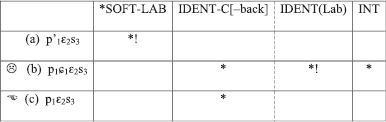
Candidate (26b) violates IDENT-C[–back] on the [p] part of the cluster because [p] is not soft and IDENT(Lab) on the [ɕ] part of the cluster because [ɕ] is not labial. There is no ranking of the constraints in (26) that could deliver the correct result. The reason is that candidate (26b), the desired winner, has a superset of the violations of candidate (26c), the wrong winner.
The source of the problem in (26) is the statement of the IDENT constraints in (25). These constraints are bidirectional, so the input and the output must match in the relevant property. This is a problem because, by definition, decomposition yields correspondents that are partially but not fully faithful to the input. The solution is to assume that IDENT constraints are unidirectional, as suggested by Pater (Reference Pater, Kager, van der Hulst and Zonneveld1999). Specifically, they mandate the preservation of a feature in an output correspondent without requiring that the feature identity be bidirectional: from the input to the output and from the output to the input. The constraints in (25) are now restated in (27).
- (27)
(a) IDENT-C[–back]
[–back] on the input consonant must be preserved as [–back] on an output correspondent of that consonant.
(b) IDENT(Lab)
LABIAL on the input consonant must be preserved as LABIAL on an output correspondent of that consonant.
As the word ‘preserve’ suggests, the direction of identity is from the input to the output, which is marked as I → O, but I will ignore this marking and assume that it is the default specification.
The evaluation in (26) is now corrected as follows.
(28) /pˈ1E2s3/ → [p1ɕ1ε2s3]
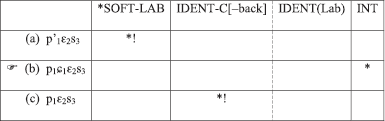
Candidate (28b) does not violate IDENT-C[–back] because the [–back] property of the input /p'/ is preserved on [ɕ]. Neither does it violate IDENT(Lab) because the LABIAL property of the input is preserved on [p]. However, it violates INT because the input /p'/ has two correspondents in the output: [p1ɕ1].
The analysis of /p'/ → [pɕ] is not complete yet. We need to make sure that both correspondents of /p'/ are obstruents, so that the candidates [p1ɲ1] and [p1j1] are excluded.
The relevant constraint is the (O)utput → (I)nput IDENT in (29).
(29) O → IIDENT[±sonor]
[±sonor] on an output segment must be found on the input correspondent of that segment.
The constraint is violated if the value for [±sonorant] in the output is not matched in the input. For example, the candidate containing [p1ɲ1] from the input /p'1/ satisfies O → IIDENT[±sonor] on the [p1] part but violates it on the [ɲ1] part because [ɲ1] is a sonorant while /p'1/ is an obstruent. The same would be true for any other sonorant correspondent of /p'1/ such as [p1j1].
The foregoing discussion is illustrated by the evaluation of pies/pśes /p'Es/ ‘dog’ in (30). INT is a dominated constraint in order to permit decomposition in the desired winner.
(30) /p'1E2s3/ → [p1ɕ1ε2s3]
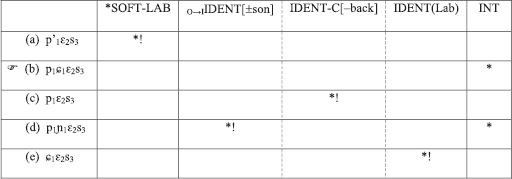
Candidate (30a) violates *SOFT-LAB because it has [p']. IDENT-C[–back] and IDENT(Lab) eliminate candidates (30c) and (30e), respectively, since [p1ε2s3] has lost the palatalization property of /p'/ and [ɕ1ε2s3] has failed to preserve the labiality. Candidate (30d) has [ɲ] whose input correspondent is /pˈ/, so it loses by O → IIDENT[±son].Footnote 29
An outstanding question is what constraint guarantees that /p'1/ is decomposed into [p1ɕ1] and not into [ɕ1p1]. The answer is that it is *SSG(Fric-Stop) stated earlier in (14c). The tableau in (31) looks at the relevant candidates.
(31) /p'1E2s3/ → [p1ɕ1ε2s3]
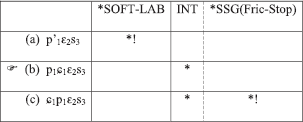
Candidates (31b) and (31c) pay tribute to the IDENT constraints and to *SOFT-LAB, but (31c) violates *SSG(Fric-Stop) since a fricative is further away from the nucleus than a stop. *SSG(Fric-Stop) acts here as a constraint producing a TETU effect in the sense that it makes a choice between the candidates that are otherwise identical and points to the less marked output. To perform this function, *SSG(Fric-Stop) can be ranked anywhere in the tableau, including the lowest position.
The discussion of /p'1E2s3/ → [p1ɕ1ε2s3] has clarified the mechanics of decomposition but it has not addressed the problem of the [pɕ] – [p] alternation in [pɕεs] (nom.sg) – [ps + a] (gen.sg). The system of the constraints developed thus far cannot account for this alternation, as (32) shows. I look at the relevant candidates and the relevant constraints only.
(32) /p'1E2s3 + a4/ → [p1s3a4] (failed evaluation)
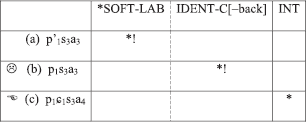
The observation is that /p/ decomposes into [pɕ] before vowels, /p'1E2s3/ → [p1ɕ1ε2s3], but depalatalizes to [p] before consonants, /p'1E2s3 + a4/ → [p1s3a4]. To account for this generalization, I adopt the proposal put forward in Rubach (Reference Rubach2008b) that the prevocalic context is a position of faithfulness privilege.Footnote 30
(33) IDENT-C[–back]Prevocalic
[–back] on the input consonant must be preserved in an output correspondent of that consonant before a vowel.
In accordance with the principles of positional faithfulness, the positional faithfulness constraint, here IDENT-C[–back]Prevocalic, must be ranked above the generic constraint, here IDENT-C[–back].
The evaluations of /p'1E2s3/ → [p1ɕ1ε2s3] and /p'1E2s3 + a4/ → [p1s3a4] are now as follows.
- (34)
(i) /p'1E2s3/ → [p1ɕ1ε2s3]
(ii) /p'1E2s3 + a4/ → [p1s3a4]
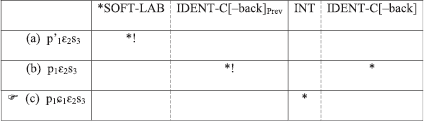
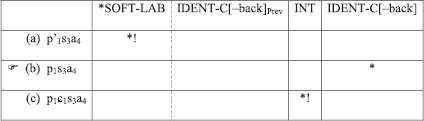
As shown by (34ii), INT must outrank the generic IDENT-C[–back], so that candidate (34ii-c) loses to candidate (34ii-b), the desired result.
The analysis of soft labial alternations becomes more complex than presented thus far when we consider palatalization before yers, i.e. the vowels that vocalize in the last syllable of the word and delete in all other contexts. The data in (35) show that palatalization occurs not only before vocalized yers that are represented on the surface as [ε] but also before unvocalized yers, that is, the yers that are deleted in the surface representation. The examples in (35) all have a morpheme boundary between the consonant and the yer E, so palatalization is executed by PAL-e. The yer suffix is /Ets/, as shown by the alternations.Footnote 31
(35) /s/ → [ɕ]
pas [s] ‘waist’ pół + pasi+ec/półpaś+ec [ɕε] ‘shingles’ (nom.sg)
pół + paś + c+a [ɕts] (gen.sg)
/st/ → [ɕʨ]
(2) czyst + y/cyst + y [st] ‘clean’ czyści+ec/cyść+ec [ɕʨε] ‘purgatory’ ‘clean’ (nom.sg)
czyść+c + a/cyść+c + a [ɕʨts] (gen.sg)
(3) /zd/ → [ʑʥ] / [ɕʨ] (Voice Assimilation)
(4) jazd + a [zd] ‘ride’ (N; nom.sg) jeździ+ec/jeźdź+ec [ʑʥε] ‘rider’ (nom.sg)
jeźdź+c + a [ɕʨts] (gen.sg)
The evaluations in (36) demonstrate that the grammar can derive the correct form when the yer has vocalized (36i) but not when the yer has deleted (36ii). I look at the relevant fragment of pół+pasi+ec/pół+paś+ec ‘shingles’ (nom.sg) – pół+paś+c+a (gen.sg). Palatalization causes a violation of IDENT-C[+back], which mandates the preservation of the underlying hard consonant.
- (36)
(i) /pas + Ets/ → [paɕεts]
(ii) /pas + Ets + a/ → [paɕtsa] (failed evaluation)
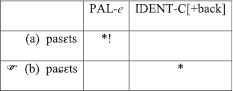
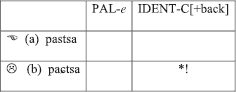
Standard OT fails to select the correct candidate in (36ii) because the front vowel has been deleted and hence PAL-e has no force. To solve the problem, we need a theory that can handle opacity. The choice of the theory is prompted by the observation that there is no palatalization at the prefix-stem juncture, even though the derived environment condition (the presence of a morpheme boundary) is fulfilled, so PAL-e should apply.
(37) z+elektryzować /zε/ = [zε] ‘galvanize’
vs. koz + a [z] ‘goat’ – kozi+e/koź+e (loc.sg): /z + ε/ → [ʑε]
The apparently contradictory behavior of /z + ε/ in (37) is exactly what Derivational Optimality Theory (DOT henceforth) predicts. DOT called also Stratal OT assumes that evaluation proceeds in steps called levels (Kiparsky Reference Kiparsky1997, Reference Kiparsky2000; Rubach Reference Rubach and Roca1997, Reference Rubach2000a, Reference Rubach2000b, Reference Rubach2003a, Reference Rubach2003b; Bermúdez-Otero Reference Bermúdez-Otero1999, and others). A language may make use of three levels defined in terms of morphological domains: the stem level, the word level and the postlexical level (Kiparsky Reference Kiparsky2000).Footnote 32 From the perspective of Slavic languages, the stem level comprises roots and suffixes while the word level extends this domain to prefixes (Rubach Reference Rubach2003a). The postlexical level, uncontroversially, covers the domain of sentences. The winning candidate from level 1 becomes the input to level 2, and the winning candidate from level 2 is the input to level 3. Constraints may be reranked between the levels but the reranking is minimal (Rubach Reference Rubach2000b).
DOT has no difficulty solving the contradictory behavior of PAL-e in (37): palatalization at the root + suffix juncture in kozi+e/koź+e ‘goat’ (loc.sg) but no palatalization at the prefix + stem juncture in z+elektryzować ‘galvanize’. The analysis is that PAL-e is active at level 1 (root + suffixes) but not at level 2 (prefix + stem). This generalization is captured by the reranking of PAL-e and IDENT-C[+back].
(38) Level 1: PAL-e > > IDENT-C[+back]
Level 2: IDENT-C[+back] > > PAL-e
The failed analysis in (36ii) is now repaired as follows. Palatalization is executed at level 1, at which all yers are kept. Yer Vocalization E → ε, and Yer Deletion, E → Ø, operate at level 2.Footnote 33 The preservation of [ɕ] from level 1 at level 2 is enforced by IDENT-C[–back].
(39) Level 1: /pas + Ets + a/ → [paɕEtsa]Footnote 34
Level 2: /paɕEtsa/ → [paɕtsa]
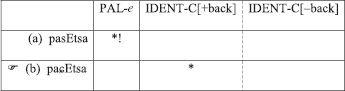
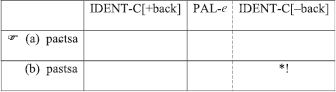
In the case of prefixes, z+elektryzować ‘galvanize’, the analysis follows from DOT architecture. Since level 1 is the stem + suffixes level, prefixes are first considered at level 2 but at level 2 PAL-e has been reranked below IDENT-C[+back] and hence is inactive. Consequently, the input [z + ε] surfaces faithfully as [zε], the correct result.
Returning to underlying soft labials, the question is how they are analyzed in a two level phonology of Kurpian. The answer is that the [pɕ] – [p] alternation in pies/pśes /p'Es/ ‘dog’ (nom.sg) – ps+a /p'Es + a/ (gen.sg) is derived at level 2 rather than at level 1. Crucial for this alternation is the depalatalization process, /p'/ → [p], which occurs before a consonant. This context is not available at level 1 because, as noted above, Yer Deletion operates at level 2. Consequently, the winner from level 1 contains the yer in the gen.sg form ps+a [p'Es + a]. At level 2, the yer is deleted, which triggers depalatalization: [p'Es + a] → [psa].
A related question is whether decomposition, /p'/ → [pɕ], as in /p'Es/ → [pɕεs], is a level 1 or a level 2 operation. There is no doubt that decomposition must be held off until level 2. If it had occurred at level 1, the input to level 2 would be [pɕEs + a] for the gen.sg ps+a. Importantly, the [p] and the [ɕ] could no longer be regarded as correspondents of a single segment /p'/ because the derivational history from level 1 is not carried over to level 2. At level 2, [p] and [ɕ] would thus be independent segments. Consequently, the putative derivation of the level 2 input [pɕEs + a] → [psa] would call for ɕ-deletion, but, as documented in (22), this operation cannot be carried out. It is precisely for that reason that the underlying representation of the morpheme ‘dog’ must be /p'Es/, with a soft labial, rather than /pɕEs/, with a cluster of consonants.
Since decomposition must be blocked at level 1, INT, the constraint that penalizes decomposition, needs to be ranked above *SOFT-LAB. Given this ranking, the optimal outputs for /p'Es/ and /p'Es + a/ are the fully faithful candidates [p'Es] and [p'Esa]. At level 2, INT and *SOFT-LAB are reranked, enabling decomposition.
(40) Level 1: INT > > *SOFT-LAB
Level 2: *SOFT-LAB > > INT
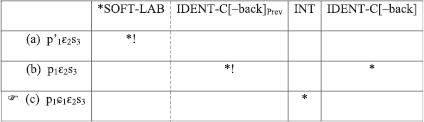
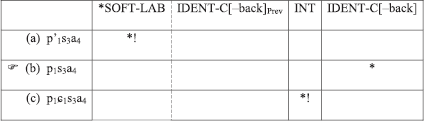
The analysis of pies/pśes (nom.sg) and ps+a (gen.sg) is now as follows. PAL-e is inactive morpheme-internally, and hence is not shown in (41). The ranking INT > >IDENT-C[–back] becomes essential for the derivation of ps+a at level 2.
(41) Level 1:
(i) /p'1E2s3/ → [p'1E2s3] (no change)
(ii) /p'1E2s3 + a4/ → [p'1E2s3a4] (no change)
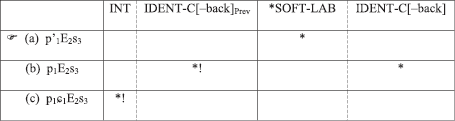
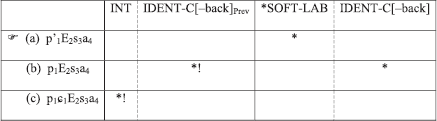
Level 2:
(i) [p'1E2s3] → [p1ɕ1ε2s3]
(ii) [p'1E2s3 + a4] → [p1s3a4]
Words in which a labial occurs across a morpheme boundary before a yer show the prominent role of PAL-e in soft labial conspiracy because PAL-e is a derived environment constraint. Below I look at the suffix /Ets/.Footnote 35
(42) kup + owa + ć[p] ‘to buy’ kupi+ec/kupś+ec[pɕ + εts] ‘buyer’ (nom.sg)
kup+c+a [p + ts + a] (gen.sg)
skarb/skårb [p] ‘treasure’ skarbi+ec/skarbź+ec [bʑ + εts] ‘treasury’ (nom.sg)
skarb+c+a [p + ts + a]Footnote 36
The underlying representation of kupi+ec/kupś+ec ‘buyer’ (nom.sg) is /kup + Ets/, with a hard /p/ attested in kup+owa+ć ‘to buy’. Palatalization, p → p', is enforced by PAL-e at level 1. In [kup' + Ets], decomposition ensues at level 2, exactly as is the case in (41). In [kup' + Ets + a], we witness depalatalization. As noted earlier, PAL-e is active at level 1, an effect of PAL-e > > IDENT-C[+back], *SOFT-LAB, but inactive at level 2, where it is reranked below IDENT-C[+back].
(43) Level 1:
(i) /k1u2p3 + E4ts5/ → [k1u2p'3E4ts5]
(ii) /k1u2p3 + E4ts5 + a6/ → [k1u2p'3E4ts5a6]
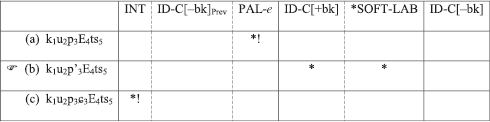
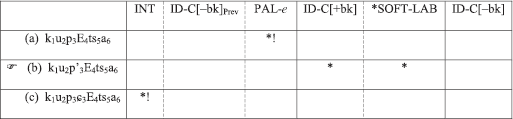
Level 2:
(i) [k1u2p'3E4ts5] → [k1u2p3ɕ3ε4ts5]
(ii) [k1u2p'3E4ts5a6] → [k1u2p3ts5a6]
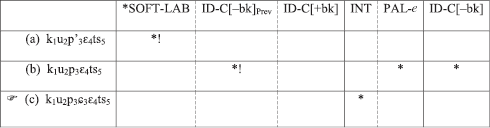
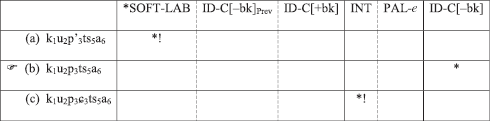
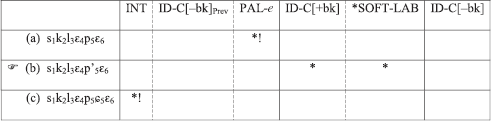
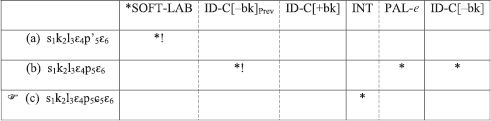
Finally, I return to the evaluation of sklepi+e/sklepś+e ‘store’ (loc.sg) discussed earlier in (15) prior to the conclusion that soft labial conspiracy must be analyzed in terms of decomposition and level ordered phonology. In all relevant ways, the derivation of sklepi+e/sklepś+e is parallel to the derivation of kupi+ec/kupś+ec ‘buyer’ in (43).
(44) Level 1: /s1k2l3ε4p5 + ε6/ → [s1k2l3ε4p'5ε6]
Level 2: [s1k2l3ε4p'5ε6] → [s1k2l3ε4p5ɕ5ε6]Footnote 37
To summarize, the analysis of labial stops documents two strategies of the soft labial conspiracy: decomposition and depalatalization. It also supports three theoretical points. First, OT must admit unidirectional IDENT constraints that match inputs and outputs separately from matching outputs and inputs. Second, labial decomposition is a TETU effect. Third, evaluation must proceed in steps, as envisaged by DOT/Stratal OT.
In the remainder of this article, I look at the decomposition of the soft labial nasal (Section 3) and the soft labial fricatives (Section 4). The facts are strikingly different from those discussed in the analysis of soft labial stops but the goal is the same: soft labials must be eliminated from the surface representation.
3. Labial nasal
The effect of decomposition with the nasal input is different from that found in the decomposition of labial stops: /m'/ appears on the surface as a prepalatal nasal [ɲ]. The missing link in the chain m'→mɲ→ɲ is provided by Southern Kurpian, a dialect spoken in the district of Jednorożec in the south of Kurpia.Footnote 38 A comparison of Central Kurpian and Southern Kurpian is instructive because the relationship between [mɲ] and [ɲ] is perfectly systematic.
(45) southern kurpianFootnote 39central kurpianpolish spelling gloss
[mɲastɔ] [ɲastɔ] miasto ˈtownˈ
[ɕmɲawɨ] [ɕɲawɨ] śmiały ˈboldˈ
[zamɲar] [zaɲɑr] zamiar ˈintentionˈ
[mɲɔdɔvɨ] [ɲɔdɔvɨ] miodowy ˈhoneyˈ (Adj)
It can be hypothesized that, historically, Central Kurpian had the system of nasal decomposition as in Southern Kurpian but moved it to a further stage by deleting the labial of the cluster: mɲ→ɲ, a process that I call simplification. The result is that the evidence for nasal decomposition in Central Kurpian appears to have been lost because, synchronically, there is no reason to believe that the words in (45) derive from a representation that is different from that found on the surface. That is, miast+o/ńast+o [ɲast + ɔ] probably comes from underlying /ɲast+ɔ/ ˈtownˈ, a representation that parallels words such as gniazd+o/gńazd+o [gɲazd + ɔ] ˈnestˈ in which [ɲ] comes historically from the dental nasal n.
Counter to what has been said so far, Kurpian (i.e. Central Kurpian) has a live and fully productive system of phonological alternations between [m] and [ɲ].
- (46)
(a) nom.sgloc.sggloss
bram + a [brama] brami + e/brań + e [braɲε] ˈgateˈ
słom + a/słóm + a [swoma] słomi + e/słóń + e [swoɲε] ˈstrawˈ
rozum [rɔzum] rozumi + e/rozuń + e [rɔzuɲε] ˈreasonˈ
(b) strom + y/stróm + y strom + izn + a/stróń + ïzn + a
[stromɨ] ‘steep’ [stroɲizna] ˈsteep slopeˈ
(c) szum/sum szum + i/suń + ï
[sum] ˈnoiseˈ (nom.sg) [suɲi] ˈit makes noiseˈ
Alternations are also found morpheme-internally (47a) and across morpheme boundaries in contexts of Yer Vocalization and Yer Deletion (47b).
(47) nom.sggen.sg
(a) Chamiec/Chańec [xaɲεts] (name) Chamc + a [xamtsa]
Niemiec/Ńëńec [ɲəɲεts] ‘German’ (N) Niemc + a/Ńëmc + a [ɲəmtsa]
(b) tasiemi + ec/taśëń + ec [taɕəɲεts] ‘tapeworm’ tasiem + c+a/taśëm + c+a [taɕəmtsa]
sami + ec/sań + ecFootnote 40 [saɲεts] ‘male’ sam + c+a [samtsa]
These words constitute evidence that the alternation comes either from underlying /m'/ (47a) or from [m'] that is produced at an intermediate stage of derivation (47b).
Looking at [xaɲεts] – [xamts + a] in (47a), the simplest hypothesis is that the underlying representation contains either /ɲ/ or /m/ as these are the segments attested in the surface representation. However, neither of these hypotheses is true. If the underlying representation has /ɲ/, we have a problem deriving the gen.sg form [xamts + a]. The putative process ɲ → m before a consonant is belied by words such as kaganiec/kagańec [kagaɲεts] ‘muzzle’ (nom.sg) – kagańc+a [kagaɲts + a] (gen.sg) in which underlying /ɲ/ does not change to [m] before a consonant. Neither can /m/ be postulated in the underlying representation of [xaɲεts] since there is no way to enforce the /m/ → [ɲ] change because PAL-e is restricted to derived environments and cannot look inside morphemes.Footnote 41 Consequently, the fully faithful candidate [xamεts] would win in the evaluation, the wrong result.
The solution is to postulate palatalized /m'/ as the underlying source of the [m] – [ɲ] alternation, so Chamiec/Chańec is /xam'Ets/. Underlying /m'/ never appears in the surface representation because it either depalatalizes to [m], Chamc+a (gen.sg), or undergoes decomposition cum simplification and appears as [ɲ]. We are looking here at a case of absolute neutralization that is fully parallel to that of soft labial stops discussed in Section 2 above.
The argument for an intermediate [m'] derived from /m/ through the action of PAL-e is based on examples such as tasiemi+ec/taśëń+ec ‘tapeworm’ (nom.sg) – tasiem+c+a/taśëm+c+a (gen.sg) in (47b). In all essential ways, the reasoning is identical to the argument for intermediate [p'] derived from /p/ in kupi+ec/kupś+ec ‘buyer’ discussed in Section 2. The underlying representation must have hard /m/ rather than soft /m'/ because [m] occurs in the base morpheme taśm+a ‘tape’ (-a is the ending of the feminine nom.sg). The /m/ palatalizes to [m'] at level 1 before the front yer of the suffix /Ets/. Recall from Section 2 that yers trigger palatalization regardless of whether they ultimately surface as [ε] (Yer Vocalization) or not (Yer Deletion). The examples for obstruents given in (35) are now extended to include nasals.
- (48)
(a) wy + gna + n+y [vɨgnanɨ] ‘chased away’; past participle of wy + gna + ć ‘chase away’
(b) wy + gna + ni + ec/wy + gna + ń + ec [vɨgnaɲεts] ‘outcast’ (N; nom.sg)
(c) wy + gna + ń + c+a [vɨgnaɲtsa] ‘outcast’ (gen.sg)
The derivation here is an exact parallel to the derivation of pół+pasi+ec/pół+paś+ec ‘shingles’ (nom.sg) – pół+paś+c+a (gen.sg) in (39) in Section 2. Schematically:
- (49)
(a) Level 1: /vɨ + gna + n+Ets/ → [vɨgnaɲEts] (nom.sg): PAL-e
/vɨ + gna + n+Ets + a/ → [vɨgnaɲEtsa] (gen.sg): PAL-e
(b) Level 2: [vɨgnaɲEts] → [vɨgnaɲεts] (nom.sg): Yer Vocalization
[vɨgnaɲtsa] → [vɨgnaɲtsa] (gen.sg): Yer Deletion
The derivation of tasiemi+ec/taśëm+ec ‘tapeworm’ (nom.sg) – tasiem+c+a/taśëm+c+a (gen.sg) goes through a palatalization stage in an exact parallel to the examples shown in (48). The difference is that soft labials, unlike the soft coronal in (39), cannot maintain palatalization before consonants, so [m'] depalatalizes to [m].
In the remainder of this section, I look at the details of the analysis that derives [ɲ] from the soft labial nasal. I begin with morphemes containing underlying /m'/ and then proceed to morphemes with derived [m']. To make the reading of the transcriptions of output candidates less obtrusive to the eye, I suppress the integers because the correspondence relations between the inputs and the outputs are straightforward.
The morpheme Chamiec/Chańec (name, nom.sg) cited in (47a) is derived from /xam'Ets/. Since palatalization is present in the underlying representation, nothing happens at level 1 and the input to level 2 is the unchanged [xam'Ets]. We need to make sure that the grammar selects [xaɲεts], the attested surface form, as the winner. The hardest competitor to eliminate is [xamɲεts], with the decomposition /m'/ → [mɲ]. Since, as shown by /p' b'/ → [p ɕ bʑ] in Section 2, decomposition is attested in Kurpian, the candidate [xamɲεts] cannot be eliminated by INT, so there must be some other reason why [xamɲεts] is banned from surface representations.
The relevant difference between [pɕ bʑ] and [mɲ] is the fact that [pɕ bʑ] but not [mɲ] form good onsets. The sonority slopes in pies/pśes [pɕεs] ‘dog’ (nom.sg) and babi+e/babź+e [ba.bʑε] ‘woman’ (loc.sg) are ideal, with the fricative being closer to the vowel than the stop. In contrast, the candidate [xa.mɲεts] violates *SSG(Plateau), a constraint that prohibits segments of the same sonority class in syllable margins.Footnote 42 If *SSG(Plateau) outranks IDENT(Lab), [xa.mɲεts] loses to [xa.ɲεts], the desired result. Note that the [ɲ] retains all the properties of the input /m'/ except labiality, so it is a better output correspondent of /m'/ than, for example, [ʑ], and hence [xaʑεts] cannot win with [xa.ɲεts]. Technically, this generalization is expressed by IDENT constraints. The one for nasality is stated in (50).
(50) IDENT[+nas]
[+nas] on the input segment must be preserved on a correspondent of that segment in the output.
IDENT[+nas] is a surface true and hence undominated constraint in Kurpian.
Finally, the choice of [ɲ] over [mɲ] is not a matter of violating MAX-Seg, a constraint prohibiting deletion. MAX-Seg is mute on [mɲ] and [ɲ] in [xa.mɲεts] and [xa.ɲεts] since both of these outputs are correspondents of /m'/. They come from decomposition, so there is no sense in which [ɲ] exhibits deletion.
In (51), I look at the evaluation of Chamiec/Chańec at level 2. I assume that the syllabification constraints discussed in Section 2 enforce onset maximization. The ranking of the constraints is transferred from the analysis of labial stops in Section 2, but *SSG(Plateau), now relevant, has been added.Footnote 43
(51) Level 2: [xam'Ets] → [xa.ɲεts]
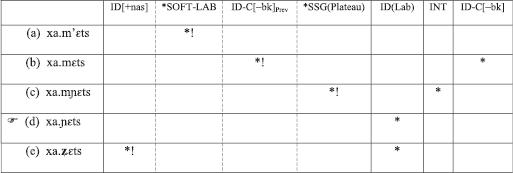
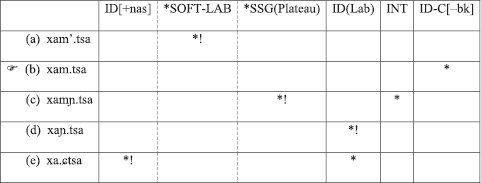
The evaluation of the gen.sg form [xam'Ets + a] → [xamtsa] parallels the derivation for [p'Es + a] → [psa] in (41) in Section 2. To save space, IDENT-C[–back]Prevocalic is omitted in (52) because it is irrelevant.
(52) Level 2: [xam'Ets + a] → [xam.tsa]Footnote 44
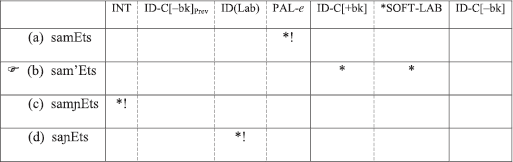
The evaluation of words with derived soft labials such as sami+ec/sań+ec ‘male’ and tasiemi+ec/taśëń+ec ‘tapeworm’ parallels that for kupi+ec/kupś+ec ‘buyer’ in (43) in Section 2. The soft labial is derived at level 1 through the action of PAL-e. *SOFT-LAB is below INT, so decomposition candidates cannot win. The simplification candidate with [ɲ] is outlawed by IDENT(Lab). Other IDENT constraints, including IDENT[+nas], omitted in (53), make sure that input /m/ does not map to [ʑ] or some such segments. The example is sami+ec/sań+ec ‘male’.Footnote 45
(53) Level 1: /sam + Ets/ → [sam'Ets]
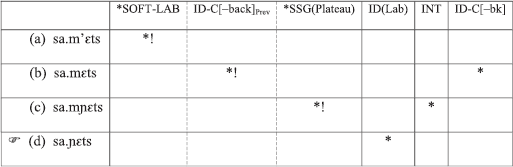
As argued in Section 2, INT and *SOFT-LAB, on the one hand, and PAL-e and IDENT-C[+back], on the other hand, change places at level 2. These rerankings capture two generalizations. First, *SOFT-LAB > >INT drives decomposition. Second, IDENT-C[+back] > >PAL-e renders PAL-e inert, hence we have [z] rather than [ʑ] when the prefix z is considered at level 2: z+elektryzować ‘galvanize’. *SSG(Plateau) plays no role at level 1 because decomposition candidates are eliminated by the high-ranking INT. However, at level 2, INT is reranked to a low position to permit p' b' → pɕ, b ʑ, so it is *SSG(Plateau) that eliminates the decomposition candidates [xa.mɲεts] in (51) and [sa.mɲεts] in (54) below. The ranking *SSG(Plateau) > > IDENT(Lab), which may exist already at level 1, makes sure that [saɲεts] wins over [samɲεts]. To keep the tableaux within reasonable bounds, I will no longer entertain candidates that offend IDENT[+nas] such as [saʑεts]. Also, I will not show IDENT-C[+back] > > PAL-e since none of these constraints plays a role in level 2 evaluations.
(54) Level 2: [sam'Ets] → [sa.ɲεts]
The evaluation of the gen.sg form /sam + Ets + a/ → [samtsa] ‘male’ and /vɨ + gna + n+Ets + a/ → [vɨgnaɲtsa] ‘outcast’ (see (47) and (49) above) makes it clear that an intermediate stage in the derivation of [ɲ] from /m/ is warranted. In (55), I ignore the prefix /vɨ/ because it plays no role.
(55) Level 1:
(i) /sam + Ets + a/ → [sam'Etsa]
(ii) /gna + n+Ets + a/ → [gnaɲEtsa]
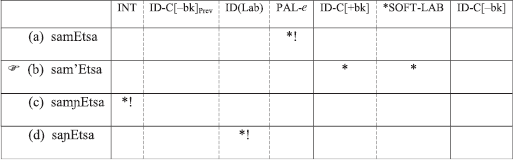

Level 2:
(i) [sam'Etsa] → [sam.tsa]
(ii) [gnaɲEtsa] → [gnaɲ.tsa]
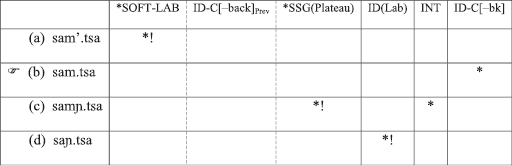

If the words exhibiting the [ɲ] – [m] alternation, such as [saɲεts] – [samtsa] ‘male’ in (55), changed /m/ to [ɲ] directly, the winner in (55i) would be candidate (55i-d), and, consequently, [saɲEtsa] would be the input to level 2. The problem is that, in the relevant ways, [saɲEtsa] would be identical to [vɨgnaɲEtsa] ‘outcast’ in (55ii), but the surface representations are different: [samtsa] vs. [vɨgnaɲtsa], with the former but not the latter exhibiting depalatalization. This problem does not exist if the input to level 2 is [sam'Etsa], with a soft labial, because [m'] makes [sam'Etsa] distinct from [vɨgnaɲtsa], which has [ɲ] in the input to level 2. I conclude that the intermediate stage with [m'] is warranted.
Finally, I look alternations in words such as bram+a [brama] ‘gate’ (nom.sg) – brami+e/brań+e [braɲε] (loc.sg) listed in (46). These words do not contain allomorphs exhibiting depalatalization, so the derivation of [ɲ] from /m/ parallels that for sami+ec/sań+ec ‘male’ (nom.sg) in (53)–(54). The evaluations in (56) consider the loc.sg form /bram + ε/ → [braɲε].
(56) Level 1: /bram + ε/ → [braɲε]
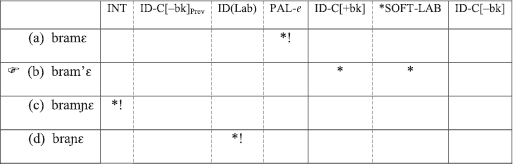
Level 2: [bram'ε] → [braɲε]
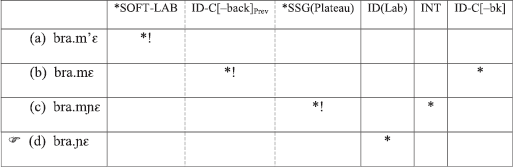
An outstanding question is whether the system of the constraints developed in this analysis does not have an adverse effect on the derivation of skromni+e/skrómń+e [skromɲε], an adverb from the adjective skromn+y/skrómn+y ‘modest’. The answer is negative. The crucial difference between [skromɲ + ε] ‘modestly’ and [braɲ + ε] is that the former has a nasal cluster in the underlying representation while the latter derives [ɲ] from a single consonant: /skromn + ε/ and /bram + ε/, respectively. At level 1, /skromn + ε/ undergoes palatalization, so the input to level 2 is [skromɲ + ε]. The candidate [skroɲε] loses to [skromɲε], the attested surface form, because it violates MAX-Seg: the [m] has been deleted. In contrast, the absence of [m] in the desired winner in (56d) of level 2, [braɲε], does not violate MAX-Seg because [ɲ] is the output correspondent of the input [m'], so there is no deletion to speak of. This is the only admissible understanding of how MAX-Seg works in OT, an understanding that is able to distinguish between instances of deletion and instances of decomposition.
To conclude, the analysis of /m'/ inputs has shown that the goal of eliminating [m'] from the surface representation is achieved in a different way than in the case of the labial stops /p' b'/ discussed in the preceding section: /m'/ defaults to [ɲ], a strategy that I term simplification.
4. Labial fricatives
The first part of this section is structured much like the previous section: I first show that fricative alternations are productive and then develop an argument that Kurpian must have both underlying and derived [f' v']. In the second part of the section, I argue that depalatalization of soft labial fricatives leaves a trace on the preceding sibilant, which constitutes evidence for a Duke-of-York derivation.
The soft labial fricatives /f' v'/ parallel /m'/ in the sense that they exhibit simplification rather than decomposition: /f' v'/ → [ɕ ʑ]. The non-alternating [ɕ ʑ] come historically from /f' v'/ and are probably best analyzed as underlying segments (57a). However, the process of deriving [ɕʑ] from the palatalized labial fricatives is not dead by any means. On the contrary, it is live and productive, a fact that is documented by examples showing alternations in (57b).
- (57)
(a) ofiara/łośara [ɕ] ˈofferingˈ wiara/źara [ʑ] ˈfaithˈ
kwiat/kśåt [ɕ] ˈflowerˈ człowiek/cłoźek [ʑ] ˈmanˈ
(b) paragraf[f] ˈparagraphˈ (nom.sg) paragrafi+e/paragraś+e [ɕε] (loc.sg)
paragraf+ik/paragraś+ïk [ɕi] (dimin)
(c) traf/tråf [f] ˈaccidentˈ traf + u/tråf + u [f] (gen.sg)
traf+i/tråś+ï [ɕi] ˈhe will hit itˈ
(d) Litw + a/Lytwa [f] ˈLithuaniaˈ (nom.sg) Litwi+e/Lytś+e [ɕε] (loc.sg)
Litw+in/Lytś+ïn [ɕi] ˈLithuanianˈ
(N; nom.sg)
(e) chlew/chléw [f] ˈpigstyˈ (nom.sg) chlewi+e/chléź+e [ʑε] (loc.sg)
chlew+ik/chléź+ïk [ʑi] (dimin)
(f) staw/ståw [f] ˈpondˈ (nom.sg) stawi+e/staź+e [ʑε] (loc.sg)
staw+ik/staź+ïk [ʑi] (dimin)
(g) krow + a [v] ˈcowˈ (nom.sg) krowi+e/kroź+e [ʑε] (loc.sg)
krow+in + a/kroź+ïn + a [ʑi] (dimin)
The argument for underlying soft /f' v'/ comes from morpheme-internal alternations.
(58) hufiec/huśec [ɕ] ‘detachment’ (nom.sg) – hufc + a [f] (gen.sg)
krawiec/kraźec [ʑ] ‘taylor’ (nom.sg) – krawc + a [f] (gen.sg)
owies/łoźes [ʑ] ‘oats’ (nom.sg) – ows + a/łowc + a [f] (gen.sg)
wieś/źeś [ʑ] ‘village’ (nom.sg) – wsi + e/wś + e [f] (nom.pl)
Looking at the first example in (58), the simplest analysis is to derive the alternation either from underlying /ɕ/ by labialization, ɕ → f before a consonant, or from underlying /f/ by palatalization, f →ɕ before e, but neither of these analyses is correct.
The labialization process is falsified by the fact that [ɕts] is an attested cluster in surface representations, for example, in pół+paś+c +a [powpaɕtsa] ‘shingles' (gen.sg) analyzed in Section 2. In general, Kurpian admits prepalatals before consonants, so postulating labialization cannot be correct.
(59) bodziec/bodźec [bɔʥεts] ‘incentive’ (nom.sg) – bodźc + a [bɔʨtsa] (gen.sg)
gościec/gośćec [gɔɕʨεts] ‘rheumatism’ (nom.sg) – gośćc + a [gɔɕʨtsa] (gen.sg)
The other hypothesis that [ɕ] – [f] derives from underlying /f/ is also incorrect. If [xuɕεts] is /hufεts/, then /f/ must palatalize to [ɕ] by PAL-e, but PAL-e applies only in derived environments and has no force morpheme-internally. This is documented by the fact that [fε] and [vε] occur in surface representations in, for example, felczer/felcér ‘surgeon’ and wesel+e ‘wedding’.
The solution to the problem is to assume that Kurpian has underlying soft labials /f' v'/, and hence the underling representation of hufiec/huśec is /xuf'Ets/. The analysis of /xuf'Ets/ → [xuɕεts] (nom.sg) and /xuf'Ets + a/ → [xufts + a] (gen.sg) is parallel to that discussed for /xam'Ets/ → [xaɲεts] (nom.sg) and /xam'Ets + a/ → [xamts + a] (gen.sg) in Section 3. Nothing happens at level 1 because soft /f'/ is present in the underlying representation. The prepalatal correspondent of [f'] is derived at level 2.Footnote 46
(60) Level 2:
(i) [xuf'Ets] → [xu.ɕεts]
(ii) [xuf'Etsa] → [xu.ftsa]
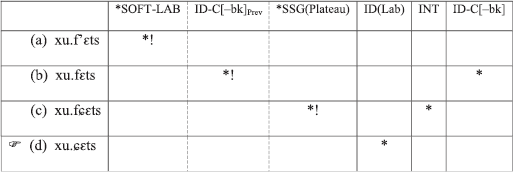
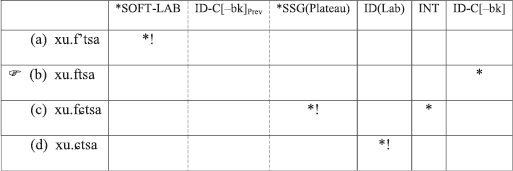
The argument for derived soft fricatives that constitute an intermediate stage in the derivation of [ɕ ʑ] from /f v/ is parallel to that for intermediate [m'] discussed in Section 3.
(61) sport ‘sport’ sport + ow + y (Adj)
sport + owi + ec/sport + oź + ec ‘athlete’ (nom.sg) sport + ow + c + a [f] (gen.sg)
par + a ‘steam’ par + ow + y (Adj)
par + owi+ec/paroź+ec [ʑε] ‘steamer’ (nom.sg) par + ow + c + a [f] (gen.sg)
The analysis that derives [ʑ] from /v/ in one swell swoop runs into difficulty in the gen.sg form [spɔrt + ɔf + ts + a], underlying /spɔrt + ɔv + Ets + a/. As argued in the preceding sections, yers are not deleted at level 1 and hence cause palatalization. Consequently, the output of level 1 and the input to level 2 is [spɔrt + ɔɕ + Ets + a], but then there is no way of recovering [f] at level 2 in order to derive the attested form [spɔrtɔftsa]. The reason is the same as in the analysis of hufc+a ‘detachment’ discussed earlier: Kurpian has words such as pół+paśc+a ‘shingles’ (gen.sg) exhibiting [ɕts], so labialization, ɕ → f before a consonant, is not possible. I conclude that an intermediate representation containing [v'] is warranted. The derivation of sport+owi+ec/sport+oź+ec ‘athlete’ (nom.sg) and sport+ow+c+a (gen.sg) proceeds as follows. I ignore the first morpheme, sport, since it is irrelevant.
(62) Level 1:
(i) /ɔv + Ets/ → [ɔv'Ets]
(ii) /ɔv + Ets + a/ → [ɔv'Etsa]
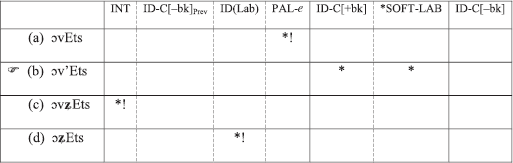
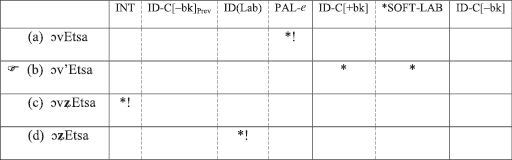
At level 2, the constraint ranking is different, as argued in Sections 2 and 3. PAL-e is inactive and hence omitted in (63). On the other hand, *SSG(Plateau) is displayed because it plays a role.
(63) Level 2:
(i) [ɔv'Ets] → [ɔ.ʑεts]
(ii) [ɔv'Etsa] → [ɔ.ftsa]
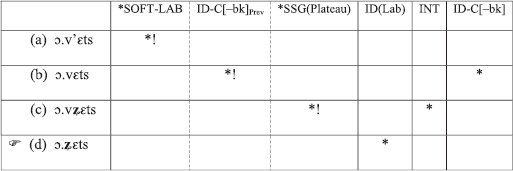
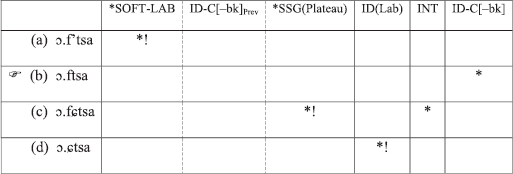
The evaluation of the forms in (57) that do not exhibit depalatalization such as paragraf [f] ‘paragraph’ (nom.sg) – paragrafi+e/paragraś+e[ɕ] (loc.sg) and chlew/chléw [f] ‘pigsty’ (nom.sg) – chlewi+e/chléź+e [ʑ] (loc.sg) is, in all relevant ways, identical to the evaluation of sport+owi+ec/sport+oź+ec ‘athlete’ in (62)–(63). The underlying representations of the loc.sg forms are /paragraf + ε/ and /xlev + ε/, respectively. The labials palatalize at level 1, /f v/ → [f' v'], and undergo simplification at level 2, [f' v'] → [ɕ ʑ].
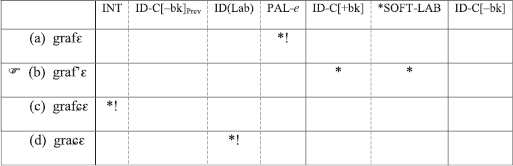
In (64), I look at the graf fragment of /paragraf + ε/ → [paragraɕε], the loc.sg of pragraf ‘paragraph’.
- (64)
(i) Level 1: /graf + ε/ → [graf'ε]
(ii) Level 2: [graf'ε] → [graɕε]
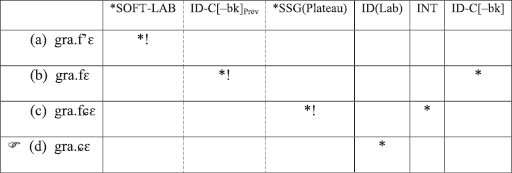
Finally, as was the case with /m'/, the fact that simplification candidates (63d) and (64d) are chosen over decomposition candidates (63c) and (64c) at level 2 has no consequence for the analysis of [vʑ] and [fɕ] clusters that derive from independent input segments. Such clusters do not simplify, for instance, wziąć/wźąźć [vʑ] ‘take’, from underlying /vʑ/, and wśród [fɕ] ˈamongˈ, from underlying /fɕ/. The matter is straightforward: as established in Section 3, MAX-Seg is ranked above *SSG(Plateau), so deletion cannot be used to improve sonority relations within the syllable.
A point of special interest is the observation that labial fricatives exhibit a new strategy in the conspiracy to eliminate soft labials: depalatalization cum vowel retraction. We see this strategy at work in words such as świni+a/śwyń+a ‘pig’ in which soft labials are trapped in complex onsets: [ɕf'iɲ + a] → [ɕfɨɲa], where soft [f'] changes into hard [f] with vowel retraction, [i] → [ɨ], ensuing in the wake.
It is by no means true that the context of /i/ alone conditions depalatalization, i.e. that /i/ changes into [ɨ] under decomposition, as shown by the examples in (65).
- (65)
(a) sklep [p] ‘store’ (nom.sg) sklepi+e/sklepś+e [pɕ + ε] (loc.sg)
sklep+ik/sklepś+ïk [pɕ + ik] (dimin)
bab + a [b] ‘woman’ (nom.sg) babi+e/babź+e [bʑε] (loc.sg)
bab+in+a/babź+ïn+a [bʑina] (dimin)
(b) traf/tråf [f] ˈaccidentˈ (nom.sg) trafi+e/tråś+e [ɕ + ε] (loc.sg)
traf+i/tråś+ï [ɕ + i] ‘he will hit itˈ
mow + a [v] ‘speech’ (nom.sg) mowi+e/moź+e [ʑ + ε] (loc.sg)
mów+i/móź+ï [ʑ + i] ‘he speaks’
As these data show, the resolution of the conflict between PAL-i and hard labials is in favor of retaining /i/ in the output and adjusting the labials in order to achieve agreement in [–back] between the vowel and the consonant. As expected, labial stops undergo decomposition (65a) while labial fricatives show decomposition with simplification (65b). In order for decomposition to set in, the labial must first become palatalized. This happens at level 1, exactly as it does when the trigger is [ε], a situation that we saw in Section 2. In (66), I look at sklep+ik/sklepś+ïk [sklεpɕ + ik] ‘store’, the diminutive of sklep cited in (65a). The active constraints at level 1 are the same as in (44), where /sklεp + ε/ → [sklεp'ε] was evaluated, but PAL-i replaces PAL-e. Given the input /p + i/ and the fact that Kurpian has both /i/ and /ɨ/, the output with vowel retraction is a viable candidate: /sklεp + ik/ → [sklεpɨk]. It should be noted that [pɨ] is widely attested in Kurpian. For example, it occurs in the plural sklep+y /sklεp + ɨ/ = [sklεp + ɨ] ‘store’ (nom.pl), where the surface form is identical to the underlying form. Since [sklεpɨk] is undesired as an output, the derivation must recruit IDENT-V[–back] as an active constraint. IDENT-V[–back] bans the candidate with vowel retraction, as documented in (66).
(66) Level 1: /sklεp + ik/ → [sklεp'ik]
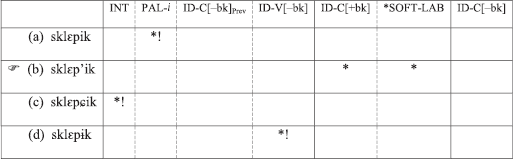
The ranking of PAL-i above IDENT-C[+back] allows for palatalization, exactly as in (44), while the ranking IDENT-V[–back] > > *SOFT-LAB makes sure that *SOFT-LAB cannot select the vowel retraction candidate in (66d) as the winner.
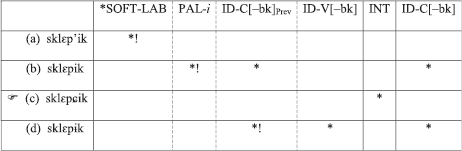
Level 2 executes decomposition, [sklεp' + ik] → [sklεpɕik], so IDENT-C[–back]Prev in conjunction with PAL-i prohibits retraction, i →ɨ. IDENT-V[–back] loses relevance and can be ranked low.Footnote 47 The ranking in (67) is transferred from the level 2 evaluations in Sections 2 and 3. Irrelevant constraints have been suppressed. Candidate (67c) exhibits decomposition, so both [p] and [ɕ] are the correspondents of the input [p'].
(67) Level 2: [sklεp'ik] → [sklεpɕik]
The data in (68) below show a new situation. These words exhibit vowel retraction, /i/ → [ɨ] in świni+a/śwyń+a [ɕfɨɲa] ‘pig’ instead of exhibiting decomposition with simplification, and thus appear to be incompatible with the examples in (65), where /i/ makes it to the surface and triggers decomposition or decomposition with simplification in /sklεp + ik/ → [sklεpɕik] and /trαf + i/ → [trαɕi], sklep+ik/sklepś+ïk ‘store’ (dimin) and traf+i/tråś+ï ‘he will hit it’, respectively.
(68) świnia/śwyń + a [ɕfɨɲa] ‘pig’ świt/śwyt [ɕfɨt] ‘dawn’
świder/śwyder [ɕfɨdεr] ‘drill’ świstać/śwystać [ɕfɨstaʨ] ˈwhistleˈ
Even though these data do not show alternations, their analysis is essential for another reason: Kurpian does not admit sequences of labial fricatives followed by i, so [fi] is an ill-formed output. Furthermore, the sibilant before [f] that causes retraction is always prepalatal, so it is [ɕ] and not [s], as in [ɕfɨɲa]. Those generalizations need to be accounted for. In particular, the question is why Kurpian changes the strategy of avoiding [fi] by doing vowel retraction in (68) rather than decomposition with simplification as in /trαf + i/ → [trαɕi] ‘he will hit it’.
The analysis at level 1 is clear: /sfi/ → [ɕf'i], where /f/ → [f'] is an effect of PAL-i and /s/ → [ɕ] is enforced by a new constraint that I call Sibilant Assimilation. This constraint can claim much evidence in its favor. The data in (69) show that /s z/ assimilate in [–back] to the following [–back] consonant.
(69) post [st] ‘Lent’ (nom.sg) pości+e/pość+e [ɕʨε] (loc.sg)
bruzd + a/brózd + a [zd] ‘furrow’ (nom.sg) bruździ+e/bróźdź+e [ʑʥε] (loc.sg)
jasn + o [sn] ‘clearly’ jaśni+ej/jaśń+éj [ɕɲej] ‘more clearly’
The root-final consonants in (69) palatalize to [ʨ ʥ ɲ] and, consequently, trigger Sibilant Assimilation: /pɔst + ε/ → [pɔsʨε] → [pɔɕʨε] ‘Lent’.
Sibilant Assimilation, abbreviated as *sC', is stated as an AGREE constraint.
(70) Sibilant Assimilation (*sC')
Sibilants must agree in [–back] with the following [–back] consonant.
A level 1 evaluation is now straightforward: *sC' enforces assimilation, s → ɕ before f'. To keep the tableau within reasonable bounds, I omit the irrelevant constraints: IDENT-V[–back]Prev, INT and IDENT-C[–back].
(71) Level 1: /sfiɲ + a/ → [ɕf'iɲa]
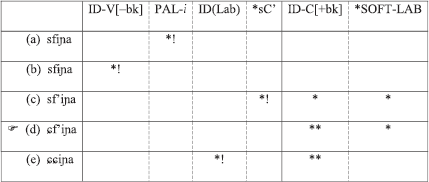
The level 2 evaluation appears to be problematic. The problem is what can enforce depalatalization and vowel retraction: [ɕf'iɲa] → [ɕfɨɲa]. The current constraint system cannot deliver this result. On the contrary, IDENT-V[–back]Prev guards the preservation of palatalized consonants in the output representation. On the other hand, IDENT(Lab), which makes sure that /f/ is not changed to [ɕ] at level 1, is reranked to a low position at level 2, so it cannot mandate the preservation of [f].
In order to solve the [ɕf'i] → [ɕfɨ] problem, let us imagine the structure that would be derived from the input [ɕf'i] by the current constraint system at level 2: [f'] would change to [ɕ], yielding [ɕɕi]. Evidently, it is the [ɕɕ] cluster that the grammar does not want to admit.
A hypothesis that Kurpian blocks decomposition with simplification in order to avoid the creation of a cluster cannot be correct. This is shown by words such as kwit/kśït [kɕit] ‘receipt’ and gwizdać/gźïzdać [gʑizdaʨ] ˈwhistleˈ which begin with the clusters [kɕ] and [gʑ], respectively. The [ɕ ʑ] derive from /f v/ via palatalization to [f' v'] at level 1. At level 2, decomposition with simplification is not hampered by the fact that new clusters are created: [kf'i gv'i] → [kɕi gʑi].
A different hypothesis is that decomposition with simplification cannot lead to the creation of a geminate, so the candidate [ɕɕiɲa] from [ɕf'iɲa] is excluded. This hypothesis is incorrect as well because Kurpian permits the derivation of geminates via decomposition with simplification, as shown in (72).
(72) łyżw + a/łyźw + a [wɨʑva] ˈskateˈ (nom.sg) – łyżwi + e/łyźź + e [wɨʑʑε] (loc.sg)
trzeźw + y/trzéźw + y [tʃeʑvɨ] ‘sober’ – trzeźwi + e+ć/trzéźź + é + ć [tʃeʑʑeʨ] ˈbecome soberˈ
The question is how the words in (72) are different from those in (68). The relevant observation is that the outputs with geminates in (72) syllabify the geminates heterosyllabically: [wɨʑ.ʑε] and [tʃeʑ.ʑeʨ]. This option is not open to the words in (68), in which the cluster is derived in the word-initial onset. That is, the candidate [ɕɕiɲa] from [ɕf'iɲa] contains a geminate inside one syllable, specifically, in the onset. Such configurations are banned by a constraint that goes back to Trubetzkoy (Reference Trubetzkoy and Baltaxe1939/1969) and Kuryłowicz (Reference Kuryłowicz1947) that I call Heterosyllabic Geminate and abbreviate as HET-GEM.
(73) Heterosyllabic Geminate (HET-GEM)
Geminates must be heterosyllabic.
HET-GEM enforces the syllabification [wɨʑ.ʑε], łyżwi+e/łyźź+e ‘skate’ (loc.sg), as well as [pan.na], pann+a ‘miss’, which win over the onset maximization candidates [wɨ.ʑʑε] and [pa.nna]. The generalization is expressed as the ranking HET-GEM > > NO-CODA.
Since in (68) the geminate cannot be heterosyllabic because it is word-initial, the [ɕɕ] candidate falls prey to HET-GEM and is eliminated. The derivation of [ɕf'iɲa], the winner from level 1 in (71), continues at level 2 in tableau (74). I omit the irrelevant constraints or the constraints that are ranked too low to matter.
(74) Level 2: [ɕf'iɲa] → [ɕfɨɲa]
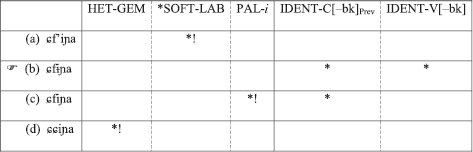
The evaluation in (74) establishes a new ranking at level 2 that was not evident in the other evaluations: *SOFT-LAB > > IDENT-C[–bk]Prev, which favors candidate (74b), the attested output, over candidate (74c).Footnote 48 HET-GEM and PAL-i are surface-true, so they are undominated. The evaluation documents the reranking of IDENT-V[–back] and *SOFT-LAB. At level 1, the ranking is IDENT-V[–back] > > *SOFT-LAB in order to outlaw vowel retraction, i →ɨ. At level 2, on the other hand, it is exactly vowel retraction that is the desired change, so the ranking must be reversed and hence candidate (74b) wins over candidate (74a), the correct result.
I conclude that the analysis of the examples in (68) shows a new strategy of the soft labial conspiracy: vowel retraction. At level 1, the labial palatalizes, /sfi/ → [sf'i], and the soft [f'] induces Sibilant Assimilation, [sf'i] → [ɕf'i]. At level 2, [f'] depalatalizes to [f], with vowel retraction following in the wake: [ɕf'i] → [ɕfɨ]. The derivational stage at which the labial is a palatalized [f'] is recorded in the surface representation on the preceding prepalatal [ɕ], which comes from /s/ via Sibilant Assimilation. The derivation exhibits a Duke-of-York gambit (Pullum Reference Pullum1976): f → f' → f, where /f/ is the input to level 1 (the underlying representation), [f'] is the output of level 1 and the input to level 2, and [f] is the output of level 2 (the surface representation).Footnote 49
A similar Duke-of-York derivation occurs with labial stops, as in kupi+ec/kupś+ec ‘buyer’ in (43) in Section 2. Underlying hard labial /p/ is palatalized to [p'] at level 1 and then decomposed to [pɕ] at level 2: p → p' → p. Such Duke-of-York derivations are afforded by DOT because evaluation is carried out at two levels and is not bound by the classic OT principle of strict parallelism.
5. Conclusion
Unlike many other languages, Kurpian exhibits a rich and productive system of labial palatalization. In a way typical for a phonological conspiracy, a number of actions are undertaken in order to eliminate soft labials from the surface representation: depalatalization (p' → p), decomposition (p' → pɕ), simplification (m' → ɲ), and vowel retraction (fi → fɨ). These repairs are a response to the pressure from the markedness constraint *SOFT-LAB, the IDENT constraints mandating the preservation of the input properties in the output and the markedness constraints enforcing palatalization. The array of disparate repairs contributes to the discussion of the ‘too many solutions’ problem by providing a typology of changes that have not been reported for labials in the past phonological research.
In addition, the analysis of soft labial conspiracy highlights three further points of theoretical interest: absolute neutralization, the nature of IDENT constraints and the resolution of opacity. First, absolute neutralization is motivated by labial alternations whereby the source of the alternants is a soft labial that never occurs in the surface representation. Second, decomposition requires that IDENT constraints be unidirectional rather than bidirectional. Third, the treatment of opacity calls for Duke-of-York derivations and thus provides evidence for Derivational Optimality Theory.


