Introduction
Charles Taylor’s Reference Taylor2007 book A Secular Age (henceforth ASA) may have single-handedly transformed the way social scientists think about the secular. Shifting the focus away from both state policy toward belief and the rate of belief toward the actual conditions of belief, it has recast Christian fundamentalism and the new atheism as being elements of the same totality as much as, if not more than, incompatible alternatives. Furthermore, it has shown this totality—here called “deep secularity”—to be a contingent one, thereby dealing a powerful blow to what remained in religion scholarship of the triumphalist teleologies of the modernization theory variety.
ASA does have significant shortcomings, however. Most importantly, Taylor’s careful restriction of deep secularity to the Western world limits the materials that can be used to further develop our understanding of deep secularity. It also undermines the public import of the work: the secular may be embattled and in need of reconstruction in the West, but it is the Islamic Middle East, South Asia, and Southeast Asia that stand to benefit most from any such reconstruction.
In this article, I work on these two problems by tracing deep secularity outside the West. After critically reviewing Taylor’s conceptual apparatus, I demonstrate that the discourse of certain pious twentieth-century Turkish poets is in fact deeply secular. I also indicate a good reason why there may well be many more such examples in unexpected places: while Taylor rightly identifies the transformation of selfhood as a key component of deep secularity, there are more ways in which this happens than he discusses. In the absence of Taylor’s “buffered self,” pious actors may split their selves in two, allowing their commitment to total religion to stand side by side with a mechanistic and relativistic worldview. On the other hand, the discourse of pious novelists of the same period shows no signs of either deep secularity or the split self.
The variable presence of the split self is difficult to explain with reference to the factors most plausibly used to account for such phenomena. Therefore, using network analysis, I complement those factors by allowing for the greater possibility of coexistence between the pious and the nonpious among poets. Nonpious poets were quite unavoidable, and contact with them could be very beneficial for pious poets, giving the latter an incentive to find ways to initiate or continue cross-aisle interaction. The split self was the solution to that problem; the novelists, though, did not develop that solution, because they did not have the same problem. All this means that, in Turkish literature, as in late seventeenth-century European politics, secularization was at least partly a matter of self-interest after religious conflict had ended in stalemate—Turkish literature had a “Westphalia moment.”
My research also suggests that loss of connection to the religious other may lead to the rapid unsplitting of the self such that deep secularity may appear and disappear within a single lifetime. Therefore, rather than focusing, as Taylor and many others have done, exclusively on the glacial movements of the Braudelian longue durée, scholars of the secular should ask whether the making—and unmaking—of deep secularity also has an eventful aspect.Footnote 1
I will proceed as follows: after first critically reviewing ASA, I will introduce the milieux of Turkish poetry and the novel and the methods I use to study them, demonstrating that, while the former features deep secularity, the latter does not. I will then attempt to explain this contrast in terms of the relevant actors’ habitus, the characteristics of the two genres, or the features of the movements that dominated them. When that fails, I will turn to network analysis. Finally, I will conclude by discussing the implications of my findings for future research.
A Secular Age and its “Eastern question”
The framework
Once taken as one of the few certainties of the modern world, secularization returned to the sociology of religion as a problem in the late 1980s and early 1990s. Observing that rates of religious participation and belief are not declining in large swaths of the world, the “new paradigm” in the sociology of religionFootnote 2 has called the “secularization thesis”Footnote 3 a mere figment of liberal sociologists’ imagination. Responding to this attack, proponents of the secularization thesis marshaled new evidence for the decline of the religious life.Footnote 4 At the same time, a third group of scholars has pointed out that secularization can continue to be seen as a real tendency of some societies (though not of others), provided that it is understood not as the decline of religious vitality, but rather as religion’s migration to the private sphereFootnote 5 or as its mere differentiation from other spheres of human activity.Footnote 6
The importance of Charles Taylor’s ASA lies in the work’s uniquely intelligent synthesis of this debate. It begins with a simple but powerful question: what exactly does it mean to live in a secular age? The answer to that question, Taylor writes, must distinguish between at least three distinct senses of the word “secular,” only two of which have received sufficient scholarly attention. While secularization may indeed refer to the decline or the privatization of religious belief, both of these notions are limited to describing the content of religious belief. In addition to this, he claims, one must also pay attention to the conditions of belief; i.e., to transformations of what it means to believe (or not believe) in the first place.
Using this lens, ASA reinterprets Euro-American cultural and intellectual history and finds that a key component of the making of the modern West is the transformation of the “background pictures” that make words like “god” intelligible. This is not a linear story, but it does have a main theme: the increasingly reflexive nature of belief. For premoderns, Taylor writes, belief was like the air they breathed, and so very much taken for granted. Consequently, ordinary premoderns could not even imagine unbelief: everybody believed, and belief did not have as its object remote and invisible entities—the world was fully enchanted.
In the modern West, on the other hand, believers know that unbelief is not only possible but also quite plausible: there, belief has become one option among many, and “frequently not the easiest one to embrace.”Footnote 7 The switch to this state of affairs is due not only to the fact that people with different beliefs live in proximity, but also has to do with the trajectory of Christian theology. Presenting the Protestant Reformation as a manifestation of a larger trend toward the “excarnation” of religion—i.e., toward less bodily and more intellectualistic practices of faith—ASA locates a third, deeper sense of secularity in the culmination of that trend. This “secularity three” is the basis on which the decline of belief and the privatization of religion may eventually take place, but even if they do not, such a transformation of the conditions of belief is significant in and of itself. As Taylor notes, however, this is something that scholarly work has rarely focused on, and ASA is first and foremost a challenge to that state of affairs.
Deep secularity is primarily the result of the emergence, from the sixteenth century on, of what Taylor calls the “immanent frame,” a mode of explaining the physical universe, society, and/or the human psyche by reference to nothing other than what is immediately available to the actor doing the explaining.Footnote 8 The immanent frame thus brings about the possibility of excluding transcendental entities when making sense of oneself and of one’s physical and social environment. It involves, among other elements, a switch from seeing the human self as a porous self (i.e., one that can easily be influenced by supernatural entities) to the “buffered self,” one that is sealed off from the rest of reality to such an extent that its workings are to be understood only in terms of mechanisms internal to it. While the former view of the self makes, for example, possession by demons a relatable and almost ordinary experience, with the latter the notion of supernatural entities taking control of human actions becomes unthinkable.
The switch from the porous to the buffered self heralds the path that leads to psychoanalysis. Among other things, the development of the other components of the immanent frame leads evolutionary biology to supplant the Genesis story and popular sovereignty to take over from the divine right of kings. From this perspective, the accumulation of “better” scientific knowledge (assuming that there was/is indeed such a development) is the consequence rather than the cause of the rise of the immanent frame: the making of the immanent frame involves the transformation of human imagination rather than that of human cognition. It is not, therefore, true that “Darwin refuted the Bible”;Footnote 9 rather, Taylor argues, an imagination that centers around god has lost against one that makes him peripheral at best.
That god is now peripheral does not mean that he is dead. Belief is still possible, but it is no longer the only imaginable state. If it is to go on, however, it must adapt, reckoning with the fact that it is no longer a given. Making god part of any narrative now requires work, and that work takes the form of giving such a spin to the immanent frame that things religious will not stand out. The first casualty of such a move is the idea of god as a force that directly intervenes in nature and in human affairs: that view is replaced by the “clockmaker god” of providential deismFootnote 10 and the notion of an impersonal order.Footnote 11
It goes without saying that, in contrast to this “open” spin, a “closed” one is also available. As deep secularity takes hold, it creates “something like a nova effect, spawning an ever-widening variety of moral/spiritual options, across the span of the thinkable and perhaps even beyond.”Footnote 12 As a result, for the first time in human history, unbelief enters the picture as a mass phenomenon.Footnote 13
As these two spins are available to anyone, a considerable number of people are “cross-pressured”Footnote 14 in a Jamesian open space: they tend toward one or the other of the two spins, but the one that is not selected does not lose all of its appeal, calling out to them from time to time. In short, in the secular age, neither belief nor unbelief is a fully stable state. Thus, in this third sense, secularity refers to the cessation of the possibility, in matters of ultimate meaning, of final closure for many: in a secular age, god is a question that refuses to be answered once and for all.
The problem
Critics have often found ASA difficult to evaluate due to its extraordinary breadth and sheer erudition,Footnote 15 but this has not stopped the formation of a “cottage industry of comment”Footnote 16 around it.Footnote 17 Likewise, some critics charge ASA with anti-secular bias,Footnote 18 while others deny this line of attack.Footnote 19 A less divisive critique concerns the work’s reliance on phenomenology rather than sociology,Footnote 20 but this is not necessarily a damning verdict: books do not have to be sociological to be valuable.
Far more important than such critiques is ASA’s unwillingness to deal with the non-West.Footnote 21 Taylor adamantly restricts his discussion of the immanent frame to the Western world,Footnote 22 thereby putting ASA in danger of being inadvertently orientalist: if the divergence of the Western and non-Western worlds begins so early, and if it is rooted in the depths of human subjectivity, it makes little difference if that divergence is ultimately socially constructed rather than natural and thing-like. Non-Western and Western experience are thus cast as having no common denominator: ASA, unlike other cutting-edge work on the Western/non-Western difference,Footnote 23 takes “The West” as an all-too-real entity, one that clearly and obviously stands out from the rest of the world.
Taylor does not deny that similar developments may have occurred in some corners of non-Western worlds, but he does claim that deep secularity as a mass phenomenon is a Western affair. There may be a point here: viewed at the level of entire societies, there may indeed be such a basic difference between the average Western society and the average non-Western one, with the latter either resisting secularization tooth and nail or inventing a wholly different, shallower form of it.
This contrast between “average” cases may well mean little, however, if there is great variation around those averages. This is exactly what the best available studies of culture say: behind the smooth façade of “Islam,” for instance, lies so much heterogeneity that shortcuts like “the Islamic world” lack any analytic use that bird’s-eye views might confer on them.Footnote 24 A more fruitful approach to the study of non-Western difference, including discussions of secularity in the non-West, would thus vigorously seek exceptional aspects of non-Western experiences—especially in places that experienced secularization in other ways—and contrast them with what are, for them, stereotypical ones. In short, we may want to take the fact of Western difference as the starting point of the discussion rather than as its finale: refraining from facile slogans of the “the Orient does not exist” variety, as well as those of the “the Orient is wholly different from the Occident” variety, we may instead want to introduce some much-needed nuance to this old debate. There is thus good reason to look at non-Western experience more closely, this time paying more attention to its less frequently encountered forms.
With all this in mind, I propose to attend to the particular case of Turkey. Ottoman/Turkish secularization from 1839 to 2002 is, according to scholarly consensus, the classic example of a shallow, top-down secularization that failed to transform subjectivities and thus operated exclusively at the levels of the state and law. Concerned with preserving a declining state against superior enemies, Turkish secularization has consistently pursued short-term political and military goals rather than long-term social ones, and the goals that it has pursued have rarely resonated with the daily experience of the majority of the population.Footnote 25 It has thus taken the form of an elite project, provoking furious political reaction in the form of populist conservatism and, at moments when that populist conservatism was denied the right to exist, occasional violent backlash. In it, the constant struggle between secularism and antisecularism has taken on much greater significance than in the typical Western case: while both secularism and antisecularism exist across the East/West divide, in the average Western experience they have rarely defined a central political fault line as they have done in Turkey. Placed beside the average Turkish experience, therefore, the average Western pattern of secularization appears quite natural, civil, and processual. As such, the question I would like to pose is how representative the average is of the picture thus simplified; i.e., whether or not exceptions to the Turkish norm exist within Turkey, and, if they do, what to make of them.
Data and method: historical ethnography and network analysis
My rethinking of deep secularity is based on a comparative study of two very similar milieux; namely, those of poetry and of the novel in twentieth-century Turkey. The rationale for the selection of these two milieux is straightforward: while one features deep secularity, the other does not (see the two subsequent sections, on the poetic and novelistic milieux, respectively). As such, these two milieux provide both the average and the exception discussed above, though in every other sense they are almost identical and thus perfectly comparable. The sources of data on these two milieux are archival and biographical in nature, consisting of autobiographies, biographies, diaries, essays, interviews, memoirs, correspondence, and photographs.
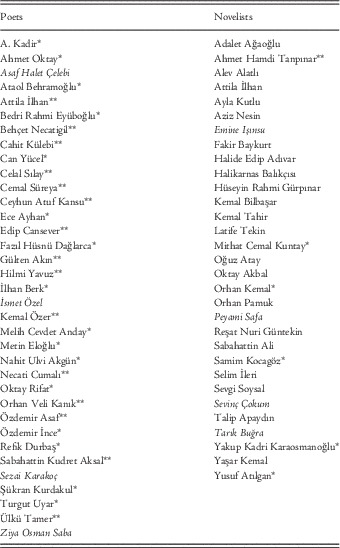
Consideration of the natures of the two milieux and a review of the relevant literature lead to the hypothesis that the crucial difference between the two milieux concerns network ties between pious and nonpious actors (see the section entitled “Making sense of the split self”). In order to test this hypothesis, I built a database using seven anthologies for poetryFootnote 26 and five for the novel.Footnote 27 I selected these anthologies based on their scope, preferring larger ones to smaller ones, as well as with an eye to including viewpoints that ranged across the political spectrum. This exercise yielded a very large number of actors: 286 poets and 78 novelists. In order to make the research feasible, I focused specifically on the 35 poets and 31 novelists whose names appear in the greatest number of sources: for poetry, these are the people who are recorded in six or more anthologies, while for the novel, the corresponding number is three. These writers are listed in Table 1, in which the names of pious actors are italicized. As a result, there are two groups of roughly the same size, which is important for the reliability of network analysis.
Most Frequently Anthologized Poets and Novelists.

Pious actors italicized; * Directly connected to pious actors; ** Indirectly connected to pious actors
Subsequently, I conducted an extensive study of archival and biographical materials in order to find out how many nonpious actors were in regular contact with their pious counterparts in both poetry and the novel. I examined how many of the latter were directly or indirectly—i.e., at one degree of separation—connected to the former; in Table 1, these are the names are followed by two asterisks and one asterisk, respectively. I excluded converts—i.e., the poet İsmet Özel and the novelist Peyami Safa—as it was not always clear from the available evidence which of their contacts predated their conversion and which postdated it.
The difference between the two milieux yielded by this procedure should be sufficiently stark in itself for most readers, but I nevertheless proceeded to conduct statistical analyses, using Fisher’s exact tests, so as to formally evaluate the hypothesis that poetry and the novel were, as milieux, distinct in their ability to put pious and nonpious actors in contact. The results of these tests show that the difference was extremely statistically significant for both direct and indirect connections.
“The world in isolation”: Turkish poetry milieux in the twentieth century
With the above critical summary of ASA in mind, consider twentieth-century Turkish poetry milieux. From the 1950s on, they have featured a new breed of pious Muslim, one at home in riotous avant-gardism. The first identifiable example of this new figure is Sezai Karakoç (born 1933). In the mid- to late 1950s, Karakoç invented a dense new poetic language for subtly expressing Islamic themes: his poetics was based more on contemporary French and German materials than on the classical heritage of Arabic, Persian, and Ottoman literatures. For this he was criticized by the more mainstream Islamists of the day: “Karakoç, who led the new generation in this [false] understanding [of the world] in this age of ignorance and unbelief that requires us to describe Islam in the simplest terms to the Turkish people and to new generations, must be regarded as part of the treason.”Footnote 28
Like other literary notables, Karakoç eventually came to function as a gatekeeper, making (and perhaps also breaking) careers. In that capacity, he helped in the rise to fame of another pious Muslim, Cahit Zarifoğlu (1940–1987). Zarifoğlu developed Karakoç’s modernist line, expanding it, in a first for Islamists, to include sexual themes. Upon coming to fame, Zarifoğlu also held the hands of younger Muslim writers, advising them on what and how to write. In that capacity, he did thoroughly ecumenical work, repeatedly urging his protégés to broaden their horizons beyond what Islam made available to them:
It’s nice that you’ve met Mustafa, Ahmet, Ebubekir. See them often. But don’t forget that you must be new and seek the new. In all those [Islamic] circles there is a stale atmosphere. It will affect you even if you don’t want it to. So you must have a broad perspective. Try John Kenet [sic] Galbraith’s The Age of Uncertainty. Right there are the tools for that broad perspective. […] I do not want to see you limited by a solely Islamic sensibility.Footnote 29
For the most part, Zarifoğlu sought to expand his protégés’ horizons because he strived, like many other modern writers, for novelty, preferring the fruits of its uncertainty to the comforts of the familiar: “You are looking at literature and at thought from a narrow perspective. […] Let us expand our horizons, try to see the whole world, leftist and rightist, foreigners and locals. Otherwise we will be chasing our own tails.”Footnote 30
Coming from a pious Muslim like Zarifoğlu, these calls to make literary rules religion-free also serve as calls to reform Muslim subjectivities. Though Zarifoğlu adhered to an interpretation of Islamic dogma that hardly recognized the right of non-Muslims to speak publicly, departing from that view, he advises his protégés to (re)valorize the nonpious as worthy peers, role models, and partners. He was able to do this by reserving a special, newly constructed place in the mind where religion continued to reign supreme, thus rationalizing the operation as one that preserved the integrity of the religious worldview where it really mattered. At the level of interpersonal relationships, however, such an operation effectively makes religion optional.
The buffered self is not involved in this operation. Men like Karakoç and Zarifoğlu did not adhere to a modernized, excarnated interpretation of Islam: Zarifoğlu fiercely rejected “humanistic” proposals to remake Islam, calling them spiritual poison,Footnote 31 while Karakoç saw them as a conspiracy headed personally by the pope.Footnote 32 The orthodoxy to which they subscribed required them to profess and practice belief in numerous supernatural entities described and named in the Qur’an, where it is declared that such entities are able to penetrate weakly guarded human souls. I have found no evidence suggesting that either man found it difficult to sustain this belief; indeed, they seem to have taken it for granted.
Nevertheless, one of Taylor’s underdeveloped insights can be used to make sense of this operation. Consider his description of how deep secularity looks from the point of view of a believer: “I may find it inconceivable that I would abandon my faith, but there are others, including possibly some very close to me, whose way of living I cannot in all honesty just dismiss as depraved, or blind, or unworthy, who have no faith (at least not in God, or the transcendent).”Footnote 33
This new subjectivity, which never found full expression in either Karakoç or Zarifoğlu, emerges more clearly in one of Zarifoğlu’s protégés, Ebubekir Eroğlu (born 1950). In 1993, Eroğlu was asked to interpret the following line (the translation is mine) from one of his poems:
Each morning as I am abandoned my inner realm my self my hands they become strangers to me
His answer demonstrates that he is living inside the immanent frame, trying to give it as open a spin as possible for himself, but also recognizing the power of the closed spin:
This is the truth of those past times. Perhaps also this present time, and of the future to come. The breaking away from the person of his/her deeds, his/her work. An action that, just a while ago, had to be interpreted with reference to the person’s own existence, now losing that connection. The subsequent feeling of abandonment when the world and everything in it are understood, inexplicably, each in isolation.Footnote 34
“Inexplicably” is the key word here. For a pious Muslim such as Eroğlu, “the world and everything in it” cannot be understood in isolation from both one another and from an active, present god, very unlike the clockmaker god of the immanent frame. If they appear to be in such isolation, the pious Muslim must seek out and fight the causes of this illusion. But Eroğlu cannot find such causes, and is therefore resigned to weakly protest the isolation of things from one another and from god.
This leads Eroğlu to do as Taylor’s secular believer does: he splits his selfhood into two, enabling his absolute—and absolutist—faith to survive side by side with a relativistic tolerance toward others’ lack of such faith. This is the second function of the word “inexplicably”: being above ordinary human reason, an omnipotent god could very well create a world that appears cold and fragmentary while simultaneously requiring his faithful to reserve a piece of their minds for a meaningful whole. However, this ingenious maneuver to save belief also abandons the presecular vision, where things are connected with god for everyone and with no qualifications. Cutting his/her losses, the believer thus adapts to the secular age and looks ahead after first wistfully acknowledging the value of an irrecoverable past. Here, then, is a very good reason why deep secularity may indeed exist outside the West: splitting a porous self is a lot easier than buffering it, and if the self is split, it can be simultaneously porous and secular.
“Miracles and myths”: the Turkish novel as contrast case
We thus observe a concrete instance of deep secularity in non-Western experience, with its condition of possibility appearing to be the split self. Does further evidence from similar cases that nevertheless fail to feature deep secularity support this thesis? What, for example, is the state of affairs in the Turkish novel in the same time period?
As will be seen, it presents a very different picture, one that can easily fit the standard account of Turkish secularization as an elite project. The leading practitioners of the New Islamic Novel—who were contemporaries, and in some cases friends, of Karakoç, Zarifoğlu, and Eroğlu—are rather more conservative in style and content than the poets mentioned above, displaying, for instance, none of the bold experimentation of Karakoç or the sensuality of Zarifoğlu. What is more, instead of splitting their selves like Eroğlu in such a way as to accommodate the nonpious, the subjectivity that they present is one of a piece under the sign of Islam’s active god. Zarifoğlu’s friend Rasim Özdenören (born 1940), for example, sometimes appears to be unable to even imagine duality in personality:
Each of us encounter, each and every day, opportunities of which we may be aware or unaware. We fail, as I said, to even notice some of these. Some of them fail to interest us even when we are aware of them. Those that interest us are only those opportunities that, coming from within, poke us continuously and seek their way to the surface. This means that we are open only to those opportunities that agree with our individual natures and we count as opportunities only those opportunities that agree with our individual natures.
Now, a young woman tells of the beginning of her career thus: “One day,” she says, “when I was looking in a shop window, I was discovered by the representative of a fashion agency and started modeling. I wanted to be a doctor and I was not even considering the work I do now.” Now I say that this young woman would not have, could not have done this if she had not already been suitably predisposed; not even the highest rewards would have done the trick.Footnote 35
Whenever the facts of inconsistency and incoherence cannot be ignored, Özdenören’s response is a moralistic denunciation of the powers behind them. The difference between this approach and Eroğlu’s merely nostalgic resignation is remarkable: while Eroğlu sees the integrated personality as a thing of the past, for Özdenören it is still the attainable ideal of human perfection:
We think that modern social relations take place on an impersonal and professional plane. For that reason, people must take the stage until they die! Those who have taken up the production of the stage never tolerate the disruption of the play. A single disruption will cost, partially or wholly, the day’s profit; it is unthinkable to forgo this, as numerous people depend on the show for their livelihood. The easy way to put up with such sacrifice [of continuously working] is to make people—spectators and actors alike—believe that what is being done is sacred and sublime: this way, people feel that they are doing something sacred even if, in the end, what they experience is sadness.Footnote 36
With the immanent frame thus missing in that part of the novelistic world which could make it unproblematic for all, it should come as no surprise that nonpious novelists tended to see Islam as a problem needing to be solved or, at the very least, managed. Under such strain, the immanent frame could only, as in mainstream Turkish secularism, be a project rather than a given reality; this was true even for the least partisan nonpious writer. Consider the following, from the diary of Oğuz Atay (1934–1977), a mild-mannered socialist who in his work was able to bring himself to make fun of the artificiality of Kemalist reforms: “It seems to me that we are a nation that has not grown up and we interpret the world, rather seriously, by miracles and myths. In a manner that we take terribly seriously but that any reasonable Westerner will find laughable.”Footnote 37 With so little confidence in Turkish people’s ability to approach the world rationally, Atay planned on using his work to display the stupidity of the presecular vision: “The important thing about Hikmet’s tragedy is that, though every disaster he has to endure is the result of his own actions, he attributes them to the power of Fortune.”Footnote 38
Atay, however, did not represent the dominant force in novelistic milieux: more widespread was a far more aggressive and orientalist anti-Islamism of the sort that has come to be associated with the worst excesses of Kemalism. One representative of this attitude was Fakir Baykurt (1929–1999), a leading figure of socialist realism who linked Turkey’s backwardness directly to its religious traditions:
Taught to accept religious submission [kulluk] for centuries, our people have come to have little confidence in themselves. We have the appearance of a static oriental society, one that expects everything from others, thinks everything uttered by the higher-ups to be the truth, unable to strive for good things or demand what is its right. We continue the kind of education that produces such individuals. […] Heavy oppression by despotism and subjection to the education of submission have turned our people to one that cannot move, rise, or make progress.Footnote 39
The response of pious Muslims to this state of affairs has been predictably resentful. They have viewed Kemalist novelists’ denunciation of “submission” as a particularly egregious form of Western aggression against Islamic civilization, whose spokespersons they have attempted to become. In the Turkish novel, just as in Turkish political culture as a whole and unlike in the milieux of Turkish poetry, secularism has become a project, one that was swiftly challenged by antisecularism. Consider the following, from a relatively successful pious novelist:
The novel is known in this country as a Western transplant and as a product of the bourgeoisie, entering our lives with the Tanzimat. It has functioned as a weapon at the hands of pro-Western powers as we switched our civilizational allegiance. Though it was not as openly and officially influential as drama, by invading our people in their homes and during their spare time, it has explained our problems in ways favoring Westerners, often in line with Christian sensibilities.Footnote 40
Making sense of the split self? Habitus, genre, movement
How to make sense of the fact that the split self is found among Turkish poets but not among Turkish novelists? The question seems answerable through reference to some rather simple ideas. Ultimately, however, these leads prove unsatisfactory in the absence of one particular additional assumption that cannot be lightly made in the Turkish context.
Cleft habitus
The split self may be thought of as the manifestation of a cleft habitus; i.e., a habitus pulled in different directions by one’s family, schooling, and field, such that the consistency that habitus typically displays is missing.Footnote 41 Karakoç and Zarifoğlu seem to fit the bill: coming from families without much economic or cultural capital, they were “miraculous survivors”Footnote 42 plucked from obscurity by a meritocratic public education system. If their novelistic counterparts, like Özdenören, belonged to better-off families or were unaffected by the school system, then the split self will begin to be explained: once we can say something about why their habitus developed in this particular way as opposed to others—not an easy task, but certainly doable—then our puzzle will be solved.
The evidence, however, flatly denies this easy account. The New Islamic novelists on whom I was able to find information were indistinguishable in this regard from New Islamic poets: like the latter, the former tended to be provincial talents on state scholarships. Özdenören, for instance, went to the same high school as Zarifoğlu; there, the two men became close friends, going on to publish a literary journal together and remaining close allies until Zarifoğlu’s death. Were it not for the fact that they wrote in different genres, the two men would appear relatively indistinguishable.
Moreover, Özdenören was not an exception among New Islamic novelists in this regard. Of the three other New Islamic novelists highlighted by the leading anthology with New Islamist sympathies,Footnote 43 the two whose social background I was able to gather reliable information on—namely, Şükrü Karaca and Sadık Yalsızuçanlar—fit the bill: both had origins in the countryside and attended non-elite universities before making their literary reputations in the metropole. The split self, it seems, is not a product of the cleft habitus.
Genre-specific dynamics
There was one obvious difference between Özdenören and Zarifoğlu, and that is the genres on which the two men concentrated their effort. Perhaps, therefore, the difference between the pious poets and pious novelists discussed above is simply the difference between the poetic and novelistic milieux of the time: maybe poets, in order to become central figures in their milieu(x), had to develop a particular outlook, including a particular subjectivity that would thrive on what other people might consider inconsistency and incoherence.
The difficulty here is that, of the two genres, it is the novel that, as a result of its contingent historical development, is most closely associated in the relevant literature with subjectivities of the split self variety. Bakhtin, in his The Dialogic Imagination, holds the essence of the novelistic to be “a mode of representing the world characterized by its open-endedness and plasticity”;Footnote 44 in other words, the novel, and not poetry, is the modern genre most suited for exploring the many within the one that is the self:Footnote 45
The individual in the high distanced genres is an individual of the absolute past and of the distanced image. As such he is a fully finished and completed being. […] He is all there, from beginning to end he coincides with himself, he is absolutely equal to himself. […] Laughter [in the novel] destroyed epic distance; it began to investigate man freely and familiarly, to turn him inside out, expose the disparity between his surface and his center, between his potential and his reality. […] Man ceased to coincide with himself.Footnote 46
While imputing such general characteristics to whole genres may be odious to some, Bakhtinian analyses have nonetheless been deployed in contexts as different from one another as the Native American novel,Footnote 47 novels about British India,Footnote 48 the African women’s literary tradition,Footnote 49 the relationship of the contemporary Arabic novel to Arab nationalism,Footnote 50 and Islamic literature in Turkey.Footnote 51 In all these works, “the novelistic” emerges as the domain of heterogeneity, difference, and multivocality, whereas poetry tends to be treated as one of the “high distanced genres” referred to by Bakhtin.
We are thus left with another form of the question of why the Turkish case constitutes an exception to the pattern found elsewhere: why was the mainstream of poetry more novelistic in the Turkish case than the novel itself?
Movements and countermovements
The above question can be answered by taking into account the succession of movements and countermovements that gave the upper crust of Turkish poetry and the Turkish novel their characteristic features, thereby defining their mainstreams: if it turns out that poetry was especially dominated by movements emphasizing plurality while the Turkish novel, for contingent reasons, charted a course different from the evolution of the novel in general, then the puzzle is solved.
It is indeed possible to interpret Turkish literary history in this way. Modernism, the literary outlook that best approximates the Bakhtinian spirit, had a strong presence in poetry from the 1940s on, while in the novel it was sidelined by a more unitary-minded socialist realism until the 1970s.Footnote 52 There was thus, perhaps, a self-selection mechanism at play: writers with the tendency or the ability to split their selves were drawn to poetry, where their personal attributes would be and were rewarded, while others felt more comfortable focusing on the novel.
For this mechanism to plausibly account for the contrast between the two genres, however, one must make one more assumption; namely, that the pious Muslims who could perform well in poetry were able to easily gain favorable attention from the nonpious gatekeepers. This is something that cannot be taken for granted in situations like Turkey at midcentury, where the pious and the nonpious lived in different universes separated by a veritable chasm between both their lifestyles and their institutions, a chasm that effectively segmented the whole fabric of society. One must therefore demonstrate that Turkish poetry, unlike the Turkish novel, was different from Turkish society: i.e., that these two universes were aware of and connected to one another in poetry but not in the novel.
Explaining the difference: the strength of literary weak ties
It is in order to demonstrate this that I propose to examine the network aspect of literary practice. Like any other network, Turkish literary milieux were about sustained human interaction: the kind of interaction particular to them involved actors passing along valuable information and knowledge; specifically, information on journals, publishing houses, and editors, as well as the knowledge of what counts as literature. Much of this activity was no doubt competitive, with literary rivalries occasionally turning to feuds over what must seem, to outsiders, mere trifles. Even in competition, however, poets and novelists needed allies, and so like-minded actors in both genres banded together, and much poetic and novelistic activity consisted of maintenance work on one’s contacts.
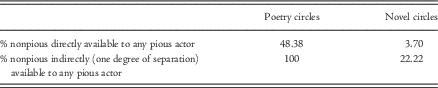
The difference was that, in poetry, pious actors could reasonably hope to count the nonpious masters of the genre among their connections, whereas in the novel they could not. In a sense, pious novelists were in the novelistic world but not of it: when they made it to the canon, they made it as writers of bestsellers or as otherwise minor figures unworthy of recognition by “real novelists”—who, of course, happened to hail from the other side of the divide. The results of network analysis, as described in the section on methodology above, demonstrate that pious poets were clearly more connected to their nonpious counterparts than pious novelists were to theirs (Table 2). Statistical analyses using Fisher’s exact tests, with p-values of 0.0001 for direct ties and less than 0.0001 for indirect ones, confirm and formalize this finding.
Cross-aisle Connections between Poets and Novelists

The network illustrated
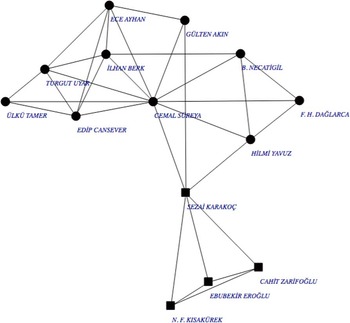
The case of Karakoç is instructive. As Figure 1 shows, this leader of the New Islamist Poetry was a veritable Janus. On the one hand, he looked toward other Islamist luminaries, like Zarifoğlu and Necip Fazıl Kısakürek (1904–1983), and together these people formed a chain of masters and apprentices that spans the entire twentieth century. On the other hand, however, he looked toward the great modernist vein of Turkish literature via his friendships with Cemal Süreya (1931–1990), Gülten Akın (1933–2015), and Hilmi Yavuz (born 1936). In this second role, Karakoç played a unique role as the sole pious founding father of İkinci Yeni (the Second New), the movement that redefined Turkish poetry and brought it up to date with contemporary Western trends in the mid-1950s. This status meant that the pious poets he instructed could, if they played their cards right, themselves become associated with this very influential movement. Indeed, Cahit Zarifoğlu is often considered to belong to the second generation of the İkinci Yeni movement, and, by extension, Zarifoğlu’s protégé Eroğlu can claim membership in its third generation.
The Network Connections of Sezai Karakoç (partial)

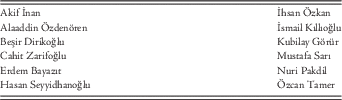
A study of the network connections of Rasim Özdenören, in the milieux of the novel and elsewhere, reveals a sharp contrast with Figure 1. Although he came from the same provincial background as Karakoç and Zarifoğlu and shared their religious and political convictions, this lone master of the New Islamic Novel had neither direct nor indirect connections to the (much larger) world of nonpious novelists: his literary allies (Table 3) were limited to fellow Islamists. It was both a cause and a consequence of the complete unavailability to this group of nonpious gatekeepers in the novelistic field that they either gradually moved away from the novel (e.g., Özdenören and Zarifoğlu) or else simply never even tried their hands in that genre.
Rasim Özdenören’s Literary Circle

Causal flow
Very importantly for my purposes, the actual or anticipated formation of cross-aisle ties came first, while that of the split self came second; even more importantly, when cross-aisle ties—or their prospect—weakened, so did the split self. In the case of Karakoç, the formation of such ties goes back to his college years in Ankara, when he was a classmate of Cemal Süreya’s. Between 1955 and 1960, the height of Karakoç and Süreya’s friendship, the latter introduced the former to the other leaders of İkinci Yeni and ensured that Karakoç had a regular place at Pazar Postası, the movement’s flagship journal. There, Karakoç published not only poems but also book reviews and essays on poetics; these works feature him at his most liberal and most generous.
In 1958, however, Karakoç’s critique of Edip Cansever (1928–1986), another leading İkinci Yeni poet, led to controversy in the pages of Pazar Postası, thereby leading him to distance himself from the milieux he shared with his nonpious literary allies. Notably, the poets who supported him here, Cemal Süreya and Ece Ayhan (1931–2002), were those with whom he had stronger ties, as they had all shared the same milieux in Ankara. The military coup of 1960 solidified Karakoç’s differences from his allies: while others were relieved to be delivered from perceived conservative oppression, Karakoç saw in the so-called “May 27 Revolution” yet another top-down move by secularist elites to disenfranchise the pious population of the countryside. As political polarization increased over the course of the 1960s and 1970s, Karakoç drifted away from the other İkinci Yeni poets, turning more and more to conservative Islamic circles, who now welcomed him as the man who had put them on the literary map. He became, in literature as in politics, less generous to the nonpious, increasingly subjecting them to the exacting demands of his brand of Islamic orthodoxy and unsplitting his self in the process. Consider the comments he made about Cemal Süreya in 1989, where Süreya is characterized—baselessly as far as I can tell—in terms diametrically opposed to Taylor’s believer (i.e., “depraved, or blind, or unworthy”):
I used to love Cemal. I very much wanted us to unite in Islam, although I have always known that that is a matter for fate and providence and I have acted accordingly. Our friendship lasted for a long time. Then, at some point, I realized that it was somehow a one-sided friendship. […] Realizing that being a leftist is advantageous [in literary circles], Cemal turned increasingly to the left, displaying a negative attitude toward me for years. But not many notice this because he does it covertly. As he is intelligent, the reader can be misled. He prefers to plant a seed of negativity about me in the subconscious of the reader. […] Over time, Cemal focused his intellect on shrewdness and on shuffling human relationships like a deck of cards. Cemal, who is very sensitive on some matters, took up an attitude of ignoring the essence of friendship—loyalty, integrity, truthfulness.Footnote 53
A similar pattern defines the course of Cahit Zarifoğlu’s life, except that in his case the network ties to the nonpious were projected rather than actual. Growing up in a provincial town among conservative friends, he learned of İkinci Yeni by following the movement’s journals, which he relished in spite of the this-worldly character of the poems they featured. He could, and perhaps did, look toward the example set by Karakoç as an equal member of a mixed environment that had launched all of its members to poetic fame. When it was time for Zarifoğlu to move to Istanbul for college, he famously wrote to Cemal Süreya, asking him half-seriously to be his roommate. Once in Istanbul, he apprenticed himself to Karakoç, thereby establishing a credible link to the İkinci Yeni establishment and eventually emerging as the second leader of the movement’s Muslim wing. From 1961 to 1971, he published in Yeni Dergi, Soyut, and Papirüs—the last edited by Cemal Süreya himself—which were all among the leading journals of the secularist-leftist literary establishment.
The response of the dominant nonpious wing, however, seems to have been chilly: whether it was in reaction to their volatile experience with Karakoç, to Zarifoğlu’s own personality, or as a result of political polarization, in any case they were less than friendly. As a result, fellow pious Muslims increasingly came to dominate Zarifoğlu’s contacts, and he became less and less in favor of cross-pollination, preferring instead to use Western materials selectively so as to fortify his position while simultaneously giving no real power to the producers of those materials. To use an economic metaphor, his laissez-faire approach gave way to a mercantilist one:
Since the beginning, we tried not to publish translated materials in Mavera.Footnote 54 We emphasized original work. Regardless of how close the foreign writer may have been to us, we did not find it right to leave him alone with our readers without our commentary or mediation. […] I am not in favor of publishing a Westerner’s poem or short story. This is done frequently and only serves cultural imperialism. We must retain the initiative and the commentary.Footnote 55
Zarifoğlu eventually came to see literary work in terms of a clash of civilizations in which the faithful were permitted to explore the world of the enemy solely in order to examine its weaponry, so that they would not be caught unprepared in the inevitable next round of the conflict. The point was to copy the ways of the infidel solely in order to survive, and to go on the offensive whenever it was relatively safe to do so: “As you know, we publish translations from our own language to foreign ones. As a counter-attack of sorts.”Footnote 56
Toward the end of his life, Zarifoğlu even came to regret the earlier, sensual work that had put him on the literary map: “The corporeal and the evil are also part of the poetic terrain. The poet must protect himself from them as much as possible. I have sometimes wished never to have published some poems I wrote thinking about those things.”Footnote 57
The experience of Ebubekir Eroğlu was also defined by anticipated rather than actual coexistence, but his expectations from the nonpious other seem to have undergone no such drastic transformation. Beginning his literary career under the guidance of Karakoç and Zarifoğlu, he was informed more by what was left of their cosmopolitan attitude than by their distrust of the religious other. In a number of essays he published on poetics throughout the 1980s, in his journal Yönelişler, he thus managed to strike a dispassionate and even tone, identifying the great problem of Turkish poetry not as the undeserved hegemony of the nonpious over the pious—which was the general stance of the later Karakoç—but rather as the hyperpoliticization of the entire practice. These essays were not universally acclaimed by the old guard of İkinci Yeni, with Ece Ayhan in particular privately expressing doubts about their author’s talent and understanding. They were, however, clearly noticed, perhaps partly because of Eroğlu’s decision to publish in Yönelişler some nonpious writers, among them Enis Batur (born 1952), Selim İleri (born 1949), and Lale Müldür (born 1956). With skeptics like Ayhan keeping their ideas to themselves, a new career path opened up for Eroğlu, one that eventually led to the republication of his works by Yapı Kredi Yayınları, one of the most respected secular literary publishers in Turkey.
In contrast to the poets, the novelist Özdenören had no reason to even imagine a future in which he would be admired, or even merely respected, by his nonpious peers. Reading no laudatory reviews of his work by these privileged men and women, sharing no conversations with them as equals, and collaborating in journal work exclusively with men exactly like himself, he was not at all inclined to develop a less than fully integrated subjectivity.
The mechanism
How to make sense of this network-selfhood nexus? What is the mechanism that mediates cross-aisle connections and the split self, causing the former to bring about the latter?
The four trajectories I have traced suggest that the answer has to do with the vagaries of reputation-making. In fields of cultural production animated partly by group labels, associating with actors with whom one has significant differences is a part of the game that competitive actors play. (It goes without saying that associating with influential actors requires interacting with them so long as they are still living.) This does not necessarily involve a conscious plan: in such fields, one becomes a competitive actor by thoroughly internalizing the rules of the game such that they operate almost as a reflex; a highly tuned “feel for the game” may dispose such actors to seek to be associated with older, more entrenched actors, those who have monopolized certain scarce resources, including literary labels.
İkinci Yeni was one such label for Turkish poets in the second half of the twentieth century. If, therefore, its acquisition appeared to be within one’s grasp, on condition that the current holders of that label be welcomed as worthy peers and role models, it is no wonder that at least some actors near its center developed a strategy of accommodation toward actors currently in that center. The latter welcomed such rapprochement because they, too, were interested in making new acquaintances, friends, and allies. Consider, for example, how Alaaddin Özdenören (1940–2003), a pious storywriter and Rasim Özdenören’s brother, describes his encounter with Cemal Süreya:
One day Cahit [Zarifoğlu] came to the office of the [local] newspaper we were publishing and handed me a copy of Üvercinka [Cemal Süreya’s first book of poems]. I read it. Fertile, fresh, and beautiful poems. […] Cahit also liked it. He suggested I write a review of it. So I wrote one. It came out in the arts page of our newspaper.
I finally met Cemal Süreya in 1961. […] He had followed our local newspaper, its arts page. I was amazed by his sensitivity and by the reach of his attention. He reminded me of my review and told me that I had been his first reviewer.Footnote 58
Indeed, the simultaneously competitive and collective nature of the world of poetry required the cultivation of backup allies from rival camps, just in case one’s primary circle failed one. The following quote from Zarifoğlu indicates that poets could be quite aware of these dynamics:
In journals roughly classified as “left,” between groups that crystallize around minor, but perhaps to them vital, differences of opinion, there are clearly unhealthy quarrels about rather unimportant issues […] On both the left and the right, an interesting picture emerges: a reader may, at times, read journals from the other camp, but be fearful of establishing any interest in certain journals from his/her own. This polarization between readers of journals of roughly the same point of view is, in a sense, a civil war. A reader who can approach the other camp with moderation and tolerance cannot do the same to journals that differ from his/her point of view only slightly.Footnote 59
For actors with significant religious differences from the center of poetic innovation, all this amounted to a need to solve a problem similar to the one that Calvinists, according to Max Weber, experienced: they had to find a way to convince themselves that their religious salvation was not in peril. Hence the split self. When solving that problem became less urgent—whether because they no longer felt the need to associate with the nonpious or because the prospects of such associations grew weaker in their eyes—they could easily return to their comfort zone. It is therefore possible to think of the split self as a component of the cultural toolkitFootnote 60 that allows actors to drift in and out of the immanent frame as their perceived circumstances change.
By contrast, a pious novelist of the time felt no such incentive at any depth of his/her psyche. The professional world in which he/she lived and moved was so wholly segregated into distinct clusters defined by religiosity (or its absence) that the nonpious other was experienced, if at all, as nothing more than a distant oppressor. Pious novelists were thus led to close ranks and find solace in the sameness of every other actor around them. Their salvation was never imperiled by the prospect of association with the “impure,” whom they could comfortably continue to see in purely negative terms as the antagonists of a one-dimensional narrative. Nothing worthy beckoned from outside their comfort zone.
Discussion: the “Westphalia moment” of Turkish literature
Ultimately, then, Turkish poetry’s deep secularity was a matter of cosmopolitanism. At a time when most pious Turkish Muslims were reacting to what they saw as secularist excess by avoiding the nonpious and relying exclusively on fellow coreligionists, their counterparts in the poetic field could reasonably view their left-leaning, bohemian peers as valuable resources. Out of their encounter—or specifically in order to bring about that encounter—there emerged the split self, a route to deep secularity that Taylor anticipates but does not theorize.
Among novelists, by contrast, the picture that emerges is almost identical to the Turkish stereotype: pious novelists experienced their nonpious peers as enemies who did not even bother to dissimulate their uncharitable feelings toward men and women of faith. The chasm that separated the two groups being unbridgeable, pious novelists had no reason why they would want, at any level, to split their selves in the way that pious poets sometimes did.
The mental transformation involved in the formation of the split self was not necessarily transparent to the actors who undertook it, and they were able to view nonpious actors as resources only to the extent that they valued literary recognition above other things. The self-interest of which I speak is thus not that of rational choice theory. Still, as far as Turkish literary milieux are concerned, a broadly realist account is in order: with no prospect of forming cross-aisle connections, writers in the novelistic world developed neither the split self nor deep secularity.
There may be a wider point here that concerns all deep secularity as such. It is well known that a crucial historical moment for European secularization was when religious conflict ended in stalemate in 1648, thereby dispelling all hopes of achieving religious unity for the western half of the continent. Peace may well not have been the initial impulse of any of the parties involved, and the treaties that made up the Peace of Westphalia may well have been signed only when it became abundantly clear to all those parties that none of them could annihilate any of the others. But when war was finally over, some Protestant merchants must have found that the few Catholics remaining in their vicinity could make reliable business partners, and like the pious poets focused on in this article, they must have been pleasantly surprised that contact with the religious other could be beneficial without costing them their salvation.
In this context, it is useful to point out that there was a long religious war of sorts in Turkish literature, especially in poetry, well before Sezai Karakoç and Cemal Süreya turned a new page. Through the second half of the nineteenth and the early twentieth centuries, literature, and especially poetry, was a veritable arena where pro-Western and pro-Islamic camps contested the troubled soul of the nation. Tevfik Fikret (1867–1915) and Nâzım Hikmet Ran (1902–1963) became famous partly for their spirited defense of the secularist cause against, respectively, Mehmed Akif Ersoy (1873–1936) and Necip Fazıl Kısakürek. There was no exact parallel to the Peace of Westphalia, but by 1955 a de facto truce was somehow in place: with Tevfik Fikret and Ersoy dead, Ran in exile in the Soviet Union, and Kısakürek devoting less and less of his time to poetry, the next generation was effectively free to follow a different path.
This is an aspect of the experience of secularization that is absent from ASA. There, Taylor, perhaps in order to shift the focus from the state to culture, makes few references to religious conflict and its resolution.Footnote 61 This leads to an overly longue-durée picture of secularization, with developments in the sixteenth century fatefully shaping the main thrust of human development: early divergence from the Western pattern via the inability to develop the immanent frame is presented as having irreversible consequences that echo across centuries. In contrast, the evidence presented here shows that deep secularity can appear and disappear within a single lifetime, in response to developments moving to a much faster rhythm. It also shows that, as timely as the shift from the state to culture may be, secularization can proceed to the deep level indicated by Taylor only if the circumstances are right on a shallower level: deep secularity may be the unintended consequence of religious conflict when that conflict is resolved in such a way that none of the parties involved is fully satisfied. The “Westphalia moment” may be universal.
A particularly interesting question relating to all this is whether or not a new round of religious conflict will follow in Turkish poetry milieux. Westphalia was the second peace treaty signed between Catholics and Protestants, and, as the Glorious Revolution of 1688 shows, confessional differences continued to shape European power politics for some time after it. Especially given the demonstrated fragility of the split self, renewed hostility between pious and nonpious poets is a distinct possibility. That almost all the nonpious leaders of İkinci Yeni have passed away is another factor pushing in that direction: it is now possible to associate oneself with that prestigious label by usurpation, rather than by interaction. It is thus not surprising to see upstart Muslim poets starting to call İkinci Yeni a subset of Sezai Karakoç’s activity, rather than the other way around.Footnote 62
As a result, even if Taylor was wrong to ignore non-Western deep secularities, it does not follow that Western and non-Western deep secularities are essentially “the same”: for all its shortcomings, the edifice that Taylor describes is built on more solid foundations than the one described here. Non-Western secularities may eventually acquire that kind of staying power, but it would nevertheless be a mistake to roundly dismiss ASA as just another orientalist book. The point, again, is to acknowledge the difference between the average Western experience and the average non-Western one, and then to explore the variance internal to each, and particularly to the understudied latter.
I would therefore like to conclude with a series of questions that such an exploration is likely to encounter. How widespread is the split self? Are there other transformations of subjectivity that lead to the immanent frame (i.e., third, fourth, etc. paths to deep secularity)? If such paths do exist, how durable are they? Is the split self found equally in all sorts of milieux, or do certain kinds of environment favor it more than others do? Does the split self always arise from cosmopolitanism, or are there other mechanisms leading to it? And finally, what brings about cosmopolitanism in the first place? Why, for instance, was the world of the Turkish novel not cosmopolitan?
This last question is of paramount importance insofar as the relative import of the eventful aspect of secularization depends on how exactly it is answered. Without the unique personal relationship between Sezai Karakoç and Cemal Süreya, it is not clear whether deep secularity would have emerged at all in Turkish poetry, and without more rigorous analysis of the relevant poetic and novelistic milieux, one cannot fully dismiss the thesis that poetic deep secularity was a mere coincidence unlikely to be repeated anywhere else. Such a rigorous analysis may well reveal a set of causal factors that makes such contact likely—a single conflux of basic rules defining the poetic “game” across the twentieth century. Or, on the other hand, it may instead reveal a chain of developments whose unfolding cannot be reduced to the interplay of variables because those events themselves change the basic rules of the game. Whether or not a variable-based or an event-based approach prevails—or whether they will have to be somehow combined—could have important implications for the study of secularization.