Is it the case that the publics of western democracies make environmental policy demands upon their politicians that they have no desire to see fulfilled? If so, why, and what are the implications? The empirical evidence suggests that the answer to the first question is ‘quite possibly’, although this depends upon what environmental question we are considering, what it means to make a political ‘demand’, and whether we can distinguish ‘simulative’ demands from those that are merely weak. As to ‘why?’ and ‘what follows?’, one theory has posited the existence of a ‘post-ecologist’ turn, represented by, above all, a move away from ‘authentic’ demands for environmental change and sustainable social and economic practices, towards demands that are made inauthentically (although still presented with all due seriousness). These demands are hollow and rhetorical, they articulate no genuine desire for substantive change that would threaten the institutional architecture of ‘democratic consumer capitalism’. This approach to understanding contemporary environmental politics is most closely associated with the work of Ingolfur Blühdorn,Footnote 2 and reappears in the recent edited collaboration between Blühdorn and Welsh.Footnote 3
The first stage of the analysis will be to review some recent survey material for evidence of ‘simulative environmental politics’. As ‘environmental politics’ covers a vast range of topics from species preservation to the pros and cons of nuclear power generation, I will focus on one issue, that of climate change. This is an apposite topic for a number of reasons. There has been a significant amount of recent work on public attitudes to climate change, some of which points toward a ‘paradox’ that – as we shall see – suggests that here, at least, simulative politics may exist. Thus if we are going to find support for the post-ecologist thesis anywhere, this may well be a good place to start. Furthermore many of the suggested policies for ameliorating the causes and effects of climate change will be costly; the effects of climate change threaten to be profound, so if there are simulative demands being made in this area it probably matters.
I will go on to set out the key elements of simulative politics articulated in the post-ecologist paradigm, paying particular attention what are taken to be novel features of the post-ecologist condition. Having established this, I will go on to ask whether these features can be explained via the intentions and/or actions of individual political actors. I will propose that there is a body of theories and concepts that can offer micro-foundations for a phenomenon that Blühdorn and others take to be explicable at a predominantly social/systemic level. The concept of ‘rational irrationality’, as developed by Bryan Caplan,Footnote 4 with its focus on the effects of variations in the costs of error, offers a useful window for examining the survey evidence discrepancy between the making of apparently strong environmental demands on the one hand, and a reluctance to back them up with a ‘willingness to pay’ on the other, on the part of western publics.
IS THERE A SIMULATIVE ECO-POLITICS?
What evidence is there that we have ‘simulative’ eco-political demands in contemporary western societies? One relevant finding in the work on public attitudes to climate change is that there seems to exist what Jamieson calls a ‘paradox’: this is that most Americans surveyed self-report as environmentalists, believe that climate change is an environmental bad and say that they were willing to pay to mitigate it. When, however, specific policies with definite costs are placed before them, their support for mitigation fades away.Footnote 5 I agree with Jamieson that this is, on the surface, a paradox. The propositions that citizens are (1) willing to pay to mitigate climate change and (2) not willing to pay for any specific measure to mitigate climate change cannot both be true simultaneously. The paradox may be resolvable if citizens favour some other unspoken policy to tackle climate change that has not been presented to them in survey questions. For the reasons we will see below, however, this seems unlikely.
As Jamieson notes, this paradox is not confined to the USA; similar findings have been reported in the UK,Footnote 6 with McLean describing the phenomenon as ‘cheap talk environmentalism’.Footnote 7 Lieserowitz reports that Americans seem concerned about global warming but, ‘paradoxically’, seem also to view it as less important than almost any other issue. Sterman and Sweeney also find that there is a ‘contradiction’ in people's attitudes to climate change, they express concern but then oppose policies designed to mitigate its effects. Pidgeon et al. report a UK survey in which 69 per cent of respondents thought climate change best managed through behavioural change, but only 8 per cent thought that responsibility for this change lay with ‘individuals and families’. Stradling et al., in a report on attitudes to car use in the UK, show that while 82 per cent of drivers think that car use has a serious effect on climate change, and 66 per cent agree that everyone should reduce how much they use their cars, only 18 per cent agreed that car users should pay higher taxes. Lorenzone et al. report wide awareness of climate change in the UK, but it was also given a low priority by the public, and Bazerman notes that while climate change is almost impossible to ignore, given its media profile, both politicians and the public are failing to respond.Footnote 8
These survey results from the USA and UK may reflect a number of things, such as a lack of faith in taxation to achieve desired results,Footnote 9 awareness of the problem of collective action, or that pro-environmental preferences are consensual but weakly held. The ‘paradox of climate change’ may also suggest that there are apparently strong demands made with regard to ecological problems in the abstract, which are not replicated in policy specifics. This might well indicate a form of politics that could be described as simulative. To take some further examples, a poll by the Nicholas Institute for Environmental Policy Solutions at Duke University found that 79 per cent of respondents favoured ‘stronger national standards to protect our land, air, and water’, with 40 per cent ‘strongly’ in favour. However, only 22 per cent said that environmental concerns would affect who they would vote for.Footnote 10 The ‘demand’ for strong national standards does not translate into a vote. Jamieson notes that the US public does not just object to one particular policy approach but to several, especially those most favoured by economists and policy experts, which often use price incentives to change behaviour.Furthermore, these self-reporting environmentalists ‘often vote for environmentally abusive candidates’.Footnote 11 On the question of whether these espoused preferences are simulative or merely weak, it is interesting to note that respondents often opt for very strongly worded environmental commitments. For example, in a 2005 Harris poll in the USA, 74 per cent of respondents held that ‘protecting the environment is so important that requirement and standards cannot be too high, and continuing environmental improvements must be made regardless of cost’.Footnote 12 Such a high level of agreement with a strongly worded statement might well imply ‘simulation’ if these respondents would then not be willing to support specific policies on the grounds of expense. This evidence suggests, prima facie, that there are ‘demands’ for ‘action’ on environmental problems (to the extent that we can think of survey responses as reflecting people's political will) such as global warming, but that such demands are not necessarily made politically effective through any relation to a vote, or a willingness to incur up-front costs.
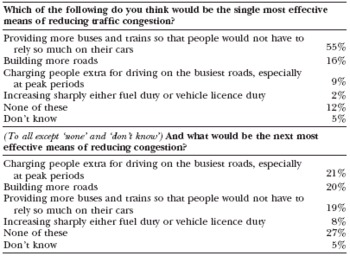
Another analyst who has examined this phenomenon in relation to climate change is Iain McLean. He notes that if the question is simply ‘Do you care about global warming?’ the answer is ‘yes’. In the UK, for example, 67 per cent report having ‘a great deal’ or ‘a fair amount’ of concern about global warming, in Spain 85 per cent, and even in the USA the figure is 53 per cent.Footnote 13 However, as McLean says, the ‘feeling that something must be done is disconnected from feeling in favour of doing anything’.Footnote 14 He employs data from a survey regarding methods of reducing traffic congestion as a proxy for willingness to take policy action on climate change. Some caution is therefore required, as these are not the same respondents who suggest, in the abstract, that we should be willing to incur large costs to mitigate climate change. McLean's defence of the substitution involved here rests on the fact that any measure that reduced traffic would, as well as mitigating congestion, also mitigate climate change, so ‘the question is a valid measure of people's willingness to be inconvenienced in order to mitigate public bads.’Footnote 15 The figures are shown in Table 1.
Responses to Questions Regarding Traffic Congestion

McLean's judgement on these figures is crucial in suggesting that there is evidence for something we might plausibly call a simulative eco-politics in Blühdorn's sense.
Like every other poll I have seen, this confirms that citizens are willing to make cheap talk or non-budget-constrained commitments (‘let there be more buses and trains’), but unwilling to make commitments where the costs are obvious and upfront. Only 11 per cent of respondents to the first question are willing to support either of the only two economically literate solutions to transport congestion and emission abatement.Footnote 16
Citizens are, then, willing to make only ‘cheap talk’ offers to ‘solve’ the public bad of congestion, which avoids making the hard choices that would actually affect the pay-offs that they expect. Cheap talk consists of ‘costless, nonbinding, nonverifiable messages that may affect the listener's beliefs’.Footnote 17 A claim by the public that we must ‘do whatever it takes’ to ‘solve’ climate change (which is similarly a public bad) would be just such a message. A willingness to make abstract commitments is not matched by a commitment to policy choices that contain obvious up-front costs. The combination of evidence from climate change surveys and McLean's work on congestion may indicate a general tendency towards ‘simulation’ in the politics of public bads, and specifically a ‘simulative eco-politics’ with respect to climate change.
POST-ECOLOGISM AND THE POLITICS OF UNSUSTAINABILITY
Why is this so? One explanation put forward by Ingolfur Blühdorn is that the contemporary politics of nature and the environment is ‘post-ecologist’. Post-ecologism is held to consist of four key ‘ingredients’.Footnote 18 First, ‘the most fundamental idea’ is the ‘abolition of nature’ as a unified conception. The implication here is that ecologist politics sought to operate with a single, unified notion of the natural world, whereas nature is a contested concept that can be understood in a wide variety of sometimes contrasting ways. Blühdorn approvingly cites Niklas Luhmann here, whose ‘model replaces singular nature by an unlimited number of environments’.Footnote 19 Immediately implicit in this idea of the abolition of nature is the ‘abdication of the subject’, as the second element of post-ecologism, which takes a broadly Althusserian line on subjectivity. The conception of the unified autonomous self employed in ‘modernist’ ecologist politics is replaced by a subordinated individual who is ‘part of the environment of social systems, but never their centre’.Footnote 20 The third integral notion of post-ecologism is the end of eco-ethics and ecological rationality. This is closely connected to the ‘abdication of the subject’ as eco-ethics demands an autonomous ethical agent capable of making moral choices, but ‘ecologists simply overestimated the relevance and capacities of the human individual.’Footnote 21 Finally, post-ecologist politics is taken to be ‘post-problematic’, in that it is no longer centred upon specific ecological concerns. Ecologist politics takes certain physical changes in the world as problematic in themselves, whereas post-ecologism recognizes the register of social construction behind this ‘problem’ designation, and repudiates the naive connection between physical correlates and ‘problem’ status. Political activity is not driven in any straightforward way by changes to the natural environment.
Post-ecologism is, then, all of post-nature, anti-humanist, post-ethical and post-problematic. In this it does not deny that physical features of the world, such as climate, may be changing, but wishes to insert recognition of a social dynamic between change and ‘problem’. It moves us away from a singular, universal notion of ‘an environmental problem’ that has an ‘ethical’ solution, and towards far more fragmented, partial and varied notions of what might constitute environmental problems and solutions. A ‘post-ecologist politics of nature is primarily determined by the problems and needs of specific function systems…post-ecologist politics is committed to partial rationalities and particular exclusive interests.’Footnote 22
There are critiques of this conception of post-ecologism already published,Footnote 23 and I do not intend to add to them here; the above is provided rather to orient readers who may be less than familiar with the term. What is particularly relevant for the purpose of this enquiry is Blühdorn's suggestion that post-ecologism is characterized by a form of simulative politics. This proposition emerges from two of the conditions of the post-ecologist paradigm – that, on the one hand, there are no more serious eco-ethical demands being made (a ‘core ingredient’), and on the other, that ecological politics has been (re-)subordinated to the imperatives of economic growth. Given this, how do we explain an ‘(eco-)political correctness’ that presents politicians with a string of demands of ecological action, when the superordinate consideration is apparently economic growth as normal?
For Blühdorn (drawing on Baudrillard)Footnote 24 this simulative politics has come into play at a time when ‘symbolic politics’ has become ‘empty’ and exhausted. The symbolic elements of politics have become entirely self-referential and fail to connect with, or represent, any authentic, substantive form of ecological politics. Thus demands made to ‘do something’ about the ecological crisis – knowledge of which has permeated throughout society in various mediated forms – are not demands for an authentic solution to the problem, which would involve radical changes in lifestyles and institutional forms. Instead, such demands represent ‘the performance of seriousness, the performance of authentic (eco-)politics, it is the form of political communication that…articulates demands that are not supposed to be taken seriously and implemented, but which are nevertheless constantly rearticulated with politicians being criticized – as part of the performance – for not implementing them.’Footnote 25 This constitutes a ‘simultaneity’ of discourses: the demand that something must be done about environmental crisis along with an insistence on the inviolability of consumer capitalism.
One assumes that under these conditions a trap lies in wait for any politician foolish enough to take ecological ‘demands’ at face value in terms of policy proposals. The politician may be lambasted for not delivering the environmental goods, but would be punished at the polls if she did. Thus, for example, the then UK Transport Secretary John Prescott could get away with pledging in 1997 that, ‘I will have failed if, in five years' time, there are not many more people using public transport and far fewer journeys by car. It's a tall order, but I urge you to hold me to it,’Footnote 26 and then failing to deliver on that pledge. He played the appropriate rhetorical strategy, and there was no electoral punishment for him or his party emanating from the fact that the Labour government did nothing to reverse the long-term trend of static or falling real costs for motoring while the cost of public transport went up.Footnote 27 Under the (eco-)politics of simulation nobody would be interested in enforcing the sort of environmental demands that include reducing car use.
There would appear to be a problem for democracy in coping with insincere demands of this sort. If democratic, representative institutions are to respond (to a sufficient extent to maintain legitimacy) to the demands of voters, insincerity on the part of the public adds an additional level of complexity. Not only do politicians and parties have to detect what demands carry popular support, they also have to filter genuine and sincere demands from insincere ones, for if they act upon the latter they may be electorally punished for not carrying out their ‘part of the performance’ appropriately. Indeed, if problems such as climate change lead to the making of insincere political demands on the part of the public, this might be seen as another example of the ‘moral corruption’ associated with climate change catalogued by Gardiner.Footnote 28
The account of post-ecologism given above describes a condition in which simulative demands might be made; it has done nothing to explain how those demands come about. How does Blühdorn approach that question? To begin, we need to ask why actors would make demands upon their political elites that they had no ambition to see fulfilled. This, however, is one of a number of lines of enquiry about which Blühdorn and Welsh have reservations. Blühdorn says: ‘it is important to note that the practices of simulation and the performance of seriousness which have been discussed here cannot be described as conscious strategies which are deliberately adopted by individual or collective actors. The point of the analysis cannot be to question and judge the committedness and integrity of any particular actor.’Footnote 29 Instead, the post-ecologist thesis works as a descriptor at the societal level, offering a ‘different’, but not ‘better’ insight into society than that available to the critical theory of symbolic politics. The politics of simulation is not a conscious strategy in this view, but is rather an exercise in ‘societal self-deception’, as this form of politics somehow meets the urgent needs of late-modern society. In a related context, Blühdorn asks, ‘what strategies does it [i.e. late-modern society] develop in order to stabilise or regenerate the external point of reference, the dualism of modernity on which it depends?’ to which the answer is that ‘Traditional modernity can be simulated.’Footnote 30 This does stray into explanatory territory, but the sense in which ‘late-modern society’ should be the subject of the verb–noun relationship ‘develop strategies’ is not entirely clear, when Blühdorn also accepts that it has no relevant ‘cognitive capacities’ or agency. It is clear enough, however, that for him and Welsh answers to these questions lie at the systemic level, even if such systems-based answers are intended only to ‘supplement’ other, unspecified levels of explanation. My argument here is that there is rather more mileage to be gained from individualistic accounts of political motivation than such systemic approaches allow for. Resolution of the apparent paradox of demands that are not intended to be fulfilled might lie in accounts of the incentives facing individuals rather than social systems.
SIMULATION WITH MICRO-FOUNDATIONS?
What may help us to explain an (eco-)politics of simulation? I could not hope here to give a complete account, but I do want to suggest that there is available, from literature on voter attitudes and behaviour, a set of concepts and ideas that can help us to construct a partial explanation of simulative eco-politics with micro-foundations. What this will suggest is that, far from requiring us to believe that we have emerged into an entirely new form of ‘post-ecologist politics’, we can instead understand simulative eco-politics as a manifestation of rational ignorance combined with rational irrationality. This can lead to political posturing, an over-moralized politics, ‘cheap-talk’ solutions and the manipulation of information costs on the part of interested lobbies. While ‘simulative eco-politics’ does not mark a radical new departure, it does mark out some high-profile environmental problems, such as climate change, as seriously intractable.
The alternative explanation rests in part upon the nature of some of the most important environmental problems that we face, such as rapid loss of biodiversity and climate change. The latter, in particular, is a technical, long-term problem that is removed from the everyday concerns that most of us have as economic agents and citizens. Immediate problems of flood, drought and extreme weather events may emerge, but there have always been such things, and so causality is difficult to establish with respect to climate change. Getting the best information on whether Hurricane Katrina was induced or exacerbated by climate change or merely a ‘standard’ extreme weather event that just happened to make landfall at a vulnerable and highly newsworthy spot would be costly, as even among ‘experts’ opinion seems divided.Footnote 31 The pay-off for obtaining reliable information to anyone who does not require a professional understanding of Katrina would seem to be, on the other hand, tiny. Similarly, understanding what the precise effects of climate change will be, globally, in 2100 or 2300 would involve considerable costs and little, if any, pay-off for most of us. On the other hand a vague sense that climate change is a ‘bad’ that will have negative consequences of some indeterminate sort is easily come by through exposure to television, radio and print media.
Under these circumstances, as perhaps most famously both Joseph SchumpeterFootnote 32 and Anthony DownsFootnote 33 pointed out, we might reasonably expect people to be ‘rationally ignorant’ of such large-scale complex environmental problems. What some see as the cynicism of Schumpeter's account of democratic politics is rooted in a conception of individual rationality in the face of uncertainty regarding the gains that are to be made from acquiring particular types of information. Schumpeter sees rational individuals as generally capable of looking after their own interests within their immediate sphere of economic activity and social interaction. Within the context of ‘democratic consumer capitalism’ this means that individuals will, generally, gather enough information to make rational decisions about employment and consumption choices such that these choices will serve their best interests. Perhaps this will not be the case every time, but on enough occasions that it will be the general trend in society that people make instrumentally rational choices. Decisions on employment and consumption have a sufficiently large impact on our welfare that diligent information-gathering is rewarded. Some of this information is gathered through repeated interactions that develop into relationships of trust, but where interaction is infrequent (i.e. closer to ‘one-shot’ games), we can expect the explicit accrual of information to pay dividends.
In the field of political decision-making things look very different. Here the control over outcomes that can be exercised by any individual is highly diluted by the scale of the political community in which they exist. Where outcome influence is so limited as to be virtually non-existent, then the costs of information-gathering are very unlikely to be paid back in the rewards that accrue to information holders. Thus we have a set of circumstances inducing rational ignorance. While this is always problematized by the fact that we do not know the true value of information until we possess it (if then), it makes sense as a rule of thumb to think that information gathered that relates to personal circumstance will always pay better than information gathered about collective-level phenomena, over which one has virtually no control.
Climate change serves as a useful illustration here: it brings together two areas over which people are likely to be both ignorant and irrational – politics and science.Footnote 34 In his book, Heat, environmental activist and writer George Monbiot expresses his surprise at the levels of ignorance that exist regarding the science of climate change, despite the fact that information about global warming is printed and broadcast almost daily.Footnote 35 On a Schumpeterian view this is precisely what we might expect. Climate change is a macro-level global phenomenon, control over which does not pass down to anything like the individual level. For Schumpeter, the individual drops to the level of the infantile or the ‘primitive’ in his or her political life.Footnote 36 Climate change, or the relationship between interest rates, inflation and unemployment, are not the kind of phenomenon about which it pays to be well-informed, unless there is some kind of professionalized interest. After all, a well-informed vote counts for no more than an ignorant one in the democratic arithmetic. This remains true despite the fact that information about climate change is easily obtained. Schumpeter says that this ignorance strikes us as ‘more shocking’ in the case of highly educated people, ‘when information is plentiful and readily available’. We should not, however, wonder at it. The lawyer has every incentive to master his brief, but ‘in the other case, he has not taken the trouble to qualify; he does not care to absorb the information or to apply to it the canons of criticism he knows so well how to handle; and he is impatient of long or complicated argument.’Footnote 37 This is the point here: it is not that people are stupid or inherently irrational, just that we have to make, under resource constraints, calculations about what information we will pursue. Even when information is plentifully available and almost costless, we should not necessarily expect people to take it on board, as there are clearly costs to processing information as well as gathering it in the first place.
One of the more notable aspects of the circumstances leading to an expectation of rational ignorance is that the private cost of being mistaken about public policy is, for most people across many issues, likely to be zero. Even if it is the case that, for example, taxes rise unnecessarily because of bad policy decisions, and that represents a real cost to voter A, the chances that A can causally bring about the circumstances which lead to A paying more tax are infinitesimally small. Thus the costs to A of being wrong on matters of fiscal policy are similarly small, which means that A can afford to have strident views, even when these are based on very little information. This outcome is captured by Bryan Caplan's discussion of ‘rational irrationality’.Footnote 38 If ‘irrationality’ is taken in this case to refer to the holding of strong views without good reason, then such holding of views can be rational when they are also costless. Views can be privately costless even when a large number of systematically biased individuals bring about poor collective outcomes. Pincione and Tesón note that the circumstances leading to rational ignorance are also likely to lead to ‘political posturing’, in which there is an (over-)moralized politics and demands for ‘consequence insensitive change’.Footnote 39 This may help to explain a phenomenon regularly seen in surveys whereby, as noted above, in the abstract, people are happy to demand that ‘something must be done’ (‘continuing environmental improvements must be made regardless of cost’), but they then baulk at the prospect of paying McLean's ‘obvious and up-front costs’. In a word, it may help us to explain an ‘eco-politics of simulation’. People are prepared to hold strong views on environmental matters for as long as those views are costless. When, however, these views cease to be costless, the changing pay-offs are likely to lead to revised views. When people are asked specific questions about how much tax they would pay to mitigate climate change, or whether they would give up their car, the costs of climate change abatement become obvious. Even though one could at this stage give a dishonest answer to maintain consistency with the abstract view, people seem more likely to report contradictory preferences: thus the paradox.
There is another question worth considering here. When information is costly why hold any opinion or say anything at all – even when the costs of being wrong are zero? Why have any opinion on climate change or foreign affairs when one could be expressing a view on something over which one has more control?Footnote 40 This is a reasonable question, to which there are two possible responses, one of which concedes more than the other to the implied objection. On the concessionary side, much of the ‘evidence’ with regard to public attitudes to climate change is gathered in response to direct questions via surveys. It may be, as Sunstein and Jamieson both suggest,Footnote 41 that many people actually have no stable or well-thought-through preferences in these areas in the absence of being asked such a direct question. When faced with a question from the lips of a surveyor, they might feel that some sort of response is appropriate, and so articulate a view that is more-or-less made up on the spot. If this view was cast in strong rhetoric, that ‘strength’ would not relate to any deeply held conviction. Empirically, this information about unformed preferences is probably hard to access, although questions relating to the salience of the problem may get some traction on whether people actually think about an issue prior to being asked about it.
The non-concessionary answer is to follow Caplan's suggestion that people also have preferences about the content and intensity of their beliefs.Footnote 42 The assumption is that people have predilections for certain things to be true, and those with a taste for irrationality ‘are likely to trade off some material wealth in exchange for more satisfying beliefs’Footnote 43 (all the easier when the ‘material wealth’ element is zero or close to it). When irrationality is very cheap, it would only take a small pay-off to encourage such citizens to ‘consume’ some. There may also be (but does not have to be) reward in terms of social interaction in having views on political matters, or kudos to having ‘strong’ views, then this may be sufficient to give irrationally held beliefs a warrant of rationality.Footnote 44 It is intuitively plausible to think that this is often the case. Political questions are frequently the subject of heated discussion, and in the field of social interaction having a view on climate change, immigration, or the wars in Iraq and Afghanistan will, presumably, often lead to exchanges that participants find enjoyable. The level of enjoyment, it is worth remembering, would not have to be far above zero to pay off. This social interaction may even act as a constraint of sorts on the degree of irrationality that can be expressed without private loss. A view that climate change is caused by aliens may get short shrift in most settings, and so irrationality may be bounded by some notion of plausibility if it is to be rewarded.
If climate change lends itself extraordinarily well to conditions of rational irrationality, what kind of political discourse can we expect these conditions to generate? Strong views based upon weak informational foundations may lead towards ‘over-moralized politics’,Footnote 45 cheap talk, and demands for change that is insensitive to consequence, which suggests that people will have highly ‘selective aspirations’ in terms of their environmental demands,Footnote 46 and that these demands will bear little if any relationship to economic or scientific literacy. Evidence also suggests that people have ‘single-cause’ bias in explaining problems and ‘single-action bias’ in seeking to resolve them.Footnote 47 This may lead to scapegoating, as both blame and hope are pinned on one pollution point, even though causes are multiple. So the problem is framed such that 4 × 4 drivers, budget airlines, power generators, meat farming, or some other single activity is given excessive emphasis. Furthermore, we can, as noted by Galles and Sexton,Footnote 48 expect intense lobbying activity under these conditions, providing that there are some institutions or groups of individuals who stand to make significant gains or losses in the wake of any changes to government policy.
The cheaper information is, the more likely it is that segments of the public will garner some knowledge, even when the incentives for doing so are weak. Some information (such as what one may hear on the radio during the morning drive to work) is virtually free, requiring merely a little concentration and retention of information; access to this information may lead to changes in public attitudes.Footnote 49 If one section of the population, with interests in the status quo, sees the best available accounts turning against it, it may well have an interest in deliberately obfuscating an issue in order to increase the costs of getting reliable information. If plausible counter-arguments can be constructed then information costs can be increased and people become pro tanto less likely to become well informed. There can be little doubt that at least some of the climate change denial industry has operated in the way it has for these reasons. Its work is frequently funded by large, fossil-fuel dependent economic interests and its raison d'être often appears to be sowing the debate with the seeds of confusion. Take this view of the Bush White House on climate change: ‘ “They decided they didn't need to win the debate on climate,” says [Rick] Piltz, the former official who exposed Cooney's tactics. “They just had to leave an atmosphere of uncertainty about it and dissipate the will for political action.” ’Footnote 50 Contrarily, climate sceptics accuse of alarmism a ‘self-interested gaggle of journalists, environmental lobbyists, scientific and business groups, church leader and politicians, all of whom preach that we must “stop climate change” by reducing CO2 emissions.’Footnote 51 The manipulation of information costs and exploitation of an ignorant electorate by lobbies is exactly what would be predicted in scenarios that produce rational ignorance and rational irrationality. Theoretical support for this view is given by Roger D. Congleton, who proposes that ‘the cost of information affects voter decisions to remain rationally ignorant.’Footnote 52 As information becomes cheaper to obtain, it becomes more likely to be rational to take it on board, and thus ‘the very rationality of rational ignorance potentially allows the degree of rational ignorance to be manipulated.’Footnote 53 Interested parties may have a stake in making some pieces of information highly visible, even if only to compete with alternatives –‘electoral, and thereby policy outcomes, can be affected by systematically altering information costs.’Footnote 54
At this point it is worth deflecting what may appear to be an obvious conclusion of this line of enquiry. Rationally irrational people may demand climate change abatement at any cost, or none at all, or any position between. Evidence for systematic bias seems to indicate that a majority demand strong measures in the abstract, but much weaker measures when these have explicit costs attached. This is the ‘paradox’ but it is not possible to conclude from this that people simply demand ‘too much’ climate change abatement in the abstract, and then something closer to the right amount when abatement is costed. Including costs improves the information flow, but asymmetrically. What remains unknown is how much benefit such abatement would bring. Quite apart from the general problems in applying cost–benefit analysis to climate change,Footnote 55 it is very unlikely that rationally irrational respondents are setting the costs of abatement against any concrete sense of the benefits that would follow, either for themselves, for others or for future generations.
CONCLUSION
The conclusions to be drawn at this stage can be no more than tentative and provisional. In the absence of survey work explicitly designed to reveal simulative preferences, we can do no more than infer the possibility of their existence from existing evidence of public attitudes on climate change and other public bads. The surveys cited here are drawn almost exclusively from the UK and USA, and the evidence is no more than suggestive. That said, given what is at stake in terms of the impact of climate change, if the governments of liberal-democratic regimes are faced with simulative ‘demands’ in this area and if (a question requiring further evidence) they would be electorally punished for taking costly action to mitigate and adapt to climate change, this matters.
It is worth reminding ourselves that Blühdorn and Welsh see their account of simulative eco-politics as a ‘descriptive’ theory working at the societal level. Where, however, it does stray into explanatory territory this account is problematic. Even if it is empirically the case that we see something like a simulative politics of post-ecologism, why should we accept that this comes about in order to fulfil a systemic, societal level need? The long-standing critiques of systems-level analysis and structural functionalismFootnote 56 apply here, in that without an adequately specified over-arching explanation, such as the evolutionary process for functional genetic change, the society-level explanation remains somewhat mysterious. Even if, that is, simulative politics offers ‘exactly what late-modern society urgently requires’, it is not clear by what process, operating at the societal level, late-modern society ensures that it gets what it needs. This is what remains mysterious in their explanation: especially so when it is accepted that ‘Systems cannot be assumed to have either the cognitive capacities to become aware of their crises, or the agency to take co-ordinated remedial action.’Footnote 57
My purpose in this article has been to suggest that questions about the motives of the individual actor in contributing to simulative eco-politics are highly relevant. Furthermore, the literature on rational ignorance and rational irrationality offers at least part of an answer. If the ‘post-ecologist politics’ descriptor is at all accurate, then the public is making demands for action to its politicians that are not really demands at all. This entails a problem for politicians, who will have to disentangle serious political demands from demands made with all due appearance of seriousness but which in fact are insincere. Normatively, the effects of this may be somewhat mixed. If the conditions that lead to rational ignorance and rational irrationality can also encourage an ‘over-moralized politics’, and strident demands for ‘consequence-insensitive change’, then they may lead to an over-demand for abatement and damaging forms of policy. As Pincione and Tesón note, in consequentialist vein, legislation has ‘complex consequences’, many of them unintended, so merely that climate change is a public bad may not be reason enough to take very expensive measures of mitigation.Footnote 58 On the other hand, if such strident, moralistic demands are mere cheap talk, and politicians suspect that they are cheap talk, then this may lead to under-demand and very little being accomplished in policy terms with respect to a very important environmental problem. All of the seductions of moral corruption discussed by Gardiner may then come into play. Furthermore, even if the abstract demands to ‘do something’ about climate change are made on the basis of poor information and are simulative, it does not follow axiomatically that they are wrong. One may come to a sound policy position for bad reasons. Setting out costed policy options only increases the knowledge base asymmetrically and inadequately, and if rational ignorance holds, very few would have a clear sense of the benefits that climate change abatement would bring. And this is to say nothing of whether people consider issues such as intergenerational justice.
The opinion of a rationally irrational public may have no bearing on the question of how much climate change abatement we, as a society, should pursue; but it may have a bearing on how much will be tolerated, and in what form. For this reason public attitudes to climate change have to be taken seriously. We know from recent European experience that fossil fuel taxation is a politically explosive matter. The positing of a simulative form of eco-politics is an interesting thesis that can provide an additional dimension to our understanding of the dynamics operating with respect to environmental politics. It deserves explicit empirical investigation. The survey evidence referred to in this paper suggests a prima facie case for the existence of simulative elements in eco-politics. To the extent that this may be true, the work on cheap talk, rational ignorance and rational irrationality from the likes of Schumpeter, Downs, Caplan, Pincione, Tesón and McLean suggest that micro-foundational explanations might be found for what Blühdorn and Welsh see as a societal-level phenomenon. This may be complementary with, rather than contradictory of, the societal-level explanation, but it has the additional merit of non-mysteriousness in suggesting why simulative forms of politics might be adopted.