Introduction
Migration is the relocation of residence of various durations and various natures (Hossain, 2001). Marriage migration is an important form of migration for women in Bangladesh. Bangladesh is a small country of 147,570 km2 with a population of around 158,665,000 (ESCAP, 2007). The proportion of people living in urban areas in Bangladesh rose from 9.9% in 1975 to 25.1% in 2005, and is expected to reach 39.9% in 2030 (Bangladesh Bureau of Statistics, 2003; United Nations, 2005).
Marriage, one of the most important events in the life cycle, is an institution that imposes economic and socio-cultural constraints on both women and men. In most societies, women are subject to a more demanding set of gendered expectations and responsibilities associated with marriage, and with their roles as wives and mothers. In South Asian, one of these expectations is that women will move at marriage to live with their husbands. Another related expectation is that women will follow their spouses when they migrate, mostly to support the latter's career development. Studies based on developing countries often view women as passive, tied movers within marriage, viewing migration as a result of, but not the motive for, marriage (Oberai & Singh, Reference Oberai and Singh1983; Watts, Reference Watts1983; Houstourn et al., Reference Houstourn, Kramer and Barrett1984; Rosenzweig & Stark, Reference Rosenzweig and Stark1989; Bonney & Love, Reference Bonney and Love1991; Fincher, Reference Fincher1993). According to the customs of Muslim and Hindu communities, after marriage women move to their husbands' families. This is a common picture in Bangladesh and India. Researchers involved in the study of the spatial aspects of society have been giving more attention to the relationship between marriage and migration distance. A variety of models have been developed to study the distribution of distance associated with marriage migration (Morril & Pitts, Reference Morril and Pitts1967; Sharma, Reference Sharma1984; Yadava et al., Reference Yadava, Raju and Yadava1988; Samuel, Reference Samuel and Maithili1994; Perry, Reference Perry1996).
In 2002, Yadava and colleagues applied the Pareto-exponential function and exponential distribution model to study the distance associated with marriage migration using data from the Comilla district of Bangladesh. They found that the exponential distribution provides a better approximation to the distribution of distance associated with marriage migration in this Muslim community. Therefore, the main focus of this paper is to study marriage migration according to the distance associated with it, and to identify the factors influencing short-distance marriage migration.
Significance of the study
The measurement and analysis of migration are useful for regional policy planning for socioeconomic development. It is important to study the characteristics of migrant households to get an idea about the selectivity of the migration process. This will provide a better understanding as to why some families undergo short-distance migration while others do not. Thus, this study could be of practical use if the results provide information about how families respond to the ‘distance dilemma’: namely, where a female gets a better marriage proposal, but the distance is so far than she/her family is unsure about whether to accept it.
Conceptual framework
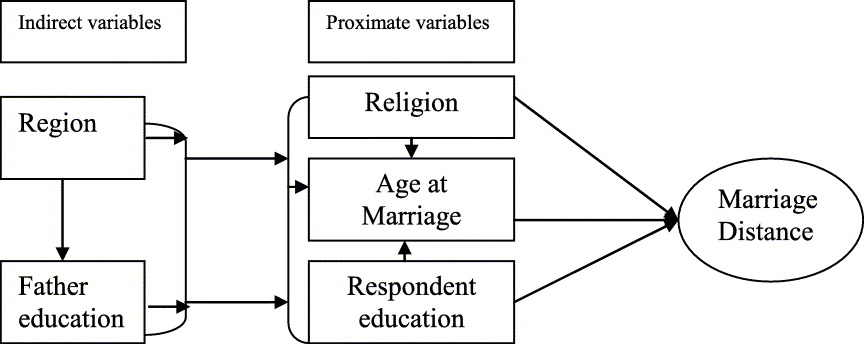
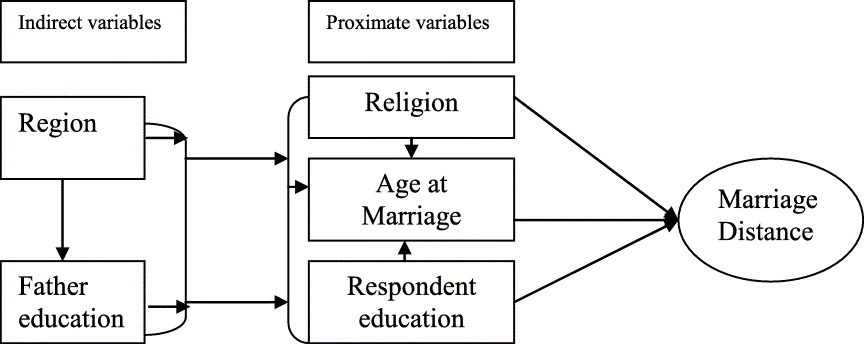
The research seeks to understand the reasons for short-distance marriage migration. The conceptual framework in Fig. 1 shows the interrelationship between socioeconomic characteristics and marriage distance. The framework indicates that respondent's education and marriage mainly depend on religion and her father's education status. The proximate variables (religion, respondent's education, age at marriage) have a direct effect on marriage distance of the respondent.
Conceptual framework showing the interrelationship between socioeconomic characteristics and marriage distance.
Data and Methods
Data sources
The data for this study were collected between May and July 2007 from two administrative divisions of Bangladesh: Rajshahi in the north and Khulna in the south. A multistage random sampling technique was adopted for the selection of districts, thanans (the lowest administrative unit) and villages. A total of 2265 women were interviewed, and of these 2250 women who had already migrated due to marriage were selected for the study. The remaining fifteen women, who were already married but had not migrated due to marriage, were excluded from the analysis. A semi-structured interview schedule was developed consisting of socio-demographic variables such as age at marriage, both respondent's education and her father's education at the time of marriage, region and religion. For data analysis logistic regression analysis was performed using SPSS version 17.0; models parameters were estimated using Statistica and those for the graph were estimated using Statistica-6.0 version.
Analytical methods
Data were initially analysed with descriptive statistics including frequency counts of relevant variables and testing for the relation between distance and marriage migration using exponential, Pareto and Pareto-exponential models. The binary logistic regression models were used to assess the effect of some selected socio-demographic factors on migrant's marriage distance. This is because the dependent variable – migration distance – is measured in two categories: (1) short distance (20 km or 10 km) and (2) long distance (20 km and above or 10 km and above), and is therefore binary. Morril & Pitts (Reference Morril and Pitts1967) expressed exponential, Pareto and Pareto-exponential functions as follows:
The exponential function of the form:

The Pareto function of the form:

The Pareto-exponential function of the form:

where a, b and c are the parameters, y represents the number of observations and D represents marriage distance.
Model validation
To check how much these models are stable over the population, the Cross Validity Prediction Power (CVPP),  , is applied. Here:

where n is the number of cases, k is the number of regressors in the model and the cross-validated R is the correlation between observed and predicted values of the dependent variable. The shrinkage of the model is the absolute value of the difference of and R 2. Moreover, the stability of R 2 of the model is equal to (1–shrinkage) (Stevens, Reference Stevens1996).
Results and Discussion
Background characteristics of female marriage migrant
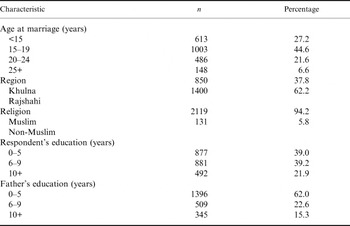
Table 1 provides the percentage distribution of migrants (i.e. who have migrated due to marriage) by selected variables before they were engaged in the marriage experience. The result indicates that about 72% of the women married for the first time before they reached the age of 20 and the remaining (i.e. 28%) married at 20 years or later. The age at marriage of 64.5% of the respondents was under 18 years, the legal age for marriage for females in Bangladesh (Mitra and Associates, 2005); 35.5% married at 18 years or older (see Table A1). The mean age at first marriage of women in the northern Rajshahi division is about 17 years, and in the southern Khulna division it is around 16 years (Rahman, Reference Rahman2005; Akter et al., Reference Akter, Rahman, Sultnan and Rahman2007). Most respondents and their fathers have completed 0–5 years of education and only a small percentage are educated to a higher level.
Percentage distribution of the background characteristics of respondents, Rajshahi and Khulna divisions, Bangladesh

Percentage of legal and illegal marriages according to age of the respondent, Bangladesh

Exponential, Pareto and Pareto-exponential models
Table 2 represents the results of the exponential, Pareto and Pareto-exponential models. These models appear to be suitable for describing the distance associated with marriage migration.
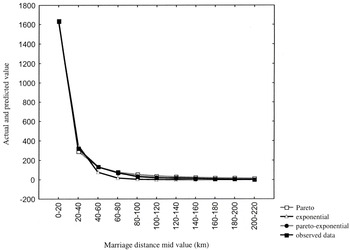
The analysis results show that all models are good fits. In particular, the Pareto-exponential function was found to fit better (p<0.001) than the exponential and Pareto functions for the marriage cohort and is stable at 100%. Several studies have showed that marriage migration is positively associated with migration distance and have found a better fit for the Pareto-exponential function (Hossian, Reference Hossain2000; Yadava et al., Reference Yadava, Hossian and Islam1998; Yadava et al., Reference Yadava, Srivastava and Islam2002), which supports this study's results. As shown in Fig. 2, tendency of marriage was observed to be higher with shorter (<20 km) migration distance, and the propensity for marriage is lower with higher distance (i.e. >20 km). Also, the actual value and predicted value of the Pareto-exponential model were shown to be the same for the three models.
Marriage and migration data: observed and predicted moves in the Rajshahi and Khulna divisions of Bangladesh.

Model validation
A model validation technique such as Cross-Validity Prediction Power (CVPP), , was applied to these models to verify whether the model is valid or not.
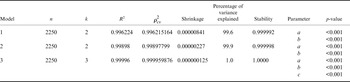
As shown in Table 3, the exponential model is more than 99.99%, the Pareto model is 99.99% and the Pareto-exponential model is exactly 100% stable. Therefore, from the statistics it is observed that the fitted models and the corresponding R 2 are highly statistically significant.
Distribution of distance associated with marriage migration for different marriage cohorts, Rajshahi and Khulna divisions, Bangladesh

Estimated cross-validity prediction power,  , of the predicted equations of marriage migration with distance

Determinant of marriage distance: the logistic regression model
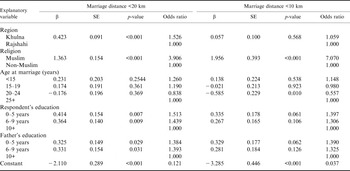
Table 4 presents the results of binary logistic regression of the relative risk of short-distance migration. The multivariate analysis indicates that all the included predictor variables are statistically significant except age at marriage in the case of distance <20 km, while for distance <10 km region of residence showed an insignificant result.
Logistic regression estimates for the effect of socio-demographic characteristics with marriage distance as the dependent variable, Bangladesh

Region has a highly significant effect on marriage distance <20 km, but its effect on <10 km distance showed an insignificant result. The relative risk of marriage migration in the Khulna division is 1.526 times higher than Rajshahi division when the distance is <20 km, and 1.059 times higher when the distance is <10 km. The analysis result shows that Muslim respondents are at about four times higher risk of migration in distance <20 km than their non-Muslim counterparts, while for marriage distance <10 km the relative risk is double that for <20 km. It is also found that age at marriage showed an insignificant effect on marriage distance <20 km, but age at marriage of 20–24 years showed a significant effect on distances <10 km. At both distances the risk of marriage migration is comparatively lower than all other marriage categories. Both respondents' and their father's levels of education have a positive significant influence on marriage migration. The risk of marriage migration is higher at distances of <20 km and <10 km for 0–5 and 5–9 years educated respondents and their fathers than their higher educated counterparts. So, more years of schooling increases the tendency to migrate higher distances.
Conclusions
This paper studied the distribution of the distance associated with marriage migration using the Pareto, exponential and the Pareto-exponential functions. From the point of view of the test, the Pareto-exponential function tended to be superior to either of the functions separately. The findings indicate that the Pareto-exponential function provides a better approximation to the distribution of distance associated with marriage migration. As expected, the tendency for marriage migration decreases as distance increases. The logistic regression analysis suggests that region, religion and education of respondent and her father have a significant influence on marriage migration for distances <20 km, but for distances <10 km religion and education levels are statistically significant. In conclusion, it was found that the risk of marriage migration at distances of <20 km and <10 km is higher for lower educated Muslim families.