Introduction
Generally speaking, the English gamekeeper has not enjoyed a good reputation. Seen as embodying a privileged world of animal cruelty, respect for his position has at times been in short supply. As Richard Hoyle observes in Our Hunting Fathers (2007), a work that argues convincingly for more scholarly engagement with modern field sports, while the poacher is seen as ‘heroic’, his actions a ‘legitimate answer to repressive landlordism’, the keeper is often cast as little more than a ‘hired thug’. However, continues Hoyle, such views deny the keeper’s ‘standing’ as a skilled worker on the land with the potential to exercise considerable agency and influence.Footnote 1 This standing was never greater, or more subject to comment, than in the years between the 1880 Ground Game Act and the outbreak of war in 1914. ‘Par excellence the era of the sporting landlord’, these were the years in which keeper numbers were at their highest, the size of the bag at its heaviest, and when the various controversies attaching to the so-called Land Question, an issue closely linked to sporting estates, reached their own historic peak.Footnote 2
As a sign of established wealth, an essential positional good for the newly monied, or a means for estate owners to generate income through the sale or rental of sporting rights, the gamekeeper mattered because the social and economic terms on which a great deal of shooting took place mattered too.Footnote 3 The veneration with which the game book was treated, sometimes akin to the family Bible, and fierce opposition to any initiatives thought to impinge upon the position of game preservers, indicate well what was deemed to be at stake. In the summer of 1909 the unfolding controversy over the Liberal government’s land-taxing budget merged politics with sport as peers and MPs from both sides of the political divide faced missing the Glorious Twelfth (August). Be it on the first day of the grouse season, or at any other point in the shooting year, in the words of Lord Walsingham and Sir Ralph Payne-Gallwey, ‘On keepers the prospects of sport greatly depend, they are the non-commissioned officers of a shooting field, and their duties are as necessary as those of the same rank of men in the field of war.’Footnote 4 More numerous during our period than at any time before or since, by 1914 there was one keeper in England and Wales to every four licensed shooters. The ratio today is around one to 160.Footnote 5
The keeper’s considerable standing at this time was also recognised by Richard Jefferies. Introducing The Gamekeeper at Home (1878), the influential chronicler of the late Victorian countryside found him so prominent a figure in rural life ‘as almost to demand some biographical record of his work and ways’.Footnote 6 Quickly recognised as an ‘English classic’, and reissued many times since, Jefferies’s richly detailed portrait of the Wiltshire gamekeeper Benny Haylock occupies a sparsely populated field.Footnote 7 Indeed, with the exception of Peter Munsche’s study of the late Stuart and Georgian gamekeeper (1981), a work that stops well short of our period, and David S. D. Jones’s illustrated history of keepering from the eighteenth century to the present (2014), there has been little in the way of dedicated work on this significant but divisive figure.Footnote 8 In the words of an 1894 guide for keepers, if he ‘carries out his duties thoroughly and conscientiously he will make many enemies’, yet consolation might be found in that ‘right is on his side’ and ‘all well-meaning people agree with his efforts.’Footnote 9
The gamekeeper’s importance to the late Victorian and Edwardian countryside notwithstanding, Jefferies’s follow-up subject, the poacher, has attracted much greater attention. For those memorably described by Charles Kingsley as keepers turned ‘inside out’, coverage has not only been more extensive but, broadly speaking, more positive.Footnote 10 Reviewing John ‘Lordy’ Holcombe’s ghostwritten Autobiography of a Poacher in 1902, the Academy was disappointed that its subject eventually turned to gamekeeping, and even worse to being a water bailiff, while in Robert Colls’s recent history of sport and liberty in England ‘Keepers complained like any other worker … yet went cap in hand to their employer.’ Poachers on the other hand retained their independence and thus earned ‘respect’.Footnote 11 Whether they were necessarily given to such behaviour, there are plenty of stories of demanding keepers, Colls usefully identifies them as workers. Some keepers developed a lifelong passion for their craft, and others followed the family line, but in the final analysis the men who reared and preserved game did so because they were paid, and relative to many other rural workers and estate servants, paid well.
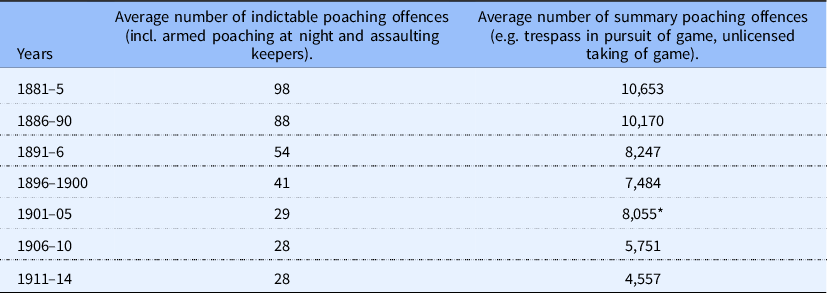
In marked contrast to the impoverished labourer, Jim Hurd, in Mrs Humphry Ward’s Marcella (1894), the ambitious young keeper, George Westall, enjoys ‘good pay, and an excellent cottage some little way out of the village’.Footnote 12 Just as the novelist intended, however, the location of this enviable dwelling also points to the keeper’s liminal status – somewhere between those he served and the class he invariably came from. A ‘tyrant and a bully’, Westall will later have his brains ‘blowed right out’ [sic] by Hurd, a reminder that while poaching-related violence was now declining (Table 1), the job could still be a dangerous one and the possession of a fierce-looking night dog and ‘four o’clock in the morning courage’ remained high on the list of requirements.Footnote 13
Taken from the Judicial Statistics for England and Wales (BPP)

Note: * The trend-bucking rise of 1901–05 might owe something to the wet harvests affecting these years. The areas suffering these were often those most heavily preserved.
Inspired by a fatal affray in Hertfordshire in 1891, as the reference to Marcella suggests the following pursues several lines of enquiry. Specifically, I want to combine consideration of what the gamekeeper actually did on the ground, with an account of the ways in which he was represented across an expanding media landscape to a population that since the mid-1880s was increasingly enfranchised (keepers included). Mostly this will be done in parallel, but the final two sections of the article are reserved for a closer look at keeper representations from artists and writers of the quality of William Nicholson, John Galsworthy and Somerset Maugham. Leading lights in their fields, none are usually linked to rural subjects. As will be seen, the complex character delineated by Munsche was still to be found in a world where economically and demographically the urban had decisively replaced the rural. Moreover, the numerous technologies that had accompanied this urban-industrial shift – from firearms with greater killing power to developments in mass communication – meant that the keeper of our period became functionally and representationally a more active and visible presence. The keeper worked to produce game, and in ever greater quantities, but he was also a service provider within a wider leisure economy that increasingly looked to the rural for its recreation and entertainment.
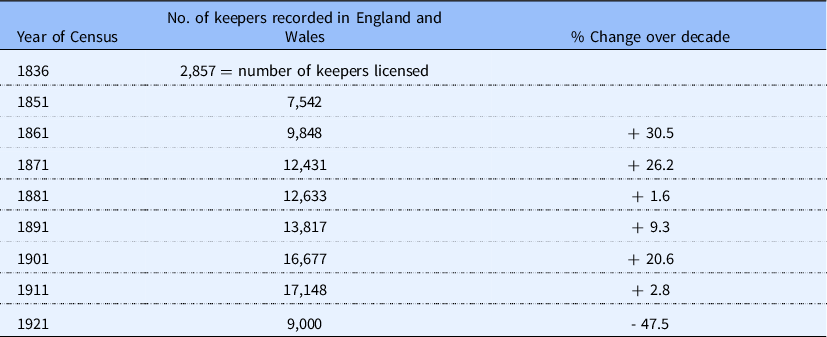
That shooting was now an industry in which ‘thousands of gamekeepers, gillies, beaters and outdoor men’ served the ‘pleasure-loving rich’ was not lost on the landlord-hating David Lloyd George.Footnote 14 Continuing a line of attack developed by John Bright in the 1840s, and more recently by the Anti-Game Law League, the Chancellor used the opening speech of his 1913 Land Campaign to equate the 600,000 labourers lost to farming between 1851 and 1911 with the more than doubling in keeper numbers over the same period (Table 2).Footnote 15 In what might be seen as an exercise in Lloyd Georgian alternative facts, land-reformers were not above giving the figure of 23,000 keepers for England and Wales having conveniently merged the 17,000 recorded by the 1911 census with the 6,000 counted in Scotland – a distinctive part of the keepering map that lies beyond the bounds of this study.Footnote 16
Calculated from the Census for England and Wales (1851–1911)

Source: The 1836 and 1921 figures come from F. M. L Thompson, Landed Society in the Nineteenth Century and Hoyle, Hunting Fathers.
Here it should be stressed that while not entirely the preserve of men, the job of keepering, like game-shooting (and poaching), was heavily male-gendered, a point recently taken up by Krissie Glover’s research into the ‘hyper-masculine’ content of The Gamekeeper – the trade journal launched by the game-food manufacturers Gilbertson & Page in 1897.Footnote 17 Both a marker of rising professional status, and a means of promoting it further, such publications also gave keepers a way of presenting themselves to those who employed their services. Re-emphasising the ambiguity of the keeper’s position, negative accounts of his character and work often came from this quarter. Expected to be ‘handy, honest, clever and brave … civil, yet not too good natured’, in a world defined by unwritten codes and conventions, relations between these rural NCOs and their commanding officers were not always easy or smooth.Footnote 18
Associated with a fiercely contested set of laws, and central to the demonology of land reformers, complicating the narrative the keeper was also represented in more positive, or at least sympathetic, terms. Reminding us of the increasing interconnectedness between town and country, much of this cultural production was either wholly or partly external to the world of field sports, an essentially urban-ruralist gaze directed towards a potentially interesting, and possibly admirable, part of the working countryside. But before returning to the role and representation of the gamekeeper, we need briefly to consider the sport that for good or ill gave him his work.
Late Victorian and Edwardian game shooting
Synonymous with the lavish delights of high-end rural living, in the late nineteenth and early twentieth centuries the sporting estate loomed large. According to one recent account, ‘If gardens added to the prestige of a country house so too did the great shooting parties of the period [that] define our image of country house life.’Footnote 19 An image further advanced by successful novels (and films) like The Shooting Party, where amid scenes of clashing manners and casual affairs in prewar Oxfordshire countless birds fall to the waiting guns. Meanwhile, Sir Randolph Nettleby’s head keeper, George Glass, expertly directs his small army of under-keepers, loaders and beaters.Footnote 20 Though undeniably the age of the ‘Big Shots’, the recreational shooting of game did not always amount to an elite form of mass slaughter. If at least fifteen times more game was shot in 1912 than fifty years earlier, an estimate thought low by some, it was now being accounted for in a range of different settings.Footnote 21
Available at differing rates for all or part of the season (a full season licence cost £3, half-a-season £2), across the UK as a whole the number of game-shooting licences issued in 1881 equalled 57,983, rising to almost 74,000 by 1901. An increase in percentage terms of 24 per cent. Over the same period we find that UK keeper numbers grew by 26.5 per cent, and in England and Wales by 27.5 per cent. Numbers continued to rise, albeit at a slowing rate, until 1914 when the impact of war led to a marked contraction in game shooting. By the time of the 1921 census keepers in England and Wales numbered c. nine thousand – a century on they are less than one-third of this.Footnote 22
Given the receding threat of poaching indicated in Table 1, the rise in keeper numbers up to 1914 was as much about providing enough game for the guns, and supporting them on the day of the shoot, as it was about stopping those who would otherwise take it. Indeed, one contemporary explanation for poaching’s decline was that along with better rural policing, and a general improvement in living standards, so much legally hunted game was being brought to market any illicit trade in it was pointless.Footnote 23
While the preserving and shooting of game was a nationwide activity, encouraged in part by the growing ease and speed of cross-country travel, it was not everywhere pursued to the same degree or keepered to the same level of intensity. Not susceptible to artificial rearing, compared to the lowland production of partridges and pheasants even the best run grouse-moors required relatively few keepers. Based on figures published in 1905, a 9,000-acre estate in southern England spent 44 per cent of its total sporting budget on keeper and beater wages, while for an estate of similar size in Yorkshire the equivalent outlay was 26 per cent.Footnote 24
Within this broad lowland/upland divide, the bulk of organised game shooting was centred on southern and eastern England with Suffolk, Norfolk and Hampshire being the most intensively keepered counties. Demonstrating how the preservation and shooting of game, like poaching, often had a pronounced urban-rural aspect, counties within easy reach of the capital such as Hertfordshire, Surrey and Sussex also had relatively high concentrations.Footnote 25 Lampooning the ‘excessive speed’ of the nouveaux riches lifestyle, Cecil Hepworth’s 1907 film, The Busy Man, shows ‘one of our great city magnates’ lunching in town before motoring off to his shooting ground. Upon arrival the busy man’s sport ‘proceeds at as rapid a pace as possible’ with the hard-pressed keepers barely having time to reload his overheating guns.Footnote 26
Contrary to the image presented in this and other films such as Charles Urban’s Pheasant Shooting at Sandringham (1912), the shooting of game was not entirely restricted to the very wealthy. For those lacking the means or connections to enjoy shooting on an individual basis, one way to access it was to join a rental-based syndicate. In such circumstances the keepers needed to maintain the shoot would be provided by the lessor, or else brought in by those collectively leasing the sporting rights. Providing a typical example of the former, and pointing to the fact that keepers often had more than one master, we find Sir Edward Gascoyne Bulwer of Haydon Hall advertising ‘6,000 acres of well-preserved shooting’ near Norwich, including the run of a fully furnished grange and the services of three licensed keepers, all at 1,000 guineas for the 1900–01 season.Footnote 27 In this case the rental was taken up by a pair of brothers from New South Wales, plus two other men. ‘All very bad shots, but enjoyed the sport’, was the satisfied entry in the game book.Footnote 28
If the shooting of (or at) game was not solely the preserve of the landed aristocrat or socially climbing nouveaux riches, nor was it always an occasion for noisy excess. Even in Norfolk it was possible for Henry Rider Haggard to enjoy more peaceful days ‘knocking through outlying spinneys’ while admiring the colours of autumn.Footnote 29 This quieter style of sport was also to be found at places like Canwick Hall in Lincolnshire. The seat of an established gentry family, the Sibthorps, over the course of a typical season around forty shoots would be held for a variety of landowning friends and other guests drawn from the wider community.Footnote 30 Across 6,500 acres, bags in excess of 1,000 birds were rare and a day’s sport would usually yield less than 200 head of game. Thus if shoots like that belonging to Edward Guinness (Lord Iveagh) at Elveden in Suffolk, with its ‘army of keepers, watchers, rearers and general helps’, typified one kind of sporting estate, Canwick and its trio of keepers did another.Footnote 31 Not only does the Sibthorp way of doing things point to the associational value of a more traditional invited shoot, it shows how alongside royally-patronised venues like Elveden, and the numerous shooting lets providing less elevated sport, the late Victorian and Edwardian gamekeeper had a variety of places and positions to fill. It is to the keeper’s work in filling his position, and how this was variously represented, that we now turn.
‘Well up in the rearing of pheasants’: the keeper as professional servant
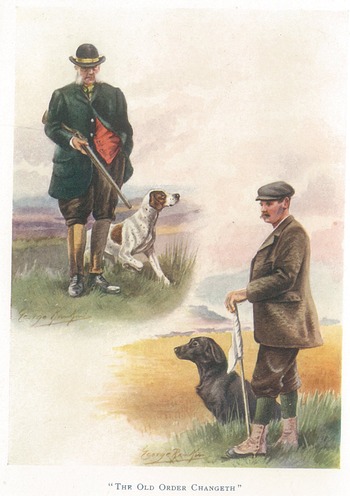
Towards the end of Aymer Maxwell’s 1913 treatise on Pheasants and Covert Shooting, we find the illustration seen in Figure 1.
‘The Old Order Changeth’.
In the transition from old-style velveteen to new-style tweed, and from the pointing dog to the retriever, we have beautifully represented the changes and continuities in the working life of the gamekeeper. Suitably titled The Old Order Changeth, it was now common to contrast the traditional countryman keeper with his modern, better-educated counterpart, and to remark upon game preserving’s evolution into a kind of science.Footnote 32 But if in the words of the Oxford-educated gamekeeper-turned-author, Owen Jones, the ‘day of the “no scholard”’ was increasingly done, many of his duties were essentially what they always had been: rearing, pest control, dealing with poaching and other forms of trespass, and generally promoting the sportsman’s interests.Footnote 33
What had changed was the amount of game a keeper was typically expected to produce, and how it should be presented, along with new patterns of employment linked mainly to the rise of the shooting tenant. One implication of this was the flooding of the job market at the end of a season (February) as lets were given up or otherwise disposed of.Footnote 34 More situations were created, but competition among keepers for the better, more permanent ones, intensified. With the passing of the kind of old retainers eulogised by the aristocratic Willoughby de Broke, and overall numbers growing, keepers became ever more insistent on belonging to a profession.Footnote 35 A clear indication of this was the transfer in 1908 of the Gamekeepers’ Association to new headquarters in Thetford, ‘the very heart of a game preserving country’, while simultaneously launching a monthly journal The Gamekeeper’s Gazette.Footnote 36
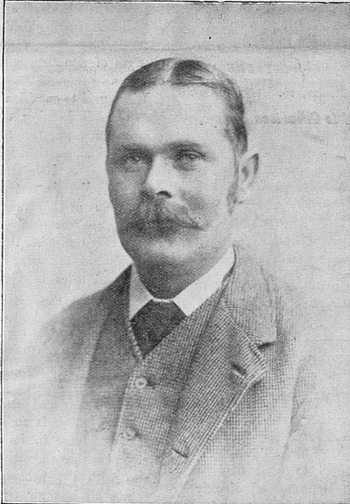
Formed in the wake of the first ever gamekeepers’ dog show at London’s Royal Aquarium in 1900, an event that included a display of how mastiffs dealt with poachers, the Association had initially relied on the Hertford offices of Gilbertson & Page and taken the firm’s own magazine, The Gamekeeper, as its official organ. Published monthly, it offered a forum for discussing a range of pertinent issues from the need or not for keepers to abstain from alcohol (mixed views) to the thorny subject of tipping. As well as getting themselves into print, keepers were also given the chance to represent themselves through the Portrait Illustration feature. In order to enter what Glover calls this ‘quasi hall of fame’, keepers were invited to submit a short biography and photograph for inclusion on The Gamekeeper’s front page (Figure 2).Footnote 37 Professional respectability was again the keynote as contributors routinely showed themselves in their best Sunday clothes. Adapting this device during the war, the Gazette often ran pictures of keepers in uniform, having also established a hardship fund for the families of those killed or seriously wounded in action.Footnote 38
The head keeper at Hatfield, W. E. Hall, the first to feature in the Portrait Illustration gallery. Gamekeeper, 13th October 1897. © British Library Board.

Avowedly an association not a union, an important distinction at a time of mounting labour unrest, the Gamekeepers’ Association had a management committee comprising twenty-four keepers from across the UK and boasted as its president the Earl of Kinnoull. Claiming to represent the interests of all those involved in game preserving, beyond general advocacy of the keeper’s role the Association’s principal functions were to organise the trading and showing of dogs and to act as a recruitment agency and clearing house for the benefit of both ‘gentlemen and keepers’. By 1914 the Association had around two thousand members drawn mostly from the senior end of the profession.Footnote 39
For all of its representations of respectability, however, the timing of the Association’s relocation to Norfolk was closely linked to the exposure of a sophisticated criminal enterprise organised and run by an Essex head keeper, Herbert Stride, and the editor of the Gamekeeper (and the Association’s own secretary), Frederick Millard. Apparently confirming a long-standing prejudice against corrupt or dishonest keepers, over a number of years Stride had been supplying Millard with large quantities of stolen pheasant eggs. These were then sold to unwitting (or unquestioning) keepers elsewhere. In January 1908 the case came to the High Court where the original verdict and sentence of a year’s hard labour for each of the guilty men was upheld.Footnote 40
‘Of course, there are keepers and keepers’, noted one of the period’s numerous volumes on game preserving, but ‘there is no greater poacher and no greater enemy to preserving than a bad gamekeeper.’Footnote 41 Not generally given to expressions of uncertainty, for many of the game-preserving class the statement was thus the proof and the presence of ‘black sheep’ keepers like Stride was widely accepted.Footnote 42 Within this rich field of condescendingly negative representations, keepers might be more than just idle and dishonest. The ‘disgrace’ keeper who ‘quarrels with farm servants’, ‘shoots every suspicious dog that he meets’ and ‘is outwitted by poachers’ did not come from the pen of a radical critic of game preserving, but from the gentlemen authors of a 1904 vade mecum for keepers.Footnote 43 Dissatisfaction could be mutual. Bernard Gilbert’s one-act play from 1913, The Ruskington Poacher (later retitled The Hordle Poacher) captures well a Lincolnshire keeper’s frustrations as he struggles to combat an upsurge in poaching while meeting his employer’s pressing demands for more game. ‘I felt like telling him to get suited with somebody else’, he confides to his long-suffering spouse, ‘he talks as soft as a turnip.’Footnote 44 Playing on the idea of the keeper not always being as sharp as his perennial foe, seen also in W. W Jacobs’s Claybury stories for the Strand, it is the keeper’s wife who eventually catches the poacher of the play’s title.Footnote 45
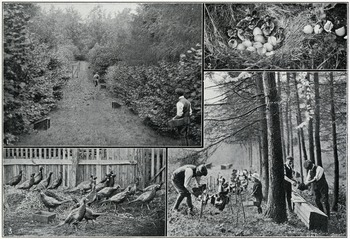
As the Gamekeeper Association’s 1908 move to Thetford suggests, in considering the various roles of the gamekeeper it is to the lowland keeper of partridges, and especially pheasants, that we are necessarily drawn. In addition to height, ‘life experience’, and all-round steadiness of character, being ‘well up in the rearing of pheasants’ was a vital attribute for most keepers seeking a place.Footnote 46 This is not to overlook the commonality of much of the keeper’s work, or the fact that a great many were geographically mobile – Owen Jones described shiny-booted keepers in February ‘setting out by road or rail’ in search of a new berth – but in focusing on the south-country keeper we are looking at both the occupational core and the sort most commonly featured in high-profile magazines such as Country Life and the Illustrated Sporting and Dramatic News (Figure 3).Footnote 47
‘Pheasant Rearing – The Gamekeeper’s Work in Spring’, Illustrated Sporting and Dramatic News, 4th May 1912. © Mary Evans Picture Library.

However densely populated with keepers (and pheasants) some parts of the country had become, this proverbial army was both smaller and larger in number than the official figures suggest. First of all, the figure of 17,000 keepers for England and Wales given in the 1911 census (see Table 2) fails to distinguish between those enumerated as gamekeepers and those in possession of an annual keeper’s licence. Since 1860 this had been fixed at £2, plus an additional 15s payable in servant tax. On these terms the number of fully paid-up keepers, registered with the clerk of the peace and deputed to kill game or to seize ‘dogs, nets and other engines and instruments’ (but not guns), fell some way short of 17,000. In 1907, for instance, the tax and excise returns recorded a little under 6,300 keeper licences issued for the year, considerably less than half the number of keepers then listed.Footnote 48
Second, the figure of 17,000 underestimates the numbers actually involved in the day-to-day rearing and preservation of game. Even allowing for the buying in of eggs and poults via specialist game farms, legitimate or otherwise, estate-based production was highly labour intensive. Mechanical incubators were now available, but these had nothing like the capacity or efficiency of their modern equivalents, and rearing remained largely dependent on human agency. Successful preservation also required the management of woodland cover and the vigorous purging of animals classed as vermin.Footnote 49 Noting the tendency of estate clerks to classify under-keepers as agricultural labourers or woodmen (so avoiding the servant tax), one modern authority puts the 1911 total as conservative.Footnote 50 Also during certain points in the year, and especially in the winter, it was normal for keepers to be given extra help in watching the preserves. But as the 1891 affray that inspired Marcella reveals, distinctions between keepers and seasonal helpers were easily blurred. In this case it was reported that two Hertfordshire gamekeepers had been killed when in fact one of the men was just an unfortunate hired watcher.Footnote 51
The situation was further complicated by the Poaching Prevention Act of 1862. Actively endorsed by Chief Constables concerned at its criminalising effects, it empowered the police to stop and search anyone suspected of poaching, or of otherwise aiding it. For the Act’s many critics this effectively created an auxiliary force of keepers funded out of the rates.Footnote 52 Yet while the legislation strengthened the hand of the game-preserving landowners who had also pressed for it, even if fully licensed and deputed it gave no additional authority to the keeper himself and to ‘cultivate’ the village constable with an occasional rabbit or ‘something better’ was recognised as sound policy.Footnote 53 This in turn meant keepers being portrayed as police spies or narks endlessly engaged in getting up cases against the local populace. In 1913 the novelist and dramatist Max Pemberton described to readers of the Morning Chronicle the ‘ceaseless campaign of espionage now waged between the keeper and the village’, while for the staunchly Methodist labourer’s leader Joseph Arch, such men were ‘an Egyptian plague’ and the only remedy was to abolish the game laws and give them proper work to do. Footnote 54
‘Now I trespass less’: the law, access and farmers
What powers the gamekeeper did possess were contained in the 1828 (and 1844) Night Poaching Acts, and the all-important Act of 1831 setting out the revised terms on which the preservation, shooting, and selling of game could take place. By removing the right to search any premises within the bounds of the manor, together with the ending of his indemnity in the event of a poacher’s death, this Act significantly reduced the keeper’s legal room for manoeuvre and the over-zealous or under-informed might easily find themselves in difficulty.Footnote 55 To help navigate this tricky legal terrain various abbreviated guides to the game laws were produced, while for the benefit of sporting landowners, and the men in their service, Walsingham and Payne-Gallwey recommended the printing on cards of the ‘chief clauses of the poaching and trespass laws’ that keepers might hang in their cottages for ‘ready reference’.Footnote 56
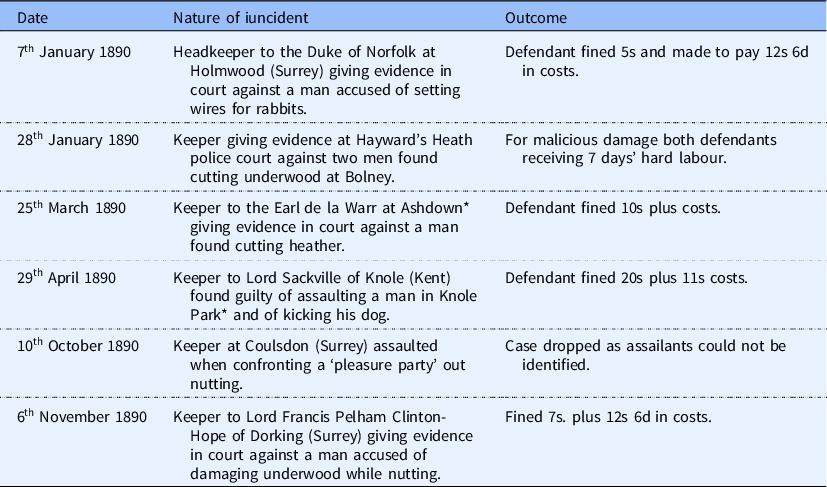
Beyond the inevitable run-ins with poachers, or those so accused, keepers might also encounter those practising traditional acts of resource gathering such as nutting or wood cutting (Table 3). In a custom versus law conflict given fresh impetus by the return of the Land Question as a major political issue, a question that as we have noted was closely linked to the preservation of game, keepers were routinely charged with putting over-fed birds before legitimate human needs and concerns. ‘Public opinion does not blame the poor women for taking the wood; it blames the keepers for a wanton and cruel waste of good fuel’, was how one Edwardian account of land-monopoly described a situation close to London where ‘the vast common woods’ had been ‘enclosed’ solely for the preservation of game.Footnote 57
All cases taken from the Sussex Express (January 1890 to December 1890)

Note: *Both of these places had a history of disputes over access and usage rights.
Tracy Young’s much wider sampling of press reports from in and around the Nene Valley and the Chilterns produces a similar mix of cases. Tracy Young, ‘Popular Attitudes Towards Rural Customs and Rights in Late Nineteenth and Early Twentieth Century England’ (PhD thesis, Hertfordshire, 2008).
With the struggle for recreational land-access also gathering force – in 1899, for instance, the National Footpaths Society merged with the Commons Preservation Society – the ‘Velveteen’ was similarly accused of obstructing wider public enjoyment of the outdoors. Although it was never a certainty that one would be encountered, and the sense of a lurking presence might only ever be that, as the nature-loving Edward Thomas could testify there was often a hard truth to such claims. ‘I have thrown away a chance to fight with a gamekeeper … And now I trespass less’, was Thomas’s bitter response to his meeting with a ‘glowering’ Gloucestershire keeper in 1914 when walking in woods with the American poet Robert Frost.Footnote 58 Judging his masculinity to have been undermined by the experience, according to Frost the episode was a major factor in Thomas’s decision to enlist the following year.
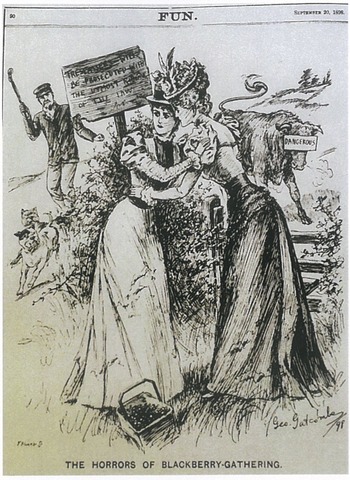
Explaining ‘Why Gamekeepers Hate Trespassers’ in an early article for Pearson’s Weekly, Owen Jones worked through a list of those seemingly harmless people who were a ‘greater worry’ than poachers. Most disliked were the courting couples who ‘love to stroll away into the quiet, solemn woods’, followed by springtime primrose pickers, the walkers of ill-trained dogs, and the ‘blackberrying parties’ of early autumn who, beyond the wrath of the keeper, risked being inadvertently shot by partridge-hunting sportsmen (Figure 4).Footnote 59
The stick-wielding figure represents a keeper. Fun, 20th September 1898. © British Library Board.

While Jones’s piece was not without its humour, and plays like The Simple Life (1908) found comedy in the clashes between innocent members of the public and unwaveringly suspicious keepers (in this case a shop-bought pheasant in the possession of two fashionable lady caravanners brings the ridiculous charge of poaching), the focus on the sporting estate in highly-charged debates over the present and future use of the land meant that the role and position of the gamekeeper not only became more politically controversial, but also more legally contested.Footnote 60 For if Edwardian chroniclers of rural tyranny such as F. E. Green could characterise the ‘feudal’ game laws, and their front-line defenders, as an affront to social progress, changes in local government in the wake of the Third Reform Act (1884–5) meant that a keeper’s occasional day in court was not always a happy one.Footnote 61
However one-sidedly the game laws had previously been enforced, and this is open to debate, the greater accountability that county and parish councils encouraged meant that the balance was becoming less predictably weighted in favour of those bringing the prosecution.Footnote 62 Taking Norfolk as an example, a county with an active and well-resourced poaching prevention society, we find that of the 2,181 cases brought before its courts between 1893 and 1900 no fewer than 372 were dismissed, or 17.5 per cent of the total. Prior to this point the conviction rate had stood at around 90 per cent. Much to the regret of residents of the county like Rider Haggard, and various other interested parties, even when the evidence was strong convictions for poaching were apparently becoming harder to obtain, and when they were secured the ensuing punishment unduly light.Footnote 63
In this changing environment not only did keepers risk having their judgement or integrity challenged, not least from sitting magistrates, but also having counterclaims brought against them.Footnote 64 Another function of the Gamekeeper’s Association was to offer legal advice to its members, and if necessary provide funds for any defence costs that might be incurred. As the Association’s honorary solicitor advised in 1902: ‘never resort to lawyers until a really good case has been obtained and the evidence is strong, otherwise you will do no good’.Footnote 65 And when a favourable verdict was returned, which as Table 3 indicates was mostly still the case, the keeper might then be left facing an uncomfortable public backlash. Looking back to the 1890s, Elveden’s redoubtable head keeper, Ted Turner, recalled a number of occasions when on leaving court in Mildenhall he was confronted by ‘young toughs’ loudly threatening to take their revenge.Footnote 66
Hostile, or at least difficult, elements were also to be found within typically more law-abiding groups of the community such as farmers and fox hunters. When it came to the former, of whom the vast majority were tenants, preserving good relations could be challenging. Though the fabulously wealthy Lord Iveagh might simply buy up all the farms in the vicinity, in most cases this was not possible and keepers needed to maintain their employer’s interests while not antagonising those who accounted for most of the land under cultivation. While the geography of sporting estates meant that in some parts of the country the preservation of game had little or no impact on farming, the potential for conflict was sedulously exploited by land reform groups and radical MPs in a continuing crusade against wasteful privilege and unearned wealth. An effort culminating in what the Gamekeeper called the ‘Lloyd-Georgian assault’ on sporting estates that accompanied the launching of the Land Campaign in 1913.Footnote 67
Beyond the determining rhetoric of Lloyd George, in November 1913 he told a packed Holloway Empire of the ‘pagan thraldom’ of the gamekeeper’s life, there might well be space on the ground for a keeper to exercise discretion and professional judgement.Footnote 68 From advising on the health and training of dogs to making the occasional gift of a pheasant, the courteous and thoughtful keeper, and all-round ‘general utility man’, reportedly had a ‘hundred’ small ways to make himself a friend to the farmer. The importance of not trapping ‘Mrs Farmer’s’ favourite cat was also stressed.Footnote 69 It was also in the keeper’s gift to reward helpful farmworkers with small payments of cash, or rabbits, or to offer a day’s work beating – a welcome occupation during the slack months of winter. On top of this, the keeper’s ambassadorial efforts would ideally be assisted by his employer. Paying compensation for damage caused by winged game, making a suitable reduction in rent, or allowing tenants some supervised shooting at the end of the season could do much to help a keeper’s reputation.
Yet despite the plentiful advice on offer, the kind of amicable arrangements described in A. G. Street’s account of life on his father’s Wiltshire farm in the ‘spacious’ prewar days (Street was taught to shoot by a local under-keeper) were not altogether typical.Footnote 70 A more probable scenario was that widespread dislike of the Liberal legislation of 1880 meant keeper’s often being the object of resentment and hostility. ‘It was because they passed that **** Act we won’t vote for t’other party’, was the reported response of one keeper when later questioned by a Conservative canvasser.Footnote 71 Meant to promote better husbandry by enabling farmers to protect their holdings from the depredations of hares and rabbits, the practical benefits of the Ground Game Act were debatable and disputes over its workings commonplace. Footnote 72 Compounding matters was that prior to the 1906 Agricultural Holdings Act the keeper could draw on a landlord’s authority to fix a tenant’s cropping patterns to suit the needs of game. Even after the Act became operative (1909), tenurial insecurity meant influence in this area was often retained. And while Richard Winfrey’s claims that ‘gentlemen in velvet coats carrying double-barrelled guns are driving the farmers and labourers off the land’ bore the touch of land-reformist hyperbole, there is no doubt that in balancing the competing demands of farmers with those of his employer the ‘cursed game question’ was a difficult one for the keeper.Footnote 73
‘A bread and butter business’: pay, perks, vulpicide and vermin
Within what Jeremy Musson has termed the ‘emphatic hierarchy’ of country house life, the gamekeeping class had clearly defined orders of rank and responsibility. When W. E. Hall became head keeper at Hatfield in the mid-1880s (see Figure 2), he inherited a team of nine men and two boys.Footnote 74 If it was rare to find a keeper who felt over-rewarded for his work, compared to many other sectors in the rural economy it paid well. Allowing for variation by estate or individual circumstance, across our period head keepers could typically expect to receive between £1–10s to £2 per week.Footnote 75 More generously, the 1906 edition of Mrs Beeton’s guide to household management proposed an annual sum of £100 to £150 for the head keeper, compared to £70–£120 for the head gardener and £55 to £90 for the butler.Footnote 76 In addition to money wages, there were also the customary perks of free accommodation, a clothing, fuel and candle allowance, and as many rabbits as he cared to take.Footnote 77 There was also the prospect of tips. Though as with most other aspects of a shoot there were no hard and fast rules, and on some estates the practice was banned, when it came to ‘backsheesh’ the assumption was that head keepers would take the lion’s share. Depending on the nature of the venue, and the make-up of the party, this could be considerable and dark tales were told of keepers dismissively handling notes of too low a denomination – stories that keepers took to print to insist were ‘humbug’.Footnote 78
Another possible income stream was through the private training, or trading, of dogs – areas in which most keepers professed expert knowledge and over which the Gamekeepers’ Association took a close interest. The head keeper might also be rewarded, in cash or kind, by his chosen supplier of game food, and other necessary items, or alternatively invited to offer product endorsements.Footnote 79 Often granted considerable autonomy in this area, the running of the game department entailed numerous financial disbursements and suspected dishonesty, or incompetence, in managing the books usually brought instant dismissal. In a telling example of the hierarchies operating on even the most senior keepers, regardless of the reason for leaving his post any licence he had to kill game automatically reverted to the holder of the sporting rights. Whatever the keeper’s standing, it was always the master’s game.
Below the position of head keeper there was usually a well-ordered arrangement of beat keepers, under-keepers and trainees. Depending on responsibilities and length of service, even the relatively lowly under-keeper could be earning up to £1 per week in cash wages, plus additional payments in kind.Footnote 80 With Board of Trade figures (1907) recording weekly average earnings for agricultural labourers of 17s 6d (including any non-cash payments), compared to many other workers on the land a keeper’s financial position was mostly one to be envied.Footnote 81 This was even more the case in southern and eastern counties where earnings for labourers tended to be much lower. The very places, of course, where game-preserving was carried on most intensively and well set-up keepers like George Westall most visible.
Keepers could also improve their lot through a finely graded system of ‘head and tail’ payments. Parish-based vermin control had been an extra source of earnings (and sport) for many villagers since Tudor times, but the development of large-scale sporting estates, and the move to more intensive rearing, meant that by middle of the nineteenth century, gamekeepers were largely performing this function.Footnote 82 Moreover, in their unremitting campaign against all manner of winged and four-footed species, the number and range of animals affected was greatly, and in some cases disastrously, increased.Footnote 83 Yet while the keeper’s ‘all-destroying propensities’ had numerous critics, in The Heart of England Edward Thomas imagined one stood ‘with smoking gun barrels, and a cloud of jay’s feathers still in the air’, for anyone engaged in the work the killing of what constituted vermin was a vital part of the job.Footnote 84
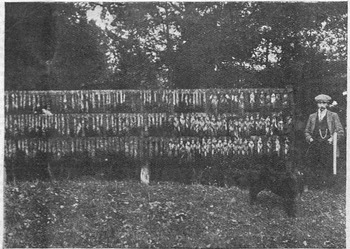
Although clearly there were sensitivities around the subject, and the Gamekeeper used its first issue to insist that keepers were simply doing their ‘appointed duty’, others took an altogether less defensive view.Footnote 85 Believing that ‘the circumvention of vermin’ provided the ‘salt’ of a keeper’s working life, for men like Owen Jones the issue was less about treating native wildlife as vermin, but of deciding which vermin was most destructive and developing the best method of elimination.Footnote 86 As the socially well-placed Jones would have understood and recognised, the ‘book of kills’ by which many humbler keepers kept a tally of vermin disposed of, and displays like the one shown in Figure 5, were not just a means of accounting, but proud assertions of an essential keepering skill.Footnote 87
A Warwickshire keeper poses proudly by his vermin pole. Note also his dog and gun. Gamekeeper, November 1909. © British Library Board.

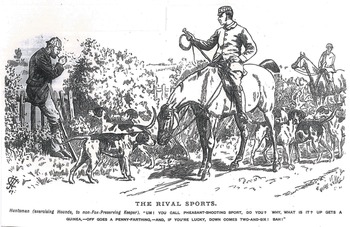
Whether as ruinous vermin or noble Reynard, there was also the ‘Everlasting Question’ of the fox.Footnote 88 In the days when game was less intensively preserved, and the all-round sporting squire not a fading memory, negotiating the needs of naturally incompatible species had usually been possible. However, with ever more game being reared, and the number of hunting packs also increasing (up from 28 in 1837 to 178 in 1911), in districts where hunting and shooting coexisted compromise had become harder and relations increasingly strained.Footnote 89 Within this state of ‘rural civil war’ the keeper found himself trapped in a no man’s land of employer demands and huntsman’s scorn (Figure 6).Footnote 90
Punch, 1889. Here the keeper adopts a studious silence as the huntsman quotes a well-known comment on the high cost of pheasant rearing.

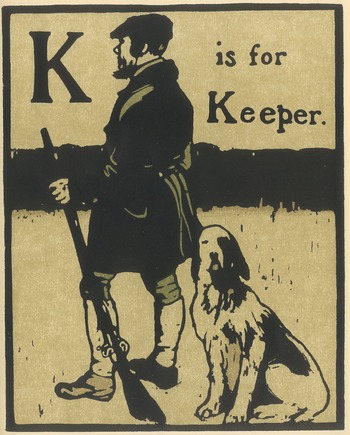
From William Nicholson’s Alphabet (London, 1898).

Aside from angry exchanges in the hunting and shooting press, this unsporting conflict, and its impact upon the keeper, also found its way into the wider culture. In Kipling’s Stalky & Co. (1899), the schoolboy trio get a Devonshire keeper sacked for an alleged case of vulpicide, while the head keeper in John Galsworthy’s The Eldest Son (1912) wilfully disobeys instructions and eliminates all the foxes he can find.Footnote 91 Prepared to be criticised for his action, we appreciate Studdenham’s judgement that his master would sooner have plenty of birds to shoot at than animals to chase. But whatever strategy the keeper adopted, others would claim to be killing foxes while quietly sparing them for a grateful hunt master, the Everlasting Question was never an easy one to answer. ‘Not a pastime’ but ‘a bread and butter business’, a keeper’s rewards were generally hard-earned.Footnote 92
‘The grandest scouts in England today’: writing and painting the keeper
As the portrayal of Studdenham shows, in contrast to the period studied by Munsche when ‘defenders were rare and cautious’, across a range of media forms the keeper’s virtues and skills, and the challenges attending his role, were now regularly and variously explored.Footnote 93 Particularly striking is the fact that while some of these portrayals were, not surprisingly, the product of the world he inhabited, many others were the products of a wider, largely urban, culture. In terms of transmission and reception, publications like Punch – which often showed keepers deftly handling the expectations and egos of would-be sportsmen, or else quietly dealing with those who would scorn them – had a far greater reach than the Gamekeeper or the Field. Such representations also tended to give the keeper a freestanding agency and independency of his own. As Punch itself claimed in 1893, ‘If ever the sport of game shooting is attacked, one powerful argument in its favour may be found in the fact that it produces such men as these.’Footnote 94
The driving context for these representations was the urban-centred ruralism that also gave affirmation to certain kinds of poacher.Footnote 95 It is no coincidence that the chapter on the gamekeeper in Walter Raymond’s epitome of Edwardian ruralist culture, A Book of Crafts and Country Character, was preceded by one on the poacher.Footnote 96 Returning us to Charles Kingsley’s notion of the interchangeability of poacher and keeper, many of the attributes attaching to the former, including a deep understanding of nature, a keen eye and deductive intelligence, and the ability to train and work with dogs, were also those of the latter. Above all, perhaps, both carried ‘the atmosphere of the wood’ and served as admirable living rejections of the ‘sluggish, artificial life indoors’ – an appealing idea at a time of growing national concern over town-based physical deterioration.Footnote 97 Containing many of the elements found in this kind of representation, and which might usefully be compared to that in Figure 1, we have the artist William Nicholson’s K is for Keeper (1898) (Figure 7).
In some ways Nicholson’s keeper could be taken as an amalgam of the ‘old’ and ‘new’ as presented in the illustration from Maxwell. Yet while closer in age and look to the cap-wearing modern keeper, and likewise accompanied by an animal bred and trained for retrieving rather than pointing, his possession of a gun puts him closer to the traditional keeper of public imagining. Although the carrying of guns by keepers, especially in the lower ranks, was not entirely agreed upon (habitual firing at rooks and rats disturbed the game), as the photograph in Figure 5 suggests, their possession and use was common.Footnote 98 By equipping his keeper thus, Nicholson was not only creating compositional balance and interest – the gun’s angle and placement mirrors the dog, while also directing us to the ‘K’ of the title – but providing him with a key marker of his profession. Poised, watchful and properly equipped, this is a keeper to be reckoned with.
Completing Nicholson’s knowingly affirmative assemblage is the keeper’s equally poised and watchful gundog. Ownership of dogs, when properly licensed, had come to play a significant role in male-identity formation, and the building and maintaining of affectively rich interspecies attachments not only signified masculine self-mastery and control, but all-round good citizenship.Footnote 99 The men who displayed their animals at the annual Gamekeeper’s Dog Show, an event run strictly under Kennel Club rules, were not just projecting their skills in breeding, training and handling, but joining in a much wider associational culture of canine interest and care.Footnote 100 Taking a lead from Cecil Hepworth’s much-loved 1905 film Rescued by Rover, but suggestive of the wider cultural penetration of the keeper-dog relationship, Norwood’s The Gamekeeper’s Dog (1907) has the sagacious animal of the title variously aid its master in his struggles with an arrogant motorist, while also helping him to find true love. Footnote 101
Although Edward Thomas might have disdained the ‘policeman god’ of The Gamekeeper at Home, and himself regretted not fighting with one, other countryside writers were prepared to be more accommodating.Footnote 102 Quite literally following in Richard Jefferies’s footsteps, in 1913 the Swindon-based poet and folk-song collector Alfred Williams went in pursuit of Benny Haylock’s modern-day counterpart. Ruddy-cheeked and ‘abounding with knowledge of wildlife’, Williams found a textbook study in the model keeper.Footnote 103 Troubled more by foxes than poachers, he enjoys a peaceable life in his cosy woodland home filled with cases of stuffed birds and an impressive array of antique firearms. Incorporating the kind of picturesque country cottage found in the Happy England paintings of Helen Allingham, such dwellings were another core component of the idealised keeper assemblage.Footnote 104 ‘A gamekeeper’s house and its surroundings never fail to be objects of interest’, announced one account of the subject, before going on to describe the keeper’s gun ‘hung in leather straps’ from an ancient ceiling beam and the old retriever enjoying its rest by the fire.Footnote 105
While the representations of Nicholson and Williams were essentially outside-in, as Jefferies’s earlier account of Haylock had been, those from Owen Jones were experientially rooted in the world of the subject. By the time he gave up keepering for full-time writing in 1909, the Hampshire-born Jones was on 22s per week, plus one new suit a year, a free cottage, and four tons of coal.Footnote 106 The significance of Jones was twofold. First, he wrote with the easy-going authority of an expert insider and in titles like Ten Years of Gamekeeping took a clear-sighted, but supportive, view of his profession. Second, via mass circulation magazines such as Pearson’s Weekly and C. B. Fry’s, along with several co-authored books for Scout groups and schools, he reached a wide and varied audience.Footnote 107 Through Jones, readers not only learned of a keeper’s fondness for gardening and cricket, and why he stood ‘for a large slice of the country’s romantic interest’, but how poachers used their dogs, why game-shooting was a ‘national asset’, plus a keeper’s likely value in any future conflict.Footnote 108 Possessing skills that ‘would not make a bad prime minister’, and the ‘grandest scouts in England today’, the background that set Jones apart from his ‘brother keepers’ was put to sterling use in their service.Footnote 109
‘Don’t be afraid, Sir William’: staging the keeper
Further establishing the keeper in the public mind, and giving him both voice and physical presence, was his regular appearance in the theatre, a nationwide cultural form with widespread popular appeal. From veterans like Fitton in Arthur Wing Pinero’s romantic comedy The Amazons (1891), to younger men such as Tom Hudson in The Ruskington Poacher (according to the 1911 census, 42 per cent of keepers were under thirty-five), gamekeepers had an active representational life on stage. Laying out the clichés and conventions of village-based melodramas, an 1892 article in the Era noted that even more than the poacher, ‘who has always so lurid a role to play’, no such entertainment could do without the keeper – though in his more villainous capacity, as with the splendidly named Jake Grudgewell in Shadow of the Night (1898), he often doubled as both.Footnote 110
Beyond what another critic diagnosed as this ‘“Jekyll and Hyde” condition’, as with Galsworthy’s The Eldest Son the stage-keeper could have a more developed and complex presence.Footnote 111 Faced with the loss of his promising under-keeper for getting a local girl pregnant, Studdenham is confronted with his own daughter’s seduction by his master’s eponymous son. Unwilling to accept any offers of charity – including that of face-saving marriage – the keeper effectively dismisses his employer of twenty-five years. In what the Labour-supporting Daily Herald thought a ‘fine play … brutal in the expression of the privileges of the owners of the soil’, it is the keeper who has the final word.Footnote 112 ‘Don’t be afraid, Sir William. We want none of you’, declares the newly radicalised servant to the holder of a thirteenth-century baronetcy.Footnote 113
The ongoing divisions of social status and wealth, and the keeper’s exposure to such, were also prominent in Somerset Maugham’s Grace (later published as Landed Gentry), which opened at the Duke of York’s Theatre in the autumn of 1910.Footnote 114 A year earlier the same theatre had put on Galsworthy’s industrial conflict drama, Strife, and though set around a country house rather than a tin-plate works, Maugham’s play likewise simmers with class tension. At the centre of the drama was the ageing gamekeeper Gann, convincingly played by the talented character actor Edmund Gwenn. The son of the estate’s previous keeper, Gann has served the Insoley family for forty years. However, when like Studdenham’s daughter the keeper’s only child finds herself pregnant, estate rules dictate her banishment. Gann pleads for an exception to be made, but underlining the need for better welfare provision and improved worker rights he learns that if he cannot accept the rule he must quit too, an outcome that will mean ‘the work’us’ [sic].Footnote 115
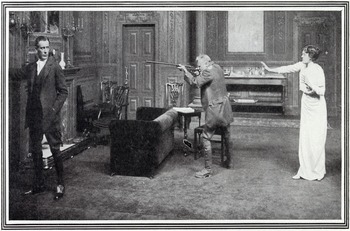
Eventually offered £50 in consideration of his long service, Gann rejects the ‘dirty money’ prompting Insoley to label him a thick-headed ‘Somersetshire peasant’.Footnote 116 With the bonds of the so-called ‘sacred trust’ between servants and employers fast dissolving, disaster inevitably follows with the suicide of Gann’s daughter.Footnote 117 Mad with grief and the obligatory drink, the keeper threatens to shoot Insoley – who coolly provides him with the cartridges – before wrenching himself back to his senses (Figure 8).
Tatler, 9th November 1910. Insoley is daring the keeper to shoot. His wife, Grace, looks on. © Mary Evans Picture Library.

Though on this occasion the sang froid of the landed gentry appears to have won the day, and a broken Gann resumes his duties, Insoley’s complacent existence has been shattered. Laying bare the depth of long-harboured local resentment towards their squire, in a show of solidarity with the keeper the villagers hiss Insolely outside the pub that bears the family name. Performed at the height of the political crisis triggered by the previous year’s budget, a crisis played out on the fault-line between landed wealth and wider society, Insoley’s realisation that ‘they can’t stick me’ once again put the keeper and his working life at the heart of contemporary concerns and debates.Footnote 118
Conclusion
More visible than at any time before or since, the late Victorian and Edwardian gamekeeper had a presence and visibility that demands closer attention. Yet while the social criminality of poaching, justified or not, has given the keeper’s opposite number an enduring interest and appeal, despite the wealth of material available those engaged in the preservation of game, and its optimal presentation in the shooting field, have enjoyed markedly less attention. Hoyle’s claim that historians have been wrong to neglect Victorian and Edwardian field sports could certainly be extended to the gamekeeper, a ‘functionary of immense importance’ who, whatever the habitat distortions and cruelties involved, played a significant role in creating and maintaining much of the rural landscape now valued as quintessentially English.Footnote 119 At the same time, of course, the keeper continues to be seen as part of the ‘cult of exclusion’ actively maintained by the hunting and shooting community for their own selfish interests.Footnote 120
Bound to the land as he was, the keeper was also part of a rapidly industrialising society. The railways and roads that connected the nation’s towns and cities were the arteries that fed its sporting estates and grouse moors. In this context the keeper straddled both the primary and tertiary sectors: a producer and service provider rolled into one. Advances in communications technology also meant that the keeper of our period became representationally more active. But at the keeper’s maximum moment of impact and ‘standing’, what had not changed was the essential ambiguity of his position. ‘It was about this time I cultivated the acquaintance of the keeper. All the world hated him … But he had a great attraction for me’, explains the narrator of D. H. Lawrence’s first novel, The White Peacock (1911).Footnote 121 Socially indeterminate himself, Lawrence’s fascination with keepers derived not only from their specialist knowledge and skills, but also from their position as unusually independent servants.
Situated on the ‘frontier’ between social class served and likely class origin, it is here that the keeper of this study comes closest to that of Munsche’s.Footnote 122 The key difference was that more, and in much more varied terms, was now being thought and said about him. For some still an object of deep dislike (Lawrence’s keeper, Annable, is found dead in a quarry), and a prime target in the radical campaign against sporting estates, more affirmative associations were also now developing. When in 1912 Little Tich did his popular music-hall turn as Nimrod the Gamekeeper he was doubtless having a joke at his subject’s expense, but the performance also carried an appreciation of his work. In this case the diminutive keeper who punningly ‘knows the game’ catches poachers by hiding down rabbit holes. And of course the joke worked because one way or another audiences knew about gamekeepers.Footnote 123
Remaining in some ways a ‘being apart’, this rural ‘aristocrat of humble life’ was also now a part of national life.Footnote 124 Against a densely layered backdrop of land politics and ruralist culture, where shooting was both narrowly unifying and widely divisive, the gamekeeper carried a range of meanings and associations. If ‘A’ was for Artist and ‘Z’ for Zoologist, then ‘K’ was decidedly for Keeper.
Acknowledgements
My thanks to the editors of Rural History and the two anonymous reviewers for their invaluable comments. Thanks also to Professor Claire Langhamer and to David S. D. Jones for all their help.