INTROUCTION
Divisions between religious groups in America have been supplanted by a culture war between conservatives and liberals (Hunter Reference Hunter1991; Wuthnow Reference Wuthnow1988; Putnam and Campbell Reference Putnam and Campbell2011). New interdenominational partnerships dissolve old tribal loyalties: altering public attitudes, voting behavior and elites’ strategic political calculations on public policy issues: abortion, same-sex marriage, healthcare, welfare, and many others (Kellstedt and Green Reference Kellstedt, Green, Leege and Kellstedt1993; Blake Reference Blake2012; Hunter and Wolfe Reference Hunter and Wolfe2006). But these social and political changes are not reflected in America's private K-12 school system or in patterns of public aid for children who attend them where divisions between religious traditions remain stark. Catholic schools are still over-represented and Protestant schools underrepresented compared to their respective shares of the population in almost every state. In-kind aid such as textbooks and transportation is associated with a large state Catholic population but not with other religious groups. School voucher programs, of which there are currently 57 offering parents a sum of public money for private education, are more common in largely Protestant states notwithstanding the increasing propensity of Catholic elites to ally with Protestants in support of such programs. In the politics of private education and public aid to its students, differences between religious traditions are surprisingly tenacious.
This article seeks to explain modern patterns of private schools and public aid for children attending them: voucher and tax credit programs and in-kind aid such as publicly funded textbooks and transportation. I argue that the modern distribution of religious schools and aid programs are rooted in path dependent processes stemming from differing conceptions of identity, theology, legal status, and church functionality. Critical junctures in America's social, legal and political development forced citizens and religious organizations to choose between exiting the public schooling system for the private sector, voicing concerns through political or legal means, or remaining loyal to that system. The differential choices of Catholics, Evangelicals, Mainline Protestants, and members of other religious traditions at these junctures help explain why religious traditions still matter in the politics of private schools.Footnote 1 This timely article, written during an unprecedented expansion of school vouchers across the United States (Whitehurst and Whitfield Reference Whitehurst and Whitfield2014), examines an unusual policy area in which religious coalitional activity may be slowed or forestalled by the institutional legacy of historical religious divides.
THE EXIT-VOICE CHOICE
The development of America's private school system and state variation in the nature and extent of aid provided for private school students are determined by the choices of parents, religious institutions, and state government. Parents choose where to send their child to school. Religious organizations decide whether to establish a private religious school. State policymakers decide whether to provide public aid for students attending private schools and, if so, what form that aid should take: in-kind benefits, vouchers, or both. These choices are of course interrelated since parental preferences are affected by the availability and affordability of private alternatives. By the same token, state policies influence, and are in turn influenced by, the number and relative attractiveness of private schools in comparison with public ones.
Albert Hirschman's categorization of customer responses to declining business performance in terms of their use of “exit” and “voice” strategies is an appropriate metaphor for religious groups’ relationships to public schooling. If public schools fail to meet a group's needs then members can “exit,” that is, vote with their feet to escape the public school system entirely, or they can “voice” their criticisms in an “attempt…to change, rather than escape from, an objectionable state of affairs” (Hirschman Reference Hirschman1970, 30). Hirschman noted that the exit-voice choice tends to operate in a see-saw fashion: if exit is simple then voice becomes less attractive. Conversely, if voicing criticism is straightforward and effective, the desire to exit is diminished. The modern distribution of religious schools, and patterns of public aid for students who attend them, can be understood in terms of differential exit-voice choice at critical junctures in history. Many religious groups have criticized public schools for failing to meet their needs but, as I show in the following section, historically Catholics have disproportionately tended to exit, Evangelical Protestants to voice criticisms, and Mainline Protestants to remain loyal to public schools.
With the rapid expansion of school voucher programs over the last five years the exit option has become more attractive for all religious groups, a development coinciding with the rise of culture war divisions between liberals and conservatives and the dissolution of older denominational divides and animosities. As I show here, however, these new fluid coalitional dynamics confront an institutional landscape profoundly shaped by denominational disputes and theological division. Private schools’ religious affiliations do not reflect the population's religious traditions proportionately in any state. Religious affiliation is associated not only with the exit-voice choice but also with support for certain forms of exit: the market-mechanisms of voucher programs or the provision of in-kind aid for religious school students. In the politics of private schools, religious tradition still matters in surprising ways.
MODERN PATTERNS OF RELIGIOUS SCHOOLING AND PUBLIC AID
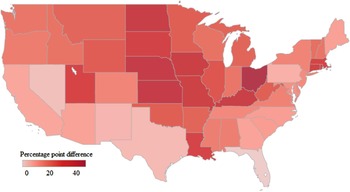
Notwithstanding the decline in the number of Catholic schools over the past two decades, Catholic schools and enrolments remain over-represented as a proportion of all religious schools and enrolments compared to the Catholic portion of the population. Cross-referencing United States Religious Landscape data with information from the most recent Private School Universe Survey (PSS) shows that this relationship holds true across almost all states.Footnote 2 For instance, in Kentucky, where just 14% of the population identify as Catholic, almost half of religious schools are Catholic in orientation; in Ohio, the respective proportions are a fifth and almost two-thirds (Kosmin and Keysar Reference Kosmin and Keysar2009). On average, there is a 14 percentage-point difference between the proportion of religious schools that are Catholic and the proportion of Catholic state residents. Only six states have a lower proportion of Catholic schools as a percentage of all religious schools than the Catholic proportion of the population and in these states the difference is small.Footnote 3 Catholic school enrolments as a proportion of the total private school enrolment are also higher in all but two states (Maine and Vermont) than the Catholic portion of the state population. Figure 1 shows the gap between Catholic population and Catholic schools. By contrast, Baptist schools are under-represented in all but 10 states compared to the Baptist population.Footnote 4
Gap between the proportion of a state's population that identifies as Catholic (2014 Religious Landscape Survey) and the proportion of religious schools that are Catholic in orientation (Private School Universe Survey 2011–2012).

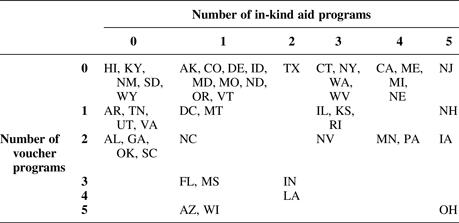
Many states provide in-kind aid to students attending private schools in the form of transportation, textbooks, equipment, and food and health services, and more than half of states provide some form of school voucher or tax credit scholarship that supports student exit to the private sector. Due to qualitative differences between in-kind aid and vouchers — although either can be expensive, the latter provides tuition payments and attenuates the connection between government and religious institutions by means of parental choice (Mettler Reference Mettler2009) — I treat these two program types separately for analytical purposes. Aid is not distributed evenly across the nation: some states (mainly but not exclusively Southern) including Alabama, Arizona, Mississippi, North Carolina, and Wisconsin, offer many voucher programs but little in-kind aid. Some (mainly but not exclusively North-Eastern) including California, Michigan, New York, Massachusetts, and West Virginia, offer in-kind aid but few vouchers. Others (mainly but not exclusively Western) including Delaware, Hawaii, Missouri, Texas, and Wyoming, offer neither in-kind aid nor vouchers. Six states (mainly but not exclusively Midwestern: Iowa, Kansas, Minnesota, Nevada, Ohio, and Pennsylvania) provide generous funding for both voucher programs and in-kind aid. Table 1 maps states according to their support for in-kind aid and for voucher programs in December 2015.
In-kind aid and voucher programs by state, December 2015

I suggest that the distribution of aid programs for children at private religious schools is related not only to region and partisan control of the state government (private school choice tends to be a Republican cause) but also to the religious make-up of the state population. In the eight states with a Catholic population of more than 30%, all provide in-kind aid but just two (Illinois and Rhode Island) offer a voucher. Conversely, among the 22 states with a Catholic population of less than 10%, 19 provide no in-kind aid at all, or just one program, and more than half offer at least one voucher. The modern distribution of religious schools and the variety and scope of public aid programs for students who attend them can be explained in part by differences in church functionality, mission and theology, and by critical junctures in American political development.
BACKGROUND CONDITIONS
Why is “the supply of attractive private schools…greater for those of particular religious traditions” (Campbell, West, and Peterson Reference Campbell, West and Peterson2005, 527)? And why does state aid for students at private schools “[take] many different forms and [flow] through many different channels and in exceptionally varied amounts” (Connell Reference Connell2000, iv)? The relative attractiveness of the exit and voice options has historically diverged for Catholics and Protestants. Catholics have a long history of parish-supported parochial schools in America and government-funded schools elsewhere, a commitment to social justice that involves the provision of education to non-Catholics, and a workforce whose religious vocation includes teaching (National Catholic Educational Association 2010; West and Woessmann Reference West and Woessmann2010). These features help explain the large numbers of Catholic parochial schools and acceptance of governmental aid for students.
Private Christian schools are typically less keen on governmental aid or interference with their mission, which tends to be more about providing Bible-based education than social uplift for non-church members (Forman Reference Forman2007). These differential school functions are evidenced in Catholic and Evangelical schools’ mission statements (Boerema Reference Boerema2006). Across the sweep of American history, the norm for most Evangelical schools has been active avoidance of governmental aid of all kinds (Green Reference Green1991). Baptists, for example, have a strong separationist heritage despite modern accommodationist beliefs (Williams Reference Williams1644; Jefferson Reference Jefferson1802; Healey Reference Healey1962; Gaustad Reference Gaustad1996; Drakeman Reference Drakeman2010). This heritage may affect attitudes toward in-kind aid particularly (Laycock Reference Laycock1997). Many Evangelicals support school voucher programs, which allow private parental choice to intervene between government and religious institution (Campbell, West, and Peterson Reference Campbell, West and Peterson2005; Wells and Biegel Reference Wells and Biegel1993; Deckman Reference Deckman2002).
The organization of the Catholic Church in America also facilitates the funding of parochial schools to a greater degree than Protestant Churches. The former is centralized and more fully institutionalized, at least since the late 19th-century, partly because it is both hierarchical in organization and prophetic in its approach to religious doctrine (Hennesey Reference Hennesey1981; Mao and Zech Reference Mao and Zech2002; Allen Reference Allen1995). By contrast, most Evangelical churches operate in a decentralized and competitive manner because they are individualistic in doctrinal matters, emphasizing individual revelation rather than tradition or priestly interpretation of Scripture. The pronounced tendency of Protestant sects to split into separate organizations makes it harder for Evangelicals to create and sustain a system of private schools, reinforcing their reluctance to exit the public school system. Thus, the over-representation of Catholic schools and underrepresentation of other Christian schools (particularly schools with an Evangelical Protestant affiliation) can be understood in terms of the Exit-Voice Choice. Church organization, conceptions of religious mission and historically accommodationist attitudes toward church-state separation made exit more attractive to Catholics but less easy and attractive to many Evangelical Protestants. Mainline Protestants have tended to stay loyal to the public school system rather than exit from that system or voice criticisms, as a result of which there are few Episcopalian or other Mainline Protestant schools compared to their proportion of the population (Marty Reference Marty1970).
Detwiler's explanation for the failure of Evangelicals to choose “home schooling or Christian schools” in numbers commensurate with their share of the population (Homeschooling Catholic Reference Catholic2013; National Center for Education Statistics 2007) — that “both of these alternatives place a financial burden on Christian parents” — does not explain religious group differences because all parents bear a financial burden in choosing private education (Detwiler Reference Detwiler1999, 9). A key part of the explanation, I suggest, lies in the way some Protestant groups have understood their place within America. From the beginning of the American republic the dominant cultural seam was Protestant (Hennesey Reference Hennesey1981; Noll Reference Noll2002). Even in an exceptionally diverse country, the concept of “Americanism” remains to some degree intertwined with “Protestantism.” Nowhere was this intertwinement more obvious than in the early American education system, where immigrant children were encouraged to assimilate “into a system that reflected a Protestant vision of America” (Green Reference Green2012, 11).
Before the mid-20th century public schools routinely mandated Protestant forms of worship as part of the regular day, including Protestant prayers, hymns and readings from the King James Bible (Green Reference Green2012; Hennesey Reference Hennesey1981). Accordingly, Protestant parents who wanted their children to be educated in a Protestant environment could send their child to a traditional public school. Early public school leaders were characteristically Anglo-American in background and Protestant in religion (Kaestle Reference Kaestle1983). “Early public education relied on assumptions of an inherent relationship between Protestantism and republicanism that denied the legitimacy of alternative models” (Green Reference Green2012, 11). There was an assumption “that Americanism and Protestantism were synonyms and that education and Protestantism were allies” (Smith Reference Smith1967, 680). Public education favorable to Protestantism led many Catholics to set up private parochial schools.
Although Baptists and other groups were persecuted during colonial times, by the 19th century Evangelical Protestantism had emerged as one of the most powerful forces in the new American Republic. During the 19th centuries the Evangelical fervor of the Second Great Awakening (~1800–1840) was followed by the spread of public education as part of an Protestant republican nation-building effort in the West (Green Reference Green2012; Meyer et al. Reference Meyer, Tyack, Nagel and Gordon1979). The Anglican Church had been established in five colonies but by the time school systems were first created in the mid-19th century Evangelical churches were resurgent. Evangelicalism and republicanism became “not only the most powerful value system in the nation, but also the most powerful value system defining the nation” (Noll Reference Noll2002, 14).
By contrast Catholics had a fraught relationship with the dominant Protestant American culture, although feelings have recently softened (Pew Research Center 2014). As late as 1960 JFK's Presidential campaign was forced to confront concerns about his religion. Nativist “Americanist” criticisms of Catholicism were rife throughout the 19th- and early 20th-centuries (Kinzer Reference Kinzer1964; Stern Reference Stern2004). Although anti-Catholic sentiment has now largely disappeared, we live with its legacy. Recent research shows that Protestant immigrants are more likely to identify as “American” than Catholic immigrants, and to believe that Americans think being a Christian is a defining feature of American identity (Taylor, Gershon, and Pantoja Reference Taylor, Gershon and Pantoja2014).
This cultural history helps unpack differing Protestant and Catholic reactions to perceived problems in public schools. Many Evangelicals see Protestantism as central to “what it means to be an American” (McDaniel, Nooruddin, and Shortle Reference McDaniel, Nooruddin and Shortle2011, 5; Citrin, Reingold, and Green Reference Citrin, Reingold and Green1990). Given that the public school has historically advanced American culture, it is natural for Evangelical Protestants to seek to change the public school system itself, through lobbying for school prayer and the teaching of creation science rather than to opt out of the system entirely (Deckman Reference Deckman2002). Evangelicals typically believe that “public schools are an extension of the divinely ordained institution of the family…Christian parents have an obligation, given to them by God, to monitor the schools and make sure that they are run in a manner consistent with biblical principles” (Detwiler Reference Detwiler1999, 9). By contrast, American Catholics historically stood outside mainstream American culture. Catholicism is not and never has been popularly identified as crucial to “Americanness.” The decision to exit the mainstream schooling system and set up parochial institutions reflects this cultural dislocation.
CRITICAL JUNCTURES
Modern patterns of private schools and public aid are shaped by path dependent relationships between communities, schools and governmental units formed during periods of intense conflict, particularly the 19th-century Common School movement and 20th-century battles over school prayer. For much of American history, the Exit-Voice Choice was resolved differently for different religious groups at these critical junctures: Catholics tended to exit the public system while Protestants tended to voice criticisms instead (Davis Reference Davis2006). Even after the Warren Court school prayer decisions stymieing Protestant “voice” within the public system — Engel, Schempp, and Curlett — the balance of choice between exit and voice did not alter substantially for many Protestants. More recently, the expansion of school choice has made exit more attractive for all religious parents and organizations, including both Protestants and Catholics. But the social, political, and institutional legacy of religious division makes change slow, in part because Catholic schools are so much more numerous than those of other religious traditions. Culture war “strange bedfellow” coalitions abound in other areas of public policy (Bendyna et al. Reference Bendyna, Green, Rozell and Wilcox2001; Wuthnow Reference Wuthnow1988), but the landscape of private schools and public aid continues to reproduce historical religious divides.
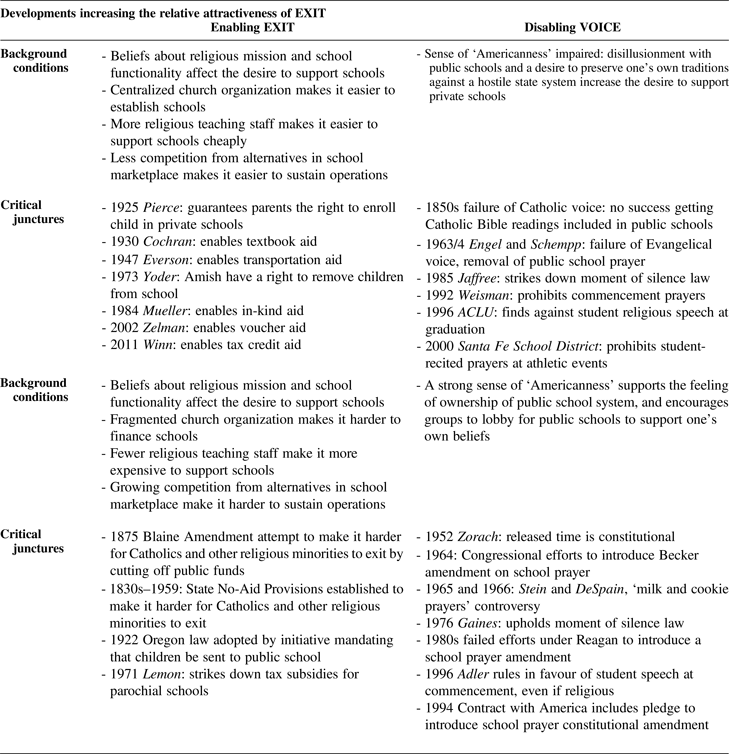
The Exit-Voice Choice is shaped by the severity of perceived problems with a particular service — in this case, the public school system — and the relative ease and attractiveness of exit or voice. Table 2 summarizes the political, social, and legal developments affecting the exit-voice choice for religious groups throughout America's history.
The exit-voice choice in American history

During the early-19th century Catholics vocalized their opposition to Protestant public schools and launched numerous lawsuits (Green Reference Green2012). Although school officials in a few religiously diverse cities banned Protestant worship, Catholic voice mostly failed in the courts (Donahoe v Richards 1854; Commonwealth v Cooke 1859). At the federal level Protestant school prayer lasted, legally, until 1962. Hence, as the Catholic population in the United States grew during the 19th century members increasingly turned to private parochial schools instead. They exited the public school system. Efforts to stymie Catholic exit came with the passage of “Blaine Amendments” or “No-Aid Provisions,” which banned aid for denominational schools in 40 states between 1835 and 1959, although a similar federal effort failed in 1875 (Hackett Reference Hackett2014).
The National Association of Evangelicals’ response to the 1963 Schempp decision on school prayer recommended “that Evangelicals consider Christian schools as an alternative to school districts that were hostile to religion,” a clear incitement to exit (Green Reference Green1991, 553). Most plaintiffs in Mozert, a textbook content challenge, subsequently exited the public school system (Forman Reference Forman2007). In the 20th century, Evangelical Protestants exited the public school system in two ways, homeschooling and “white flight” to segregated academies,Footnote 5 although the numbers taking such options are still modest today relative to the size of the total school population (Reardon and Yun Reference Reardon and Yun2002; Carper Reference Carper2000; National Center for Education Statistics, Schools and Staffing Survey 2009; Roper Center for Public Opinion Research Data Archive 2006; Isenberg Reference Isenberg2007). When the Warren Court challenged public school prayer and Evangelical criticisms of public schools increased, many Evangelicals exerted pressures on legislators to provide for such practices in the public schools (Delfattore Reference Delfattore2004; Djupe and Conger Reference Djupe and Conger2012; Truman Reference Truman1951, 59). Notwithstanding the internal diversity of Evangelicalism and Catholicism, Evangelical criticisms of public schools historically differed from Catholic criticisms: the latter provoked departure from the public school system; the former provoked attempts to reform the public system itself.
Using media outlets and direct lobbying, Evangelical Protestants spearheaded efforts to introduce school prayer or moments of silence through constitutional amendment and state legislation (Green Reference Green1991). They provoked a series of lawsuits including Stein, Gaines, and Jaffree (Table 2). The Moral Majority, largely Evangelical Protestant and headed by Baptist minister Jerry Falwell, was central to President Reagan's efforts to restore state sponsored school prayer. During the 1990s a set of Evangelical interest groups drafted a Religious Freedom Amendment that would explicitly permit school prayer (Delfattore Reference Delfattore2004). Wherever there were efforts to reform the public schools to admit religious practices they were led by Evangelicals. Mainline Protestants — whose congregations (despite a brief fillip in the early- to mid-20th century) continue to shrink — played a far more limited role in such conflicts than Evangelicals. Mainline Protestants’ loyalty to the public school system is reflected in the relative scarcity of private schools affiliated with these denominations (National Center for Education Statistics 2012).
EXAMINING EXIT-VOICE THEORY
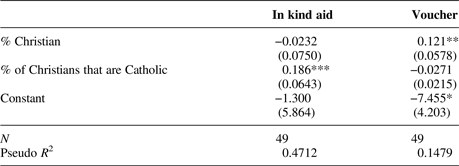
The long period over which these developments occurred makes direct testing of the Exit-Voice Choice difficult, but it is possible to examine the legacy of these historical junctures and the strength of the connection between the modern religious composition of a state, its private school landscape and public aid for children who attend them. Suggestive correlations provide a snap-shot of the legacy of the Exit-Voice Choice.Footnote 6 Since Catholic schools are numerous and such schools have historically lobbied for public aid, and since Evangelical Protestant schools have historically shunned public funding in addition to being fewer in number, Exit-Voice implies Catholic population is positively related to in-kind aid for children at private religious schools and Evangelical Protestant population is negatively related to such aid. These expectations are reflected in state-level data drawn from the PSS, the United States Religious Landscape Survey, and public school information from the National Center for Education Statistics.Footnote 7 Logistic regression reveals differences in the kinds of aid program a state adopts depending on its religious composition, shown in Table 3.Footnote 8
Aid programs and state religious composition

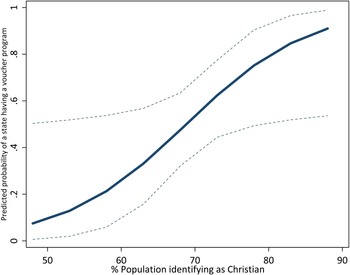
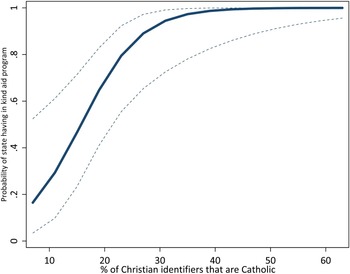
The larger the proportion of Christians in a state,Footnote 9 the greater the probability it has a voucher program facilitating exit. But also, the larger the Catholic portion of that Christian population in a state, the greater the probability the state provides in-kind aid facilitating exit. Figures 2 and 3 display the predicted probabilities of voucher programs and in-kind aid, respectively: States that are only just over half Christian have a low probability of adopting a voucher: around 20%. But when three-quarters or more of the state population is Christian the probability of a voucher rises above 70%. If just one in 10 Christians in a state are Catholic the chances it has an in-kind aid program are less than 20%, but if 30% or more of Christians are Catholic the state is almost certain to have an in-kind aid program of some sort. Catholics were historically more accommodationist than Protestants (Jelen and Wilcox Reference Jelen and Wilcox1997; Witte Reference Witte2006), particularly respecting in-kind aid, and this tendency is reflected in modern patterns of aid. For Evangelical Protestants, who have historically been more separationist in their views about church and state, voucher programs that attenuate the connection between government and religious school may be a more acceptable form of aid facilitating exit to private schools.
Voucher programs and Christian population by state.

In-kind aid programs and Catholic population by state.

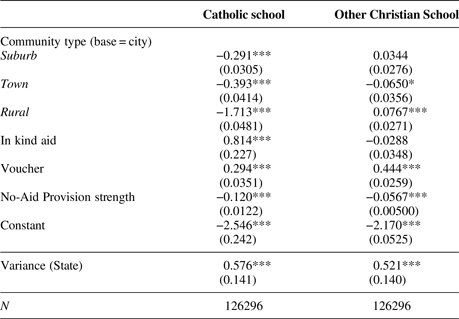
At the school level, the distribution of religious schools can be related to location and the presence of constitutional barriers preventing exit from the public system or programs facilitating it. Deploying multilevel logistic regression with data on all public and private schools in 2011–2012, I model the likelihood that a school is Catholic or Christian according to both school and state characteristics. For example, Catholic schools are more likely to be located in cities while other Christian schools are more likely to be located in rural areas than other schools (Downes and Greenstein Reference Downes and Greenstein1996). Table 4 below displays the results.
Religious schools, constitutional barriers, and aid programs

Strong state No-Aid Provisions or “Blaine Amendments” are correlated with fewer Catholic and other Christian schools, perhaps by closing off aid to religious institutions and thereby reducing the attractiveness of the exit option as shown in Table 2 (Hackett Reference Hackett2014).Footnote 10 Crucially, Catholic schools are more common in states with in-kind aid programs while states with more voucher programs tend to have more religious schools of all faiths, suggesting such programs facilitate exit from the public sector by religious groups.
CONCLUSION
Evangelicals have historically tended to lobby for reform of the public school system while Catholics exited for parochial institutions, resulting in an over-representation of Catholic institutions. These differential group responses stem from differing conceptions of identity and belonging, theological understanding, and institutional structure, rooted in Catholics’ historical alienation from Protestant culture. By promoting private schools, aid programs uphold a vision of America in which religious group differences are preserved in opposition to the assimilationist “melting pot” logic of public schools (Hirschman Reference Hirschman1983; Zangwill Reference Zangwill2007). Such policies represent the triumph of “democratic nationalism” where strong group identities are tolerated within a nation, as opposed to “assimilationist democracy” in which absorption by the majority culture is a condition of membership (King Reference King2005). Despite changing attitudes among religious groups and shifting alliances, new boundaries between orthodox and progressive and the dissolution of old divides, this article identifies persistent religious differences in the institutional landscape of schools and aid programs.
The “culture war” diminishment of denominational antagonisms plays out against the institutional legacy of division by religious tradition embodied in the private school system.
The growing number of Latino congregants as a proportion of the American Catholic Church and Latino students in the Catholic school system adds a racial dimension to the culture wars that may slow the diminishment of religious particularism (Putnam and Campbell Reference Putnam and Campbell2011). Catholic schools now average 14.7% Latino.Footnote 11 61% of Latino students attending private education are in Catholic schools. Race affects the Exit-Voice choice because of competition from the charter sector for this demographic (Renzulli and Evans Reference Renzulli and Evans2005; Wells et al. Reference Wells, Lopez, Scott and Holme1999), racialized patterns of church and school attendance (Wrinkle, Stewart, and Polinard Reference Wrinkle, Stewart and Polinard1999), and linguistic division; several state No-Aid Provisions require lessons in public schools to be conducted in English (Leshy Reference Leshy2011; Adkinson and Palmer Reference Adkinson and Palmer2011; Smith Reference Smith2011).
As sites of socialization, parental choice and religious mission, private schools are central to the continuation of religious life and the future trajectory of the culture wars. Jeffries and Ryan once argued that the culture war defection of Evangelicals from the separationist coalition means “the constitutional barrier against financial support of religious schools will not long stand” (Jeffries and Ryan Reference Jeffries and Ryan2001, 283). This prediction is broadly correct, but neglects three key issues raised here: First, “support” for religious schools takes many different forms and differences persist amongst religious traditions in their enthusiasm for such programs. Second, for those “voicing” criticisms rather than “exiting,” the accommodation of religious exercises within public schools is the central goal, not aid to private religious schools (Sokol Reference Sokol2015; Friedman Reference Friedman2015). Third, the sharpening of the orthodox-progressive divide in religious and political life confronts an institutional landscape that over-represents schools of certain denominations.
For much of America's history, the interests of Catholics and Protestants diverged substantially in the realm of private education and public aid for students at those schools. Now these interests are converging as voucher programs become more numerous, so “strange bedfellow coalitions” between religious groups all favoring “exit” are likely to become more common. But the speed of such changes may be slowed by legal and political developments that alter the balance of choice between exit and voice by striking down school choice programs or providing religious accommodation within the public school system. All modern efforts to facilitate exit must contend with the historical legacy of religious division in patterns of religious schooling.