As a consequence of the 1982 amendments to Section 2 of the Voting Rights Act (VRA), in conjunction with the preclearance provisions of Section 5, the creation of majority–minority districts has become the standard method for securing minority representation in legislative institutions.1
Though this practice increased dramatically after the 1982 changes, there were majority–minority districts in existence prior to the 1991 redistricting process. The term Majority–minority simply refers to electoral districts drawn with a sufficient minority population so that the minority population can elect a candidate of choice, usually candidates of like race or ethnicity. What constitutes “sufficient” population size is a source of some debate but typically ranges between 55% and 65%. See a recent exchange between Cameron, Epstein, and O'Halloran (1996) and Lublin (1999) for a thorough review of this discussion.
This approach has been remarkably successful, at least descriptively, generally resulting in the election of minorities to legislative office.
Less certain, however, is the impact of these districts on the political behavior of citizens residing in them. Creating majority–minority districts provides minority voters with a new-found opportunity to elect a candidate of choice,2
There is some disagreement in the literature over whether the critical threshold of minority concentration is actually 50% (Grofman, Handley, and Lublin 2001). Nevertheless, we begin here with the recognition that securing minority representation has often required some degree of electoral engineering, whose behavioral effects we explore here.
empowering this previously excluded group and increasing their incentives to turn out and vote. On the other hand, low levels of competition in these districts, coupled with disappointment associated with the lack of perceived policy effects from increased descriptive representation, may serve as dual disincentives to participation and dissipate any gains in turnout.
What, then, is the net effect? The central question of this paper is whether majority–minority districts are empowering to minority voters or, in contrast, whether they actually drive down turnout. Focusing on actual turnout at the individual level in five counties of southern California, we estimate the effects that residing in majority–minority districts has among Latinos and non-Latinos alike.
In light of the impending debate over renewal of the VRA,3
The Voting Rights Act comes up for reauthorization in 2007.
understanding the behavioral implications of minority districting is important. If Latino turnout is enhanced by these structures, then majority–minority districts unambiguously enhance Latino political influence. If, however, Latino representation is gained at the expense of Latino turnout, these districts may be detrimentally affecting the overall influence of Latinos by reducing their impact on up-ballot races where outcomes are less certain.
MAJORITY–MINORITY DISTRICTS AND MINORITY VOTER TURNOUT
Literature that directly, and empirically, examines the notion of minority voter turnout within majority–minority districts is still comparatively rare. This is somewhat surprising, especially given that scholars frequently document the importance of institutional context to political attitudes and participation (Jackman 1987; Pantoja and Segura 2003). More recently, work examining the sociopolitical context of participation (Huckfeldt and Sprague 1995) has undermined the very individualistic assumption made about the process whereby citizens choose to engage in political activity. The role of racial or ethnic context (Leighley 2001) and organizations (Pantoja and Woods 1999; Ramirez 2002), for example, has been identified as central in determining who is likely to be mobilized through elite efforts and group solidarity and who is likely left behind.
In addition to the relative paucity of research on the behavior effects of minority districting, empirical observation has been limited to anecdote, case study, and aggregate-level analyses yielding mixed results. Several early researchers found that minority participation is actually enhanced with regard to local, particularly mayoral elections. Bobo and Gilliam (1990) find that the participation of African Americans increases in cities with black mayors, while Lublin and Tate (1992) find a similar effect given the presence of African-American mayoral candidates. Roll-off also seems diminished where African-American candidates are on the ballot (Vanderleeuw and Utter 1993).
In contrast, other research is less sanguine about the potential for increased voter participation as a result of the presence of a minority candidate or previously elected official. Gaddie and Bullock (1994) find that no increased voting occurred among African Americans at the school board level, even as a result of newly created black-majority districts. Brace et al. (1995) concur. Using aggregate turnout figures at the precinct level for congressional, State Senate, and State House districts in Florida, they find that turnout is not necessarily increased in safe districts, even as “candidates of choice” were elected. Haeberle (1997) similarly finds that white majority–minority districts (in this case in Birmingham, Alabama) did not increase turnout.
Most recently, Gay (2001) examined precinct-level turnout data from eight states with African Americans elected to Congress. Using ecological inference analysis (King 1997), Gay rejects both the optimistic and the overly pessimistic scenarios regarding minority turnout and majority–minority districts. While she finds very little evidence that the election of African Americans to Congress produces meaningful increases in black turnout, she does see significant declines in white turnout in those same majority-black districts. This decline in white participation, she suggests, may well be the cause of low overall turnout rates in majority black districts and serve as evidence that majority–minority districts do not have a demobilizing effect on the minority voters in question.4
This, of course, is why simply comparing turnout across majority-black and majority-white districts presents an inaccurate portrait of the differences.
In each of these analyses, turnout rates are measured at the level of precinct, district, or jurisdiction. The results differ primarily with regard to the focus on minority turnout in mayoral elections, versus the elections of minority candidates from districts. Where district contests are the focus, what little evidence is provided implies that voter turnout among minorities is not stimulated under safe-districting formats. These analyses are limited in a number of important ways, not the least of which is their focus on aggregate turnout rates and the participation of African Americans. Brace et al. (1995) take up the question of Latino participation, and only in Florida, where the heavily Cuban population is not at all representative of the Latino population in other states. Barreto et al. (2003) have recently examined this question, but with respect to mobilization rates rather than actual turnout. And the propensity of minority voters to turn out when they reside in more than one majority–minority district has been, until now, unexamined.
THEORY AND ARGUMENT
Our theory is built on two specific points. First, we suggest that the argument that majority–minority districts suppress turnout is logically flawed. Second, we suggest that properly estimating the effect of majority–minority districts on turnout requires us to understand better the electoral context in which minority voters choose to go—or not to go—to the polls. Since individual electoral contests are conducted simultaneously with others, we need to account for whether the voters have incentives to turn out for a variety of contests on the ballot, rather than merely one. We examine each in turn.
The “Empowerment” View
Repeated trips to the polling place with nothing to show for your effort would get old, fast. In places where minority vote dilution has undermined the voices of African-American and Latino voters, no level of vigilance or turnout would be sufficient to secure victory against a determined majority.5
The level of white “determination” necessary depends on the population distributions in the jurisdiction. The level of white unity necessary for minority exclusion is positively related to the minority's share of the electorate. See Grofman, Handley, and Lublin 2001 for a fuller discussion.
Losing every election, in short, is discouraging, undermines the perceived legitimacy of the system, and should drive down participation.
Once descriptive representation is secured through the creation of majority–minority districts, minority voters no longer face the discouragement associated with repeated votes and zero victories. While incumbency may briefly impede success, these districts have generally led to successful attempts on the part of the group in question to elect a candidate of their choosing, presuming, that is, that a candidate of the same racial or ethnic background (Lublin 1997) is their preference. Newly successful minority voters experience an enhanced sense of empowerment. Since their votes now may be perceived to matter, turning out to vote is a more rewarding—and hence more likely—experience.If this is the case, the value of majority–minority districts to the overall cause of minority representation is unquestionably positive. These districts serve the dual purposes of both increasing descriptive representation and increasing the overall minority share of the electorate. As minority turnout increases, those voters will exercise a larger impact on the outcomes of up-ballot elections where they do not constitute a majority of the electorate, as well as secure their representation by coethnics in the down-ballot districts where the group is, in fact, a majority.
The Skeptical View
But do their votes now matter? As long as the district's demographics do not change for the worse, these voters will pile success on top of success. Guinier (1994, 58–60) and others have suggested that, while turnout might increase in the first chance to elect a minority officeholder, this success might also be problematic. In a safe, majority–minority district, the outcome is as invariant as the outcomes in the majority-white, minority vote-diluted context. Yes, the outcomes are better for the minority group—they win—but the incentive to participate repeatedly is undermined by the irrelevance of turnout to the outcome. In addition, the assumption that incumbents are then unbeatable, and the reluctance of primary challengers to emerge from within the group, reduces competition in these electoral environments. Further, disappointed that the election of a minority legislator fails to produce tangible results, voters might find themselves even more disillusioned than before. If the result is a disillusioned electorate with little motivation for participation, the argument goes, turnout may well decline.
OUR VIEW
Our task here is to sort out these competing logics. We hypothesize that minority turnout is enhanced through the creation of majority–minority districts. While there may be a disincentive for turning out in repeated electoral success, we believe that its magnitude pales when compared with the disincentive implied in repeated electoral failure. More importantly, pessimistic arguments that majority–minority districts discourage turnout proceed from two fundamentally flawed assumptions. First, these analysts assume that there is no competition to attract turnout in majority–minority districts, that is, that they are effectively “rotten boroughs.” Second, this assumption is juxtaposed with another—that majority-white jurisdictions have competitive races, i.e., are not “rotten.”
Neither assumption is justified. While cautions regarding electoral invincibility, incumbency advantage, and machine politics are well taken, we think that they are nonunique. Scholars of congressional elections regularly document how few House seats are meaningfully competitive. In any given election year, most observers agree that only about 45 or 50 of the 435 House seats have genuine races in which the outcome is uncertain. In this instance, of course, noncompetitive refers to the partisan outcome but it may as well also refer to the racial outcome, as there are currently no African-American or Latino members of the House currently representing a district that is not majority–minority or was not at the time of their first election.6
The last to date was J. C. Watts (R-OK), who stepped down in 2002.
The politics of redistricting is driven by incumbent protection, a pattern replicated at the state level. As a practical matter, then,
the vast majority of non-Hispanic white voters in America lives in jurisdictions where both the racial and the partisan outcomes of legislative elections are rarely, if ever, in doubt. And while this noncompetitiveness no doubt does drive down political participation, it is not at all clear that it affects one group more than another.In contrast, a quick examination of
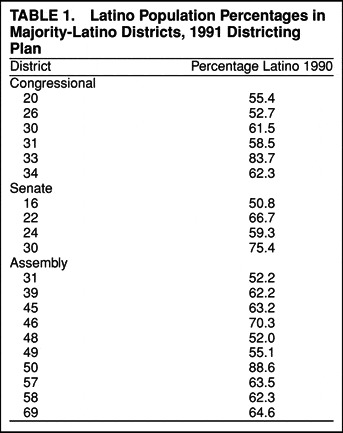
Table 1 shows just how narrow minority voters' grip is on the little political power they do have.
Table 1 reports the Latino percentage of the total population in each district coded “majority–minority.” Many of these majority–minority or majority-Latino districts are considerably less safe than the majority white districts against which we are comparing them. The population pluralities are often modest, and important differentials in citizenship, voting age, registration, and turnout are significant. Indeed, the very reason why some researchers fetishized the 65% threshold in the early studies of majority–minority districts was precisely the uncertainty of victory associated with a smaller plurality.
Those expecting lower turnout among minority voters in majority–minority districts assert that, whereas in a vote-diluted environment, no amount of turnout could secure a win, in a majority–minority district, no amount of abstention can risk a loss. But this, of course, is an overstatement. There is a fundamental asymmetry between majority and minority status, and an apathetic majority can lose the occasional election, while even the most zealous minority cannot, alone, change the fate of their candidate. While a determined majority could always exclude a minority of Latino or black voters from electing a candidate of their choice, a majority of minority voters could win, but only with sufficient turnout to make their demographic majority translate into an electoral one.
We logically conclude that while noncompetitive electoral environments are a disincentive to everyone's turning out, the incentives for participation among minority voters are systematically stronger in majority–minority districts than in majority white districts.
H1: Voter turnout will be significantly greater among Latinos living in majority–minority districts than among other Latinos.
Accounting for Ballot Context
Previous work on the behavioral effects of majority–minority districts has invariably focused on a single office, specifically the school board, mayoral elections, or Congress. But decisions regarding turnout in elections for different offices should not be viewed as independent trials when the elections occur simultaneously. Though a voter need not cast a ballot in every race, and roll-off is a well-documented phenomenon, most scholars would agree that the biggest self-selection process is between those who show up and those who do not. And in this sense, the incentive to vote is a product of more than simply the characteristics of only one of the races on the ballot.
If there are State Senate, Assembly, and U.S. House elections on the same day, the level of turnout for one race is invariably endogenous to circumstances of the others. Latino voters living in a majority–minority Assembly district may or may not be more empowered by this fact, but their decision about whether to vote is driven in part by their level of interest in the State Senate and House races, as well. Some of these Latinos living in a majority–minority Assembly district reside in more evenly divided Senate and House districts, while others may live in majority–minority districts for all three bodies. The behavioral effects of living in minority districts, then, should be stronger among those living in multiple, overlapping majority–minority districts.
H2: As the number of majority–minority jurisdictions in which a Latino citizen resides increases, so does his/her probability of turning out to vote.
DATA AND DESIGN
To test these hypotheses, we turn to Registrar of Voters' records for all registered voters from five counties in southern California: Los Angeles, Orange, Riverside, San Bernardino, and Ventura.7
With the exception of registered voters in Assembly districts 67, 70, and 73 in the 1996 and 1998 election and district 73 in the 2000 election. Due to errors by Riverside County in collecting and recording vote history data, these data are not available. Fortunately, these areas are not within Latino-majority jurisdictions.
Specifically, we examine data on general elections from 1996 to 2000. Our dependent variables are constructed using the actual record of whether or not individual registered voters turned out for a particular election.
Our unit of analysis is the individual, a departure from previous work. As Gay's (2001) innovative work pointed out, the use of aggregate turnout numbers can often mask what is really happening at the level of individual choice. This approach provides us with two advantages and arguably one potential disadvantage. First, unlike analyses that use polling data, we do not need to make inferences from samples to populations. Second, since Registrar of Voters' actual records do not rely on self-reporting, overreporting due to a social-acceptability bias is not a problem.
The potential disadvantage has to do with the self-selected nature of our universe of analysis. Our measure of turnout is, of necessity, only among registered voters. It is very likely the case that the empowering or demobilizing effects of living in a majority–minority electoral district would be reflected at the voter registration stage, as well as the actual election-day decision to vote. In that sense, some of the variance that can be explained by majority–minority districts has already been lost. On the one hand, this may well cause us to underestimate any effect. On the other, our confidence in a significant finding is raised since the self-selected nature of the registered voter pool makes such a finding more difficult.
We estimate the effect of living in a majority–minority district on the likelihood that a Latino citizen turns out to vote, controlling for other well-recognized determinants of behavior. We examine individual voter turnout in each general election, as well as an index of turnout across three elections for voters registered for the entire time period. For each individual election, the dependent variable is Voted and is coded one if the registrant signed into the polls on election day and zero otherwise. For voters registered for the entire time period, a second variable, Voted 96-00, ranges from zero to three. For voters registered for the last two elections (including those registered earlier), we code Voted 98-00, ranging from zero to two. In both instances, the values are simply the frequency at which the registrant signed in at the polls or voted absentee for the three (or two) general elections in question.
In estimating the principal effect, we take advantage of the natural quasi-experiment built into the multiple layers of representation each voter receives at the state and federal level to see if the frequency of voting in a majority–minority context is associated with the hypothesized effect. At a general election, each registered voter in our universe of analysis has the opportunity to vote for a State Assembly member, and U.S. House member and in alternating elections a State Senator. The voter, then, could conceivably be living and voting in as many as three majority–minority districts or as few as none.8
In fact, a citizen may also live in a majority–minority city or city council district, school board district, and county Board of Supervisors district. These elections, by and large, are not conducted simultaneously with statewide and general elections, so while they might have a contextual impact on the citizen's overall level of empowerment, they are not specifically relevant to turnout in general elections.
, then, captures the overall experience of the voter with living and voting in majority–minority districts for state and federal representation. It varies from zero to three and is the number of majority-Latino districts
9 For our purposes, we count a district as majority Latino when more than 50% of the voting-age population in the jurisdiction is identified as Latino. Replication of all of the following results at any level above 50% does not appreciably change the findings.
in which the registered voter resides for State Assembly, State Senate, and U.S. House elections.
10 As a practical matter, there are no truly majority-black districts in the five-county area studied. There are, of course, districts where African Americans are a plurality, but since we are studying the voting behavior of Latinos—in part because we cannot determine conclusively whether a registrant is black—these districts would not be “empowering” to the Latino electorate and are hence coded zero on these measures.
The vast majority of both Latino (64.4%) and non-Hispanic (89.4%) citizens live outside of majority-Latino districts. Owing to the “nested” nature of legislative districts in California, the next most common value is three for both non-Hispanics (5.4%) and Latinos (24%). Relatively smaller percentages of both live in only one majority-Latino district, with the value two being the least common. Fortunately, our universe is large enough that even the smallest cell has approximately 60,000 citizens.
Since not all representative offices may be equally salient to the voter, our design allows us to test whether voting in majority–minority districts for particular offices has different marginal effects. To estimate these effects separately, we use individual variables to capture whether the registrant lives in a majority–minority district for each office. MM-Assembly, MM-Senate, and MM-Congress are each coded one if the registrant's district for that office is majority-Latino and zero otherwise.
Identification of Latino voters is accomplished through the use of the Census Bureau's Spanish surname list, which flags those registrants with commonly occurring Hispanic surnames.11
The Spanish Surname list is based on the 1990 census and is constructed by tabulating the responses to the Hispanic origin question. Each surname is categorized by the percentage of individuals that identified themselves as “Hispanic.” Though the use of this instrument results in a modest underestimate, given the presence of Latinos with non-Hispanic surnames, the Census Bureau estimates that this captures 93.6% of all Hispanics, and less than 5% of those identified are false. For a full explanation on the methodology of the list see Word and Perkins 1996.
We identify Latino registered voters with the variable
Latino, which is coded one if the voter's surname indicates Hispanic origin. Given long-standing findings on the lower rates of turnout among all minority voters,
ceteris paribus, we expect the coefficient on this variable to be negative, though some more recent findings about Latino mobilization in California give us caution with regard to these expectations (Barreto and Woods
2000).
In order to differentiate the effects of living in majority-Latino districts on Latinos and non-Latinos, we interact these two variables. MM-Latinos identifies the effect of overlapping majority–minority districts only on Latinos, as opposed to a companion effect among non-Hispanics. Gay's (2001) findings on whites suggest that we might expect the coefficient on the main effect to be negative. If our argument is correct, however, the coefficient on the interaction of that effect with the Latino identifier will be positive. This coefficient, then, represents the degree to which the effect among Latinos is a departure from the effect among non-Hispanic voters. The overall net effect of majority-Latino districts on Latino turnout is obtained by adding the two coefficients together.12
For estimations of the separate effects of each office, the interactive terms are named MMA-Latinos, MMS-Latinos, and MMC-Latinos and will be the product of the Latino dummy and the dummy variable for whether the district for the particular office is majority Latino.
The large concentration of Asian Americans in California necessitates a demographic control for this group as well. We again use a Census Bureau database to identify Asian surnames. Asian-American is a dichotomous variable coded on the basis of surname. Asian-American turnout also consistently lags behind that of whites, so we would expect the coefficient to be negative.
African-American voters have similarly demonstrated a lower propensity to turn out. Unfortunately, it is not possible to identify which registrants are African Americans. To control for this effect, we code Probability Black as the likelihood that a given voter is African American, inferred from the proportion of non-Hispanic and non-Asian residents in that Zip Code that is black, ranging from zero to one. This variable is set to zero when the registrant is coded as either Asian or Latino (since their probability of being African American is known). While this estimate is of limited use for inferential purposes, it is helpful in separating out the potentially different effects of living in majority-Latino districts on African Americans and non-Hispanic whites. We would expect the coefficient to be consistently negative.
Party ID captures partisan registration. Republicans are coded as one, with all other voters coded as zero. Since Republicans tend to vote more frequently, we would expect this coefficient to be consistently positive. Female is a dichotomous variable. Determination of gender is directly from Registrar of Voters' records. Age is year minus date of birth and is also coded from records. Since younger citizens have been consistently found to vote less often, we would expect a positive coefficient.
In addition to these individual-level effects (or proxies, as in the case of Probability Black), we include a battery of contextual effects to control for other well-recognized factors influencing turnout that are not part of the registrars' database and, hence, not available for each individual registrant. Each variable is coded using the Zip Code as the unit of analysis, and the data are drawn from the 1990 national census, with the exception of Probability Black, which is drawn from the 2000 census.
Income and education are the obvious necessary controls. Median Income is median household income in the Zip Code, and Percent College captures the percentage of residents with a college education or better. Both should be strongly and positively associated with turnout. Since we are primarily interested in the behavior of Latinos, we need to control for the effects of nativity.13
In a similar vein, language use is often a measure of political incorporation, and we generally expect Spanish speakers to be less attentive to political and social matters in the United States and potentially less informed. To that end, we created Percent Spanish Speaking, a variable that accounts for the percentage of households in the Zip Code that speak primarily Spanish in the house. Unfortunately, this variable correlates highly with Percent Foreign Born (r=.795), above the usual threshold for multicollinearity, and we are unable to include both in the estimations.
serves as a proxy for individual nativity. Since naturalized citizens generally turn out less often, we would expect lower turnout in areas where the foreign-born population is larger.
14 One caution is necessary. In a recent piece, turnout among recently naturalized immigrants was examined and found to be significantly greater than among longer-term immigrants (Pantoja, Ramirez, and Segura 2001). This finding, contrary to earlier work, they argued, was primarily driven by the highly politicized environment in California over issues of ethnicity resulting from a series of ballot initiatives in the mid-1990s perceived to be Latino-targeted.
Finally, we also control for two district-level political effects. Since Senate terms in California are four years, voters in biennial Assembly and House races will not always have a Senate race in which to vote. Senate Election is a dummy coded one if there is a Senate race in the voter's district in that election. Since we would expect turnout to be greater when there are more choices to be made, the coefficient should be positive.
We also control for whether one or more of the seats are secure for Democrats. Safe Democratic counts the number of specific races (year and office) represented in the particular dependent variable that could be considered safely Democratic.15
This variable ranges from zero to three for models of single election years or single offices, zero to six for the model pooling all three jurisdictions for two election cycles, and zero to nine for the model pooling all three jurisdictions across three election cycles.
Should the first and second hypotheses be sustained, one potential alternative explanation for this heightened turnout would simply be partisanship. That is, since majority–minority districts are heavily Democratic, the positive effect on turnout could be driven by the enthusiasm of Democrats electing Democratic officeholders, without regard to ethnicity. By including this variable, we are able to isolate the specific effects of majority–minority districting controlling for that of partisanship alone.
16 One potentially important variable missing from this analysis is the level of competition in the races in which the individual can vote. We calculated Average Competitiveness as the mean level of competition (100 minus the margin of victory) in the districts facing an election in which the resident votes. Since competition has long been thought to increase turnout, we would anticipate positive effects. The resulting variable, however, correlates significantly (and negatively) with the safe seat control, making the simultaneous inclusion of both problematic. In results not presented here (but available from the authors), we replace the Safe Democratic control with the Average Competitiveness control. This change has no meaningful effect on the results presented.
TESTING AND RESULTS
Election-by-Election Analysis
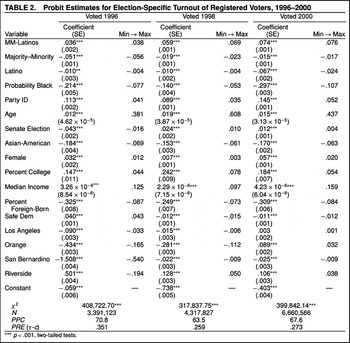
To estimate the effect of majority–minority districts on the propensity of individuals to turn out to vote in each election year, we modeled participation in each election using Probit. The results, presented in Table 2, vary only modestly across the three election years presented. Overall, the models are very effective, correctly predicting between 63.5% and 70.8% of the cases and yielding a proportional reduction of error (Goodman–Kruskal's τ-c) ranging from .259 to .351, a significant improvement over a null hypothesis of random proportional assignment of outcomes.
The effect of living in a majority–minority district is consistently negative and significant, while the coefficient on the interactive term for Latinos is consistently positive and significant. These findings are consistent both with our hypotheses and with Gay's (2001) earlier findings on whites. Non-Hispanics living in majority–minority districts are less likely to vote, and this decline in likelihood appears to be directly related to the number of overlapping majority-Latino constituencies in which they reside. In contrast, Latinos differ from this pattern. The positive coefficient indicates that Latino turnout is either less depressed, or actually increased, by residing in majority-Latino constituencies.
The net effect, calculated by summing the coefficients, varies across the elections. For 1996, the sum remains negative (−.015), suggesting that majority–minority districts depress turnout among Latinos as well, though to a much smaller degree than among non-Hispanics. We are reluctant to place much stock in this single finding for two reasons—the sum is perilously close to zero, indicating a very small net effect, and the result is not repeated for 1998 and 2000. For those two models, the sum of these two coefficients is positive—.04 in 1998 and .059 in 2000. Latinos living in overlapping majority–minority jurisdictions are more likely to turn out and vote. Even considering the somewhat more modest finding for 1996, it appears clear that Latinos are mobilized by living in environments where they have a chance of winning with a candidate of their choice.
The direct effect of being Latino appears to be negative, as expected. In general, Latinos have historically voted less frequently than non-Hispanics and this appears to be replicated here. Results for each of the other variables are nearly all as expected.17
Differences in election technology, registration patterns, and history of political incorporation suggest that each of the five counties might have historically different rates of turnout, irrespective of the other exogenous factors captured. This presents possible error-term problems. For this reason, we coded for the five counties, one of which (Ventura) is omitted as a predictor in each estimation as the unexpressed category. We have no strong priors on what the nature of these relationships will be, nor do we believe them to be theoretically important.
Other minority groups are less likely to turn out; Republicans are more likely to turn out. Coefficients on aggregate measures of income and education are both positive, indicating that each is positively associated with turnout. Similarly age is positively associated with the probability of showing up at the polls, while the estimate on the percentage born outside the United States is negative and significant. Finally, women appear more likely to vote than men.
Two anomalies do appear, however. First, the effect of a district being safe for Democrats is inconsistent in its effect, positive in 1996 and negative in the other two elections. Our priors on the net effect of this variable were not strong, yet we find the inconsistent results curious. Perhaps the unusually good Democratic year (and unusually weak GOP nominee) enhanced Democratic turnout vis-à-vis Republicans in 1996. Second, the coefficient on having a Senate election that year is negative for 1996. This is very odd in that it suggests that the presence of more voting opportunities on a single ballot is associated with a lower propensity to turn out. In contrast, results on this measure in 1998 and 2000 are positive and significant, as predicted.
Two methodological notes are worth mentioning here. First, we used 50%±1 as the definition of majority–minority, while the literature has often suggested that the electorally necessary threshold is much higher—as high as 65%. In results not reported here, repeating the analysis by recalculating all majority-Latino variables using a 65% cutoff does not appreciably change any of the results (and, in fact, makes the net effect on Latinos in 1996 positive, thereby eliminating the somewhat anomalous finding).18
All results referenced but not reported are available from the authors.
Second, this analysis is conducted using a universe, not a sample. So when we speak of statistical significance, we are really only referring to the amount of error surrounding the estimated relationship. We are not, therefore, engaged in statistical inference from samples to populations and there are no confidence intervals—the relationship reported is the one in the population of registered voters, without question. Using statistical significance, then, as some indicator of the importance of a relationship—always an error—is even less useful here.
What, then, is the substantive significance of the identified effects? We calculated the changes in predicted probabilities, also reported in Table 2, in columns directly adjacent to the relevant parameter estimates.19
Changes in probabilities are calculated using Long's (1997) Change program for Stata.
The negative effect of majority-Latino districts on the predicted probability of turnout for non-Hispanic voters ranges from about 1.7% to 5.6%. In contrast, the net effect for Latinos (again, summing across the direct and interactive effects, this time using changes in the predicted probabilities) varies from just below zero (−1.8% for 1996, again) to an increase of 5.9%. That is, non-Hispanics living in three majority-Latino constituencies turn out at a rate as much as 5.6% less than that of non-Hispanics living in no majority-Latino districts, while for Latinos, living in three majority-Latino districts increases turnout by as much as 5.9% compared to that of Latinos living in non-Hispanic districts.
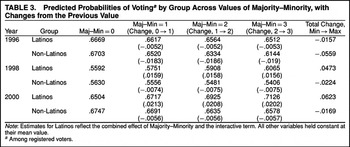
In addition, the changes estimated by the models in Table 2 make it clear that this is genuinely an additive process—living in three majority-Latino districts does have a much larger effect than living in just one. In Table 3, we report both the predicted probability of a registered voter turning out at each value of Majority–Minority (0 to 3), holding all other variables constant at their means, and the change from the previous value (Long 1997). For non-Latinos, the effect is estimated by varying the value of Majority–Minority, while for Latinos, it is the summed effect of this variable and the interaction term. It is readily apparent that a unit change in the variables capturing residence in majority–minority districts has a much smaller effect than a change from zero to three, and the relative size of the effect is constant across the range of values. Moreover, in all three instances, Latinos go from being disadvantaged to advantaged, vis-à-vis non-Latinos, in propensity to turn out. We conclude that the effect of living in majority–minority districts, generally positive for Latinos and negative for non-Latinos, is greater among both as the frequency of that occurrence increases. Hypothesis 2 is sustained.
The results from individual elections are convincing. Residing in majority-Latino districts serves as a disincentive to turn out among non-Latinos but appears to have a generally more positive effect on Latinos. The effect grows when the citizen resides in multiple majority-Latino districts. While a 5.91% increase may not seem very large, 384,728 Latinos reside in three majority–minority constituencies, meaning that the net effect of this variable just on those Latinos produces 22,737 more voters at the polls (not including additional turnout among those living in two or one majority-Latino electoral districts) than if they lived in non-Hispanic districts.20
In results not presented, we replicated these estimations using the multielection indices Voted 96-00 and Voted 98-00 as the dependent variables. The results of the Poisson regressions on these pooled measures of participation were completely consistent with those from individual election years. While majority–minority districts did have a negative effect on the turnout of voters in general, for Latinos the net effect was positive in both instances. Moving from no majority-Latino constituencies to three decreased the average number of votes cast by non-Hispanic registrants by .068 for the three elections between 1996 and 2000 and by .026 in the 1998 and 2000 elections only. In contrast, the same difference resulted in a .116 increase in the average number of votes cast by Latino registrants for the entire period and .138 for the last two elections. All of the remaining results are consistent in magnitude and effect with the earlier specifications.
Estimating Effects from Different Offices
One remaining question is whether there are differences in the effects of each specific office. We have been treating these offices as additive by simply coding whether the registrant lives in zero, one, two, or three majority Latino constituencies. If, however, the salience, visibility, or accessibility of one office has a greater impact on Latino voter efficacy, it could be exerting a greater effect on turnout than the others.
To estimate these effects separately, we replace the count variable Majority–Minority with an office-specific variable (MM-Assembly, MM-Senate, MM-Congress) coded one if the district for that office in which the citizen resides is majority-Latino. The interactive term for Latinos is similarly replaced with office-specific interactions.
To eliminate any idiosyncratic effects from elections, we indexed each citizen's record of participation in all of the elections under study. The dependent variable, then, is a count of the frequency with which the registrant signed in for a general election. We include only registrants who were registered for all three elections, so as not to make assumptions about the turnout of individuals who may have left the jurisdiction and registered elsewhere. Since the dependent variable is not continuous but takes on more than two discrete values, we employ Poisson regression, the appropriate functional form for event-count data neither over- nor underdispersed.21
In results not presented here, the same estimations on the other index, Voted 98-00, and on each election year separately yield results consistent with earlier findings and those presented here.
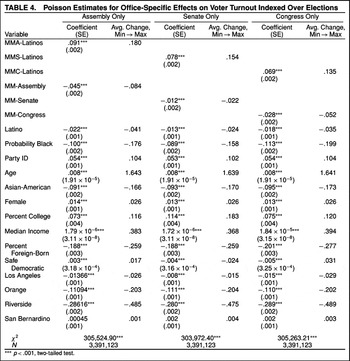
The results are presented in
Table 4, with the estimates accompanied by average changes in expected values.
22 Changes in expected values were calculated using Clarify (King, Tomz, and Wittenberg 2000; Tomz, Wittenberg, and King 2001).
In terms of magnitude, direction, and significance, the results are highly consistent for all variables across the three specifications. Turning specifically to the variables of interest, being in a majority-Latino district is again uniformly negatively associated with turnout among all voters, yet uniformly positively associated with turnout among Latino voters, even when we consider the net of the two effects. As indicated by the average changes in the expected values reported in columns 2, 4, and 6, the number of times non-Hispanic voters turn out declines by .084 for Assembly districts, .022 for Senate districts, and .052 for House districts. In contrast, among Latino voters, the mean frequency of turnout across the three elections increases by .096 for Assembly districts, .132 for Senate districts, and .083 for House districts. That is, it is clearly not the case that elections for a single office are driving the multioffice findings presented earlier.
The similarity in these results is not surprising given the significant overlap in values on these variables. Assembly districts are the smallest units of aggregation here and, logically, should have the largest percentage of Latinos living in majority-Latino districts, and this is in fact the case. Approximately 34% of Latinos in this universe live in Latino Assembly districts, 24% in Latino Senate districts, and 29.4% in Latino House districts. Among Latinos, MM-Assembly correlates with MM-Senate at r=.7826, and with MM-Congress at r=.8217.23
The inversion of Senate and Congress values is not surprising. As the state constitution specifies the size of the Senate at 40, Senate districts are actually larger in population than the state's 53 House seats (52 at the time of these data). Since smaller and more numerous districts tend to increase the share of minorities living in a majority–minority district, the closer association between the Assembly and the House is not surprising.
This overlap, of course, is precisely the origin of our contention that to estimate the effects of living in a majority–minority district, one really must consider the context of other offices that will almost certainly exacerbate this effect.
CONCLUSION
In this effort, we set out to determine whether living in majority–minority districts was mobilizing for the Latinos and whether these effects would be better estimated by considering the larger electoral context. Focusing exclusively on legislative elections and using turnout data at the individual level, we have demonstrated that both are the case. Having the opportunity to elect a candidate of your choosing is a consistently empowering circumstance. Latinos vote more when in a majority-Latino district, contrary to the expectations of those who expected or feared minority demobilization. In contrast, non-Hispanics living in Latino majority districts have less to cheer about and, apparently, less to drag them out to the polls on election day.
The larger electoral context was found to play an important role in establishing the incentives or disincentives to vote. Our findings are unambiguous in this regard as well. If living in one majority Latino district is good for turnout propensity, living in two or even three is better. And by devoting our attention to Latinos rather than African Americans, our findings fill a sizable lacuna in the literature on minority voting.
We need to highlight three potential caveats. First, focusing on southern California may limit the generalizability of these findings. Nevertheless, testing the effects of majority–minority districts requires a focus on regions containing significant numbers of such districts. Even in the largest concentration of Latino voters in the United States, only 36% of Latinos lived in even one majority-Latino district. The fairly broad distribution of voters across majority-Latino and majority-white districts, then, makes this environment well suited to our purposes.
Second, as we reported earlier, voter registration is a self-selection process and our results might be different if we estimated the effect on all citizens. Fortunately, this selection bias actually makes it harder to sustain our hypotheses. Since the incentives and disincentives for participation undoubtedly affect the willingness of Latinos and non-Hispanics to register, at least some of the effect of majority–minority districting is absorbed by the decision to register—yet our results are still as we expected.
Finally, we have little to say about the impact on African Americans since we are not able to identify black registrants and since there are only black influence districts, rather than majority African American, in this region. In order to test our hypothesis among African Americans, a data set from another region is required.
Majority–minority districting boosts Latino turnout, even as it increases Latino descriptive representation. The potential up-ballot advantages of this increase in participation are profound and suggest that Guinier's (1994) and others' concerns about the potentially detrimental effects of these instruments are in error.
Authors' names are presented alphabetically. Communications and questions should be directed to Gary Segura. We would like to thank Harry Pachon of the Tomás Rivera Policy Institute for use of the County Registrar data sets and Steve Voss of the University of Kentucky and Ricardo Ramirez of the University of Southern California for their helpful feedback. We also wish to thank participants in the political science research colloquia at the University of Iowa and the University of Wisconsin for their extensive comments. Responsibility for the analysis, interpretation, and remaining errors is solely that of the authors.






Comments
No Comments have been published for this article.