

INTRODUCTION
In December 2021 in Sialkot, Pakistan, a Sri Lankan factory manager was tortured and killed by a mob of angry employees after rumors spread that he had torn down religious posters at the workplace. In April 2017 in Haryana, India, a Muslim dairy farmer was accosted by a mob after rumors spread of him illegally transporting cows across state borders; the mob forced the farmer to praise Hindu gods while brutally beating him to death. The commonalities across these incidents are noteworthy: in both cases, mobs targeted individuals over purported crimes seen as violating majoritarian norms (Jaffrey Reference Jaffrey2021). And, in both cases, the mobs’ actions were prompted by unsubstantiated rumors (Samuels Reference Samuels2020).
Similar acts of collective vigilantism against ethnic or religious minorities are common around the world, from Indonesia to the United States. We focus on South Asia, where vigilantism can sometimes spill over into group violence and large-scale riots (Brass Reference Brass1997; Wilkinson Reference Wilkinson2006) or amplify anti-minority polarization (Jaffrelot Reference Jaffrelot2021). Despite the horrific nature of these acts, many Indians and Pakistanis view mob violence as justified (Banaji and Bhat Reference Banaji and Bhat2019). Such support for vigilantism can have critical consequences: public opinion can influence how governments choose to respond to vigilante behavior, either by holding perpetrators of violence to account or punishing victims themselves.
In recent years, a number of studies have examined the drivers of support for vigilantism in diverse contexts (Cohen, Jung, and Weintraub Reference Cohen, Jung and Weintraub2022; García-Ponce, Young, and Zeitzoff Reference García-Ponce, Young and Zeitzoff2023; Jung and Cohen Reference Jung and Cohen2020; Smith Reference Smith2019; Wilke Reference Wilke2023), but fewer works have assessed the type of identity-based vigilantism more commonly seen in South Asia. In parallel, academic and policy scholarship has increasingly suggested that false or misleading information can incite violence (Banaji and Bhat Reference Banaji and Bhat2019; Brashier and Schacter Reference Brashier and Schacter2020). Yet empirical research investigating the link between misinformation and support for vigilantism is surprisingly scarce. Scholarship to date has neither identified whether exposure to unsubstantiated rumors and misinformation, nor whether counter-messaging correcting them, can affect citizens’ response. In this article, we focus on the latter and ask: can reducing the credibility of rumors via corrections decrease support for vigilante violence?
We answer this question through simultaneous, jointly registered, and in-person experiments in Punjab, Pakistan, and Uttar Pradesh, India, regions where media reports have linked misinformation to brutal public lynchings of citizens. Through an audio methodology that prioritizes privacy and sensitivity in volatile settings, we investigate whether correcting misinformation, thereby reducing the credibility of rumors, adversely affects support for vigilante violence. Respondents listen through private headphones to a series of professionally produced newscasts describing acts of vigilantism modeled on real incidents. In our main treatment condition, we provide corrective information stating that investigative reporting found the rumor to be baseless. We also manipulate two additional variables: state behavior and elite rhetoric in response to vigilantism. We measure the effect of our treatments on three interrelated dependent variables: personal support for vigilante violence, perceived support for vigilantism among the respondent’s community, and willingness to punish the vigilante mob.
Using a sample of 1,500 respondents in Pakistan and 1,800 in India (overall
 $ n=3,300 $
), our study yields three key findings. First, while their effectiveness varies across type of rumor, corrections on average significantly reduce support for vigilantism: in India, they shift public opinion by 8%–10% and in Pakistan, by 17%–19%. We further demonstrate that changing beliefs in underlying misinformation may drive these downstream effects on support for vigilantism: that is, disseminating information about journalistic investigations suggesting that the initial rumor is baseless not only results in decreased belief in the accuracy of the rumor but also reduces preferences for violent mob justice.
Second, and contrary to common expectations about motivated reasoning, reducing the credibility of rumors through corrections is effective regardless of respondents’ prior attitudes toward out-groups. In both India and Pakistan, respondents do not refrain from self-reporting out-group prejudice. Despite this, trust in the out-group does not condition the efficacy of our treatment. Public support for vigilante violence appears malleable to corrective information that counters rumors, marking a divergence from previous findings on the potency of motivated reasoning to limit the effectiveness of misinformation countermeasures (Flynn, Nyhan, and Reifler Reference Flynn, Nyhan and Reifler2017).
Third, we find that the behavior of the state—a factor often highlighted as a key driver of attitudes toward vigilantism—does not systematically shape support for vigilante violence. In our experiment, neither Indian nor Pakistani respondents decreased their support for vigilante acts when given information that police authorities investigated victims or arrested vigilantes. In addition, only Pakistani respondents were affected by elite messaging to abide by the rule of law. While these factors may have mattered in a different informational environment (Clayton et al. Reference Clayton, Horiuchi, Kaufman, King and Komisarchik2023), we find that once the rumors were corrected, they ceased to matter in India.
Our results contribute to ongoing debates about popular support for collective violence, the role of misleading or false information in these processes, and their ramifications for the functioning of democracy. They demonstrate that corrections not only change belief in misinformation but can also reduce support for violence which emanates from these rumors. This is a consequential finding as much of the literature on misinformation showing that corrections change beliefs demonstrates that they do not influence other downstream attitudes (Porter, Velez, and Wood Reference Porter, Velez and Wood2023; Swire-Thompson et al. Reference Swire-Thompson, Ecker, Lewandowsky and Berinsky2020). Consequently, our results highlight new theoretical pathways to information processing that support belief change even in highly polarized settings. However, corrections are not successful at altering support for vigilantism for the most salient type of crime in this context—beef smuggling rumors in India—pointing to the persistence of certain beliefs and to the limited efficacy of corrections in shifting attitudes more overtly linked to partisanship.
Our findings also advance a rich literature on ethnic conflict and riots in South Asia (and beyond) by demonstrating the central role that credible information can play both in contentious group behavior and the strength of democratic institutions more broadly. Because vigilante violence ostensibly takes place in order to maintain law and order—and may even support a state’s ethnocentric policy—it is worthy of study as a distinct manifestation of collective violence. Increasingly, scholars and policymakers have raised concerns about how “pattern(s) of false and misleading information adversely affects democratic practice” (Sircar Reference Sircar2021); this article contributes to this growing conversation by examining the interplay between the credibility of information and support for violence.
THEORETICAL EXPECTATIONS
What Drives Support for Vigilantism?
Scholarship in recent years has grappled with central questions about the circumstances facilitating vigilantism (Cohen, Jung, and Weintraub Reference Cohen, Jung and Weintraub2022; Dow et al. Reference Dow, Levy, Romero and Tellez2024; Moncada Reference Moncada2017; Smith Reference Smith2019), defined by Bateson (Reference Bateson2021) as “extralegal prevention, investigation, or punishment of offenses.” Some scholars have privileged the role of the state, including perceptions of state capacity and legitimacy (Jung and Cohen Reference Jung and Cohen2020), trust in law enforcement (Zizumbo-Colunga Reference Zizumbo-Colunga2017), or right-wing populist politics (Jaffrey Reference Jaffrey2021) in facilitating vigilantism and its support. Others have found that characteristics of the act of violence itself, for example, the nature of the crime (Dow et al. Reference Dow, Levy, Romero and Tellez2024) or the identity of the violent actor (Wilke Reference Wilke2023), matter in determining support for vigilantism. Another line of work highlights individual-level psychological predictors, such as prior exposure to violence or emotions like anger (García-Ponce, Young, and Zeitzoff Reference García-Ponce, Young and Zeitzoff2023). Still other studies have pointed to economic factors, such as local economic inequality (Phillips Reference Phillips2017) or economic cleavages (Moncada Reference Moncada2022) in either support for or shaping presence of vigilante violence.
Regardless of the explanation, this research has tended to group together identity-based forms of vigilantism—which target members of social out-groups, whether ethnic, racial, sectarian, or religious—with vigilantism which addresses petty or other forms of crime and may not necessarily be targeted at specific communities (see Bjørgo and Mareš Reference Bjørgo and Mareš2019 for one recent exception). While these two forms of extralegal violence have much in common, violence which takes place explicitly on the basis of religious sensibilities, notions of ethnic or racial superiority, or in relation to majoritarian norms is likely to be distinct in both in its causes and consequences.
In this study, we focus on support for this subset of vigilantism which we call identity-based vigilantism: extralegal violence that is collective in nature and targets individuals on the basis of real or perceived transgressions of majoritarian norms.Footnote 1 When it comes to identity-based vigilantism specifically, the theoretical boundaries between ethnic riots, pogroms, lynching, mob violence, hate crimes, and vigilantism remain blurry (Varshney Reference Varshney2022). We distinguish identity-based vigilantism from other forms of collective violence by suggesting that it is targeted toward individuals perceived as committing offenses or violating laws. However, like riots, identity-based vigilantism may sometimes hold an entire community responsible for the acts of one member of that community.Footnote 2
Our focus in this study is support for vigilantism linked to misinformation. Support for vigilantism is a consequential outcome: it may correlate with participation in violence, but it can also influence how governments respond to vigilantism—either by holding perpetrators of violence to account or punishing victims. Where governments rely on the support of the majority, political leaders may feel compelled to stay silent rather than condemn vigilante behavior, or even support it, further legitimizing citizens’ attitudes.Footnote 3
The Role of False and Misleading Information
While the literature on vigilantism has so far largely overlooked misinformation, journalistic and policy accounts increasingly assert that misinformation—claims that contradict or distort common understandings of verifiable facts (Guess and Lyons Reference Guess and Lyons2020)—has the capacity to incite violence (Arun Reference Arun2019; Banaji and Bhat Reference Banaji and Bhat2019).
Rumors—“statements that lack specific standards of evidence” (Berinsky Reference Berinsky2017, 242)—constitute a subcategory of misinformation. As has long been documented in South Asia (Brass Reference Brass1997), rumors arise in environments of information ambiguity or social uncertainty (Huang Reference Huang2017), and “acquire their power through widespread social transmission” (Berinsky Reference Berinsky2017, 243). While rumors may sometimes contain true information and in other cases remain unverifiable, we contend that they often contain at least one falsity that can be corrected. We accordingly argue that rumors in our study are verifiable and thereby correctable through the provision of credible information.Footnote 4
Whether rumors or other forms of false information affect support for vigilante acts remains an open question. An early literature on collective violence in India highlighted the potentially significant role of rumors in assisting ethnic entrepreneurs in mobilizing support for riots (Brass Reference Brass2003). However, the causal relationship between belief in rumors and violence remains untested in these accounts. On the one hand, malicious rumors targeted at out-groups may serve to demonize minorities and make more salient existing societal cleavages. Since anger or hatred often fuel support for violence (Halperin et al. Reference Halperin, Russell, Dweck and Gross2011), belief in rumors may then directly increase public support for vigilantism. Alternatively, if rumors serve as a pretext to engaging in violence by mobilizing those already predisposed, the veracity of misinformation may be tangential to support for vigilantism (Arun Reference Arun2019). If rumors have the capacity to facilitate support for violence, then manipulating their credibility should adversely affect support for vigilantism. A large literature drawing on several different contexts has explored the effects of decreasing the credibility of misinformation via various methods. These solutions include providing tips to spot misinformation (Guess et al. Reference Guess, Lerner, Lyons, Montgomery, Nyhan, Reifler and Sircar2020), fact-checks or warning tags (Bowles, Larreguy, and Liu Reference Bowles, Larreguy and Liu2020; Clayton et al. Reference Clayton, Blair, Busam, Forstner, Glance, Green and Kawata2020; Porter and Wood Reference Porter and Wood2021), providing social corrections (Bode and Vraga Reference Bode and Vraga2018), and even digital literacy trainings (Ali and Qazi Reference Ali and Qazi2023; Badrinathan Reference Badrinathan2021). More recently, scholarship has examined the downstream effects of misinformation on vaccine behavior (Porter, Velez, and Wood Reference Porter, Velez and Wood2023) and its link with allied concepts like affective polarization (Jenke Reference Jenke2023). While evidence of their effect on downstream outcomes is sparse, the majority of experimental studies on misinformation suggest that corrective interventions lead to small but beneficial effects on belief change.
Because rumors are distinct from other forms of misinformation—they tend to “materizalize suddenly” (Berinsky Reference Berinsky2017, 243)—their correction necessitates distinct strategies. Widespread expert consensus on whether a piece of information is true or false may not be readily available for rumors because of their time-dependent nature (Nyhan and Reifler Reference Nyhan and Reifler2010). In addition, the informational environment aiding the spread of rumors becomes crucial. Our studies are conducted in contexts of low Internet penetration, where primary news sources are still radio and television as opposed to social media (Badrinathan et al. Reference Badrinathan, Chatterjee, Kapur and Sircar2021), and where information sharing is largely dependent on offline routes (Gadjanova, Lynch, and Saibu Reference Gadjanova, Lynch and Saibu2022). These challenges underscore the need for solutions to misinformation that focus specifically on rumors. In response, we designed an informational intervention taking into account these considerations: we debunk rumors with longer messages than typical one-line fact-checks, rely on contextual local experts, and highlight TV/radio as the key method of transmission of corrections.
We hypothesize that providing such corrective information aimed at reducing the credibility of a rumor will decrease support for vigilante acts of violence that are linked to that rumor. Accordingly our main hypothesis is:
Hypothesis 1: Correcting rumors will decrease support for vigilantism relative to rumors which remain uncorrected.
In line with this argument, if rumors do affect support for vigilantism, they likely do so by promoting misperceptions about the (minority) group allegedly involved in the crime. Correcting the rumor that ostensibly led to the vigilante act should thus reduce belief in that rumor. Accordingly, we hypothesize:
Hypothesis 2: Correcting specific rumors will lead to lower perceived accuracy of those rumors relative to rumors which remain uncorrected.
Prior attitudes toward out-groups could also affect how citizens engage with rumors. We tend to seek out information that reinforces our preferences and view pro-attitudinal information as more convincing than counter-attitudinal information (Taber and Lodge Reference Taber and Lodge2006). In this regard, a primary factor influencing the efficacy of corrections is motivated reasoning (Thorson Reference Thorson2016). In India and Pakistan, vigilantism may emerge as an appealing extra-legal strategy to reconstitute notions of right and wrong in society, eventually paving the way for movements that align with majoritarian politics. Accordingly, we hypothesize:
Hypothesis 3: Corrections will reduce support for vigilantism to a greater extent for those with more trust in the out-group (relative to less trust).Footnote 5
The Role of the State and Political Elites
Beyond the perceived credibility of rumors, beliefs about state capacity and state legitimacy may affect how respondents react to vigilantism. Some work finds that support for lynching is more likely where neither the state nor its competitors have monopoly over authority (Jung and Cohen Reference Jung and Cohen2020). Others argue that citizens have a more “ambiguous” relationship to the state, with Smith (Reference Smith2019) suggesting that vigilantism is part of the process of democratic state formation rather than a mere substitute for the state where it cannot provide order. Meanwhile Bateson (Reference Bateson2021) argues that the state often changes its own behaviors in response to vigilantism, either in legalizing previously illegal behaviors or intensifying state punishment to preempt vigilantism. In this way, the perceived ideological leanings of government actors may affect support for vigilantism. Pro-majoritarian governments may embolden vigilantes to respond to perceived offenses with violence; this may lead to a reduced fear of sanction by the state (Jaffrey Reference Jaffrey2021).
Existing measures and conceptualizations of state capacity sometimes conflate the ability of state institutions to act as needed with the willingness of these institutions to do so. We thus define state positionality, the position that the state takes in response to vigilantism by state-aligned or majoritarian groups, which in turn affects the state’s willingness to punish these groups. We operationalize state positionality to mean actions taken by state police and conceive of it in two broad but distinct ways: (1) state desire to investigate the individual(s) accused of alleged criminal acts (victims of vigilantism) and (2) state willingness to prosecute the mob committing vigilante violence.
Vigilantes may believe that the state will refrain from prosecuting alleged perpetrators and hence feel compelled to act in the state’s place upon receiving (mis)information about these crimes. For example, politicians may choose to deploy state institutions, such as the police, only when it is politically beneficial for them (Wilkinson Reference Wilkinson2006). Even with high state capacity, state institutions are often biased in how they react to crime (Knox, Lowe, and Mummolo Reference Knox, Lowe and Mummolo2020). Alternatively, state positionality may manifest as state institutions failing to hold vigilantes accountable for taking the law into their own hand. In these cases, individuals may feel emboldened to act on receiving (mis)information because they do not anticipate being punished for engaging in vigilantism. Vigilantes and police actors may operate as complements to one another, taking on distinct security provision roles (Tapscott Reference Tapscott2023).
Accordingly we hypothesize:
Hypothesis 4: Receiving information that the state will prosecute vigilantes will reduce support for vigilantism relative to a no-information condition.
Hypothesis 5: Receiving information that the state will investigate the alleged crime will reduce support for vigilantism relative to a no-information condition.
Related but distinct from state positionality is elite positionality. Vigilantism often derives from signaling by political elites: across various contexts, political leaders may directly instigate violence, may choose to condemn violent acts, or may choose to remain silent in the face of vigilante violence. By elite positionality we refer to the messaging or rhetoric of politicians and political actors themselves. Whether or not elite condemnation of vigilante acts affects support for vigilante behavior is an open empirical question. We hypothesize:
Hypothesis 6: Statements by political elites that citizens should not take law and order into their own hands will reduce support for vigilantism relative to no elite statements.
VIGILANTISM IN INDIA AND PAKISTAN
In recent years, the neighboring countries of India and Pakistan have seen numerous examples of vigilante violence. In Hindu-majority India, this has largely manifested as violence against the Muslim minority, who make up about 14% of the country’s population, with the incidence of violence crimes against Muslims accelerating substantially over the decade starting in 2009 (Miliff and Read Reference Miliff and Read2023). ACLED data demonstrate that recent lynchings are concentrated in the northern state of Uttar Pradesh, our study site in India.Footnote 6 Muslims have been attacked for their alleged involvement in cow slaughter as well as the selling, transportation, or possession of cattle or beef. Muslims have also been targeted for engaging in “love Jihad,” a conspiracy theory alleging that Muslim men are seducing Hindu women in an effort to convert them to Islam (Sinha, Shaikh, and Sidharth Reference Sinha, Shaikh and Sidharth2019).
Key to understanding anti-Muslim vigilante violence in India is the rise to power of the Hindu nationalist Bharatiya Janata Party or BJP (Jaffrelot Reference Jaffrelot2021). While Hindu–Muslim tensions and violence are not new in India (Brass Reference Brass2003), policing majoritarian norms has become a priority for the party, with BJP politicians often either expressing support for, or failing to condemn, vigilante mobs. According to Human Rights Watch reports, police frequently stall the prosecutions of participants in vigilante acts, while several BJP politicians publicly justify the attacks.
In Muslim-majority Pakistan, meanwhile, vigilante violence has tended to target individuals accused of blasphemy: allegations ranging from burning the Islamic holy book, the Quran, to posting blasphemous content online and critiquing the tenets of Islam. Human rights reports suggest that such blasphemy allegations most often target minority groups in Pakistan (Amnesty 2016). Members of the minority Shia sect, the marginalized Ahmadi community, as well as non-Muslims such as Hindus and Christians, have therefore faced the brunt of such mob violence. In one incident that grabbed international attention, a Christian couple was killed by a mob for allegedly desecrating the Quran in a brick kiln (Hashim Reference Hashim2015). In another, churches and homes in a Christian community were burned down in Jaranwala after two Christian members of that community were accused of desecrating the Quran. It is estimated that about 75% of blasphemy cases originate from Punjab province, our study site in Pakistan.
Vigilantism in response to such purported crimes appears to have gained in strength and popular support over the past decade in Pakistan as well. In our data, for example, 63% of the sample either somewhat or strongly support the Tehreek-e-Labbaik Pakistan, an Islamist movement calling for violence against anyone perceived as engaging in blasphemy. Public support for vigilantism has accordingly made it difficult for the government and political actors to take sustained action against its perpetrators.
In both India and Pakistan, the rise in use of social media, particularly WhatsApp, has served to amplify partisan agendas and rhetoric and provided fertile grounds for the spread of falsehoods (Chauchard and Garimella Reference Chauchard and Garimella2022; Siddiqui Reference Siddiqui2020). In India, journalistic accounts report party volunteers and supporters forming WhatsApp groups to promote pro-party messages; often these groups morph into havens of misinformation that forefront incendiary anti-minority rumors culminating in lynchings (Ali Reference Ali2020). In Pakistan, similarly, a former chief justice in 2015 stated, “The majority of blasphemy cases are based on false accusations stemming from property issues or other personal or family vendettas rather than genuine instances of blasphemy, and they inevitably lead to mob violence against the entire community” (Gokal and Mirza Reference Gokal and Mirza2023).
The nexus between government disdain for minority rights, a rise in majoritarian vigilante violence, and the escalation of social media usage with its potential to spread rumors suggests a potential causal link between belief in misinformation and support for anti-minority vigilante violence in South Asia. It is this link we empirically investigate in our study.
RESEARCH DESIGN
We fielded simultaneous, in-person household surveys in India and Pakistan from September to November 2022, the main component of which was a jointly preregistered experiment.Footnote 7 In Pakistan, we worked with the Institute of Development and Economic Alternatives (IDEAS) to field the study in Punjab province among 1,500 respondents. In India, we worked with the Policy and Development Advisory Group (PDAG) to field the study in western Uttar Pradesh (UP) among 1,800 respondents.Footnote 8 We limited the sample in India to only Hindu respondents because the victims of vigilantism in this context are disproportionately Muslim. In Pakistan, while we did not exclude any religious or sectarian groups, the large majority of the sample belonged to the majority Sunni sect of Islam (only about 7% identified as Shia).Footnote 9
Experimental Design
Our survey first measured a number of relevant pretreatment covariates including attitudes toward minority groups, perceptions of state capacity, and media usage. We then provided respondents with three vignette scenarios, each describing a distinct vigilante act. Each vignette followed a similar structure: first, a rumor about an alleged crime committed by an individual circulates on social media; next, a vigilante mob perpetrates violence against that individual after hearing about the rumor. In India, our vignettes detail vigilante acts in response to three alleged crimes: forced interfaith marriage (or “love jihad”), cow meat transportation, and a conspiracy that Muslims were deliberately spreading COVID-19. In Pakistan, the alleged crimes were sharing blasphemous speech online, burning the Quran, and tearing down religious posters.Footnote 10
Vignettes were delivered to respondents via audio. The audio clips were brief and produced in the style of a news presenter, designed to resemble a short radio or TV message that citizens might come across in real life. To play these audios, we provided respondents with private headphones. We relied on this technique to reduce enumerator variance in reading out potentially sensitive scenarios, to maintain respondent privacy (as personal headphones meant family members or inquisitive onlookers could not hear the treatment), and to inject realism into our study.Footnote 11 While the headphones were designed to increase respondent attention, we note that we surveyed respondents face-to-face in their homes. Given the density of neighborhoods and houses in South Asia, it is likely that despite the private headphones respondents were in a potentially distracting environment, mimicking the real world. Recent research in this context demonstrates that the presence of non-respondent others (family members, neighbors) during face-to-face interviews is common (Malik and Siddiqui Reference Malik and Siddiqui2024). As respondents heard this audio, they were also shown a social media headline illustrating the incident (see Appendix B of the Supplementary Material for details).Footnote 12
Each respondent was exposed to all three vignette scenarios successively, presented in random order. Each vignette contained a number of randomly varied attributes that we hypothesized might affect support for vigilantism. These included varying credibility of the rumor via corrections (our main manipulation of interest), how state police reacted to the vigilantism, and whether high-level political elites made public statements condemning the violence. Figure 1 outlines the flow of the experiment and the attributes varied in each vignette. Each vignette started out by describing an act of vigilante violence. After describing the incident, we next provided information based on our different attributes. Below, we describe each attribute and its corresponding levels.
Summary of Experimental Design
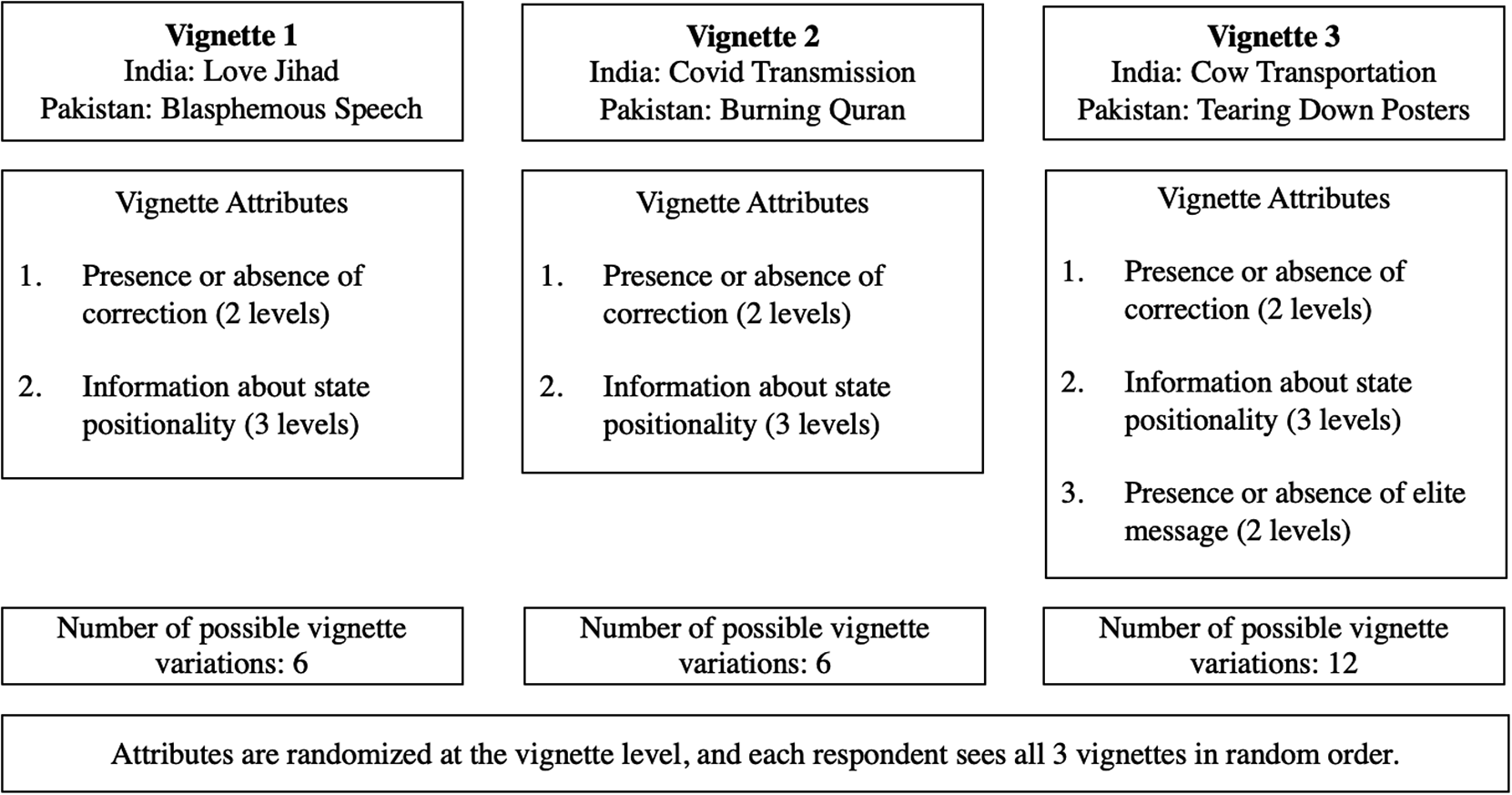
Attribute 1: Correction
The presence or absence of corrective information designed to reduce the credibility of rumors in each audio is our main attribute of interest. The correction treatment described investigations that journalists belonging to several news channels had conducted about the alleged crime and which led to their conclusion that the rumor was baseless. This attribute was varied in every vignette and had two levels:
-
• Presence of correction (treatment): After describing the act of vigilante violence and mentioning the rumor that had preceded it (in the example that follows, that a Muslim man had abducted a Hindu woman), the newscaster followed with: “Subsequent to this incident, reporters from several main Hindi news channels—such as Aaj Tak, Zee News, and NDTV—spent a month thoroughly investigating the story. They interviewed dozens of local stakeholders with knowledge of the case—such as the police, eyewitnesses, neighbors, netas (local leaders). Their investigations found that the initial rumor was baseless—it was a love marriage, and the Muslim man had not kidnapped the Hindu woman in order to convert her to Islam. The mob violence took place because of false information.”
-
• Absence of correction (control): No information provided about corrections.
This correction treatment was deliberately designed to be a relatively strong treatment, as it suggested that several TV news channels had investigated and debunked the rumor. In contrast with most studies that aim to correct misinformation through one-line fact-checks or single-source corrections, we provided a longer treatment with several sentences asserting the falsity of the information. We chose such a treatment for three reasons. First, in the absence of systematic, prior evidence suggesting that misinformation could affect public opinion on vigilantism in India and Pakistan—far from a foregone conclusion in contexts as highly polarized as these and where there is little research on misinformation—we wanted to learn whether any corrective prompt could move the needle. Second, we wanted to maximize power by avoiding source effects. Third, our choice to use a multi-source correction resembles the ground reality in this context. For example, professional fact-checkers in India often cite a variety of sources to develop convincing debunks.Footnote 13
Our choice to use TV news channels in the treatment reflects realities of the current media landscape in both countries. While misinformation is spread in large part on social media, in actuality only a small percentage of Indian and Pakistani citizens rely on social media for news relative to traditional media like television (Badrinathan et al. Reference Badrinathan, Chatterjee, Kapur and Sircar2021; Mir and Siddiqui Reference Mir and Siddiqui2022). To form credible corrections, we take inspiration from examples of news stations conducting investigations to debunk underlying rumors. For example, NDTV (New Delhi TV) reporters used hidden cameras to investigate two lynchings in 2018 (Shukla Reference Shukla2018). International news outlets, such as the BBC, have also conducted independent fact-checking investigations of lynchings in both Pakistan (Hashim Reference Hashim2015) and India (Shireen Reference Shireen2021).Footnote 14
Attribute 2: Information about State Positionality
Next, our state positionality attribute varied information about how police reacted to the vigilante act. This attribute was varied in every vignette and had three levels:
-
• Police investigates crime/sides with vigilantes (treatment 1): The police is described as acting immediately to “investigate whether a crime had occurred.”
-
• Police prosecutes vigilantes/sides with mob (treatment 2): The police is described as acting to round up “the vigilante mob and arrest(ing) them for unlawfully taking justice into their own hands.”
-
• No information (control): No information provided about the police’s reaction to vigilantism.
Attribute 3: Elite Rhetoric
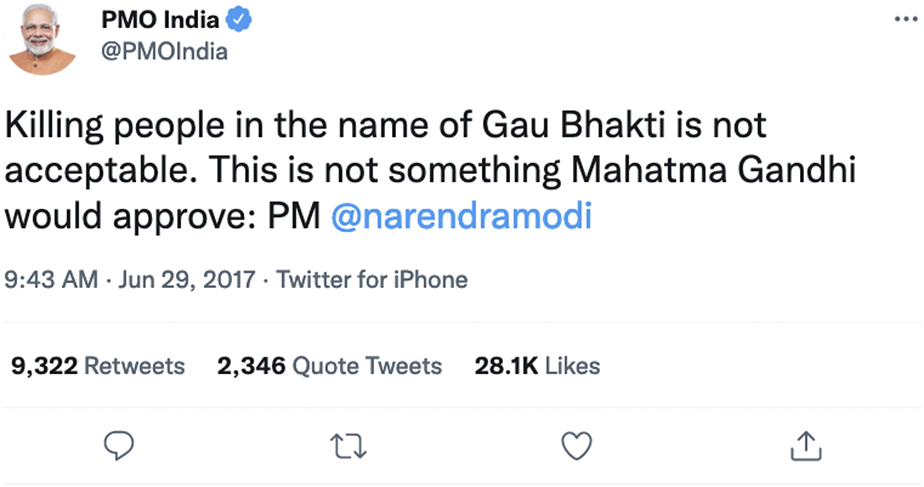
Finally, our elite rhetoric attribute varied the presence of a real elite message from a high-level politician condemning the crime. This attribute had two levels: the presence of an elite message (treatment) or no message (control). The elite message was a real tweet by a high-level politician (prime minister) asking citizens not to take the law into their own hands. For this attribute, the oral description of the tweet was accompanied by a visual of the original tweet. See Figure 2 for the tweet shown in India (Pakistan example is in Appendix B of the Supplementary Material).
Visual Component of the Elite Rhetoric Treatment (India)
Note: “Gau Bhakti” in this context roughly translates to “cow worship.”
As shown in Figure 1, this attribute was always tied to one specific vignette. In India, it was included with the Cow Transportation Vignette, and in Pakistan with the Tearing Down Posters vignette. We restricted this attribute to one vignette because the elite message we chose for the experiment in India was a real message from Indian prime minister, Narendra Modi, and pertained to the specific crime of illegal cow meat transportation. For purposes of comparability, in Pakistan, we used a real tweet by former prime minister Imran Khan. As it is relatively rare to have high-level elites express opinions on mob violence in our context, we deemed it unrealistic for this experimental manipulation to appear too often.
Outcome Measures
Our study included four key outcome measures, each of which was asked after every vignette/scenario. Thus, the respondents answered the battery of questions three times, each time in reference to a different incident.
Listed below are questions from the India survey:
-
1. Belief in the misinformation contained in the story, measured on a four-point belief accuracy scale. Example from the love jihad vignette: According to you, how accurate is the claim that the Muslim man in the story kidnapped the Hindu woman?
-
2. Support for vigilante action at the individual level, measured on a 10-point scale: How strongly do you support the actions of the group of men that attacked the neighborhood of the Muslim man?
-
3. Support for vigilante action at the group level, measured on a 10-point scale: Now think about people in your neighborhood. How strongly would they support the actions of the group of men that attacked the neighborhood of the Muslim man?Footnote 15
-
4. Support for punishment, measured on a four-point agree–disagree scale: In your opinion, to what extent do you agree that the mob who attacked the neighborhood of the Muslim man should be punished?
To test crucial heterogeneous effects by degree of pre-existing (in)tolerance and (dis)trust of minorities, we additionally measured pre-treatment attitudes toward out-groups with two survey items asking about out-group trust and comfort with having close friends from the out-group (item wording in Appendix B of the Supplementary Material).
Ethical Considerations
Given the sensitivity of the research topic, ethical considerations were paramount in the design of our study.Footnote 16 First, we refrained from asking about participation in vigilantism as an outcome given the complexity of collecting information about respondent’s direct involvement in (illegal, extra-judicial) violence. We decided instead to focus on support for violence, an important outcome in its own right.
Second, we worked closely with our country research teams to ensure the safety of enumerators. We opted for an audiovisual medium in part to prevent enumerators from having to read potentially sensitive vignettes directly to respondents. The headphones also ensured privacy, particularly important in contexts which often attract the presence of third parties during interviews (Chauchard Reference Chauchard2013; Malik and Siddiqui Reference Malik and Siddiqui2024). Third, in order to avoid further spreading misinformation, we made sure that the focus of the vignettes was on the acts that derived from the misinformation rather than on the misinformation itself, for which we provided minimal details.
Next, we read a detailed debrief to respondents which contained information not only about the vignettes, but also a reminder that misinformation in general can lead to acts of violence and that respondents must be particularly vigilant in assessing the veracity of information (see Appendix K of the Supplementary Material for the text of this debrief as well as more information on ethics). Finally, we carried out a number of pre-tests and a larger pilot prior to the implementation of the survey.
RESULTS AND ANALYSES
The following sections describe the main experimental effects before investigating the moderating effect of distrust in out-groups. Summary statistics of key variables for both countries are included in Appendix F of the Supplementary Material.
Out-Group Trust and Baseline Belief in Misinformation
We first provide descriptive analyses that highlight the extent of intolerance toward minority groups as well as belief in misinformation. Figure 3 demonstrates how trustworthy Hindus in India and Muslims in Pakistan in our sample perceive their in-group (the majority) and the out-group (the minority). In India, the salient out-group in this case is the Muslim minority; in Pakistan, we look at non-Muslims.
Trust toward the In-Group and Out-Group
Note: Majority/minority refers to Hindus/Muslims in India and Muslims/non-Muslims in Pakistan.
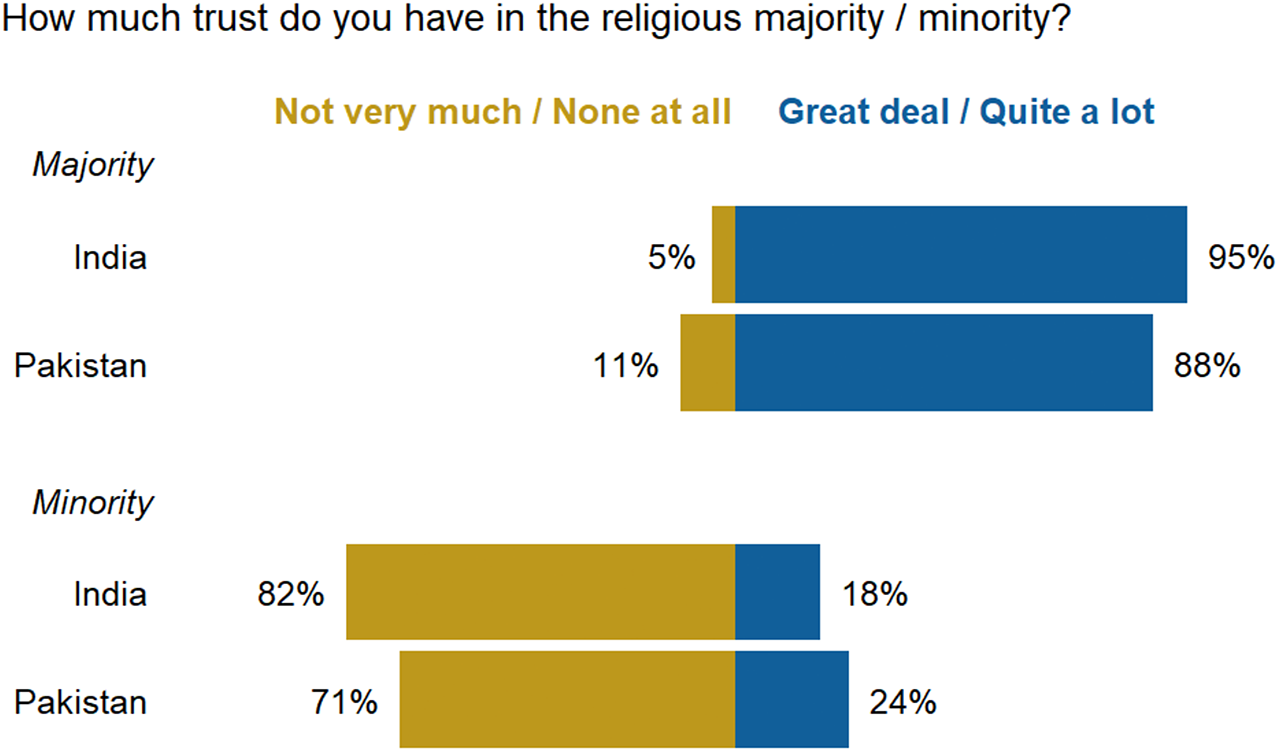
In both countries, we see that citizens trust their in-group to a much larger extent than the out-group. Further, in both countries, the proportion who say that they trust the minority is significantly smaller than the proportion that trusts other groups and institutions in society, such as the courts, the media, or the government.
While our samples in the two countries share similar attitudes of distrust toward out-groups, they vary significantly in baseline levels of belief in the rumors we asked about. We find that a majority of respondents in the control group in India believed each of the rumors but a much smaller percentage in Pakistan believed them (see Appendix D of the Supplementary Material). These differences could owe to different levels of baseline acceptance of misinformation, or different levels of education (the Indian sample was more rural with lower levels of education). It is also possible that the specific scenarios we selected in India generate a distinct response than those in Pakistan. What is key, as the next section demonstrates, is that correcting this misinformation was effective in both contexts.
Effect of Corrections
We estimate effects of the treatments on three measures of support for vigilantism. The causal quantity of interest is the average marginal component effect, and empirical models are specified relying on random treatment assignment to control for potential confounders. Since we are primarily concerned with the effect of correcting rumors on support for vigilantism, our key focus is the marginal effect of the correction attribute across all three vignettes in each country.
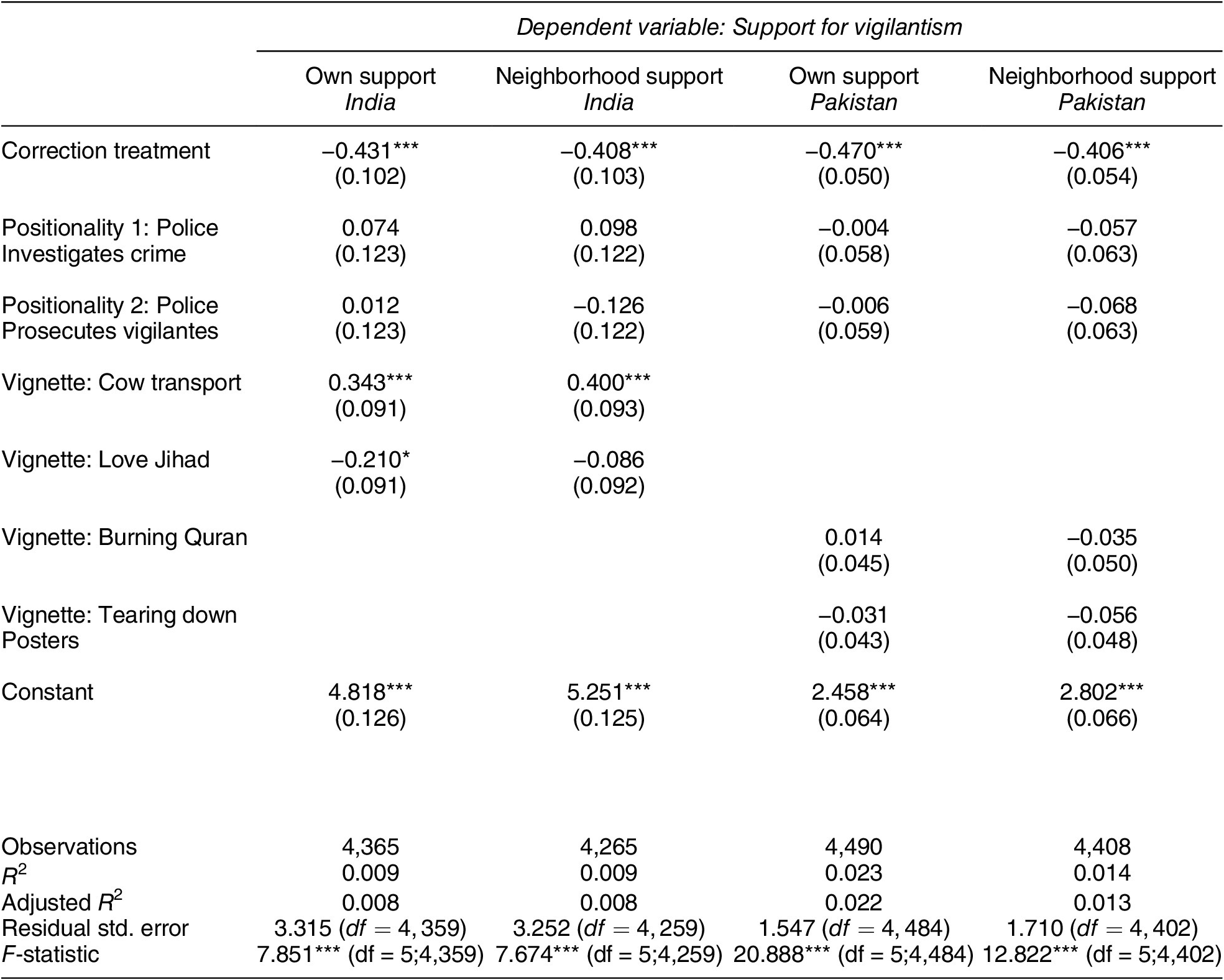
Results are shown in Table 1. The key dependent variable here is respondent support for the vigilantism measured on a 10-point scale, with higher values indicating greater support. We distinguish between respondents’ own support for vigilantism (columns 1 and 3) and respondents’ perceived support for the same act amongst those in their neighborhood (columns 2 and 4). Since each respondent answers outcome measures three times, once after each vignette, we include a vignette fixed effect and cluster standard errors at the respondent level (Hainmueller, Hopkins, and Yamamoto Reference Hainmueller, Hopkins and Yamamoto2014).
Effects of Treatments on Support for Vigilantism
Note: *
 $ p<0.05 $
, **
 $ p<0.01 $
, ***
 $ p<0.001 $
.
Table 1 demonstrates that correcting rumors significantly decreased respondents’ expressed support for vigilantism, both at the personal and perceived group levels, as well as in both countries. Our rumor correction treatment resulted in an 8%–10% decrease in support for vigilantism in India and 17%–19% in Pakistan on average. We additionally note stark differences in baseline support for vigilantism across models. In both India and Pakistan, respondents were less likely to admit that they personally support vigilantism but more likely to perceive that their neighbors did. The magnitude of this effect appears the largest in the case of Pakistan with perceived support for vigilantism in one’s neighborhood but remains statistically significant across all our models. In Pakistan, mean support for vigilantism nearly doubles when asked about neighbors relative to personal support. It is possible that these differences are due to respondents wanting to appear socially desirable, thereby expressing that their neighbors are more likely to support vigilantism than themselves. However, we cannot be sure that this is what accounts for the difference; indeed, it could be that respondents simply perceive others as more supportive of violence than they are themselves.
Despite these differences across dependent variables, the marginal effect of corrective information significantly decreases support for vigilantism across both outcome measures. These analyses thus demonstrate that the credibility of information matters: citizens are sympathetic to accounts that may go against their priors and are willing to update beliefs to match new information even in polarized contexts. These results hold when adding district-level fixed affects (Appendix G of the Supplementary Material), standardizing dependent variables (Appendix H of the Supplementary Material), subsetting the sample to Sunni only in Pakistan (Appendix E of the Supplementary Material), and adding enumerator fixed effects (Appendix L of the Supplementary Material).Footnote 17
Further, our results show that corrective treatments not only affected support for vigilantism resulting from the rumor but also successfully reduced misinformed beliefs in the rumors themselves. In Figure 4, we graph the mean level of belief for each vignette story in each country, comparing the treatment condition of rumor corrections to control.Footnote 18 Across the board, our treatment significantly increases the accuracy of respondent beliefs. This effect obtains even in cases where respondents had relatively more accurate beliefs to begin with (as in Pakistan).
Belief in Misinformation under Treatment versus Control
Note: Error bars show 95% confidence level.
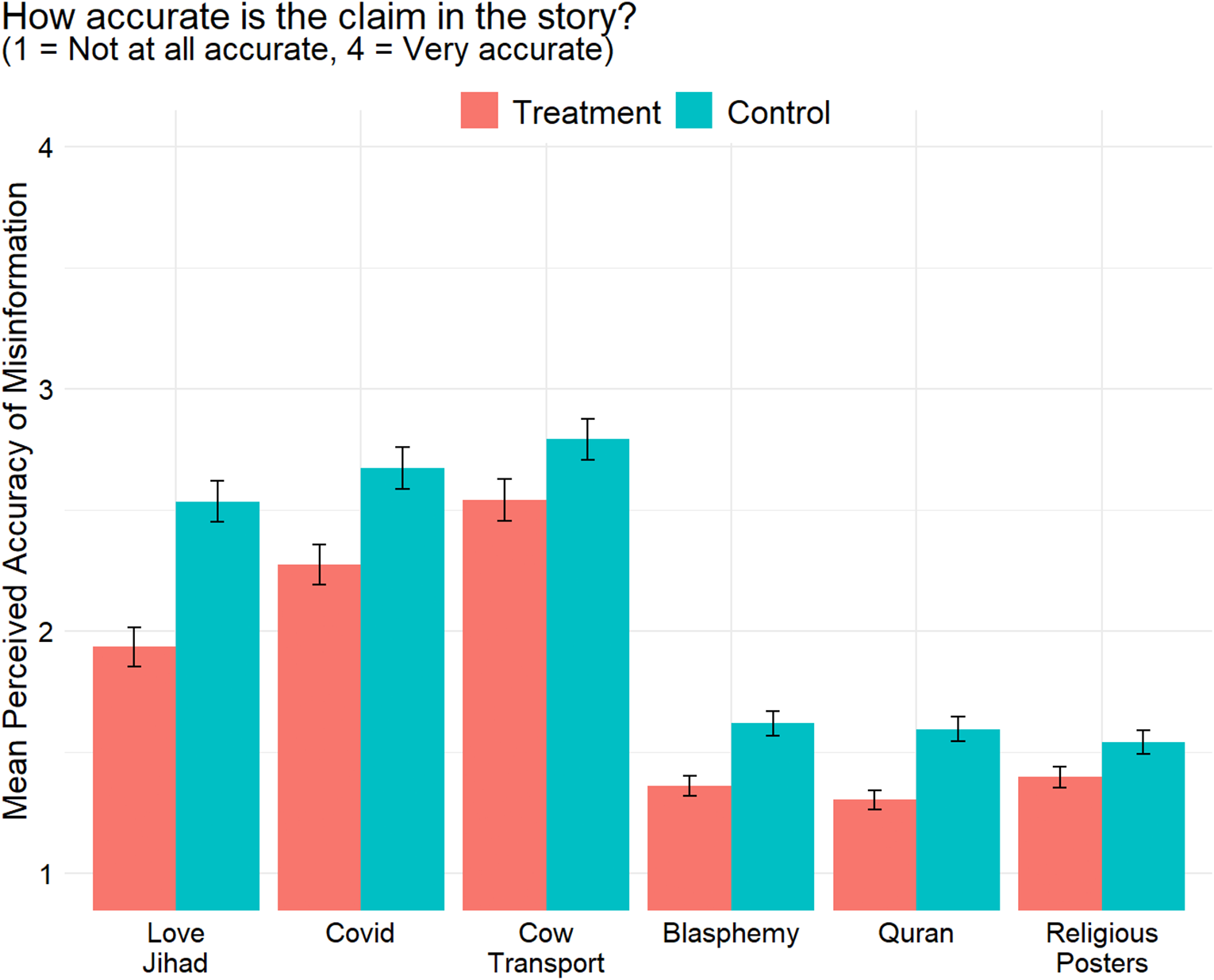
Next, we look at the role of different types of alleged crimes that spurred vigilante violence. Since each vignette described a different incident, we control for type of crime in our main model and find that in Pakistan there were no differences in support for vigilantism as a function of the crime. On the other hand, in India, respondents were significantly more likely to say that they support vigilante acts when it comes to cow crimes relative to other crimes. The salience of cow- and beef-related incidents in north India, as well as their ties to contemporary political rhetoric, may mean that these incidents occupy a more prominent place in the public’s mind. Further, for the cow vignette alone, we find that while our corrective treatment does reduce belief in misinformation (see Figure 4), this reduction does not lead to decreased support for vigilantism. Thus, there appears to be heterogeneity in the crime-specific effects of the correction. This is especially important because cow vigilantism is more commonly reported in the media than the other crimes tested, and consequently might be more salient. In sum, while misinformation corrections decrease support for vigilantism in Pakistan, they are effective in India only when the crime at hand is less salient or less explicitly linked to partisanship.
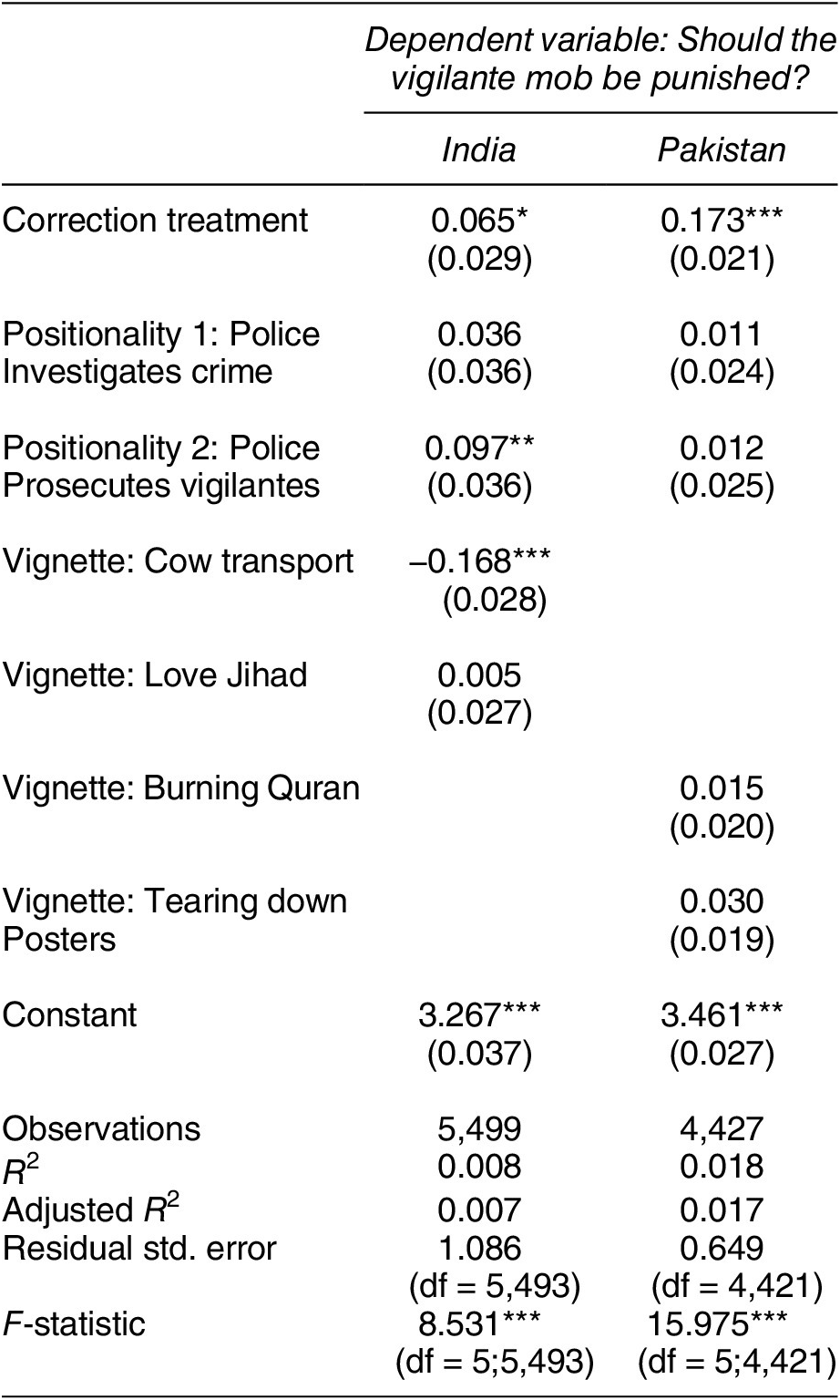
Finally, we look at our last dependent variable, support for punishing the vigilante mob. We measure this variable on a four-point scale with higher values denoting more support for punishment of the vigilante mob. Table 2 shows that reducing the credibility of rumors significantly increases citizens’ willingness to see the vigilante mob punished in both India and Pakistan. While effect sizes in this case are smaller in magnitude (though statistically significant), they are important insofar as respondent preferences for punishment are a stronger indicator of dissatisfaction with vigilantism relative to self-reported support for the mob. Further, as expressing a preference to punish the mob means punishing one’s own in-group—explicitly in India and implicitly in Pakistan—these effects are not inconsequential. Research from Western contexts on group behavior and favoritism consistently demonstrates that individuals prefer to take decisions to benefit their in-group (Turner, Brown, and Tajfel Reference Turner, Brown and Tajfel1979); hence, finding that we can move people to seek democratic outcomes not favorable for their in-group is worth underscoring.Footnote 19
Effect of Treatments on Support for Punishment of Vigilantes
Note: *
 $ p<0.05 $
, **
 $ p<0.01 $
, ***
 $ p<0.001 $
.
Effects of State Positionality and Elite Rhetoric
The findings in Tables 1 and 2 demonstrate that state positionality does not consistently move beliefs in this context. Neither informing respondents that the police investigated the alleged crime nor that the police prosecuted vigilantes changes support for vigilantism in Table 1. On the other hand, information that the police prosecuted the mob does affect support for punishing the mob, but only in India and not Pakistan (Table 2). While the relative inconsistency across outcomes and cases requires further investigation, these results suggest that information about rumor credibility is more persuasive than information about the state’s response. This conclusion departs from prior literature highlighting the role of state capacity in support for vigilantism, but echoes recent arguments suggesting state capacity may play a smaller role in South Asia (Miliff and Read Reference Miliff and Read2023).
Since these results may owe to the specific multifactorial informational environment of our design (Clayton et al. Reference Clayton, Horiuchi, Kaufman, King and Komisarchik2023), we test whether respondents would be equally unmoved by the reported behavior of the state in the absence of a correction (Appendix I of the Supplementary Material). On doing so, we find that respondents did not decrease their support for vigilantes when they were told that authorities had investigated the alleged crime. However, in the absence of a correction, Indian respondents support vigilantes to a lesser extent upon hearing that the police arrested the vigilantes. This implies that Indian respondents use both the state’s behavior toward vigilantes and the corrections of the rumor as heuristics.Footnote 20
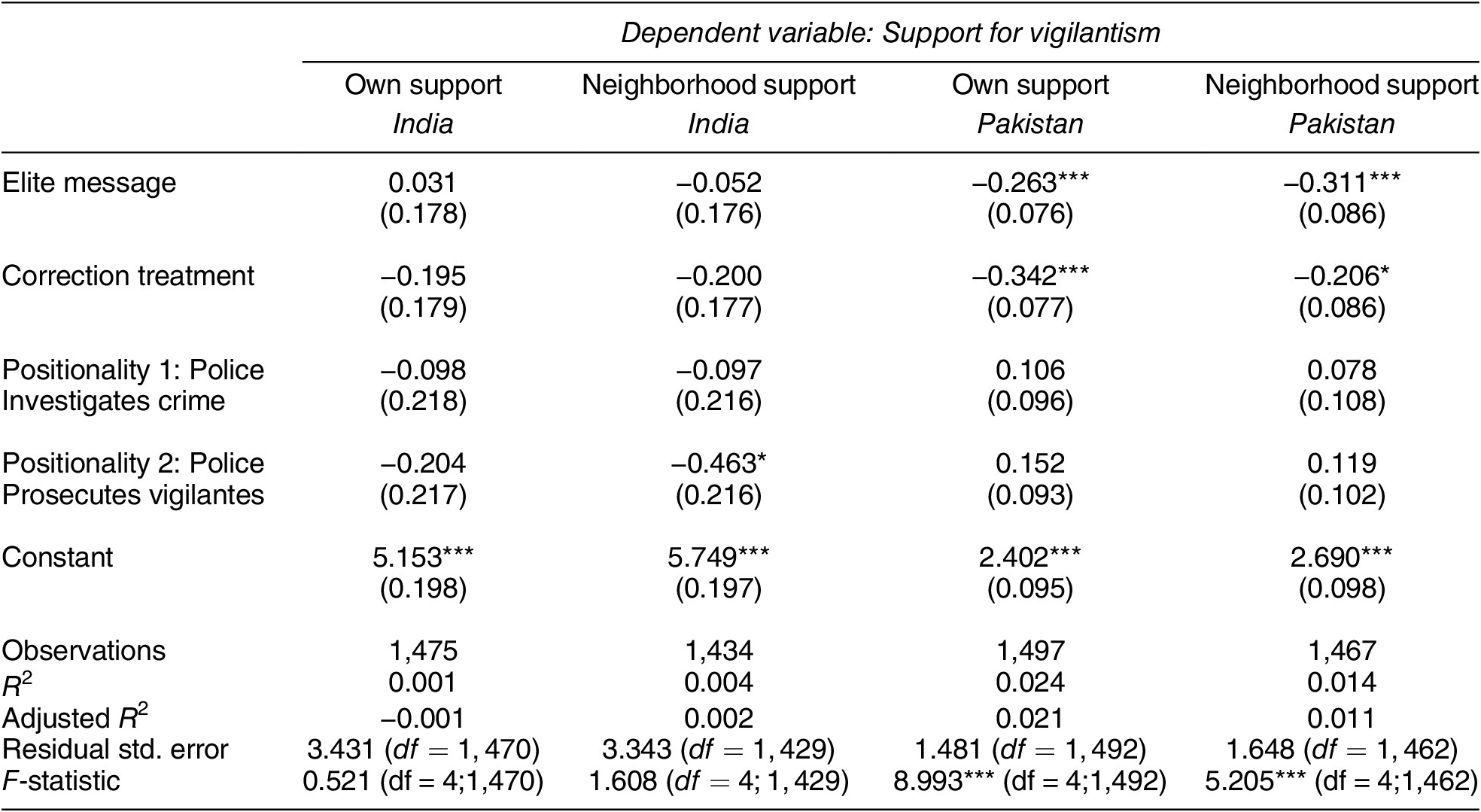
Finally, we test whether elite messaging can change opinions about extralegal violence. As noted, we manipulate this variable by showing respondents a real message from a prominent political elite—Prime Minister Narendra Modi in India and former Prime Minister Imran Khan in Pakistan—condemning vigilante violence relating to cow transport rumors in India and to the tearing down of religious posters in Pakistan. We present results in Table 3.Footnote 21
Effect of Elite Rhetoric on Support for Vigilantism
Note: *
 $ p<0.05 $
, **
 $ p<0.01 $
, ***
 $ p<0.001 $
.
Findings demonstrate that the elite message reduced support for vigilantism in Pakistan, but it did not move attitudes in India with regard to cow transportation rumors. This is a surprising finding: scholarship on public opinion has repeatedly demonstrated that elite rhetoric is influential in altering opinion and that elites have the capacity to set public discourse and agenda (Lenz Reference Lenz2013). While these null effects in India could be a function of the type of crime (since even the correction treatment did not move attitudes in India for the cow vigilante vignette), it is worth examining further why a clear message from a popular elite elicited no effect.
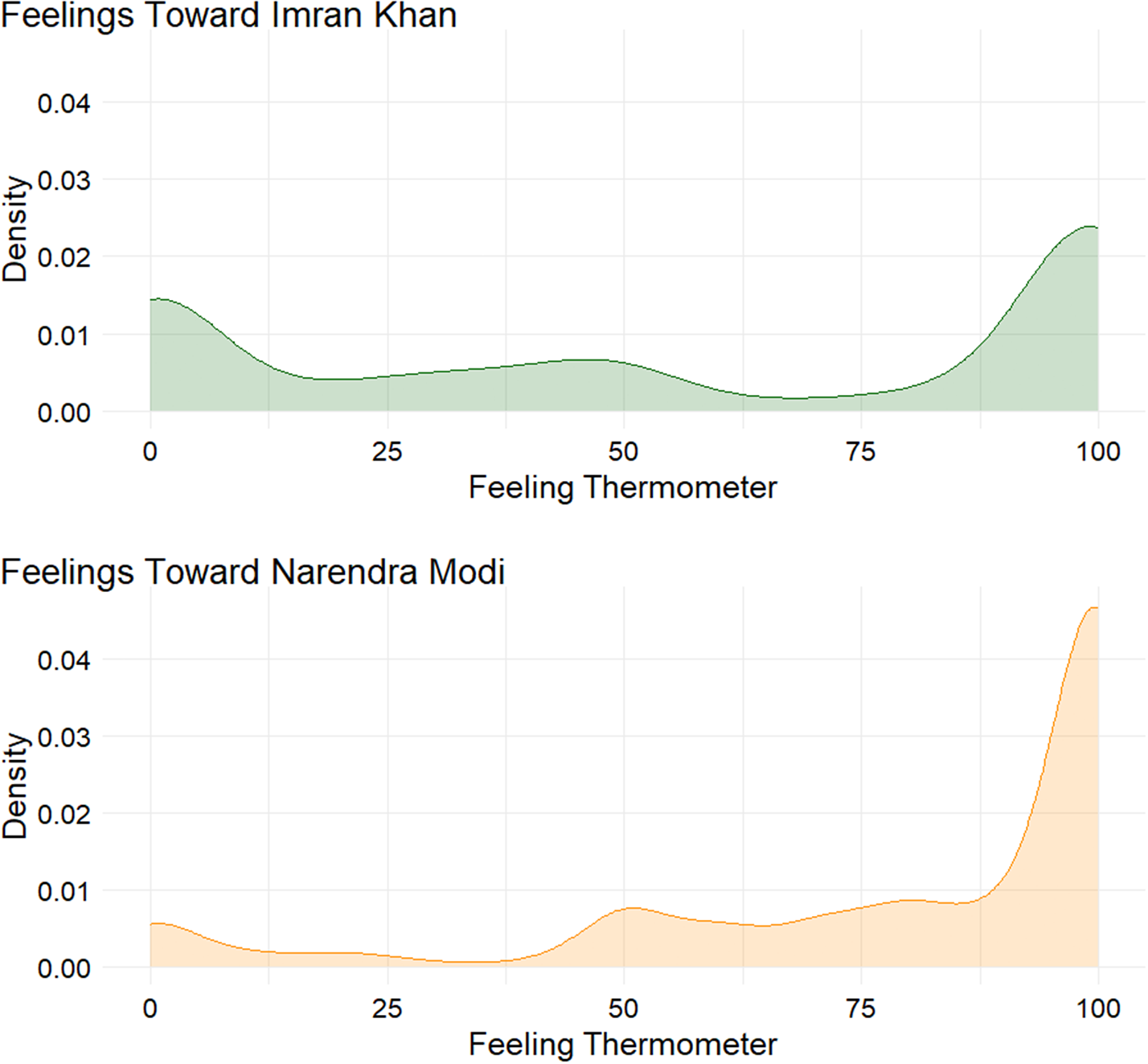
In Figure 5, we graph the feeling thermometer ratings that respondents in India and Pakistan gave to their respective political leaders on a 1 (cold) to 100 (warm) scale, measured as a pre-treatment covariate. When it comes to Pakistani politician Imran Khan, similar proportions of the sample rate him warmly and coldly. On the other hand, Narendra Modi appears to enjoy strong popularity with the sample, with over 50% giving him a 100 score and very few rating him coldly.Footnote 22 Yet Khan’s message appears to resonate with the Pakistani sample, causing them to update their opinions, while Modi’s does not have an effect in India. Why might we see these counterintuitive findings?
Feeling Thermometer Ratings toward Politicians
One possible answer relates to respondents’ differential perceptions of the sincerity of the two Prime Ministers in their messaging. Modi is widely believed to advance a Hindu nationalist agenda via legislative and policy changes, as well as support discriminatory or hostile civil society attitudes and behaviors toward India’s Muslim minority (Jaffrey Reference Jaffrey2021). For instance, Modi has propelled Hindu nationalist hardliners to powerful positions who have made incendiary statements against Muslims and/or encouraged violence against them. The Chief Minister of the state of Uttar Pradesh, where we conduct this study, is one such example. Further, since the BJP has adopted an overt pro-Hindu ideology, its supporters may hold the perception that Modi and other party leaders do not entirely mean what the displayed tweet says. It is possible that respondents viewed the tweet as intended for a distinct audience—perhaps an international one—rather than for Modi’s domestic followers and was discounted accordingly. Numerous news articles have suggested that Modi relies instrumentally on the nonviolent legacy of Gandhi, for example, while speaking on the international stage but downplays this legacy at home where his supporters have mixed feelings about the historical figure (Guha Reference Guha2023).
One interpretation of this finding may thus be that when a politician adopts a position contrary to their usual ideological discourse, citizens may disregard it or even dismiss it as untrue. While we cannot be sure of the reason behind this null finding in India, research in other contexts supports this explanation: while public opinion is shaped largely by following the leader, it may be attenuated when leaders give conflicting signals (Agadjanian Reference Agadjanian2021; Druckman and Nelson Reference Druckman and Nelson2003). Future research should explore this finding in more detail.
Heterogeneous Effects by Beliefs toward Out-Groups
Earlier we discussed how respondents in our samples in both India and Pakistan harbor prejudice toward their respective out-groups. In other contexts, these priors have been shown to condition how citizens respond to information, with motivated reasoning attenuating the efficacy of corrections (Flynn, Nyhan, and Reifler Reference Flynn, Nyhan and Reifler2017). We thus hypothesized that those in our sample with lower trust in the out-group should have a harder time accepting corrections to misinformation when such misinformation aligns with their majoritarian (or pro-in-group) prior beliefs.
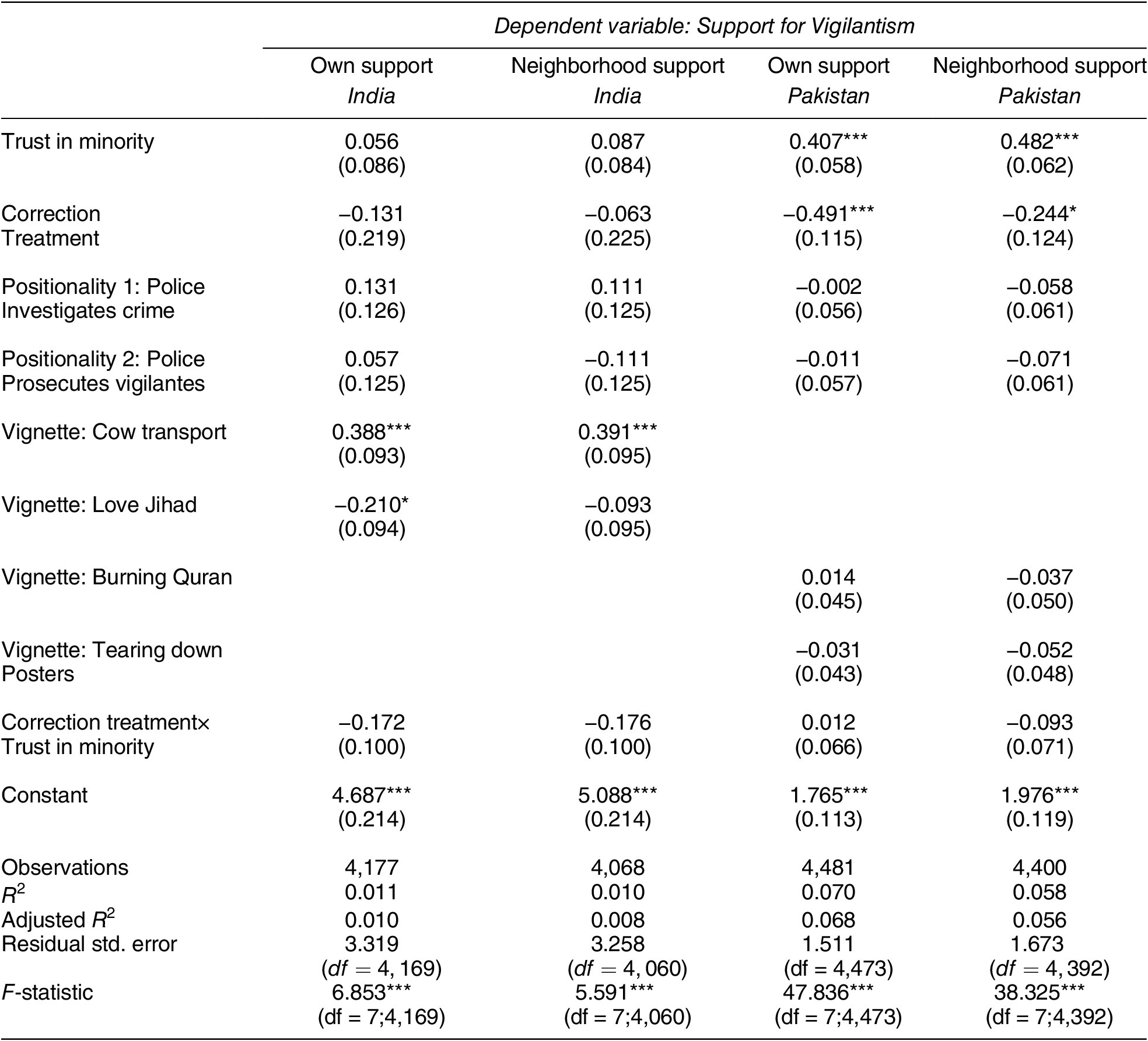
We show results in Table 4. The main coefficient of interest here is the interaction between the correction and trust in the out-group. Findings demonstrate that across models and countries, this interaction produces a null result, suggesting that the effect of misinformation correction may not be a function of respondents’ priors about the out-group. Thus, we show that treatments that correct polarizing misinformation can be effective despite high distrust in the out-group, contrary to what we hypothesized and contrary to what much of the literature says. These findings suggest that motivated reasoning may play a comparatively less systematic role in South Asia, breaking with results frequently obtained in the American context (Nyhan and Reifler Reference Nyhan and Reifler2010), but consistent with recent studies fielded in the region (Badrinathan and Chauchard Reference Badrinathan and Chauchard2024). In Appendix J of the Supplementary Material, we show that results remain robust to changing the dependent variable as well as using different questions to measure beliefs toward the out-group.
Heterogeneous Effect of Trust in Minority × Correction
Note: *
 $ p<0.05 $
, **
 $ p<0.01, $
***
 $ p<0.001 $
.
DISCUSSION
This article demonstrates that (1) correcting misinformation can reduce support for vigilante acts and increase the desire to hold the vigilante group responsible, (2) there is heterogeneity in the crime-specific effects of this correction, with particularly salient rumors appearing resistant to correction, (3) information about state and elite behavior plays a less systematic causal role in attitudes toward vigilante violence, (4) and respondents were moved to change beliefs despite prior out-group distrust.
While these results have implications for both scholarship and policy, we begin by acknowledging a number of potential limitations of the study for readers to consider. First, related to external validity, our correction treatment specified that several different news stations had conducted debunking investigations. We chose not to vary the source of the correction to maximize power, and because actors attempting to defuse rumors (such as fact-checkers and journalists) frequently cite multiple sources to craft effective corrections. In making this design choice, we arguably neutralized potential source effects (Mutz and Martin Reference Mutz and Martin2001). In addition, this led us to design a relatively strong correction. While we went to great lengths to ensure that our vignettes were realistic and mimicked journalistic stories, we cannot guarantee that participants’ experiences were entirely similar to what they would encounter in real life. We concede that respondents may not be as attentive to news stories in their everyday lives, as we possibly ensured greater attention through the use of headphones, even if it is also important to note that these interviews took place in the respondents’ own homes rather than a more artificial lab or online setting. Future research should explore how single-source corrections or different administration modes affect experimental results.
Second, our study does not allow us to evaluate the durability of the treatment effects: since we measure the effects of the treatment on outcomes immediately after, we cannot ascertain whether these effects would last or decay over time. In addition, we are unable to say whether our treatment affected overall support for vigilantism, as our outcome measure asked specifically about the act of vigilantism which was linked to the rumor in our vignette. Next, while our study tells us how we can reduce support for vigilantism conditional on the underlying rumor being labeled false, it cannot speak to reduction in support for vigilantism based on true information. We believe this to be an important—though ultimately distinct—research agenda. Indeed, that a sizeable percentage of respondents continued to support the act of violence even when they were told that innocent citizens were harmed is indicative of a troubling story that warrants further investigation.
Finally, we note that corrections could reduce support for vigilantism through multiple mechanisms. We show that corrections change belief in misinformation (prior to changing support for vigilantes). But corrections may also move respondents’ perceptions of norms or the perceived legitimacy of engaging in vigilantism. Relatedly, future research should explore how support for such violence finds its roots in in-group signaling mechanisms, emotions, or feelings of empowerment.Footnote 23 Finally, our design cannot tell us whether rumors lead individuals to support (or carry out) acts of violence, or whether the rumor merely serves as a pretext for the violence. Because our findings suggest that the veracity of the information is relevant to support for violence, future research should ascertain how information interacts with these social and emotional drivers of support for vigilantes.
Despite these limitations, we believe these findings to be noteworthy for a number of reasons. First, we demonstrate that corrective information can be consequential: when respondents pay attention to credible corrections of misinformation, they can be moved to change their priors. That is, they are sensitive to accounts suggesting that their priors about a violent, emotional act are wrong and in turn update beliefs to match new information. That accurate information can move citizens to want to punish vigilante groups is particularly novel and important, as the vigilante group in our context is composed of members of respondents’ own in-groups. That we find such effects in an environment of persistent disinformation and targeted anti-minority rhetoric perhaps makes these findings even more remarkable.
Our research design allows us to be reasonably confident that social desirability is not driving findings: respondents are willing to admit to extremely intolerant feelings toward minorities. We believe demand effects are equally unlikely to explain results, as the complexity of our design makes it harder for respondents to guess our research intent. The availability of multiple attributes in conjoint-type designs effectively conceals researcher intent from participants (Hainmueller, Hopkins, and Yamamoto Reference Hainmueller, Hopkins and Yamamoto2014). In addition, we build on Mummolo and Peterson (Reference Mummolo and Peterson2019) and indirectly test this hypothesis: in the Supplementary Material posted to the Harvard Dataverse, we focus on the second and third vignettes and show that those receiving a correction for the second time behaved similarly to those who had not.
That our study found similar patterns in both India and Pakistan, despite differences in political context and the nature of democracy, increases confidence in these results. As noted, we do find baseline differences in our results in the two countries (both in belief in misinformation and support for vigilantism), which could be due to a number of possible reasons. One explanation is that while we specify in India that the minority (or victim) is Muslim, we do not do name the identity group in Pakistan.Footnote 24 Despite these differences, it is striking that the correction treatment is successful at shifting public opinion in both countries. Further, our effect sizes are comparable (and in Pakistan, larger) than analogous studies with experimental counter-measures for misinformation in polarized settings (Ali and Qazi Reference Ali and Qazi2023; Gottlieb, Adida, and Moussa Reference Gottlieb, Adida and Moussa2022).
As previously highlighted, we note one caveat in our findings. With rumors linked to cow vigilantism in India, while corrective information reduced belief in the rumor, it did not reduce support for vigilante violence resulting from that rumor. This is perhaps unsurprising as cow protection laws have a long history in India with the first passed in 1955, and thus have plausibly broad public acceptance across the political spectrum. In recent years, however, their enforcement has been intensified, in some cases leading to bans on the consumption of beef (Sarkar and Sarkar Reference Sarkar and Sarkar2016). It is possible, then, that the pathway to reduced support for vigilantism through the mechanism of rumor correction may not hold for certain types of crimes that are particularly salient or more overtly linked to partisanship.Footnote 25 This reinforces our intuition that future work should explore other mechanisms potentially driving support for cow vigilantism, including, for example, the role of status and signaling within one’s in-group (Mukherjee Reference Mukherjee2020), feelings of empowerment, or other emotions inherent to the act of violence.
Beyond these implications for scholarship, we believe these findings have important policy implications as well. Actors interested in combating fast-moving rumors—media, NGOs, but also governments when they are not suppliers of disinformation—should not only seek to fund fact-checking and/or develop society’s capacity to correct information, but more importantly design systems to allow for thorough dissemination of correct information, even if this information often comes after the fact. This could take on a variety of formats: news media and or local authorities may choose to publicize on social media the result of their investigations, or on a more granular basis, to explain them in person to local stakeholders such as citizens’ organizations and associations. Our results suggest that disseminating credible interventions modeled after experimental findings such as our own, delivered to respondents in ways that hold their attention and incentivize take-up, should contribute to reduced support for acts of vigilantism, including in contexts of extreme polarization.
CONCLUSION
Our research contributes to a number of broad debates across the social sciences. This includes a growing literature on the downstream effects of misinformation, on polarization and group identity, and on support for collective violence. As citizens across the world are becoming more polarized and partial to their in-groups (Boxell, Gentzkow, and Shapiro Reference Boxell, Gentzkow and Shapiro2024; Kingzette et al. Reference Kingzette, Druckman, Klar, Krupnikov, Levendusky and Ryan2021), we show that people’s animosity toward out-groups need not extend to expressions of violence. While previous research finds that partisanship and identity can trump civic virtue (Svolik Reference Svolik2019), we show promising data that antidemocratic attitudes can be significantly attenuated by credible information. This has implications for not only preventing future conflict but possibly changing partisan norms in response to violence (Eady, Hjorth, and Dinesen Reference Eady, Hjorth and Dinesen2023).
At the same time, our findings raise important questions about the role of state institutions in preventing collective violence, and how public opinion can constrain, or encourage, political actors. That we found similar results across two distinct contexts—one with a long history of democracy and one which has struggled with democratic consolidation since its founding—is striking. In fact, our surveys find greater willingness to support vigilantism among our Indian sample and a smaller effect of corrections relative to Pakistan, suggesting that the existence of ostensibly democratic institutions may not have a straightforward relationship to extralegal violence. This finding is consistent with work suggesting that the relationship between democracy, democratization, and rule of law is not always clear (Smith Reference Smith2019). It is also consistent with popular writing about the ways in which ethno-national governments use misleading information as a means to perpetuate violence against out-groups (Sircar Reference Sircar2021). Finally, conducting our study simultaneously in these two contexts enhances generalizability. As advocated by the Metaketa model (Blair and McClendon Reference Blair and McClendon2021; Dunning et al. Reference Dunning, Grossman, Humphreys, Hyde, McIntosh and Nellis2019), this planned integration of field experiments allows us to foster better cumulative learning, advancing the science of correcting misinformation in diverse settings.
Future research should continue to examine the predictors of support for vigilantism as well as consequences of belief in misinformation; indeed, if we identified an effect on support for vigilantism, there is also likely a downstream effect on other variables, whether support for populist candidates or other antidemocratic norms, or even participation in vigilantism. Similarly, research on collective violence needs to take stock of the importance of misinformation as a causal variable. While there is a rich qualitative literature on this topic in South Asia (Brass Reference Brass1997; Tambiah Reference Tambiah1997), less has been written about the specific ways in which misinformation may have altered this relationship. Finally, future research should take into account the psychological and systemic mechanisms—such as perceptions of the legitimacy of vigilantism, the role of religious appeals, or the role of agency and status—through which correcting misinformation may affect support for vigilantism.
SUPPLEMENTARY MATERIAL
To view supplementary material for this article, please visit https://doi.org/10.1017/S0003055424000790.
DATA AVAILABILITY STATEMENT
Research documentation and data that support the findings of this study are openly available at the American Political Science Review Dataverse: https://doi.org/10.7910/DVN/P1TL97. Analyses are preregistered at OSF (https://bit.ly/3O48nKH).
ACKNOWLEDGMENTS
We thank Muhammad Malik and Ahsan Tariq and their team at IDEAS and Kunal Singh and his team at PDAG for help with survey implementation. We also thank Sujeet Kumar for help with field supervision and Satyajit Mukherjee for assistance with audio production. For comments and feedback, we are grateful to Adam Auerbach, Emmerich Davies, Andy Guess, Graeme Blair, Philip Johnson, Yasser Kureshi, Sarah Khan, Nahomi Ichino, Alex Scacco, Matt Levendusky, Jason Lyall, Asfandyar Mir, Akshay Mangla, Brendan Nyhan, Bhumi Purohit, Steven Wilkinson, Lauren Young, Scott Abramson, as well as seminar participants at Yale, Syracuse, Dartmouth, WZB Berlin, the Vrij Universiteit Amsterdam, American University, CUNY Graduate Center, University of Maryland, Uppsala University, PRIO, the EUI, and APSA, MPSA, and SPSA conferences. Josiah Gottfried provided excellent research assistance.
FUNDING STATEMENT
This research was funded by Facebook Foundational Integrity & Impact Research.
CONFLICT OF INTEREST
The authors declare no ethical issues or conflicts of interest in this research.
ETHICAL STANDARDS
The authors declare the human subjects research in this article was reviewed and approved by the University at Albany—State University of New York and certificate numbers are provided in the Supplementary Material. The authors affirm that this article adheres to the principles concerning research with human participants laid out in APSA’s Principles and Guidance on Human Subject Research (2020).


 Open access


Comments
No Comments have been published for this article.