Introduction
Heat stress is a regular risk to wheat in the subtropics, most of which is found in the Indo-Gangetic Plain that extends from Pakistan, India, to Nepal and Bangladesh. In the most widespread cropping system known as rice-wheat, the wheat crop is grown with irrigation in the cool dry season following the monsoon-fed rice crop (Kataki et al., Reference Kataki, Hobbs and Adhikary2001; Prasad, Reference Prasad2005; Bhatt et al., Reference Bhatt, Kukal, Busari, Arora and Yadav2016). This environment, designated wheat mega-environment 5 (ME5) which also includes wheat area in subtropical Africa, southern China and Southeast Asia, is characterized by average temperature higher than 17.5°C in the coolest month, and the risk of the wheat crop being exposed to adverse effects of high temperature (Rajaram et al., Reference Rajaram, van Ginkel, Fischer, Li and Xin1995; Fischer et al., Reference Fischer, Byerlee and Edmeades2014). Substantial yield reduction due to rising temperature in the later part of the growing season especially when planting was delayed were recorded in the 1990s in the ME5 wheat in Bangladesh (Badaruddin et al., Reference Badaruddin, Saunders, Siddique, Hossain, Ahmed, Rahman, Parveen, Saunders and Hettel1994), India (Tandon, Reference Tandon, Saunders and Hettel1994), northern Thailand (Vongburi, Reference Vongburi, Saunders and Hettel1994) and Egypt (AbdElShafi Ali and Ageeb, Reference AbdElShafi Ali, Ageeb, Saunders and Hettel1994). In India, where most of the country's wheat area is in the subtropics, major wheat cultivars were reported to yield only two-thirds of their potential when subjected to the heat stress by late planting (Mishra et al., Reference Mishra, Singh, Patil, Bhusal, Malik, Sareen, Shukla, Mishra, Chatrath, Gupta, Tomar and Sharma2014). Adverse impacts of climate change on wheat are also expected in its main growing environments outside the subtropics (Braun and Payne, Reference Braun, Payne, Reynolds, Pask and Mullan2012). A study in China covering the period from 1981 to 2009 showed that wheat yield was depressed by heat stress in the mid-latitudes, although it was increased with longer growing season in the higher latitudes (Tao et al., Reference Tao, Zhang, Zhang and Rötter2015). An exchange of wheat germplasm among breeders in a hot environment as well as materials generated at CIMMYT (the International Centre for Maize and Wheat Improvement) were put together into a Hot Climate Wheat Screening Nursery and evaluated for seven seasons in warm, hot to very hot environments in Africa, Asia and South America in the 1980s (Mann, Reference Mann, Saunders and Hettel1994). Since then more precise targeting of wheat breeding for stress-prone environments based on understanding of stress tolerance physiology, including in tolerance to heat and drought (Reynolds et al., Reference Reynolds, Manes, Rebetzke, Reynolds, Pask and Mullan2012). This study evaluated the agronomic performance of a set of wheat genotypes in a High Temperature Wheat Yield Trial (HTWYT) from CIMMYT at a location designated a representative environment of wheat ME5 (van Ginkel et al., Reference van Ginkel, Trethowan and Çukadar1998).
Materials and methods
The 49 entries of the 13th HTWYT (13HTWYT) from CIMMYT (distributed in 2014, pedigrees can be found in IWIN, 2018), with Fang 60 as the local check, were evaluated in three experiments at Chiang Mai in Thailand from November 2014 to March 2015. At Chiang Mai University (18.81°N, 98.95°E; elevation 330 m) the 50 genotypes were grown in a sand culture to simulate the condition of non-limiting nutrient and water supply (Exp. 1) and in the field (Exp. 2). Exp. 1 was sown on 5th November, each genotype was grown in a drainable pot (Ø 30 cm, 30 cm deep) containing quartz sand, with duplicated pots at five plants/pot. A complete nutrient solution containing 10 µM H3BO3, 10 µM Fe-EDTA, 1 µM MnSO4, 0.5 µM ZnSO4, 0.2 µM CuSO4, 0.1 µM CoSO4, 0.1 µM Na2MoO4, 250 µM K2SO4, 1000 µM CaCl2, 250 µM MgSO4, 500 µM KH2PO4 and 5 mM KNO3 (Rerkasem et al., Reference Rerkasem, Jamjod and Niruntrayagul2004) was applied at 1 litre/pot, twice daily. In Exp. 2, sown on 19th November, each of the 50 genotypes were grown in four 5-m rows 0.25 m apart on a sandy loam soil of Sansai series, in duplicated blocks. At the highland site (Exp. 3), sown on 25th November at Mae Wang District of Chiang Mai province (18.61°N, 98.78°E; elevation 800 m) each of the wheat genotypes was grown in two 2.5 m rows on a sandy loam soil, in duplicated blocks. Both Exp. 2 and Exp. 3 were fertilized with 100 kg N/ha, 20 kg P/ha, 37 kg K/ha and 1 kg B/ha. Days to heading, number of spikes and grain yield were determined in all three experiments. In Exp. 1 the number of spikelets per spike, seeds/spike, seeds/spikelet and weight of individual seeds were determined on the main stem and first tiller of each plant (10 tillers from each pot).
Results
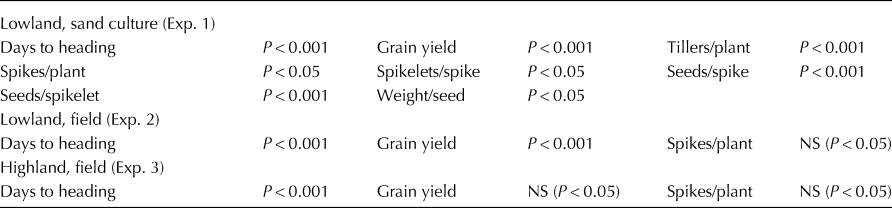
For the duration of the experiments, January was the coolest month, with monthly average temperature at 22.3°C at the lowland site and 19.0°C at the highland site (Fig. 1). Genotypic variation in the 13HTWYT at Chiang Mai was most strongly expressed when water and nutrients were not limiting (Exp. 1), less when grown in the field at the same lowland location (Exp. 2), and least of all at the highland location (Exp. 3) (Table 1). In the lowland, genotype effects were significant in days to heading stage and grain yield in both the sand culture and in the field. Genotype effects on the yield components, including the number of spikelets/spike, seeds/spike, seeds/spikelet and weight of individual seed, determined only in Exp. 1, as well as the number of tillers and spikes, were also significant. Generally development towards heading stage was more rapid in the lowland than in the highland, but in the lowland it was more prolonged in the sand culture.
Monthly average temperature at the two experimental sites (lowland: Exp. 1, Exp. 2; highland: Exp. 3) in Chiang Mai, Thailand.

Significant genotype effects by analysis of variance (n = 50)

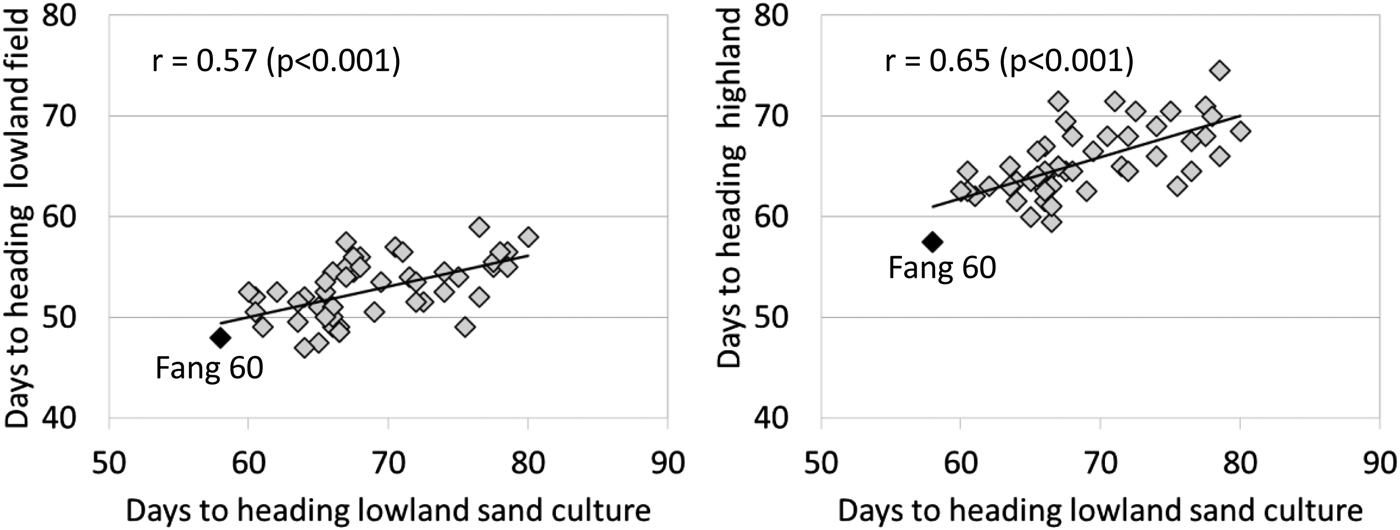
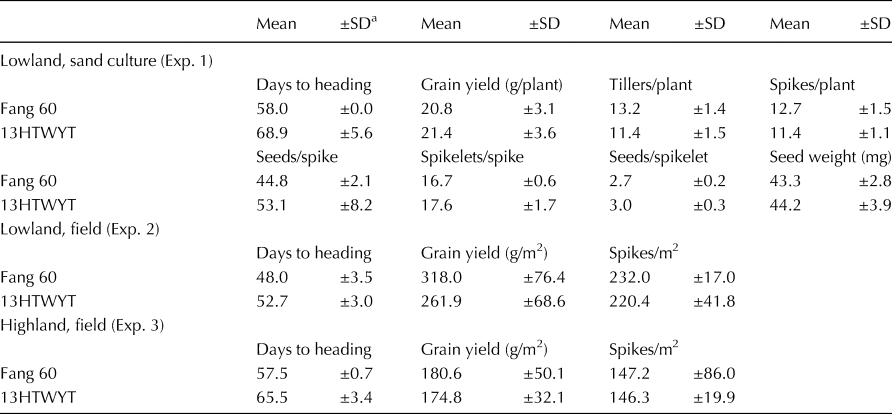
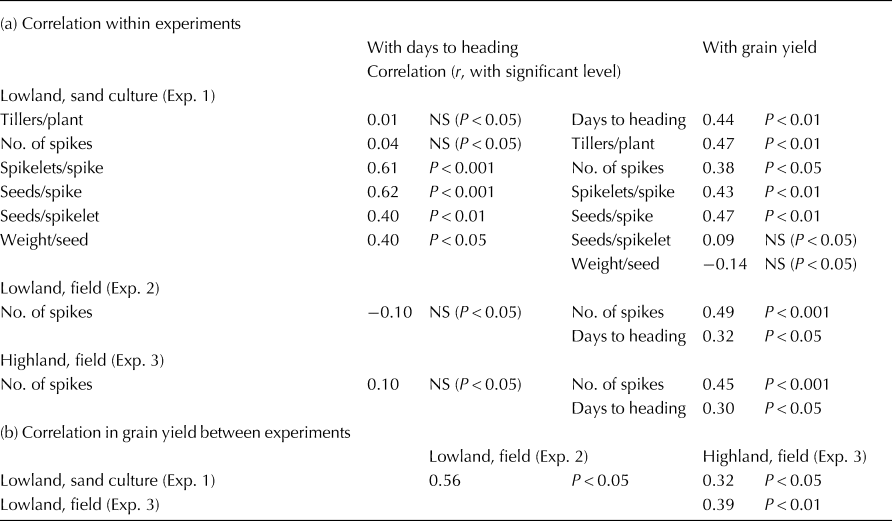
The 13HTWYT was most clearly differentiated from the local check Fang 60 in the longer time it took most of the genotypes to reach heading stage and the greater number of seeds/spike (Table 2). The rate of development of individual genotypes, as represented by the number of days each took to reach heading stage, was significantly correlated among the three experiments (Fig. 2). In all cases the local check Fang 60 was the first to reach heading stage, with several entries in the 13HTWYT reaching the heading stage up to 3 weeks later when water and nutrients were not limiting. The advantage of longer pre-heading development time was shown in the correlations between days to heading and yield components, and between the yield components and grain yield (Table 3). Longer duration of pre-heading growth was significantly correlated with greater number of spikelets/spike, seeds/spike, seeds/spikelet and the weight of individual seeds, but not with the number of tillers and spikes. Grain yield also increased with longer days to heading and number of spikes within each of the three experiments, and with number of spikelets/spike and seeds/spike, but not with the number of tillers, seeds/spikelet and weight of individual seeds in Exp. 1. Grain yield of individual entries was significantly correlated between experiments. However, none of the 13HTWYT entries out-yielded the local check Fang 60 (Fig. 3). When water and nutrients were not limiting (Exp. 1) almost half of the germplasm produced significantly fewer tillers and spikes than the local check Fang 60, although a number of entries produced larger spikes with more spikelets and grains per spike, 30% of the entries yielded significantly lower than Fang 60. In the field (Exp. 2 and Exp. 3) the 13HTWYT entries were largely indistinguishable from Fang 60 in grain yield and the number of spikes/m2.
Days to heading of the 13HTWYT in the field in the lowland (Exp. 2, left) and the highland (Exp. 3, right) as related to that in the lowland sand culture (Exp. 1). Correlation between Exp. 2 and Exp. 3 in days to heading (r) = 0.72 (P < 0.001). Significance of the linear regression by analysis of variance.

Performances of the 13HTWYT relative to Fang 60 in the lowland sand culture (Exp. 1), and in the field in the lowland (Exp. 2) and the highland (Exp. 3), in percentage of entries within one LSD (P < 0.05) value of Fang 60.

Days to heading, yield and yield components in the 13HTWYT and Fang 60 (local check) in three experiments at Chiang Mai, Thailand

a Standard deviation.
Linear relationship between days to heading, grain yield and yield components within experiments (a) and grain yield between experiments (b) of the 13HTWYT plus local check Fang 60 (n = 50)

Discussion
With average temperature for the coolest month for the duration of the experiments higher than 17.5°C, the wheat in the current study is considered to have been subjected to heat stress of the wheat ME5 (Rajaram et al., Reference Rajaram, van Ginkel, Fischer, Li and Xin1995; Fischer et al., Reference Fischer, Byerlee and Edmeades2014). The temporal pattern of heat stress within the wheat ME5, however, may vary by location, with exposure to high temperature from sowing to maturity in Southeast Asia but from flowering to maturity in the Indo-Gangetic Plain (Rajaram, Reference Rajaram and Klatt1988). The focus on tolerance to high temperature of reproductive development and grain filling (e.g. Farooq et al., Reference Farooq, Bramley, Palta and Siddique2011) is appropriate for areas where the wheat crop is subjected to high temperature after flowering. Results from the current study are applicable to wheat subjected to heat stress for the entire growing season.
The adverse effect of heat stress on the wheat plant is manifested through numerous processes, from germination, to various steps of vegetative growth and reproductive development (Farooq et al., Reference Farooq, Bramley, Palta and Siddique2011; Iqbal et al., Reference Iqbal, Raja, Yasmeen, Hussain, Ejaz and Shah2017). Tolerance to heat stress of crop genotypes, however, can be assessed from their agronomic performance in comparison with a standard genotype, without inferring the mechanism, as has been successfully applied in evaluating genotypic variation in nutrient efficiency, another physiological complexity involving capacity for acquisition and uptake from the soil, translocation and utilization (Graham, Reference Graham1984; Rerkasem and Jamjod, Reference Rerkasem and Jamjod1997). Tolerance to heat stress in the 13HTWYT is here demonstrated with agronomic performance of the wheat genotypes in a heat stressed environment in comparison with Fang 60, a local check, and with reports on the wheat germplasm of the 1980s to 1990s. Fang 60 (PIIFDIIPI/MZ/3/MXP), bred in Pakistan in 1977, selected in Thailand and released in 1987 (Rerkasem, Reference Rerkasem, Rawson and Subedi1996), has been successful in Thailand and wheat ME5 area in other countries partly because of its adaptation to low boron soils (Anantawiroon et al., Reference Anantawiroon, Subedi and Rerkasem1997). Reduction of tillering, size of the spike, grain size and test weight were previously observed to be associated with the adverse effects of heat stress on biomass and grain yield in the earlier wheat germplasm (Rajaram, Reference Rajaram and Klatt1988). In these earlier wheat genotypes, development towards reproduction was speeded up in high temperature so that the inflorescence was initiated before the plant had developed sufficient leaf area and photosynthetic capacity (Rawson, Reference Rawson and Klatt1988). Spike development is also accelerated under heat stress (Porter and Gawith, Reference Porter and Gawith1999), resulting in smaller spikes that produce fewer grains/spike from fewer competent florets in smaller and fewer spikelets (Saini and Aspinall, Reference Saini and Aspinall1982; McMaster, Reference McMaster1997). From flowering onwards, further adverse effects of heat stress on grain yield may operate through sensitivity of processes from anthesis and fertilization to seed growth and development including translocation of photosynthate into the seed (Farooq et al., Reference Farooq, Bramley, Palta and Siddique2011). In wheat screening under the influence of high temperature in the 1980s to 1990s, the longer time to heading was often found to be associated with lower grain yield (Ortiz-Ferrara et al., Reference Ortiz-Ferrara, Rajaram, Mossad, Saunders and Hettel1994).
The positive correlation between days to heading and grain yield and key yield components found here therefore indicated improvement in heat tolerance in the 13HTWYT. Pre-heading development in wheat covers a sequence of phenological events, from vegetative growth that produce leaves and tillers to floral initiation and formation of the spike and spikelets (Miralles and Richards, Reference Miralles and Richards2000; Acevedo et al., Reference Acevedo, Silva, Silva, Curtis, Rajaram and Gómez Macpherson2002). The positive association between days to heading and the number of spikelets/spike, seeds/spike and seeds/spikelet were clear evidence of how the longer time before heading enabled development of larger spikes and spikelets with more competent florets that resulted in more seeds/spike. The lengthening of pre-heading period, however, did not also result in more tillers and spikes. As part of crop modelling based on records of environmental data, of temperature, photoperiod light intensity, and so on, extensive efforts have been made in improving the precision in the estimation the rate of leaf emergence and tillering in wheat from (e.g. McMaster and Wilhelm, Reference McMaster and Wilhelm1995; Bos and Neuteboom, Reference Bos and Neuteboom1998). Tolerance to heat stress with respect to the number of tillers and spikes, however, may depend on the timing of floral differentiation, after which tillering generally ceases (Rawson, Reference Rawson1971; Baker and Gallagher, Reference Baker and Gallagher1983), and therefore the ultimate number of tillers and spikes that can develop, as well as the rate of tiller development. However with none of the 13HTWYT entries out-yielded Fang 60, while almost half had fewer tillers and spikes than the local check.
Heat tolerance in the wheat germplasm, was indicated by longer pre-heading duration, and the positive correlation between days to heading and grain yield all three experiments. The longer time before heading enabled development of larger spikes that produced more seeds from more and larger spikelets and more competent florets. This, however, was not enough to raise the yield above Fang 60, 30% of the entries actually yielded significantly lower than the local check. The limited tillering capacity and number of spikes in the 13HTWYT was indicated by the number of tillers and spikes that did not exceed Fang 60 in all three experiments, and half of the entries actually had significantly fewer tillers and spikes than the local check when water and nutrients were not limiting (Exp. 1). In the short-run, this might be compensated for by simply increasing the seeding rate.
In conclusion this study has demonstrated tolerance to heat stress in a germplasm recently developed for adaptation to high temperature, in an environment in which the wheat plants were subjected to high temperature for the entire growing season. Tolerance was indicated by longer period of development to heading, which allowed development of larger spikes with more seeds/spike, as the result of more and larger spikelets and more competent florets, when water and nutrients were not limiting. Better tillering that result in more spikes under high temperature during the first part of the growing season, while keeping the ability to produce larger spikes, might possibly raise yield potential of heat-tolerant wheat germplasm above a genotype from the 1970s like Fang 60.
Acknowledgements
The authors thank CIMMYT for providing the 13HTWYT seed and a farmer at Mae Wang for collaboration in the on-farm experiment. Financial support for the study was provided by the National Research University project of Thailand's Higher Education Commission.