I. Introduction
Although the concepts of ‘animal welfare’ (dongwu fuli) and ‘animal rights’ (dongwu quanli) are relatively new in China, seeing animals as equals and treating them with kindness and mercy has long been promoted by different schools of Chinese philosophical and religious thought. Chinese Buddhism upholds the belief that ‘all beings are equals’ (zhong sheng ping deng) and encourages vegetarianism and freeing captive animals; Taoism believes in ci xin yu wu – that ‘mercy be given to all beings’; and Confucianism promotes the principle of ‘no harm’ (wu shang) – a person who inflicts harm on a being is considered unmerciful (Cao, W., Reference Cao, Chang, Michaels, Littlefair and Li2010, pp. 19–31). Chinese scholars have documented animal protection and anti-cruelty legislation in feudal China and during the Republic of China period, arguing that the regulatory attempts demonstrate that the country has a history of enacting localised animal protection statutes (see Cao, D., Reference Cao2010; Chang, Reference Chang, Chang, Michaels, Littlefair and Li2010a). Animal protection was not a prominent concern during the pre-reform socialist era that followed, in which poverty reduction became the pressing national policy priority in the aftermath of World War II and the Chinese Civil War. In this context, animals were seen as merely resources to be exploited for social progress.
In the past three decades, China has achieved phenomenal economic growth as a result of Deng Xiaoping's post-1978 economic reform. While economic development has lifted 500 million Chinese out of poverty, it has brought significant side-effects, such as environmental degradation and animal cruelty (Li, Reference Li and Bekoff2010, p. 119; Li cited in Tobias, Reference TOBIAS2012). Li (cited in Tobias, Reference TOBIAS2012) argues that the pursuit of economic advantages is the main cause behind animal abuse in China and could also explain the country's lack of animal welfare legislation:
‘Chinese reforms, initially, were intended to improve the food supply to the 900 million Chinese people, while ethics, morality, social responsibility, environmental impact, labour rights, etc., were often ignored … Chinese authorities are not motivated to tackle the problem of animal cruelty for fear that economic growth would be slowed down.’
Cases of animal abuse associated with state-sanctioned business and law enforcement operations such as bear bile farming, fur farming and indiscriminate anti-rabies dog culls have frequently made local and international headlines. The severity of the issue is exacerbated by media reports of frequent individual animal cruelty incidents in recent years that have shocked the Chinese public and led many to call for urgent legislative change. Meanwhile, in the past two decades, instances of pet ownership in China have soared as more and more Chinese become members of the middle class, and dogs are increasingly kept by the elderly for companionship. The number of dogs kept as pets in China has surpassed 100 million – a 500 per cent increase from a decade ago (Deng, Reference Deng2013). As more people interact with, and develop affection for, their pets, sections of the Chinese community have become active advocates for animal protection laws.
Despite this, China remains without a comprehensive animal protection, welfare or anti-cruelty law. This has made it impossible to prosecute animal abusers, and consequently animal rights activists in China often end up being the ones breaking the law in their animal rescue efforts (Wong, Reference Wong2011). The lack of animal protection law has attracted heavy criticism from animal welfare advocates and animal lovers in China, and has engendered heated debate in the media as well as in academic and policy circles.
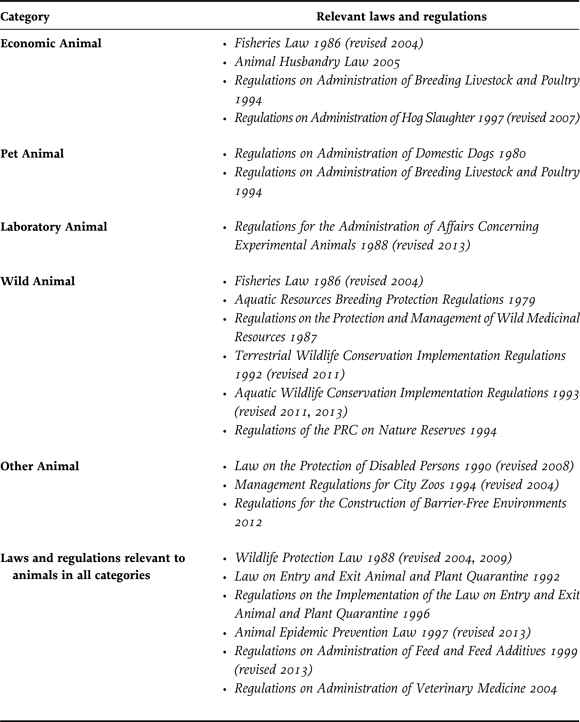
Table 1 provides a list of China's major existing animal-related laws and regulations. Throughout this paper, in order to render the analysis more systematic, we have divided animals into five broad categories: Pet Animal (chongwu dongwu), Economic Animal (jingji dongwu), Laboratory Animal (shiyan dongwu), Wild Animal (yesheng dongwu) and Other Animal (qita dongwu). This accords with the categorisation used in the draft Chinese animal protection and anti-cruelty laws.
Existing national laws and regulations in relation to different categories of animals.

China's existing animal-related legal framework is overwhelmingly focused on safeguarding human interests in relation to public health, food safety and the conservation of valuable animal resources. The Wildlife Protection Law of the People's Republic of China (PRC) 1988, for example, is ‘formulated for the purpose of protecting and saving the species of wildlife which are rare or near extinction, protecting, developing and rationally utilising wildlife resources and maintaining ecological balances’.Footnote 2 While it does protect endangered species as well as wildlife that are considered ‘beneficial or of high important economic or scientific value’,Footnote 3 it excludes Wild Animals that do not meet these criteria – which are the majority. In terms of animals that are purposely bred for economic purposes, commentators argue that China's current legal framework has failed to consider their welfare and is primarily aimed at safeguarding the economic interest, health and safety of humans (Chang, Reference Chang2006, p. 146). China is the world's largest meat producer but its Animal Husbandry Law 2005 neither forbids cruel husbandry practices nor inhumane slaughter (Whitfort, Reference Whitfort2012, p. 354). Similarly, the Regulations on Administration of Domestic Dogs 1980, along with many local ordinances, are focused on the management and control of pet dog ownership, in order to ensure human health and safety and maintain public order.
Apart from state-protected wildlife, animals used in research seem to be the only category of animal in China that are given some protection through the Regulations for the Administration of Affairs Concerning Experimental Animals 1988. This document requires Laboratory Animals to be provided with quality food and clean water, and professional training be given to people involved in animal experiments and care.Footnote 4 It also encourages protection of animals used in experiments and forbids cruelty, although no elaboration has been given on what constitutes protection and cruelty.Footnote 5
Overall however, a mentality of seeing animals as resources to be rationally utilised in order to advance human interest predominates current animal-related legal discourse in China. Where protection is mentioned in current laws and regulations, it is often couched in vague and generalised terms that lack enforceability (Li, Reference Li and Bekoff2010, p. 122). Nevertheless, it is important to recognise that, in the past decade, positive animal-related policy change has occurred. In 2006, China's Ministry of Science and Technology released the Guiding Opinions Concerning Ethical Treatment of Laboratory Animals. The document promotes the Western concept of Replacement, Refinement and Reduction (commonly known as the 3Rs) (Russell and Burch, Reference Russell and Burch1959), intended to minimise unnecessary suffering in relation to the use of animals for research purposes.Footnote 6 In 2012, under government–university–NGO co-operation, the Measures for the Management of Dogs were passed in Yang County in Western China, where rabies was rife and violent dog-culling sprees had taken place. The Measures promote humane treatment of dogs, and prohibit cruelty and abandonment (CNWEST News, 2012). In addition to a circular issued in 2010, China's Ministry of Housing and Urban–Rural Development released the Outlines for the Development of Chinese Zoos in 2013, which completely outlawed animal performances in zoos. Although such changes have been piecemeal, and most of the documents are neither laws nor regulations and hence have limited binding power,Footnote 7 they do indicate a positive change in government mentality towards affording animals greater protection.
In this paper, we first examine the major philosophical principles commonly embedded in Western animal welfare statutes. We use them to help make sense of the Chinese draft laws, and again later to aid us in comparing the Chinese laws with existing Western legislation. Subsequently, we present a review of academic debates on legalising animal protection in China, followed by an introduction of the context in which the draft laws were proposed in relation to China's legislative and political processes and idiosyncrasies. We then conduct a detailed analysis of the draft laws to examine the level and substance of protection given to different types of animals. Finally, we consider in what aspects the draft laws resemble existing Western animal welfare statutes and whether they reveal uniquely Chinese characteristics.
Our purpose in doing this is to conclude whether the fundamental dimensions of Western animal welfare law have now been settled on a global scale. In particular, we seek to understand whether the Western animal welfare model, now more than 200 years in development, is likely to be adopted wholesale by nations that do not have an animal welfare regime. Many of the countries currently without animal protection laws are developing nations. This means that the study serves as an effective case-study into China, and an indicator of likely trends among other emerging economies.
II. The guiding principles of animal welfare law in the West
The prevention of ‘unnecessary suffering’ and a duty of care are two major principles underpinning current animal welfare statutes internationally. They have been established as legislative norms, and their presence or absence in the Chinese draft laws will provide important insights into the extent to which the Chinese laws are unique in their approach to animal protection, or reflect existing Western laws.
2.1 Unnecessary suffering and cruelty prevention
Prominent animal ethicist Peter Singer argues that animals are sentient beings and therefore can feel pain and distress (Singer, Reference Singer1975). Consequently their welfare deserves ethical, moral and legal consideration and efforts should be made to reduce the pain and suffering they endure at the hands of humans:
‘When we apply utilitarianism to the issue of how we should treat animals, one vital point stands out immediately. Utilitarianism, in its classical form, aims at minimising pain and maximising pleasure. Many nonhuman animals can experience pain and pleasure … Therefore they are morally significant entities.’ (Singer, Reference Singer1980, p. 328)
As modern animal welfare laws took root in Western countries, and non-Western nation-states created their own legislation by consulting or transplanting Western concepts, animal welfare statutes globally have become dominated by the overarching theme of preventing unnecessary suffering (Mang, Reference Mang, Ping and Xueli2005). The concept has been adopted by countries, regions and organisations such as the UK, Australia, Singapore, Hong Kong SAR, the EU (Mang, Reference Mang, Ping and Xueli2005; Cao, Reference Cao2007), Germany and Sweden in the creation of relevant laws, regulations and conventions.
For example, the UK's Animal Welfare Act 2006 sets out that anyone whose action, or failure to act, caused a protected animal to suffer has committed an offence, under the condition that ‘the suffering is unnecessary’.Footnote 8 Whether the suffering is unnecessary is judged according to the following criteria:
‘(a) Whether the suffering could reasonably have been avoided or reduced;
(b) Whether the conduct which caused the suffering was in compliance with any relevant enactment or any relevant provisions of a licence or code of practice issued under an enactment;
(c) Whether the conduct which caused the suffering was for a legitimate purpose, such as (i) the purpose of benefiting the animal, or (ii) the purpose of protecting a person, property or another animal;
(d) Whether the suffering was proportionate to the purpose of the conduct concerned;
(e) Whether the conduct concerned was in all the circumstances that of a reasonably competent and humane person.’Footnote 9
Legislation surrounding Laboratory Animal welfare is particularly illustrative of the highly arbitrary and conditional nature of the concept. For instance, Germany's Animal Welfare Act 2006 states that: ‘No more animals than necessary to achieve the purpose of the experiment may be used … Pain, suffering or harm may be inflicted on the animals only in so far as unavoidable to attain the purpose of the experiment.’Footnote 10
This means that in situations where the welfare of an animal is weighed against the economic or scientific benefits to humans, the infliction of pain on the animal can be justified. In other words, in some cases animal suffering is seen as necessary. Critiquing the idea of ‘necessary suffering’, O'Sullivan (Reference O'sullivan2011, p. 41) argues that ‘the concept of necessary suffering allows for the instrumental use of animals as a means to human economic ends … [It] has the effect of permitting acts of cruelty when cruelty is economically expedient’. The definition of what suffering is justifiable, reasonable or necessary is kept ambiguous, or as Katrina Sharman (Reference Sharman and Bekoff2010, p. 359) puts it, ‘flexible’, to reflect shifting human values.
2.2 Duty of care
In recent years a legislative move has taken place globally that requires animal keepers to give animals a scientifically based ‘satisfactory standard of care’ in addition to preventing cruelty against them (Whitfort, Reference Whitfort2012, p. 348). This means that animal keepers can now be prosecuted for negligence and ignorance, which were previously not punishable under anti-cruelty laws that only prosecute those who deliberately inflict pain on animals.
Duty of care towards animals was first proposed in the Animal Welfare Act 1993 of the Australian state of Tasmania, following the discovery of 107 neglected dogs in cages in 1989 (Whitfort, Reference Whitfort2012, p. 361). Today, Germany, New Zealand, Taiwan, the UK and the US have all integrated the duty of care principle into their animal welfare statutes; Hong Kong SAR, India and Sri Lanka are contemplating similar reforms (p. 348). Amanda Whitfort (Reference Whitfort2012, p. 348) sees it as filling an important legislative void by offering protection to animals ‘that have not suffered overt cruelty but are clearly not being provided with a reasonable standard of care’. In other words, anti-cruelty laws primarily aim to prevent an animal's negative experience (i.e. unnecessary suffering), whereas duty of care provisions ensure that an animal's circumstances and experience are positive through prescribing adequate standards of care.
The adequate standards of care can be translated into the fulfilment of an animal's basic welfare needs. In 1965, the Report of the Technical Committee to Enquire into the Welfare of Animals Kept under Intensive Livestock Husbandry Systems (known as the Brambell Report) proposed minimum standards of care for farm animals in the UK in the form of the so-called Five Freedoms (Brambell, Reference Brambell1965). They are:
(1) Freedom from hunger and thirst;
(2) Freedom from discomfort;
(3) Freedom from pain, injury or disease;
(4) Freedom to express normal behaviour;
(5) Freedom from fear and distress.
Over the years, the animal needs contained in the Five Freedoms have found their way into animal welfare legislations globally. The UK's Animal Welfare Act 2006 requires animal keepers to ensure an animal's needs for suitable environment and diet, exhibiting normal behaviour, companionship, and protection from hostile animals, pain, suffering, injury and disease.Footnote 11 Germany's Animal Welfare Act 2006, under the section on animal husbandry, for instance, similarly regulates the fulfilment of animal needs that include species-appropriate food, housing (including lighting and temperature), care, freedom of movement and need for company.Footnote 12 It also requires any person keeping or caring for animals to possess the knowledge and skills needed to provide adequate care.Footnote 13 The Animal Care and Protection Act 2001 of the Australian state of Queensland emphasises that the keeper of an animal ‘owes a duty of care to it’, and needs to satisfactorily provide the animal with food and shelter, allow the animal to display normal behaviour, and give medical treatment if the animal becomes sick or injured.Footnote 14
III. The debate on legalising animal protection in China
In recent years, Chinese scholars, animal rights activists, lawyers and media commentators have engaged in a heated debate surrounding the creation of the country's first comprehensive animal protection law. Numerous attempts aimed at legalising animal protection have failed, including proposals submitted via official channels as well as the government's own policy amendment endeavours. For example, for more than a decade, many Chinese People's Political Consultative Conference (CPPCC) delegates and National People's Congress (NPC) deputies – the political and social elites who collectively exercise power over China's national political decision-making – have repeatedly called for the promulgation of animal protection and welfare laws, but to no avail (Global Times, 2012).
In March 2015, as the CPPCC and NPC annual meetings were held, CPPCC delegate Teng Ge'er and NPC deputy Zheng Xiaohe separately submitted proposals calling for the promulgation of China's animal anti-cruelty law and animal protection law.Footnote 15 More than 1.4 million people participated in an online poll regarding Teng's proposal, and over 1.2 million voted for it (Xin, Reference Xin2015). The proposal was the most trending topic on China Net, the official website hosting public discussions in relation to the two meetings. Despite overwhelming public support, however, like their predecessors, neither proposal has received the green light.
Back in 2004, the draft proposal of the new Beijing Animal Sanitation Regulations was released for public consultation. It was considered the first local animal welfare regulatory attempt in China, and set out measures such as banning animal experiments in schools, prohibiting animal abuse and abandonment, and setting minimum living standards for animals. However, the proposal was removed from the local government website just two days after being uploaded, and was eventually rejected for being premature and unenforceable (Qiao, Reference Qiao2004). The phrase ‘animal welfare’ was initially incorporated into China's Animal Husbandry Law during its drafting process in 2005, but was later removed on the basis that it was ‘ambiguous’ (Tian and Zou, Reference Tian and Zou2005). This shows that formidable cultural, political and socio-economic barriers still stand in the way of animal welfare legislative enactment in China. A thorough review of the two sides of the debate is therefore necessary to contextualise the current draft laws, and to probe their aims, orientations and emphases.
3.1 Legislative change advocates
In 2002, Chinese bioethicist Qiu Renzong published an essay titled ‘How Are Animal Rights Possible?’ He gave a comprehensive introduction to the animal rights concept and argued for humans’ direct obligation towards animals by engaging with a range of Western and Chinese ethical, moral and religious theories. He argued that China was materially and ideologically ready to put the issue of animal rights on the agenda, and that ‘protecting the rights of non-human animals will advance human rights’ (Qiu, Reference Qiu2002). Non-human animals, he suggested, can become the direct subject of rights, and ethical theory demonstrates that humans have direct obligations to them. He proposed a ‘gradual reformist approach’ to animal welfare advocacy in China, which would involve ‘passing laws and regulations when the time is right’ (Qiu, Reference Qiu2002).
Lawyer and academic Song Wei (2006) argued that popular acceptance of the concept of animal welfare and the enactment of animal welfare legislation are complementary. On the one hand, animal welfare needs to be enforced by law, and on the other hand, enforcement would not be possible without a sufficient level of public awareness and conscience (Song, Reference Song, D'Silva and Turner2006, p. 102). He argued that China's international image would benefit from the creation of animal welfare laws, and that China already had the necessary conditions for legislative reform: ‘There is an urgent need for China to enact the relevant legislation on animal welfare, especially anti-cruelty laws, to make clear the legal status of animals’ (pp. 102, 110).
In keeping with views expressed by Qiu and Song, scholar and animal welfare advocate Mang Ping (2002) argued that ‘the time is ripe for China to legalise animal welfare’, and that the passing of an animal protection law would facilitate the ‘moral awakening’ of Chinese society. She observed that China's lack of animal protection legislation had not only put it behind countries with such laws, but had also deviated from the desires and expectations of its own people. Importantly, she rejected any suggestion that a Western animal protection legal framework would clash with Chinese conditions. Instead, she pointed out that Eastern religious and philosophical thoughts on human–animal relationship had always had a noticeable influence in the West. Therefore, ‘the principle of legalising animal welfare clearly overlaps with the ideal human–animal relationship promoted by traditional Chinese culture’ (Mang, Reference Mang2002).
Other voices of support have come, perhaps unsurprisingly, from the people who drafted China's animal protection laws. The scholar spearheading the drafting efforts, Professor Chang Jiwen, is based at the Chinese Academy of Social Sciences (CASS) – a research body that serves as a think-tank for China's State Council. He argued that legalising animal protection was conducive to maintaining social order, as the failure to curb animal abuse in recent years had generated considerable public discontent (Chang, Reference Chang, Chang, Michaels, Littlefair and Li2010b). He cited the results of two online surveys conducted in June 2009 by two of China's biggest online portals which showed that over 80 per cent of people supported the introduction of animal protection legislations, and more than 75 per cent supported the investigation of criminal liability for animal abuse resulting in death (p. 250). Like Song, he argued that, as animal abuses were frequently reported by local and foreign media, China's international image had been irreparably tarnished. Moreover, in economic terms, China's export of animal products has been severely affected by an inability to meet the farm animal welfare standards of many developed countries. Legalising animal protection, Chang (Reference Chang, Chang, Michaels, Littlefair and Li2010b) concluded, would therefore restore China's international reputation and improve its trade prospects. Finally, he argued that the management of animals could be enhanced through setting legal requirements for owner responsibility and disease prevention, which could relieve the government's financial burden and safeguard public health.
3.2 Legislative change opponents
One of China's most vocal opponents of animal welfare is Professor Zhao Nanyuan of Tsinghua University. He produced a direct rebuttal of Qiu Renzong's essay titled ‘Anti-Humanity Is the Major Weakness of the Animal Rights Concept’, in which he labelled Qiu's theoretical discussions of animal rights as ‘a shipload of foreign trash’, and criticised pro-animal academics’ call for policy change as ‘an imposition of their own views on others by legal means’ (Zhao, Reference Zhao2002). Animal rights advocacy, he argued, demonstrates that ethics can coerce people into ideological submission and lead them astray. Shortly after the draft of the first-proposed Animal Protection Law of the PRC was released in 2009, he launched a vicious attack on Chang Jiwen, describing Chang's views as ‘filled with lies and preposterous arguments’ (Zhao, Reference Zhao2009). He demonstrated this by saying that in a ‘normal value system’, slaughter is a bigger crime than cruelty, and humans are superior to animals, but animal rights have promoted the contrary. He asserted that ethics only applies to human relationships and an ethical claim is only valid as far as it advances long-term human interest.
Zhao (Reference Zhao2002) also denied that animals are sentient, stating that consequently they cannot become the subjects of rights. From a social contract perspective, he argued, animals do not have any responsibilities – therefore they do not deserve corresponding rights. Furthermore, he labelled the animal rights movement as a new ideological weapon of neo-imperialism that imposes Western-centric values on other societies, and saw pro-animal Chinese scholars and activists as accomplices that lack independent judgment and blindly follow Western ideologies (Zhao, Reference Zhao2002; Zhao cited in Wang, Reference Wang2004). Introducing animal welfare concepts into China, he claimed, could potentially create ‘cultural conflict’ as Western cultures are ‘metaphysical and monistic’, while Eastern cultures are ‘physical and pluralistic’ (Zhao cited in Wang, Reference Wang2004).
Dovetailing with Zhao's scrutiny of ethical intervention, lawyer Shen Bin (2009) argued that, with the release of the draft laws, animal rights activists had attempted to establish ‘politically correct’ (moral) standards in the public sphere in order to obtain discourse hegemony. He called for a more comprehensive and objective understanding of legalising animal protection through the exposure to the public, or the ‘silent mass’ as he called them, of some ‘facts’ that ‘radical animal rights activists’ and the mainstream media failed to mention (Shen, Reference Shen2009). These ‘facts’ include his denial of any link between animal abuse and violence towards humans; Nazi Germany's eco-fascism practices; and his criticism of animal lovers in China for violating human rights through, according to him, verbally and physically clashing with animal abusers during animal rescues. The significance of animal protection legislation, he argues, should not be amplified so much as to affect the consideration of human interests.
Another critic of pro-animal legislation, Qiao Xinsheng, also focused on cultural differences, but gave a more reasoned and subtle critique. He claimed that, unlike Western countries, China did not have the same environment in which animal welfare laws could exist (Qiao, Reference Qiao2004). As a result, Chinese pro-animal rights scholars and activists had simply ‘transplanted western animal welfare standards into China’, which were neither suited to Chinese traditional values nor economically viable (Qiao, Reference Qiao2004). He reached the following conclusions: (1) at the current stage of development, it is impossible for animal welfare laws developed in advanced economies to be implemented in rural China; (2) most Chinese would find giving animals equal consideration unacceptable; and (3) Chinese people would be willing to improve the living conditions for animals through a more localised approach. The current Western animal welfare legal framework, he asserted, has chauvinistic tendencies and may obscure the line between the subject and object of rights. Consequently, he defended China's current animal-related legal framework, asserting that ‘it embodies Chinese traditions and values, reflects China's level of development, and is highly enforceable’ (Qiao, Reference Qiao2004).
IV. Background to the draft laws
In April 2008, the Institute of Law of CASS and the Royal Society for the Prevention of Cruelty to Animals (RSPCA) held an International Forum on Animal Protection Legislation in China. During the event, a consensus was reached that China was in need of an animal anti-cruelty law as well as a comprehensive animal protection law. The drafting of the Animal Protection Law of the People's Republic of China (hereafter referred to as the APL) commenced in December 2008. The preparation of the draft law was carried out by Chang Jiwen in collaboration with Chinese and overseas legal experts, scholars and activists, and received support from foreign NGOs such as the RSPCA and the International Fund for Animal Welfare (IFAW). After the draft law was released for public consultation in September 2009, some members of the public expressed discontent and even fury over its promotion of animal welfare. Opponents argued that in view of China's current status as a developing country, with many economic and social problems, animal welfare needs to be put aside when human welfare is sometimes neglected or compromised (Chang, Reference Chang, Chang, Michaels, Littlefair and Li2010c). One media commentator went as far as proclaiming that ‘if all animals were treated in accordance with [the APL's] stipulations, their living conditions would be better than those of people in impoverished areas … it's ridiculous to overemphasise animal rights while human beings are still suffering’ (Li Kejie cited in Li, Reference Li2009). Others suspected that the APL's stipulations would be hard to enforce in consideration of China's current socio-economic conditions (Chang, Reference Chang, Chang, Michaels, Littlefair and Li2010d).
In response to criticism, the drafting committee then decided to draft a Prevention of Cruelty to Animals Law of the People's Republic of China (hereafter referred to as the PCAL) to replace the APL, believing that the latter could frame the issue in a way that the public would find more acceptable (Chang, Reference Chang, Chang, Michaels, Littlefair and Li2010d). In other words, while welfare and protection seem controversial and somehow premature for Chinese society at this stage, no one would endorse cruel treatment of animals. The positive public response to the second of the two drafts confirmed this speculation. The draft of the PCAL was released to the public for consultation in January 2010, and 1,415 emails were received that showed overwhelming public support (Chang, Reference Chang, Chang, Michaels, Littlefair and Li2010e, p. 165).
The PCAL draft was formally submitted to the Standing Committee of the NPC in June 2010. The Standing Committee is a de facto legislative authority with considerable political power in China. The submission also included requests to amend the Criminal Law of the PRC to establish cruelty to animals, the dissemination of photographic images of animal cruelty, and the abandonment of animals as offences. According to the drafting team, the APL had not been abandoned (Chang, Reference Chang, Chang, Michaels, Littlefair and Li2010e). Rather, they saw it as setting a twenty- to thirty-year long-term goal to be achieved incrementally; the PCAL, on the other hand, was seen as a short-term policy instrument to tackle the urgent problem of animal abuse (Chang, Reference Chang, Chang, Michaels, Littlefair and Li2010d).
Chang's institutional connection with CASS, according to the drafting team, gave them an advantage in influencing the formulation of national legislation (Chang, Reference Chang, Chang, Michaels, Littlefair and Li2010d). Critics, however, argue that the two drafts were not commissioned or authorised by the NPC or its Standing Committee, and therefore would enjoy little legal authority or advantage in the legislative process (Shen, Reference Shen2010). Even Chang himself admitted that the draft laws were proposals rather than official legislative documents, and it was entirely up to the law-makers to decide if the proposed anti-cruelty law should be adopted and to what extent (Chang, Reference Chang2010f). This might explain why five years after the submission was made there has been little progress. Nonetheless, the draft laws remain the predominant legal proposals of animal protection and cruelty prevention in China. Analysis of both draft laws is required to fully critique the nature, extent and characteristics of China's emerging animal protection framework.
V. Comparing the draft Chinese laws
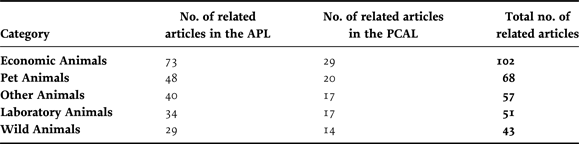
Table 2 provides a comparison of statutory protection given to various categories of animals in the two draft laws. For comparative purposes, only articles specifically regulating protection and anti-cruelty are counted. They include protection provided to each category of animals, as well as stipulations concerning epidemic prevention, veterinary treatment and principal cruelty prevention guidelines which cover all categories of animals. Articles relating to general principles, international co-operation and legal liability are not counted.
Quantitative comparison of articles in the draft laws based on animal category.
The results showed that, in quantitative terms, Economic Animals evidently received the most legal attention in both draft laws, with a total of 102 articles dedicated to their protection. This could be due to the fact that both draft laws have included two separate chapters in order to better regulate their transport and slaughter. Pet Animals followed at 68. Animals in the Other Animal category scored a total of 57 articles, while 51 and 43 articles covered Laboratory Animals and Wild Animals, respectively. Notably, the two categories of animals that are currently afforded a relatively high level of protection in China – Wild Animals and Laboratory Animals – have received the least amount of legal attention in both laws. This could mean that the protections set out in the draft laws for Wild and Laboratory Animals are intended to complement existing legislation. Confirming this, Chang (Reference Chang, Chang, Michaels, Littlefair and Li2010g, p. 342) claims that the PCAL's provisions concerning Wild Animals are intended to supplement the Wildlife Protection Law in the aspect of cruelty prevention. Strikingly, the total number of articles has been more than halved from 182 in the APL to 83 in the PCAL.
Now we will examine and compare the protection afforded to different types of animals by the two draft laws in detail.Footnote 16 The analysis probes the extent to which the laws are ‘globalised’ in terms of incorporating Western animal protection principles such as ‘unnecessary suffering’ and duty of care. In the meantime, it also highlights ‘localised’ provisions not commonly found in Western animal protection laws, and interprets them in relation to China's political, economic and social contexts.
5.1 Economic Animals
The draft laws define an Economic Animal as ‘an animal reared or possessed for the purpose of providing draught power or for producing food, feathers, hair, leather, fur or raw materials for medicines’.Footnote 17 The protective framework for Economic Animals in the APL is guided by overt economic and public health incentives:
‘The State encourages the humane rearing of economic animals and promotes the export of economic animals and animal products.Footnote 18 … The State encourages those work units, individuals and organisations with the requisite conditions to engage in free-range poultry and livestock production, in order to strengthen the immunity of economic animals, improve the quality of animal products and prevent the occurrence and spread of public health incidents.’Footnote 19
The APL has prescribed a fairly comprehensive duty of care for Economic Animals. Article 54 specifies requirements for the keeping of animals to ensure that those with animals under their control have the knowledge and skills needed to provide appropriate care. Further, it contains detailed requirements for meeting the behavioural, physiological and psychological needs of animals in large-scale intensive farming:
‘For the protection of economic animals, large-scale livestock farms should have or provide the following conditions:
(i) in a manner suited to the requirements of the animal's species, stage of growth, degree of adaptation, and degree of domestication, the animal should be provided with a living environment, food, water and care which are appropriate to its basic physical and physiological needs; the living environment should be able to withstand adverse weather, natural enemies and other hazards to the animal's health;
(ii) ensuring the freedom of activity consistent with the particular features of the species, an economic animal may not have its freedom of activity restricted in such a manner as to cause unnecessary suffering or harm;
(iii) the light, temperature, humidity, air circulation, ventilation, levels of concentration of toxic gases, noise and other environmental conditions in an economic animal's resting area should be provided in a manner suited to the requirement of the animal's species, stage of growth, degree of adaptation and degree of domestication …Footnote 20
The companionship needs of, and the lighting, keeper inspection and veterinary care requirements for Economic Animals have been addressed as well.Footnote 21 In addition to promoting a duty of care, such clauses are reminiscent of the necessary suffering principle. The underlying assumption is that the economic use of animals, for the benefit of humans, is absolutely acceptable, but, in extracting profit from animals, the law should protect against excessive suffering and provide minimally suitable environmental conditions.
Comparatively, the regulatory protection given by the PCAL to Economic Animals is almost solely focused on preventing unnecessary suffering. Economic Animals may not be driven or used in such a manner as to cause them unnecessary harm or suffering, and those who own or keep Economic Animals are ‘prohibited from abandoning in the wild those animals whose abandonment is improper or inappropriate’.Footnote 22 The requirements set out here are highly limited and generalised. They give no consideration to the physical and psychological needs of Economic Animals and fail to regulate negligence.
Both laws also provide for humane transport and slaughter, and highlight the prevention of unnecessary suffering during these processes. In regulating slaughter, for example, animals are required to be restrained in a manner that would not cause them avoidable pain and suffering, and be humanely stunned and bled rapidly, cleanly and thoroughly without being seen by other animals awaiting slaughter.Footnote 23 Overall, the APL again offers more substantive protection than the PCAL. For instance, to tackle the issue that a large number of China's farm animals are slaughtered inhumanely in illegal private abattoirs, the APL has designated places of slaughter and set detailed requirements; it also requires the persons engaged in animal slaughter to be qualified and experienced, which reinforces the duty of care.Footnote 24 These requirements are not found in the PCAL.
Despite growing public support for a ban on the consumption of dogs and cats in China, the issue remains highly contentious, as attested by the clashes between supporters of the dog/cat meat trade and animal lovers and activists in online debates and offline animal rescues. In view of this, Article 162 of the APL (Article 25 of the PCAL) can be said to be particularly progressive: ‘Based on local ethnic and cultural customs, People's Governments at the provincial level may prohibit the slaughter of dogs and cats and the transport and sale of cat and dog products in their jurisdiction.’ Although this does not completely ban the killing of non-domestic dogs and cats, it does leave room for public opinion to pressure local authorities to outlaw the practice.
5.2 Pet Animals
Although Pet Animals have the second highest number of articles relating to them, the quality of statutory protection they are afforded is far from adequate. The regulatory framework for Pet Animals in the APL largely serves the purpose of restricting and regulating pet ownership, as opposed to ensuring the well-being of pets. Out of the twenty-five articles contained in Chapter 5 of the APL (‘Legal Protection for Pet Animals’), only eleven address welfare and protection (including three articles that exclusively focus on stray animals). The regulatory framework for Pet Animals is clearly dominated by a heightened concern for public health and human safety. Article 64 of the APL sets the tone for Pet Animal protection legislation:
‘The State implements a policy of regulating the keeping of cats and dogs. In order to protect public health and safety in cities and towns in rural areas, the People's Governments of municipalities and counties may stipulate a maximum number of cats and dogs that may be kept by each household.’
Local governments also have the power to designate areas where cats and dogs cannot be kept or exercised;Footnote 25 aggressive or large dogs are forbidden in the so-called ‘key management areas’Footnote 26 – i.e. cities and densely populated residential areas; people wishing to keep a dog or cat need to submit an application;Footnote 27 and in their outdoor exercise, ‘dogs should be prevented from barking, and cats and dogs from behaving aggressively’.Footnote 28 These regulations bring to mind the controversial ‘One Dog Policy’ and the frequent crackdowns on large breeds of dogs in China in recent years, which have outraged many dog owners (see Makinen, Reference Makinen2013).
A notable feature of the APL and PCAL is that almost all the protection is aimed at cats and dogs, excluding other animals that might also be considered pets. The APL defines pets as ‘any domesticated or tame animal, including cats, dogs, birds, horses, parrots or other species, which is possessed or intended to be possessed, for the purposes of personal recreation or companionship’.Footnote 29 However, the rest of its articles make no mention of animals other than cats and dogs. This species discrimination could be due to the fact that ownership of other animals as pets is still uncommon in China, although gaining popularity. Or the reason might be that the drafting committee simply considered cats and dogs to be more popular and visible, meaning that they are thought to represent all animals in this category.
Despite its overwhelming emphasis on Pet Animal management and regulation, the APL does attempt to promote a duty of care. This is evident in its Article 79, which requires that ‘those who own, keep and care for Pet Animals should as far as is appropriate observe their duties to their pets’, including having them immunised and neutered, and providing care and treatment when necessary. Individuals or organisations with a past record of abandonment of or cruelty to animals are not allowed to apply for pet registration.Footnote 30 The APL also requires cat and dog breeders to be experienced in caring for animals, and pet animal breeding businesses to meet the same conditions as farms that keep Economic Animals.Footnote 31 Another duty of care clause is contained in Article 143, which deals with the transport of domestic cats and dogs: the person caring for an animal is asked to complete an ‘animal care form detailing the food and drinking water provision and other content’ and to ‘provide drinking water at intervals no greater than 12 hours, and food at intervals no greater than 24 hours’. Overall, however, the positive welfare requirements set out by the APL for Pet Animals remain insufficient if compared to its duty of care provisions for Economic Animals. For instance, the behavioural and psychological needs of pets are not considered.
Compared to the APL, the PCAL has dramatically diluted the protections afforded Pet Animals. Despite its purpose as an anti-cruelty statute, the PCAL contains no articles on preventing unnecessary suffering in domestic pets, nor does it establish any duty of care protocols. It is largely focused on preventing abandonment and formalising the management of stray cats and dogs in terms of group care, rescue, detention, and quarantine and shelter procedures. This renders the PCAL powerless in preventing and prosecuting the neglect of and cruelty against Pet Animals.
Notably, the PCAL requires the state to ‘establish systems of designated places for the breeding and sale of cats and dogs and of identification and registration, in order to prevent cruelty towards and abandonment of, or unlawful use as economic animals of dogs and cats’.Footnote 32 These provisions are important, considering that many cats and dogs being transported across China to be slaughtered for food are poisoned or stolen pets/strays. This has been well documented by a journalistic investigation of animal welfare in China:
‘Some dogs are still farmed, but raising dogs for meat is expensive … Now, much of China's dog meat comes from ordinary dogs – animals that have been rounded up and shipped off to illegal slaughterhouses. Some are family pets captured by traders with catch poles, some are taken off the street, some are unlovable curs that didn't sell in pet shops.’ (O'Dwyer, Reference O'dwyer2012)
Possibly in an attempt to draw a line between Economic Animals and Pet Animals where slaughter and cruelty is concerned, the APL clarifies the definition of Pet Animals: ‘Once an individual animal that is not prohibited by law from being reared as a pet has been reared as a pet, then it shall be considered a pet animal for its entire life.’Footnote 33 This protects stray companion animals from being slaughtered and could work if an effective pet identification system is put in place (e.g. microchip). However, this clarification cannot be found in the PCAL. The laws also state that the stealing of stray cats and dogs under community care constitutes theft,Footnote 34 and the offender will face disciplinary action or even bear criminal responsibility depending on the severity of the offence.Footnote 35 If the PCAL is eventually adopted, this stipulation would afford China's large number of stray animals a much-needed layer of protection.
5.3 Other Animals
Other Animals include Exhibited Animals, Circus Animals, Sport Animals, animals used in media production and animals used for special work (e.g. police and customs dogs, rescue dogs, etc.).Footnote 36 Under the APL, the duty of care principle is well integrated into the statutory protection of Other Animals. Article 103 requires that ‘animal exhibits, performances or particular work should take as a guiding principle that the animals’ lives should be respected and their basic physiological and psychological needs should be met’. The articles that followed give elaborated requirements on humanely treating animals and prohibiting abandonment and cruelty. People who keep and care for the animals are required to demonstrate relevant knowledge and professional skills, maintain animal care records, closely monitor the physiological and psychological conditions of the animals, and refrain from engaging pregnant, sick or injured animals in sport, competition or other work.Footnote 37 The APL sets out highly detailed welfare and anti-cruelty provisions based on the needs of and issues relevant to all subcategories of Other Animals. The protective framework for Other Animals in the PCAL, on the other hand, is once again centred on preventing unnecessary suffering or harm without the inclusion of the duty of care requirements.
5.4 Laboratory Animals
The basic policy put forward in the APL for Laboratory Animals seeks to strike a balance between scientific research needs, social development and animal welfare.Footnote 38 Resembling Western animal welfare statutes in their approach to legalising Laboratory Animal welfare, the APL and PCAL have prioritised the concepts of pain minimisation and the prevention of unnecessary suffering. Underpinning these priorities is the aforementioned internationally recognised 3Rs of humane animal experimentation, which have been well integrated into the statutory protection set out in both laws:
‘The State encourages the sharing of experimental data and materials domestically and internationally, in order to reduce the numbers of laboratory animals used; the State also promotes replacement experimental methods, in order to reduce the number of unnecessary animal experiments; and refinement of experimental methodology, technology, content and procedures in order to avoid causing animals unnecessary suffering and harm … when different options are available, the experimental method which uses the smallest number of animals and which produces the least pain, suffering, distress or lasting harm, but which may still provide a satisfactory result, should be selected.’Footnote 39
While the PCAL's protection of Laboratory Animals largely centres on these two priorities, the APL has again proposed a more elaborated protective framework. It includes setting ethical standards in animal experimentation through the establishment of national and provincial laboratory animal ethics committees designated to release ethical guidelines and supervise animal experiments.Footnote 40 People whose work involves the use of Laboratory Animals need to apply for permits from provincial science and technology administrative departments, and conversely, only animals that have been approved by the departments as conforming to standardsFootnote 41 can be used in experiments.Footnote 42 Importantly, the APL regulates the housing and care of Laboratory Animals in great detail: the volume of space, housing layout, equipment and facilities in the animals’ living environment should conform to set standards; animals need to be provided with clean water and nutritious food at appropriate frequencies; their living conditions and health need to be closely and frequently monitored; and complete veterinary care must be given to sick animals.Footnote 43
5.5 Wild Animals
China's existing Wildlife Protection Law 1988 defines Wild Animals as ‘the species of terrestrial and aquatic wildlife which are rare or near extinction and the species of terrestrial wildlife which are beneficial or of important economic or scientific value’.Footnote 44 In view of this, major progress made by the APL and PCAL is the redefinition of Wild Animal as ‘non-domesticated animal of any species which exists under natural conditions’ as well as ‘wild animals and their subsequent generations which have been domesticated or trained by humans’.Footnote 45 The latter affords extra protection to those Exhibited Animals who have been removed from the wild or are descendants of Wild Animals.
In 2002, a university student named Liu Haiyang attacked five bears on display in the Beijing Zoo with caustic soda and sulphuric acid, causing severe burns and deaths (see Whitfort, Reference Whitfort2012). Since the bears he attacked were neither living in the wild nor ‘endangered’, the Wildlife Protection Law 1988 could not be applied to prosecute him, and he was charged with damaging state property but later acquitted of any criminal penalty (Whitfort, Reference Whitfort2012, pp. 350–351). The redefinition of Wild Animal in the APL and PCAL hence has significant implications for the protection of Wild Animals in China: if the PCAL is eventually adopted, Wild Animals that are not endangered or considered valuable to humans, and (qualified) captive wild animals and their offspring in zoos and wildlife parks, may also enjoy the legal status of wildlife and be afforded equal protection. In addition, in recent years zoos in China have been frequently exposed for mismanaging and maltreating animals in their care (see Wang, Reference Wang2014), which has often been blamed on financial stress (Whitfort, Reference Whitfort2012; Yang and Jin, Reference Yang and Jin2015). Addressing this issue, the draft laws specifically require zoos and wildlife parks that are starving animals or subjecting them to pain or disease due to management difficulties to report to relevant government departments, who can take over the establishments if necessary.Footnote 46
To protect free-living wildlife, both laws require the methods and equipment for the capture, hunting or killing of animals to conform to humane standards.Footnote 47 Contained in the APL but removed in the PCAL are stipulations concerning the keeping of wildlife breeding records, the prohibition of commercial consumption of free-living state-protected wildlife, the conditional consumption of domesticated state-protected wildlife, and the release of animals into the wild.Footnote 48 Importantly, the APL has designated the forestry administrative department under the State Council to set the ‘living space, temperature, drinking water, feed and other protection standards and requirements’ for Wild Animals.Footnote 49 This duty of care clause is missing in the PCAL. Overall, in the protection of both free-living and captive Wild Animals, the PCAL is once again weaker than the APL in almost all aspects.
VI. A unique Chinese–Western hybrid?
Having described, analysed and compared China's two animal protection law drafts, in this section we consider the extent to which China's emerging animal welfare framework might be said to be uniquely Chinese. As we have seen, at the time of drafting a range of views were expressed by commentators concerning whether animal welfare laws were suitable for China in general, and are suitable at this point in China's economic and social development, as well as the extent to which they might be considered an imposition, by the West, on China. We argue that China's animal welfare laws, the PCAL in particular, are in fact quite reminiscent of early Western animal welfare legislation. Nonetheless, some distinctly Chinese features can be identified and are sufficiently significant that critics should not conclude that China's proposed animal welfare framework is nothing more than a wholesale importation of Western laws. However, somewhat controversially, some of the elements that make China's animal welfare laws distinctly Chinese are those elements that do not adequately protect the interests of animals from harm. We consider each type of similarity and difference in turn, starting with the similarities.
6.1 The spirit of compromise
Although China has a socialist political system, similar conditions can be found that underlie the emergence of the draft laws and the passing of animal protection and anti-cruelty statutes in some Western countries. Civil activism in China has always been linked to the influence of elites and urbanites who have used their personal, political and social connections to advance particular causes such as environmental advocacy (Sima, Reference Sima2011, p. 484). Animal rights activism is no exception. This can be demonstrated by the fact that the drafting of the laws was spearheaded by an academic from the government-affiliated CASS and carried out by Chinese and foreign legal scholars and experts. The voices of an expanding Chinese middle-class population calling for the legal protection of animals also mirrors the intensity of sympathetic public opinion towards animals in many Western countries before their first animal welfare law was enacted. The fast increase in the number of grassroots animal protection/rescue groups and NGOs in China also created favourable conditions for legislative change. The number of animal protection groups in China increased from 20 to 130 between 2002 and 2011 (Balaram and Su, Reference Balaram and Su2011), and since many activist groups operate in China without proper registration due to the complexity of registration procedures (Sima, Reference Sima2011, p. 480), the actual number is likely to be much higher. These developments are strikingly similar to those which facilitated the creation of modern animal protection statutes in the West. For instance, almost 200 years ago, Martin's Act was proposed by Sir Richard Martin MP, a member of the then British political elite, in the context of growing public support for the humane treatment of animals (O'Sullivan, 2011). Public pressure, elite influence and the emergence of animal protection groups also heralded the creation of animal protection or anti-cruelty laws in many other countries, including France, Germany and the US (Mang, Reference Mang, Ping and Xueli2005).
As discussed at length, duty of care requirements set out in the APL are largely missing in the PCAL. This is perhaps not surprising considering the change from ‘animal protection’ to ‘prevention of cruelty’ in the title and focus of the draft laws. Notably, this has deviated from the aforementioned international legislative trend, which has shifted to address positive welfare in addition to criminalising cruelty. While it has been argued that China cannot effectively protect its animals without the inclusion of a statutory duty of care in its animal protection law (Whitfort, Reference Whitfort2012), members of the law's drafting committee have defended their decision to remove welfare provisions from the PCAL in consideration of China's current circumstances (see, for example, Littlefair, Reference Littlefair, Chang, Michaels, Littlefair and Li2010).
In fact, the watering-down of the draft law illustrates that China's animal protection law-making is working through the same trajectory that has been observed elsewhere. Anti-cruelty legislation has tended to be the first step in the creation of animal welfare laws. Take the UK, for example: the full name of its first animal protection law, Martin's Act, was the Act to Prevent the Cruel and Improper Treatment of Cattle. As the name suggests, the biggest achievement of the act was criminalising cruel treatment of cattle (O'Sullivan, 2011). It stated that a penalty would result ‘if any person or persons shall wantonly and cruelly abuse or ill-treat any Horse, Mare, Gelding, Mule, Ass, Ox, Cow, Heifer, Steer, Sheep or other Cattle’.Footnote 50 This shows that, at the beginning, anti-cruelty was the legislative priority and the law was imperfect in many aspects by today's standards (e.g. the exclusion of other categories of animals). The Act was repealed by the Cruelty to Animals Act (1835, 1849, 1876), which retained the anti-cruelty focus. This focus was replaced by comprehensive protection in 1911 when the Protection of Animals Act was passed in the UK. In addition to extending anti-cruelty regulations, the Protection of Animals Act also introduced the concept of unnecessary suffering. In 2006, the Animal Welfare Act was passed, which advanced the welfare of animals by adding the duty of care principle and criminalising negligence.
Indeed, the two-steps-forward, one-step-back process of establishing an animal welfare legal framework in China is very reminiscent of the UK's experience. No fewer than four attempts were made to create an animal welfare law in the UK before Richard Martin's Act was finally introduced in 1822 (O'Sullivan, 2011, p. 147). It too was born of political compromise and very much weaker than Martin had hoped for. Merely two pages in length, it included only some of the provisions Martin had originally foreshadowed (O'Sullivan, 2011, p. 148).
6.2 Theoretical underpinnings
As our analysis shows, the two draft Chinese laws are based largely on Western legal frameworks. They have absorbed the earlier-analysed Western animal welfare philosophies of unnecessary suffering and duty of care to different extents. The APL defines animal protection as ‘any conditions or measures provided which benefit an animal's normal growth, reproduction, veterinary treatment, rescue etc., and conditions or measures which avoid causing unnecessary pain and harm to animals’,Footnote 51 reflecting both one's duty to care for animals as well as the prevention of unnecessary suffering. The legalisation of duty of care in the APL is particularly evident in the protection of Economic and Laboratory Animals, which has extended consideration to their physiological and psychological needs. Further, the prevention of unnecessary suffering has been identified as a guiding principle in both laws. According to Chang (Reference Chang, Chang, Michaels, Littlefair and Li2010a, p. 251), in writing the PCAL, the drafting committee consulted the legislative experiences of the EU, the US, Australia, Canada, India, Hong Kong SAR and Taiwan.
Additionally, the draft laws have allocated protection based on different animal categories and management processes (Chang, Reference Chang, Chang, Michaels, Littlefair and Li2010e, p. 167). Apart from one chapter in the APL that regulates transport, which indeed sets different protection standards for animals of various species, the protection outlined elsewhere in the draft laws is overwhelmingly category-driven. The categorisation of animals in this way is arbitrary and based on the uses humans make of animals, rather than more scientific categorisation, such as species groups, for example. In other words, as in the West, human preference for some animals over other animals, based either on popularity or a desire to extract profit from them, informs the level of protection received by different types of animals under the proposed Chinese laws. This species discrimination has attracted criticisms in relation to current Western animal protection statutes. Joan Schaffner (Reference Schaffner2011) argues that current Western animal welfare legislation is both speciesist and anthropocentric. In other words, they are ‘biased, or negatively discriminatory, against certain types of animals in specific contexts’ (O'Sullivan, 2011, p. 36). It appears that a similar speciesist legal framework has been incorporated into the Chinese draft laws. For example, a dog identified as an Economic Animal can be slaughtered for food, while one identified as a pet cannot.
6.3 A weakened understanding of cruelty
Yet while much of the Chinese legislation is familiar from a Western perspective, this is not the full story. Some aspects of the draft laws appear to be markedly Chinese, and therefore unlike provisions typically found in the West. For example, most of the legal requirements are general and sketchy, and do not prescribe enforceable minimum standards. Although this can also be said of some Western statutes, they tend to have accompanying codes of practice and/or regulations that provide detailed standards and requirements. These codes and regulations are almost non-existent in China.
Most strikingly, the PCAL's definition of cruelty is somewhat at odds with a typical Western definition. The APL initially included ‘deliberate action’ and ‘serious negligence’ (zhongda shuhu) as the bases for defining cruelty.Footnote 52 Chang (Reference Chang, Chang, Michaels, Littlefair and Li2010h, p. 56) stated that ‘the harm inflicted on an animal as a result of average negligence does not constitute cruelty, because everyone can be negligent sometimes’, arguing that this cruelty definition better reflects China's current conditions. Arguably, using ‘serious negligence’ as a benchmark for determining cruelty is problematic, since the line between ‘serious’ and ‘average’ negligence is open to subjective interpretation. However, even the phrase ‘serious negligence’ was removed in the PCAL, which reduced the definition of cruelty to ‘the deliberate use of brutal means or methods to cause unnecessary suffering or harm to an animal, or the use of brutal means or methods to kill an animal’.Footnote 53 This suggests that, under the PCAL, negligence and unintentional actions that cause unnecessary animal suffering or even death do not count as cruelty.
Commenting on this weakened definition of cruelty, Michael Radford (Reference Radford, Chang, Michaels, Littlefair and Li2010, p. 314) points out that, in many countries, the majority of animal abuse is not caused by intentional violence but neglect, therefore deliberate intent should not be the only basis for defining cruelty. He argues that different actions can be taken, based on the severity and frequency of neglect: the toughest penalties only apply to the worst cases of offence; in cases of potential cruelty caused by neglect, a formal notice is issued that requires animal keepers to immediately amend their conduct (p. 315). This arrangement is less likely to cause overpunishment and as a result seems to be better suited to China's current conditions. The PCAL's current clear-cut, undifferentiated definition of cruelty does not provide the best solution to preventing animal abuse, and contradicts the unnecessary suffering concept upon which it is premised.
6.4 Other distinctive Chinese features
Another evident difference between the Chinese laws and existing Western statutes lies in the lack of protection allocated to Pet Animals. As argued, under the proposed Chinese laws, greater weight has been given to regulating pet-keeping and preventing harm to other animals and humans than protecting Pet Animals from harm. This constitutes management rather than protection. Dangerous dog laws and breed bans can be found elsewhere. For instance, in the US many states have enacted such laws. A significant difference between China and other countries, however, is that the statutory protection given to Pet Animals in the Chinese draft laws has been overwhelmed by animal controls. This could partially be due to the rampancy of rabies in China, which has posed a serious public health threat.
O'Sullivan (2011) found that in many Western countries such as Australia, Pet Animals, being the most visible category of animal, are some of the most effectively protected animals before the law. Our analysis suggests that the Chinese draft laws have afforded the highest level of protection to Economic Animals. This might be attributed to the sheer number of farm animals in China, their relatively low visibility, and hence the need for greater protection, and the fact that China's exports of meat and other animal products have long been affected by non-compliance with international farm animal welfare standards. Therefore, an improvement in the welfare of Economic Animals that meets existing international legislative standards will benefit China in its trade activity.
Other differences between China and the West can also be found. First, regulations pertaining to hoarding are missing from both Chinese draft laws, probably due to the fact that it is not currently a common problem in China. Second, both draft laws have regulated the care and management of stray animals at length. This should be commended considering the large presence of strays in China and the resulting health and welfare problems. The humane destruction (rendao huimie) of abandoned or ownerless animals who cannot be rehomed, which is often regulated by Western animal protection statutes, has been replaced with ‘humane management’ (rendao chuli) in the Chinese draft laws.Footnote 54 According to Chang (Reference Chang, Chang, Michaels, Littlefair and Li2010h, p. 59), this progressive provision is based on compassionate grounds and requires animal shelters and rescue establishments to keep providing for abandoned and ownerless animals who have not been adopted, given that the organisations have the resources, and that the animals are healthy.
Finally, although the draft laws have banned the killing and consumption of dogs and cats of the Pet Animal category, they have allowed the consumption of cats and dogs if they are bred as Economic Animals. Perhaps this is a compromise that had to be made in order to have the law considered and passed. As testament to this, China's state-run newspaper, People's Daily, which is known to officially represent government positions, published an editorial in June 2014 as conflict erupted (once again) between people who support the consumption of dog meat and animal-loving activists at the infamous Yulin Dog Meat Festival. The editorial stated that ‘in reality, dogs can be companion animals as well as food’, and called on both sides to exercise constraint and tolerance, while also arguing against the abuse, stealing and public slaughter of dogs (Wu, Reference Wu2014). This shows that the government has taken a cautious and neutral stance on the issue so as not to inflame either side, and to prevent the confrontation from escalating into a social crisis. It is unlikely that the consumption of dogs and cats can be completely banned in China at this stage. That being said, dog-eating is only common in some parts of the country and is considered a culinary tradition by a minority of the Chinese population. Many Chinese, especially those living in big cities like Beijing and Shanghai, do not see it as an acceptable practice. Therefore, if the PCAL is eventually enacted, it can potentially have the practice outlawed in some parts of China first.
VII. Conclusion
In conclusion, analysis of the Chinese draft laws reveals that Western animal welfare traditions have had a marked influence on the way China has so far gone about developing its own animal protection regime. Over 200 years of animal protection policy-making globally, the involvement of academic and policy elites, and the globalisation of trade, has all exerted influences on the Chinese draft laws in following a tested legislative trajectory. This study has demonstrated that, to a certain extent, China has emulated existing Western animal protection statutes by adopting similar frameworks and concepts. This is despite certain philosophical principles and aspects of existing Western animal protection statutes themselves being anthropocentric and species-discriminatory. Consequently, the proposed laws do not provide new ways of conceptualising state-sponsored animal protection.
Yet despite evidence of external influence, we have identified a range of principles included in the laws that are distinctly Chinese. These include provisions that address issues of particular relevance to China, such as a strong emphasis on pet control, greater consideration given to the care and management of stray animals, and the permissibility of eating dogs and cats raised for food. In addition, Chinese law-makers had to prioritise a prevention of cruelty law and introduce a relaxed definition of cruelty in sync with China's current conditions, which has curtailed the law's ability to offer effective protection and deter animal abuse caused by neglect. This suggests that while Western trends are likely to influence animal welfare law-makers in developing countries, it is unlikely that Western laws will be adopted wholesale by countries creating animal welfare laws for the first time. Rather, based on the Chinese experience, it seems more likely that they will be influenced by the West, but also seek to incorporate locally conducive principles and practices.