The impact of genetic abnormalities on the post-operative course of patients with CHD varies and has been the subject of prior investigation.Reference Doell, Bernet, Molinari, Beck, Balmer and Latal 1 , Reference Simsic, Coleman, Maher, Cuadrado and Kirshbom 2 Greater morbidity after surgery for CHD may be associated with having a genetic syndrome.Reference Alsoufi 3 A microdeletion within chromosome 22q11 is common in children with conotruncal heart defects, affecting 16–40% of patients with tetralogy of Fallot with pulmonary atresia.Reference Carotti, Digilio, Piacentini, Saffirio, Di Donato and Marino 4 – Reference Maeda, Yamagishi and Matsuoka 7 In several studies, a chromosome 22q11 deletion was associated with worse early and late postoperative outcomes and mortality following cardiac surgery.Reference Brenner, Clarke and Mahnke 8 – Reference Chen, Chiu and Wang 15
Carotti et alReference Carotti, Marino and Di Donato 16 suggested that, among patients with tetralogy of Fallot, pulmonary atresia, and major aortopulmonary collaterals, those with a chromosome 22q11 deletion may have greater postoperative morbidity, possibly related more to immunologic function than to cardiovascular anatomy. Our institution has developed a significant experience in the perioperative management of this patient population.Reference Bauser-Heaton, Borquez and Han 17 One of our observations has been that children with tetralogy of Fallot, pulmonary atresia, and major aortopulmonary collaterals undergoing unifocalisation surgery are at risk for prolonged respiratory failure and prolonged intensive care and hospital stays owing to the extensive nature of this surgery.Reference Asija, Hanley and Roth 18 However, little is known about whether patient-related factors, including genetic anomalies, are associated with these outcomes. We hypothesised that patients with a chromosome 22q11 deletion are at an increased risk for greater morbidity following unifocalisation surgery – in particular, longer durations of respiratory failure and ICU and hospital stays.
Methods
Patients
All tetralogy of Fallot, pulmonary atresia, and major aortopulmonary collaterals patients undergoing unifocalisation surgery from 2008 to 2016 at Lucile Packard Children’s Hospital Stanford were included in the inception cohort for this retrospective cohort study. The cohort was established by interrogating the tetralogy of Fallot, pulmonary atresia, and major aortopulmonary collaterals REDCap database that is maintained by the Clinical and Translational Research Program of the Heart Center at Lucile Packard Children’s Hospital Stanford. Patients with unknown 22q11 deletion status and genetic syndromes other than 22q11 deletion were excluded from the study. Patients undergoing aortopulmonary window placement alone, pulmonary artery revision, and right ventricle to pulmonary artery conduit replacement were excluded.
Patients underwent one of two categories of surgery: bilateral complete unifocalisation and complete intracardiac repair with ventriculoseptal defect closure and right ventricle to pulmonary artery conduit placement or revision unifocalisation with complete repair; or bilateral or unilateral unifocalisation without intracardiac repair with placement of an aortopulmonary shunt.
As detailed in earlier reports, our institutional approach to tetralogy of Fallot, pulmonary atresia, and major aortopulmonary collaterals is to perform a complete single-stage unifocalisation surgery with intracardiac repair if the pulmonary artery pressure is below a threshold level after the pulmonary artery branches are reconstructed. Children not meeting this pulmonary artery pressure threshold undergo unifocalisation to a central aortopulmonary shunt and are re-evaluated for intracardiac repair after 6–12 months.Reference Bauser-Heaton, Borquez and Han 17 , Reference Malhotra and Hanley 19 This surgical protocol is detailed in prior studies.Reference Malhotra and Hanley 19 The decision to close the sternum after unifocalisation surgery is made at the surgeon’s discretion in the operating room.
Data collection
Demographic data were collected including age, gender, weight, length, and 22q11 chromosome status. The following clinical data were collected: cardiopulmonary bypass time; duration of mechanical ventilation – time to first extubation; intraoperative right to left ventricular pressure ratio; type of surgery – complete intracardiac repair versus unifocalisation without intracardiac repair; need for re-operation; need for delayed sternal closure; use of extracorporeal membrane oxygenation postoperatively; diaphragm paralysis postoperatively; and length of ICU and hospital stay. Patients were separated into two groups: those with 22q11 deletion and those without.
Data analysis
Outcomes were compared between patients with and without a chromosome 22q11 deletion. We tested all variables for normalcy. Groups were compared using Wilcoxon rank sum and Fisher’s exact tests, as appropriate. Variables were expressed as either mean with standard deviation or median with first and third quartiles. Multivariable logistic and linear regression analysis was used to adjust outcome analyses for potential confounders, including type of postoperative physiology – unifocalisation to an aortopulmonary shunt versus complete repair – and duration of cardiopulmonary bypass. For dichotomous outcome variables, odds ratios (ORs) or unstandardised β coefficients are presented with 95% confidence intervals. All statistical testing was conducted using SPSS version 23.0 (IBM SPSS Statistics, New York, United States of America). A p value <0.05 was considered statistically significant.
Results
A total of 180 patients met the inclusion criteria. In all, 73 patients had a documented chromosome 22q11 deletion (41%), and 70 patients in the time period had unknown 22q11 deletion status. Patients with 22q11 deletion were more likely to be female and were younger and weighed less at the time of surgery than those with a normal genotype (Table 1). A similar percentage of patients in each group had a prior surgical intervention (Table 1).
Comparison of demographic and preoperative characteristics in patients with and without 22q11 deletion.

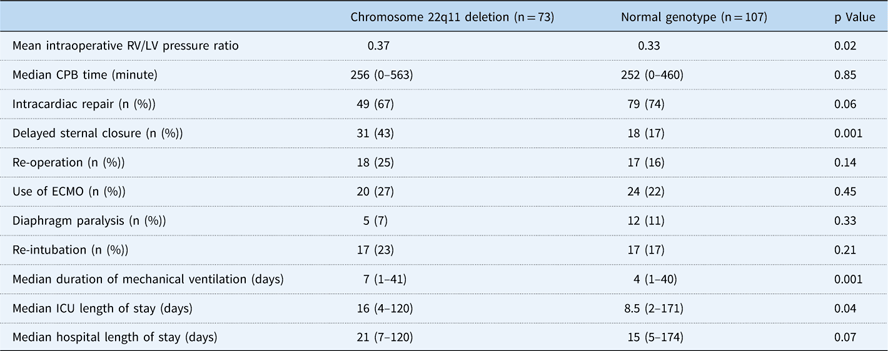
There was no difference in the proportion of patients with (67%) and without a chromosome 22q11 deletion (78%) who underwent complete intracardiac repair at the first surgery (Table 2). The right to left ventricular pressure ratio after completion of repair was higher in patients with a 22q11 deletion. Cardiopulmonary bypass time was similar between the two groups, as was the proportion of patients who underwent an additional operation during the initial admission. Re-operations included surgical exploration for postoperative bleeding, and diaphragm plication; there were no ventricular septal defect patch revisions or takedowns. Delayed sternal closure was significantly more common in patients with a chromosome 22q11 deletion (OR 4.1, 95% confidence interval (CI) 1.7–9.6; p=0.001), and remained significantly associated with a 22q11 deletion (OR 4.7, 95% CI 2.1–10.9; p<0.001) after adjustment for type of postoperative physiology (aortopulmonary shunt, OR 4.7, 95% CI 1.7–13.2; p=0.003) and duration of cardiopulmonary bypass (OR 1.012 per minute (each additional minute of cardiopulmonary bypass was associated with 1.012 odds of delayed sternal closure), 95% CI 1.007–1.016; p<0.001). In addition, the median duration of mechanical ventilation was significantly longer in patients with a 22q1l deletion than those without (7 versus 4 days, β 4.3, 95% CI 1.3–7.3; p=0.005) even after adjustment for type of post-operative physiology (β 2.9, 95% CI −0.3–6.2; p=0.079) and delayed sternal closure (β 5.5, 95% CI 2.2–8.8; p=0.001). Similarly, the median ICU stay was longer in patients with a 22q11 deletion than those without (16 versus 8.5 days, β 7.0, 95% CI 0.3–13.1; p=0.040) on unadjusted analysis and when adjusted for physiology (aortopulmonary shunt, β 13.0, 95% CI 5.9–20.1; p<0.001). Total postoperative hospital length of stay did not differ significantly according to the presence of a 22q11 deletion either with or without adjustment (Table 2).
Comparison of intraoperative and postoperative characteristics in patients with and without 22q11 deletion.

CPB=cardiopulmonary bypass; ECMO=extracorporeal membrane oxygenation; LV=left ventricle; RV=right ventricle
In the 180 cases, extracorporeal membrane oxygenation was used 44 times: 20 (27%) in those with 22q11 deletion and 24 (22%) in those without (p=0.45). Seventeen patients had a paralysed diaphragm: 5 (6.8%) in those with 22q11 deletion and 12 (11.2%) in those without (p=0.32). There were 34 re-intubations, 17 in each group: 23% of those with 22q11 deletion and 17% of those without (p=0.21). These data can be seen in Table 2.
Discussion
In this analysis of consecutive patients with tetralogy of Fallot, pulmonary atresia, and major aortopulmonary collaterals who underwent unifocalisation surgery over a 9-year period, we found that patients with 22q11 deletion are at risk for a more complicated postoperative course. Compared with patients with a normal genetic evaluation, they had a higher incidence of delayed sternal closure and longer durations of mechanical ventilation and ICU stay. Anticipating a more complicated postoperative course in this population may improve outcomes by promoting earlier recognition of possible complications.
Timing of surgery is protocolised at our institution, with recommended timing of surgery being 4–7 months of age.Reference Malhotra and Hanley 19 The 22q11 deletion patients were within this range, and the non-22q11 deletion patients were older at the time of surgery. We speculate that this may be an indication that those with 22q11 deletion were referred for surgery at an earlier time owing to symptomatology and could be the subject of future studies.
A majority of patients in both the 22q11 deletion and non-22q11 deletion groups were able to undergo complete intracardiac repair, suggesting that extensive surgical pulmonary artery reconstruction resulting in sufficiently low pulmonary artery pressures can be achieved to safely close the ventricular septal defect regardless of genotype, although we previously found that 22q11 deletion is associated with higher immediate post-repair right to left ventricular pressure ratio.Reference Bauser-Heaton, Borquez and Han 17 The incidence of early re-operation was also similar between groups, suggesting that patients with 22q11 deletion are unlikely to be at higher operative risk. However, some of this risk may have been mitigated by the higher incidence of delayed sternal closure in patients with 22q11 deletion. The decision to leave the sternum open was not protocolised and was based on the patient’s risk of destabilisation after surgery. This difference may indicate an observed clinical difference in the operating room worthy of further study, although cardiopulmonary bypass times were not different between the groups.
Because patients with mixing physiology after surgery may be at higher risk for postoperative complications, we adjusted outcome analyses for this variable. Patients with 22q11 deletion had persistently longer durations of mechanical ventilation. One reason is that patients with 22q11 deletion were smaller and younger at the time of surgery. Another plausible explanation is that patients with 22q11 deletion are at risk for respiratory complications. Patients with 22q11 deletion often have difficulties with feeding owing to palate abnormalities and are at risk for pulmonary aspiration (Koth, unpublished 2017). They are also more likely to have baseline airway abnormalities such as broncho- or tracheomalacia.Reference Sidell, Koth and Bauser-Heaton 20 – Reference Huang and Shapiro 24 Unifocalisation and pulmonary artery reconstruction surgeries involve extensive dissection out to the segmental or subsegmental level to relieve even the most distal obstructions, in an effort to achieve the lowest pulmonary artery pressure and optimise the potential for ventricular septal defect closure. Such dissection probably contributes to inflammation and significant airway secretions and postoperative respiratory failure. Given the increased risks for patients with 22q11 deletion based on preoperative factors and airway problems, it is not surprising that they would have a more prolonged course compared with non-22q11 deletion patients. Understanding the mechanisms of prolonged respiratory failure in 22q11 deletion patients is the subject of further studies from our institution.
Limitations
This study is limited by its retrospective design. Although data were generally complete, information on chromosome 22q11 deletion status was not available for all possible patients, limiting the number in our cohort. It was not previously part of our protocol to test patients for this deletion, leading to a large number of unknowns. In addition, these findings reflect the experience of a single centre, which treats many patients with tetralogy of Fallot, pulmonary atresia, and major aortopulmonary collaterals, and as such may not be generalisable to centres with different management approaches. The gestational age at birth of the patients enrolled in our study is unknown. Prematurity could lead to poor lung development and could skew the results of our study.
Given the extensive dissection needed for unifocalisation, prolonged cardiopulmonary bypass times, and occasional reperfusion injury, diagnosing infection in this population is incredibly difficult and fraught with false positives. Therefore, we did not include infection into our analysis but believe that this could be studied better in a prospective manner.
Conclusion
Children with tetralogy of Fallot, pulmonary atresia, and major aortopulmonary collaterals and 22q11 deletion are at risk for greater prolonged mechanical ventilation after unifocalisation surgery. Careful attention should be given to the co-morbidities of this population in the perioperative period to mitigate risks that may complicate the postoperative course.
Acknowledgement
None.
Financial Support
This research received no specific grant from any funding agency or from commercial or not-for-profit sectors.
Conflicts of Interest
None.