

INTRODUCTION
Although the idea that infection by metazoan parasites increases with age in fish hosts is not new (see Dogiel et al. Reference Dogiel, Petrushevski and Polyanski1958), recent empirical evidence suggests that a wide range of host traits, such as body size and/or age (e.g. Guégan and Hugueny, Reference Guégan and Hugueny1994; Lo et al. Reference Lo, Morand and Galzin1998; Vidal-Martinez et al. Reference Vidal-Martinez, Kennedy and Aguirre-Macedo1998; Poulin, Reference Poulin2000; Johnson et al. Reference Johnson, Nelson and Dock2004), habitat and diet (e.g. trophic status, feeding rates; Sasal et al. Reference Sasal, Niquil and Bartoli1999; Muñoz et al. Reference Muñoz, Grutter and Cribb2006), degree of vagility (Kennedy, Reference Kennedy, Esch, Bush and Aho1990), social behaviour and schooling (Bartoli et al. Reference Bartoli, Morand, Ruitort and Combes2000; Luque et al. Reference Luque, Mouillot and Poulin2004) act jointly to provide structure to fish parasite communities. However, studies at the host population level are necessary to pinpoint the role of host age per se, and these are still few.
Nested subset analyses have proved a useful analytical tool to detect size/age-associated compositional heterogeneity across fish parasite assemblages (Guégan and Hugueny, Reference Guégan and Hugueny1994; Poulin and Valtonen, Reference Poulin and Valtonen2001; Timi and Poulin, Reference Timi and Poulin2003). An ontogenetic shift in host diet and/or habitat utilization is a straightforward mechanism that can produce nested patterns of infracommunity structure (e.g. Rohde et al. Reference Rohde, Worthen, Heap, Hugueny and Guégan1998; Poulin and Valtonen, Reference Poulin and Valtonen2001). However, the addition of size-dependent parasites (i.e. with prevalence increasing with size due to higher feeding rates of the host and/or accumulation of parasites) to a baseline community of size-independent parasite species can also result in a nested structure in the absence of a strict diet shift (Zelmer and Arai, Reference Zelmer and Arai2004). Therefore, other approaches must be combined to nested subsets analyses to determine exactly how the acquisition of parasites in relation to host age serves to structure parasite communities.
Here, we address these questions using a model species. The bogue, Boops boops (L.), is an omnivorous (trophic level 2·5–2·97), demersal to semipelagic non-migratory species of fish. It is gregarious, found on the shelf of the coastal pelagic zone at a depth range 0–350 m (Froese and Pauly, Reference Froese and Pauly2007). Although the bogue is perhaps one of the most abundant species in both the Mediterranean and the North-East Atlantic (Valle et al. Reference Valle, Bayle-Sempere and Ramos-Esplá2003; Boyra et al. Reference Boyra, Sanchez-Jerez, Tuya, Espino and Haroun2004), data on its feeding habits are scarce and somewhat ambiguous. Thus, Bell and Harmelin-Vivien (Reference Bell and Harmelin-Vivien1983), who considered B. boops to be microphagic carnivores, found that juveniles normally feed high in the water column but, on occasions, descend to browse on algae within the seagrass canopy. They recorded fairly large quantities of algae eaten by juveniles, whereas Bauchot and Hureau (Reference Bauchot, Hureau, Whitehead, Bauchot, Hureau, Nielsen and Tortonese1986) considered that juveniles are mostly carnivorous and adults mostly herbivorous. Linde et al. (Reference Linde, Palmer and Gómez-Zurita2004) classified B. boops as suction-feeding secondary planktivores, Karpouzi and Stergiou (Reference Karpouzi and Stergiou2003) as omnivores, and Stergiou and Karpouzi (Reference Stergiou and Karpouzi2002) as omnivorous with a preference for plant material but also feeding on a wide range of invertebrates. Finally, Fernández et al. (Reference Fernández, Moyano, Díaz and Martínez2001) suggested that B. boops is mainly herbivorous whereas Ruitton et al. (Reference Ruitton, Verlaque and Boudouresque2005) have shown that grazing of algae by bogue only occurs in the post-spawning period.
B. boops hosts a large number of metazoan parasites (67 species) among which we identified a group of 9 species with a wide geographical distribution, forming the core of the bogue parasite fauna and consistently present in both Mediterranean and N.E. Atlantic fish (Pérez-del Olmo et al. Reference Pérez-del Olmo, Fernández, Gibson, Raga and Kostadinova2007a). A pilot study on bogue revealed positive or negative (depending on the parasite species) correlations of abundance with fish size (unpublished observations). This size-associated variability in some bogue parasites (see also Renaud et al. Reference Renaud, Romestand and Trilles1980; Saad-Fares and Combes, Reference Saad-Fares and Combes1992) raises the question as to whether the observed community parameters are inherent to parasite communities in B. boops or merely artefacts of sampling heterogeneity with respect to fish size. Knowledge of size-related variation in parasite community composition and abundance among hosts in a fish population is essential for the adequate application of multivariate statistical analyses of entire parasite communities as biological tags of fish populations (Williams and MacKenzie, Reference Williams and MacKenzie2003, and references therein). Therefore, a study on the demography of parasite community structure as a function of size of individual hosts in bogue has important implications for investigations seeking to establish the harvest localities of fish or surveying post-oil spill recovery using bogue parasites (e.g. Power et al. Reference Power, Balbuena and Raga2005; Pérez-del Olmo et al. Reference Pérez-del Olmo, Raga, Kostadinova and Fernández2007b).
Here, using a single population sample from a single habitat, we examine the patterns of composition and structure of parasite communities in B. boops along a gradient of fish sizes in order to test the prediction that species forming the core of the parasite fauna and being responsible for recognizable community structure should appear in the fish population earlier than rare and stochastic species (e.g. Vidal-Martinez et al. Reference Vidal-Martinez, Kennedy and Aguirre-Macedo1998). We provide novel data on the sequential development of an unusual sparid-metazoan system characterized by high transmission rates and low levels of host specificity, focusing on (i) variation in community parameters, (ii) distributions of ‘key’ parasite species, and (iii) predictability of community composition with size. We further explore data on the life-cycles, distribution and host range of the parasites in the Mediterranean, and on host biology, to explain the observed patterns of parasite community structure.
MATERIALS AND METHODS
A total of 130 B. boops was collected by local fishermen in 2 days in June 2005 off Santa Pola (Spanish Mediterranean coast). Fish, transferred on ice to the laboratory, were measured [total length (TL, cm), standard length (SL, cm), weight (W, g)], labelled, and packed individually before being frozen. A subsample of fresh fish was examined to obtain live parasite material for a precise identification. Ecto- and endo-parasites were recovered according to a standardized protocol. All metazoan parasites were identified and counted. Worms were fixed and stored in 70% ethanol. Trematodes, monogeneans and acanthocephalans were stained with iron acetocarmine and examined as permanent mounts in Canada balsam. Nematode larvae were identified on temporary mounts in saline solution or glycerine. Voucher specimens have been deposited in the Parasite Collection of Cavanilles, Institute of Biodiversity and Evolutionary Biology, University of Valencia, Spain.
Ecological terms follow Bush et al. (Reference Bush, Lafferty, Lotz and Shostak1997). Species with a prevalence of >30% will be referred to henceforth as common, those with a prevalence of ⩽30% as rare and those with prevalence <10% as accidental. Component population size refers to the total number of individuals of a given species in the total sample. Observed species density distributions within total communities in each size-class were tested for fit to the null model of no interspecific interaction (Janovy et al. Reference Janovy, Clopton, Clopton, Snyder, Efting and Krebs1995). Due to the non-normal distribution of the data, Spearman rank correlations (rs) and non-parametric tests (Mann-Whitney (M-W) and Kruskall-Wallis (K-W)) were applied for statistical comparisons with a Bonferroni correction in post-hoc tests. Prevalences were compared with Fisher's exact test. Analyses were carried out using the statistics program SPSS® 12.0.
The data set (SL 10·2–25·0 cm) was stratified into 5 size-classes with 3·0 cm intervals (ranges and means in Table 2). All parasite taxa were divided into 2 groups (labelled ‘D’ and ‘F’ in Table 1; parasite assemblages referred to as DA and FA in the text) with respect to the mode of infection: (i) D, transmitted to fish directly or via cercarial penetration; and (ii) F, food-transmitted parasites. Parasites were classified into 3 categories with regard to their host specificity: (i) bogue specialists (BS); (ii) sparid generalists (SG); and (iii) generalists (G). Parasite life-cycle and host specificity data were compiled from an exhaustive search of literature sources and both the Host-Parasite Database (http://www.nhm.ac.uk/research-curation/projects/host-parasites/database/) and the Host-Parasite Catalogue compiled by the Natural History Museum, London. Data for the regional distribution of parasites were taken from a complete checklist of parasites of B. boops (see Pérez-del Olmo et al. Reference Pérez-del Olmo, Fernández, Gibson, Raga and Kostadinova2007a).
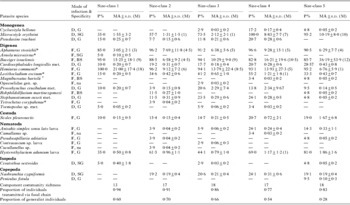
Prevalence (P%) and abundance (mean, MA±s.d. (median shown if >0 only)) of parasites in the sample of Boops boops stratified by size
(na, not applicable; BS, bogue specialist; SG, sparid generalist; G, generalist; D, transmitted via direct infection; F, transmitted via food ingestion. Hemiuroideans marked with a star.)

Nested subset analyses were carried out for the total parasite communities and separately for the separate matrices containing either directly transmitted or food-transmitted parasites using the Nestedness Temperature Calculator Program of Atmar and Patterson (Reference Atmar and Patterson1995). The latter matrices were further stratified by size-class and subjected to analysis. Matrices were packed maximally and the nestedness metric ‘temperature’ (T) was calculated. For each matrix, the value of T was compared with those of 1000 random matrices generated by Monte-Carlo simulations, with no row or column constraints, to assess the probability of randomly obtaining a matrix with the same or higher degree of order.
RESULTS
Parasites of B. boops off Santa Pola
Species composition, prevalence and abundance of each parasite in each size-class sample are summarized in Table 1. A total of 26 parasite species was found in the 130 fish examined from Santa Pola. These include 3 additional new host records (Camallanus sp., Cucullanellus sp. and Tormopsolus sp.). With respect to the mode of infection, 16 species were parasites with complex life-cycles transmitted to the final host by ingestion of the second intermediate/paratenic host. This group accounted for 84·6% of all parasites in the overall sample (range for size-class samples: 77·4–93·8%) and included 9 species of trematode with a high representation of the superfamily Hemiuroidea (6 species, 53·5% of individuals transmitted via food ingestion), 6 nematodes and a larval cestode. The remaining 10 species were parasites transmitted to fish directly (3 monogenean and 3 crustacean species) or via cercarial penetration (4 larval trematodes).
Generalist parasites comprised a considerable part of the component community in B. boops (16 species, 53·5% of all individuals) compared with bogue specialists (3 species, 35·4%) and sparid generalists (4 species, 11·1%). This excludes 3 taxa not identified to the species level but only being represented by 1 specimen each in the total sample (see Table 1).
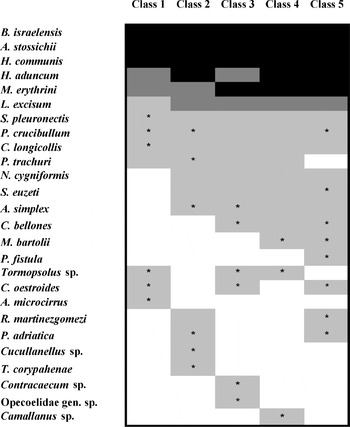
Fig. 1 shows the distribution of parasites in relation to their first appearance and prevalence in the size-class samples. Thirteen species colonized the fish of size-class 1. Seven species appeared for the first time in the second size-class and 3, 2 and 1 species were added to the species lists of the subsequent samples, respectively.
Schematic illustration of colonization and persistence (order of appearance and prevalence status) of bogue parasites in the component communities of the five size-class samples. ■, prevalence >60%;  , prevalence 30–60%;
 , prevalence 10–30%;
 , prevalence <10%.

Five groups of species can be distinguished with respect to their prevalence and persistence in the 5 samples stratified by size. Six species (B. israelensis, A. stossichii, H. communis, Hysterothylacium aduncum, Microcotyle erythrini and Lecithocladium excisum) were found in all 5 samples with high prevalence (>30%, common species; except for L. excisum with a prevalence of 15·0% in size-class 1). Of these, the first 3 species were the most frequent in all 5 size-class samples (prevalence: >60%, overall range: 83–100%) and represented the vast majority (78–95%) of the parasites found. Three species (Cardiocephaloides longicollis, Prosorhynchus crucibulum and Scolex pleuronectis) were recovered in all samples but at low prevalences (<30%, rare species). Four species occurred at low prevalences in 4 samples, and 6 species were found with low prevalences in 2 or 3 samples. Finally, a group of 7 species occurred in only one size-class and, with the exception of Peniculus fistula, in a single fish (accidental species). There was a highly significant negative correlation between the order of the ‘arrival’ of the species (coded 1–5, according to the size-class) and the prevalence at which they infected fish (rs=−0·643, P=0·0004; n=26).
Host size and parasite community descriptors
All specimens of B. boops examined were infected with 2–13 parasite taxa and harboured 7–245 individual parasites. Species density distributions in all 5 samples were found to fit the null model of no interspecific interaction based on frequency of co-occurrences (Janovy et al. Reference Janovy, Clopton, Clopton, Snyder, Efting and Krebs1995). Data on the mean parasite infracommunity richness and abundance in each size-class are given in Table 2. Assemblages formed by the two parasite groups with different transmission strategies (direct vs food transmitted) are presented as separate subsets.
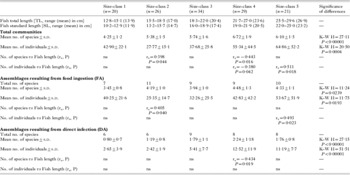
Community parameters of parasite assemblages, significance of differences and length correlations of infracommunity richness and abundance in the 5 size subsamples of Boops boops
(Abbreviations as in the Material and Methods section; ns, P>0·05.)

Infracommunities tended to increase in richness and abundance with host size (rs=0·399, P<0·0001 and rs=0·251, P=0·004, respectively). This positive association was stronger in DA (rs=0·389, P<0·0001 and rs=0·593, P<0·0001, respectively) and significant for the number of species only in FA (rs=0·210, P=0·017). Furthermore, there were significant differences in the distributions of species and individual parasites among the 5 size-classes (see Table 2). These differences were largely due to the higher parasite load in the largest size-classes (4 and 5) compared to size-classes 1 and 2. With respect to the distributions of individual parasites the lowest abundance of food-transmitted parasites in size-class 2 and the substantially higher load of directly-transmitted parasites in large fish (class 4–5) contributed to the overall significant differences for total communities by size (see Table 2).
Despite the narrow range of lengths within size classes, some within-class variability was observed. Thus, there were correlations between richness or abundance and host length in some size classes (see Table 2 for details).
Key parasite species
Six species (1 bogue specialist, 1 sparid generalist and 4 generalists) were present in all size samples (most with prevalences of >60% in at least 3 samples, see Fig. 1), and represented the majority of the parasites recovered in each size-class (96·8, 93·9, 90·3, 91·5 and 95·2% of all individuals, respectively). Of these, B. israelensis, H. aduncum and M. erythrini showed a positive correlation between abundance and fish size (rs=0·179, P=0·041; rs=0·281, P=0·001; and rs=0·646; P<0·0001, respectively) in contrast to H. communis that exhibited a negative association (rs=−0·379; P<0·0001). No significant relationship was found for A. stossichii and L. excisum.
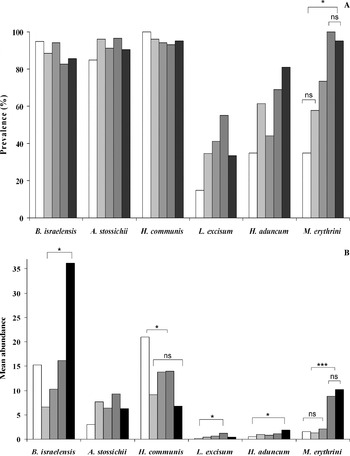
A tendency for an increase in prevalence with size was detected for H. aduncum (χ2=8·284; P=0·004) and M. erythrini (χ2=30·954; P<0·0001). However, with the exception of the monogenean M. erythrini, which had distinctly higher prevalences in the largest fish (classes 4–5 as compared to 1–2), the prevalence of infection by the dominant species did not differ significantly among the 5 size-classes of fish (see Fig. 2A). The abundance of M. erythrini also exhibited the most significant differences between size-classes (all P<0·00001), following the prevalence divergence pattern (Fig. 2B). The abundance of the other key species exhibited a few significant differences among size samples (Fig. 2B). A comparison of the within-class abundance distributions of the 3 most abundant trematode species showed significant differences exclusively in size-class 1 and 5. The smallest fish had more individuals of H. communis than A. stossichii and B. israelensis (P<0·0001; P=0·023), whereas in the largest fish, there were more individuals of B. israelensis (P=0·014; P=0·006).
Prevalence (A) and mean abundance (B) of the key species in parasite communities of Boops boops off Santa Pola. Error bars omitted for clarity. Differences between host size classes (the 5 columns, in order) indicated by asterisks (*, P<0·05; ***, P<0·001; ns, not significant).

There was a strong positive correlation (rs=0·813, P=0·008) between the regional distribution (measured by the number of records in Pérez del-Olmo et al. Reference Pérez-del Olmo, Fernández, Gibson, Raga and Kostadinova2007a) and local prevalence in our total sample of 9 taxa (B. israelensis, A. stossichii, H. communis, L. excisum, H. aduncum, Anisakis simplex, M. erythrini and Ceratothoa oestroides, forming the core of bogue fauna, plus unidentified tetraphyllidean larva Scolex pleuronectis) known from both the Mediterranean and Atlantic.
Host size and non-random community structure
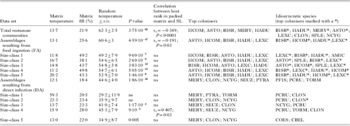
The pooled infracommunities in B. boops produced a significantly nested matrix, as did the assemblages, resulting from food ingestion (FA) and direct infection (DA) (Table 3). There were significant correlations between the standard length of individual fish and their rank order in the packed matrix in the total community and FA datasets (the latter being rather weak, with low values for both rs and P) but not in the DA dataset. Significant nested subset patterns were observed among FA of the 5 size-classes, as well as among DA of the larger fish (size-classes 3–5). With the exception of class 4 DA, no significant association between the rank order and size of fish was detected (Table 3).
Nested subset analyses results for the metazoan infra-assemblages in Boops boops from off Santa Pola (1000 Monte-Carlo simulation runs)
(ns, not significant; AMIC, A. microcirrus; ASTO, A. stossichii; BISR, B. israelensis; CBEL, C. bellones; CLON, C. longicollis; COES, C. oestroides; HADU, H. aduncum; HCOM, H. communis; LEXC, L. excisum; MERY, M. erythrini; NCYG, N. cygniformis; PCRU, P. crucibulum; PFIS, P. fistula; PTRA, P. trachuri; SEUZ, S. euzeti; SPLE, S. pleuronectis; TORM, Tormopsolus sp.)

In contrast, there was a strong association between the rank position in the matrix and component population size of parasites (total communities, rs=−0·961, P<0·0001; FA, rs=−0·949, P<0·0001; DA, rs=−0·854, P=0·0016). Furthermore, the order of species in the packed matrix of total communities was not related to either the mode of transmission (direct infection vs via food ingestion, P>0·05) or host specificity (generalists vs specialists, P>0·05). The 6 ‘key’ species exhibited consistently the highest ranks in all subsets.
With the exception of M. erythrini, these key species also exhibited the most idiosyncratic distributions, which resulted in a characteristic gradual increase to a peak, of idiosyncratic temperatures of the infracommunities with the lowest richness in DA subsets (pooled and size-class 2–5 sets). Generally, the ‘kinds’ of species contributing to ‘erosion’ of the uniform distributions of temperatures across hosts differed between FA and DA. Three main groups were distinguished: (i) species ‘unexpectedly’ present in most species-poor assemblages, (ii) species with erratic occurrence showing both unexpected absences and presences, and (iii) species with low occurrence showing a few accidental unexpected presences. The first group was only detected in FA and consisted of the 3 most prevalent species (B. israelensis, H. communis, and A. stossichii), whereas the species of the third group were mostly represented in the DA (see Table 3). Species of the second group were detected in both DA (P. crucibulum, C. longicollis and N. cygniformis) and FA (H. aduncum, L. excisum and S. pleuronectis).
DISCUSSION
The 26 species found in this study comprised ~40% of the parasites of B. boops throughout its distributional range (67 species; see Pérez-del Olmo et al. Reference Pérez-del Olmo, Fernández, Gibson, Raga and Kostadinova2007a). A characteristic feature of the parasite community in B. boops off Santa Pola was the high representation of parasites with complex life-cycles that are transmitted to fish via food ingestion (16 species comprising >80% of all parasite individuals) and the dominance of trematodes (mostly hemiuroids, comprising more than half of the individuals transmitted via the food chain in the total sample). The present data only partially support the suggestion for a strong phylogenetic element of the trematode fauna of sparids (Bartoli et al. Reference Bartoli, Gibson and Bray2005), since generalist parasites transmitted to B. boops from other sympatric species comprised a large percentage of the community (62% of all species and >50% of all individuals). Of the 3 bogue specialists, only B. israelensis exhibited substantial abundance.
The observed sequence of infection with parasites of bogue size-classes clearly supports the hypothesis that species with wide geographical distributions should appear in the fish population earlier than rare and stochastic species since all helminths (7 species) and the isopod Ceratothoa oestroides identified as the ‘core’ of the bogue parasite fauna were already present in size-class 1 comprised of juvenile 1-year-old fish. Furthermore, 6 of these key parasites in developing communities persisted as common (prevalence typically of >60%) in all subsequent size samples and represented the vast majority (>90%) of the individuals. Finally, all species added to communities in larger fish were either rare or accidental; only 5 persisted in subsequent size-class samples, but showing low intensities of infection.
The present observations are supported by the data on another large Mediterranean sample of B. boops from the Gulf of Lion, which includes fish sizes below the range of Santa Pola sample (Renaud et al. Reference Renaud, Romestand and Trilles1980). These authors found that 6 of the ‘core’ bogue parasites infect fish of smaller size (juveniles as small as 11 cm (TL); 9 cm for B. israelensis) and are consistently present in larger fish (up to 20 cm). These include the 4 key species of our study (i.e. B. israelensis, A. stossichii, H. communis and H. aduncum) plus the isopods Ceratothoa paralella and C. oestroides. Saad-Fares and Combes (Reference Saad-Fares and Combes1992) also found that B. israelensis and A. stossichii infect bogue off Lebanon at an early age (young-of-the-year juvenile fish; forklength: <10 cm).
In spite of the uncertainties regarding the diet of bogue, the most detailed surveys clearly demonstrate that copepods represent the prevailing portion of its food (55·7% and 98·0%, respectively; see Jukic, Reference Jukic1972 for data from Eastern Mediterranean and Bell and Harmelin-Vivien, Reference Bell and Harmelin-Vivien1983 for data from Western Mediterranean). Information on parasite life-cycles supports this notion, since harpacticoids (Acartia spp.) act as intermediate hosts for 4 common species (H. communis, A. stossichii, L. excisum and H. aduncum) and indicate 3 additional alternative routes of transmission for the key parasites of bogue: (i) ctenophores (H. communis, L. excisum, B. israelensis and H. aduncum), (ii) chaetognaths (H. communis and A. stossichii), and (iii) amphipods (B. israelensis and H. aduncum). Furthermore, the presence of 7 accidental species can be also attributed to transmission via either the main food resource (e.g. harpacticoid and calanoid copepods (Contracaecum sp., A. simplex, M. bartolii and A. microcirrus) or chaetognaths (T. coryphaenae and A. simplex) and plants (R. martinezgomezi)).
The only species that exhibited a notable positive correlation with size and an increase in both prevalence and abundance in the larger size-classes (SL>19 cm, over 4 years old) was the directly transmitted monogenean M. erythrini. This species appeared on the gills of the smallest fish (SL=10·2 cm) and persisted thereafter, but at much lower prevalence and abundance in younger fish (1–3 years old). Host body size is perhaps the main determinant of monogenean species richness and abundance due to increased gill habitat heterogeneity and surface in larger fish (Rohde, Reference Rohde1989); this may explain the observed increase of infection levels of M. erythrini in older fish.
Overall, the correlation with size of the abundance of the other key parasites (all diet-transmitted) was either not significant (A. stossichii and L. excisum), weakly positive (B. bacciger and H. aduncum) or moderately negative (H. communis). Whereas the association of the abundance of H. aduncum and size is due to a slight larval accumulation as a function of fish age (Poulin, Reference Poulin2000), the differences in abundance distributions of H. communis between juvenile (SL 10·2–12·9 cm; 1 year old) and larger fish (SL>13·0 cm, 2–8 years old) may indicate differential microhabitat use. For most demersal fish species, there is a trend for fish size to increase with depth, with juveniles occurring in shallower waters and older fish at greater depths (Cushing, Reference Cushing, Cushing and Walsh1976; MacPherson and Duarte, Reference MacPherson and Duarte1991). Studies of fish landings from different types of fishing gear in the Mediterranean support this tendency for B. boops, since purse seine landings off Lebanon were exclusively comprised of juvenile young-of-the-year individuals (TL 5·40–14·30 cm; Bariche et al. Reference Bariche, Alwan and El-Fadel2006) and a discard study in North West Mediterranean indicates that bogue collected by bottom trawl between 14 and 35 m were all small-sized juveniles (Sánchez et al. Reference Sánchez, Demestre and Martín2004). Visual fish counts in the area close to Santa Pola have shown that B. boops were represented predominantly by fish in the larger size categories (TL 20–29 cm), with no juvenile fish being recorded at depths between 35 and 40 m where adults were found at highest abundances. On the other hand, the juvenile fish cohort (TL<15 cm) was much less abundant in the overall counts and only observed at somewhat lower depths (30 m) where no adults were recorded (Dempster et al. Reference Dempster, Sanchez-Jerez, Bayle-Sempere, Giménez-Casalduero and Valle2002). These data support the hypothesis of a bathymetric juvenile-mature segregation effect on the distribution of H. communis within the bogue population off Santa Pola.
Parasite infracommunities were rich and abundant from an early age. The observed complexity of FA, in particular, meets the prediction of Kennedy et al. (Reference Kennedy, Bush and Aho1986) for diverse helminth communities in hosts with selective feeding on prey that serve as intermediate hosts for a wide variety of helminths. Although infracommunities tended to increase in richness and abundance with host size, the differences in richness/abundance distributions were mostly due to the higher infection levels in older fish (SL>19 cm, 4–8 years old), perhaps related to an increase in feeding rates. Since trematodes encysting on vegetation and transmitted to fish via grazing are few (Bartoli, Reference Bartoli1987; Jousson and Bartoli, Reference Jousson and Bartoli1999), we expected that a notable decrease of both richness and abundance in older fish would support the statement made by Bauchot and Hureau (Reference Bauchot, Hureau, Whitehead, Bauchot, Hureau, Nielsen and Tortonese1986) that juveniles are predominantly carnivorous and adults mostly herbivorous. However, we did not observe an abrupt change in parameters to indicate an ontogenetic diet shift; rather, our data suggest that plant grazing by bogue is only occasional and does not affect the assemblages of food-transmitted parasites (see also Ruitton et al. Reference Ruitton, Verlaque and Boudouresque2005). The observed variability and lower abundance of infracommunities in size-class 2 might relate to increased vagility as an effect of a transition in bathymetric distribution of fish reaching maturity or to the presence of 1-year-old fish in this sample.
Although bogue parasite communities and those of gastrointestinal parasites, in particular, were rich and abundant, we found no supportive evidence for interspecific competition. The present results indicate a neutral structure in all 5 size-class subsamples, since no departures from the null model of independent acquisition were observed in the species density distributions (Janovy et al. Reference Janovy, Clopton, Clopton, Snyder, Efting and Krebs1995). Species co-existence in our system appears to be favoured by the different microhabitats utilized by the parasites. Indeed, the most abundant and prevalent species in our study did not exhibit substantial microhabitat overlap. M. erythrini is a gill parasite, A. stossichii inhabited the oesophagus and anterior stomach, whereas H. communis and L. excisum were found predominantly in the posterior stomach, and B. israelensis in the caeca.
A key result was the recognition of repeatable community structure across size/age cohorts of B. boops which translated into a nested subset pattern at the lowest scale, i.e. infracommunities within the individual cohorts. This was not unexpected, considering previous studies on developing communities (Poulin and Valtonen, Reference Poulin and Valtonen2001; Timi and Poulin, Reference Timi and Poulin2003; Vidal-Martinez and Poulin, Reference Vidal-Martinez and Poulin2003) and the high richness and abundance of infracommunities in bogue resulting from lowered specificity and the presence of several species utilizing more than a single route of transmission. However, the higher-level order that delineates predictability of parasite community structure in Santa Pola's bogue could not be completely attributed to either accumulation over time or segregation of species among different size-class hosts. Thus, although the total communities exhibited significant moderate correlation between host rank positions in the packed matrix and size, the 2 assemblages (FA and DA) differed. FA exhibited a weak correlation with size, whereas no significant correlation was detected in DA. Furthermore, nested patterns were repeated in virtually all size-class subsets within a fairly narrow size range and in the absence of significant correlations between host rank positions and fish size. Finally, key parasites both contributed to, and reduced nestedness, and there was a strong association between the rank position in the matrix and component population size of parasite species.
Poulin and Guégan (Reference Poulin and Guégan2000) suggested a possible link between non-random community compositional patterns and a positive relationship between spatial distribution and local abundance of faunas. The present study system seems to provide an illustration of this prediction. Thus, the strong positive correlation between the regional distribution and local abundance of the core species of bogue fauna observed at both component and infracommunity levels, and the fact that these largely contributed to the homogeneity in parasite community structure and composition in Santa Pola's bogue population, both support the prediction.
In addition to being an unusual sparid, with respect to the specificity of its parasites, bogue appears to be the best candidate (at least among the Mediterranean omnivorous fishes) to provide a setting for the action of passive sampling as a mechanism leading to non-random parasite community structure. Mouth size is one of the most important factors determining foraging ability and consequently fish diet (Breck, Reference Breck1993; Magnhagen and Heibo, Reference Magnhagen and Heibo2001). Karpouzi and Stergiou (Reference Karpouzi and Stergiou2003) have shown that bogue possesses the smallest mouth dimensions among 18 Mediterranean species (including a group of 12 omnivorous species). Ontogenetic changes in diet often are related to alterations in mouth structures (Castro and Hernández-García, Reference Castro and Hernández-García1995). However, Stergiou and Karpouzi (Reference Stergiou and Karpouzi2002) have not reported significant alterations in mouth structures of B. boops with increasing body size. This information, together with the exceptionally slow increase in mouth area with length (Karpouzi and Stergiou, Reference Karpouzi and Stergiou2003) which does not allow consumption of large prey by B. boops during its life span, suggests that individual fish are homogeneous and equally accessible to food-transmitted parasites. This proposal is supported by the fact that bogue attains its maximum trophic level early in its life span (at 20 cm (size-class 3 in our study), see Stergiou and Karpouzi, Reference Stergiou and Karpouzi2002). On the other hand, suction feeding does not allow for active prey selection.
The small mouth size/area in B. boops coupled with suction feeding, while restricting prey size to small invertebrates suspended in the water column, thus facilitates passive ingestion of substantial quantities of potential second intermediate hosts of the key food-transmitted parasite species (copepods, chaetognaths, ctenophores and occasionally small amphipods), which explains their co-occurrence in all size groups and few differences in abundance. However, this non-selective feeding pattern also leads to ingestion of a large additional suite of parasites utilizing the same intermediate host groups. This addition to a baseline community of key parasite species results in a nested structure which is linked to the differential species abundance rather than fish size.
We are grateful to Dr Jean-Paul Trilles, University of Montpellier, France, for his help in identification of Ceratothoa spp. Thanks are due to Dr Javier Aznar for advice during the study, and Tamara García for technical assistance (University of Valencia). This work was supported by project CTM2006-07106/MAR (MEC) and FEDER funds. A. P. O. benefits from a grant from MEC and a Visiting Studentship to the University of Otago, Dunedin, NZ; A. K. benefits from a Marie Curie grant FP6-MTKD-CT-2004-003175; M.F. is supported by a ‘Ramón y Cajal’ contract (MCYT, Spain).