Stroke is one of the leading causes of morbidity and mortality worldwide. In the industrial countries, stroke is the third largest course of death after cardiovascular diseases and cancer, and a major factor in permanent disability (Reference Lopez, Mathers and Ezzati15). The burden of stroke is heavy for patients, their caregivers, and society, in terms of premature death, long-term disability, restricted social functioning, costs of care, lost productivity, and informal caregiver time (Reference Caro, Huybrechts and Duchesne6).
Acute stroke care requires rapid assessment; a patient's medical history must be obtained, and neurological examination and brain imaging with expert interpretation carried out to obtain an accurate diagnosis. Patients who receive organized stroke unit care are more likely to survive and make a good recovery compared with patients treated in general medical wards (1). Systemic tPA treatment within 3 hours of the onset of stroke symptoms for acute ischemic stroke patients has been shown to reduce subsequent dependency and mortality. tPA dissolves the obstructing blood clot restoring blood flow before major brain damage has occurred.
However, most stroke patients do not have access to stroke unit care and systemic tPA. Both are primarily offered in academic stroke departments. The main reasons for this are the lack of available experts (especially in nonurban areas), financial factors, and delayed hospital admission. Most stroke patients are unable to access a hospital with the appropriate facilities within the 3-hour treatment window for systemic tPA (Reference Wardlaw, Zoppo, Yamaguchi and Berge26).
In the past decade, with the development of information and communication technologies in medicine, there has been growing interest in the role that telehealth interventions could play in improving the quality of stroke management. The primary benefit of a telemedicine system is that areas with insufficient neurological services can be supported by a stroke expert over the telephone or by means of a real-time video consultation (VC). Telemedicine interventions in acute stroke care may improve quality and processes in stroke care and increase the use of tPA. Other putative advantages reported are a reduction in costs (due to the avoidance of patient transfer), an improvement in stroke education and better efficiency in the implementation of rehabilitation services (Reference Deshpande, Khoja and McKibbon9). This systematic review aims at the following: (i) exploring the effectiveness, cost-effectiveness, and quality of telemedicine technologies in acute stroke management; (ii) exploring the impact of telestroke initiatives on health outcomes, processes of care, health resources, and user and patient satisfaction/acceptance; and (iii) providing a synthesis of practices from organizations that provide telestroke services of relevance to policy makers.
For the purposes of this report, the term “telestroke” is defined as: ‘the process by which electronic, visual, and audio communications (including the telephone) are used to provide diagnostic and consultation support to practitioners at distant sites, assist in or directly deliver medical care to patients at distant sites, and enhance the skills and knowledge of distant medical care providers’ (Reference Deshpande, Khoja and McKibbon9).
METHODS
A systematic literature search was conducted on 12 November 2008, in Ovid Medline, Embase, DARE-NHSEED-HTA (INAHTA), and The Cochrane Library using the MeSh/Emtree terms: stroke, telemedicine. We used text term: telestroke in conjunction with the above terms for each database. The search was limited to the years 1995–2008, and to peer-reviewed journals. A total of 144 references remained after the removal of duplicates. A further five articles were identified through hand searching, yielding a total of 149 references. The full search strategy is available on request from the author.
Selection Criteria
A PICO framework (Population, Intervention, Control, Outcome) was designed and its elements used as selection criteria. Articles were regarded as potentially eligible if they met all of the following criteria: inclusion of stroke patients, evaluation of a telestroke service, inclusion of original data on health outcomes, process of care, user/patient satisfaction/acceptance, or resource utilization. Articles on imaging technologies of telemedicine that focused exclusively on diagnostic concordance between telehealth and traditional face-to-face consultations were excluded, as were telemedicine interventions in stroke prevention and in prehospital stroke care.
Selection and Data Extraction
Two reviewers independently screened each title and abstract of a potentially eligible report using Endnote, with the help of a standardized internal manual. Each article was categorized into one of three groups: “yes” (based on abstract, seems to meet inclusion criteria), “no” (does not meet the inclusion criteria), and “background” (useful background material). Of the 149 articles identified in the literature search, 51 papers were ordered for full text review and of these 18 were included. Three extraction tables including a set of parameters for extracting relevant information on telemedicine technologies in stroke management were created.
RESULTS
Eighteen studies on telemedicine technologies in acute stroke settings were included in this review (Supplementary Table 1, which is available at www.journals.cambridge.org/thc2010011). Ten of these studies used two-way real-time audio video conferencing system (Reference Audebert, Kukla and Clarmann von Claranau2–Reference Audebert, Schenkel and Heuschmann4;Reference Choi, Porche and Albright7;Reference Hess, Wang and Hamilton12;Reference LaMonte, Bahouth and Hu14;Reference Schwamm, Rosenthal and Hirshberg20;Reference Waite, Silver and Jaigobin23;Reference Wang, Gross and Lee25;Reference Wiborg and Widder27). Three studies compared telephone consultation with video consultation (Reference Handschu, Scibor and Willaczek11;Reference Meyer, Raman and Hemmen16;Reference Wong, Poon and Jacobs28), and five interventions used telephones to support community hospitals in acute stroke management (Reference Frey, Jahnke and Goslar10;Reference Kuhle, Mitchell and Andrew13;Reference Rymer, Thurtchley and Summers17;Reference Vaishnav, Pettigrew and Ryan22;Reference Wang, Rose and Honings24). There were two randomized controlled trials (Reference Meyer, Raman and Hemmen16;Reference Wong, Poon and Jacobs28) and one controlled clinical trial (Reference Audebert, Schenkel and Heuschmann4), while fifteen studies used an observational study design such as case series or prospective cohorts. Thirteen studies reported the source of funding, two of these reporting industry funding. We identified fifteen networks with telemedical technologies in acute stroke settings: ten were located in the United States, three in Germany, and one each in Canada and China.
Telemedicine Models and Processes
Acute stroke patients in telemedicine programs are generally triaged by emergency physicians at the community hospitals. Before initiating a VC the stroke center is contacted by means of a digital pager system or a telephone call (Reference Audebert, Kukla and Clarmann von Claranau2;Reference Choi, Porche and Albright7;Reference Hess, Wang and Hamilton12;Reference Meyer, Raman and Hemmen16;Reference Wang, Gross and Lee25). A remote stroke expert then carries out a consultation or advises the referring physician using telemedicine technologies. In seven studies, clinical stroke protocols were used to triage stroke patients in community hospitals (Reference Audebert, Kukla and Clarmann von Claranau2–Reference Audebert, Schenkel and Heuschmann4;Reference Frey, Jahnke and Goslar10;Reference Hess, Wang and Hamilton12;Reference Waite, Silver and Jaigobin23;Reference Wang, Gross and Lee25). In most networks the stroke protocols include a guideline driven criteria list for tPA treatment (Reference Audebert, Kukla and Clarmann von Claranau2–Reference Audebert, Schenkel and Heuschmann4;Reference Choi, Porche and Albright7;Reference Frey, Jahnke and Goslar10;Reference Schwamm, Rosenthal and Hirshberg20;Reference Vaishnav, Pettigrew and Ryan22;Reference Waite, Silver and Jaigobin23).
The two main approaches in the use of telemedicine technologies in acute stroke care are two-way real-time VC or a telephone consultation (TC) -based support system. In a real-time VC service the neurologist can conduct a full neurological examination. The National Institutes of Health Stroke Score (NIHSS) can be determined and tPA eligibility analyzed. Laboratory results and computer tomography (CT), and sometimes magnetic resonance imaging (MRI) scans, can be transferred through most systems; otherwise these findings are verbally reported (Reference Choi, Porche and Albright7;Reference Frey, Jahnke and Goslar10;Reference LaMonte, Bahouth and Hu14;Reference Schwamm, Rosenthal and Hirshberg20;Reference Waite, Silver and Jaigobin23;Reference Wiborg and Widder27;Reference Wong, Poon and Jacobs28). Based on the medical findings, the stroke specialist provides the physicians with recommendations for stroke care.
Two-way videoconferencing systems require monitors, video cameras, and microphones located both on-site and at the stroke center. The VC networks are based either on a fixed point-to-point connection system dependent on Integrated Service Digital Network (ISDN), on a Digital Subscriber Line (DSL), or on an Internet connection. ISDN lines guarantee bandwidth availability as well as consistent service quality, but restrict the accessibility of the telestroke system to the facilities where the dedicated lines are installed (Reference Choi, Porche and Albright7;Reference Wang, Gross and Lee25). The Web-based model can be initiated from almost any location, provided that the device has access to the public Internet and the necessary software is installed. The advantage of this model is that time can be saved by avoiding the need for the consultant to travel to the hub sites which shortens the onset-to-treatment time (Reference LaMonte, Bahouth and Hu14;Reference Waite, Silver and Jaigobin23;Reference Wang, Gross and Lee25). When using a Web-based system, the connection to a specific Internet provider may fail. Unstable bandwidth are further problems inherent to using the Internet (Reference Wang, Gross and Lee25).
Results Presented in the Telestroke Studies
All the telemedicine networks reported a positive experience and improved quality of care, suggesting that the implementation of such systems is feasible and acceptable. One study reported better health outcomes including reduced dependency and mortality at 3-month follow-up compared with conventional stroke care patients. The percentage of patients treated in the intervention hospitals who died within the first 3 months was 16 percent, compared with 18 percent in the control group (p = .20). A total of 44 percent of patients in the intervention group had a poor outcome (modified Rankin score >3 or Barthel index <60) after 3 months, compared with 54 percent in the control group (p < .0001) (Reference Audebert, Schenkel and Heuschmann4).
Only three studies reported on satisfaction with telemedicine interventions in acute stroke care. Overall, patients and healthcare providers reported high levels of satisfaction and acceptance, but few studies had the evaluation of satisfaction and acceptance as a main objective (Reference LaMonte, Bahouth and Hu14;Reference Schwamm, Rosenthal and Hirshberg20;Reference Wiborg and Widder27).
One VC took an average of 15 minutes (Reference Audebert, Kukla and Clarmann von Claranau2;Reference Wiborg and Widder27) to 17.8 minutes (Reference Handschu, Scibor and Willaczek11). A telephone consultation took 13.6 minutes on average (Reference Handschu, Scibor and Willaczek11). Accounting for all directly related processes, such as preparation and documentation, the VC took 49.8 minutes (29–62 min) at the stroke center and 44.2 minutes (35–60 min) at the local hospital. The telephone consultation took a mean time of 27.2 minutes (15–38 min) at the stroke center and 22.3 minutes (10–29 min) at the local hospital (Reference Handschu, Scibor and Willaczek11).
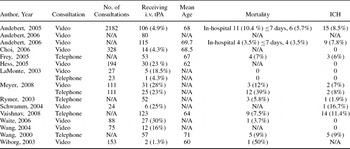
Fifteen studies reported on the delivery of tPA treatment by means of telemedicine (Table 1) (Supplementary Table 2, which is available at www.journals.cambridge.org/thc2010011). Nine studies used VC technologies (Reference Audebert, Kukla and Clarmann von Claranau2–Reference Audebert, Schenkel and Heuschmann4;Reference Choi, Porche and Albright7;Reference Hess, Wang and Hamilton12;Reference Schwamm, Rosenthal and Hirshberg20;Reference Waite, Silver and Jaigobin23;Reference Wang, Gross and Lee25;Reference Wiborg and Widder27), four studies were based on telephone consultations (Reference Frey, Jahnke and Goslar10;Reference Rymer, Thurtchley and Summers17;Reference Vaishnav, Pettigrew and Ryan22;Reference Wang, Rose and Honings24), and two studies reported on the delivery of tPA by means of both telephone and VC technologies (Reference LaMonte, Bahouth and Hu14;Reference Meyer, Raman and Hemmen16). The number of consultations differed widely between the studies, from 24 to 2,182 consultations. In the included studies, a total of 739 patients were treated with intravenous tPA by means of telemedicine. The mean age of the patients treated in the included studies was 66.2 years; 45 percent of the patients were female. The rates of intracerebral hemorrhages (ICH) ranged from 0 percent to 16.7 percent and the mortality rate ranged from 0 to 50 percent.
tPA via telephone or video consultation interventions

tPA, tissue plasminogen activator; ICH, intracerebral hemorrhage; i.v., intravenous.
Different process indicators were analyzed in the studies. Most studies reported time from onset of stroke symptoms to admission (“onset-to-hospital”), time from admission to thrombolysis (“door-to-needle”), and time from onset of stroke symptoms to thrombolysis (“onset-to-needle”). The mean “onset-to-hospital” time ranged from 54 to 71 minutes. The mean “door-to-needle” time was 76–106 minutes, and the mean “onset-to-needle” time 122–165 minutes. In the telephone-based studies, length of stay varied from 4 days (Reference Vaishnav, Pettigrew and Ryan22) to 12.3 days (Reference Handschu, Scibor and Willaczek11). One telephone study reported a median length of stay of 5 days (Reference Frey, Jahnke and Goslar10). Of the VC interventions, one study reported a median length of hospital stay of 12 days (Reference Audebert, Kukla and Clarmann von Claranau2) and in another study the mean length of stay was 11.4 days (Reference Handschu, Scibor and Willaczek11).
The number of patients transported to a stroke center after telemedicine consultation varied in the studies. In Audebert et al. (Reference Audebert, Schenkel and Heuschmann4), 248 (13 percent) patients in the telemedicine group and 146 (13 percent) in the control group were transferred to other hospitals or departments. In Wang et al. (Reference Wang, Gross and Lee25), seventy-five patients were given consultations using telemedicine and fifty-four were transferred (72 percent) to the stroke center. In another study of 153 telestroke patients, 8 (5 percent) were transferred to a stroke center (Reference Wiborg and Widder27). In one study, fewer patients in the VC group were transported to the stroke center than in the TC group, seven (9.1 percent) and thirteen (17.6 percent) respectively (Reference Handschu, Scibor and Willaczek11). One VC study reported that transfer was avoided in 11 cases (Reference Schwamm, Rosenthal and Hirshberg20). Patients treated with tPA by means of telephone consultation were often transported to the stroke center for surveillance and monitoring (Reference Frey, Jahnke and Goslar10;Reference Meyer, Raman and Hemmen16;Reference Vaishnav, Pettigrew and Ryan22). In two VC systems, all tPA patients were transported to the stroke center (Reference LaMonte, Bahouth and Hu14;Reference Wiborg and Widder27), although the total treatment number was very small (n = 8). In two other VC studies, twenty-nine of forty-five (64 percent) tPA-treated patients were transferred to a stroke center (Reference Choi, Porche and Albright7;Reference Meyer, Raman and Hemmen16).
Some studies have reported that VC methods are superior both in terms of diagnostic accuracy (Reference Wong, Poon and Jacobs28) and in terms of leading to a correct treatment decision (Reference Meyer, Raman and Hemmen16), compared with telephone systems. In one study, the diagnostic accuracy in the VC group was 87.7 percent versus 63.8 percent (p = .001) in the telephone group (Reference Wong, Poon and Jacobs28). A correct treatment decision was reported in 108 VC cases (98 percent), compared with 91 telephone cases (82 percent) (odds ratio 10.9, 95 percent confidence interval, 2.7–44.6; p = .0009) (Reference Handschu, Scibor and Willaczek11).
Cost
Few studies assessed the impact of telestroke on resource utilization. Some studies mentioned investment costs (Reference Hess, Wang and Hamilton12;Reference Wiborg and Widder27), but not maintenance costs and only one study dealt with cost-effectiveness (Reference Wong, Poon and Jacobs28). Wong et al. (Reference Wong, Poon and Jacobs28) noted a higher mean cost per patient in the VC group ($ 16,300) than in the telephone group ($ 14,000) and the teleradiology group ($ 14,000), although these differences were not statistically significant. Audebert et al. (Reference Audebert, Kukla and Clarmann von Claranau2) reported that the costs of the TEMPiS service were approximately €300,000 per year. The estimated savings made by the network are between €32,00 to €4,200 per thrombolysis. The predicted absolute increase of 76 tPA treatments per year would produce a reduction of subsequent costs of between €243,200 and €319,200. After the subtraction of the teleconsultation expenses, net expenses varied between €56,800 and €19,200 per year. Based on this study, a telestroke service is only cost-effective when screening tPA candidates by means of video consultation.
DISCUSSION
Disparities in access to healthcare services exist due to geographical barriers and limited resources. Rural locations often lack the resources for adequate acute stroke care. Based on the existing studies, telestroke appears to be a feasible means of enabling dedicated stroke teams at specialist stroke centers—often at academic institutions—to support several community hospitals without pre-existing neurological services by means of telephone or VC.
In telestroke programs, neurologists, emergency physicians, nurses, and radiologists collaborate in caring for patients with acute stroke (Reference Demaerschalk, Miley and Kiernan8). The remote stroke neurologist, or a physician supported by a bedside nurse, can quickly and reliably obtain a valid NIHSS score through an audio VC system (Reference Schwamm, Holloway and Amarenco19). Radiology technologists ensure that neuroimaging is successfully transferred through the system. Telestroke can transfer knowledge from evidence-based stroke care units, speed up treatment with tPA and minimize unnecessary transfers to stroke centers, although the majority of the studies report that patients receiving tPA treatment in community telestroke hospitals are transported to stroke centers for surveillance and monitoring.
Recently published studies on telestroke and long-term outcomes have reported better health outcomes for patients treated in telestroke hospitals compared with conventional stroke care patients (Reference Audebert, Schenkel and Heuschmann4;Reference Audebert, Schultes and Tietz5). It is debatable whether it is better to transport all potential tPA patients directly to a stroke unit, assuming it is within an acceptable distance, or whether telestroke services should be used. If a tPA candidate is directly transported to the stroke center, time can be saved by avoiding a further hospital admission, and by not performing the teleconsultation.
Telemedicine networks require a substantial capital investment in equipment, education and technical support. The development and maintenance of such systems require resources to cover information technology support, the necessary clinical and administrative personnel, personnel training and accreditation, and allowances for on-call coverage (Reference Demaerschalk, Miley and Kiernan8). Studies of the cost and cost-effectiveness of telemedicine interventions in acute stroke management are rare. An increased use of tPA treatment reduces costs and is cost-effective (Reference Sandercock, Berge and Dennis18).
Factors for Good Telestroke Practice
A key factor in the success of telemedical interventions in acute care is the implementation of stroke protocols to aid the triaging of patients and the standardization of care. These protocols normally also include guidelines for tPA treatment. Stroke education, initial training, ongoing education for health personnel, and a 24-hour service have also been reported as key factors in successful of telestroke interventions (Reference Audebert, Kukla and Clarmann von Claranau2–Reference Audebert, Schenkel and Heuschmann4;Reference Choi, Porche and Albright7;Reference Hess, Wang and Hamilton12;Reference LaMonte, Bahouth and Hu14;Reference Vaishnav, Pettigrew and Ryan22;Reference Waite, Silver and Jaigobin23;Reference Wang, Gross and Lee25;Reference Wiborg and Widder27).
Three studies reported shorter process times after the program had been running for some time, compared with the early stages of implementation (Reference Audebert, Kukla and Clarmann von Claranau2;Reference Choi, Porche and Albright7;Reference Hess, Wang and Hamilton12). The onset to treatment time became shorter, due to educational efforts that improved the recognition of stroke and prompted an earlier activation of the system (Reference Hess, Wang and Hamilton12). Another study reported an increase in the tPA rate in the second phase of the intervention.
Increased public awareness and better prehospital stroke management, achieved by continuous educational activities in the regional hospitals, were proposed as the reason for the increased use of tPA (Reference Hess, Wang and Hamilton12). The need for community-based stroke information/campaigns to improve public awareness of stroke was highlighted in some articles. This is important due to the fact that most stroke patients arrive after the 3-hour tPA treatment window. Better recognition of stroke symptoms and improved understanding of this time-sensitive illness may reduce the time to hospital admission. Centrally organized emergency inter-hospital transfers were reported as an important factor for success in some studies (Reference Audebert, Kukla and Clarmann von Claranau2–Reference Audebert, Schenkel and Heuschmann4;Reference Frey, Jahnke and Goslar10). One study reported a high failure rate, which was due to logistical problems: the lack of a dedicated team of medical escort staff, and the fact that the relevant technology could not be moved from the emergency department. A further problem was that intra-hospital transfer of critically ill patients was often regarded as unsafe by emergency physicians (Reference Wong, Poon and Jacobs28).
Collaboration between remote emergency departments and stroke centers is probably the most important element of a successful telestroke program (Reference Demaerschalk, Miley and Kiernan8;Reference Frey, Jahnke and Goslar10). Each telestroke program is unique in terms of personnel resources, technology, the use of different health outcome measures, and process management. Standardized outcome measures would allow increased harmonization, making it easier to compare programs and determine which factors ensure the success of such programs (Reference Deshpande, Khoja and McKibbon9).
Telephone or Video Consulting-Based Interventions?
It is difficult to draw a final conclusion as to whether VC methods are superior to telephone systems in telestroke. In three studies, the remote consultant had to rely on verbal reports of medical findings, including results from CT scans (Reference Handschu, Scibor and Willaczek11;Reference Meyer, Raman and Hemmen16;Reference Vaishnav, Pettigrew and Ryan22). It would have been interesting to analyze whether a VC system with teleradiology is superior to a telephone-based system with teleradiology. It seems likely that when the remote neurologist interprets the CT scans, he or she may feel more confident when giving treatment advice (e.g., tPA delivery) than when an on-site radiologist interprets the CT scans. In a telephone-based system, the accuracy of the diagnosis may be better when a neurologist has access to CT images. In other words, telephone-based systems with teleradiology might be more efficient than the telephone systems identified in the literature thus far.
Telestroke: A Tool for Support
During stroke unit planning, the fact that the number of stroke patients treated in stroke centers might increase if teleconsultations result in transfers to the unit must be considered. Community hospitals may see telemedicine as a way of replacing healthcare workers. However, it must be underlined that the primary aim of telestroke services is to support healthcare providers in improving the quality of stroke care. The service does not aim to replace health professionals in regional community settings.
Lessons to Be Learned for Telestroke Evaluations
To evaluate a telestroke network, good data collection and storage are necessary. The TEMPiS telestroke network study was the only one stating that patient data were entered into a telemedicine database according to an agreed protocol (Reference Audebert, Kukla and Clarmann von Claranau2–Reference Audebert, Schenkel and Heuschmann4). To ensure “good practice” in the evaluation of telemedicine interventions, it is important that the collected data are valid, accessible, and transparent. It is also important that the system is accepted and integrated into routine care, and, therefore, patient data should be entered into the clinical information system (CIS). A potential barrier is that hospitals use different information systems and software programs, which do not always allow the transfer of data between hospitals.
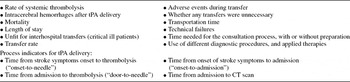
For optimal data collection, telemedicine patient data could be entered into a database or quality register for stroke care. Quality registries can contain individual-based data on diagnoses, treatment, and outcomes that allow evaluators to assess the quality of care, utilization, and processes. Quality registries also provide benchmarking data. When reporting telestroke program evaluations, general information should be presented (Table 2). Based on the studies included in this systematic review several evaluation indicators related to the quality, utilization, and processes of telestroke initiatives are proposed (Table 3). Indicators for measuring health outcomes and follow-up indicators are required to explore the health impact of the intervention (Table 4).
Reporting of general information

Quality, utilization, and process indicators for telestroke evaluation

tPA, tissue plasminogen activator; CT, computed tomography.
Health outcome and follow-up indicators

NIHSS, National Institutes of Health Stroke Scale; CT, computed tomography; MRI, magnetic resonance imaging.
In the practice of telemedicine, the principles of medical ethics should be followed. Rules of confidentiality and security apply to telemedicine documentation and storage. Patient data should only be transferred where confidentiality and security can be guaranteed. Patient data and other information should only be sent to a physician or other health professional on patient request or with informed consent (21).
CONCLUSION
Telemedicine technologies, whether using a telephone-based system or a real-time VC system, are safe and feasible in acute stroke management. Telestroke interventions can support areas with insufficient neurological services with evidence-based stroke care. The use of intravenous thrombolysis, which has been shown to significantly reduce the burden of illness, should be increased. There are few economic studies on telemedicine technologies in stroke management. Standardized measures to assess telestroke services would assist in the comparison between telestroke and standard care and would facilitate comparisons across telestroke studies. More research is needed to explore the clinical and economic impact of telemedicine technologies in stroke management, so as to support policy makers in making informed decisions.
CONTACT INFORMATION
Tim Johansson, MSc (tim.johansson@hta.lbg.ac.at), Researcher, Health Technology Assessessment, Ludwig Boltzmann Institute, 7/20 Garnisongasse, 1090 Vienna, Austria
Claudia Wild, PD (claudia.wild@hta.lbg.ac.at), Senior Researcher, Chief, Health Technology Assessment, Ludwig Boltzmann Institute, 7/20 Garnisongasse, 1090 Vienna, Austria
SUPPLEMENTARY MATERIALS
Supplementary Table 1
Supplementary Table 2