

Introduction
All domesticated animal breeds, strains and species that are of economic, scientific and cultural interest to current and future human needs in terms of food and agricultural production are referred to as animal genetic resources (AnGR) (Rege and Gibson, Reference Rege and Gibson2003). However, the development of new technologies that alter the traditional production environment, the need to meet the world's increasing demand for animal products and the unpredictable effects of climate change put AnGRs under pressure. This includes farming practices to alter AnGR diversity through the creation of new breeds, breed improvements and breed adaptations to address changing global circumstances (FAO, Reference Ikani and Dafwang2007). Unfortunately, not all of these changes are beneficial (Woolliams, Matika and Pattison, Reference Woolliams, Matika and Pattison2008) and many animal species are now in danger of extinction, while others are threatened by inefficient use or loss due to cross-breeding (FAO, Reference Ikani and Dafwang2007). Therefore, to meet future challenges in the agricultural and food industries, special efforts are imminently needed to conserve AnGR.
Although, it may not be possible to conserve all breeds, the adequate maintenance of the biodiversity of AnGRs can allow farmers to adapt to environmental challenges, veterinary health issues as well as the changing demands of human socio-economic activities by either conserving existing stocks or by developing new breeds (FAO, 2000). The appropriate use and sustainable farming of AnGRs will help to assure both national and global food security, especially since the majority of the world's food products (75 percent) come from a small number of plant and animal species (FAO, Reference Rischkowsky and Pilling2007). Therefore, it becomes important not only to protect the biodiversity (the evolutionary and genetic foundations that describe both phenotypic and molecular aspects of numerous populations and species distributed globally in small ecosystems and larger biomes but also to proceed diligently.
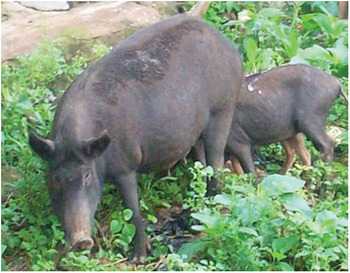
One AnGR that calls for great concern and requires further study and cataloguing is the domestic pig as they are one of the most prolific and fastest growing livestock. Currently, there are more than 730 breeds or lines of pigs all over the world, two-thirds of which are raised in China and Europe, but approximately 270 of these breeds are threatened by extinction (FAO, Reference Ikani and Dafwang2007). The loss of this diversity will have considerable impact, not only on the global pork industry, but more dramatically on small, local farmers in developing countries such as Nigeria. The indigenous pigs are monogastric animals raised by rural families to supplement protein intake or family income because of the less intensive management and feed requirements (Omitogun, Reference Omitogun, Oriyo, Ikeobi, Ozoje, Omoniyi and Kehinde2004). Local pigs are easily adapted to variable environmental conditions and can also convert food waste into valuable products that supplement the local economy. Additionally, the pig has several advantages over other farmed animal species because of their large litters and/or two or more litters per year. This allows the pig to transit from a local economic AnGR to a more valuable economic resource because pedigrees can be produced faster (Archibald and Haley, Reference Archibald and Haley1992). Further advantages of pigs are the relatively low cost of pig production and fast growing rate (Osaro, Reference Osaro1995), short generation interval and high production potential, prolific fecundity (Holness, Reference Holness1991; Osaro, Reference Osaro1995) and highly efficient carcass yield or high meat to bone ratio (Pathiraja and Oyedipe, Reference Pathiraja and Oyedipe1990; Ikani and Dafwang, Reference Ikani and Dafwang1995; Olomu and Oboh, Reference Olomu and Oboh1995). The Nigerian indigenous pigs (NIP) (Figure 1) is a valuable genetic resource that is gradually disappearing because of the cross-breeding practices of local farmers with exotic breeds and little is known about the NIP genetic make-up. They may possess ancient characteristics or genetic variants that were present in their ancestors that are absent in improved modern livestock. Such traits may be of commercial, scientific, aesthetic or historical value (CTA, 1994). Although there have been few genetic studies on the NIP, there has been relatively more research on the growth and reproductive performance (Oseni, Reference Oseni2005), feed conversion rate and carcass quality (Pathiraja and Oyedipe, Reference Pathiraja and Oyedipe1990) of the NIP as well as these performances in hybrids crossed between NIP and exotic pigs (Fetuga, Babatunde and Oyenuga, Reference Fetuga, Babatunde and Oyenuga1976; Adebambo, Reference Adebambo1982; Adebambo and Onekade, Reference Adebambo and Onakade1983; Sonaiya, Reference Sonaiya1987). More recently, the karyotypes of the NIP were characterized with eight chromosome pairs by submetacentric sex chromosomes XX for females and XY for males (Oluwole and Omitogun, Reference Oluwole and Omitogun2009), which were not found to be different from the domestic pig, Sus scrofa domestica (CSKSS, 1988). However, no comprehensive molecular analysis of the genetic make-up of the NIP has been conducted.
NIP from Igbara Odo, Nigeria.

Furthermore, the extensive and random distribution of exotic pig breeds in the Nigerian pig population is believed to dilute the indigenous genetic stock and if this trend continues, the gene pool of the indigenous pigs could be lost in the near future, before they are described and studied. This general threat is in line with the views of Cardellino (Reference Cardellino, Ruane and Sonnino2006) that AnGRs in developing countries are being eroded through the rapid intensification of tropical agricultural systems favouring exotic commercial breeds. This then calls for a sustained research on NIP genetics because of their general hardiness and importance to the local and sustainable economy. Additionally, the NIP may be a potential source of important genetic information that controls specific and economically favourable traits. However, there is a lack of up-to-date information on this subject, making the formulation of future and sustainable NIP breeding programmes difficult (Omitogun, Reference Omitogun, Oriyo, Ikeobi, Ozoje, Omoniyi and Kehinde2004). In order to develop breed conservation programmes, an evaluation of the genetic uniqueness and breed diversity of NIP is needed. Although microsatellite loci and other DNA markers remain popular and efficient polymorphic markers used to measure genetic diversity in various farm animal species (Kemp et al., Reference Kemp, Hishida, Wambugu, Rink, Longeri and Ma1995; MacHugh et al., Reference MacHugh, Loftus, Cunningham and Bradley1998; Handley et al., Reference Handley, Santucci, Townsend, Taylor, Bruford and Hewitt2007; Granevitze et al., Reference Granevitze, Hillel, Chen, Cuc, Feldman, Eding and Weigend2007), endangered animals (Akst, Boersma and Fleischer, Reference Akst, Boersma and Fleischer2002; Vidya et al., Reference Vidya, Fernando, Melnick and Sukumar2005; Bhagavatula & Singh Reference Bhagavatula and Singh2006; Gaur et al., Reference Gaur, Shailaja, Singh, Arunabala, Satyarebala and Singh2006), plants (Yu et al., Reference Yu, Dixit, Ma, Chung and Park2009) and human studies (Ghosh, Das and Seshadri, Reference Ghosh, Das and Seshadri2003), the use of protein polymorphism markers in diversity studies provides an economically feasible approach to perform preliminary studies on the genetic diversity of many species, including the NIP. Therefore, the aim of this paper was to investigate the genetic diversity, as a preliminary assessment of NIP, using pig stocks known to be uncontaminated and unlikely to have been altered by cross-breeding with exotic strains. Blood protein polymorphisms were analysed as an estimate of the genetic similarity between three NIP stocks and a collection of pigs selectively cross-bred with commercial exotic founder stocks at Obafemi Awolowo University, Osun, Nigeria.
Materials and Methods
Animals and study sites
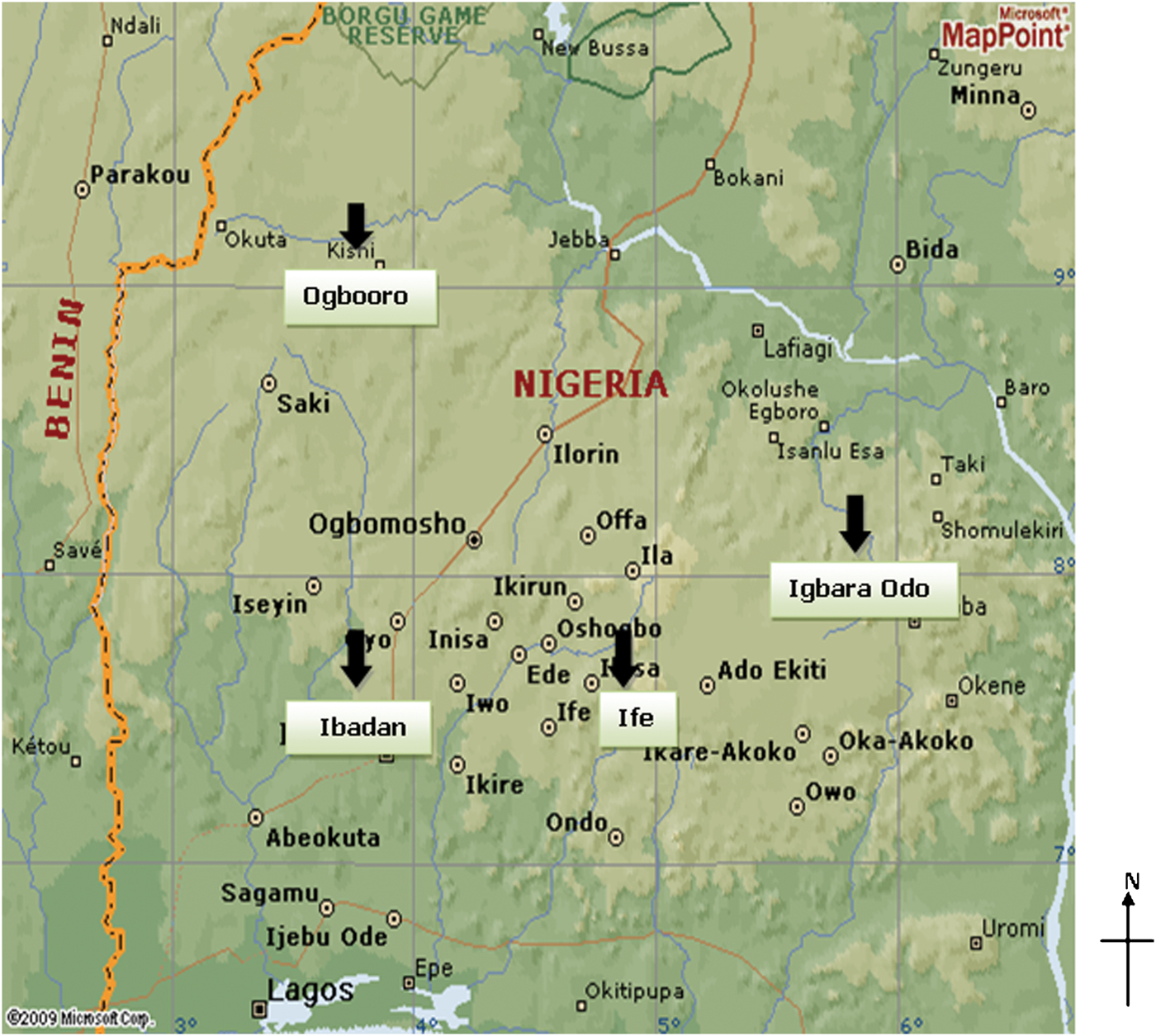
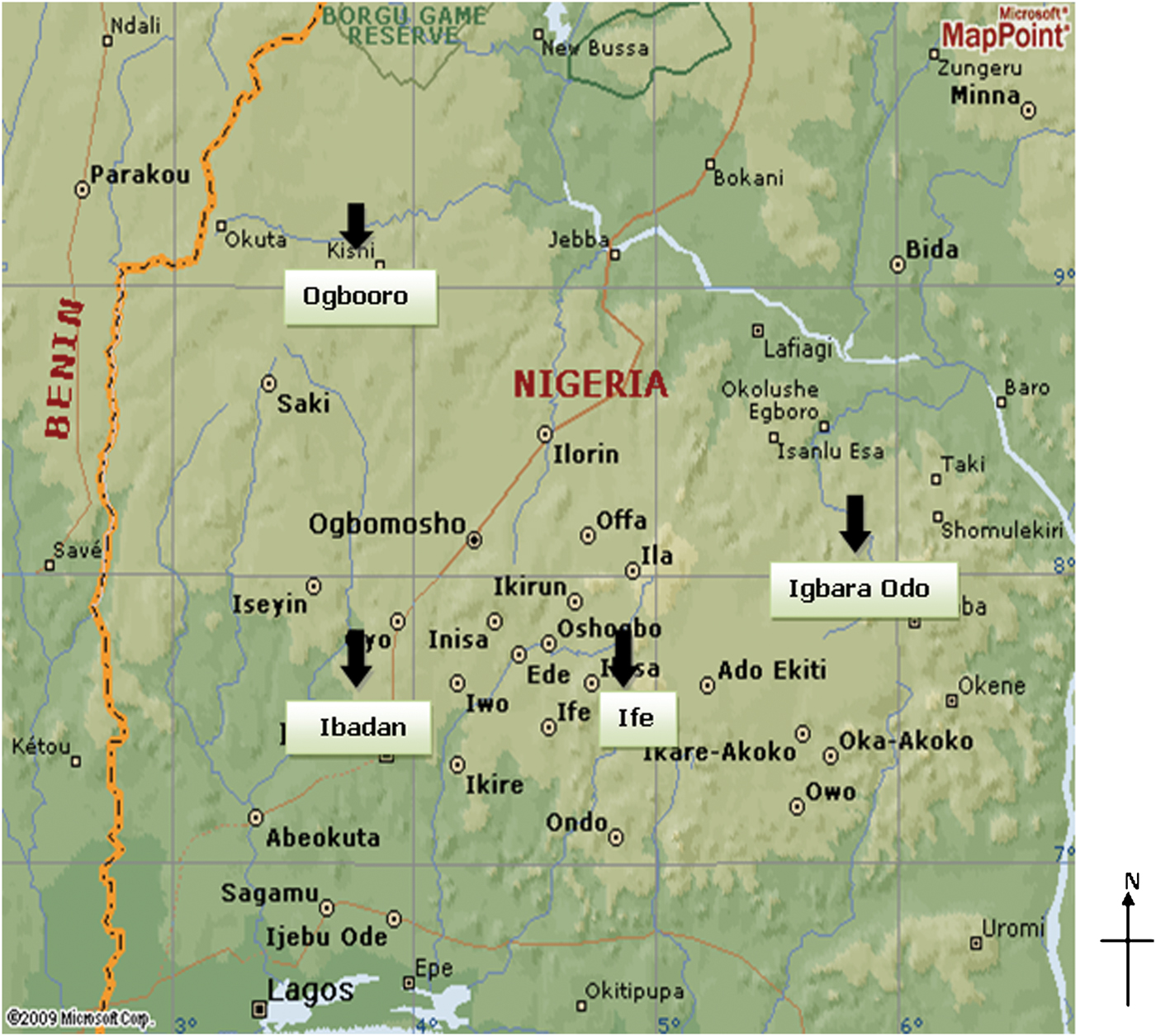
One hundred and twenty pig blood samples were collected from four different locations more than 100 km apart in southwestern Nigeria (Figure 2). The geographic of the region are as follows: latitude: 7–9° south; longitude: 3–6° west; altitude range: 200–500 m above sea level; climate: abundant and reliable rainfall from April through October. NIP samples were collected from three separate locations: (i) Ogbooro, Saki Oyo State (30 NIP samples from pigs that were locally kept in a mud house and were occasionally released to roam about the village. These animals may have undergone limited, but restricted genetic infiltration by other breeds of pigs from neighbouring states, although the animals were inherited and maintained by a few Christian families in a predominantly Muslim region); (ii) Institute of Agricultural Research and Training (IAR&T), Ibadan, Oyo State (16 NIP samples from animals kept on a research farm, where animals received regular feeding and proper records were kept on each animal); and (iii) Igbara Odo, Ekiti State (33 NIP samples from local pigs that were allowed to roam about scavenging for survival. These animals had a history of being reared for many years (Figure 1)). Cross-bred pig samples were collected from Obafemi Awolowo University (OAU), Teaching and Research Farm (T&R Farm), Ife, Osun State (41 cross-bred samples were obtained from animals crossed with selected or introduced commercial exotic founder stocks (Landrace/Large White and Duroc). These animals had a known history of cross-breeding for at least 5 years followed by inbreeding within a closed herd and served as an out group with considerable contamination of their genetic line (i.e. the commercial exotic breeds have been developed through extensive crossing with other breeds of pigs). The sampling areas were identified and selected after a field reconnaissance of the geography and after personal interviews of the pig farmers were conducted to confirm the uncontaminated genetic lines of the NIP.
Map of southwestern Nigeria. The four sampling locations are highlighted by arrows. Nigerian indigenous pigs were from Ibadan, Igbara Odo and Ogbooro, respectively, and the crossbreed strains were from the Teaching and Research Farm, Obafemi Awolowo University, in Ife, Osun State.
Sample preparation and electrophoresis
Blood samples (5 ml) were collected from the jugular vein of each pig with 5 ml hypodermal syringes. All whole blood samples were transferred to the laboratory at OAU and were analysed as previously described by Adeleke et al. (Reference Adeleke, Peters, Ozoje, Ikeobi, Adebambo, Olowofeso, Bamgbose and Adebambo2011). Briefly, blood serum was collected by centrifugation and stored at −35°C. Protein polymorphisms of three blood proteins (globulin, transferrin and albumin) were then analysed by sodium dodecyl sulphate-polyacrylamide gel electrophoresis (SDS-PAGE). All sample preparation steps and the electrophoresis protocol were maintained throughout the analysis. Serum samples were denatured in 7.5 percent β-mercaptoethanol by heating at 95°C for 5 min. Then 15 μl samples were loaded on SDS–polyacrylamide gels (4 percent stacking gel (pH 6.8) and 10 percent resolving gel (pH 8.8)) and separated at 150 V for 2 h with the Bio-Rad Mini Protean II Electrophoresis system. Each gel contained a molecular weight standard and three lanes each loaded with the individual marker proteins.
Following SDS-PAGE, gels were rinsed and then stained in 0.1 percent Coomassie Blue in 1:4 glacial ethanoic acid:methanol. Following staining, gels were de-stained with 60 percent 1:4 glacial ethanoic acid:methanol. Gels were then scanned and protein bands were visually scored (positive bands were scored as (1) and negative or absent bands were scored as (0).
Statistical analysis
Each sample was awarded a total score based on the cumulative presence of the three marker proteins. The total score was then analysed and a dendrogram was produced with the mean score of each breed using the unweighted pair group method (UPGMA; Sneath and Sokal, Reference Sneath and Sokal1973) with the statistical software package PAST (Hammer, Harper and Ryan, Reference Hammer, Harper and Ryan2001). The similarity index within each of the four groups, within the whole NIP (i.e Ogbooro, IAR&T & Igbara Odo) and within the four groups was calculated using the model S jk = M/(M + N), where S represents the genetic similarity; M the number of matches and N the total number of columns with a presence in just one band. Genetic distance (D) was scored from a similarity matrix between breeding groups where D = 1–S.
Results
The genetic makeup of Nigerian indigenous and cross-bred pigs was estimated and compared using polymorphism in the size and expression of three blood proteins: globulin, transferrin and albumin. The three proteins examined were found to display a maximum of 19 bands in the SDS-PAGE analysis. However, not all of the pigs displayed these 19 bands and the frequency of the protein loci (globulins, transferrins and albumins) for each pig were represented in the descending order of the relative anodal migrations of each marker on the gel. The range of frequencies for each of the 19 protein loci were found to be between 0.41 and 1.0; where a frequency of 1.0 represented a polymorphism found in all samples. Globulin 1 and 2 were found to be monomorphic for all pigs sampled. However, some of the transferrin and albumin markers were found to be polymorphic in the gel migration.
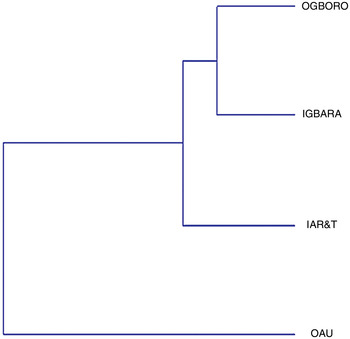
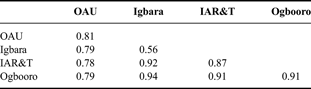
The protein polymorphisms were used to cluster the NIP and crossbred pigs into similar strains and a phylogenetic relationship was developed (Figure 3). The UPGMA dendrogram established that the NIP samples from the three different locations clustered together, while the cross-bred samples formed a separate phylogenetic branch. Comparison of the four populations found the mean genetic similarity to be 55 percent; with the cross-bred pigs being the least related among the four populations. Overall, the four populations were divided into two branches with the three NIP groups forming one branch and the cross-bred pigs clustered into the other branch. Among the local pig populations, samples from Igbara Odo and Ogbooro clustered first, followed by the NIP from the IAR&T. The values of the genetic similarities between each cluster used for the construction of the dendrogram are presented in Table 1.
UPGMA-dendrogram of Nigerian indigenous pig populations (Ogboro, Igbara and IAR&T) and crossbred population (OAU) protein polymorphisms in southwestern Nigeria. The dendogram was created with a UPGMA cluster analysis to identify genetic similarities in the pig populations sampled from each of the four locations where the animals were studied.

Genetic similarities within and among the four populations of Nigeria indigenous and crossbred pigs studied.
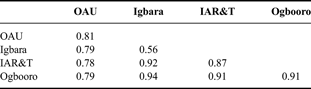
Values on the diagonals are the similarity coefficients of the four different populations.
Among the individual pig populations, the pigs from Ogbooro were found to have a very high level of genetic similarity (91 percent similarity coefficient), the IAR&T pigs had 87 percent similarity coefficient and samples collected from Igbara Odo showed a 56 percent similarity coefficient. The cross-breeds from the T & R Farm, OAU, had a high level of genetic similarity, with 81 percent similarity coefficient.
Discussion
The similarity measure produced here indicated very low levels of genetic variability, which tend towards homozygosity, among the individual populations of NIP in Ogbooro and at the IAR&T in Ibadan. Their SDS-PAGE results showed relatively high similarity (91 and 87 percent, respectively), and this is in agreement with results obtained in Korean and Chinese native pigs using microsatellite DNA markers that local indigeneous pigs have relatively stable genetic lines (Kim and Choi, Reference Kim and Choi2002). It is likely that these animals tended to be homozygous due to genetic drift and/or reproductive isolation of the Korean native pigs (Kim, Yeo and Kim, Reference Kim, Yeo and Kim2002). This reproductive isolation has also been seen in a Chato Murciano pig breed (Peinado et al., Reference Peinado, Vega-Pla, Martinez, Galian, Barba, Delgado and Poto2006). This suggests that the high genetic similarities observed in the Ogbooro NIP samples might be in concordance with the farming history of the animals. These NIPs reared in Ogbooro originate from a small genetic pool of founder individuals that had been used to establish the investigated populations, raised by a few Christian families, leaving the NIPs more or less genetically isolated. Similarly, samples from the IAR&T tended towards homozygosity, which also may have been a result of inbreeding among the few numbers of individuals kept at the institute.
However, the NIP from Igbara Odo were found to have a relatively lower genetic similarity (56 percent), which may be attributed to the fact that the animals were reared in a way that allowed them not only to scavenge for food but probably also to mix with distant strains.
However, the dendrogram supported the separation of all NIPs from the cross-bred pigs at T&R farm at OAU. The three NIP samples clustered together with a similarity coefficient of 95 percent confirming their genetic distinctness from the commercially developed breeds. In addition to being from a distinct line of animals, the cross-bred animals were found to have a low genetic diversity. This observation in the T&R Farm samples is likely due to known history of cross-breeding followed by inbreeding within a closed herd of two commercial strains (Landrace/Large White and Duroc) as a founder stock over the past few years.
The results of this first baseline information on the genetic structure of the NIP may be useful in further designing a breeding as well as conservation programme to protect the remaining NIP pure population. The Ogbooro stock was found to be genetically distinct, as well as considerably uniform in its genetic make-up. Therefore, it is recommended that samples from this population be utilized for an NIP breeding and conservation programme.
Conclusions
This preliminary genetic analysis suggests that further studies with more specific polymorphic DNA markers on the pig stocks from Ogooro, Nigeria may be used to conserve the NIP as a genetic resource in a planned NIP breeding program at the IAR&T (Oluwole, personal communication). This paper is now an urgent call for the development of an NIP conservation programme as number of indigenous pigs in the country are dwindling, which may eventually lead to a total of loss of the animals' adaptive characteristics and its important genetic resource.