One day in the spring of 1857, the 25-year-old Viennese conductor and composer Johann Herbeck, newly appointed Chormeister of the Wiener Männergesang-Verein (hereafter WMgV), made a discovery that would have a far-reaching effect on his professional career. As recounted in 1885 by his son Ludwig,Footnote 1 Herbeck was browsing that day in the retail shop of the music publisher Carl Anton Spina on the Graben in central Vienna, when he noticed a package of manuscripts that the manager of the shop, Josef Doppler, had pushed off to the side. Herbeck’s enquiry about the contents of the package prompted an off-hand response from Doppler: ‘nothing but trash’.Footnote 2 His curiosity piqued, Herbeck began to leaf through the pile of papers and came to a breathless halt when he recognized a manuscript of Franz Schubert – the autograph score of the master’s ‘Gesang der Geister über den Wassern’ (D. 714), a part-song setting of Goethe’s poem for a double quartet of men’s voices accompanied by two violas, two violoncellos and contrabass.Footnote 3 As the successor to the firm of Anton Diabelli, the foremost original publisher of Schubert’s music, Carl Anton Spina was in possession of a number of the composer’s autographs.Footnote 4 Herbeck borrowed the priceless document and quickly set about having the parts copied so that the piece could be rehearsed at his residence nearby. Whenever he wanted to try out new works for the WMgV, it was his custom to convene a private reading with his most competent singers. On this occasion, Herbeck gathered his colleagues through personally written-out invitations:
The gentlemen listed below are most kindly requested to gather at 6:00 in the evening on Friday, 10 July, at my residence, Stock im Eisen, No. 623, third story on the right, for the purpose of a reading rehearsal of exceedingly interesting novelties, among them a totally unknown chorus by Franz Schubert [in] manuscript!!!!
Yours respectfully J. Herbeck.Footnote 5
Among the objects in the room of Herbeck’s apartment where the singers assembled on 10 July 1857, as described by Ludwig Herbeck, was a piano made by the Viennese firm of Christoph Lorenz Jahn,Footnote 6 on which presumably the host played the string parts during the rehearsal. Herbeck was so elated by the outcome that he made a special entry in his diary on the same day: ‘Reading rehearsal at my residence: “Gesang der Geister über den Wassern”, composed by F. Schubert in the year 1821 – and found by me as a completely unknown manuscript in the year 1857! Belongs to the greatest, boldest revelations of this genius!’Footnote 7 The enthusiasm of the small ensemble was magnified greatly in the spirit shown by the entire membership of the WMgV when they experienced the full effect of the work at their rehearsal on 13 November.Footnote 8
In the concert in the large Redoutensaal in Vienna on 27 December, the performance of this work by the WMgV, some 200 voices strong, created such excitement that the audience demanded an encore. Enthusiasm for the concert had been generated by an announcement published in a leading Viennese artistic newspaper two days beforehand:
In its concert taking place on the 27th of this month, the men’s choral music association of this city will present one of the most worthy compositions of Franz Schubert, which lay dormant in oblivion for more than thirty years, buried in a bundle of music papers. It was destined for Herr Herbeck, the active choral director of this association, to draw out this treasure, discovering it in a group of Schubert’s manuscripts and causing this chorus to be published by its owner, Herr Spina.Footnote 9
A positive review of the performance by the respected journalist Eduard Hanslick begins with the comment that it was almost as if the work had just received its premiere, so difficult was it to recall the lack of understanding exhibited equally by the performers and the audience at the original performance in Vienna on 7 March 1821.Footnote 10 Hanslick gives credit for the success entirely to Johann Herbeck, proclaiming that the former severe misjudgement ‘has only now received its complete atonement, and the musical world has only now recovered the squandered treasure, never to lose it again’.Footnote 11
A pessimistic analysis pointing out a lack of attention paid to Schubert’s music after his death, including the performance of his works for men’s chorus by German ensembles, was voiced in 1887 by Otto Elben, who had served on the board of directors of the Deutscher Sängerbund:
A particular position in the history of German music for men’s chorus is occupied by one of our greatest masters [Schubert], in that his works became known only at a much later time, and their effect was able to be manifest only after the composer had long lain in the grave and decades of further development had passed.Footnote 12
Notwithstanding this opinion, evidence exists that the male choral singers of Vienna honoured the legacy of its native son to some degree in the early years. The WMgV was organized in 1843, and among its founding members were Josef Barth and Wenzel Nejebse, both of whom had been friends of Schubert in their youth. The first concert in which the new organization participated, on 17 December 1843 (only some 15 years after Schubert’s death), included a performance of the master’s song ‘Der Hirt auf dem Felsen’.Footnote 13 Later performances presented additional music by Schubert, and special events in November 1847, November 1850, November 1853 and succeeding years were devoted exclusively to his works. In fact, prior to Herbeck’s discovery and performance of ‘Gesang der Geister über den Wassern’, as chronicled above, his association with the WMgV (member since 1852, conductor since 28 March 1856Footnote 14 ) would have acquainted him with the following choral works by Schubert already in the performance repertoire of that organization: ‘Mondenschein’, ‘Der Gondelfahrer’, ‘Schlachtlied’, ‘Nachtgesang im Walde’, ‘Widerspruch’, ‘Nachthelle’, ‘Ständchen’, ‘Hymne’, ‘Die Nachtigall’, ‘Naturgenuß’, ‘Der 23. Psalm’, ‘Graduale’ and ‘Geist der Liebe’.Footnote 15 A significant change in the performance practice of these and other similar works had already taken place by Herbeck’s time. Originally conceived for and performed by one-on-a-part ensembles (consisting of Schubert’s friends, who evidently volunteered their servicesFootnote 16 ), with the advent of large men’s choruses in the German-speaking world these pieces had entered the genre of choral music, characterized by a full blend of sound not possible with small ensembles.
In his positions as conductor of the WMgV, founding conductor of the Singverein of the Gesellschaft der Musikfreunde (hereafter GdM) and director of that organization’s orchestral concerts (1858 and 1859, respectively), and later imperial Vize-Hofkapellmeister (unpaid) and first Hofkapellmeister (1863 and 1866, respectively), Herbeck strove to bring Schubert’s music to Viennese audiences.Footnote 17 His best-known, legendary success in this regard was his securing of Schubert’s autograph score of the Symphony in B Minor (‘The Unfinished’) and the subsequent premiere performance of the work by his GdM orchestra on 17 December 1865.Footnote 18 A less well-known accomplishment begun in that same year was Herbeck’s edition of selected Schubert works for men’s chorus, women’s chorus and mixed chorus.
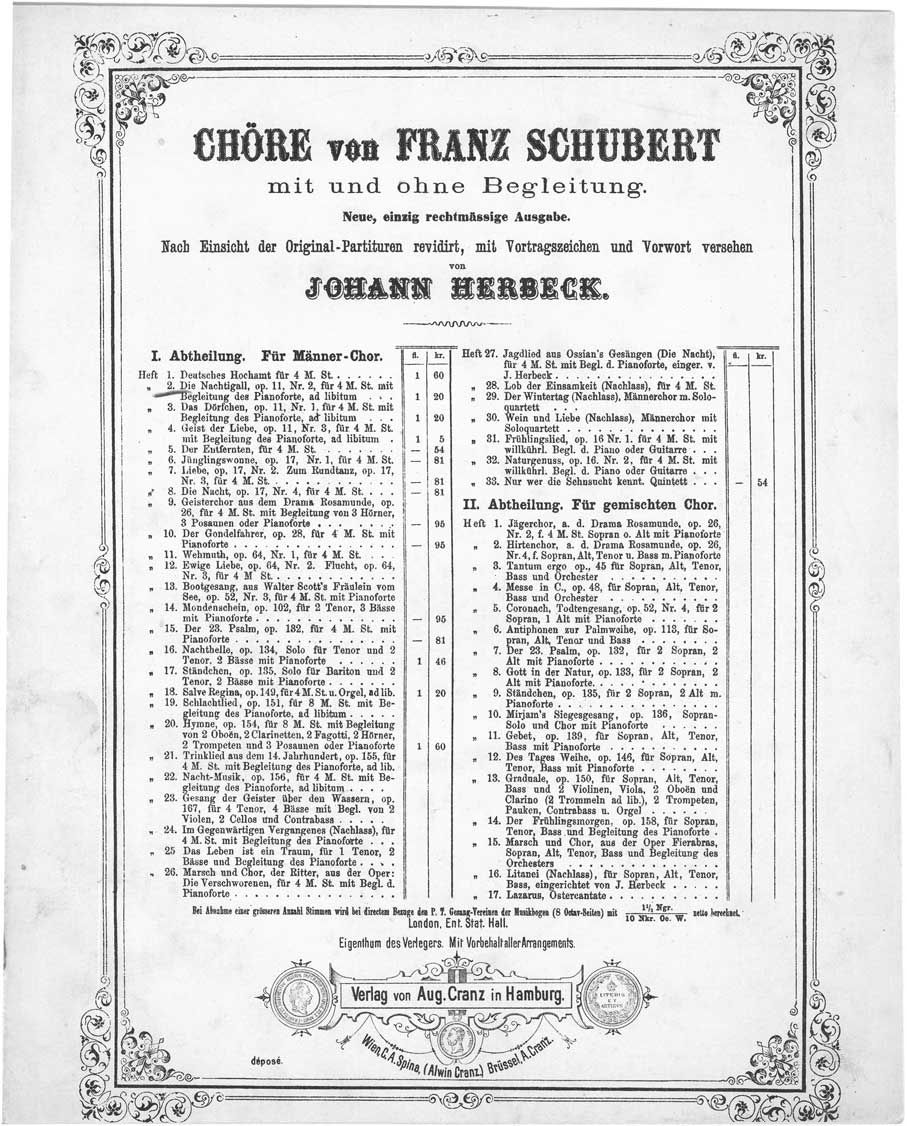
Individual numbers of Herbeck’s edition were first published in Vienna by C.A. Spina, and subsequently the series was continued by that firm’s successors, as documented below. The edition comprises two sections (‘Abtheilungen’), the first containing works for men’s chorus (eventually 34 numbers, of which ‘Gesang der Geister über den Wassern’, published in January 1858, is no. 23) and the second containing mostly works for mixed chorus (17 numbers in all, four of which are for women’s chorus). Summary information about these contents is given in detail, number by number, in Appendix 1.Footnote 19 As shown in Figure 1, the title of the edition is Chöre von Franz Schubert mit und ohne Begleitung. Neue, einzig rechtmässige Ausgabe. Nach Einsicht der Original-Partituren revidirt, mit Vortragszeichen und Vorwort versehen von Johann Herbeck (‘Choruses by Franz Schubert with and without Accompaniment. New, Uniquely Legitimate Edition. Edited According to an Examination of the Original Scores, with Performance Markings and Foreword Provided by Johann Herbeck’). Herbeck’s lengthy Foreword is presented here, with translation, in Appendix 2.Footnote 20 Dated October 1865, it addresses several issues, among which is refuting an evidently widespread belief among members of choral associations that Schubert’s music is too difficult to perform with the right ‘effect’. The author presents several explanations for this attitude without endorsing any of them, arriving at the opinion that good German perseverance and dedication will produce an effective performance of this music, an act to which he imparts almost spiritual value. Along the way, Herbeck engages in romantic, imaginative language to depict Schubert’s life and creative process, indulging in the practice, typical of the time, of attributing thoughts and desires to the composer that are expressed in the poetic texts he set to music. Carrying fantasy even further, Herbeck accounts for whatever human weaknesses Schubert may have had by finding their origin in the influence of his ‘warm-blooded mother’, a personification of his native city, Vienna. The composer’s short lifespan is even invoked as a cause, as if through his premonition, of his occasional light-heartedness; the example given is the joyful, sprightly second half of ‘Die Nachtigall’ (section I, no. 2) – although the carefree mood of the piece surely derives as much from Johann Karl Unger’s poetry as from Schubert’s musical setting of it. Herbeck’s chief aim in this essay was to encourage singers to perform the Schubert choruses, and in fact to do so by purchasing his own editions, as shown by his remarks about competitors’ ‘expensive, deficient’ products. Having begun his Foreword with a statement of regret that the number of men’s choruses that even concern themselves with Franz Schubert is small and decreasing, he goes on to inspire these associations to devote themselves to the master’s works ‘with a serious determination, with ardour and enthusiasm’. In the same mood he concludes with a rousing call to his brothers-in-song to ‘sing Schubert’.
Chöre von Franz Schubert mit und ohne Begleitung. Neue, einzig rechtmässige Ausgabe, ed. Johann Herbeck, section I, no. 2, ‘Die Nachtigall’ (Hamburg: Verlag von Aug. Cranz, 1876 or later), p. 1, list of contents of edition (passe-partout). Possession of the author.

The Foreword also presents descriptions of the methods followed in preparing the edition – information that a modern, knowledgeable reader would consider of major importance in such an essay. Herbeck cites his reliance on original sources, but he does not define this concept further to specify whether they are manuscripts or prints, and in the former category whether they are autographs or copies (although a subsequent comment about parts written ‘in Schubert’s hand’, within the context of a discussion of the validity of guitar accompaniments vis-à-vis those for piano, indicates his awareness of this distinction). He takes proper cognizance of first-hand testimony by members of the WMgV who had sung for Schubert,Footnote 21 but he is also willing to give primary status to anonymous markings of unspecific provenance in original performance parts. Although he emphasizes that ‘not one note, to say nothing of a chord, has been altered’, he appears to take a free hand in adding performance markings that are not identified as editorial. Nonetheless, even where this is the case, the versions he presents may be considered today to have significance as a documentation of performance practice of the works in question during his own time, some three or four decades after their inception.
The appearance of Herbeck’s edition was anticipated by an announcement in the Viennese press in August 1864:
The court music business of C.A. Spina is preparing a very interesting consignment of new publications for the autumn season. This will contain: Schubert’s Müllerlieder, critically edited according to the original manuscripts and first editions; German dances, yet unprinted, for piano and also in an arrangement for piano four-hands by Julius Epstein. – Besides other things, this active business is preparing a complete edition of Schubert’s choruses (augmented by opera choruses), and, specifically, the works for men’s chorus will come first in the series. The edition has chiefly, along with all correctness and neatness of production, such an overall inexpensiveness in view that associations will thereby be dissuaded from making illegal copies, since the cost of this method of duplication, compared with the new edition, will be much higher.Footnote 22
This article raises points of comparison with Herbeck’s Foreword. Its author – probably Leopold Alexander Zellner – uses the phrase ‘nach den Original-Manuscripten’, which would have been generally understood at the time to refer to autograph manuscripts; and in combination with first editions as sources for the edition of Schubert’s Müllerlieder, they represent a more exacting editorial principle than the one briefly described by Herbeck himself. Another comparison reveals the same reference, in both writings, to the inexpensive prices of the Spina edition of Schubert’s choruses, which make it unprofitable for choral groups to do their own copying.
Herbeck’s accomplishments in the revival of Schubert’s music were praised by none other than George Grove, the unique enthusiast of music (by trade a civil engineer) who later published his famous musical Dictionary and served as the founding director of the Royal College of Music in London. In October 1867, he and his friend Arthur Sullivan visited Vienna for a period of nine days in search of sources of Schubert’s symphonies and incidental music for the play Rosamunde. During their sojourn in that city they were greatly aided in their quest by the publisher Carl Anton Spina; by Carl Ferdinand Pohl, librarian at the GdM; by Johann Herbeck; and by Dr Eduard Schneider, lawyer and nephew of Franz Schubert. In 1869, Grove issued a detailed report of his discoveries in Vienna, giving descriptions of the manuscripts of the symphonies he examined and also expressing his dismay that with one notable exception there seemed to be little interest among the Viennese in performing this music:
Such is an account, as far as I am able to give it, of the original MSS. of Schubert’s nine Symphonies. I fear they are likely to remain in manuscript for some time to come, for even in Vienna he is not the object of that general enthusiasm which is felt for him by the best musicians and amateurs of England, or, as we should imagine, would naturally be felt by the countrymen of one of the most remarkable musical geniuses that ever was born or resided in Vienna. An exception must be made in favour of Herr Herbeck, the Imperial Capellmeister and leader of the Vienna Concert Orchestra, who is unwearied in the service of Schubert, and has given his time, abilities and best exertions in the cause.Footnote 23
Grove’s singling out Herbeck as a champion of Schubert’s music was certainly appropriate. By the time of the Englishman’s visit to Vienna, Herbeck had already made the following contributions to the preservation of the Schubert legacy. He introduced the master’s Mass in G to the Hofkapelle on Christmas Day in 1865 and gave repeated performances in May 1866 and May 1867; he also conducted the Mass in E-flat there in September 1866.Footnote 24 Schubert’s works performed by the WMgV under conductors prior to Herbeck are cited above. Under Herbeck’s direction, the organization presented a concert devoted specifically to Schubert’s music in October 1858, and in August 1862 it joined with other men’s choruses to form an ensemble of 1200 singers in a concert to raise money for a Schubert monument sponsored by the WMgV with the plan to erect it in the Vienna City Park (completed and dedicated in 1872). Another WMgV performance devoted to Schubert was conducted by Herbeck’s successor, Rudolf Weinwurm, in May 1867.Footnote 25 Grove’s citation of the ‘Viennese Concert Orchestra’ refers to Herbeck’s direction of the orchestra of the GdM, but he also conducted the Singverein of that organization, which performed works by Schubert in November 1858, January and March 1859, January, April and December 1860, and March 1866.Footnote 26 Prior to the establishment of the Singverein under Herbeck’s direction, choral music by Schubert was performed in concerts of the GdM in November 1829, March 1830, February 1836, April 1843, March 1847 and November 1858 (this last a separate concert from the one by the Singverein listed above).Footnote 27 Another large Viennese mixed chorus, founded in the same year as the Singverein, was the Singakademie, which presented only one choral work by Schubert during the period in question, and that in its initial formal concert in November 1858.Footnote 28 Grove may not have been aware of the Viennese men’s chorus called the Schubertbund, founded in 1863 and (as the name implies) devoted to the master’s works. This organization performed a number of formal concerts and informal ‘Liedertafel’ annually.Footnote 29
The context of Grove’s comment chiding the musicians of Vienna for lacking enthusiasm for Schubert’s works shows that it was most likely meant to refer to instrumental music. In this genre, Grove may not have known about the string quartet of Joseph Hellmesberger, senior, the leading Viennese violinist of the time who also directed the conservatory of the GdM and served as Herbeck’s predecessor and successor as conductor of the GdM (1850–59, 1870–71 and 1877–78) and successor in the Hofkapelle (1877–1893). As early as November 1849, the Hellmesberger ensemble performed Schubert’s quartet in D minor (D. 810), going on in November 1850 to present the quintet in C (D. 956) with an additional violoncellist, and in December of the same year the quartet in G (D. 887); a dozen years later, in February 1862, they presented the quartet in B-flat (D. 112).Footnote 30 Before Herbeck’s time the orchestra of the GdM performed the first two movements of Schubert’s ‘Great’ Symphony in C (D. 944) in December 1839, the Overture to Alfonso und Estrella in March 1845, and a Symphony in C (probably D. 944) in December 1850.Footnote 31 Under Herbeck, the organization played a Symphony in C (again, probably D. 944) in November 1859, the last movement of the Symphony in D (D. 200) in December 1860, and the abovementioned Symphony in B Minor in December 1865 (augmented by the last movement of D. 200), with a repetition of that work in November 1866. Herbeck also conducted orchestrations of Schubert’s piano works by Franz Liszt in March 1860, March 1862, November 1864 and February 1866.Footnote 32 The Vienna Philharmonic Concerts began in 1842 with the founding of that orchestra. Fifteen years went by until a work by Schubert was first programmed, conducted by Karl Eckert, in March 1857 – the popular Symphony in C (D. 944). Repeat performances of this work, under the direction of Otto Dessoff, were given in November 1862 and March 1865, the latter concert also featuring the overture to Alfonso und Estrella and four Schubert art songs. Also conducted by Dessoff, the overture to Fierabras was performed in November 1865 and two entre’acts from Rosamunde in March 1866.Footnote 33 Between 1831 and 1865, the newspaper Wiener Zeitung published approximately 225 announcements by publishers and retail shops mostly in Vienna advertising printed music by Schubert for sale, the heaviest annual concentrations (10 or more announcements) occurring in the years 1831, 1832, 1838, 1839, 1840, 1842, 1844 and 1846.Footnote 34 Announcements and reviews of concerts were also published in the Wiener Zeitung, as well as other events pertaining to the Schubert legacy. Included among the latter is an account of the exhumation of the mortal remains of both Beethoven and Schubert in the Währing Cemetery on 13 October 1863, followed by an examination of their bones, making plaster casts of their skulls, and replacing the remains into two metal coffins. The reburial ceremony took place on 23 October in the presence of 200 observers.Footnote 35
In a private letter written to a London friend during his stay in Vienna in 1867 (but not published until 1903), George Grove may have made an indirect reference to Herbeck’s edition in his comment that ‘Spina the magnificent has behaved like a prince … and he has given me many pieces of printed music’.Footnote 36 That this gift included Herbeck’s edition is strongly suggested by the presence of 18 numbers from this series in the library of the Royal College of Music in London (the repository of Grove’s papers), all of which are identified in the online catalogue with the provenance ‘Grove, George, Former owner’, or ‘Grove, Edmund, Donor’, or both; Edmund Grove was George’s younger brother.Footnote 37 A more direct reference to Herbeck’s edition is presented in an article by the journalist Ludwig Speidel coincidentally published during the time of Grove’s visit to Vienna.Footnote 38 Stressing the importance of Schubert in the musical history of Vienna, Speidel calls for a monument to the composer not in stone or metal, but in the form of a Complete Works edition, and he suggests that it should be undertaken by the firm of Spina, which has lately been active in publishing Schubert’s music, including the initiation of a collection of his four-part works for men’s chorus (Herbeck’s editorship is not identified specifically). The edition of Beethoven’s works by Breitkopf & Härtel is cited as a precedent.
If the Spina publishing house should wish to do something along these lines, it would need only to point the finger to secure straightaway the right men, close at hand – men who would decide what is to be included in the Schubert edition (for we do not take the term ‘Complete Edition’ literally) and would compare the manuscripts and the first editions and critically determine the correct readings.Footnote 39
This is followed immediately by the recommendation of Johann Herbeck, who – along with Franz Liszt – is credited generally with service to Schubert’s works, and also of Gustav Nottebohm, who had made valuable contributions to the new Beethoven edition.Footnote 40 With a further citation of the Beethoven edition, as well as editions devoted to Haydn and Mozart, all published in Leipzig, Speidel ends with the proverb that not all of the Austrian skylarks should be allowed to fly off to Germany!Footnote 41
As indicated in Appendix 1, a number of bibliographical sources have been examined to determine the contents of Herbeck’s edition and to assign each number a publication date, if possible. Among these sources, the most important are inventories issued by the original publishing company and its successors, either devoted solely to the contents of the Herbeck edition or covering all of the firm’s publications to date, including the numbers in that edition. The discussion that follows presents the sources in four stages denoting the progress of the edition; numbers cited here may be compared to the complete, final listing in Appendix 1. The earliest source, representing stage 1, is the C.A. Spina Ablieferungsbuch,Footnote 42 which consists of filled-out forms for all publications of the firm from 8 January 1858 to 13 August 1867. This inventory documents seven numbers in Herbeck’s section I (1–3, 5, 9, 23 and 27) and one in section II (17), as well as Drei geistliche Lieder (1858), not included in the edition. For each item, the composer, title, publication (‘plate’) number, precise date and – for some items – identifications of performance media are given. Also documented for each item are the receipts of mandatory deposit copies by six governmental offices in Vienna (the k. k. Ministerium des Innern, Bibliothek der k. k. Obersten Polizei-Behörde, k. k. Polizei-Direktion, k. k. Staats-Anwaltschaft, k. k. Hofbibliothek and Wiener Universität Bibliothek).Footnote 43
The next example, illustrating stage 2, is a one-page printed list that bears the title of the edition, the name of C.A. Spina in Vienna as publisher, and the date 1867. It is devoted entirely to the Herbeck edition, presenting continuous numbers in section I from 1 to 32 (‘Naturgenuss’) and likewise all numbers in section II (1–17) in a passe-partout, indicating the extent of the publisher’s overall plan and its realization at that stage. Prices are given in Austrian currency (fl. and kr.) for 15 numbers in section I (1–10, 14–16, 18 and 20) and none in section II, thus revealing a limited availability of the individual items at that time.Footnote 44 It is strange that nos. 23 and 27 in section I and 17 in section II – all three reported in stage 1 – are not included here among the available numbers.
Stage 3 is represented by two additional printed lists of the contents of the edition. The first was issued by C.A. Spina’s Nachfolger (Friedrich Schreiber) and is otherwise identical to the Spina example cited above (including the date of 1867) except for the addition of no. 33 (‘Nur wer die Sehnsucht kennt’) to section I, along with a price.Footnote 45 The original lithographic plate of the earlier list was clearly revised and reused to produce the present version, an action that could be accomplished without much difficulty in the process of lithography. In spite of the printed date, this list must have been produced in 1872, the year in which Friedrich Schreiber took over the Spina firm and styled its name in the given form.Footnote 46 The second list in question (shown in Fig. 1) also gives the same information, but no date is given and the publisher is identified as Aug. Cranz in Hamburg, with two branches reported: C.A. Spina (Alwin Cranz) in Vienna and A. Cranz in Brussels. The Cranz firm acquired F. Schreiber (vorm[als] C.A. Spina), as it was then called, in 1876Footnote 47 – thus the earliest year in which the list could have been produced. At this time the limited availability of individual numbers shown in the list was considerably out of date. This second example representing stage 3 was included as the first page of a copy of ‘Die Nachtigall’, whose score bears an edition number (C.S. 18401) that indicates publication in 1866,Footnote 48 and therefore this copy must be a later reprinting.
The next three bibliographical sources all represent stage 4, characterized by the 17 numbers in section II and the addition of no. 34 to section I, to which ‘Nur wer die Sehnsucht kennt’ (formerly no. 33) is assigned; no. 33 is now assigned to an additional work, ‘Rüdigers Heimkehr’. First in line chronologically among the three sources is a large catalogue of the publications of the firm of Friedrich Schreiber, successor to C.A. Spina.Footnote 49 The title page bears the date of 1874, but the effective date of the contents is revealed by a second title page, on the next recto, with the name C.A. Spina and the date of 1872.Footnote 50 This catalogue lists the contents of Herbeck’s edition in separate categories: choruses for men’s voices; choruses for mixed voices; cantatas, oratorios, operas, operettas and singspiels; and church music. Prices, again given in Austrian currency, are registered for 32 of the 34 numbers in section I (nos. 29 and 30 are listed, but the absence of prices is shown by horizontal lines), indicating the actual availability in 1872, much greater than in 1867. As for section II, all 17 numbers are listed, with prices given for 13; the exceptions are nos. 3, 4, 6 and 13, for each of which a cross-reference to the church-music listing is supplied.Footnote 51
The second source is Gustav Nottebohm’s Thematisches Verzeichniss of 1874 (cited above), which followed directly on the heels of the Spina/Schreiber catalogue of 1872/1874. Devoted exclusively to publications of Schubert’s music, Nottebohm’s catalogue was published by Friedrich Schreiber, which was most appropriate, as the Schreiber firm was the chief publisher of Schubert’s music at the time. In this source, the listings of the numbers in Herbeck’s edition conform in general to the inventory presented in the Spina/Schreiber list, although no. 30 in section I and no. 15 in section II are missing.
The third source representing stage 4 is yet another (and surely the last) printed list of the contents of the Herbeck edition, produced by Aug. Cranz in Leipzig, A. Cranz in Brussels, and Cranz & Co. in London. Like the lists of 1872 and 1876 (issued, respectively, by Schreiber and Cranz) cited above under stage 3, this source shows the traces of Spina’s original lithographic plate of 1867, again revised and reused. Although no date is indicated, it must have been produced no earlier than 1897, the year in which the location of the firm was changed from Hamburg to Leipzig.Footnote 52 In this list, no. 33 (‘Rüdigers Heimkehr’) is identified by the first line of its text, ‘Durch der Ostsee wilde Wogen’. Prices are given in German currency (M. and Pf.) for all of the numbers in both sections, with two exceptions, no. 30 in section I and no. 15 in section II, thus matching the Nottebohm catalogue, described above.Footnote 53
Further information about the production of Herbeck’s edition is found in correspondence between himself and C.A. Spina preserved in the archive of the GdM in Vienna. Stemming from the possessions of the Herbeck family, this group of letters includes four by Spina and one by Herbeck. Spina’s letter of 9 May 1865 acknowledges a payment of 300 gulden to Herbeck, requests a receipt, and thanks him for supplying the parts to the Litany (a reference to Herbeck’s arrangement of Schubert’s song ‘Litanei auf das Fest aller Seelen’ for mixed chorus, published by Spina as no. 2 in Drei geistliche Lieder and also separately in Herbeck’s edition of Schubert’s choruses, section II, no. 16; see Appendix 1). Spina’s letters of 20 October 1866 and 11 November 1866 are in reference to Herbeck’s editions of orchestral music by Schubert. Spina’s letter of 13 November 1869 mentions his having received a manuscript (unidentified) from the printer and asks Herbeck to point out the mistakes in a chorus (also unidentified) by Schubert. Herbeck’s letter is preserved in the form of a hastily written draft consisting of a main part signed and dated 12 February 1868, as well as an addendum intended to be incorporated into the main text, signed and dated 15 February 1868.Footnote 54 Herbeck complains to Spina that a year has gone by since he submitted Schubert’s ‘Morgengesang im Walde’, but it has not yet appeared.Footnote 55 Herbeck also mentions the Easter cantata Lazarus, for which his piano reduction has been published by Spina, but not the score (thus, Herbeck evidently prepared a full score of this work, which remained unpublished). Furthermore, with regard to ‘Rüdigers Heimkehr’ and ‘Nur wer die Sehnsucht kennt’, he says that the parts were published, but there was not a trace of the score and the piano reduction. ‘It may be mentioned, moreover’, Herbeck continues, ‘that in the meantime your worthy publishing house has produced a ponderous quantity of novelties which, without holding any artistic content, have also not given you any material profit’.Footnote 56 Herbeck surely had seen the article by Speidel cited and quoted above, for his next comments echo sentiments expressed in that essay. He mentions his hopes for a complete Schubert edition and adds:
Filled with the most heartfelt, spirited interest for this artistic matter of honour, I feel myself bound to these sincere observations because I see with shame how Vienna again and again is outflanked by non-Austrian firms that have less expectation of profit.Footnote 57
He goes on to say that although he has always taken Spina’s side in the latter’s willingness to make acquisitions for charitable purposes, under these circumstances he might no longer be in a position to do so in the future.
Herbeck may eventually have made good his threat, although he went on in the short run to collaborate with Spina in the publication of ‘Rüdiger’s Heimkehr’ – as well as ‘Morgengesang im Walde’, mentioned above – in 1868 and was still working with the publisher in November 1869, as shown in Spina’s fourth letter cited above. It may be significant that out of the 49 numbers of the Herbeck edition listed by Nottebohm, the editor is cited only in connection with ten (section I, nos. 2–4, 9, 14, 21, 27 and 33; and section II, nos. 16–17), almost all of which were issued before early 1868. At any rate, although Herbeck’s name continued to appear in the boilerplate title heading the publisher’s lists of the entire edition as late as 1897 (see the commentary, above, on the passe-partout of Aug, Cranz, Leipzig), no evidence has been found to show an active involvement on Herbeck’s part with any publication of Schubert’s choral music brought out by Spina or his successors after 1869.Footnote 58 As a result of Herbeck’s letter to C.A. Spina, quoted above, a feeling of hostility on the part of the publisher may have developed toward the editor.Footnote 59 On the other hand, Herbeck’s association with the Court Opera, beginning as conductor in 1869 and increasing to the position of Director in the following year (at which time he relinquished his position at the GdM), in addition to his continued duties as Hofkapellmeister, may simply have left him little time to spend on his Schubert project.
Additional evidence of a deterioration in the relationship between Herbeck and Spina may be found in the outcome of an agreement made on 4 April 1867 between the GdM and Herbeck on one side and C.A. Spina on the other, according to which the first two parties would supply manuscripts of certain Schubert works, along with publication rights, to the third party. The net proceeds from this business arrangement were to go to a fund, established by Herbeck, to aid poor talented pupils at the Vienna Conservatory (a division of the GdM), as well as to support impoverished relatives of Schubert.Footnote 60 The GdM made manuscripts of the following works available: Alfonso und Estrella (D. 732), the Mass in A-flat (D. 678), Der vierjährige Posten (D. 190), Die Zwillingsbrüder (D. 647), the String Quartet in G Minor (D. 173) and the Mass in G (D. 167).Footnote 61 Of these, Spina published only the Overture of D. 732 (and D. 678 was published by Friedrich Schreiber, Spina’s successor, in 1875). Herbeck, for his part, made manuscripts of the following works available: Adrast (D. 137), ‘Mainacht’ (D. 194), ‘Der gute Hirte’ (D. 449), Andante in A for Pianoforte (D. 604), ‘Wer nie sein Brot in Thränen aß’ (D. 480), ‘Rückweg’ (D. 476), ‘Durch der Ostsee wilde Wogen (Rüdiger)’ (D. 791), Symphony in B Minor (‘The Unfinished’, D. 759), and Thirteen Variations on a Theme by Anselm Hüttenbrenner (D. 576).Footnote 62 Again, the Spina firm seems not to have lived up to its part of the agreement, publishing only D. 791 (Herbeck’s arrangement, presented as ‘Rüdigers Heimkehr’, section I, no. 33), D. 759, and D. 576.
It is difficult to reach an understanding regarding Herbeck’s continued relationship with Spina, especially since so few copies from Herbeck’s section II have been located. A clue to what the publishing company evidently did on its own to supply these numbers, without the editor’s involvement, is given in one of the surviving copies, ‘Der 23. Psalm, Gott meine Zuversicht’ (section II, no. 7). The exemplar is incomplete, lacking four inner pages of the score, but the parts are intact and allow the following analysis. Its publisher is given as Aug. Cranz in Leipzig (also A. Cranz in Brussels and Cranz & Co. in London); therefore, as shown above, it dates from 1897 or later (at least 20 years after Herbeck’s death), although it may be a reissue of an earlier publication by Friedrich Schreiber. The title page of the score is identical to that of the original Diabelli edition, except for the change in the publisher’s name and other identifying marks. In fact, the original plate was revised and reused to produce this page, an action – as with the lists of the Herbeck edition identified as dating from 1867, 1872, 1876 and 1897 described above – that could be accomplished without much difficulty in the process of lithography. On the inside pages, the Diabelli edition number (3182) is retained, but it is preceded by the abbreviation ‘F.S.’ (Friedrich Schreiber). The inside pages were produced from different plates, although the notation agrees with that of the Diabelli edition. Thus, without Herbeck’s editorial intervention (which could be extensive, as described below), but with a strong reliance on the first edition, the publisher created a result that satisfies the modern ‘Urtext’ concept.
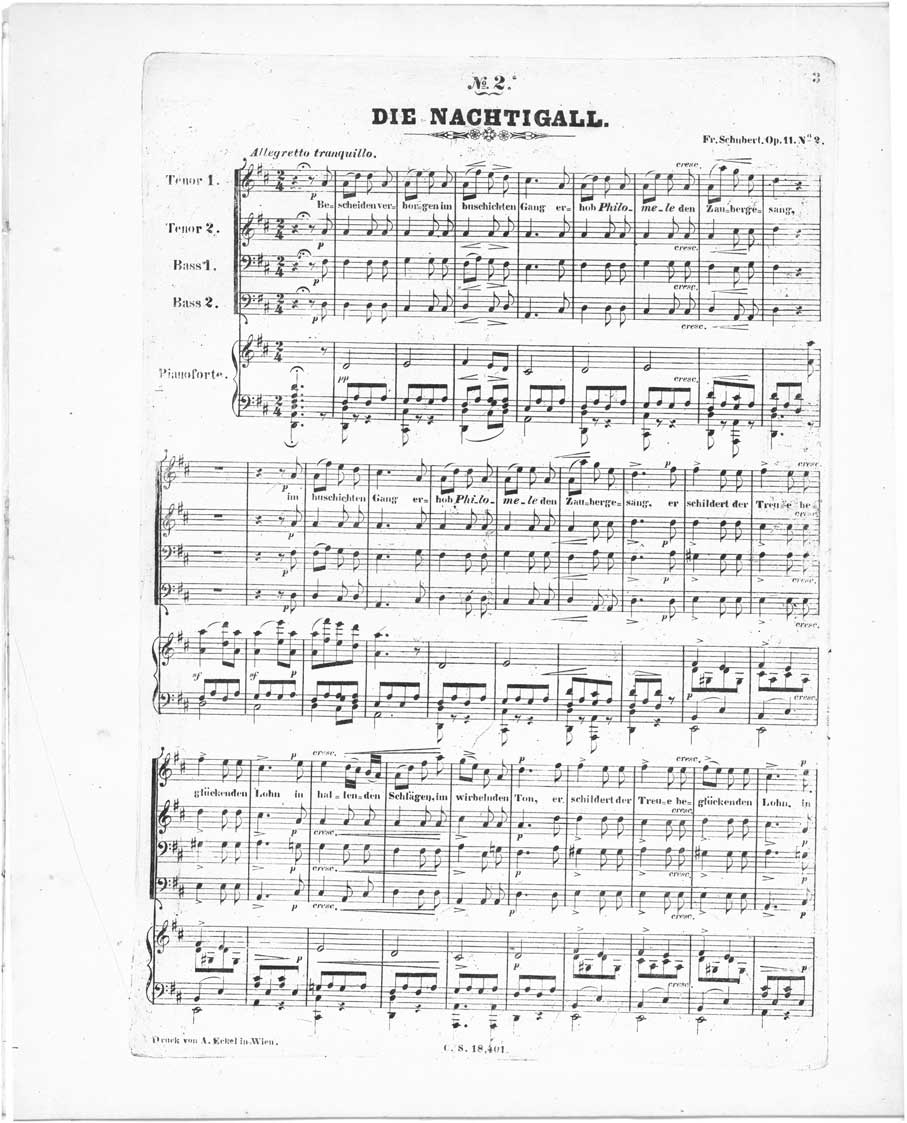
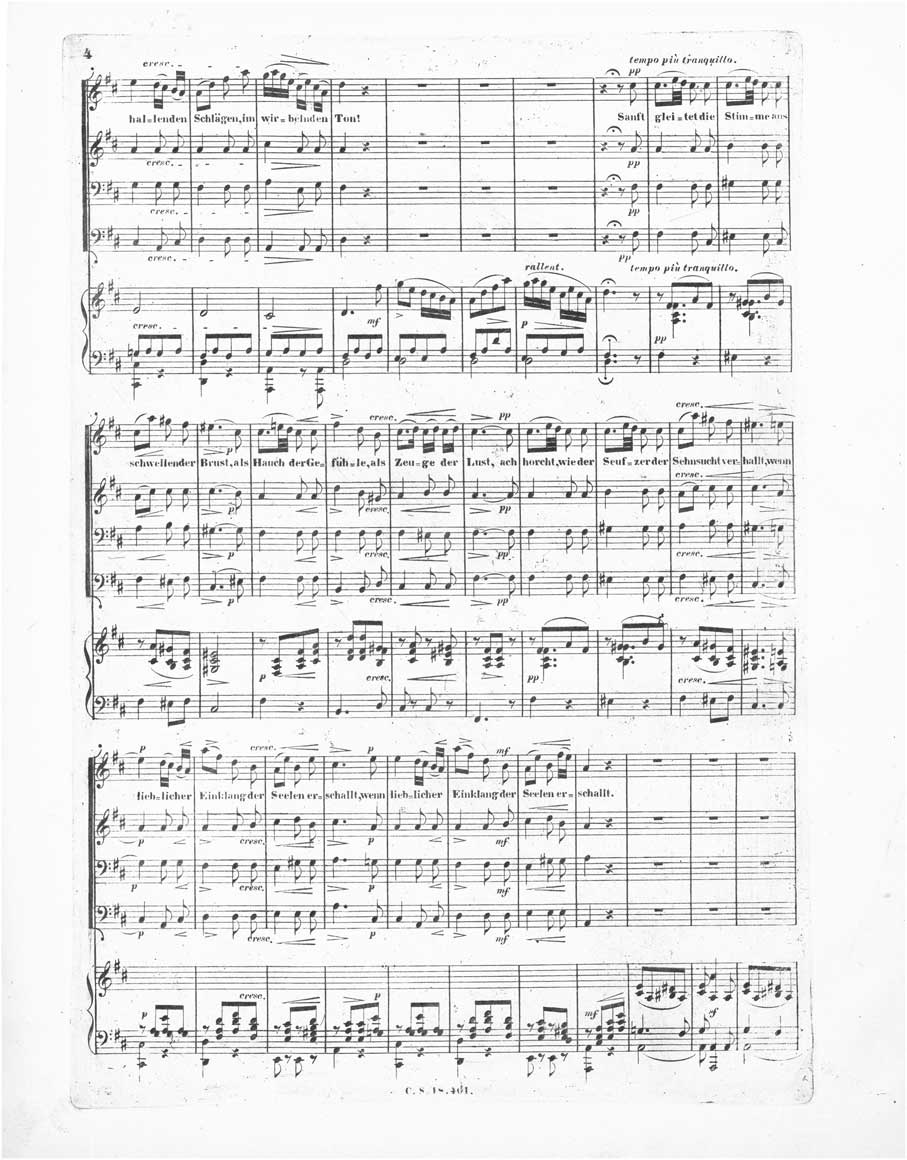
The title of the Herbeck edition makes reference to Vortragszeichnen supplied by the editor, and such intervention on his part may be observed in many of the surviving numbers in the edition. Eusebius Mandyczewski, editor of the series devoted to works for men’s chorus in the old Schubert Complete Works edition (series 16), observed that Herbeck’s interpretive marks are ‘not merely supplemented, but often exaggerated’.Footnote 63 A good example of this excess is found in the notation of ‘Die Nachtigall’ (section I, no. 2), the first two pages of which are presented here in Figures 2 and 3 (pp. 2–3, bars 1–60). Herbeck’s source was the first edition by Cappi & Diabelli, which has also served subsequent editors owing to the absence of the original autograph. In a comparison with corresponding pages in this source (whose notation is readily available, reproduced in both the old and the new Schubert Complete Works), Herbeck’s version is seen to contain additional material in almost every bar, consisting largely of marks for dynamic levels and indications of crescendo and decrescendo (some verbal abbreviations, but mostly hairpins). In addition, Herbeck altered tempo and mood designations, as follows: the original opening Allegretto is changed to Allegretto tranquillo; at bar 36, rallent. is added in the piano part; at bar 37, tempo più tranquillo is added; at bar 86, ritard. is added; and at bar 87, Allegro is changed to Allegretto assai tenuto (the last two examples are not shown in Figs 2 and 3). Moreover, he changed the content of the piano accompaniment from the original in seventeen bars of the piece. As mentioned above, this editorial method had little to do with the modern philosophy of scholarly editing that treats the entirety of a composer’s notation as sacrosanct and expects performers to know how to interpret it appropriately. Herbeck was editing for musicians of his time, who had become increasingly more accustomed to and dependent on excessive interpretation marks.
Chöre von Franz Schubert mit und ohne Begleitung. Neue, einzig rechtmässige Ausgabe, ed. Johann Herbeck, section I, no. 2, ‘Die Nachtigall’ (Hamburg: Verlag von Aug. Cranz, 1876 or later), p. 3. Possession of the author.

Chöre von Franz Schubert mit und ohne Begleitung. Neue, einzig rechtmässige Ausgabe, ed. Johann Herbeck, section I, no. 2, ‘Die Nachtigall’ (Hamburg: Verlag von Aug. Cranz, 1876 or later), p. 4. Possession of the author.

Most of the numbers in Herbeck’s edition that have been located can be shown (or, where no surviving copies have been found, can be presumed) likewise to have been based on first editions. Among these is ‘Salve Regina’ (section I, no. 18), which follows the Diabelli first edition, a source characterized as ‘corrupt’ by Otto Erich Deutsch.Footnote 64 Herbeck retained not only Diabelli’s organ part but also the perplexing passage found in bars 34–41, which presents the correct text ‘et Jesum benedictum fructum ventris tui, nobis post hoc exilium ostende’ with note values devised to suit the proper declamation of that text. What Schubert wrote and set to music here, however – and what must be favoured, for better or worse – was a distorted version: ‘et ostende nobis, nobis post hoc exilium ostende Jesum, filium tuum’.Footnote 65 By contrast, ‘Der Entfernten’ (section I, no. 5) seems to have been modelled on a manuscript copy of the autograph in question. A significant change (although perhaps not noticed by an audience) appearing in Herbeck’s version is the transposition of the probably original key of C-sharp major to the more ‘singer-friendly’ key of C major.Footnote 66
Autograph scores served directly as models for a few of the numbers in the Herbeck edition, and when these originals were left alone, unaltered, to present ‘Urtext’ editions, the editing approaches modern standards. An example is ‘Gesang der Geister über den Wassern’ (section I, no. 23), cited above as the work that inspired Herbeck to create his edition of Schubert’s choral music. Published by C.A. Spina in 1858, this edition follows the autograph strictly, no doubt a result of the lithographer’s practice of doing what engravers and lithographers did best: copying exactly what they found in the model. This publication, which was incorporated into Herbeck’s edition, credits him only with having prepared the separate piano reduction of the instrumental parts. Another number, similarly based on autograph material and exhibiting no editorial excess, is ‘Lob der Einsamkeit’ (section I, no. 28, 1859), although the version published in 1868 contains some editorial additions. A greater degree of editorial freedom is exhibited in other numbers modelled on autographs, such as ‘Rüdigers Heimkehr’ (section I, no. 33) and ‘Nur wer die Sehnsucht kennt’ (section I, no. 34).Footnote 67
Another category represented in Herbeck’s edition consists of versions significantly distant from Schubert’s intentions. These include the songs for solo voice and piano arranged by Herbeck for four-part men’s chorus in ‘Jagdlied’ (section I, no. 27) and for mixed chorus in ‘Litanei’ (section II, no. 16: copy not found, but probably the same as the second piece in the Drei geistliche Lieder). Herbeck is distinctly indicated as arranger in both of these publications. Schubert’s A-flat setting of ‘Psalm 23’ for women’s ensemble, written for the pupils of Anna Fröhlich, appears as no. 7 in section II (derived from the first edition by A. Diabelli & Co.), but the arrangement in B-flat for men’s voices in section I, no. 15 (also derived from an edition by Diabelli) has been attributed to Ferdinand Schubert.Footnote 68 The origins of the two settings of ‘Ständchen’ (for alto or baritone solo, men’s vocal quartet, and piano in section I, no. 17; and for alto solo, women’s vocal quartet, and piano in section II, no. 9) are similar to those of ‘Psalm 23’, but more complicated. According to the well-known story, Schubert originally wrote the setting for men’s voices (D. 920, 1. Fassung) for Anna Fröhlich’s ensemble, but upon being reminded that her singers were female, he created the version for an ensemble of women’s voices (D. 920, 2. Fassung).Footnote 69 The second version is not just a transposition of the first, but employs the same melodic material in an appropriately different arrangement. Herbeck presumably based his edition for women’s voices (copy not found) on the first edition by A. Diabelli & Co. The original version for men’s voices, however, appeared as late as 1891 in the first Complete Works edition, and the autograph score had evidently not been available to Herbeck. His solution was to attempt to recreate this original version by transposing the second version down into suitable ranges for male singers and adjusting the bottom part to make it more appropriate for lower bass voices. The result was a hybrid version of the piece with no historical validity other than as an example of the editor’s ingenuity.
A noticeable distance from the composer’s intentions is also illustrated in the male-voice arrangement of Schubert’s Gesänge zur Feier des heiligen Opfers der Messe in Herbeck’s edition, which is all the more surprising because the editor gave it pride of place as no. 1 in section I. The title is presented as Deutsches Hochamt in the passe-partout and as Deutsche Messe (the most common but least authentic form) in the score. Schubert’s original version of this piece was written for mixed chorus, winds and organ. Along with its several subsequent arrangements for other ensembles, this minor composition has been given more attention by writers and performers than it probably merits. The men’s-chorus version presented by Herbeck was accepted by Nottebohm as authenticFootnote 70 and was reported to be popular, but it is a poor representation of the composer’s work and rightly deserves Eusebius Mandyczewski’s harsh verdict in the old Schubert Complete Works edition:
There is no measure in Herbeck’s edition that in the handling of the men’s chorus could even in the slightest degree bear witness to the mastery that was characteristic of Schubert. There is also no cause, in Schubert’s life, for such an arrangement. As the piece is shown in the autograph, it is a work ordered by the author of the text, and it is more readily to be accepted that Schubert, out of necessity, would have written a separate Mass for men’s voices than that he would have supplied an arrangement like the one published by Herbeck.Footnote 71
This prompts the question of how Herbeck, the experienced conductor of Schubert’s works and himself a gifted composer of choral music, could have been taken in by this inferior, spurious arrangement. The answer is probably that he believed the version to be authentic because it came from a source that he considered trustworthy – Franz Schubert’s brother Ferdinand, whose ‘Schubert Cabinet’ (‘Schubert Schrank’) contained several versions of the work, including the one that seems to have served as Herbeck’s source.Footnote 72 The manuscript in question (GdM, o. Kl. 47205, IIA, 20b) bears Ferdinand’s inscription ‘Frz Schuberts deutsches Hochamt / für 4 Männerstimmen / eingerichtet von Ferdinand Schubert mp’. Otto Erich Deutsch, writing in 1928, identified this source of Herbeck’s arrangement, described it as being quite far removed from Schubert’s original, and suggested that the author of this version might have been Ferdinand Schubert’s colleague Joseph Ferdinand Kloß, based on similarities with the latter’s published arrangement of the work for mixed chorus.Footnote 73 In 1951, however, Deutsch favoured Ignaz von Seyfried as the possible author.Footnote 74 Later writers also joined the discussion. Franz Burckhart reviewed all of the research and sources of information on the subject and pointed to Kloß as the most likely author of the version presented in Herbeck’s edition.Footnote 75 Erich Benedikt devoted a more recent article mostly to the origin and subsequent history of Schubert’s original composition, touching on the men’s-voice version in question – whose composition he attributed to Herbeck with little investigation – only in passing.Footnote 76 In the final analysis, it is not as important to identify the author of the faulty version presented by Herbeck as it is to acknowledge its lack of authenticity. After Ferdinand’s Schubert’s death in 1859, his manuscripts passed on to his nephew Eduard Schneider, who had connections to Spina and thus to Herbeck.
In the opening remarks of his commentary on the music for men’s chorus in the old Schubert Complete Works, editor Eusebius Mandyczewski states that ‘practically all of the editions in use today stem from Herbeck’s edition’.Footnote 77 Candidates for inclusion in this group, as identified by Gustav Nottebohm in his catalogue (1874), are editions published by several firms, among which by far the most significant, in terms of output and reputation, is C.F. Peters in Leipzig. Peters produced three volumes devoted to Schubert’s choral music, edited by Alfred Dörffel: for mixed chorus (publisher’s edition no. 1045), men’s chorus (1046) and women’s chorus (1047).Footnote 78 A comparison of the men’s-chorus volumeFootnote 79 with the 26 surviving copies representing Herbeck’s section I proves Mandyczewski’s point: Dörffel relied heavily on Herbeck’s versions, reproducing most of them exactly. He even accepted and therefore perpetuated the most unauthentic arrangements in the Herbeck edition (section I, nos. 1 and 17).
After an increasingly stormy and exhausting relationship with the governing board of the Court Opera on the matter of mounting deficits, Johann Herbeck resigned from his post as Director in 1875 with diminished physical capacity. He was welcomed back to his position at the GdM, but any possibility that his greater freedom might have allowed him time and energy to turn his attention again to his Schubert edition was cut short by his untimely death on 28 October 1877, some two months before his forty-sixth birthday. With this event, an important chapter in the reception-history of Schubert’s music was brought to a close.
APPENDIX 1
Check List of Johann Herbeck’s Edition of Choral Works by Franz Schubert, with Two Additional Publications
Abbreviations
Sp.=published by C.A. Spina and/or successors
npr.=listed, but no price given, and therefore number not issued
*=copy located and examined
der.=derived from
Dia.=Cappi & Diabelli or Diabelli & Co. edition
arr.=arranged by
int.=interpretation marks
Chief Bibliographical Sources
SpA=C.A. Spina, Ablieferungsbuch (Wienbibliothek, 159610 Ja) (Stage 1)
Spl=C.A. Spina, list, 1867 (Stage 2)
SpNl/CrHl=C.A. Spina’s Nachfolger, list, [1872] / Aug. Cranz, Hamburg, list, [1876] (Stage 3)
Sp/SchV=C.A. Spina / Friedrich Schreiber, Verlags-Catalog, 1872 / 1874 (Stage 4)
NoT=Gustav Nottebohm, Thematisches Verzeichniss, 1874 (Stage 4)
CrLl=Aug. Cranz, Leipzig, list, [1897] (Stage 4)
Additional Bibliographical Sources
M=Musikalisch-literarisches Monatsbericht neuer Musikalien (Hofmeister, Jost)
V=Verzeichniss sämtlicher . . . in Deutschland und den angrenzenden Ländern gedruckter Musikalien (Hofmeister)
O=Oesterreichischer Catalog: Verzeichniss aller . . . in Oesterreich erschienenen Musikalien (Bermann)
Libraries/Archives
AGdM=Archive of the Gesellschaft der Musikfreunde, Vienna
AWMgV=Archive of the Wiener Männergesang-Verein, Vienna
ÖNb=Österreichische Nationalbibliothek, Vienna
Wb=Wienbibliothek (formerly Stadt- und Landesbibliothek), Vienna
Section I: Men’s Chorus
1. ‘Deutsches Hochamt / Deutsche Messe’ (TTBB)
D. 872, Gesänge zur Feier des heiligen Opfers der Messe (SATB, Org.) – Sp. (C.S. 18400)* – SpA (12 May 1866), Spl, SpNl/CrHl, Sp/SchV, NoT, CrLl, M, O; der. arr. by Ferdinand Schubert or J. F. Kloß (AGdM, o. Kl. 47205, IIA, 20b), repeats written out, int. added.
2. ‘Die Nachtigall’ (TTBB, Pf. ad lib.)
D. 724 (TTBB), op. 11, no. 2 – Sp. (C.S. 18401)* – SpA (28 July 1866), Spl, SpNl/CrHl, Sp/SchV, NoT, CrLl, M, V, O; der. Dia. (C. et D. 1018), many int. added, changes made in rhythm and Pf. part.
3. ‘Das Dörfchen’ (TTBB, Pf. ad lib.)
D. 641 (TTBB), op. 11, no. 1 – Sp. (C.S. 18402)* – SpA (28 July 1866), Spl, SpNl/CrHl, Sp/SchV, NoT, CrLls, M, V, O; der. Dia. (C. et D. 1017), int. added.
4. ‘Geist der Liebe’ (TTBB, Pf. ad lib.)
D. 747 (TTBB), op. 11, no. 3 – Sp. (C.S. 18403)* – Spl (1867), SpNl/CrHl, Sp/SchV, NoT, CrLl; der. Dia. (D. et C. 1019), int. added and changed.
5. ‘Der Entfernten’ (TTBB)
D. 331 – Sp. (C.S. 18404)* – SpA (27 Oct. 1866), Spl, SpNl/CrHl, Sp/SchV, NoT, CrLl, M, V, O; possibly der. autograph (lost) or MS copy in possession of J. Brahms (AGdM, V 37392), transposed from C-sharp to C, int. slightly changed.
6. ‘Jünglingswonne’ (TTBB)
D. 983, op. 17, no. 1 – Sp. (C.S. 18405)* – Spl (1867), SpNl/CrHl, Sp/SchV, NoT, CrLl; der. Dia. (C. et D. 1176), int. added.
7. ‘Liebe’; ‘Zum Rundetanz’ (TTBB)
D. 983 A, 983 B, op. 17, nos. 2 & 3 – Sp. (C.S. 18406)* – Spl (1867), SpNl/CrHl, Sp/SchV, NoT, CrLl; der. Dia. (C. et D. 1176), int. added.
8. ‘Die Nacht’ (TTBB)
D. 983 C, op. 17, no. 4 – Sp. (C.S. 18407)* – Spl (1867), SpNl/CrHl, Sp/SchV, NoT, CrLl; der. Dia.(C. et D. 1176), a few int. added.
9. ‘Geisterchor’ (Rosamunde) (TTBB, 3 Horns, 3 Trombones, Pf. ad lib.)
D. 797, no. 4 (TTBB, 3 Horns, 3 Trombones) – Sp. (C.S. 18408)* – SpA (29 Oct. 1866), Spl, SpNl/CrHl, Sp/SchV, NoT, CrLl, M, O; evidently der. Sauer & Leidesdorf edition (M.I.L. 1098), a few changes made in rhythm.
10. ‘Der Gondelfahrer’ (TTBB, Pf.)
D. 809, op. 28 – Sp. (C.S. 18409)* – Spl (1867), SpNl/CrHl, Sp/SchV, NoT, CrLl; der. possibly Sauer & Leidesdorf edition (599), but more likely Dia. (D. et C. 3535), int. added. Herbeck arr. the pf. part for 2 violins, viola, violoncello, contrabass, 2 bassoons, and 2 horns (manuscript score in AWMgV).
11. ‘Wehmut’ (TTBB)
D. 825, op. 64, no. 1 – Sp. (C.S. 18410?) – Spl (npr.), SpNl/CrHl (npr.), Sp/SchV (1872), NoT, CrLl; presumably der. Dia. (D. et C. 5215).
12. ‘Ewige Liebe’; ‘Flucht’ (TTBB)
D. 825 A, 825 B, op. 64, nos. 2 & 3 – Sp. (C.S. 18411?) – Spl (npr.), SpNl/CrHl (npr.), Sp/SchV (1872), NoT, CrLl; presumably der. Dia. (D. et C. 5215).
13. ‘Bootgesang’ (TTBB, Pf.)
D. 835, op. 52, no. 3 – Sp. (C.S. 18412)* – Spl (npr.), SpNl/CrHl (npr.), Sp/SchV (1872), NoT, CrLl; der. possibly Artaria edition (M.A. 813), but more likely Dia. (D. et C. 7046), int. added.
14. ‘Mondenschein’ (TTBBB, Pf.)
D. 785, op. 102 – Sp. (C.S. 18413?) – Spl (1867), SpNl/CrHl, Sp/SchV, NoT, CrLl; presumably der. Dia. (D. et C. 3181).
15. ‘Gott meine Zuversicht (Psalm 23)’ (TTBB, Pf.)
D. 706 (SSAA, Pf., in A-flat), op. 132 – Sp. (TTBB, Pf., in B-flat: C.S. 18414)* – Spl (1867), SpNl/CrHl, Sp/SchV, NoT, CrLl; der. Dia. (D. et C. 8777), a few int. added. See section II, no. 7.
16. ‘Nachthelle’ (T Solo, TTBB, Pf.)
D.892, op. posth. 134 – Sp. (C.S. 18415)* – Spl (1867), SpNl/CrHl, Sp/SchV, NoT, CrLl, O; der. Dia. (D. & C. 6265), int. added.
17. ‘Ständchen’ (A or Bar. Solo, TTBB, Pf.)
D. 920, 2. Fassung (A Solo, SSAA, Pf.), op. posth. 135 – Sp. (C. [S.] 18416)* – Spl (npr.), SpNl/CrHl (npr.), Sp/SchV (1872), CrLl; der. Dia. (D. & C. 6266), Pf. part retained, SSAA transposed down 8va, with deviations, int. added; this is not Schubert’s original version (D. 920, 1. Fassung: A Solo, TTBB, Pf.). See section II, no. 9. Copy owned by George Grove, probably acquired during his visit to Vienna in 1867, thus establishing latest date of publication.
18. ‘Salve Regina’ (TTBB, Org ad lib.)
D. 811 (TTBB), op. posth. 149 – Sp. (C.S. 18417)* – Spl (1867), SpNl/CrHl, Sp/SchV, NoT, CrLl; der. Dia. (D. & C. 7972), int. added. Dia. has incorrect reading in bars 34–41, retained by Herbeck.
19. ‘Schlachtlied’ (TTBB, TTBB, Pf. ad lib.)
D. 912 (TTBB, TTBB), op. posth. 151 – Sp. (C.S.18418?) – Spl (npr.), SpNl/CrHl (npr.), SpSchV (1872), NoT, CrLl; presumably der. Dia. (D. & C. 7974) or version in Witteczek-Spaun Collection, vol. 33, pp. 133–63 (AGdM), including Pf. part by Ferdinand Schubert.
20. ‘Hymne’ (TTBB Soli, TTBB, 2 Oboes, 2 Clarinets, 2 Bassoons, 2 Horns, 2 Trumpets, 3 Trombones, or Pf.)
D. 964 (TTBB Soli, TTBB, 2 Oboes, 2 Clarinets, 2 Bassoons, 2 Horns 2 Trumpets, 3 Trombones), op. posth. 154 – Sp. (C.S. 18419)* – Spl (1867), SpNl/CrHl, Sp/SchV, NoT, CrLl; der Dia. (D. & C. 8778, with Pf. part by Ferdinand Schubert), int. added.
21. ‘Trinklied aus dem 14ten Jahrhundert’ (TTBB, Pf. ad lib.)
D. 847 (TTBB), op. posth. 155 – Sp. (C.S. 18420)* – Spl (npr.), SpNl/CrHl (npr.), Sp/SchV (1872), NoT, CrLl, M, V, O; der. Dia. (D. & C. 8849), int. added. Copy owned by George Grove, probably acquired during his visit to Vienna in 1867, thus establishing latest date of publication.
22. ‘Nacht-Musik’ (TTBB, Pf. ad lib.)
D. 848 (TTBB), op. posth. 156 – Sp. (C.S. 18421?) – Spl (npr.), SpNl/CrHl (npr.), Sp/SchV (1872), NoT, CrLl: presumably der. Dia. (D. & C. 8850).
23. ‘Gesang der Geister über den Wassern’ (TTTTBBBB, 2 Violas, 2 Violoncellos, Contrabass, or Pf. four-hands)
D. 714 (TTTTBBBB, 2 Violas, 2 Violoncellos, Contrabass), op. posth. 167 – Sp. (parts C.S. 16373, Pf. parts C.S. 16374, score C.S. 16509)* – SpA (21 Jan. 1858), Spl (npr.), SpNl/CrHl (npr.), Sp/SchV, NoT, CrLl, M, V; clearly der. autograph score in possession of C. A. Spina (Wb, MHc 15.803), Pf. ‘eingerichtet von Herrn Joh, Herbeck’.
24. ‘Im Gegenwärtigen Vergangenes’ (TTBB, Pf.)
D. 710 – Sp. (C.S. 18423)* – Spl (npr.), SpNl/CrHl (npr.), Sp/SchV (1872), NoT, CrLl: der. Dia. (D. & C. 8820), int. added.
25. ‘Das Leben’ (TBB, Pf.)
D.269, 2 (SSA, Pf.) – Sp. (C.S. 18424)* – Spl (npr.), SpNl/CrHl (npr.), Sp/SchV (1872), CrLl; der. Dia. (D. & C. 8821), voices transposed down 8va, int. added, last two chords in Pf. simplified.
26. ‘Marsch und Chor der Ritter’ (Die Verschworenen) (TTBB, Pf.)
D. 787, no. 5 (TTBB, Orch.) – Sp. (C.S. 18425)* – Spl (npr.), SpNl/CrHl (npr.), Sp/SchV (1872), NoT, CrLl, O; der. Spina edition with Pf. part by E. Schneider (SpA, C.A.S. 17355, 11 Jan. 1862), int. added, minor changes made.
27. ‘Jagdlied aus Ossian’s Gesängen (Die Nacht)’ (TTBB, Pf.), ‘eingerichtet für Männerchor von J. Herbeck’
D. 521 (Voice, Pf.) – Sp. (C.S. 16601)* – SpA (28 Apr. 1859), Spl (npr.), SpNl/CrHl (npr.), Sp/SchV, NoT, CrLl, V; der. Dia. (D. et C. 3631), arr., transposed from F to D, 8ve doublings added in Pf. bass, int. added; same title page as section I, no. 28.
28. ‘Lob der Einsamkeit’ (TTBB)
D. 337 – Sp. (C.S. 16606; C.S. 18427)* – Spl (npr.), SpNl/CrHl (npr.), Sp/SchV (1872), NoT (‘um 1868’), CrLl, V; der. autograph parts in possession of C. A. Spina (Wb, MH 44/c), int. added. Copy owned by George Grove, probably acquired during his visit to Vienna in 1867, thus establishing latest date of publication.
29. ‘Der Wintertag’ (TTBB, Pf.)
D. 984 (TTBB; Pf. lost), op. posth. 169 – Sp. (C.S. 17933)* – Spl (npr.), SpNl/CrHl (npr.), Sp/SchV (npr.), NoT (1874), CrLl; voice parts der. autograph parts in possession of C. A. Spina (Wb, MH 43/c); title page states ‘Männerchor mit Solo-Quartet u. Pianoforte-Begleitung’, but no distinction given between soli and chorus in the edition; title page states ‘Die Pianoforte Begleitung, welche in Schubert’s Nachlasse nicht aufzufinden war ist von J. P. Gotthard hinzugefügt’; score omits some int. found in voice parts, but adds others.
30. ‘Wein und Liebe’ (TTBB)
D. 901 – Sp. – Spl (npr.), SpNl/CrHl (npr.), Sp/SchV (npr.), CrHl (npr.); presumably der. Tobias Haslinger edition (T.H. 3554).
31. ‘Frühlingslied’ (TTBB, Pf. or Guitar)
D. 740, ‘Frühlingsgesang’ (TTBB, Pf.), op. 16, no. 1 – Sp. – Spl (npr.), SpNl/CrHl (npr.), Sp/SchV (1872), NoT, CrLl (combined with section I, no. 32, with single price given); presumably der. Dia. (C. et D. 1175).
32. ‘Naturgenuss’ (TTBB, Pf. or Guitar)
D. 422 (TTBB, Pf.), op. 16, no. 2 – Sp. Spl (npr.), SpNl/CrHl (npr.), Sp/SchV (1872), NoT, CrLl (combined with section I, no. 31, with single price given); presumably der Dia. (C. et D. 1175).
33. ‘Rüdigers Heimkehr’ (T Solo, TTBB, Orch.[or] Pf.)
D. 791, no. 1 (T Solo, TTBB, Orch.) – Sp. (parts, C.S. 18429; score, C.S. 19473)* – Sp/SchV (1872), NoT (“um 1868”), CrLl (identified by the text: ‘Durch der Ostsee wilde Wogen’); Herbeck mentions this edition as already published in his letter to C. A. Spina of 12 Feb. 1868 / 15 Feb. 1868. Copy owned by George Grove, probably acquired during his visit to Vienna in 1867, thus establishing latest date of publication. Arr. by Herbeck from autograph sketch in possession of Nikolaus Dumba (Wb, MH 11/c); title is Herbeck’s, text altered and augmented
34. ‘Nur wer die Sehnsucht kennt’ (TTBBB)
D. 656, ‘Sehnsucht’ – Sp. (C.S. 18447)* – SpNl/CrHl (listed as no. 33), Sp/SchV (1872), NoT (‘um 1867’), CrLl; Herbeck mentions this edition as already published in his letter to C. A. Spina of 12 Feb. 1868 / 15 Feb. 1868. Evidently der. autograph score in possession of J. P. Gotthard (lost) or perhaps copy by Albert Stadler (ÖNb, Mus. Hs. 29480), int. added. Herbeck also wrote an accompaniment for 2 Violas and 3 Violoncellos (Herbeck’s autograph in ÖNb, Mus. Hs. 29481). Copy owned by George Grove, probably acquired during his visit to Vienna in 1867, thus establishing latest date of publication.
Section II: Mixed Chorus (and Women’s Chorus)
1. ‘Jägerchor’ (Rosamunde) (SSAA, TTBB, Pf.)
D. 797, no. 8 (SSAA, TTBB, Orch.), op. 26, no. 2 – Sp. – Spl (npr.), SpNl/CrHl (npr.), Sp/SchV (1872), NoT, CrLl; presumably der. Dia.
2. ‘Hirtenchor’ (Rosamunde) (SATB, Pf.)
D. 797, no. 7 (SATB, Orch.), op. 26, no. 4 – Sp. – Spl (npr.), SpNl/CrHl (npr.), Sp/SchV (1872), NoT, CrLl; presumably der. Dia.
3. ‘Tantum ergo’ (SATB, Orch.)
D. 739 (SATB, Orch., Org), op. 45 – Sp. – Spl (npr.), SpNl/CrHl (npr.), Sp/SchV (1872; npr.?), NoT, CrLl; presumably der. Dia.
4. Messe in C (SATB, Orch.)
D. 452 (SATB Soli, SATB, Orch., Org.), op. 48 – Sp. – Spl (npr.), SpNl/CrHl (npr.), Sp/SchV (1872; npr.?), NoT, CrLl; presumably der. Dia.
5. ‘Coronach, Todtengesang’ (SSA, Pf.)
D. 836, op. 52, no. 4 – Sp. – Spl (npr.), SpNl/CrHl (npr.), Sp/SchV (1872), NoT, CrLl; presumably der. Dia.
6. ‘Antiphonen zur Palmweihe’ (SATB)
D. 696, op. posth. 113 – Sp. – Spl (npr.), SpNl/CrHl (npr.), Sp/SchV (1872; npr.?), NoT, CrLl; presumably der. Dia.
7. ‘Gott meine Zuversicht (Psalm 23)’ (SSAA, Pf.)
D. 706, op. posth. 132 – Sp. (F.S. 3182)* – Spl (npr.), SpNl/CrHl (npr.), Sp/SchV (1872), NoT, CrLl; der. Dia. See section I, no. 15.
8. ‘Gott in der Natur’ (SSAA, Pf.)
D. 757, op. 133 – Sp. – Spl (npr.), SpNl/CrHl (npr.), Sp/SchV (1872), NoT, CrLl; presumably der. Dia.
9. ‘Ständchen’ (A Solo, SSAA, Pf.)
D. 920, 2. Fassung, op. posth. 135 – Sp. – Spl (npr.), SpNl/CrHl (npr.), Sp/SchV (1872), NoT, CrLl; presumably der. Dia. See section I, no. 17.
10. ‘Mirjam’s Siegesgesang’ (S Solo, SATB, Pf.)
D. 942, op. posth. 136 – Sp. – Spl (npr.), SpNl/CrHl (npr.), Sp/SchV (1872), NoT, CrLl; presumably der. Dia.
11. ‘Gebet’ (SATB, Pf.)
D. 815, op. posth. 139 (a) – Sp. – Spl (npr.), SpNl/CrHl (npr.), Sp/SchV (1872), NoT, CrLl; presumably der. Dia.
12. ‘Des Tages Weihe’ (SATB, Pf.)
D. 763, op. posth, 146 – Sp. – Spl (npr.), SpNl/CrHl (npr.), Sp/SchV (1872), NoT, CrLl; presumably der. Dia.
13. ‘Graduale’ (SATB, Orch., Org.)
D. 184, op posth. 150 – Sp. – Spl (npr.), SpNl/CrHl (npr.), Sp/SchV (1872; npr.?), NoT, CrLl; presumably der. Dia. The description of the orchestra in Spl, CrHl, and CrLl includes ‘2 Oboën und Clarino (2 Trommeln ad lib.), 2 Trompeten, Pauken’; this is probably a corruption of the Dia. parts: ‘Oboe o Clar. 1, Oboe o Clar. 2, Clarino 1 C, Clarino 2 C, Tympani C G’.
14. ‘Der Frühlingsmorgen’ (STB, Pf.)
D. 666, op. posth. 158 – Sp. – Spl (npr.), SpNl/CrHl (npr.), Sp/SchV (1872), NoT, CrLl; presumably der. Dia.
15. ‘Marsch und Chor’ (Fierabras) (SATB, Orch.)
D. 796, no. 3 (SSAA, TTBB, Orch.) – Sp. – Spl (npr.), SpNl/CrHl (npr.), Sp/SchV (1872), CrLl (npr.).
16. ‘Litanei’ (SATB), ‘eingerichtet von J. Herbeck’
D. 343 (Voice, Pf.) – Sp. – Spl (npr.), SpNl/CrHl (npr.), Sp/SchV (1872), CrLl; presumably der. Dia., arr. Herbeck with Pf. deleted. See Additional Publications.
17. Lazarus, Ostercantate (Solo Voices, SATB, Orch.).
D. 689 – Sp. (C.S. 18544)* – SpA (4 Dec. 1865), Spl (npr.), SpNl/CrHl (npr.), SpSchV, NoT, CrLl, M, O; der. autograph scores of act 1 in possession of C. A. Spina (ÖNb, S.m. 27666) and of act 2 in possession of Schubert’s heirs (Wb, MH 26/c); ‘Clavier-Auszug von Johann Herbeck’; prefatory remarks by Herbeck.
Additional Publications
Drei geistlicher Lieder (SATB), ‘für gemischten Chor bearbeitet von J, Herbeck’
‘Vom Mitleiden Mariä’ (D. 632, Voice, Pf.).
‘Litanei auf das Fest aller Seelen’ (D. 343, Voice, Pf.). See section II, no. 16.
‘Pax vobiscum’ (D. 551, Voice, Pf.).
Sp. (C.S. 16571)* – SpA (25 Nov. 1858), Sp/SchV, NoT, M; der. Dia., arr. Herbeck with Pf. deleted.
‘Morgengesang im Walde’ (Der Graf von Gleichen) (TTBB, Orch. or Pf.), ‘Orchestrirung, Clavierbegleitung und Text von Johann Herbeck’
D. 918, no. 1 – Sp. (C.S. 19192)* – Sp/SchV, NoT (‘um 1868’), V; der. autograph short score in possession of Schubert’s heirs (Wb, MH 169/c); a manuscript sketch (ÖNb, Mus. Hs. 36960) contains autograph material by Herbeck, signed and dated December 1865.
APPENDIX 2 VORWORT
zur neuen Ausgabe der Chöre von Franz Schubert.
(Eigenthum und Verlag der Hofmusikalienhandlung C.A. Spina in Wien.)
Franz Schubert hat den Männergesang mit den originellsten, bedeutsamsten Tondichtungen beschenkt – das darf man, ohne den hervorragenden Schöpfungen gleicher Art eines Mendelsohn, Schumann und Anderer Abbruch zu thun ungescheut aussprechen.
Der folgerichte Schluss, dass sich jeder Männergesangverein, der nur halbweg genügende Kräfte besitzt, mit der Pflege Schubert’scher Chöre eifrigst beschäftigen müsse, wird leider ein irriger Glaube, wenn man die verhältnissmässig ver-schwindend kleine Zahl von Vereinen in Betracht zieht, welche sich auch mit Franz Schubert befassen. – Den Grund davon blos in der Bequemlichkeit oder gar schlechten Geschmacksrichtung finden zu wollen, wäre immerhin einen so ungerecht, als diese Vernachlässigung einzig und allein den bisherigen mangelhaften, hauptsächlich theuren Ausgaben zur Last zu legen. Es mögen wohl verschiedene Factoren zusammengewirkt haben, worunter einer der wichtigsten das Vorurtheil ist, dass Schubert so ‘ungeheure Schwierigkeiten’ bietet und nicht den Effect macht, wie mancher leichte Chor, der so wenig kostet und so dankbar ist. An eine tief gehende Verbreitung des erst aufgeführten Grundes zu glauben (Bequemlichkeit und schlechte Geschmacksrichtung) schiene mir in Bezug auf Deutschland eine Versündung an dem Musiksinne unseres Vaterlandes, der gesunder und urwüchsiger in der Welt nicht zu finden. – Die Beseitigung der theuren, mangelhaften Ausgaben wird aber eine Ehrensache der Verlagshandlung C.A. Spina, und beziehungsweise des Unterzeichneten sein. – Schubert’s musikalische Dichtungen für Männerchor (später folgen auch die für gemischten Chor) ohne und mit Begleitung werden in rascher Aufeinanderfolge, würdig ausgestattet, in handsamen Formate in Partitur und Stimmen erscheinen, und wird der Anschaffungspreis für die Vereine ein so billiger sein, wie ihn weder Abschrift, noch Umdruck erzielen können. – Die Fehler, ungenauen und ungleichen Vortragszeichen u. s. f. wurden nach Einsicht der Original-Partituren und Stimmen, wo selbe nicht zu beschaffen waren, verlässlicher Abschriften, entfernt. Neu hinzugekommene nähere Zeitmass- und Vortragsbezeichnungen fand ich durch gewissenhaftes Eingehen und die allgemeine Erfahrung , dass sorgfältig bezeichnete Auflagstimmen den Dirigenten und den Sänger wesentlich unterstützten, – geboten. Diese Bezeichnungen ersparen dem Dirigenten manches Wort, das sich daher der Sänger nicht zu merken braucht, und wird dadurch ein Hauptübel bei den Proben das durch häufige Bemerkungen erforderliche, oftmalige Unterbrechen und Wiederholen mit Ermüdung und Abspannung im Gefolge, möglichst verhütet. Mehrere dieser Bezeichnungen, die Alle nicht gegen den Geist der Sache sind, wurden schon von meinen Vorgängern in der Direction des Wiener Männergesang-Vereines angebracht und waren auch damals keine willkürlichen, denn um nur Eines anzuführen, ist z. B. das in der Mitte des ‘Widerspruch’ befindliche, in der bisherigen Ausgabe nicht angegebene Meno mosso ein traditionelles, wie Männer bekräftigen, die mit Schubert selbst öfter dessen Männerquartette gesungen.
Einzelne technische Aenderungen in der Clavierbegleitung (siehe u.a. ‘Die Nachtigall’) wären durch den Umstand gänzlich gerechtfertigt, als zu Schubert’s Lebzeiten und mit seiner Einwilligung und Hinzuthun mehrere der Männergesänge mit Clavier- oder Guitarre-Begleitung erschienen, und es wohl nicht nöthig ist zu erläutern, welch’ eigenthümliche, willkürliche, gewiss unvortheilhafte Umwandlung der Begleitungsformen entsteht, wenn an die Stelle des Claviers die Guitarre tritt. Es beweist dies auch, dass Schubert selbst die Begleitungsform bei den betreffenden Gesängen mehr als eine harmonische Basis oder ledigliche Unterstützung der Singstimmen, denn als eine unabänderliche Hauptsache betrachtete.
Dessen ungeachtet wurde zur beliebigen Wahl bei allen solchen Stellen die bisherige als original geltende Leseart mit beibehalten, obgleich sich in manchen Fällen eher bezweifeln als feststellen lässt, ob selbe von Franz Schubert’s Hand herrührt.
Kürzungen und Erleichterungen sind mit Sternchen und kleinen Noten nur dort angezeigt (z. B. bei ganz gleichlautenden, anstrengenden oder schwierigen Stellen), wo selbe, ohne gegen den Geist und das Wesen der Sache zu verstossen, angebracht werden konnten; hiebei wurde insbesonders auf kleinere Vereine Rücksicht genommen, deren Kräfte, der Anzahl, und künstlerischen Beschaffenheit nach, nicht immer die erwünschte Ausgiebigkeit haben können. – Wem diese Kürzungen und Erleichterungen nicht nöthig, oder unpassend dünken, betrachte sie als nicht vorhanden. Als Schluss dieser Redactionsbemerkungen muss aus triftigen Gründen ein eigentlich Selbstverständliches nachdrücklich betont werden, dass nämlich in dieser Ausgabe nicht eine Note, geschweige denn ein Accord geändert erscheint.
Den Cardinalpunkt: ‘die grossen Schwierigkeiten und der Mangel an Effect’ muss ich nochmals berühren, und wiederholen, dass bei dem heutigen Stande der Gesangvereine im Allgemeinen und der vorgeschrittenen Sorgfalt in der Ausführung, den Schubert’schen Chören gegenüber, diese Einwendung Vorurtheil ist. Man gehe nur mit ernstem Wollen, mit Wärme und Begeisterung daran, und mancher Verein, der sich ausschliesslich mit sogennanten leichten Dingen abquält, die, wie namentlich die meisten modernen komischen Chöre, nicht allzuleicht auszuführen sind, wird, wenn er dieselbe Mühe, z. B. um etwas gefürchtet Schweres herauszugreifen, auf den ‘Gesang der Geister über den Wassern’ verwendet, mit lohnender Genugthuung erfahren, dass es nicht so übermenschlich schwierig ist Schubert zu singen, und sogar der ‘Effect’ wird nicht fehlen. – Ja, eine Wirkung macht dann Schubert, so gewaltig und packend, dass es einem die Seele durchschauert. Wenn er ‘mit Geisterhänden in die geistigen Tiefen greift’ und zu singen anhebt: ‘des Menschen Seele gleicht dem Wasser’, vom ‘Silbergarten duft-umrauscht’, ‘es muss hinaus, die letzte Schranke bricht’, – wem dann das Blut nicht heisser wallt, wer da nicht jauchzen und weinen kann, der füllt nicht die Musik, er verspürt höchstens den Schall – dem wird der Musik geheimnissvoller Zauber für immer eine von verrückten Dichterlingen ersonnene Fabel sein!
Schubert’s Muse aber weihte sich nicht einzig und allein dem hohen Liede, stimmte nicht immer die erhabenen Klänge der ‘Hymne’, des ‘Geistergesanges’ an – sie weilt auch gerne auf freundlicher Erde, unter freundlichen Menschen, die ‘der Geist der Liebe’ erfüllt, sich nach ‘Liebe und Wein’ sehnen, im ‘Dörfchen’ den kind-lich unbefangenen Ton belauschen! – Und den ‘Naturgenuss’ musste ihn nicht Schubert schreiben, Franz Schubert, der geborne Wiener, mit der hellen Frische, der Empfänglichkeit für Natur und Leben, die sein Oesterreich kennzeichnet?! Der ‘Nachtgesang’ ertönt, die Stimmen und Hörner verklingen in Eins, – ist es da nicht, wie wenn ein leiser, warmer Hauch aus Wälschland den tiefgrünen, deutschen Wald durchzittert? Ja, durch die reizvolle Vermählung deutschen, innigen Gemüthes mit südlicher, farbenprächtiger Gluth berührt uns Schubert so wunderbar!
Rastlos auch und unermesslich reich war seine Schöpfungskraft – die Zeit war ihm zum Schaffen allzu knapp bemessen, wo hätte er sie zum Wählen gefunden? Das macht ihn zu Zeiten – Verzeihung dem Worte – etwas sorgloser und leichtfüssig, wie im 2. Theile der ‘Nachtigall’. Wer wagte es ihm zu verargen! Seine heisblütige Mutter, die alte, vielfach verketzerte Phäakenstadt ‘Wien’ trägt die Schuld! Sie hat ja den leichten Sinn im Kopfe, schmückt sich so verführerisch mit Laub, Blumen und Reben, macht ihren Kindern das Leben gar so süss und reizend, und duldet, dass sie Weib, Gesang und auch den Wein lieben! Dass dann Franz ab und zu wieder gerne ‘bei Hafis’ weilt, und lustig ausschlägt, weil ihm der Tanz-Rhythmus schon im Liebe prickelt, – können wir nicht erstaunlich finden – nur die Mutter hat’s verschuldet! Sie kann und mag diese leidliche Schuld, die natürliche Kehrseite so vieler Tugend, mit Stolz tragen, denn ihr Franz war ein Genie, dem sie als Wiegengeschenk den ihm eigenthümlichen Zug der feinsten Sinnlichkeit mitgegeben, der packen und zünden wird, so lange es noch Menschen gibt, die Blut und Nerven haben, und nicht lediglich pure Geister sind!
Das Vorwort ist jetzt ungebührlich lang geworden, – wenn man von Franz Schubert spricht, lässt sich schwer der Schluss finden, denn: ‘das Blühen will nicht enden’. – Darauf habe ich auch gepocht, und des Lesers Geduld mehr, als bei einem Vorworte üblich, in Anspruch genommen, Nachsicht erhoffend im Namen desjenigen, dem guter Wille, mit schwachen Kräften diese Zeilen geweiht! Namen, die uns lieb und theuer sind, wird man immer und immer zu nennen nicht müde, und so rufe ich den Vereinen unablässig zu: Singt Schubert! Schubert! Schubert! und noch einmal Franz Schubert!
Wien. im October 1865. Johann Herbeck.
FOREWORD
To the New Edition of Choruses by Franz Schubert
(Property and Publication of the Court Music Firm C.A. Spina in Vienna)
Franz Schubert bestowed the most original and meaningful musical compositions on the field of vocal music for men. One may proclaim this unabashedly without defaming the excellent creations in the same genre by composers like Mendelssohn, Schumann and others.
The conclusive deduction that every men’s choral music association that possesses even half of the necessary strength should engage in the most eager manner in the cultivation of Schubert’s choruses unfortunately becomes a mistaken belief when one takes into consideration the relatively decreasing, small number of associations that even concern themselves with Franz Schubert. Nevertheless, the desire to find the reason for this simply in convenience or a tendency toward bad taste would be just as unjust as laying the charge for this neglect solely and singly on the existing deficient and particularly expensive musical editions. Many different factors have probably contributed to this, one of the most important being the prejudice that Schubert presents such ‘enormous difficulties’ and does not produce the effect of many choruses that cost so little and are so rewarding. To accept a widespread distribution of the first reason given above (convenience and a tendency toward bad taste) would seem to me, with reference to Germany, an offense against the musical consciousness of our Fatherland, which cannot be found healthier and more indigenous anywhere in the world. The elimination of expensive, deficient editions is a matter of honour, respectively, to the publisher C.A. Spina and to the undersigned. Schubert’s musical creations for men’s chorus with and without accompaniment will appear in quick succession (those for mixed chorus will follow later), properly designed in attractive format in score and parts, and the purchase price for associations will be on an inexpensive level that neither copies nor reprints can match. Errors, ambiguous and inconsistent performance markings, etc. have been removed as a result of examination of the original scores and parts, and where these were not available, trustworthy copies. I discovered new additional, more precise markings of tempo and interpretation through conscientious study and the general experience that carefully marked parts substantially aid the conductor and the singer, – definitely. These markings spare the conductor many a word, which the singer therefore does not need to notice, and thus a main inconvenience in rehearsals, through frequent, necessary interruption and repetition resulting in fatigue and exhaustion. is prevented as much as possible. Several of these markings, all of which are not contrary to the spirit of the matter, were already applied by my predecessors in the direction of the Wiener Männergesang-Verein and were also not capricious at that time; for, to cite only one: in the middle of ‘Wiederspruch’, for example, the traditional Mene mosso, not found in the existing edition, which men confirm who often sang this men’s quartet with Schubert himself.
A few technical alterations in the piano accompaniment (see, inter alia, ‘Die Nachtigall’) would be completely justified through the circumstance that at Schubert’s time and with his consent and action, several of the men’s choral pieces appeared with accompaniments for piano or guitar, and it is probably not necessary to explain what a specific, arbitrary, indeed unprofitable transformation of the method of accompaniment arises when the guitar appears instead of the piano. Further evidence shows that Schubert himself regarded the method of accompaniment in the choral pieces in question more as a harmonic foundation or mere support of the voices than as an unalterable essential.
In spite of this, the arbitrary choice at all such places has been to retain the prevailing reading as original and valid, although in many cases there is more doubt than confirmation whether a reading stems from Schubert’s hand.
Abbreviations and simplifications are indicated with asterisks and small notes only at places (e.g., entirely same-sounding, taxing, or difficult places) where they could be supplied without violating the spirit and essence of the matter; hereby, consideration has been made especially for smaller associations, which cannot always have the desired abundance on account of their strengths, numbers and artistic disposition. Those to whom these abbreviations and simplifications do not appear necessary or appropriate may consider them as not present. To conclude these editorial remarks, an inherently obvious statement must be made for appropriate reasons, namely that not one note, to say nothing of a chord, has been altered.
Once again I must touch on the cardinal point ‘great delays and lack of effect’ and repeat that in the present state of singing associations in general and the advanced carefulness in performing, with respect to the Schubert choruses this objection is prejudicial. One should set to work only with a serious determination, with ardour and enthusiasm, and many an association that exerts itself exclusively with so-called easy things, which, especially like most modern comical choruses, are not so very easy to perform, when the association employs the same effort (in order to choose something frightfully difficult), on ‘Gesang der Geister über den Wassern’, will experience with profitable satisfaction that it is not so superhumanly difficult to sing Schubert, and even the ‘effect’ will not be lacking. Yes, Schubert produces a result so powerful and stirring that it fills one’s soul with awe. When one ‘reaches with spectre’s hands into the spiritous depths’ and begins to sing ‘des Menschen Seele gleicht dem Wasser’, with ‘Silbergarten duftumrauscht’, ‘es mus hinaus, die letzte Schranke bricht’ – whose blood, then, does not flow more warmly, who there cannot rejoice and weep; he feels not the music, the most he senses is only the sound – to him music will be a mystery full of secrets, forever a fable conceived by demented poetasters!
Schubert’s muse was not dedicated solely and only to elevated song; it did not always voice the lofty sounds of the ‘Hymne’ or the ‘Geistergesang’ – it sojourned gladly also on the friendly Earth, among friendly people, who, filled with the ‘Geist der Liebe’, yearn for ‘Liebe und Wein’, and in ‘Dörfchen’ listen to the unconstrained childish tone! – And did not Schubert have to write ‘Naturgenuss’, Franz Schubert, the born Viennese, with the bright freshness, the receptiveness for nature and life, which characterized his Austria?! The ‘Nachtgesang’ sounds, the voices and horns fade away into oneness. Is it not here as when a gentle, warm breeze out of Italy quivers through the deep-green German woods? Yes, through the charming marriage of the earnest German spirit with the colourful splendour of southern passion, Schubert moves us so wonderfully!
Restless and boundlessly rich was his creative power – his time to create was meted out all too meagrely for him; how would he have found time to choose? This made him at times – forgive the word – somewhat carefree and nimble-footed, as in the second part of ‘Nachtigall’. Who could venture to reproach him? His warm-blooded mother, the aged, frequently disparaged city of phaetons, Vienna, carries the blame. Indeed, it has a frivolous disposition, bedecking itself with trees, flowers and vines, making life so sweet and charming for its children, and tolerating their love for women, song and wine! That Schubert from time to time gladly lingered at ‘Hafis’ and kicked joyfully because the dance rhythm prickled him in love – we can find this not astounding – only the mother was to blame! She can and may carry this tolerable blame with pride, for her Franz was a genius, to whom she had imparted as a cradle gift his specific characteristic of the most elegant sensuousness, which will lay hold and ignite as long as there are still humans who have blood and nerves and are not simply pure spirits.
This Foreword has now become excessively long, – when one speaks of Franz Schubert, it is difficult to come to an end, for ‘blossoming will not cease’. – I have pounded away on this and demanded the reader’s patience more than is customary in a foreword, hoping for indulgence in the name of the one to whom I have dedicated these lines with good intentions and feeble powers. Names that are dear and beloved to us, we never ever tire of speaking, and so I call unceasingly to the associations: Sing Schubert! Schubert! Schubert! and once again Franz Schubert!
Vienna, in October 1865 Johann Herbeck