


INTRODUCTION
All multinational corporations (MNCs) face political risks in countries that lack strong institutions to protect property rights, but some are more vulnerable than others. For example, a major Turkish power provider in Azerbaijan tried to use political connections to prevent adverse government treatment, but it ultimately suffered expropriation and sued the Azerbaijani state in 2006.Footnote 1 BP, in contrast, has benefitted from an informal “roof” under which both it and its network of suppliers have enjoyed good relations with the Azerbaijani regime.Footnote 2 Why are some foreign firms, like the Turkish power provider, more vulnerable to adverse government treatment than others, like BP and its suppliers? What determines the likelihood that a host government will violate or honor the property rights of a foreign firm?
Many scholars and policymakers argue that the ebb and flow of global capital in itself constrains a government from violating the property rights of foreign firms. If expropriation triggers the exit of existing firms or deters the entry of new firms, then a capital-seeking government has incentives to protect foreign investment. Market forces could thus constrain a host government. Other scholars have highlighted the role of organizations in protecting foreign investors from their host governments. In medieval Europe, merchant guilds coordinated the activities of their members to enforce the property rights of guild members in foreign countries. Business associations, such as chambers of commerce, attempt to provide similar coordination in the modern era. And in some countries, extralegal organizations, such as mafias, enforce property rights. By exchanging rents for political protection, extralegal organizations create a buffer between foreign investors and their host governments.
We argue that an additional mechanism may shield firms from adverse government treatment: economic links, such as supply chains, can create a protective “roof.” Members of a supply chain derive economic benefits from other firms in the host economy. These benefits provide a direct economic incentive for partner firms to enforce the property rights of a firm that is a target for possible mistreatment. Informal property rights are thus created not only by market forces and formal organizations, but also by the conscious individual efforts of firms acting to preserve the economic benefits created by their partner firms. This leads to the key empirical implication of our theoretical model: Host governments are less likely to violate the property rights of firms that are more tightly linked with other firms in the host economy.
We also examine the impact of government capacity, firm value, and the number of partner firms on risks to property rights. In our theoretical model, a host government is more likely to violate a firm’s property rights when the host government has high capacity, such as operational expertise in the firm’s industry, because this increases the host government’s utility from seizing the firm’s assets. In contrast, a host government is less likely to break its contract when the firm has more value. While increasing the value of a firm makes it a more attractive target for mistreatment, it also gives partner firms more incentive to invest effort in protecting the firm. Finally, we show that holding constant the aggregate strength of a target’s links with all other firms in the host economy, increasing the number of partner firms puts a target firm at risk, as it reduces the strength of individual firm-specific links. While all partner firms have incentive to protect the target, they suffer from a collective action problem: each partner is tempted to free-ride on the efforts of others.
In our empirical tests, we find evidence that foreign firms that are more tightly linked with other firms in the host economy are less likely to face government interference with their property rights. We find support for our arguments about government capacity but less support for firm value. We employ multiple methods to get around difficult identification issues in conducting tests. We first demonstrate the plausibility of our argument by showing that in countries with more US supply chain activity, US MNCs take fewer international legal actions against host governments. We then present results from a novel survey of government affairs representatives at US MNC subsidiaries that operate in Russia. Finally, we discuss individual cases that illustrate our argument, drawing on field interviews with 14 MNC executives and officials in Azerbaijan. Our results show that, indeed, firms with more supply chain activity in a given host country are less likely to suffer property rights violations.
The article proceeds as follows. In the next section, we discuss how our argument differs from previous explanations. We go on to develop a formal model of endogeneous property rights. We then describe our multipronged research design and present results consistent with the model’s implications. We summarize our argument and findings in the concluding section.
INFORMAL PROTECTION OF FOREIGN DIRECT INVESTMENT
Previous research on foreign direct investment (FDI) argues that host governments face a commitment problem (Guzman, 1998; Jensen et al., Reference Li, Malesky, Pinto, Pinto and Staats2012).Footnote 3 Before receiving an investment, host governments have incentives to promise favorable treatment to a foreign investor. Host governments make these promises in firm-specific written contracts, investment treaties, or informal understandings about future treatment. However, after receiving an investment, a host government that is not constrained by domestic institutions can be tempted to break its promises. We refer to such broken promises generally as “contract breach,” because the state’s prior explicit or implicit contractual commitments underlie investors’ conceptions of property rights violations.Footnote 4 Contract breach includes outright expropriation, in which a government nationalizes or forces a change in ownership of foreign-owned assets. For example, the Ukrainian Ministry of Justice estimates that from the Russian invasion of Crimea in March through the end of 2014, the local Crimean government expropriated property from 4,000 Ukrainian firms, including US$1.1 billion in property from the Ukrainian PrivatBank (MacFarquar Reference MacFarquhar2015). Contract breach also includes indirect or “creeping” expropriation, in which a government devalues foreign-owned assets by violating its prior commitments. For example, a Portuguese-owned bakery claimed in 2012 that Hungary violated international law in its handling of the firm’s local bankruptcy and insolvency (Peterson Reference Peterson2012).Footnote 5 Regardless of its form, contract breach is often an attractive option to a host state because FDI often involves illiquid assets, ensuring that contracts “obsolesce” because it is difficult for investors to retrieve their initial investment (Vernon, Reference Vernon1971).
Many scholars argue that the global market for capital constrains host states. They emphasize the role of repeated interactions and reputation in creating informal property rights (Ahlquist and Prakash Reference Ahlquist and Prakash2010; Albertus and Menaldo Reference Albertus and Menaldo2012; Allee and Peinhardt Reference Allee and Peinhardt2010; Cole and English 1991; Dixit Reference Dixit2004). Suppose that foreign investors are unwilling to invest in a country where a government has previously broken its contract with another foreign investor. If past government behavior affects future investment decisions, then a capital-seeking government may honor its commitments to foreign investors even if it is not constrained by a judicial institution. Because the government must repeatedly seek capital, it has incentive to cultivate a reputation for honoring its contracts with foreign investors. The loss of future investment is thus an indirect punishment for breaking a contract, and future investors implicitly enforce the rights of current investors.
While this argument about the constraining effect of global capital is both compelling and plausible, some previous scholars have highlighted the limitations of reputational explanations of international cooperation (Downs and Jones Reference Downs and Jones2002; Mercer Reference Mercer1996). Reputation is only effective—that is, induces a government to honor a commitment that it would otherwise break—if future investors change their investment decisions based on a government’s past behavior. Political risk may not tip the scales when resource-, market-, or efficiency-seeking investors make complex investment location decisions (Dunning Reference Dunning1993; Reference Dunning1998). Even if investors are simple profit-maximizing actors, the host government’s past behavior may not change their decision-making. For example, the potential return on capital may be so large that investors are willing to take the risk that the government will break its promises in the future. Or investors may believe that the government broke its previous promises because of extraordinary circumstances that are unlikely to recur. Alternatively, investors may not be able to observe the host government’s treatment of previous investors, or may be uncertain about whether a government policy has broken a contract. Finally, even if an investor knows for certain that a host government has broken its past promises to others, she may believe that this is irrelevant to how she will be treated in the future. Differences in nationality, industry, government composition, and other factors might lead an investor to disregard past behavior.Footnote 6 For example, a US citizen who invests in software development when a country is being ruled by a right-wing government may not care whether a previous left-wing government broke its contract with a European energy company.
Since states themselves recognize that they cannot rely solely on global market forces to tie their hands, they often use international law and institutions to reassure investors and bolster the credibility of their commitments to property rights. States routinely use bilateral investment treaties to create legal commitments to protect foreign investment (Allee and Peinhardt Reference Allee and Peinhardt2014; Büthe and Milner Reference Büthe and Milner2008; Reference Büthe and Milner2014; Milner Reference Milner2014; Simmons Reference Simmons2014). These treaties usually allow investors to challenge their host government for possible treaty violations using international arbitration (Allee and Peinhardt Reference Allee and Peinhardt2010; Sornarajah Reference Sornarajah2004). Yet it is often difficult for foreign investors to secure compensation for contract breach, whether in a domestic or an international legal body (Frye Reference Frye2004; Johnston Reference Johnston2013; Lowenfeld Reference Lowenfeld2008). Thus, when a firm invests in a country without strong domestic judicial institutions, it effectively engages in commerce under anarchy.
Economic historians have shown that similar challenges hindered international commerce in medieval Europe. The absence of the modern nation-state meant that political actors could easily violate legal protections that were promised to foreign merchants. Merchants in many parts of medieval Europe responded to this problem by organizing guilds (Greif Reference Greif2006; Lloyd Reference Lloyd1991; Renard Reference Renard1968). If an individual guild member was mistreated in a foreign territory, the guild could compel its members to boycott or withhold tax payments to the host government. Guilds could also buy protection for their members by organizing loans to the crown, thus “oiling the wheels of justice” (Lloyd Reference Lloyd1991, 23). By coordinating the actions of many traders, guilds made it less attractive for a host government to target an individual trader.
In the modern era, foreign investors often use business associations—like chambers of commerce and industry groups—to coordinate their actions in a similar way. Business associations often lobby governments for stronger legal protections for investors (Sell and Prakash Reference Sell and Prakash2004; Streeck et al. Reference Streeck, Grote, Schneider and Visser2006). They also help investors in environments with weak legal systems by pressuring public officials to respect property rights (Doner and Schneider Reference Doner and Schneider2000). This pressure creates “a substitute for the pressures of political competition” and other constraints on host governments (Pyle Reference Pyle2011, 3).
In many countries, firms also seek protection by hiring extralegal organizations. Mafia and analogous private protection groups, or “rackets,” facilitate business in many Latin American, African, and post-Soviet states (Frye Reference Frye2002; Gambetta Reference Gambetta1993; Mehlum, Moene, and Torvik Reference Mehlum, Moene and Torvik2002; Volkov Reference Volkov2002). These organizations operate outside of formal legal systems, but they are not necessarily illegal. For example, some government officials in Italy view these organizations as “complementary rather than opposed to . . . the state” (Gambetta Reference Gambetta1993, 4). In post-Soviet countries, like Azerbaijan, firms often seek protection under a krisha. Translated literally, a krisha is a “roof,” yet the term is used colloquially in business to describe “a private protection arrangement” or “enforcement partnership” in which protection is a “service provided by violence-managing” groups (Volkov Reference Volkov2002, 168). A krisha can be provided by criminal organizations, demobilized military personnel, or even “state employees, normally high-ranking bureaucrats in conjunction with state security or law enforcement officers” (Mehlum, Moene, and Torvik Reference Mehlum, Moene and Torvik2002; Volkov Reference Volkov2002, 140). A krisha creates a buffer between the firm and the state, which can be attractive to investors in countries with weak judicial institutions.Footnote 7 Investors have thus used organizations—such as guilds, associations, or krisha—to protect their property.
We argue that economic transactions between firms can also coordinate the interests of individual investors, creating a common roof of protection. Modern industrial organization is characterized by a world of largely “deverticalized” firms. MNCs routinely subcontract or outsource the development and distribution of new products and services to other firms (Davis, Diekmann, and Tinsley Reference Davis, Diekmann and Tinsley1994). Activities that in the 1970s and 1980s were kept within a firm’s four walls are now regularly separate from the parent firm but linked to it through supply chains (Locke Reference Locke2013). Today, MNC-coordinated supply chains account for 80 percent of global trade, with local firms contributing 40 to 50 percent of export value added.Footnote 8 MNC parents often have complex legal and financial relationships with subsidiaries, joint ventures, and strategic partners to effectively manage the vagaries of local tax laws and regulation (Mosley Reference Mosley2010). Because ownership relationships between members can vary, global supply chains generate both intrafirm and intermediate goods trade.Footnote 9
Supply chains—in which “intermediate goods and services are traded in fragmented and internationally dispersed production processes”—vary tremendously (UNCTAD 2013, ix). At one extreme, supply chain members can make very intensive, relationship-specific investments in each other, or “investments whose returns depend on the investment’s continuation,” which can increase the value of the economic link for both parties (Crawford 1990, 561). At the other extreme, members of loose supply chains may face only small transaction costs when replacing a supplier or buyer. Supply chains can also stretch across industries. For example, in the Thai automotive industry in 2012, 60 percent of the value added to exports came from MNC networks in the automotive industry, while 40 percent came from other industries including services (UNCTAD 2013, 137). Worldwide, services as intermediate inputs for manufactured goods represent over 30 percent of total value added.Footnote 10 But regardless of their form or function, supply chains link firms to each other.
Firms in a supply chain are partners: if the host government breaches its contract with one firm in the chain, then all members of the chain can be harmed. For example, Lukoil, a Russian MNC, is currently in a tax dispute with Romania. In early October 2014, the Romanian government seized Lukoil assets, forcing a closure of Lukoil’s AO Petrotel refinery in Romania. The Romanian government then threatened to nationalize the refinery. The Russian Ambassador to Romania quickly intervened to assist in negotiations. Rather than threatening the Romanian government with diplomatic or political punishments from the Russian government, the ambassador highlighted the economic harm that Romania would be imposing on itself were it to nationalize the refinery. He warned the Romanian government that it had “put in jeopardy the functioning of the whole technological chain of ‘Lukoil’ in Romania.”Footnote 11 This was no idle threat.
Lukoil has complex and circular economic relationships in Romania.Footnote 12 A plethora of both Romanian- and Russian-owned companies—with varying levels of legal and financial independence—are tightly connected through their transactions. For example, Lukoil runs drilling operations throughout Europe and Asia, including the Est Rapsodia and Trident project in the Romanian portion of the Black Sea. Lukoil processes oil from these drilling operations in AO Petrotel and other refineries. These refineries produce industrial goods that are sold to chemical companies like LLK International, which manufactures lubricants in Romania. The refineries also produce consumer oil that is sold in Lukoil retail gas stations, which make up 12 percent of Romania’s retail motor fuel market.Footnote 13 These Lukoil gas stations buy electricity and heat from Energy & Gas Romania, a Lukoil subsidiary. Energy & Gas Romania and LUKERG Renew—a joint venture between Lukoil and an Italian company—are investing in renewable energy. In particular, LUKERG Renew generates wind power in Romania, and Energy & Gas Romania has been building a solar energy facility on land that belongs to the AO Petrotel refinery.
When Romania seized Lukoil’s assets, it disrupted the operations of not only the AO Petrotel refinery, but also its independent service-providers. For example, Oil Terminal SA, which is an independent Romanian firm, transports oil to and from refineries. It got dragged into the crisis when it received a court notice that the government had seized Petrotel oil that was held in Oil Terminal SA’s tanks and pipelines.Footnote 14 Oil Terminal SA might have kept its service contract with AO Petrotel if Romania took permanent ownership of the refinery. However, the transition would have disrupted the supply chain and probably reduced the size of Oil Terminal SA’s contract, because the Romanian government, without experience operating an oil refinery, would probably have processed less crude oil than Lukoil, thereby reducing demand for Oil Terminal SA’s services.
Romania quickly backed down from its threats and allowed the refinery to reopen after one week. However, if the Romanian government had permanently nationalized AO Petrotel, it would have triggered an even worse chain reaction for other firms in the supply chain. Nationalization would have forced Lukoil to redirect its crude oil to other countries, increasing the operating costs of Lukoil gas stations and perhaps forcing their closure. If this occurred, Energy & Gas Romania would then have lost customers, reducing revenue to invest in wind and solar energy facilities. Like the proverbial Mrs. O’Leary—who milked the cow that kicked the lantern that started the fire that burned Chicago—the Romanian government’s adverse treatment of AO Petrotel could have triggered adverse outcomes throughout the Romanian economy.
When a firm in a supply chain is targeted, other firms in the chain have incentive to exert effort to protect the target. We define “effort” as any activity that is costly to the firm, beneficial to the host government, and conditioned on the government’s treatment of the firm. Effort can include bribery and corruption. Additionally, just as domestic firms can use political contributions to secure trade protection (Grossman and Helpman Reference Grossman and Helpman1994), foreign investors can use political contributions to protect themselves from a host government. Even tax revenue can be interpreted as a form of effort, since government treatment affects firm productivity, which determines the amount of taxes that the firm pays to the government. Because a foreign investor knows that expropriation is always a possibility, we expect investors to spend effort over time to ensure a good relationship with the host government—this is simply the price of doing business in many countries.
In the Lukoil crisis, we don’t know what happened behind closed doors to convince the Romanian government to back down. However, the initial response of the Russian Ambassador is telling. Immediately after warning Romania about the economic consequences of closing the refinery, the Russian Ambassador emphasized Lukoil’s charitable programs: “During its presence in Romania ‘Lukoil’ . . . invested in environmental protection, improvement of the emergency assistance services, development of non-conventional energy sources, [and] helped disabled children and orphans.”Footnote 15 This message contained an implicit threat: disrupting Lukoil’s activities would threaten not only the Romanian economy, but also social programs.
Lukoil’s charitable activities reflect a broader business trend: the growth of corporate social responsibility (CSR) programs. These programs focus on “the creation of public goods and curtailment of public bads” (Besley and Ghatak Reference Besley and Ghatak2007). This can include corporate spending on public education, environmental protection, economic development, and other social objectives (Jenkins Reference Jenkins2005). Because CSR began as a business management concept, most research has focused on its economic causes and effects.Footnote 16 These programs may be driven by executives’ social values, but even a purely profit-maximizing business has incentive to create these programs if shareholders and consumers make decisions based on their own social values (Baron Reference Baron2008). Yet there is also a political benefit from CSR. These programs can improve the public’s perception of a business or industry, thereby creating legitimacy for business practices and reducing pressure on politicians to impose strict regulations (Fooks et al. Reference Fooks, Gilmore, Collin, Holden and Lee2013; Frye Reference Frye2006; Kinderman Reference Kinderman2009). Similarly, CSR spending can help firms to build alliances with local communities to bolster the firm’s political influence (Markus Reference Markus2012).
CSR programs match our conceptualization of firm effort. CSR benefits governments when it becomes a substitute for public spending. By relaxing a government’s budget constraint, politicians can more easily pursue other policy agendas or extract private rents. Even if an MNC publicly claims credit for a CSR program, politicians can claim credit for the positive externalities created by these programs. For example, an increase in corporate spending on education, transportation, or utilities can lead to economic growth, allowing a government to claim that it is adept at managing the economy. CSR programs are costly to firms, beneficial to the government, and implicitly conditioned on a favorable business environment. When an individual firm is harmed by government actions, that harm can spread throughout the supply chain, limiting the ability and willingness of the target and partner firms to participate in CSR and to maintain good relationships with the host government.
Because firms vary in their economic links, our theory explains why a host government might treat different investors in different ways, even when these firms have the same nationality. Previous accounts of such variation have largely focused on the role of asset specificity, or the “degree to which an asset can be redeployed to alternative uses and/or by alternative uses without sacrifice of productive value” (Henisz Reference Henisz2000). For example, an industrial boiler is not a specific asset: its steam can be used to turn, heat, propel, and so on. In contrast, a drag line for a surface mine is a specific asset, designed for the life of the mine at that location (and not sufficiently valuable to be sold as scrap). When a foreign investor uses specific assets, she has less bargaining power vis-à-vis the host government and is thus a more desirable target for mistreatment (Vernon Reference Vernon1971).Footnote 17
Most scholars treat asset specificity as an industry-level attribute, separating industries like energy and mining from manufacturing and services. In our analysis, we are careful to control for the industry of the firms in our sample, to ensure that we have adequately accounted for the impact of asset specificity and because industry itself can drive supply-chain characteristics. However, while the industry level of aggregation can be useful (and is often necessary, given data constraints), it does not allow us to explain variation within given industries. Asset immobility is not absolute: even a surface mine—a canonical example of an immobile asset—uses both redeployable boilers and a specific drag line. Acknowledging variation within immobile industries helps to explain why BP enjoys secure contracts in Azerbaijan while the utility firm Barmek was expropriated.Footnote 18 By examining firm-level economic links, our analysis complements previous research on asset specificity and allows us to examine variation at a finer grade of detail than is possible with standard approaches to specificity.
In the next section, we present a simple formal model that examines the impact of economic links between firms. We argue that when a government threatens to break its contract with a target firm, another firm will provide “effort” against breach only if it receives positive benefits from the target. A host government is thus less likely to target a firm that is integrated with others. We also show that the behavior of a host government is affected by its capacity, the overall value of the target firm, and the number of partner firms. We go on to test our arguments with cross-national, survey, and case study evidence focusing on supply chain relationships.
THEORETICAL ARGUMENT
We present here a simple one-period model to show the logical consistency of our argument. This model allows us to clearly identify our causal mechanism: that economic links can endogenously create property rights. It would be difficult to identify this effect in an infinitely repeated model because such a model would allow for (at least) two mechanisms to coexist—economic links and reputational concerns. Our one-period model shows that endogenous property rights are possible even in the absence of reputational concerns.Footnote 19
Model
The players in our model are a host government (G), a target firm (T), and a set of partner firms (P) that operate in the host country and are linked to the target. These partner firms may be foreign-owned or domestically owned.Footnote 20 We denote the number of partner firms by parameter ρ. The game begins when Nature chooses the host government’s type, α, which is the political and/or economic pressure on the host government to break its contract with the firm.Footnote 21 The host government receives a benefit from breaking the contract when α > 0. A variety of circumstances might cause this: breach might enable a government to survive in power, to respond to the particular demands of a sector or industry, to cater to domestic interests, to achieve foreign policy goals, or to commit corruption (Fails Reference Fails2012; Kobrin Reference Kobrin1984; Wellhausen Reference Wellhausen2015a ). Breach might also be caused by an unexpected regime change or surge in nationalism. The benefits of breach may vary with economic conditions and the partisan or institutional structure of the government (Jensen and Johnston Reference Jensen and Johnston2011; Li Reference Li2009; Pinto Reference Pinto2013). Since expropriation can also generate costs, we allow for the possibility that breach is sometimes costly, α < 0. For example, the host government might derive ongoing political and economic benefits from FDI that would be lost with expropriation (Eaton and Gersovitz Reference Eaton and Gersovitz1984). Regardless of how we substantively interpret parameter α, it represents the firms’ uncertainty about how willing the host government is to break its contract. We remain agnostic about the government’s motives for breach, simply acknowledging that a variety of circumstances may lead a government to believe that breaking a contract will generate an overall benefit or cost.
After the host government learns its true type, each firm simultaneously chooses a level of effort, ei ⩾ 0, to spend on protecting the target firm from expropriation. As discussed above, effort might represent a monetary payment, such as a campaign contribution or a bribe, from a firm to the government. This is a standard assumption in models of special interest groups, including the literature on endogenous trade policy (e.g., Grossman and Helpman Reference Grossman and Helpman1994, Reference Grossman and Helpman1996). We can also interpret effort more generally as costly activities like publicly supporting the host government or providing local goods and services through CSR activity, such as infrastructure and public health programs. After the target and partner firms choose their level of effort, the host government decides whether to break or honor its contract with the target. Table 1 shows the utility functions for each player and each possible outcome.
Utility Functions for the Theoretical Model

Note: eP is the aggregate effort of partner firms.
If the government breaks its contract, it is in essence reducing the value of the target firm. In the case of outright nationalization, the government might seize a physical asset such as an oil refinery. In the case of indirect (creeping) expropriation, the host government may impose discriminatory regulation or taxation that redirects profit from the target firm to the government. We therefore assume that breaking a contract shifts value from the target firm to the government. We let parameter v > 0 represent the value of the firm’s operations in the host country.Footnote 22 If the government breaks its contract, the target firm receives a payoff of zero, and the government receives a share of the target firm’s total value plus the government’s payoff from the pressure to breach, σv + α.Footnote 23 We refer to parameter 0 < σ < 1 as the host government’s capacity to extract value from the target’s assets. This capacity can be affected by many different factors that are government-, industry-, and firm-specific, some of which are discussed below. To allow for the possibility that partner firms may receive some economic benefits even if the government breaks its contract, we assume that a partner firm i receives payoff γ i v where 0 ⩽ γ i < 1. For example, when the government seizes ownership of a firm through outright nationalization, a supplier may be able to continue to sell products to the firm.
If the government honors its contract, it receives a payoff that is equal to the effort invested by the target and its partner firms, eT + eP . The target firm retains its total value and loses only the cost of its own effort, v − eT . A partner firm i receives a share of the firm’s value less its own effort, (γ i + λ i )v − ei where γ i + λ i < 1. Since γ i v represents a partner firm’s payoff when the government has broken the contract, the quantity λ i v represents the added benefit that i receives when the target’s contract is honored. We refer to parameter 0 < λ i < 1 as the economic link between the target and partner firm i because larger λ i values indicate that a partner firm has more incentive to protect the target’s contract with the government.Footnote 24 This parameter can represent transactions in which the target buys and/or sells intermediate goods to partner i, as well as nonmonetary benefits, such as the ability to share expertise or technology. Even if a partner firm continues to transact with an expropriated target firm (under private or public ownership) in the future, contract breach can disrupt operations in the short-term or decrease the efficiency of the partner firm. The parameter λ i can thus be interpreted as a partner firm’s cost when the government breaks a contract with the target firm.
Results
We derive the weak perfect Bayesian equilibrium of this game in the Appendix and focus here on the comparative statics of the model. Holding the number of partner firms constant, when the target firm has stronger economic links to its partners (larger λ i values), those partners benefit more from the survival of the target. They therefore invest more effort in protecting the target. This increase in effort will make it more attractive for the host government to honor, rather than break, its contract.
Proposition 1. An increase in the target’s link to a partner firm (λ i ) reduces the probability that the government breaks its contract.
While the reasoning here is simple, it is important to recognize what this result does not say. We do not need to assume that economic interactions are infinitely repeated in order to have stable property rights (Greif Reference Greif2006; Milgrom, North, and Weingast Reference Milgrom, North and Weingast1990). Short-term self-interest can generate stable property rights when firms are economically linked to one another.
The willingness of the host government to honor its contract is driven in a large part by its temptation to take value from the firm. Short-term political and economic fluctuations (α) change the government’s calculations, but so do certain fixed attributes of the government, industry, and firm. The government’s willingness to take an asset is driven by its capacity (σ) to use that asset in a way that promotes the government’s interests. For example, a country like Ecuador, which for decades has contracted with foreign partners in the natural resources sector, should have over time acquired relatively high capacity to manage and extract value from resource investments. This reasoning is consistent with Ecuador’s 2007 announcement that it would no longer consent to public international investment arbitration at ICSID in natural resource sectors such as oil, gas, and minerals.Footnote 25 In contrast, Ecuador likely has low capacity to operate firms in the services sector, consistent with the success of foreign investors like US retail and restaurant franchises and European-owned breweries. When the host government’s capacity increases, it is better able to extract value from the target firm, increasing the probability that it breaks its contract.
Proposition 2. An increase in the host government’s capacity (σ) increases the probability that the government breaks its contract.
The impact of the target firm’s value (v) is more complex. When the target’s value increases, every player’s payoffs are affected. An increase in the target’s value has a direct effect on the host government’s decision-making: it makes breaking the contract more attractive. However, each firm will receive a higher utility if the contract is honored, making these firms more willing to spend effort to protect the target. This increase in effort makes honoring the contract more attractive to the host government. This latter effect dominates the former in our model, because we assume that the host government has less capacity to generate economic value than the firms can collectively generate. Increased effort by the firms will always outweigh the government’s ability to directly generate value.
Proposition 3. An increase in the value of the target firm (v) reduces the probability that the government breaks its contract.
When a firm invests effort in protecting the target, it is paying a private cost (ei ) to increase the probability that the contract is honored, which benefits all of the firms. Each firm is accordingly tempted to free-ride on the effort of others, generating a collective action problem. Many formal models of special interest groups assume that this collective action problem does not exist; that is, they assume that the group “solves” that collective action problem faced by individuals (e.g., Grossman and Helpman Reference Grossman and Helpman1994). Our results do not rely upon such an assumption.
To demonstrate that our mechanism works in spite of the collective action problem, we hold the overall strength of economic links (Σ i λ i ) constant, and examine how the number of partner firms affects equilibrium behavior.Footnote 26 Suppose the target firm purchases $1 million in goods from a single local firm. If the target firm increases its number of suppliers without increasing the amount that it purchases—for example, by dividing its $1 million in purchases between two suppliers—then each firm will be tempted to free-ride on the other firm’s effort. This leads to a lower aggregate level of firm effort, and a corresponding increase in the probability of contract breach.
Proposition 4. An increase in the number of partner firms (ρ) increases the probability that the government breaks its contract.
This last result suggests that there is a suboptimal level of effort in equilibrium. Even though each firm is tempted to free-ride, each firm would be better off if all of the firms were forced to increase their effort. Nevertheless, our model demonstrates that economic links, through supply chains and similar exchanges, can lead to endogenous property rights.
Robustness
We have presented the simple model above so that we can clearly identify the mechanism that drives our main argument: an increase in the strength of economic links generates more aggregate firm-level effort to protect the target, thus reducing the probability that the host government breaks its contract with the target. Nevertheless, it is worth asking whether our results are robust to alternative assumptions and complicating factors.Footnote 27
Uncertainty plays a key role in our model because breach occurs when firms underestimate the host government’s true net benefit from breaking the contract and hence choose too little effort. If firms could perfectly observe the true value of α, then the firms could almost always induce the government to honor its contract. The only situation in which they could not deter breach would be if the government is under so much pressure that it would break its contract even if all of the firms spent all of their profits on effort (i.e., eT = v and ei = λ i v for all partners). Since governments often break contracts even when they are not under such extreme pressure, we must have uncertainty in our model for its observable outcomes to match real-world events. We could alternatively allow the government to send a cheap talk signal to the firms about its true value of α. However, such an extension yields the same mechanism and equilibrium outcomes, because the government would always have incentive to over-report its type (i.e., claim that its value of α is larger than the true value) in order to extract more effort. Any attempt by the government to communicate would be ineffective because rational firms would understand that the government does not have an incentive to tell the truth.
Another key component of the model is that we focus on firms that receive benefits from the target. Such partner firms want the host government to honor its contract with the target. However, a target may also harm competitor firms that want the host government to break its contract. We can easily include competitor firms in our model and allow them to invest effort in trying to get the government to break its contract. This more complex model yields the same basic results. We can also include firms that are not affected by the target, either positively or negatively. These firms would never invest effort—either for or against contract breach—because they would be unaffected by the host government’s decision.
Our model can also easily accommodate additional variation in sector, industry, and firm attributes. For example, we might imagine that the host government is more responsive to sectors, industries, and/or firms that are located in politically valuable areas or that are domestically owned, rather than foreign-owned. Similarly, some firms may find it less costly to spend effort than others. Larger firms may find it easier to hire full-time staff to manage their government relations than smaller firms. We remain agnostic about such factors, and note only that our results are robust to including sector-, industry-, and firm-level variation in the cost of effort and its benefit to the government.
Other forms of enforcement do not invalidate our results either. Suppose that even if the host government decides to break the contract, there is some probability that this action might be stymied or overturned. For example, we might imagine that the target can sometimes secure relief from a domestic or international judicial institution after the host government breaks its contract. Alternatively, the host government might be constrained by veto players or other institutional constraints that support the rule of law (Frye Reference Frye2004; Reference Frye, Aslund, Guriev and Kuchins2010). When these constraints grow stronger, firms will invest less effort in equilibrium, but Propositions 1–4 all continue to hold.
Finally, we should comment on our assumption that economic links are exogenous. If links are endogenous, then potential target firms should build economic links when possible to provide long-term protection from future contract breach. While we believe that this is one major implication of our argument, we recognize that there are inherent limits in the ability of firms to create these links. First, it is unlikely that a firm can change its economic links immediately after being targeted for a possible contract breach. In this sense, every target’s links are exogenous in the short term. Second, while links may provide protection from contract breach, they can come with other costs, such as transaction costs and economic inefficiencies. Our model provides intuition about one possible benefit of economic links, but it does not fully consider their potential costs. Third, some firms will find it difficult to construct links because of the nature of their industry or form of production. For example, firms that produce intermediate goods, such as electronic componentry, should find it easier to create economic links than firms that do not.
Empirical Implications
Our model shows that economic links play a key role in the endogenous protection of property rights. Host governments are most likely to break contracts with firms that are not integrated with others. One way to measure economic links is to consider supply chains. Supply chains create transactions that link the activities of firms in the chain. Breach at one link would likely cause other firms in the chain to reduce investments to account for expected changes in inputs. Government breach of contract may even trigger automatic exit by other firms in the chain if, for example, it limits the ability of firms to do business in the host country.
Our key comparative static, Proposition 1, considers how variation in the strength of a target’s links affects the likelihood that the government breaks its contract. One possible determinant of the size of a target’s links is its relative position within a supply chain. As a simple illustration, consider two firms, A and B, that are linked in a chain. Suppose that firm A is a supplier that sells a good to firm B, its customer. If the government breaks a contract with the supplier (firm A), the customer (firm B) is likely to experience some harm, as government interference will likely generate either higher prices for firm B or require firm B to find a new supplier. So the supplier creates a relatively small, albeit positive, benefit for its customer.Footnote 28 In contrast, if the government breaks a contract with the customer (firm B), then the supplier (firm A) is likely to experience much greater harm, ceteris paribus, since demand for the supplier’s good is reduced. That is, the customer should generate a relatively large benefit for its supplier, conceptualized here as stronger economic links. By the logic of Proposition 1, this asymmetry implies that the customer (which generates larger benefits) should be less likely to experience contract breach than the supplier (which generates smaller benefits). Put differently, a host government is less likely to break contracts with “downstream” firms, which purchase more goods from other firms. Proposition 1 is the basis for our main empirical hypothesis in the next section of our article:
Hypothesis 1. A host government is less likely to break its contract with a firm if the firm purchases more goods in the host country.
We also examine two additional empirical implications of our argument. First, Proposition 2 suggests that the government will be less likely to break its contract when it lacks capacity to extract value from the target firm. We measure capacity using various measures of operational expertise, thereby generating our second empirical hypothesis:
Hypothesis 2. A host government is less likely to break its contract with a firm if the firm is located in an industry in which the host government does not have operational expertise.
Finally, Proposition 3 states that the government is less likely to break contracts with high-value firms. As we emphasized above, this parameter refers to the total value of the firm’s operations in the host country, not worldwide. We accordingly measure a firm’s value by the size of its investment in the host’s economy, creating our final empirical hypothesis:
Hypothesis 3. A host government is less likely to break its contract with a firm that has made larger investments in the host’s economy.
EMPIRICS
It is difficult to empirically test our argument for several reasons. The ideal dependent variable would capture government breach of contract in all its forms, from outright nationalization to more subtle, but nonetheless costly, forms of contract violations such as discriminatory regulation. However, we cannot observe all of these violations. As such, we do not know whether the absence of a breach indicates that the government was deterred based on the (expectation of) efforts of economically linked firms, whether the government simply was not tempted to break the contract in the first place, whether the government and a firm reached a private settlement, or whether a firm chose not to challenge the government’s action.
To get around these problems, we marshal evidence of contract breach in several ways. We first measure breach with a new time-series cross-sectional dataset on international investment arbitration. This analysis cannot serve as a definitive test of our argument because these data only include investment disputes that are so contentious that they result in public arbitration. Nevertheless, this analysis demonstrates the plausibility of our argument using the best-available cross-national data.
Second, we present the results of a survey that we administered to US MNCs with operations in Russia. This survey captures the self-reported experiences and perceptions of government affairs executives regarding contract breach in Russia. While this research strategy has its own inherent limitations, it allows us to hold constant the home and host governments under question. We can thus be confident that any variation in outcomes is not driven by variables like firm nationality, diplomatic relationships, and institutional constraints. Further, by collecting data at the firm level we avoid ecological inference problems inherent in aggregated units of analysis. This survey evidence thus complements the evidence from cross-national data.
Third, we provide qualitative evidence based on our own interviews of executives at foreign firms operating in Azerbaijan. We compare the experiences of two firms that are as similar as possible on relevant dimensions (George and Bennett, Reference George and Bennett2004). As in any case study, we are not able to control for all characteristics of our subjects. However, our selection method allows us to directly contrast one firm’s honored contract with a second firm’s broken contract while controlling for alternative explanations, including industry vulnerability, firm contributions to the host economy, and firm political prominence. One additional methodological limitation of any case study is generalizability: we cannot claim that these particular cases reflect the experiences of all foreign investors in all developing countries. We nonetheless believe that these case studies are useful because they illustrate the logic of our argument and provide evidence that actors on the ground recognize the importance of our causal mechanism.
Each of these research designs has its own strengths and limitations. Nevertheless, we believe that the combination of these three designs provides a compelling variety of evidence that firms that purchase more goods in a host country are less likely to face government breach of contract.
Cross-national Evidence
To demonstrate the plausibility of Hypothesis 1, we examine country-level data for non-OECD countries to see if economic links are associated with less government contract breach. We restrict our analysis to US-tied supply chains and government contract breach with US firms, because if home-host government politics affects investment disputes, as suggested by Ramamurti (Reference Ramamurti2001) and Wellhausen (Reference Wellhausen2015a ; Reference Wellhausen2015b ), then limiting the analysis to one home country is an appropriate starting point.Footnote 29
Our ideal dependent variable would be the percentage of contracts with US firms that the host government breaks in each country-year. As the best observational proxy, we measure the number of public investment arbitrations filed by US firms against each host government while controlling for that government’s opportunities to break contracts.Footnote 30 A public investment arbitration captures a contract dispute contentious and intractable enough that a firm files against an offending government in a public international tribunal. Clearly, there is a complex selection process into arbitration, making this analysis a plausibility probe rather than a definitive test of our argument. However, this analysis is useful for two reasons. First, it would be difficult to believe a theory that is inconsistent with the available observable evidence. Second, if we make the admittedly strong assumption that more arbitration is associated with more contract breach altogether, then the measure is an underestimate of the ideal dependent variable.
We collect data about public investment arbitrations brought by US firms against host governments from 2002 to 2012.Footnote 31 There are a total of 94 US-filed public investment arbitrations in our dataset, filed against 38 countries, ranging from 1 to 5 per country-year. Even though these arbitrations are “public,” the specific details of the cases (such as claim sizes) are usually private, because these cases are filed by firms as private actors.Footnote 32 Public investment arbitration is usually facilitated by bilateral investment treaties (BITs) and related instruments that allow investors to bring disputes at venues like ICSID, but MNCs often include investment arbitration clauses in their written contracts as well. Therefore, in our sample we include all available countries and control for the presence of a US BIT with the host country, allowing for the possibility that an investor may be able to arbitrate through a firm-specific contract, even if the host country has not signed a BIT.Footnote 33
To account for the fact that a host country with more FDI has more opportunities to break contracts, we scale US-filed public investment arbitrations by US-origin FDI stock. Scaling allows us to meaningfully compare breach across countries with governments that differ in their opportunity to breach. This ratio is our standardized dependent variable, Arbitration. The variable ranges from 0 to 1, with a mean of 0.002 investment arbitrations filed by US firms per US$1 million in US-origin FDI.Footnote 34 For the ease of the reader, we multiply this measure by 1,000 when performing the analyses in Table 2.
Economic Links Are Associated with Less Arbitration

Notes: Non-OECD countries. Robust standard errors are clustered by country.
Significance levels: * p < 0.1.
We measure our explanatory variable of interest in two ways. Our first measure of purchasing relationships is US intra-firm trade (sometimes called “related-party trade”), which measures “trade between a US entity and an entity that receives the export shipment where either party owns directly or indirectly 10 percent or more of the other party” (US Census Bureau). In other words, intrafirm trade involves exchange between entities that are economically linked through ownership stakes, capturing parts of the supply chain that operate through US MNCs. Our second measure of purchasing relationships is US intermediate goods, which measures exports of intermediate goods by in-country firms to US firms.Footnote 35 This measure captures parts of global supply chains that operate outside the ownership of a US MNC.Footnote 36 We lag these measures and log them to account for skewed data.Footnote 37 We control for the host country’s Polity score, because the host country’s domestic institutions could affect economic links as well as FDI and the government’s willingness to breach and submit to arbitration (Jensen Reference Jensen2006; Li and Resnick Reference Li and Resnick2003).
We use two specifications. First, we analyze the data as a panel, with year fixed effects and a lagged dependent variable, which acknowledges that a government’s past experience with arbitration and levels of FDI may influence its future behavior. Second, we collapse the data and identify our model off of cross-country variation. All models are OLS regressions with robust standard errors, clustered by country. Table 2 shows our results.
In three of the four models, economic links are significantly and negatively associated with public investment arbitration relative to FDI. As a real world analogue for effect sizes, Belize, which has economic links at about the sample mean, has faced more US-filed arbitration relative to its US-origin FDI than El Salvador, which has economic links that are about one standard deviation above the mean.Footnote 38
While this plausibility probe, based on novel arbitration data, is consistent with our argument, we now use novel survey evidence that more directly gets at the relationship in question.
Survey Evidence
We created and administered a survey of government affairs executives in US MNCs operating in Russia to directly test Hypotheses 1–3. These hypotheses and our empirical measures are summarized in Table 3. Russia is an appropriate setting, as expropriation of various kinds has taken place in various industries since Russia’s independence (Frye Reference Frye2004, Reference Frye2006; Gustafson Reference Gustafson2012). We focus on one host country to avoid confounders, since host country risk environments shape firms’ entry decisions (Antras Reference Antras2005; Bernard et al. Reference Bernard, Jensen, Redding and Schott2011; Dunning and Lunda Reference Dunning and Lunda2008; Henisz Reference Henisz2000; Reference Henisz2002). As was a concern in the cross-national analysis, variations in diplomatic relations could confound our findings, so we survey only US firms. A key advantage of our survey is that the respondents, predominately located in Moscow or Washington, DC, are responsible for their firms’ relationships with the Russian government. We can therefore reasonably expect our respondents to be informed about actual or potential government interference with their firms’ operations.
Empirical Implications

Note: * In our empirical analysis, the sign for these variables should be reversed because we exclude the largest category.
We emailed respondents an anonymous online survey, with two follow-up emails and one follow-up phone call to each person in the sample. Of 703 people contacted, we had 56 responses or an 8 percent response rate.Footnote 39 The firms in our sample are all members of the US-Russia Business Council (USRBC), which aims to provide “significant business development, dispute resolution, government relations, and market intelligence services” to its members.Footnote 40 The organization occasionally acts on behalf of particular members that are facing possible expropriation by the Russian government.Footnote 41 If the USRBC is effective in this mission, we would expect members to have systematically lower expectations of expropriation than nonmembers, meaning that we are blunting our ability to test our argument to the extent that nonmembers are otherwise similar to members.
How representative is our sample?Footnote 42 Firms span the full range of new entrants to Russia in 2013 to firms that were present in Russia in 1990; the average firm had been in Russia for 8.9 years (with a standard deviation of 6.8 years).Footnote 43 Twenty-five percent of the sample reported that their firms had less than US$500,000 of investments in Russia, and 25 percent reported investments greater than US$200 million; the variety of firm sizes in our sample is useful.Footnote 44 Table 4(a) breaks our sample down by industry. From 2010 to 2012, the biggest sectors for inward FDI to Russia (from any country) were finance and energy/mining, both of which are represented in our data (US Commercial Service 2013). To the extent that nonfinance services and manufacturing are over-represented in our sample, the “obsolescing bargain” literature suggests that we underestimate concerns about expropriation in the full MNC population. This is because such industries, with relatively mobile assets, should be less likely to face expropriation (e.g., Kobrin Reference Kobrin1987; Vernon Reference Vernon1971). We do not know the productivity of either our surveyed firms or the population. Because productivity has an effect on firms’ decisions as to how and where to invest abroad (Chen and Moore 2010; Yeaple Reference Yeaple2009), we control for a variety of characteristics of the firm—including size, sales, and industry—that likely correlate with productivity.
Survey Respondent Characteristics

We relied on a respondent’s expertise to report past experience as well as expectations about future experience with breach of contract at the firm. We prompted respondents with the statement: “Sometimes, government actions lower the value of foreign investments in ways that violate contractual obligations or general expectations of fairness.” We then ask how important this issue has been “for your firm in Russia” and how important “do you expect this issue to be in the next five years,” in four categories from “not at all important” to “very important.”Footnote 45 Our first dependent variable, Lowers value, averages responses to the current and five-year projections. We prompted respondents a second time with the statement: “Sometimes, government actions transfer ownership of foreign investments to the state or state-owned entities.” We form our second dependent variable, Transfers ownership, out of parallel issue importance questions. Our third dependent variable, Total breach, averages the values of Lowers value and Transfers ownership.
For each issue, we went on to ask respondents how important “is this issue for your non-Russian competitors?” Respondents on average reported that their foreign-owned competitors face significantly more problems with ownership transfer (p < 0.01).Footnote 46 This result works to our advantage. It could be that respondents are systematically underestimating their own risks, which would lead us to underestimate any effect of economic links on Transfers ownership. Or, it could be that those firms we surveyed are indeed better risk managers than their competitors, meaning that our sample would be a more difficult one in which to find effects.
To measure our main explanatory variable, we focus on a firm’s upstream economic links with Russian firms (Hypothesis 1). For our primary measure, we asked respondents, “Approximately what proportion of your supplies do you buy from Russian firms?”Footnote 47 Results on the main explanatory and dependent variables are summarized in Table 4(b). In support of our hypothesis, the average value of the dependent variables generally decreases as supplier categories increase. The main exceptions are the average values for the eight firms reporting no Russian suppliers. However, we do not know whether these firms have only non-Russian suppliers or no suppliers at all. Our results below are robust to including or excluding these observations.Footnote 48 We also asked how many Russian firms the respondent’s firm uses as suppliers. Fifty-one percent answered our maximum category, “10 or more,” while only one respondent reported having only one Russian supplier.Footnote 49 We can thus have confidence that, on the whole, the economic links captured with the proportion question include benefits that are spread across multiple Russian firms. Our main explanatory variable, Proportion of Russian suppliers, is measured as a categorical variable. Our excluded category is firms with a proportion of 75 percent or more, and we compare this to firms with 0, 1–24 percent, 25–49 percent, and 50–74 percent. Thus, we expect positive coefficients: relative to the excluded category, respondents with weaker economic links should report more breach of contract.
As an ancillary test of Hypothesis 1, we examine another form of economic link: joint ventures. When a foreign-owned firm creates a joint venture with a domestic firm in its host country, it links their economic activities. This suggests that any harm that is experienced by the foreign-owned firm will spill over and hurt its domestic partners. Accordingly, we asked survey respondents whether their firm has a joint venture with a Russian entity. Our theory suggests that the coefficient for the dummy variable Joint venture with Russian entity should be negative.Footnote 50
We examine the impact of government capacity (Hypothesis 2) using two measures. First, we create a dummy variable Interactions with SOEs that equals 1 if a firm has business interactions with state-owned entities (SOEs) at least monthly.Footnote 51 We expect that more interactions with SOEs indicate that the host government has more capacity to use foreign-owned assets, making breach a larger concern. We therefore expect the coefficient for Interactions with SOEs to be positive.Footnote 52 Second, we create a dummy variable called Foreign-owned market share that equals 1 if foreign-owned firms dominate the Russian market (i.e., control 50 percent or more of the industry’s market, as reported by respondents). In this case we expect a negative sign, as more foreign control in the market suggests less government capacity to successfully use expropriated assets.
To test Hypothesis 3, we use two measures that account for the value of a targeted firm. We aggregate each firm’s Size of Russian investments into four categories: less than $500,000; $500,000–10 million; $10–200 million; and over $200 million. We use firms with over $200 million in Russian investments as the excluded category. Next, we use a dummy called Sales in Russia that equals 1 if 50 percent or more of a respondent firm’s sales are in Russia. Consistent with Hypothesis 3, we expect that firms with more investment and more sales in Russia will be less concerned about a possible breach of contract.
We include several important control variables. Because the characteristics of a particular industry could be correlated with both economic links and expropriation risk, we control for whether a firm is in industries with relatively immobile assets; manufacturing; or services (the excluded category). The “obsolescing bargain” literature implies that firms in immobile industries should report systematically higher concerns about breach than those in mobile services (e.g., Kobrin Reference Kobrin1987; Vernon Reference Vernon1971). Because the assets of manufacturing firms are not easily redeployable, they may have few concerns about breach (Frieden Reference Frieden1994), although it is not ex ante clear how their breach concerns should compare to those of services firms.Footnote 53 Finally, we control for a firm’s Years in Russia since 1990. We are agnostic as to whether this suggests firms should face more or fewer risks of breach.
Because our dependent variables are scales that are both bottom- and top-censored, we use Tobit regressions (with robust standard errors).Footnote 54 Sample size varies due to respondent dropouts on particular questions, which we assume to be random. We report our results in Table 5.
Firms with Weaker Economic Links Report More Concern over Breach

Notes: Dependent variables range 1–4. † Excluded industry category: services.
Robust standard errors. Significance levels: *** p < 0.01, ** p < 0.05, * p < 0.1.
Our analysis supports Hypothesis 1. We see consistent evidence, across a variety of forms of the dependent variable, that respondents at firms with a lower proportion of Russian suppliers report significantly more breach as compared to the excluded category, which includes respondents at firms with a very high proportion of Russian suppliers. In Models (5) and (6), where breach is captured by Lowers value, respondents at firms in supplier categories from 1 to 24 and 25 to 49 percent report significantly more concerns about breach than firms with more than 75 percent Russian suppliers. In Models (7) and (8), the dependent variable is Transfers ownership. Results are again positive and significant for firms with either 1–24 percent or 1–24 and 25–49 percent Russian suppliers. Because these analyses treat the four categories “not at all important” to “very important” as a continuous four-point scale, we can interpret coefficients as such: in Models (5)–(8), respondents at firms with lower proportions of Russian suppliers are between 1.4 and 1.8 points closer to “very important” on their responses than are respondents at firms with 75 percent or more Russian suppliers. Model (9) averages the Lowers value and Transfers ownership dependent variables into one scale, Total breach, and results are consistent: respondents at firms from 1 to 24 and 25 to 49 percent Russian suppliers report significantly more breach concerns. Coefficients for firms in the 50–74 percent range are positive across all models but not significant.Footnote 55 Our ancillary test of economic links, Joint venture with Russian entity, is uninformative.
We also find evidence that supports Hypothesis 2 regarding government capacity. Firms that regularly interact with SOEs report more concerns about breach, but the relationship is not significant.Footnote 56 In Models (6), (8), and (9), firms that operate in industries with a large foreign-owned market share have significantly fewer breach concerns. Additionally, we find no significant support for Hypotheis 3. The coefficients for the size of firm investments in Russia are opposite to predictions, while the coefficient for sales in Russia is as predicted; none, however, are statistically significant. With regard to control variables, we find that firms in Immobile industries in fact report no more concern about breach than firms in services, while firms in manufacturing report significantly fewer concerns (Models (8) and (9)).Footnote 57 A firm’s Years in Russia does not have a significant impact on its perceptions of breach.
Results on Hypothesis 1 are robust to using a dichotomous measure of the proportion of Russian suppliers.Footnote 58 Results are consistent but insignificant when replacing the proportion with a measure of the actual Number of Russian suppliers.Footnote 59 These weaker results correspond with a key element of our theory: firms face a collective action problem when they must jointly protect the property rights of other firms (Proposition 4). While each firm within a supply chain has an incentive to protect other firms in the chain, this incentive must be balanced against the temptation to free-ride on the effort of other firms in the chain.Footnote 60
With our novel survey of government affairs representatives at US MNCs operating in Russia, we find evidence from MNC executives that a greater proportion of domestic suppliers goes together with less government breach of contract. In the next section, we use foreign firms’ experiences in another host country, Azerbaijan, to describe how domestic suppliers might provide property rights security in practice.
Case Study Evidence
We now examine relationships between the Azerbaijani government and two foreign-owned firms to demonstrate how upstream economic links can protect firms against breach of contract (Hypothesis 1).Footnote 61 These cases involve two similar firms: BP, a British oil and gas firm that leads operations in the Caspian Sea, and Barmek, a Turkish energy firm that ran the privatized power grid in Baku, Azerbaijan’s capital and largest city. These cases are not intended to serve as proof that our theoretical argument explains the behavior of all investors in all developing countries. However, we do not believe that these cases are exceptional or idiosyncratic. Azerbaijan is one of many former Soviet republics with weak political and judicial institutions that are attempting to develop their economies using foreign investment. Additionally, expropriation is a major concern for the energy industry in many developing countries.Footnote 62 BP and Barmek were very similar on many key dimensions that are relevant to foreign firm-government relations: they were both leaders in immobile industries core to Azerbaijan’s economy; local actors report that investors of each nationality are respected in the country; both received considerable political and press attention; and both have contributed considerably to government coffers. For example, Barmek reported that it paid US$54.6 million in taxes to Azerbaijan from 2001 to 2006.Footnote 63 However, they received dramatically different treatment from the Azerbaijiani government. BP’s contract with the government remains solid as of 2015 while Barmek sued Azerbaijan for expropriation in 2006.Footnote 64
The oil and gas industry is highly politicized in oil-rich Azerbaijan. As the leader of the Caspian Sea drilling consortium, BP regularly interacts with the government. The two sometimes disagree on issues like quotas for hiring domestic workers, the rights of foreign workers, and production levels. However, none of these disagreements have triggered public discussion of expropriation. Local interview respondents struggled to come up with an example of government interference with BP’s operations.Footnote 65
To explain the lack of expropriation disputes, several respondents stated that BP benefits from a kind of krisha established by its suppliers. As explained above, the Russian term krisha has historically been associated with protection rackets under which firms make extra-legal payments to ensure their safety. But here, in a benign way, firms that have “strategically overlapping interests” with BP generate informal protection for BP from the Azerbaijani government.Footnote 66 One well-placed executive explained his use of the term krisha by pointing out that BP’s “Tier 1, 2, or 3 suppliers are as strong as the firm is with the government.”Footnote 67 A tier 1 supplier is a supplier closest in the chain to BP, while tier 2 and 3 suppliers are two or three links away, respectively. That the krisha has such a deep reach reinforces the finding from our formal model that any firm that receives a benefit from the target—no matter how far removed—can play a role in protecting the target. Further, BP is involved in joint ventures with SOCAR, Azerbaijan’s state-owned oil firm, which reinforce BP’s krisha.Footnote 68 In short, a number of Azerbaijani firms, both large and small, receive benefits from BP’s presence and would be hurt by BP’s expropriation. Executives on the ground recognize that BP’s economic links form a krisha that protects BP, likely helping to keep BP’s regular interactions with the Azerbaijani government from generating risks of breach of contract.
The situation of BP and its krisha stands in contrast to the Azerbaijani government’s expropriation of the Turkish firm Barmek. Similar to BP, Barmek had a central role in the Azerbaijani economy: it won the 2001 privatization tender to manage the electricity grid for Baku for 25 years. Germany’s Siemens was the first foreign owner of Baku’s grid, but after the firm disagreed with the Azerbaijani government over the grid’s development, Siemens exited. Siemens’s dispute, as well as the subsequent international privatization tender process, revealed considerable information about the Azerbaijani government’s preferences over the operation of the grid. In light of this information, Barmek decided to actively manage its government relations through close personal contacts with top officials.Footnote 69 In fact, it is widely believed that Barmek’s relationship with the Minister of Economic Development, Farhad Aliyev, helped Barmek to win the tender. When the government contained Barmek supporters, the government would have received a low benefit from expropriation (α in our model), making Barmek secure. However, Aliyev was arrested in October 2005 on charges of conspiring to overthrow the government prior to the November parliamentary elections. This change in the government’s composition increased the government’s benefit from breaking its contract with Barmek and triggered an immediate decline in Barmek’s relationship with the government. By 2006, Azerbaijan had brought 30 criminal cases against Barmek employees, accusing them of “abuse and misappropriation of money by inspectors” (Turan Information Agency 2006). These prosecutions sent a clear message: the government wanted Barmek to leave. Eventually the government decreed a forced change to Azerbaijani ownership.
We contend that this expropriation was possible in part because Barmek lacked relationships with local suppliers and hence lacked a protective krisha. Barmek’s particular ownership did not confer substantial benefits on the power plants that were its sole local suppliers, leaving supply chain links weak and the likelihood of an effective enforcement community low. Power plants had a reliable market in Baku’s grid and were still able to supply their product after Barmek’s ouster, despite the fact that the grid’s operations suffered under the government’s low operational capacity. Any costs emanating from ousting Barmek did not spread up a supply chain impacting private investment as would, say, a similar action against BP. One former government official noted the difference in the supplier base between BP and Barmek explicitly. Recalling Barmek’s lobbying efforts to save its investments, he said the firm failed because it “tried to act independently.”Footnote 70
Despite their similarity, BP and Barmek received starkly different government treatment. BP, with a krisha formed by links to local suppliers, benefited from stable property rights, while Barmek, a firm without deep economic links, did not. Barmek sought protection directly from its government relations, but this choice did not compensate for its missing krisha. BP, despite being in a vulnerable position in an oil-rich state, benefitted from economic ties in a way that was recognized by foreign executives both in and out of the energy industry.
Clearly, BP and Barmek are not exactly the same on all characteristics except their economic links. Nonetheless, they are useful cases because they are extremely similar on many relevant dimensions—including their importance to the host economy, asset type, and political prominence—and they illustrate the causal logic of our argument (George and Bennett Reference George and Bennett2004). One meaningful difference between the two firms that could support an alternative explanation is that they have different home countries: BP is a British firm, while Barmek is Turkish. If the Azerbaijani government placed a high value on its relationship with Great Britain and little value on its relationship with Turkey, then perhaps firm nationality, rather than economic links, can explain why BP had a better outcome than Barmek (Ramamurti Reference Ramamurti2001; Wellhausen Reference Wellhausen2015b ). While we might expect Great Britain to have more influence than Turkey in many regions of the world, the opposite is true in the Caucasus region: Azerbaijan cared far more about its relationship with Turkey than its relationship with Great Britain.
Azerbaijan and Turkey are linked so tightly by their language and culture that they are often described as “brother” countries, and some prominent politicians have even proposed unification (Olson Reference Olson2002). Since its independence in 1991, Azerbaijan has cultivated a very close relationship with Turkey, in part to offset Russian and Iranian influence. Azerbaijan and Turkey have strong national security ties: Turkey provides military training to the Azerbaijani army, and Turkey supported Azerbaijan during its 2001 territorial dispute with Iran (Kamm Reference Kamm1994; Frantz Reference Frantz2001). Similarly, Azerbaijan and Turkey have strong economic ties. Shortly before the Barmek expropriation, Turkey signed a multiyear contract to buy Azerbaijani natural gas and completed construction of the Baku-Tbilisi-Ceyhan pipeline, which allows Azerbaijan to transport its oil to Turkey for sale in European markets (Ismailzade Reference Ismailzade2005; Kalicki Reference Kalicki2001). Turkey and Azerbaijan were also building a similar pipeline for the Shah Deniz gas field and planning a railway network for passengers and goods (Ismailzade Reference Ismailzade2005). More generally, Turkey is a major market for Azerbaijani exports. In the five years preceding the government’s breach of its contract with Barmek (2001–2005), Azerbaijani exports to Turkey steadily increased and had an average annual value of US$143 million (COMTRADE). The quality of the Turkish-Azerbaijani relationship has varied over time—largely in response to Turkey’s evolving foreign policy towards Armenia—but its importance has not changed.
In contrast, Great Britain has a relatively weak relationship with Azerbaijan. The political relationship between Azerbaijan and Great Britain has been strained by the European Union’s response to the Nagorno-Karabakh conflict. Western influence on Azerbaijani politics comes primarily from the US, not from Great Britain. And while Great Britain is a major provider of foreign investment via BP, it is not a significant export market for Azerbaijan. During 2001–2005, Azerbaijani exports to Great Britain steadily decreased and had an average annual value of only US$13 million, less than one-tenth of the value of Azerbaijan’s exports to Turkey (COMTRADE). Thus, if firm nationality played a key role in Azerbaijan’s decision to break contracts, we would expect a British firm to be more vulnerable than a Turkish firm. The fact that Azerbaijan broke its contract with Barmek and not with BP suggests that the bilateral ties between Azerbaijan and Turkey were not sufficient to offset the Turkish firm’s otherwise heightened political risks.
CONCLUSION
Globalization has spawned complex business networks, with multinational corporations (MNCs) spreading over borders and across industries. Developing countries are often economically attractive options for MNCs, yet investment comes with political risk. Foreign firms investing in countries with weak domestic political institutions rely on international legal as well as informal mechanisms to enforce their contracts with host governments. Nevertheless, host governments sometimes break contracts, whether through outright nationalization or more subtle means of devaluing foreign property. How does a host government choose which firms to target for contract breach? Why do some firms, like BP, benefit from secure property rights while other firms, like Barmek, do not?
We argue that a host government is most likely to honor its commitments to foreign firms that are economically linked to other firms in the host economy and to break its commitments with foreign firms that operate in isolation. Firms often link their economic activities through supply chains and other transactions. These links ensure that when a host government breaks a contract with an individual target firm, it indirectly harms the partner firms that are linked to the target. Therefore, all partner firms benefit when the property rights of an individual firm are secure. Firms can protect one another’s interests using political contributions, bribes, and corporate social responsibility programs, thus forming a common “roof.” As such, our argument implies that offshoring and sub-contracting in a host country brings with it protections against government interference with property rights. In the absence of a krisha formed by economic links, a firm like Barmek was left to “act independently” and suffer breach when an unexpected change in the Azerbaijani government left it vulnerable.
A preponderance of evidence—including cross-national data, an elite survey, and case studies—supports our core argument. Our field interviews with executives in Azerbaijani firms reinforce our arguments even further. For example, when we interviewed the CEO of a small financial software firm in Azerbaijan, he lamented that he did not have a krisha of partner firms to protect his operations.Footnote 71 The CEO could not easily build economic links because his product simply does not require many suppliers. Conscious that his firm is somewhat stranded without a supply chain to provide protection, the CEO is considering increasing foreign equity or accessing multilateral financing in order to protect the firm from government breach of contract. Our analysis implies that, without a built-in set of partners interested in his firm’s property rights, the CEO would do well to take extra measures to mitigate risks.
Our argument speaks to broader concerns about dependency theory and the distributional impact of globalization. In the wake of decolonization in the 1960s and the New International Economic Order in the 1970s, scholars and advocates often argued that globalization prioritized MNCs over the development of local firms (Evans Reference Evans1979; Moran Reference Moran1978). Moreover, MNCs have advantages over local firms, since international institutions and global market forces help to constrain host governments and protect MNCs’ property rights. However, by sharing business activities with an MNC, a local firm can gain a roof that shields the firm from adverse treatment by its own government. Global supply chains can thus mitigate political risks for local firms, aiding local development.
We do not believe that the growth of global supply chains has been driven by MNCs’ desire to improve their property rights. Any firm’s decision to enter a market will fundamentally be driven by risk and reward, and, all else equal, a firm is better off when it is protected by a well-functioning political and judicial system rather than a “roof” of its own making. However, once a firm has entered a market, the benefits provided by a “roof” create incentives for the firm to double-down, expanding its business connections and entwining its interests with those of other firms in the host economy. The resulting “roof” shields both foreign investors and domestic firms. In their search for private gain through deverticalization and outsourcing, MNCs may unintentionally be spreading a public good: the rule of law.
SUPPLEMENTARY MATERIAL
To view supplementary material for this article, please visit http://dx.doi.org/10.1017/S000305541500057X.
APPENDIX
We assume that the host government’s type has a uniform distribution, α ~ U[α
L
, α
H
]. Define A ≡ α
H
− α
L
and let
 $\widehat{\alpha}$
denote the type of government that is indifferent between breaking and honoring the contract. We solve for the model’s weak perfect Bayesian equilibrium, which requires that the strategy profile is sequentially rational, and players update their beliefs according to Bayes’ rule when possible. We do not need to impose any additional equilibrium refinements. We then derive the comparative statics that are contained in the main text.
Lemma 1. In an interior equilibrium:
 $$\begin{eqnarray*}
e^*_T &=& \frac{\left( 1 + \sigma + \rho - \lambda _P \right) v + \alpha _L}{\rho + 2}, \\
e^*_P &=& \frac{\left[ 2 \lambda _P - (1-\sigma ) \rho \right] v + \alpha _L \rho }{\rho +2}, \\
\widehat{\alpha }^* &=& \frac{\left( 1 - \sigma + \lambda _P \right) v + \alpha _L (\rho +1)}{\rho +2}.
\end{eqnarray*}$$
Proof of Lemma 1. The host government will break its contract if and only if
 $$\begin{equation*}
\sigma v + \alpha \ge e_T + e_P \quad \Leftrightarrow \quad \alpha \ge e_T + e_P - \sigma v \equiv \widehat{\alpha }.
\end{equation*}$$
The firms therefore believe that the ex ante probability that the government honors the contract is
 $F \left( \widehat{\alpha } \right)$
, and the ex ante probability that the government breaks the contract is
 $1 - F \left( \widehat{\alpha } \right)$
. To ensure that both breaking the contract and honoring it sometimes occur in equilibrium, we focus on an interior equilibrium in which
 $\widehat{\alpha } \in \left(\alpha _L, \alpha _H\right)$
.
For the target firm,
 $$\begin{eqnarray*}
EU_T \left( e_T \right) &=& F \left(\widehat{\alpha }\right) \left(v - e_T \right) = \left( \frac{\widehat{\alpha } - \alpha _L}{A} \right) \left(v - e_T \right), \\
\frac{\partial EU_T \left( e_T \right)}{\partial e_T} &=& - \left( \frac{\widehat{\alpha } - \alpha _L}{A} \right) + \left( \frac{1}{A} \right) \left( v - e_T \right) = 0 \\
\Leftrightarrow e_T &=& \frac{1}{2} \left[ \left(1+\sigma \right) v - e_P + \alpha _L \right].
\end{eqnarray*}$$
For a partner firm i ∈ P:
 $$\begin{eqnarray*}
EU_i \left( e_i \right) &=& \left[ 1 - F \left(\widehat{\alpha }\right) \right] \gamma _i v + F \left(\widehat{\alpha }\right) \left[ \left( \gamma _i + \lambda _i \right) v - e_i \right]\\
&=& \gamma _i v + \left( \frac{\widehat{\alpha } - \alpha _L}{A} \right) \left( \lambda _i v - e_i \right), \\
\frac{\partial EU_i \left( e_i \right)}{\partial e_i} &=& - \left( \frac{\widehat{\alpha } - \alpha _L}{A} \right) + \left( \frac{1}{A} \right) \left(\lambda _i v - e_i \right) = 0 \\
\Leftrightarrow e_i &=& \left( \lambda _i + \sigma \right) v - e_T - e_P + \alpha _L\\
& =& \frac{1}{2} \left[ \left( \lambda _i + \sigma \right) v - e_T - e_{-i} + \alpha _L \right],\end{eqnarray*}$$
where e − i is the aggregate effort of all partner firms except i.
Define
 $\lambda _P = \sum \limits _{i \in P} \lambda _i$
. Then the aggregate effort of all partner firms is
 $$\begin{equation*}
e_P = \sum \limits _{i \in P} e_i = \frac{\lambda _P v + \rho \left( \sigma v - e_T + \alpha _L \right)}{\rho + 1}.
\end{equation*}$$
Combining this with the best response functions yields the values of (e*
T
, eP
*) above. To show that such an interior equilibrium exists, assume that ρ = 3, λ1 = 0.5, λ2 = 0.55, λ3 = 0.6, σ = 0.4, v = 100, and α
L
= 0. Then e*
T
= 55, e*1 = 5, e*2 = 10, e*3 = 15, and
 $\widehat{\alpha }=45$
. We have a well-defined interior equilibrium iff α
H
> 45. Interested readers can easily derive more general conditions on parameter values using the information above.
 $\Box$
Proof of Proposition 1.
 $$\begin{equation*}
\frac{\partial \widehat{\alpha }^*}{\partial \lambda _P} = \frac{v}{\rho +2} > 0.
\end{equation*}$$
 $\Box$
Proof of Proposition 2.
 $$\begin{equation*}
\frac{\partial \widehat{\alpha }^*}{\partial \sigma } = - \frac{v}{\rho +2} < 0.
\end{equation*}$$
 $\Box$
Proof of Proposition 3.
 $$\begin{equation*}
\frac{\partial \widehat{\alpha }^*}{\partial v} = \frac{1-\sigma +\lambda _P}{\rho +2} > 0.
\end{equation*}$$
 $\Box$
Proof of Proposition 4.
 $$\begin{eqnarray*}
\widehat{\alpha }^* \left( \rho ^{\prime } + 1 \right) < \widehat{\alpha }^* \left( \rho ^{\prime } \right) &\Leftrightarrow & \frac{\left( 1 - \sigma + \lambda _P \right) v + \alpha _L (\rho ^{\prime }+2)}{\rho ^{\prime }+3}\\
&& < \frac{\left( 1 - \sigma + \lambda _P \right) v + \alpha _L (\rho ^{\prime }+1)}{\rho ^{\prime }+2} \\
&\Leftrightarrow & \alpha _L < \left( 1 - \sigma + \lambda _P \right) v.
\end{eqnarray*}$$
This parameter restriction holds in an interior equilibrium because it is necessary to ensure that the government sometimes honors the contract; that is, that
 $\alpha _L < \widehat{\alpha }^*$
.
 $\Box$
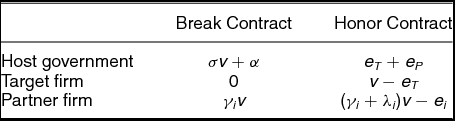
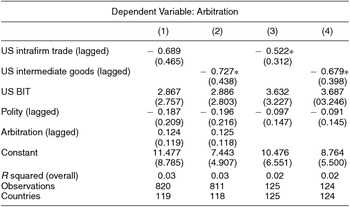
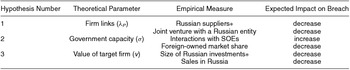
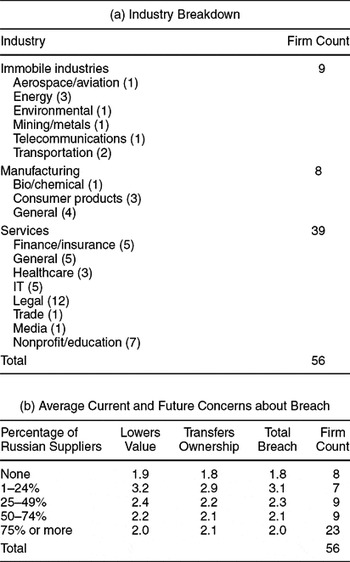
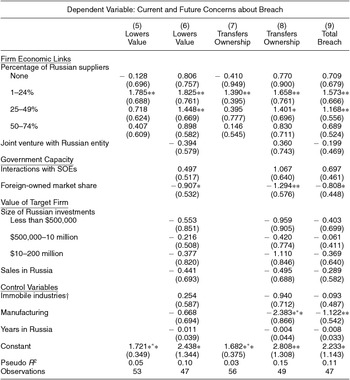




Comments
No Comments have been published for this article.