Introduction
One of the most important problems in astrobiology, particularly in the origin of life, is the predominance of biological molecules, as well as whole organisms, having a well-defined chirality (Babinec and Krempasky, Reference Babinec and Krempasky1994; Frank, Reference Frank1953; Hegstrom and Kondepudi, Reference Hegstrom and Kondepudi1990; Kafri et al., Reference Kafri, Markovitch and Lancet2010; Quack, Reference Quack2012).
Chirality is an important geometric property: a molecule or ion is called chiral if it cannot be superposed on its mirror image by any combination of rotations and translations. For example, with the exception of glycine, any amino acid has two enantiomers, L and D, but only the first one is used in the construction of proteins on Earth.
The prevalent presence of a single enantiomer is surprising since the two enantiomers have the same thermodynamic stability and should be found with the same frequency in biological systems. Primordial life might have exploited homochiral molecules of extra-terrestrial origin. However, the chiral excesses in amino acids inside meteorites are usually small, being significant in some cases only (Pizzarello et al., Reference Pizzarello, Zolensky and Turk2003; Meierhenrich, Reference Meierhenrich2008). It seems difficult to attribute the homochirality of present live organisms to a cosmic process.
The process called ‘chirogenesis’, the genesis of homochirality, probably occurred on Earth just before, or in conjunction with, the development of the first life forms (Bergstrom and Reimchen, Reference Bergstrom and Reimchen2003; Longo, Reference Longo2009; Loehr et al., Reference Loehr, Leinonen, Herczeg, O'Hara and Meril2012). The classic explanations of the predominance of a single chirality in biomolecules include many possible external causes that might have favoured the predominance of a single enantiomer through a process of induction of chirality, or inheritance from the environment. Some of the causes taken into consideration are: the existing chirality of the crystalline surfaces on which the biomolecules were produced for the first time; the selective destruction by intense polarized light, induced by violent cosmic events; the electroweak interactions between the elementary particles of the atoms in the molecules; the effect of vortices in primordial fluids on the crystallization of selected proteins (Kondepudi and Nelson, Reference Kondepudi and Nelson1985; Epstein, Reference Epstein1995; Crusats et al., Reference Crusats, El-Hachemi and Rib2010; Elango et al., Reference Elango, Maciel, Palazzetti, Lombardi and Aquilanti2010; Aquilanti et al., Reference Aquilanti, Grossi, Lombardi, Maciel and Palazzetti2011; Lombardi et al., Reference Lombardi, Palazzetti, Maciel, Aquilanti and Sevryuk2011; Palazzetti et al., Reference Palazzetti, Maciel, Lombardi, Grossi and Aquilanti2012; Szurgot, Reference Szurgot2012).
There is another explanation that interprets the process of chirogenesis as a non-equilibrium phase transition. In other words, chirogenesis is an unstable phenomenon that arises in the presence of autocatalysis. Because of this instability, the situation in which the populations of the two species are comparable always tends to fall into one of the two extreme situations, thanks to a selective extinction. This type of transition requires, however, that the multiplication phenomena occur with second-order kinetics, of the 2x→3x type (Prigogine, Reference Prigogine1981): although the resulting behaviour is promising, the second-order kinetics is not very plausible from the prebiotic point of view.
The idea that the presence of a single chiral variant of proteins and enzymes in current life forms might derive from a selective extinction process has been the subject of research in the field of astrochemistry and astrobiology. The basic idea is the existence of extremely primordial life forms carrying one of the chiral variants of a certain molecule; these organisms are capable of reproducing themselves, and are therefore called ‘replicators’. This is certainly a plausible hypothesis, although experimental confirmation can hardly be obtained from the analysis of organic remains in rocks, since these primordial life forms must have been extremely simple and therefore among the first forms of life ever.
Our proposal shifts most of the chiral selection phenomena to a stage following the prebiotic phase and, therefore, places them in a primordial life perspective. This proposal may have advantages, given that the prebiotic autocatalytic amplification mechanisms proposed for prebiotic chiral selection often involve unlikely reagents and reaction mechanisms in primordial Earth.
Another very important assumption is an extension to the astrobiology of the concept formulated, already in the 1980s, by Ilya Prigogine (Prigogine, Reference Prigogine1981): the so-called ‘breaking of the law of large numbers’. The breaking of the law of large numbers implies that the species populations do not converge to their average values, but they can deviate greatly from them. Due to these strong fluctuations, it is possible that a species extinguishes by chance, even when the related probability appears to be very low a priori.
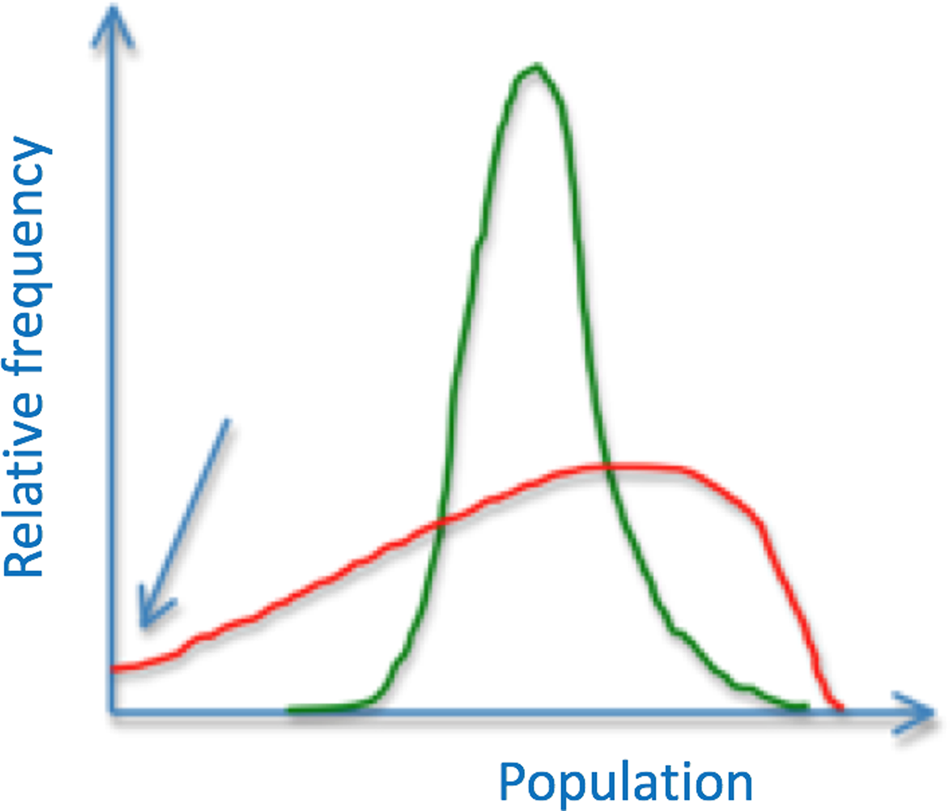
Figure 1 schematically shows the concept: the normally observed distribution of the fluctuating number of replicators is quite narrow, and consequently extinction is an extremely unlikely event unless a very small number of replicators are present. On the contrary, the development of anomalous fluctuations (the breaking of the law of large numbers) produces a very wide distribution which makes the extinction event possible.
Qualitative representation of the distributions of the number of replicators observed in typical conditions (green curve) and in the presence of anomalous fluctuations (red curve). The arrow indicates the extinction event.

The possible role of anomalous fluctuations was recognized in the past in stochastic models of chemical systems in different fields (Van Kampen, Reference Van Kampen1981; Gardiner, Reference Gardiner1985; Ottino and Ottino, Reference Ottino and Ottino1989; Metcalfe and Ottino, Reference Metcalfe and Ottino1994; Longo, Reference Longo1997; Gayathri and Rao, Reference Gayathri and Rao2007; Longo and Coppola, Reference Longo and Coppola2013).
In the case of chemical reactions of the type A→2A, A→0, or reactions where a species generates itself (‘reproduction’) while it is subject to a probability of disappearance caused by the chemical attack (‘death’), the breaking of the law of large numbers is observed; therefore, large fluctuations of the population of the species involved in the two reactions occurs. Here lies the idea that a similar mechanism can be applied to populations with two variants (called 0 and 1) and can lead to the extinction of one of the two at a higher speed than the one expected by statistical estimates that do not account for the law of large numbers.
In order to verify the plausibility of the overall idea, it was decided to use a computer simulation of the simplest type possible, in order to minimize the secondary hypotheses whose validity should be discussed. Therefore, the history of the first populations of primordial life forms is reduced to a game based on well-defined rules and on some element of randomness.
This is not a new idea: already in 1983, the English translation of a book originally printed in German in 1981 appeared; the authors were Manfred Eigen and Ruthild Winkler (Eigen and Winkler, Reference Eigen and Winkler1983). In the book, it is proposed the idea that the constructive and dynamic principles of life forms can be simulated through a restricted class of games, i.e. pawn games on chessboards, such as checkers, provided that dices are used occasionally to randomize the dynamics and appropriate rules are formulated. We can, therefore, speak of a paradigm for the formulation of new research in chemistry and biology based on the ‘games of life’ (Dewdney, Reference Dewdney1989; Longo Reference Longo2009).
Thanks to the development and use of these kinds of models, there are indications of the plausibility of a selection mechanism between two equally fit primordial forms of life (Longo and Coppola, Reference Longo and Coppola2013).
A very interesting feature of this mechanism is that it is not based on pre-existing external chiral causes, such as homochiral crystal surfaces or vortex flows. Although the selection process is random, it is shown to be very effective.
Computational method
In the first version of the model (based on the methodology exposed later in the present section), in order to stabilize the total population of replicators, a mean-field hypothesis was used: it is assumed that the probability of replication per unit of time is inversely proportional to the total number of replicators present. The aim of this simulation is to take into account empirically the limited availability of chemical energy from the external environment. In our model, the chemical energy is just a numerical parameter, whose changing value induces a competition between individuals. It is quite clear that any primordial life-form must rely on a carrier of chemical energy to drive its allosteric enzymes, and consequently complex functions, such as reproduction. Although the actual chemical identity of such a carrier needs to be specified no more than the nature of the replicators themselves, these energy carriers can be molecules such as ATP, very simple sugars, or, in a very primordial environment, monomers such as disulphides or light-activated species.
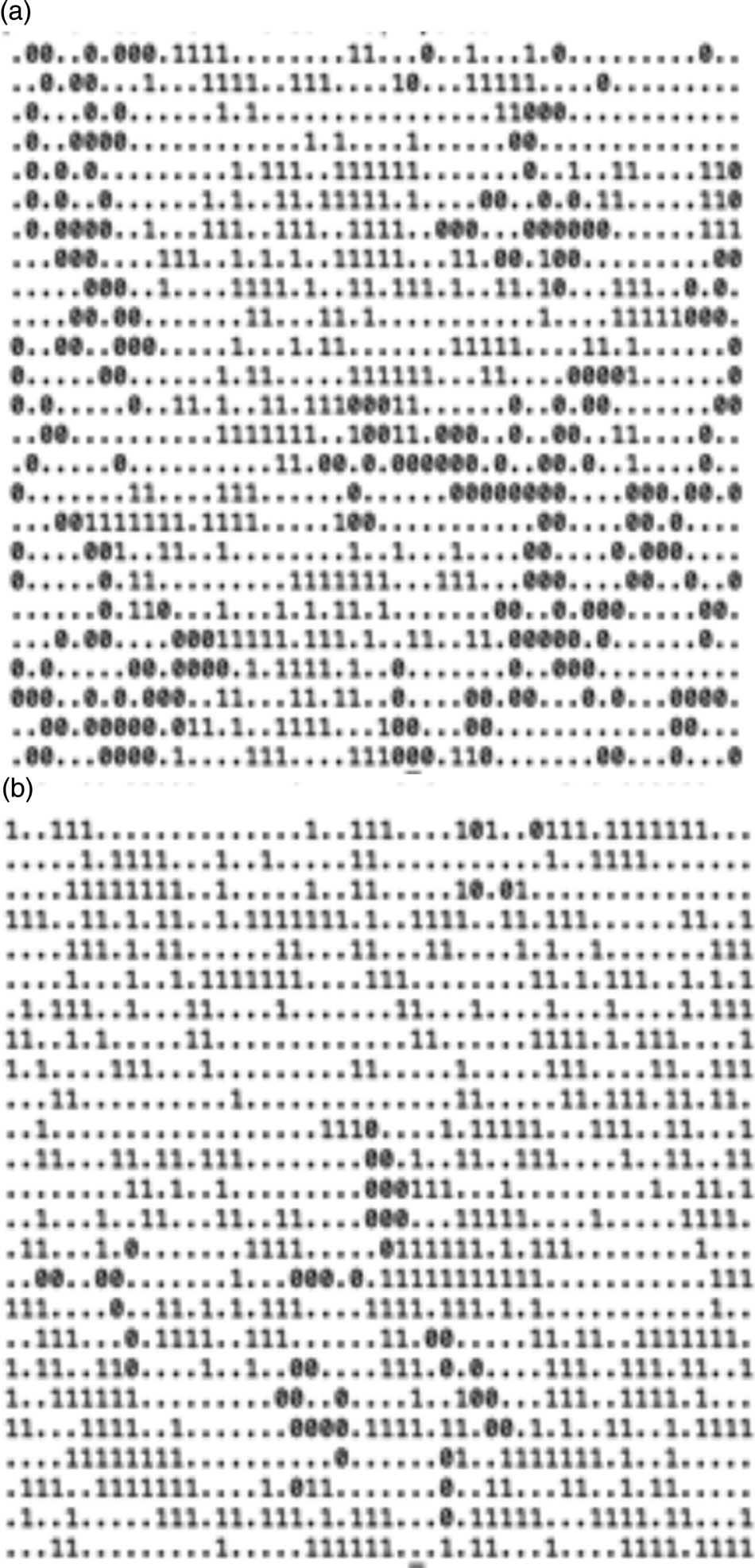
Figure 2 shows the result of a model of this type. On the left, after 2000 time units, a ‘separation’ regime is observed: there are regions dominated by the type 0 replicator and regions dominated by the type 1 replicator. On the right, after 5000-time units, we observe the selective extinction of one of the two species.
The results of a preliminary simulation of a game of life with two species of replicators, 0 and 1. Left (a): after 2000 time units; right (b): after 5000 time units. Dots represent unoccupied positions.

By repeating the computer simulation multiple times, one of the two species is always extinct, while the total population of replicators remains constant. In no case, both species extinguish.
To allow a quantitative statistical analysis, a more complex calculation programme was created: the molecules that transport energy, available for the replicators, are simulated explicitly and are represented by different types of ‘pawn’, randomly placed on the board. In this way, it becomes possible to study the correlations between energy availability and population dynamics.
A two-dimensional discrete domain n × m (n rows, m columns) is considered. It represents the surface of a crystal (mineral layer) on which the primordial replicators are free to multiply or to go extinct. The chessboard has a periodic outline: when a square outside the outline is invoked, for example n + 1, the code automatically invokes square 1; the same happens for the other three edges.
This hypothesis is necessary: otherwise, the equivalent size of the crystal would be very small, while in reality it is intended to simulate a crystal of macroscopic dimensions.
In the model, the replicators do not move.
The unit of time is defined in such a way that n × m random events are attempted in its course. Each attempt consists of the random selection of a square: if it is occupied by a replicator, a replication or destruction process can take place.
When the multiplication occurs, the single replicator generates a copy of itself in one of the four adjacent squares (first neighbours), provided that one of these is free.
Replication occurs randomly with a defined probability, but it can only occur if there are at least two monomers of chemical energy on the same square, as it will be clarified later. At the same time, with an equally well-defined probability, a replicator can be destroyed by a chemical attack (such as hydrolysis or an oxidative attack).
Energy carrier monomers are explicitly simulated on the same board. As mentioned, their chemical nature is unspecified, just as in the case of replicators. During the simulations, they appear randomly and with a certain probability. Such a phenomenology may be interpreted as carrier diffusion onto the solid surface from a solution, or as random activation of a low-energy species by light. To simulate their steric hindrance, it is assumed that no more than five monomers can be present on a square. At the same time, the replicators do not disturb the deposition process and their steric hindrance is not taken into account since they are not allowed to move. When the multiplication occurs, two units of monomers are eliminated from the square by the replicator that reproduces itself.
Obviously, the above-mentioned values of constants, such as 2 and 5, and others to be introduced in the next section, are assumed arbitrarily to introduce well-defined mathematical constraints in the simulation. These values are kind of small from the point of view of actual biology: several thousands of energy carrier molecules should realistically be used in a reproduction act, or even much more. However, such high numbers would only make the simulation unnecessarily time consuming, with no gain in term of insight. Only the identification of the involved chemical species will allow us to establish realistic values in the future. The same considerations apply to the small dimension of the n × m board used.
Nevertheless, it was verified that the general figure of the mechanism that emerges from the simulation does not depend critically on any of these assumptions.
The computational model was implemented as a native Fortran90 code.
Results
The overall stability of the code is quite critical and the parameters (probability of survival and extinction) should be chosen in very narrow ranges.
A satisfactory scenario is produced for all the following experimental discussions, with the following choice of parameters:
• Chessboard size: n = 20, m = 23
• Starting energy of the monomers: 4
• Probability of filling a square: 2%
• Single species replication probability: 4%
• Single species extinction probability: 1%
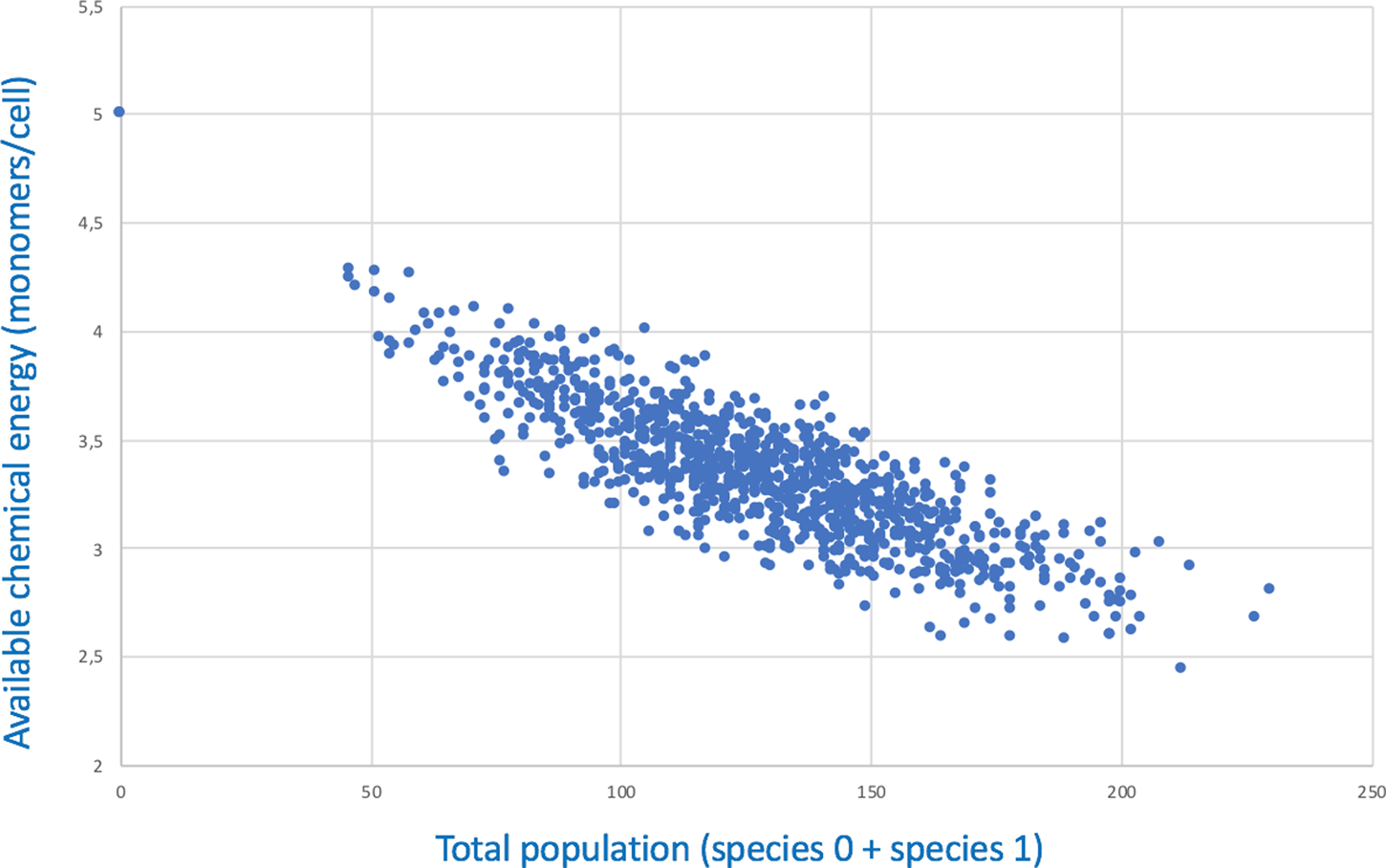
Figure 3 shows the anti-correlation relationship between the total population of replicators (type 0 and type 1, N 0 + N 1) and the availability of energy, after a certain number of time steps. It is clear that the replicators evolve: some will survive, others will disappear. In the same time interval, the energy resources will change. Consequently, it is reasonable to expect that, after a certain number of time steps, a larger total population will have less energy available, and vice versa.
Anti-correlation between total population and available energy, after 40 000 time steps.

Each point of Fig. 3 corresponds to 40 000 time steps. Indeed, it was observed that for values ≥40 000, one of the two species of replicators has certainly become extinct.
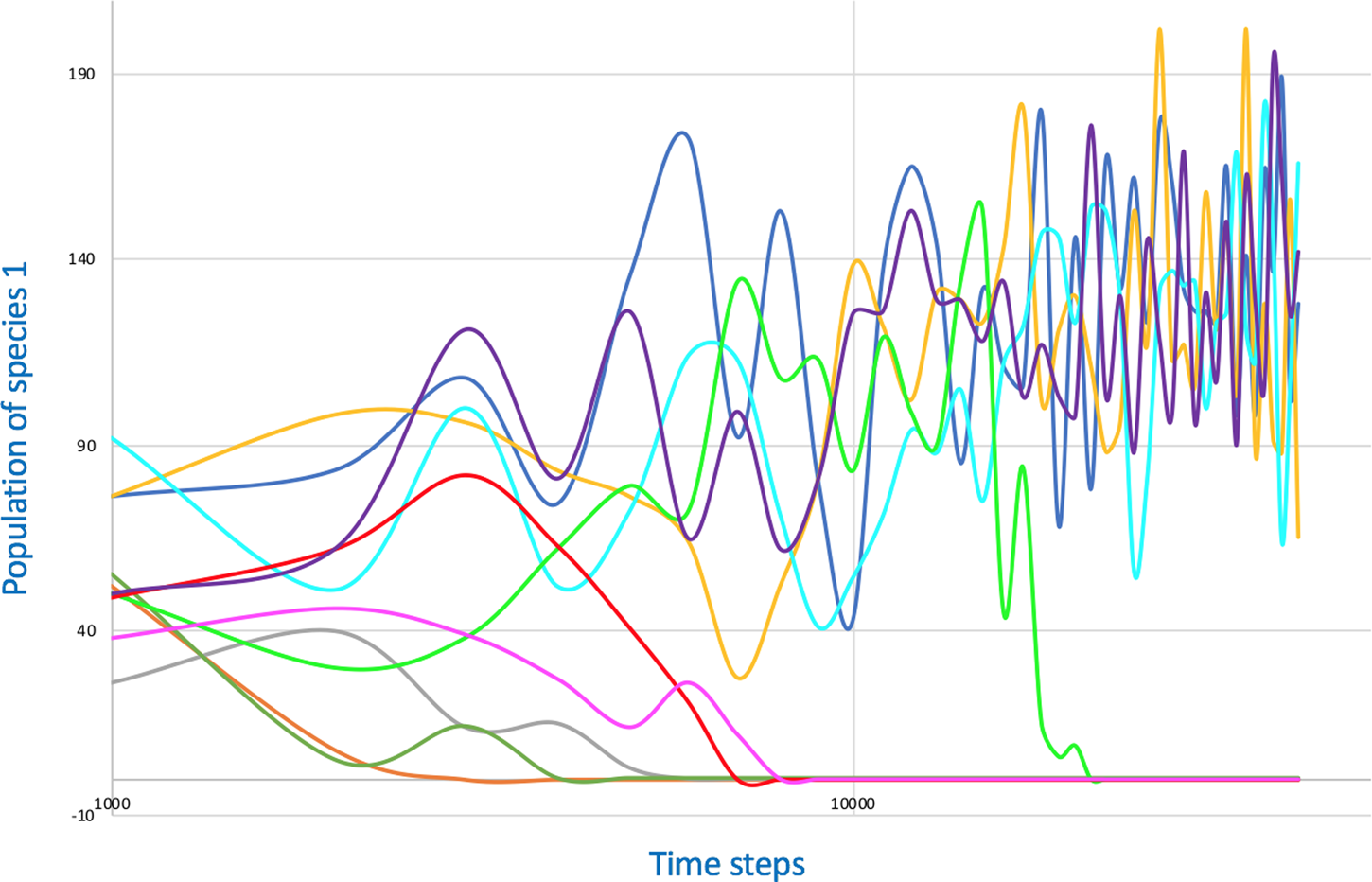
In Fig. 4, the time is plotted on the abscissa on a logarithmic scale and the ordinate shows the population of only one of the two species. The different curves, represented with different colours, correspond to different simulations starting from randomly chosen initial conditions.
Evolution of the population of one of the two species over time (logarithmic scale).

It is clear that one of the two species becomes extinct, thus reaching the zero population; in many cases, it happens in the initial stages of the simulation. Moreover, the extinction of a specific species occurs approximately in half of the cases, confirming the hypothesis that the extinction event is completely random. This last observation is corroborated by a more comprehensive statistical analysis, discussed later.
The presence of large and fast population oscillations is also observed: clearly, these oscillations are due to the kinetics of the prey–predator type, or Lotka and Volterra (Prigogine, Reference Prigogine1981), where the chemical resources represent the prey, while the replicators represent the predators. By averaging the fluctuations, in the long run, the population of the surviving species is roughly the same.
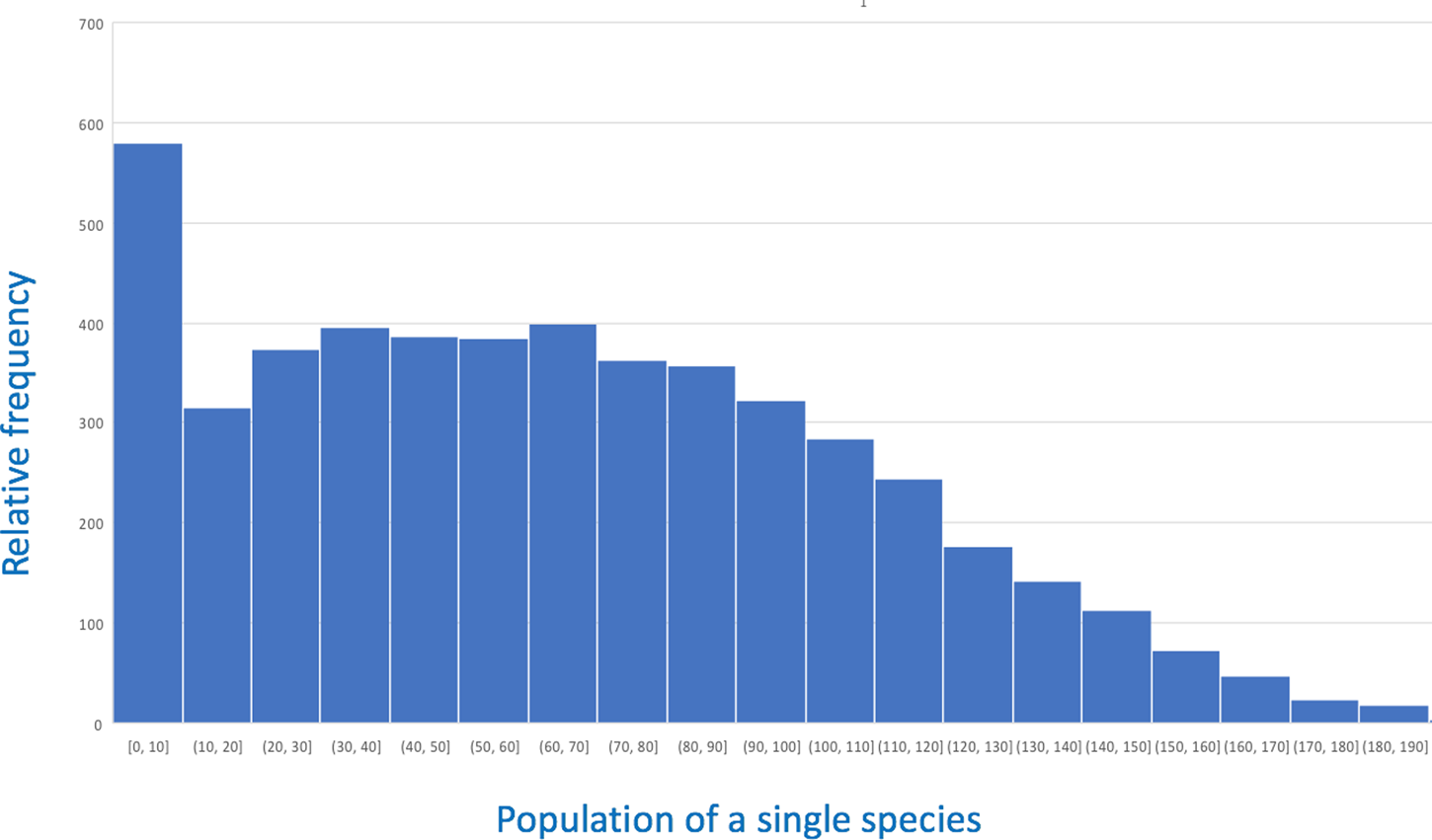
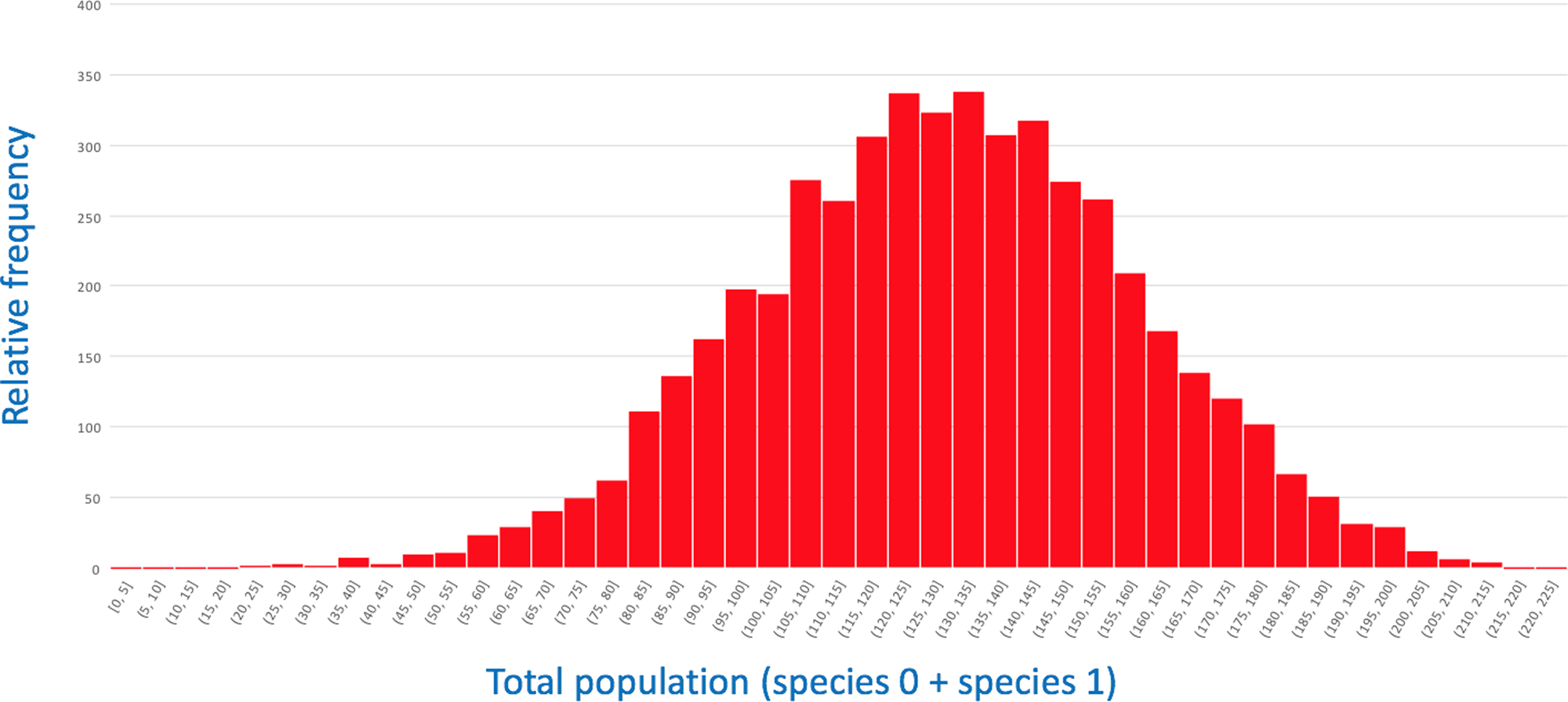
Figures 5 and 6 represent the statistical analysis, averaged over the entire simulation domain, of populations of type 0 (N0), and of the total population; the simulation time is 3000 calculation steps: this value was chosen on the basis of Fig. 6, which shows that at this time a substantial number of selective extinction events took place. The Monte Carlo points are 5000.
Statistical analysis on the whole simulation domain of the population of species 0. For species 1, the same distribution is obtained, confirming the symmetry of the two species in the kinetics (symmetry broken in any single simulation).

Statistical analysis on the whole simulation domain of the total population.

Figures 5 shows that the distribution of population N0 is very wide, extending significantly from 0 to about twice the average value. This wide distribution indicates that in our simulations the law of large numbers breaks. The visible peak at 0 population represents the extinction of the species already occurred.
A completely different behaviour is observed in Fig. 6, which shows the statistical analysis of the total population, i.e. N0 + N1. The distribution obtained in this case is very narrow, which is expected in a ‘normal fluctuation’ case.
Once again, the extinction as a selective process, which, therefore, affects only one species at a time, is confirmed. The total population remains very stable.
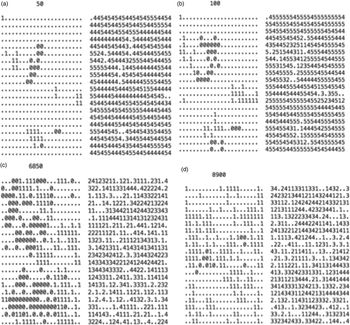
Figure 7 shows the snapshots of the evolution of the game produced by the code. Four stages of a single experiment are represented. In each of the four figures, the corresponding simulation time t appears on the top left.
Four snapshots of a single experiment.

Each graphical representation shows the arrangement of the replicators on the board (on the left) and the arrangement of the chemical energy resources (on the right).
It is observed that in the early stages of the experiment (t = 50, t = 100), the replicators are few individuals who begin to reproduce and occupy the space available. The chemical energy is consumed very quickly in the areas where the replication occurs; an accumulation of a large amount of chemical energy takes place in the remaining areas.
At a much longer time, t = 6850, competition for space by the two different species and the formation of areas populated by only one of the two are observed.
There are also completely empty areas which, compared with the graphic representation of chemical energy, are associated with an accumulation of energy.
Conclusions
This work proposes the idea that a computer model can simulate the evolution of two species of replicators that represent extremely primordial life forms, with an account of the limited resources of chemical energy. The aim is to demonstrate the plausibility of an innovative hypothesis according to which the chiral selection processes of enzymes and biomolecules took place as a result of a proto-biological selection.
The nature of these replicators is not specified since it would be quite difficult in the present state of our knowledge.
Following the original suggestion of Eigen et al., we were able to produce a simulation based on a minimum of hypotheses, exploiting the analogy between biological evolution and chessboard games. The replicators are represented by different types of pawns that replicate on the board while competing for access to finite resources. Our numerical experiments are specified in full details, and can be verified easily, in order to confirm the somewhat surprising population dynamics; the limitation in the supply of chemical energy is essential in stabilizing the total population and this role has never been discussed in the previous literature.
Selective extinction occurs thanks to the development of large fluctuations due to replication kinetics, as it was hypothesized by Prigogine with his mechanism of ‘breaking of the law of large numbers’.
The limited availability of chemical energy in the form of monomers (energy bearing species) is explicitly simulated in the model. For this reason, we have been able to study the correlation between chemical energy and populations. These correlations produce Lotka–Volterra-like oscillations, which affect the chirogenetic scenario.
The selective extinction of one of the two species can explain the disappearance of alternative variants of the only biochemical mechanism that we currently find on our planet, in particular as regards the chirality of the biomolecules. Consequently, our model represents a possible scenario of chyrogenesis, the details of which can be clarified with a subsequent work of code development and computer experiments.
This interdisciplinary approach, which mixes biology and computer programming, can provide new insights into the nature of the process that changed the ‘rules of the game’ of life billions of years ago.