Introduction
Agricultural evolutions and farmers’ work organisation problems
Farmers’ working conditions have radically changed as a result of structural, economic and sociological evolutions. The volume of farmers’ work grows steadily: farms are becoming bigger while the number of agricultural workers (especially family members) is decreasing, and among farmers’ adjustment strategies, we find agricultural diversification or participation in off-farm activities (Johnsen, Reference Johnsen2004). These changes are reinforced by the decline of work contribution by family members and the development notably of wage labour (International Labour Organization (ILO), 1996) or subcontracting. The perceptions of work are evolving as well: farmers are paying more attention to working regular hours, being free on Sundays, having holidays, etc. This is the end of ‘peasant toil’ (Barthez, Reference Barthez1996), when the livestock farmer did not count his hours, when there was no distinction between life at work and private life. In French family dairy farms, the lack of breaks is the first complaint of farmers (Seegers et al., 2004) and explains the increasing interest throughout the country in labour replacement services, employers’ groups, milking robots or once-a-day-milking techniques.
Society, research and development institutions pay less attention to these structural and sociological transformations in farms than to the evolution of production models towards multifunctional and sustainable agriculture (Hermansen et al., Reference Hermansen, Noe and Halberg2006). European aid systems and contractual forms of production (land use contracts, official quality signs, etc.) encourage the creation and implementation of new herd management patterns preserving the environment and ensuring quality of products and regular deliveries. It is nonetheless the farmers’ responsibility to adapt the management of both their technical activity and their work, at the scale of the working year and on the long-term evolution of their farm management pattern. These movements affect the technical and social components of livestock farming systems (Dent et al., Reference Dent, Mc Gregor and et Edwards-Jones1994; Gibon et al., Reference Gibon, Sibbald, Flamant, Lhoste, Revilla, Rubino and Sorensen1999) and their interactions in work organisation.
Thus, the aim of the paper is to propose a review of the developments in science related to work organisation in farms with a particular focus on the integration of the technical dimension. We define work organisation, following Mintzberg (Reference Mintzberg1982), as the social and technical division of work and, more precisely, the interaction between the technical management of agricultural activities, other activities (economic or private) and manpower. Here, we will present a short review of disciplinary approaches on work organisation and a French historical overview of the contribution of livestock and crop farming sciences. We will then present two promising approaches (considering work challenges in livestock farms) developed in France that explicitly take into account livestock management and work organisation dynamics. They renew the work organisation analysis framework with the aim of shedding light on farmers’ situations, helping and supporting changes in livestock farms.
Livestock farming systems in the research field on work organisation
Social sciences are the main disciplines developing studies and theories on work and its organisation. The questions are how they take into account the relationship between technical and social dimensions and whether livestock sciences have their place in the debate on agricultural work organisation analysis.
Contributions from the social sciences to the study of work organisation in agriculture
Four social science approaches (sociology, economy, management sciences and Ergonomics) should be mentioned because they deal with work organisation in agriculture. These different disciplines propose different views on work organisation and its links with the production systems.
Indeed, rural sociology is interested in the transformations of relations within work groups, workers’ conditions or status (notably of women – Brandth, Reference Brandth2002) in relation with the task division on farms, the evolution of the composition of the work group (from family labour to hired manpower or associations, etc.). The function of a worker within the work group is a concept that links manpower with the production process and the tasks to do. It refers to the tasks carried out by the worker and to his level of responsibilities inside the work group (Lesne and De Montlibert, Reference Lesne and De Montlibert1972). It aims at understanding how the work is distributed among the workers and according to which modalities. In the rural economy, work organisation is not explicitly taken into account even though the industrial world recognises that production organisation (taylorism, toyotism) is an essential factor of competitiveness (Greenan, 1994). In economy, the term ‘work’ immediately refers to a production factor, a count of the workers or the worked times to take account of productive choices, labour allocation or evolution of labour productivity (Kuroda, Reference Kuroda1995; Fafchamps and Quisumbing, Reference Fafchamps and Quisumbing1998).
For economy and sociology, work organisation refers first of all to the organisation of workers. The farming production system, simply described (often by the type of production), is a context or a variation factor either of the duration of work or of the perception farmers have of their profession.
For management sciences, the analysis of production organisation in its technical, economic, work and relational dimensions is essential for the evaluation of a system. The applications to agricultural work developed jointly by managers and agronomists: (i) simulate the allocation of resources (labour and equipment) at work peak periods in arable crop cultivation (Attonaty et al., Reference Attonaty, Laporte, Papy and Soler1987); and (ii) deal with labour flexibility, notably workforce able to respond quickly, easily and cheaply to changes in product or process (in response to market requirements), through a range of working time options (use of subcontractors, hired workers – seasonal, regular or casual – etc.) (Errington and Gasson, Reference Errington and Gasson1996). The production system is very partial in the first case since it is seen through the cropping operations to carry out at peak periods, and very simplified in the second one since the accent is put on workforce and its fluctuations.
A review of contributions by Ergonomics in agricultural development (Jafry and O’Neill, Reference Jafry and O’Neill2000) mention the following themes: ‘work place design’, ‘tool and equipment design’, ‘accidents and injury’, ‘safety’ and for the future needs: ‘technology transfer’, ‘the needs of women’, ‘musculo-skeletal injuries’, but nothing is specified about work organisation. The French-speaking Ergonomics Community focuses on activity analysis, which is the work actually done (in comparison with the task which is the work to be done). The non-correspondence between the two comes from the intervention of an operator or a work team, who, with their own characteristics, will adapt the work to be carried out to the situation (Leplat, Reference Leplat1994). In agriculture, the analyses are oriented on: (i) the unfolding of tasks during a day for a same worker or for a specific post (Valax, 1986); (ii) the circumstances or chaining of the farmer’s actions at the scale of a period (Jourdan, Reference Jourdan1997); and (iii) the impact of technical innovations on work conditions and organisation (work group, task division, etc.) (Nicourt and Souron, Reference Nicourt and Souron1989). The concept of regulation makes it possible to account for the variations in activities in relation with the evolution of the work situations (Cellier and Marquié, Reference Cellier and Marquié1980) and then enables the link between the production process and the workforce to be established.
Management and Ergonomics are interested in the expression of production systems in terms of a calendar of tasks to be carried out, mobilising equipment and people, usually at a specific period of the production cycle. Ergonomics is the only discipline dealing with technical management and its variations during the agricultural year, with real activities and regulations to face concrete work situations.
Why does livestock farming system research have its place in the debate on work organisation analysis?
Considering all the movements affecting the sector (cf. Introduction), the general question is how farmers harmonise:
• Their responses to social and market chain expectations (changing production management, limiting intensification, changing the type of product, adapting technical practices, etc.)? Social expectations in terms of environment or quality of products are expressed in technical specifications, contracts that often require techniques demanding in work;
• Their expectations in terms of quality of life and the evolution of their farm (workforce, dimensions, combination of activities)? The increasing workload reinforces the trend of farmers adopting techniques that are less demanding in terms of work: they are levers to work re-organisation as well as to equipment, buildings and changes in workforce composition (Dedieu et al., 1993).
In this research of harmonisation, livestock management and the combination of techniques and practices must be considered via their various relations to work: they can modify the duration of work, working calendars, priorities between tasks, competences (and hence the way workers are interchangeable). For instance, Cournut and Dedieu (Reference Cournut and Dedieu2005), studying the simplification of milking and feeding techniques, showed that the implications of such changes can be categorised in two ways: (i) changes that aim more specifically at reducing daily work duration at some periods of the year without modifying technical logics, for example, reducing the daily duration of work with once-a-day-milking or complete diet feeding system, breaking the routine by omitting one milking per week; and (ii) more radical changes that modify the annual work calendar, the distribution of work throughout the year with, for example, the temporary closing of the milking parlour by concentrating calving.
The evolution of livestock farming systems had been considered separately in the past; on the one hand, the improvement of labour productivity and work conditions and, on the other hand, the improvement of production techniques. Moreover, they were considered as two distinct registers each treated by different disciplines (social sciences v. technical sciences). The current dynamics show that such a separation is no longer relevant. Livestock farming system research proposes a framework (Gibon et al., Reference Gibon, Sibbald, Flamant, Lhoste, Revilla, Rubino and Sorensen1999) that helps to jointly consider the farmer’s projects, the decisions and social norms, and the productive system. In this research field, some studies have underscored the need for more understanding of the socio-economic component of the farm system, i.e. the farm household and its dealings with the outside world (Dent et al., Reference Dent, Edwards-Jones and McGregor1995), particularly of work organisation and labour dynamics, and on their correlation with off-farm and migratory activity, factors that remain under-investigated (Hervé et al., Reference Hervé, Genin and Migueis2002).
Contributions of livestock and crop sciences to work analysis – the French experience
Short historical overview
Work organisation is not a new preoccupation in livestock and crop sciences. But the questions and the analysed dimensions have evolved in relation with the evolution of the socio-economic context. In a synthesis, Madelrieux (2004) distinguishes three major inflections since the end of the Second World War in France: (i) to rationalise the work; (ii) to improve the efficiency of manpower and equipment use; and (iii) to harmonise efficiency and liveability. This gives birth to different methods, although mostly based on the gathering of information about work duration.
The first phase: rationalisation. After the end of the Second World War, modernisation and improvement of work productivity are the order of the day. ‘[French] agriculture will be modern … or won’t be’ (Dumont, Reference Dumont1946). We see the transformation of agriculture as a way of life into agriculture as a professional activity (Barthez, Reference Barthez1996), where work becomes a production factor evaluated in terms of money and time. The reference to enterprises and waged work, the research of the ‘good use’ of resources give birth in this period to a number of institutions including IOSTA (Institute for the Scientific Work Organization in Agriculture). They favour the measurement of work duration, seen as an addition of elementary time. These quantifications are used to spot the ‘time, material and energy waste,’ to research the correct correspondence between the demand in work and the supply and to decrease production costs (Piel-Desruisseaux, Reference Piel-Desruisseaux1963). These studies produce norms to reach. The consequences are to favour mechanisation, the specialisation of men and machines, leading to an improvement of work productivity, and also leading to harder peak periods and not to the annual smoothing of work originally sought.
The second phase: the efficiency of manpower and equipment in cropping systems. The previous approaches rapidly show their limits. The organisation cannot be scientific because it combines different logics. The goal of measuring durations leaves aside the question of the irregularity of work throughout a production cycle, the competition between tasks, the hazards, notably the climatic hazard and its management by farmers. Moreover, the questions of manpower (who is carrying out the tasks) or of the farmer as a decider on his farm are not tackled. The resistance of farmers to the adoption of technical innovations and the great decrease in agricultural workforce lead research and development institutions to pay attention to the functioning of farms. This curve takes place in the 1980s and the 1990s. Against the optimisation models, the agronomists try to understand farmers’ decision rules, ‘the good reasons’ they have to do what they do (Petit et al., Reference Petit, Deffontaines and Osty1975), notably the rules governing the order of priorities of cropping operations and the management of climatic hazard (Attonaty et al., Reference Attonaty, Laporte, Papy and Soler1987). They focus on work peak periods that are strategic periods for production (notably the end of summer when sowing and harvest are in competition). The goal is to increase work efficiency (use of equipment and manpower) with regard to the technical performances sought.
The third phase: efficiency in work and liveability. The third inflection corresponds to a change both in the work analysis challenge and in the approaches. A new object appears: the quality of life (in work and outside), the control of one’s work. The research context is big herds in the centre of France, with great volumes of activities, and a demand from farmers to help them solve their work problems, improve their situations and make them liveable (Dedieu et al., 1993). A different perspective then emerges that adopts the idea that work conditions are part of the farmers’ project: the technical choices depend on the way farmers define their work and life expectations (jointly with economical expectations). These registers ‘efficiency’ and ‘liveability’ are still present in the current debates, with an increasing weight of social views on the farmers’ way of producing and increasing expectations for free time and time-controlled work, especially in dairy farms. The models of work elaborated by livestock researchers integrate this last phase. Historically, they were conceived to introduce the work dimension in the analysis of livestock farming systems in response to questions from farmers on the sustainability of their systems.
Work models developed by livestock researchers: principles
Livestock farming consists of articulating animal and plant cycles, which have different periodicities. There are different tasks to be accomplished throughout the year. The tasks are variable not only in their nature (animals, land, equipment, administrative tasks, etc.) but also in their rhythm. Some tasks have to be done every day, such as milking or feeding animals, others are carried out once or several times a week, such as selling cheese on markets, and others are seasonal, such as making hay. Tasks are either imperative or able to be postponed to a later date. Some tasks are subject to conditions such as climatic conditions; others, even of limited duration, require a specific workforce or numerous workers (for the handling of the herd for example). Tasks require different skills, for which workers are not inevitably interchangeable. They can be operated by individuals (daily care) or by groups of workers (silage). The workforce, too, is variable during the year. Their rhythms of involvement vary according to the individual and the periods of the year, and are not necessarily linked to the agricultural work peaks.
Thus, to represent a work organisation, when combining both technical and social points of view, requires dealing with three dimensions: the expression of (1) tasks (the work to do), (2) workers, and (3) temporalities of work (the different temporal coherences: daily, weekly, seasonal and annual rhythms). The recent work models in livestock sciences that we detail in the following are based on these three foundations:
(1) The tasks are not equivalent. They must be distinguished according to their rhythms and their ability of being postponed. If the daily tasks (repeated each day over a period) always appear in the bibliography on work in livestock farms as structuring the work organisation (Dedieu and Servière, 1999), it is their interaction with non-daily tasks that raises difficulties in the work organisation.
(2) All the workers are not equivalent according to their function in the work group, their rhythm of involvement and the way they are remunerated for their work. The work organisation models distinguish a basic group (the workers of the farm engaged in the farm work, its organisation, for whom we need to take into account their expectations in terms of quality of life, to know the combinations of activities – economic and private – to understand the work organisation on the farm) and workers outside the basic group (volunteers – retired people and people giving a hand – salaried workers, mutual help and the intervention of subcontracting companies).
(3) The work organisation at the scale of the year results from the linking up of periods whose organisational characteristics are different (it is due to either the evolution of the tasks to do, to the manpower or to the combination of activities). These periods are intervals of time with the same daily activities (DA). These periods are not defined a priori but they express specific modalities of interaction between technical imperatives, the workers’ rhythms of involvement, the pressure of non-agricultural activities and expectations about work organisation.
Presentation of two French models of work organisation and experience in their use in livestock research and development activities
The ‘Work Assessment’ model
Presentation of the model
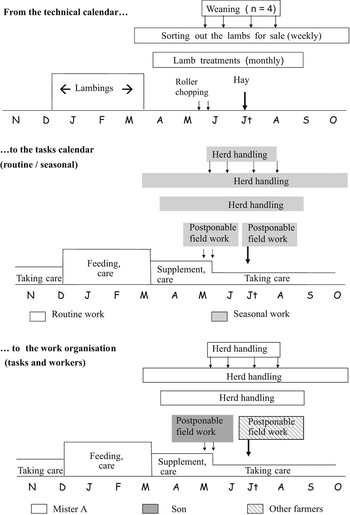
The ‘Work Assessment’ (in French: Bilan Travail) proposed by livestock researchers (Dedieu et al., 1993) aims at ‘integrating the work dimension into the analysis of how livestock farming systems operate at year level’ (Figure 1). The goal is to quantify the work linked to the management of the herds and lands and to evaluate the time remaining for non-accounted activities (agricultural or not).
From a technical calendar to work organisation combining tasks and workers (sheep farm of Mr A – see Appendix 1).

The categorisation of tasks and manpower is the foundation of this approach. The daily routine work, which cannot be deferred or concentrated, is clearly distinct from the seasonal work. This seasonal work can have different degrees of deferability (weekly for animal handlings, day-by-day according to the weather for work in the fields, or over longer periods in the case of land maintenance).
The principle of the survey consists an analytical reconstitution of the agricultural year work during a semi-directive interview and lasts 2 to 3 h. The farmer divides the year into periods during which the daily routine work is of a constant duration. Then he specifies the daily worked hours for himself and the other workers. For seasonal work and work repaid, the time spent is quantified season after season by reconstituting the succession of all the different tasks (for each type of work: herds, land or repaid work).
At the farm level, the data are analysed to characterise and quantify the routine and seasonal work load of the different contributors. At the basic group level, the work organisation is characterised by the ‘remaining calculated time’. This indicator corresponds to the time remaining to the basic group for non-accounted activities after his routine work; his seasonal work and his work repaid have been removed. It varies from zero to more than 1700 h/year per person of the basic group (Dedieu and Servière, Reference Dedieu and Servière2001). Recourse to outside labour is extremely variable in ratio (from 0% to 70% of the seasonal work) and in its forms (mutual help, employment of temporary or contracting workers). An illustration comparing two farms is given in Appendix 1.
Uses of the model: a tool for farming development and experiences
The ‘Work Assessment’ was designed to be easy to use by agricultural advisors. Software for data capture and editing has been available since the autumn of 1998. More than 200 advisors had participated in training sessions designed for ‘Livestock Network’ monitoring and more than 2000 ‘Work Assessments’ have been conducted on farms in France (Dedieu and Servière, Reference Dedieu and Servière2001).
The results of ‘Work Assessment’ surveys are principally discussed in the framework of farmers’ groups, both institutional (farmers’ unions, farming development groups, livestock networks, etc.) and occasional (training sessions for farmers). Individual expressions such as ‘work duration becomes unbearable’ or ‘my farm needs better work efficiency’ emerging into a collective discussion that the ‘Work Assessment’ formalisations help to structure is generally very fruitful. In some cases, these meetings result in visits to farms, to discuss each participant’s work organisation in his own buildings. In others, discussions may focus more on the development of mutual help (for example, taking turns for weekends (WEs)) or a worker being hired jointly by several farmers, or the opportunity to change farm management choices. These results are also contributing to the construction of sets of references by the production system. They are now included in system modelling published in the form of ‘typical cases’. Finally, the group analyses and case illustrations are used in symposia and in farms or experimental stations open days, designed to heighten the awareness of farmers and development agents on work organisation. All of these uses lead to concrete actions or interventions (‘Work Organisation’ rallies, courses, interventions by machinery and equipment specialists, employers’ groups or farmer mutual aid societies, etc.).
‘ATELAGE’: a model of work organisation in livestock farms
ATELAGE is the French acronym for ‘Activités de Travail en Exploitation d’éLevAGE’ (work activities in livestock farms). This model is more recent (Madelrieux, 2004) and was conceived as a ramification of the ‘Work Assessment’ model. The goals are to describe and qualify the work organisation in a farm and to identify the set of reasons for such an organisation. Starting from who does what, when and where, it is about identifying the forms of the interaction between production process, workforce and non-agricultural activities including breaks and holidays, and their evolution as a whole yearly production cycle proceeds. The work organisation is seen as a system of activities (an ‘activity’ corresponds to the association between a task with a temporal characteristic, a work team and a location) taking into account the different temporal scales at stake (daily, weekly, seasonal), and integrating the regulations linked to climatic hazard and the availability of workers. The quantification of the work is abandoned to the benefit of describing and qualifying work organisation.
The description of work organisation
The model consists of representing forms of organisation at different temporal scales and their combination, namely:
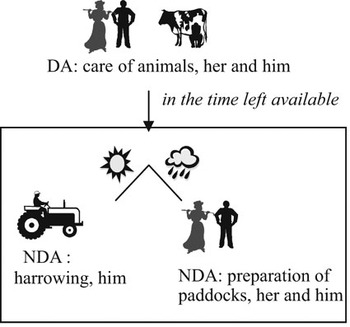
• The forms of daily organisation (FDO). The FDO represent ‘typical work days’, gathering particular work days that present the same DA and the same type of relation between daily and non-DA (NDA) (Figure 2).
Figure 2Two daily work days for a same form of daily organisation. In this example, there are two possible work days: when it is sunny (care of animals for both and harrowing for him) and when it is rainy (care of animals and preparation of paddocks for both). In each case, the form of the daily activity (DA) is the same, and the non-daily activities (NDA) are subordinate to the daily activity. Thus, we represent these two combinations in a single form of daily organisation.

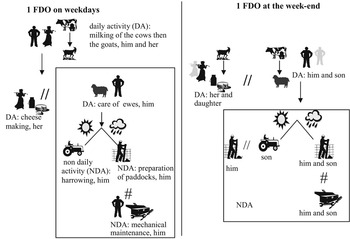
• The forms of organisation of periods of time: organisational sequences. The organisational sequences define an interval of time with a single FDO or with several FDOs in alternation due to their complementary rhythms of activation. These rhythms can be (i) each day of a period: there is a single form for the whole period; (ii) a regular rhythm, notably a weekly rhythm (for example, children coming back to the farm at the WE and who take part in daily tasks: Figure 3); (iii) a non-predefined rhythm or ‘day-by-day’ activation. This case is linked with the implementation of particular tasks, for example, tasks conditioned by the weather conditions (an FDO when it is sunny can alternate with another FDO when it is rainy). Thus, several FDOs can alternate within a same interval of time of the year. The organisational sequences delimit all the intervals of time whose content in FDO and alternation between FDOs are different.
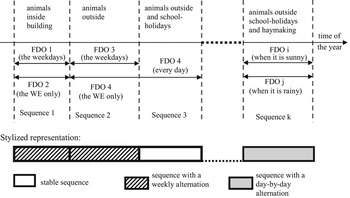
• The form of organisation of the year. It corresponds to the linking up of the sequences. It shows the variability of the work organisation – that we call regulations (in reference to Ergonomics) – over the year (Figure 4): the alternations between FDOs at each period; the evolution of the FDOs and their alternations from one period to another over the year.

An example of forms of daily organisation (FDO) alternation, with a weekly rhythm due to the presence of children at weekends (WEs), in a spring period.

Form of organisation of the year in a case where the work organisation is sensitive to the presence of the children during school-leave (weekends (WE) or holidays) and stylised representation (FDO = form of daily organisation).

The qualification of work organisation
Similar to description, the work organisation can be qualified at the scale of a sequence or of the year. The main themes for qualification at the scale of an organisational sequence are the regulations in the work organisation (the chaining of sequences, the alternation of FDOs intra-sequence) and the place of technical management in these regulations; the relationship between agricultural and non-agricultural activities; the labour division, especially between the basic group and the other workers. The procedure to qualify work organisation at the scale of the year is based on (i) linking the sequences throughout the year (what is expressed is, for each criterion of the sequences, the profile of evolution of its modalities through the seasons); (ii) specific criteria, focused on the variability of forms of organisation. An illustration of the qualification (comparing two farms) for the ‘regulation’ criteria is given in Appendix 2.
Uses of the model: experiences in livestock research and agricultural development activities
As Ford et al. (Reference Ford, Bradshaw and Agnew1993) claim, ‘the most important outcome of the modelling process may not be the model itself but rather the insight we gain as we struggle to articulate, structure, critically evaluate and agree to it’. This stage is carried out in two directions:
• knowledge production on livestock farming systems. For example, the model had been used to specify the place of waged labour in pig farms. ATELAGE work organisation qualification makes it possible to go beyond approaches identifying the function of workers (the tasks and the level of responsibilities). It specifies the role of salaried employees in the regulations of work according to the various work situations along the agricultural year (work peaks due to competition with other agricultural activities, farmer’s absences due to non-agricultural activities, WEs, vacations) (Hostiou et al., Reference Hostiou, Dedieu and Pailleux2007);
• the production of tools for and with agricultural advisors. The ‘establishment – work project’ (in French: ‘Etude prévisionnelle d’installation – travail’) is the most advanced tool derived from the ATELAGE model. The French official process of establishment (with public finance/supports) requires a techno-economical diagnosis to be sure the young farmer will earn a living from his farm. The work dimension is at present not taken into account and advisors find it difficult to tackle this subject even if they feel it is of importance. That is why they have asked for a tool to help them in a ‘liveability’ diagnosis that goes beyond a simple work calendar and the identification of agricultural work peaks. The aims of this tool are:
(1) to evaluate the level of work considerations by future farmers regarding their foreseen work organisation and regulations. Three profiles of young farmers were identified in the first year of research: those who have everything in mind (the tasks, the workforce and its diversity, the rhythms, the time and their interactions); those who have in mind the production tasks but have difficulties with tasks that do not refer to the production schedule and are linked with the establishment phase: the housings to build, their house to fit out, the elaboration of a customer base, etc.; those who have no clear idea of what their work will be. They clearly consider routine and regular tasks but ignore the seasonal rhythms and priorities between tasks at peak periods, hazards and non-agricultural constraints on work organisation).
(2) to delimit the targets of more in-depth discussions about actual work achievement.
This process is foreseen, for the moment, in an individual advice scheme for future farmers.
A similar reflexion is in process to help advisors accompanying changes in farms, particularly in looking at the consequences of changes (technical or organisational) on the re-organisation of work.
Complementarities and differences between the ‘Work Assessment’ model and Atelage
The two approaches share a common base: principles of representation of work and its organisation. Nevertheless, they differ in three points: the relation to (i) non-agricultural activities; (ii) the duration of tasks; (iii) regulations of work organisation during the agricultural year. In the ‘Work Assessment,’ the agricultural activity is the centre of the study. In ATELAGE, it is re-situated in a combination of activities that play on the work organisation (economic, associative or private non-agricultural activities) according to the availability of workers, their desire for free time and climatic hazard. Work duration is an evaluation indicator of the work organisation in the ‘Work Assessment’ model. The method follows the evolution of task duration throughout the year and the reasons for these variations. It gives quantitative references that are useful for farmers and agricultural advisors. But a representation by indicators of work duration, centred on the agricultural activity, does not cover all the debates on work organisation. The debate is also on the interactions between all the activities (agricultural and non-agricultural) and on the regulations of work organisation. With ATELAGE, we propose bases to take account of this. Thus, with the two methods we have conceptual bases for the design of tools to support and help changes in farms: technical management changes and also changes in the combination of activities and expectations of quality of life, which modify the work duration and the way the work organisation is adjusted.
Discussion and conclusions
ATELAGE and ‘Work Assessment’ methods constitute an attempt to connect social and technical dimensions of farming systems through work organisation modelling, at the farm scale. In this way, they clearly refer to the livestock farming system approaches (Dent et al., Reference Dent, Edwards-Jones and McGregor1995; Gibon et al., Reference Gibon, Sibbald, Flamant, Lhoste, Revilla, Rubino and Sorensen1999) and contribute to strengthening one way of investigation considering work as a brake on the adoption of innovations (Mak, Reference Mak2001; Ruthven and Kumar, Reference Ruthven and Kumar2002; Joannon et al., Reference Joannon, Papy, Martin and Souchère2005).
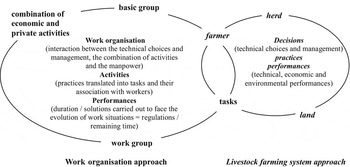
In livestock farming system approaches, the farmer is considered mostly as a decider making technical choices and managing lands and herds through his practices and their performances in a moving economic, ecological and societal environment. Our discussions with farmers and agricultural advisors, and our experiences in farms lead us to consider the farmer also as a work organiser and a worker as well. We synthesise, in Figure 5, what this assertion implies on livestock farming system research:
Renewed conceptual framework of livestock farms.

• As a work organiser, the farmer connects the work group and the livestock management (herds and lands) at different scales of time. Following Papy et al. (Reference Papy, Attonaty, Laporte and Soler1988), we then consider work organisation as a relevant integrator of the operations of the farm and also as an integrator of the interactions between on- and off-farm activities. The ‘performances’ associated with the work organisation refer to the durations of work and the profiles of solutions carried out to face the evolution of work situations along the year.
• As a worker, the farmer has a point of view on what his work should be (rhythms, duration, physical work conditions, etc.) and considers it when designing his livestock farming system. What makes sense for a farmer–worker is not a list of tasks and workers, but the real conditions in which he acts, including regular and hazard situations, daily and non-daily rhythms, help by other workers or delegation to them, etc., in Ergonomics parlance: the activities (which translate the livestock farming system concept of ‘practices’ in concrete situations of work). The remaining time of the basic group can then be a relevant ‘performance’.
These considerations question:
• The contours of the farm and the place of work in the system: a simple production factor or a constitutive element of a life project associated with the exercise of a farming activity. It led us to adopt a unit of observation that is, on the one hand, the farm and its work group (all the participants in work), and, on the other hand, the basic group and its combination of economic and private activities.
• The specific points of view of livestock researchers when linking livestock farming and work: ATELAGE and ‘Work Assessment’ express livestock management, practices and calendar in forms (routine, seasonal, daily, non-daily, FDO, sequences) that enable them to be analysed with regard to work, and particularly to work organisation and to analyse the impact of technical changes on both production and work. It goes, as well, in the sense of the challenge facing the practitioners of farming systems modelling, which ‘is not to build more accurate or more comprehensive models but to discover new ways of achieving relevance to real-world decision making and management practice’ (Keating and McCown, Reference Keating and McCown2001). It is the first step to improving our assessments of farmers’ situations, especially of the work tensions and workloads and also to exploring satisfactory solutions for the farmers according to their conception of life and work, to their relations with the other members of the work group and their will to answer social demands.
Different disciplines deal with work and its organisation in agriculture. Work organisation is neither the object of a single discipline nor the object of a single definition. Relations between production process and manpower are barely tackled. Indeed each discipline deals with one dimension: organisation of the work group or work relations inside the group (by sociology), technical organisation (by livestock and crop sciences), temporal organisation or work planning (by management sciences), know-how or working conditions (by Ergonomics). Few tackle concrete work organisation (in the sense who does what, when, where, how and why).
The conceptual frameworks and models elaborated by livestock researchers come within the scope of the evolution of the way to tackle work organisation, where the question of task duration, important to judge the efficiency of work, progressively gives way to questions of allowed latitude, available time and the different ways of preserving or organising it. What remains to be done is to associate more closely these dimensions of the organisation and open them onto other dimensions, such as mental tensions, the knowledge of farmers and its transmission (Soriano, Reference Soriano2002), the elaboration of one identity and the meaning of work with animals (Porcher, Reference Porcher2002). Indeed, if livestock sciences have their place in the discussion about work in livestock farming systems, they are not enough to answer the expectations of livestock farmers. We need to think of a construction from different points of view to improve our assessments of the situations. Multidisciplinarity should be the basis on which help and support for farmers’ projects could be built and enable the future to be considered, without sacrificing work conditions and the attraction of the job for potential successors.
Appendix 1 The various forms of work organisation – illustration from two sheep farms
The farms are two large sheep farms (140 ha, 800 ewes), in the Montmorillonais area, each run by one farmer as the only permanent worker and both managed in an extensive way (less than 0.8 livestock unit (LU) per ha). The routine work duration is less than 1600h for farmer A, as against 2300h for farmer B. The analysis shows that farmer A has a flock management that reduces the demand in work (one lambing season, outdoor wintering), whereas for farmer B management requires more work (two lambing seasons, indoor wintering with old buildings). For the seasonal work, the lamb management of farmer A is very demanding in work (weekly sorting out of lambs), but roller chopping, hay press and grass sowing are delegated to other farmers or to the elder sons who are paid for the work. Farmer B is making more grass and crop sowing but has very efficient equipment. The critical point is that he works mainly alone for the seasonal work.

Farmer A has made radical choices in terms of work organisation. Expressing the fact that he is a shepherd, it is in the very close monitoring of animals that his expertise is revealed. The other tasks must not compete with this activity. Farmer B sees his job as being a shepherd associated with a grower of grass (temporary meadows) and cereals (for consumption by his own animals). The recourse to manpower is reduced to large tasks when it is absolutely necessary (shearing, round bail silage and harvesting). At the end, farmer A's remaining calculated time is twice that of farmer B.
Appendix 2 Qualification of the regulations in work organisation – illustration from two farms
The farms are two dairy farms in the Beaufort cheese area. One is run by one farmer (C) as the only permanent worker (20 dairy cows, 15 heifers, 28 ha of meadows and 20 ha of alpine pastures). The other one is run by an association of two farmers (D) (45 dairy cows, 30 heifers, 62 ha of meadows spread over two distant sites – 100 km apart – and 500 ha of alpine pastures). In the case of farmer C, the agricultural year is made up of only seven sequences. The sequences are mainly due to the evolution of the production process, except for a holiday period (1 week in September). There is only one sequence with an alternation of two forms of daily organisation (FDO). It is linked to the climatic conditions at the haymaking period: the evening milking is subordinated to the haymaking (inversion of priorities between daily and non-daily activities). In the case of farmers D, the organisation is constantly renewed with 15 sequences, seven of them with two alternating FDOs.


In the case of farmers D, the dividing of the agricultural year into many sequences and FDOs is self-explanatory because the technical management is more complex with regard to the previous case:
1. the farm has three sites at different altitudes, which shifts the period of grazing or harvest and requires specific organisations with family labour present at the distant site;
2. there are complicated flows of animals (heifers that are wintered outside the farm, heifers that graze in spring and fall at the remote site and in summer at the alpine pastures, animals that are boarded in summer in the alpine pastures).
On the other hand, there are reasons that are non-technical but linked to manpower and the combination of activities of the associates:
1. one of the associates works at a ski resort 5 days a week in winter (two FDOs);
2. each associate takes holidays at the end of the summer (two extra sequences);
3. each associate takes one weekend out of two in October (two FDOs).
Farmer C has made radical choices in terms of work organisation, expressing the fact he is alone and favours autonomy in his work because he wants to rely only on himself and avoids entrusting tasks to others. Everything happens as if his reaction capacity was limited and thus he clings to a very simple and stable organisation, led by the production process (even if he collects the milk every day on his sector for the cooperative: 1 to 2 h every morning). Whereas farmers D give the impression that they react to events that occur throughout the year rather than seeking to synchronise them. They practise many regulations with various patterns of organisation. Their system cannot be autonomous (except perhaps in winter) and is led only by the production process: they rely on the availability of family workforce to manage a farm with a scattered field pattern, a complex flow of animals, a combination of agricultural and non-agricultural activities.