Cross-border regions can be defined as regions where at least two countries border each other, or where two regions from the same country border (when healthcare is organized at the regional level). This study relates to cross-border regions in which multiple healthcare systems are present. Since passage of the new European Directive on the Application of Patients’ Rights in Cross-Border Health Care (2011/43/EU), European citizens are free to choose their healthcare providers within the European Union. Previous research has indicated that patients choose their healthcare provider based on proximity, expected quality of care, costs of services, and to overcome organizational or legal issues in the country of residence (1). It is expected that an increasing number of patients will seek healthcare across the border, especially patients in border regions as the traveling time to the healthcare provider across the border may be less than to a healthcare provider in their country of residence. Compelled by both cross-border demand and budgetary pressures, hospitals in border regions are increasingly looking for possibilities to cooperate with hospitals across the border instead of competing with them. Cooperating can help to optimize the use of the available resources such as equipment, staff, and beds. It may also be possible to offer services to their patients that are not possible without cooperation with nearby hospitals. In addition, Directive 2011/43/EU could increase the competition for patients in border regions. In this process, the introduction of a health technology in a border region can influence patient and money flows, but can also cause problems as the reimbursement of interventions in healthcare or treatments often differ between countries. Thus, when hospitals in border regions would like to attract patients or would like to cooperate with hospitals from the other side of the border they must take the unique characteristics of the border region and its care systems into account. Two different situations can occur when wanting to make investment decisions in hospitals.
In the first situation, existing health technology assessment (HTA) knowledge is available to support the decision-making process, preferably in all affected healthcare systems. In the second situation, there is a lack of HTA knowledge on a specific technology under consideration. As a full HTA study can take a year or more to complete, new tools referred to as “mini-HTA,” have been developed for use by local decision makers. Often, such decision makers at the local level must make decisions about a technology under consideration within a few months’ time. In several countries, including Canada, Denmark, Italy, Spain, and Sweden, guidelines and instructions for local or mini-HTAs have been developed and published (2;Reference Ehlers, Vestergaard and Kidholm3). A well-known mini-HTA tool was developed in Denmark by the Danish Center for Health Technology Assessment (DACEHTA). The questions in this tool focus on the technology, the patient population, and its impact on the organization and costs/economy (2).
The existing mini-HTA guidelines can only be used to value placement of health technologies within one single country, and at times even within only a specific region within a country. As a step forward and also to respond to new needs expressed within the international environment, in particular at the EU level, Work Package 5 of the DG-SANCO financed EUREGIO II project developed a decision tool for the usage of HTA within the decision-making process in cross-border regions from now on named the cross-border mini-HTA decision tool (Reference Euregio4).
The decision tool developed is especially targeted at hospitals in cross-border regions with the aim to support their decision-making processes regarding the implementation and acquisition of health technologies. The decision tool will help to collect the necessary and most relevant information within a short time frame. In addition to being fast and easy to use, the developed decision tool should take all possible issues, opportunities, and elements into account regarding investments decisions in a cross-border environment.
METHODS
Several methods were used to collect the required information, which was then used to develop the cross-border mini-HTA decision tool. In the second phase of the study, the tool was tested in two pilot studies, carried out at the university hospitals of Maastricht (MUMC+) and Aachen (UKA). These pilots allowed to identify the strengths and weaknesses of the tool and to make the final version of the decision tool.
Literature Search
We searched for available literature on HTA on the local level and in cross-border environments. Search terms used were: “health technology assessment” (tw) OR “economic evaluation” (MeSH) OR “cost and cost-effectiveness” (MeSH), AND “border regions” (tw) OR “cross-border” (tw), AND “decision-making” (MeSH) OR “decision-makers” (tw) AND “local” (tw), “local setting” (tw) OR “hospital” (tw). Literature was searched in PubMed and Google Scholar with no limit on publication year. Furthermore, we looked at existing HTA guidelines or tools for HTA in local or hospital settings. The references of the literature found were used to find other possible suitable literature. The analysis concluded with a critical assessment of the decision-making utility in cross-border settings of two guidelines: the EUnetHTA Core Model, and the mini-HTA guideline of DACEHTA (2;5).
Interviews with Decision Makers in Hospitals in Cross-border Settings
In addition to the literature search, seven semi-structured interviews with hospital decision makers located in border regions were performed. The semi-structured interviews were undertaken over the phone with key decision makers, being heads of hospital departments or general managers, in hospitals in cross-border regions where some forms of cross-border activities exist.
The first interviewee was one of the contact persons of the European Hospital and Healthcare Federation (HOPE), who conducted the interviews, and the other interviewees were identified using a snowball approach. The interviewees had to be able to speak English, French or Italian which are the languages spoken by the interviewer. The seven interviewees were located in Bulgaria (border with Romania), France (border with Germany), Italy (border with Slovenia), Northern Ireland (border with Republic of Ireland), Romania (border with Bulgaria), Slovenia (border with Italy), and Spain (border with France).
Notes were taken during the interviews and these interviews notes were then transcribed. The interviews were semi-structured as an item list was used during the interviews including topics that needed to be discussed. The item list had three main topics with some further points of interest. The first and main topic was the decision-making process undertaken when deciding on implementing or acquiring health technologies within the hospital. In particular, we were interested to what extent the decision makers use HTA tools or another type of formal assessment for their decision-making process, being topic two. Furthermore, attention was paid to the main features, problems and outcomes of existing and expected hospital collaborations with the other side of the border, which was the third topic on the item list.
The interviews were analyzed using the item list with topics addressed in the interviews. With this item list, an overview table was constructed with all topics addressed on the one side, and the relevant responses of the interviewees on the other side.
Project Meeting on HTA
In May 2010, during a biannual project meeting, a session was organized to illustrate and discuss issues related to local HTA and HTA in border regions. The literature findings and the interviews were illustrated during some presentations by project members. In addition, experiences with the Danish mini-HTA and with hospital-based HTA in the Veneto region (Italy) were shared. Furthermore, the requirements that the cross-border mini-HTA decision tool should fulfill were discussed by the participants in two separate working groups, one with HTA experts and one with nonexperts. These requirements were then discussed in a general discussion which allowed written summarization of all findings. These findings constituted the starting point for drafting the cross-border mini-HTA decision tool.
Selection of Side for Pilot Studies
Both pilots involved the Maastricht University Medical Center+ (MUMC+) and Universitätsklinikum Aachen (UKA). The choice of these hospitals was based on the fact that the two hospitals already cooperate across the German-Dutch border in the form of joint programs and exchange of personnel and information. Furthermore, the MUMC+ and the UKA are currently evaluating their cooperation whereby strategic choices concerning the future of their cooperation need to be taken (6).
RESULTS
Findings from the Literature and Description of Two Existing Guidelines
No literature was found on the use of HTA in cross-border situations, but several studies were identified relating to the use of HTA-products by hospital managers. Although not directly relevant, we did find literature indicating that the main barriers to the use of HTA derive from difficulties with applying and replicating HTAs in specific settings. In addition, some descriptions of HTA tools for local settings or for international use were found.
One of these tools is the mini-HTA model developed by DACEHTA. It is developed as a management and decision support tool with a limited number of questions, to be used by regional and local decision makers and management teams in hospitals. The tool is based on the same principles as full HTA studies, but it is simpler, more focused on local aspects and it requires less time to complete (2;Reference Ehlers, Vestergaard and Kidholm3). In the past decade, experiences have been gained with this guideline as it has been applied in several regions (Reference Kidholm, Ehlers, Korsbeck, Kjaerby and Beck7).
Another HTA tool identified in the literature is the Core Model, developed by the European Network for Health Technology Assessment (EUnetHTA) in an attempt to define and standardize elements of an HTA. It addresses two typical problems of HTA reports: variation in the contents and lack of a refined (detailed and standardized) structure. The Core Model consists of nine domains resulting in a broad framework in which a technology is evaluated. Each domain includes several topics, and a topic in turn can be made up of one to several issues. The model defines a common core for HTA reports that can be used in multiple countries or regions (5).
Main Findings of the Semi-structured Interviews
The interviewees reported varying levels of the use of HTAs within their decision-making process. In some hospitals there is a well-defined structure supporting the acquisition process of a new technology from start to finish. In contrast, other hospitals have more ad hoc process with a limited level of formality (which may even differ for every decision under consideration). The role of the different stakeholders also varies across hospitals. Physicians only have input at the beginning of the process in some hospitals, but have a more extensive role in others. However, the final decision is always the responsibility of the hospital board. In addition, some interviewees indicated that they use a range of HTA tools, from fully fledged HTAs and national guidelines to the application of certain parts of the HTA process. In other hospitals decision making is based on implicit criteria of the professionals involved including the management team of the hospital.
All interviewees indicated that effectiveness and efficiency of the technology and capacity to invest are taken into consideration. The cross-border situation is in general taken into consideration when hospitals in two countries are cooperating. The interviewees indicated that the level of cooperation is influenced by the commitment of policy makers and organizational decision makers, the legal obstacles or facilitators present at local and national level and the readiness of regions to explore the possibility of cooperating with hospitals across the border.
Developing the Cross-border Mini-HTA Decision Tool
The findings from the literature, the interview results and the suggestions given at the project meeting on HTA were used to develop the first draft of the guideline. It was decided that the Danish mini-HTA guideline was the starting point for the guideline and that the EUnetHTA Core Model would be examined for relevant domains.
The main reason to choose the DACEHTA mini-HTA guideline as a starting point is that this specific guideline is especially developed to support the decision-making process at the local (e.g., hospital setting) and regional level. In addition, the guideline is already used in daily practice in Denmark for several years as a result of which experience has been gained on the practicality and usefulness of this guideline. Nevertheless, the Danish mini-HTA guideline is focused on performing HTA-studies for the country in which the hospital is based and the new decision tool should also take into account the effects of introducing a technology for organization and care systems across the border. In the DACEHTA mini-HTA guideline, the following topics were addressed: introduction of request, technology, patient, organization, and economy in a total of twenty-six questions. Compared with the original version of the mini-HTA guideline, six questions were deleted, five questions rephrased, and eight questions were added to make the tool more suitable for cross-border regions. Seven questions were added about the cross-border setting and one question was included for academic or research-oriented hospitals.
The obtained tool was then tested in two pilots. The aim of these pilot studies was to analyze the applicability of the decision tool in a real framework. In addition, the pilots were used to study the tool's ability to reflect the actual needs of decision makers.
Description of the Cross-border Mini-HTA Decision Tool
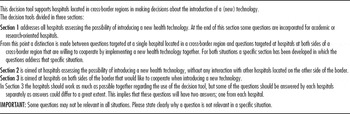
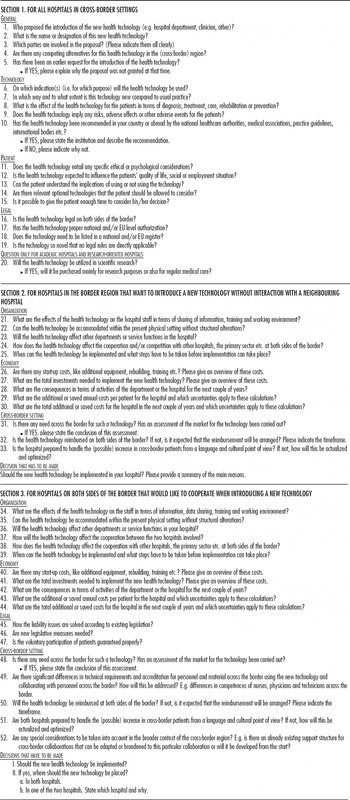
As can be seen in Table 1, the decision tool is divided into three separate sections, being one of the main differences with the Danish mini-HTA guideline. The first section consists of general questions and should be answered by everyone using the tool. The second section is only suitable for hospitals in cross-border regions that have no interaction with another hospital located across the border. For some of these, there simply is no other hospital across the border; in such situations, residents living on that side of the border with no hospital may have no other choice than to cross the border for hospital care. The third section should only be used by hospitals that are willing to cooperate—or are already cooperating—with a hospital across the border.
Instructions for Cross-border Mini-HTA Decision Tool

The questionnaire consists of open questions which should be answered in an as detailed way as possible, including all relevant information to support the decision-making process. The answers should be based as much as possible on scientific evidence, which is not always available regarding newly introduced technologies. In addition, in a given situation, some questions may not be relevant for the specific research question to be answered. Where this is the case, it is nonetheless important to articulate the reasons why a given question is not relevant. All questions in sections 1 and 2 can be answered with an answer that is jointly formulated by the hospitals together. The questions in section 3 have to be answered by both hospitals separately. The idea behind this is that the consequences of introducing a technology may have a different impact in the hospitals depending on location and organization. These specific questions are explicitly marked (Reference Euregio8).
Pilot Studies at the University Hospitals of Aachen and Maastricht
Two pilots with two different decision problems were selected with the help of the cross-border policy advisors of both hospitals. The first pilot dealt with the question of whether to obtain one or two cyclotrons and laboratories to produce radiopharmaceuticals for the departments of Nuclear Medicine (one at UKA and one at MUMC+). Having the ability to produce radiopharmaceuticals themselves should improve both patient care and research opportunities. This request came from the head of both departments who would like to invest in the departments in ways that maximize synergy and eliminate waste, as well as promote research capacity. The second pilot focused on two questions regarding Deep Brain Stimulation (DBS) by the department of Neurosurgery of MUMC+: whether it is possible to (i) perform DBS on a Dutch patient at the UKA as DBS is not reimbursed for this indication in the Netherlands and/or (ii) triage patients for DBS placement in either MUMC+ or UKA depending on the complexity of the case rather than the place of resident of the patient. The experiences with the decision tool in these two pilots were then used to identify the adjustments needed.
For both pilot studies, a work plan was made with the specific research question, the questions to be answered and a short planning and the different possible information sources. This work plan was presented and discussed with the departments in which also several questions of section 1 could be answered. In the next step, information was collected using different sources, like scientific literature, personnel communication with people, reports, and Web sites from organizations. The information was then used to start answering the questions and to identify missing information. By answering the questions step-by-step, real experience with the tool and the questions was gained and missing topics and unclear questions could be identified.
Adjustments after the Two Pilot Studies
When performing the pilots, it became clear that some changes were advisable to the first version of the decision tool. Three different types of adjustments were needed: (i) deleting questions or combining questions (four questions), (ii) rephrasing questions (five questions), and (iii) adding questions (eleven questions). Before starting the second pilot, it became clear that legal questions were lacking in the first version of the decision tool. Therefore, ten questions from the legal domain of the EUnetHTA Core model were used in this specific pilot. After the pilot, it was decided to add these questions to the decision tool. The questions were incorporated in section 1 (seven questions) and section 3 (three questions). Furthermore, three questions on economy were combined into two questions. One of the new questions is question 43, whereby now is stated which uncertainties apply to these calculations. In the first version of the tool, this was a separate question. After all adaptations, section 1 has twenty questions, section 2 has thirteen questions, and section 3 has nineteen questions (Reference Euregio8).
Use of the Decision Tool: Situations and Assessment
The cross-border mini-HTA decision tool as shown in Table 2 can be used in situations in which one or two hospitals would like to take a decision on introducing a health technology. Like most HTA-guidelines, the tool will be helpful to systematically analyze the most relevant existing evidence to the decision-making process when considering the introduction of a technology. There are several possible users, but in most cases the decision tool will be used by the staff of a department requesting the technology. This staff could be medical doctors or other health professionals as they know best why they would like to introduce the technology in their department and, therefore, they are the most suitable people to use the tool. However, when using the tool, it is useful to have access to scientific literature or databases. In addition, it is preferable that users have some basic training in HTA, or can consult (health) economists, epidemiologists or statisticians.
Cross-border Mini-HTA Decision Tool

DISCUSSION
All over the European Union local authorities and healthcare organizations are cooperating across borders. Several European countries are already using HTA as a support tool for the decision-making process on either the national or local level (Reference Glinos and Baeten9). Up until now, however, there was no HTA-tool explicitly designed to evaluate the potential placement of health technologies in a cross-border setting. To our knowledge, this is the first HTA-decision tool especially developed for hospitals in border regions. Several countries already developed guidelines for HTA in local settings, but these guidelines only focus on the country in which the organization is located. The border location of a hospital can bring additional challenges. The hospitals have to take into account existing differences with the neighboring country, such as different methods and levels of reimbursement of particular medical treatments, different laws, and legislation, and even differences in the expectations and preferences of patients. Therefore, the cross-border mini-HTA decision tool takes this special situation into account due to the inclusion of several questions about the cross-border setting and several legal questions. Although the decision tool is to a large extent based on already existing guidelines (i.e., the mini-HTA guideline of DACEHTA and the EUnetHTA Core Model), we tested it nonetheless in two pilots. This was mainly done to investigate whether the new questions were answerable, whether all topics were covered and whether questions could be deleted or needed rephrasing. The pilots were also helpful in identifying missing topics, and all these adaptations can be found in the final version of the cross-border mini-HTA decision tool.
Limitations of the Study
There are two major limitations related to this study. The first limitation is the lack of literature that was found on decision making in hospitals in cross-border regions. No article was found on this topic and, therefore, several different information sources were used to collect relevant background information.
The second limitation is related to the setting in which the pilots were carried out. Both pilots focused on questions related to the cooperation between MUMC+ and UKA. Therefore, only sections 1 and 3 were used in these pilots. However, the questions in section 2 are comparable with section 3 and, therefore, it can be concluded that this would not cause major problems. Furthermore, both pilot studies were carried out in the same region, the Euregio Meuse-Rhine, a region that has approximately 30 years of experience in cooperation in healthcare whereby it is considered a leader in the field (Reference Glinos and Baeten9).
CONCLUSION
This tool for mini-HTA in cross-border settings is the first decision tool especially developed for hospitals in border regions. Previous guidelines focused on either use of HTA at the local level or on the use of the data in another setting than where the data were collected. The developed tool was tested in two pilot studies after which the decision tool was adjusted. However, more experience has to be gained with the tool in other cross-border regions looking at other types of request. This will help to learn more about the use of HTA in hospitals dealing with cross-border issues. Overall, it can be concluded that this decision tool is a first step toward using HTA to support the decision-making process for hospitals in European border regions.
CONTACT INFORMATION
Saskia Knies, PhD, email: sknies@cvz.nl, Department of International Health and Department of Health Services Research, Maastricht University PO Box 616, Maastricht 6200 MD, Netherlands
Gloria Lombardi, MA, European Hospital and Healthcare Federation (HOPE), Brussels, Belgium
Matt Commers, PhD, MPH, Department of International Health, Maastricht University Maastricht, Netherlands
Hans-Peter Dauben, MD, PhD, Deutsches Institut fur Medizinishe Dokumentation und Information (DIMDI), Cologne, Germany
Silvia Evers, Professor, PhD, Department of Health Services Research, Maastricht University Maastricht, Netherlands
Kai Michelsen, PhD, Department of International Health, Maastricht University Maastricht, Netherlands
Wija Oortwijn, PhD, ECORYS Nederland BV, Rotterdam, Netherlands
Chibuzo Opara, MD, Department of International Health, Maastricht University Maastricht, Netherlands
Helmut Brand, Professor, MD, PhD, Department of International Health, Maastricht University Maastricht, Netherlands
CONFLICT OF INTEREST
Saskia Knies, Gloria Lombardi, Matt Commers, Kai Michelsen, Chibuzo Opara, and Helmut Brand report receiving a grant to their institution from the European Commission, DG Sanco Euregio II Project. Wija Oortwijn reports funding to her institution from Novo Nordisk AS for work outside this manuscript. The other authors report no potential conflicts of interest.