Complete heart block may occur in newborn infants due to in utero antibody mediated (anti Rho, anti La) conduction disease. These patients will require permanent pacemaker insertion if they have a persistently low heart rate (<55 beats per minute) or symptoms of heart failure.Reference Brugada, Blom and Sarquella-Brugada1. Small vessel size in newborn infants results in a significant thrombus risk with indwelling leads. As a result, single-epicardial leads or dual-epicardial leads are sited with the generator box placed in the upper abdomen. A degree of lead redundancy is required to allow for the patient growth. Lead failure will occur in up to 27% of patients at a median of 8.4 years for epicardial leads resulting in the need for pacemaker revision.Reference Murayama, Maeda, Sakurai, Usui and Ueda2.
Several complications with epicardial pacing systems have been reported. Late complications relate to lead fracture, poor lead thresholds, and exit block. Although reportedly very rare, cardiac strangulation is the most common following epicardial lead placement in the neonatal period.Reference Alhuzaimi, Roy and Duncan3. Recent data have found that the incidence of coronary compression secondary to epicardial leads is higher than previously believed. Data from Boston Children’s Hospital by Mah et al report radiological evidence of coronary compression in 5.5% of patients.Reference Mah, Prakash, Porras, Fynn-Thompson, DeWitt and Banka4. The leads may encircle the myocardium and as the heart grows, it results in the compression of coronary blood flow, making this feature unique to the paediatric population. A report in 2015 by Carreras described two cases in their institution and reviewed eight case reports in the literature to date.Reference Carreras, Duncan, Djurdjev and Campbell5.
Case report
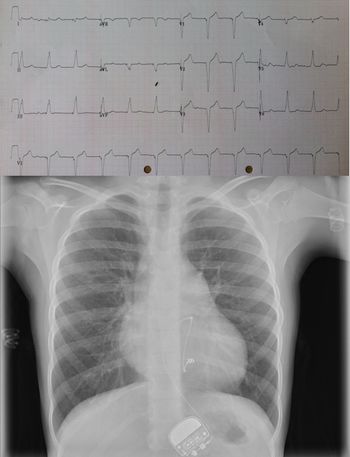
A 7-year-old girl was admitted for elective pacemaker revision. She had anti Rho and anti La antibody induced complete heart block from 22 weeks gestational age in utero. A single-chamber epicardial pacemaker was inserted on day 2 of life for a low-baseline heart rate (HR < 50). A single-epicardial pacing lead was sited on the right ventricular surface. She remained clinically well with normal indices of cardiac function and no concerns were noted on routine chest X-ray and echocardiogram (Fig 1). An elective pacemaker change to a transvenous pacing system was planned at 7 years of age as the pacemaker was approaching end of life.
Baseline electrocardiogram demonstrating ventricular pacing. Chest X-ray shows the anteroposterior image of ventricular generator and pacing lead prior to cardiac arrest.

She was initially well during anaesthetic induction. Following access in the left subclavian vein and formation of a left subpectoral pocket, a transvenous pacing lead was inserted into the right ventricle with a satisfactory R wave (8 mv) post fixation. She suddenly developed bradycardia with poor ejection noted on the arterial trace. There had been no noted prior abnormalities (ST segment changes) on cardiac monitoring. Transthoracic echocardiogram excluded tamponade and fluoroscopy outruled pneumothorax. Immediate cardiopulmonary resuscitation (CPR) and multiple rounds of epinephrine were administered. After several minutes, she developed ventricular fibrillation. She was defibrillated eight times with no response and received ongoing CPR, epinephrine, and lidocaine before extracorporeal life support (ECLS) was established. Following ECLS, aortography suggested normal coronary arterial flow. As stability on the circuit was established, a new transvenous generator and right ventricular lead were inserted, without further incident.
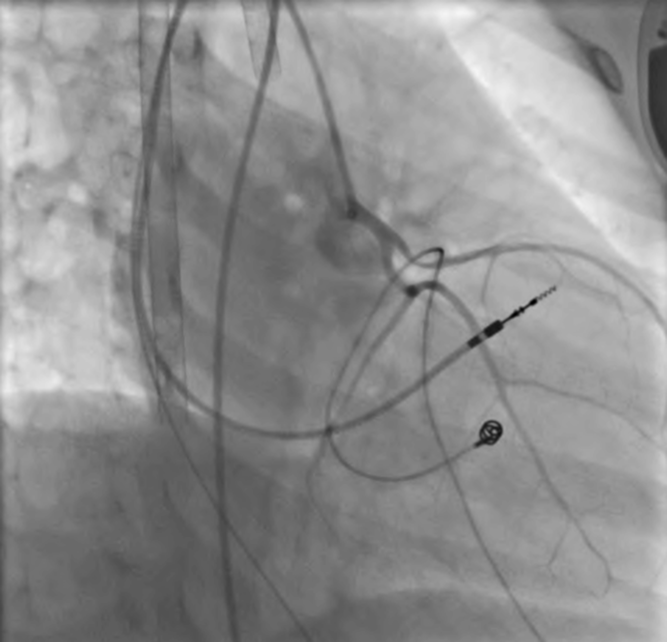
In the paediatric intensive care unit (PICU), the patient was stable with improving myocardial function on echocardiography. On day 2, post PICU admission, the patient was bridged from extracorporeal membrane oxygenation (ECMO). Echocardiography revealed a shortening fraction of 30% and she was decannulated 2 hours later. Furthermore, 3 hours post decannulation, she again became profoundly hypotensive and was resistant to immediate resuscitation. At this time, ST segment depression was observed on cardiac monitoring. A transesophageal echocardiogram (TEE) showed poor cardiac contractility. The patient was recannulated and ECMO was reinstituted. Repeat cardiac catheterisation was carried out 3 days later when stability and improved cardiac function was shown. Selective coronary angiography demonstrated dynamic collapse of the left anterior descending (LAD) and left circumflex (LCx) coronary arteries (Fig 2). A computed tomography coronary angiogram confirmed compression of the LAD and LCx just after the bifurcation by the original decommissioned epicardial pacing lead.
Selective coronary angiography demonstrating compression of the left anterior descending and left circumflex coronary arteries.

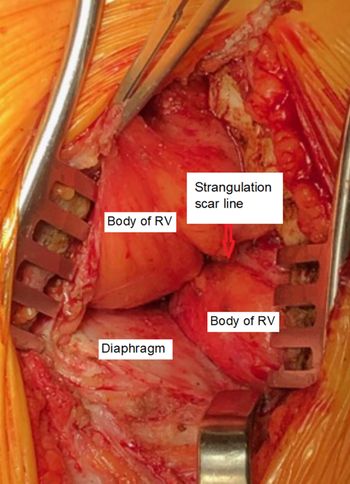
She returned to PICU and the following day underwent surgical removal of the epicardial pacing lead. The cardiothoracic surgical team identified the epicardial lead covered by a calcified capsule encircling the heart and causing significant strangulation of the heart with a 2 cm deep fissure on the surface of the right ventricle (Fig 3). The pacemaker box and leads were removed. The patient was decannulated the following day and extubated 2 days later. Despite two episodes of prolonged CPR and two ECMO runs, she sustained no neurological sequelae.
An image displaying the cardiac fissure created by encroachment of the epicardial lead across the right ventricle (red arrow).

Discussion
Cardiac arrest secondary to coronary strangulation is an extremely rare event, although there may be a hidden number of asymptomatic patients at risk. In early case reports, prior symptoms (angina, exercise intolerance, syncope, and arrhythmia) or echocardiographic evidence of impaired ventricular function was invariably present. In the Boston data, however, 25% of the patients with radiographic evidence of compression were asymptomatic.Reference Mah, Prakash, Porras, Fynn-Thompson, DeWitt and Banka4 In our patient, cardiac strangulation was not considered until evidence of dynamic obstruction to the LAD and LCx was discovered on selective coronary angiography. Initial aortography, albeit shortly following the institution of transesophageal echocardiography when cardiac contractility was poor, failed to identify coronary obstruction.
This rare report describes cardiac strangulation resulting in cardiac arrest in a previously asymptomatic patient. We hypothesise that anaesthesia led to reduced myocardial perfusion secondary to reduced diastolic blood pressure and the compressing lead resulted in a spiral of worsening coronary blood flow, myocardial dysfunction, ventricular fibrillation, and cardiac arrest. The impinging lead inhibited resuscitation with limited flow to the LAD and LCx. A case report by Watanabe et al demonstrated similar effects of anaesthesia in a patient brought for cardiac catheterisation with suspected coronary strangulation.Reference Watanabe, Hayashi, Sugawara, Hashimoto, Sato and Takeuchi6
The studies by Carreras et al suggest minimising redundant lead within the pericardial sac at the time of implantation and placing it on the anterior surface of the myocardium. They advocate three yearly anteroposterior and lateral chest X-rays to assess lead position. A review article by Takeuchi et al of 10 reported cases in the literature (the same cohort as Carreras et al) made similar recommendations regarding serial radiological follow up although they preferred lead placement on the diaphragmatic surface of the pericardium, a location originally proposed by AlHuzaimi et al.Reference Alhuzaimi, Roy and Duncan3 Our group would agree with the recommendations for radiological follow up to evaluate lead position. As described in the study by Carreras et al, patients with cardiac strangulation may demonstrate a “heart-shaped orientation of the atrial and ventricular leads within the cardiac silhouette on anteroposterior film”. If cardiac strangulation is suspected, confirmation with computed tomography angiography should be performed prior to anaesthetic administration. If confirmed, extreme caution should be taken during anaesthetic induction with an ECMO circuit primed and surgical team on hand.
Conclusion
Cardiac strangulation secondary to epicardial pacing lead compression is extremely rare with a limited number of cases reported in the literature. Screening for compression in children with epicardial leads should become a routine practice in institutions using these systems. Confirmation using computed tomography angiography may be required to risk stratify. Extreme care and preparation must be taken prior to anaesthesia in patients where strangulation is confirmed.
Acknowledgements
We would like to acknowledge the staff at Our Lady’s Children’s Hospital for their hard work and patient care.
Financial Support
This project received no funding.
Conflict of Interest
None.
Ethical Standards
Not applicable.