Introduction and Background
Low levels of cognitive ability as a child are associated with numerous negative health and social outcomes later in life (Lawlor et al., Reference Lawlor, Batty, Morton, Deary, Macintyre, Ronalds and Leon2005). There is an extensive debate regarding the significant determinants of childhood intelligence, including the nature versus nurture argument: do genetics ultimately determine our intelligence, or can early-life environment influence outcomes, and if so, by how much?
Studies that investigate the pre- and postnatal determinants of intelligence and the associated later life-cycle health outcomes can essentially be split into three broad categories. The first of these investigates prenatal determinants such as birth weight, gestational age and birth order (e.g. Breslau et al., Reference Breslau, Chilcoat, DelDotto, Andreski and Brown1996; Richards et al., Reference Richards, Hardy, Kuh and Wadsworth2001, Reference Richards, Hardy and Kuh2002; Boardman et al., Reference Boardman, Powers, Padilla and Hummer2002; Alderman & Behrman, Reference Alderman and Behrman2004; Shenkin et al., Reference Shenkin, Starr, Pattie, Rush, Whalley and Deary2001, Reference Shenkin, Starr and Deary2004; Cesur & Kelly, Reference Cesur and Kelly2010). For example, Alderman & Behrman (Reference Alderman and Behrman2004) find that reducing low birth weight (<2500 g) results in a number of economic and health benefits that relate to cognition, including productivity gains and inter-generational benefits. At the other end of the birth-weight spectrum, Cesur & Kelly (Reference Cesur and Kelly2010) find that high birth weight (>4500 g) also results in adverse impacts on cognitive outcomes. In terms of gestational age, Kirkegaard et al. (Reference Kirkegaard, Obel, Hedegaard and Henriksen2006) illustrate that a lower gestational age has a negative effect on certain school performance indicators, such as spelling and reading. Birth order also appears to play a role, and Boat et al. (Reference Boat, Campbell and Ramey1986) show that first born children tend to be more intelligent at the age of 5 and have a lower risk of developmental retardation than later born children.
A second group looks at postnatal determinants and/or interventions that may moderate or amplify prenatal determinants. Included in this research cluster are early intervention studies and those that emphasize the socioeconomic interfaces. Many studies, including Jefferis et al. (Reference Jefferis, Power and Hertzman2002), find that social status at birth does indeed have a large influence on childhood intelligence, independent of birth weight (e.g. Kramer et al., Reference Kramer, Allen and Gergen1995; O'Callaghan et al., Reference O'Callaghan, Williams, Andersen, Bar and Najman1995; McLoyd, Reference McLoyd1998; Rowe et al., Reference Rowe, Jacobson and Van den Oord1999; Guo & Harris, Reference Guo and Harris2000; Jefferis et al., Reference Jefferis, Power and Hertzman2002; Gomez-Sanchiz et al., Reference Gomez-Sanchiz, Canete, Rodero, Baeza and Avila2003 (about breast-feeding effects on IQ); Osler et al., Reference Osler, Andersen, Due, Lund, Damsgaard and Holstein2003; Turkheimer et al., Reference Turkheimer, Haley, Waldron, D'Onofrio and Gottesman2003). In another example, Guo & Harris (Reference Guo and Harris2000) investigate the mediating effects between poverty and children's intellectual development and find that it is completely mediated by factors relating to income, such as cognitive stimulation and physical environment of the home.
The final group investigates whether these effects continue into adulthood and how they manifest themselves in later health outcomes (e.g. Whalley & Deary, Reference Whalley and Deary2001; Illsley, Reference Illsley2002 (focuses on educational attainment, rather than IQ); Taylor et al., Reference Taylor, Hart and Davey Smith2003; Batty & Deary, Reference Batty and Deary2004; Deary et al., Reference Deary, Whiteman, Starr, Whalley and Fox2004; Starr et al., Reference Starr, Taylor and Hart2004; Batty et al., Reference Batty and Deary2007). Many of these studies, such as Batty & Deary (Reference Batty and Deary2004) and Batty et al. (Reference Batty and Deary2007), find that childhood IQ plays a significant role in adult cognition and health, in particular health issues that increase mortality risks. Some of these studies take a more detailed approach by examining the relationship between childhood cognition and one stream of health problems that may lead to mortality, such as Starr et al. (Reference Starr, Taylor and Hart2004), which finds that lower childhood cognition is associated with increased hypertension later in life, or Taylor et al. (Reference Taylor, Hart and Davey Smith2003) who illustrate that lower childhood IQ often leads to an increased chance of smoking as an adult. This final group is growing rapidly as more longitudinal studies become available, including the Singapore Cohort Study of the Risk Factors for Myopia (SCORM) used in this work.
This study seeks to investigate what influences children's intelligence in early childhood. The research is designed specifically so that the results can inform micro-simulation policy modelling of childhood interventions and consequently help manage life-cycle health costs from both an individual and public health system perspective. Micro-simulation modelling uses transition probabilities to model shifts in ‘agent’ or individual characteristics, such as IQ. More specifically, agents are allocated attribute constants (characteristics a child has at birth that do not change over the life cycle, such as gender, birth weight, ethnicity, mother's age at delivery, etc.) and an initial condition for health and socioeconomic characteristics. The latter includes variables that can change over the life cycle, such as income, school characteristics and mother's working status.
As an objective of the study is that the findings can be used in micro-simulation modelling, the core determinants of movements in childhood cognition are important to ascertain, as well as the probabilities of shifting IQ over time. Given these aims, the study begins with initial exploratory regression analysis that considers the various determinants of childhood IQ at age 11, using the SCORM data source. The next step of this research and one of the key contributions this study makes is to split the IQ range of the sample into specific groups with respect to the five recognized intelligence levels, and make use of ordered logistic regression to empirically examine the factors that produce large shifts in IQ. Such analysis is aimed at investigating the key drivers of movements between the IQ groupings. Subsequent to this, multinomial logit models are employed to determine characteristics that impact whether the movement in IQ is higher or lower than the average sample movement. Odds ratios obtained from both logistic models will be valuable in guiding the constructing of transition probabilities in future directions of this research that focus on micro-simulation modelling.
This research is also distinctive in that the sample is based on two extremes of schooling quality. Half the data were collected from a top-ranked school, and the remaining participants were collected from the reverse. This provided a diverse range of households and consequently a more enriched empirical analysis.
The final contribution this paper makes is to provide empirical investigation of the determinants of childhood IQ with a focus on Singapore. There is limited evidence from this country. Research by Boocock (Reference Boocock1995) focused on the influence of attending pre-school on Singaporean school children's ability to share and co-operate, as well as their proficiency in the English language. A recent study by Broekman et al. (Reference Broekman, Chan and Chong2009) focused more on the topic at hand (determinants of IQ) and also made use of the SCORM data. Their goal was to contribute to the sparse literature on the relative importance of a variety of birth parameters (birth length, weight, head circumference and gestational age) within the normal birth size range. They only used linear regression models in their empirical analysis.
The remainder of this paper is organized as follows: the next two sections outline the data sourced from Singapore, and explain the initial econometric strategies undertaken in this study (linear regression and ordered logit); this is followed by results and interpretation of the key findings; the penultimate section covers the final econometric approach of using a multinomial logit model; and this paper ends with a brief conclusion, along with indications of future directions for this research.
Data
This study uses SCORM data, which was initiated in 1999, and collected from two schools located in the north-eastern and south-eastern parts of Singapore. In 2001 it was extended to include one school located in the west. The schools were selected based on prior National Examination results with the north-eastern school ranked among the bottom twenty schools and the south-eastern and western schools both being ranked among the top twenty schools (Saw et al., Reference Saw, Chua, Hong, Wu, Chan and Chia2002). All children aged 7 to 9 (in grades 1 to 3) were invited to participate in the study. Written consent was received from the parents. Of 2186 eligible children, 1478 agreed to participate in the survey and after accounting for measurement error, and missing information, the final sample consists of 662 children. Close to half of this final sample (48.3%) are from the south-eastern and western schools, both of which are ranked among the top twenty.
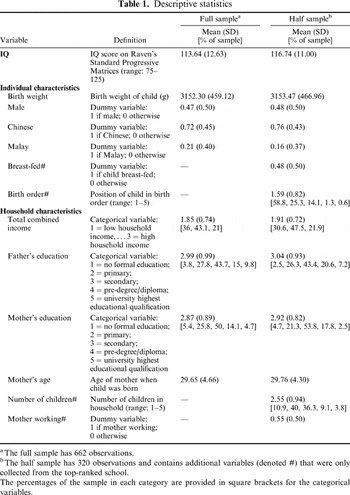
The children were followed up over a 3-year period, and information on their IQ was collected at age 11. The SCORM participants undertook the Raven's Standard Progressive Matrices, which is extensively used to test non-verbal reasoning ability (Raven et al., Reference Raven, Raven and Court1998). Parents also completed a baseline questionnaire with respect to a range of demographic information. This included details on parental education, income, ethnicity, etc. Ethnicity was assessed by asking parents to classify their ethnicity, and the ethnicity of the child was determined by using the father's reported ethnicity (in accordance to the definition adopted by the Singapore Population Census: www.singstat.gov.sg/statsres/glossary/population.html). Some additional retrospective perinatal data were collected from the parents at the top-ranked school, such as birth order, whether breast-fed and mother's work status (for further details on this data set see Saw et al. (Reference Saw, Chua, Hong, Wu, Chan and Chia2002, Reference Saw, Tong and Chua2005, Reference Saw, Shankar, Tan and Taylor2006)). Given the value of these additional covariates, all the empirical analysis in this study was conducted for both the full sample (n=662), as well as for the half sample (n=320), which had the additional independent variables. Such multiple analysis serves two functions: to the test the validity of results across a small sub-sample, versus the larger sample; and to investigate the importance of these additional variables in terms of the role they play in influencing childhood IQ levels. The key dependent variable of IQ and all other independent variables used in the forthcoming analysis are described in Table 1. This table provides the means and standard deviations for all variables used in the full sample and/or the half sample. Additionally, the table illustrates the percentage of sample for all categorical variables.
Descriptive statistics

a The full sample has 662 observations.
b The half sample has 320 observations and contains additional variables (denoted #) that were only collected from the top-ranked school.
The percentages of the sample in each category are provided in square brackets for the categorical variables.
As Table 1 indicates, the mean value for IQ score of the sample was 113.64, with this being a little higher (116.74) in the half sample. This high mean IQ is consistent with other studies that find that Singapore rates highly relative to other developed countries in terms of childhood IQ (see Lynn & Vanhanen, Reference Lynn and Vanhanen2002, Reference Lynn and Vanhanen2006). This statistic is an expected result, given that the half sample is drawn from top-ranked schools, and rankings are determined by prior National Examination results. Approximately 72% of the final sample are Chinese (this is higher in the half sample), and the split based on gender is close to half. In terms of household characteristics, it appears clear that children in the half sample (the top-ranked schools) are in comparatively wealthier homes, with higher education levels for both parents.
Placement in a primary school is based on a range of determinants. There are 27 planning areas in Singapore (as at May 2011; see Ministry of Education, 2011), and a number of primary schools within each zone. Parents need to take part in a Primary One Registration exercise, where placement in a school is allocated according to a list of priorities. At the top of this list is having a sibling studying at the school of choice (this is termed Phase 1). The next group given priority are children with a parent who was a former student and is part of the alumni or school advisory/management committee (this is termed Phase 2A(1)). Close ties/connections to the community appear to rank highly as Phase 2A(2) includes children which parents who are members of churches directly connected to the school, or who have received an endorsement from an active community leader. If applications to the school exceeds vacancies, then balloting occurs from Phase 2A(1) onwards. Given these criteria, it is highly likely that families with high household income, who were past students of top-ranked schools, have a higher probability of placement in the same school for their children.
The next section of this paper outlines the various econometric strategies undertaken to disentangle the influence of various determinants of childhood cognition, as well as the motives behind their application using the SCORM data.
Econometric approaches
Initially, a simple linear regression model is employed, where IQ measured at age 11 is regressed against a range of individual, household, socioeconomic and school determinants, consistent with the study undertaken by Cesur & Kelly (Reference Cesur and Kelly2010). Next, IQ is split into five groupings that are comparable to standard interpretations of intelligence levels. These five levels are similar to the popularly used Wechsler scale (Wechsler, Reference Wechsler1989, Reference Wechsler1991) where 120 and higher is classed as either superior or very superior; 110–119 is high average; 90–109 is average; and under-90 is below average. The interpretations are provided in parentheses below:
1 if IQ<90 (below average)
2 if 90≤IQ≤99 (low average)
3 if 100≤IQ≤109 (average)
4 if 110≤IQ≤119 (high average)
5 if IQ≥120 (superior)
Given the constructed ordinal and categorical nature of this dependent variable, the most appropriate econometric estimation method to apply is ordered logistic regression. The general form of this model is:

with Y* being a latent variable that is then ordered into the five IQ categories defined above.
The ordered response model is defined as:

where  and F is the cumulative distribution function of the logistic distribution
 .
Both econometric approaches of ordinary least squares (OLS) and ordered logit regression have their advantages. The OLS results serve to validate past empirical research on determinants of childhood cognitive ability, especially since linear regression is often the tool used in much of the research on this front, and was the econometric technique used in the one relevant study from Singapore (Broeckman et al., Reference Broekman, Chan and Chong2009). Additionally, OLS regression makes full use of the continuous nature of the IQ variable, rather than creating categorical outcomes based on expected cut-off points for different levels of intelligence. On the other hand, employing logit regression offers a unique perspective, by permitting greater interpretation through the use of odds ratios. These are useful in understanding the odds of moving from one IQ category to another, and as already indicated, will guide future directions of this research in terms of the micro-simulation modelling. Also, to the authors' knowledge, logistic regression has not been applied to understanding determinants of childhood cognition within the Singaporean setting (for a comprehensive review of the advantages and disadvantages of OLS and logistic regression, see Greene (Reference Greene2012) and Kleinbaum & Klein (Reference Kleinbaum and Klein2010)).
All econometric models are run with both the full and the half sample, where the additional covariates are available. The underlying IQ function for the full sample is:

The IQ function for estimation with the half sample is specified as:

Estimated coefficients and odds ratios for both the full sample and the half sample are detailed and discussed, and the modelling subsequently extended with the application of a multinomial logistic regression, in the Results section.
Results
Linear IQ regression
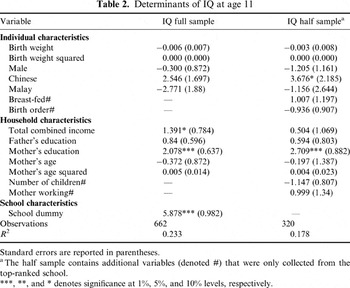
The first step in this empirical analysis was to run a simple OLS regression with the dependent variable of childhood IQ at age 11. The independent variables included a range of child, household and school characteristics (as shown in Table 1). The same regression was also re-run for the half sample, which had the additional covariates. The school variable was omitted from this half sample analysis as the additional data were only collected from participants enrolled at one of the schools. The results from both of these regressions are presented in Table 2.
Determinants of IQ at age 11

Standard errors are reported in parentheses.
a The half sample contains additional variables (denoted #) that were only collected from the top-ranked school.
***, **, and * denotes significance at 1%, 5%, and 10% levels, respectively.
Table 2 points to only one determinant that is consistently significant across both the half and full sample: mother's education. School was also significant and importantly positive in the full sample. This result is expected as the school dummy is 1 if enrolled in a top-ranked school, and 0 otherwise. Weakly significant results hold for income and ethnicity. Specifically, in the full sample, total combined household income was positive and significant at the 10% level, and a similar result was found for being Chinese (relative to ethnicities other than Malay) in the half sample regression. Finally, while several other determinants are not statistically significant in Table 2, many are in the direction expected. For example, the positive impact of being breast-fed and the higher the father's education; a negative impact the later in the birth order; and a U-shaped pattern in terms of the impact of mother's age.
Logistic regression of IQ groups
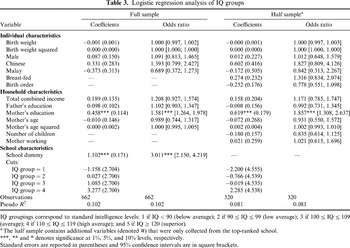
IQ is measured using the Raven's Standard Progressive Matrices at approximately age 11 for the children participating in the SCORM project. It is split into five groups based on the widely recognized and standard interpretations of intelligence levels: below average; low normal to average; high normal to average; superior; and very superior. Ordered logit analysis is appropriate given the ordinal and categorical nature of the dependent variable. Additionally, the main advantage of this approach, as opposed to OLS and making use of continuous information on IQ is that it allows easily interpretable odd ratios to be calculated (as shown in Table 3). Odds ratios are a way of comparing whether the probability of a certain event/outcome is the same for two groups. For example, an odds ratio of 1 indicates an event is equally likely in both groups/circumstances (see Tarling, Reference Tarling2009).
Logistic regression analysis of IQ groups

IQ groupings correspond to standard intelligence levels: 1 if IQ<90 (below average); 2 if 90≤IQ≤99 (low average); 3 if 100≤IQ≤109 (average); 4 if 110≤IQ≤119 (high average); and 5 if IQ≥120 (superior).
a The half sample contains additional variables (denoted #) that were only collected from the top-ranked school.
***, ** and * denotes significance at 1%, 5%, and 10% levels, respectively.
Standard errors are reported in parentheses and 95% confidence intervals are in square brackets.
Table 3 again suggests that it is the mother's level of education that is strongly significant within both the full and half sample. This strong effect could be accounted for by the environment and learning support provided by a better educated mother. This is also entirely consistent with health literature that considers the home environment (Neligan & Prudham, 1976; Boat et al., Reference Boat, Campbell and Ramey1986; Hart et al., Reference Hart, Taylor and Davey Smith2003; Turkheimer et al., Reference Turkheimer, Haley, Waldron, D'Onofrio and Gottesman2003). Alternatively, mother's level of education could be highly correlated with mother's IQ, and be impacting the child's IQ via genetics. That genetics substantially influence human intelligence was established as early as the 1800s (see, for example, Galton, Reference Galton1865), and reinforced through the 20th century (Bouchard & McGue, Reference Bouchard and McGue1981; Scarr & Carter-Saltzman, Reference Scarr, Cart-Saltzman and Sternberg1982; Plomin et al., Reference Plomin, Fulker, Corley and Defries1997). As Deary et al. (Reference Deary, Johnson and Houlihan2009) note, more recent research has done nothing to contradict this view.
Interestingly, in contrast to other studies that found that birth weight was a significant determinant of childhood IQ (Breslau et al., Reference Breslau, Chilcoat, DelDotto, Andreski and Brown1996; Boardman et al., Reference Boardman, Powers, Padilla and Hummer2002; Cesur & Kelly, Reference Cesur and Kelly2010), this study did not find that this was the case. An odds ratio of 1 indicates the irrelevance of birth weight in this sample (although this may be partially due to a high proportion of babies in this sample being born in a healthy weight range; only 6.8% of the sample were born with low birth weight, i.e. below 2500 g). Similarly in the half sample, although an odds ratio of 1.316 for being breast-fed indicates that children breast-fed (relative to those not) are 1.3 times more likely to have a higher IQ, this is not statistically significant.
Besides mother's education, the only other significant determinant of childhood IQ was schooling quality. This is reflective of the Singaporean education system and the selection of the participant schools. The schools were chosen on their rankings in prior National Examination results, so it would be expected that the school would reflect a number of confounding variables, such as measures of the socioeconomic status of the family including income, housing quality and home environment. In this case, the significance of the schooling quality supports the nurture argument that schooling, a childhood environmental factor, can influence childhood intelligence.
Multinomial logit model
The final econometric approach used in this study is multinomial logistic regression. This is an extension of logistic modelling and is relevant when the categorical dependent variable has more than two outcomes. This study is particularly interested in the impact of possible interventions and the need to model the transition between life stages. Unfortunately, IQ was only collected at one point in time in this data set and hence individuals' early cognition level must be proxied. Results from the previous econometric approaches (OLS and ordered logit) point to a clear choice of proxy. Mother's education level is found to be strongly and consistently significant and this motivates its use as a proxy for cognition at birth. Additionally, mother's education is split into five categories that are broadly comparable to the standard interpretations of the IQ groupings used for the children in this analysis. These include no formal education, primary, secondary, pre-degree/diploma and university as the highest educational qualification attained.
Preliminary inspection of the changes in IQ indicate that, on average, most individuals move up one IQ category from birth to age 11. Consequently, rather than using multinomial logit analysis to capture the drivers of movements up and down, relative to no change in IQ group, movements above and below the average sample shift are focused on. The average movement in IQ is therefore the base/reference outcome.
It is important to note a caveat in the analysis at this point. The following empirical exercise and the consequent interpretations of movements in IQ are based on the assumption that mother's level of education is a good proxy for cognition level at birth. Despite this caution, if this assumption does not hold then the resulting analysis does not become futile; rather it can then be viewed as comparing the difference between initial life circumstances (based on mother's level of education) and IQ at age 11.
The generalized form of the multinomial logit model employed is:

.
The estimated equations from eqn (5) provide probabilities for each category (in this case two categories: movement in IQ above the average sample shift, and movement in IQ below the average sample shift) relative to the reference category (in this case j=0 is the reference/base outcome of the individual's movement in IQ being the same as the average sample shift).
The contribution of this econometric approach is that it essentially controls for the Flynn Effect. This effect deals with the issue of how general IQ scores of a population change over time. Flynn (Reference Flynn and Sternberg1994) tested IQ scores for different populations over the past 60 years and found that, in general, IQ scores increased from one generation to the next for all of the countries he tested. This phenomenon has since been labelled the Flynn Effect. Consequently, by investigating the determinants of moving across IQ groups between birth and age 11, using mother's education as a proxy for cognition at birth, and using the average shift of the sample as the reference point, an attempt as made to control for the expected Flynn Effect.
Another advantage of this method is that it seeks to isolate the impact of the environment on children's IQ, and so by using mother's level of education as the proxy for cognition at birth, it can be inferred, for a given level of mother's education, how environmental factors influence development of children's cognition. In essence this permits the influence of nature versus nurture to be broadly split. For a given level of nature (i.e. same level of mother's education), it is possible to assess which environmental influences (i.e. nurture) are most significant in impacting childhood cognition.
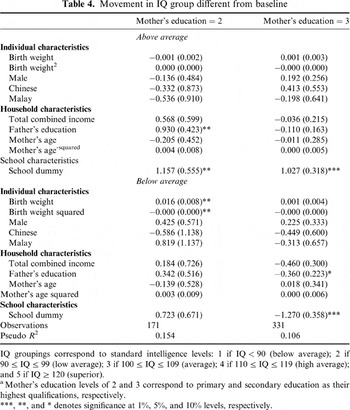
Given the small sample size for mother's education level of 1, and the limited room for movement for mother's education levels 4 and 5, results are only reported for mother's education levels 2 and 3. For these two starting points, Table 4 presents the multinomial logit results showing determinants of movements in IQ above and below the average sample movement.
Movement in IQ group different from baseline

IQ groupings correspond to standard intelligence levels: 1 if IQ<90 (below average); 2 if 90≤IQ≤99 (low average); 3 if 100≤IQ≤109 (average); 4 if 110≤IQ≤119 (high average); and 5 if IQ≥120 (superior).
a Mother's education levels of 2 and 3 correspond to primary and secondary education as their highest qualifications, respectively.
***, **, and * denotes significance at 1%, 5%, and 10% levels, respectively.
Some of the key findings in Table 4 enhance those found in the earlier regressions. School remains strongly significant after accounting for mother's level of education. This suggests the ‘nurture’ impact of the schooling environment positively influences childhood cognitive development. Sending your child to a good school appears to be of paramount importance, in terms of moving beyond the average shift in IQ of their peers born to mothers with similar educational attainment. Being at a top-ranked school is associated with the child being more likely to move more than the average rise in IQ (as shown in the mother education=2 column), and conversely, being at a top-ranked school is associated with the child being less likely to move below the average (as shown by the negative and significant coefficient in the mother education=3 column). Additionally, school also appears to have a larger influence the lower the starting point, i.e. more likely to move above the sample average shift in IQ when the mother's education level was 2 versus 3. This was also found via additional multinomial logit estimates (results not reported here) where the school dummy was interacted with mother's education level. The coefficient was larger and more significant for the lower levels of mother's education versus the higher levels (when multiplied by the school dummy).
Father's education also has a positive and significant impact. The higher the father's educational attainment, the more likely children are to move above the average rise in IQ rankings (as shown in the mother's education=2 column), and conversely, the higher the father education, the less likely the child is to make a movement below the average (as shown in the mother's education=3 column). This result is potentially confounded by the father's level of education often being related to mother's education level, if an assortive matching model is used (Becker, Reference Becker1993), and also to income. As for mother's education level, the significant result of father's education level could be accounted for by the environment and learning support provided by a better educated mother. However, it is of course not possible to rule out the potential contribution through genetics.
The last important variable is birth weight. In the earlier regression analyses this was not found to be important, contrary to findings in past research. In the multinomial logit, however, it does become important and the way it does is consistent with other studies. There is no evidence of birth weight changes impacting on above-average movement, but a higher birth weight does make it more likely for the child to move below the average shift in IQ. Combining this result with the significant, but infinitesimally small, negative coefficient on birth weight squared, indicates an inverted U-shaped effect of birth weight. This is consistent with the studies investigating whether high birth weight matters as well as low birth weight (Cesur & Kelly, Reference Cesur and Kelly2010).
Conclusions
This study has made use of the SCORM data set collected in Singapore, to assess determinants of childhood IQ and changes in IQ. Initial OLS regression pointed to the importance of mother's education in influencing childhood cognitive ability. Significant results were also found for schooling quality, household income and ethnicity (specifically, Chinese relative to other ethnicities). Interestingly, in contrast to much past literature on this topic, birth parameters such as birth weight were insignificant. Similar findings were made with the ordered logit specification, with the added advantage of odds ratios being produced. Future research avenues of this study include micro-simulation modelling, which models shifts in individual characteristics such as IQ, as well as the transition between life stages. Such odds ratios will provide preliminary transition probabilities for this future research.
Finally, this study employed multinomial logit analysis to empirically investigate changes in IQ, using mother's education level as a proxy for the cognition level of the child at birth. By allowing the average change in the sample's IQ level to be the reference category in this empirical specification, this study attempts to control for the Flynn Effect in the estimated results. Additionally, by adopting this approach separately for each given level of mother's education, an attempt has also been made to broadly split the impacts of nature versus nurture. Findings from this analysis are clear: there are three important drivers of changes in IQ: schooling quality, parental education and to a small extent birth weight. Schooling quality is of importance for policy modelling, and the importance of birth weight in the final set of analysis was interesting, given its lack of significance in the OLS and ordered logit regressions. Consequently, it appears that while birth weight has an insignificant impact on IQ levels per se, it does seem to be important in reducing the probability of childhood IQ increasing at a slower rate, relative to your peers.
Acknowledgments
The authors thank Professor Seang-Mei Saw from the Department of Community, Occupational and Family Medicine and Ophthalmology, National University of Singapore and her team for providing access to the information and data used in this study.