Introduction
The Great Leap Forward (1957–1960; GLF hereafter) is more than a socio-political and economic movement. In recent decades, scholars have either investigated how Mao’s ‘totalitarianism’,Footnote 1 cadres’ political opportunism, and the masses’ radicalism led to a structural debacle or, through an economic lens, scrutinized the policy of excessive procurement, the ramifications of yield over-reporting, and the food distribution system that resulted in a gigantic demographic catastrophe. While the political and economic perspectives are important, there are—or perhaps there should be—more ways to conceptualize this movement. The necessity of such alternatives is self-evident: in the final years of the 1950s, under intense political coercion, it was not only industry, agriculture, and infrastructure that underwent radical transformations; the cultural sphere, too, was swept up in its own fervent campaigns of ‘leaping forward’.
To foreground the cultural dimensions of the GLF is, nevertheless, not to downplay its far-reaching consequences in the political and economic spheres. Rather, the purpose is to offer a more comprehensive assessment of the GLF, one that is attentive to how the cultural leap not only accompanied but also influenced the more ‘hardcore’ domains of agriculture, industry, and infrastructure. Of late, a transvaluation of the GLF has been undertaken, moving beyond conventional political-economic concerns and turning instead to perspectives attuned to gender, religion, cinema, and affect.Footnote 2 These approaches have paved the way for a more nuanced understanding of the movement’s aesthetic symptoms and cultural logics, highlighting the constitutive role of literature and art within it.
Invariably, the cultural practices of the GLF were by no means exempt from the ideological mandates that literature and art must mirror reality, serve the masses, and contribute to the socialist cause, as set forth in Mao Zedong’s 毛澤東 1942 Yan’an talks. Yet within the fevered realm of the GLF, this doctrine of socialist realism embarked on a mutation, which intensified into a synthesis of revolutionary realism and revolutionary romanticism that demonstrate a radical epistemological and aesthetic shift. The exuberant forms that flourished—poems, folk tales, operas, documentaries, posters—were bold in artistic pursuit and populist in orientation, signalling not merely a stylistic turn but the emergence of a distinct aesthetic logic. This logic, to be sure, denotes a socialist utopianism, albeit in a Maoist regime that refused utopia’s usual associations with idealism or unreality. The challenge, then, was not to imagine the impossible, but to render the impossible imminent—to recode utopia as reality, or more precisely, as reality-in-the-making.
To understand how this was accomplished, one cannot rely solely on political or economic explanations, nor on analysis of the purported infrastructural, agricultural, and/or industrial advances. After all, socio-economic collapse and the impending famine had already begun to loom before the movement officially concluded, which suggests that the socio-economic structure alone was insufficient to sustain the movement’s continuing momentum. Instead, we must turn to the cultural, the aesthetic, and the epistemic, and to the mechanisms through which fantasy was disciplined into belief, and belief transfigured into collective practice. To reiterate, the GLF was not only a political campaign or an economic miscalculation but also a full-scale social experiment in world-making, carried out in and through the registers of art, affect, and imagination.
To account for the cultural, aesthetic, and epistemological peculiarity of the GLF as such, this article turns to the satellite (weixing 衛星) as a site of excavation. Born of the Cold War’s space competition between superpowers, the satellite soon took root in Chinese soil—as a name for falsified production reports, a fixture in the vernacular imagination, a motif in poems, paintings, and operas, and, ultimately, as the harbinger of socialist China’s first venture into space. In this layered genealogy, the satellite emerges not as a singular object, but as a node where politics, science, agriculture, industry, and the arts converge. It is this convergence, where falsehood and truth coexist, science entwines with romanticism, and past and future stand side by side, that renders the satellite a connective thread, interweaving disparate actors and social domains into a dynamic network subject to critical enquiry into the GLF, not only in terms of politics and economy but also of culture, aesthetics, and epistemology. Precisely for this reason, this article adopts the satellite as a research object qua method, as will be elaborated on in greater detail in the sections that follow. Before proceeding, the remainder of this introduction sketches the satellite’s initial encounter with socialist China and outlines its contours within the GLF.
The satellite assumed an indispensable and enigmatic role throughout the GLF. On 4 October 1957, the Soviet Union launched Sputnik 1, the first artificial satellite, into space. Mao Zedong, arriving in Moscow on 2 November of that year to attend the conference of communist leaders, eulogized that ‘the first man-made satellite launched by the Soviet Union is an event that leads human beings to embark on a new era of conquering nature’.Footnote 3 During Mao’s stay in Moscow, Sputnik 2 was launched on 3 November. Impressed by the Soviet Union’s technological advancement and Khrushchev’s ambition to surpass America in 15 years,Footnote 4 Mao impetuously put forward the goal of ‘overtaking the United Kingdom and catching up with the United States’ (chaoying ganmei 超英趕美), which adumbrated the GLF. It is a daunting challenge to measure the extent to which the Soviet satellites influenced Mao’s policy-making. However, as argued below, the satellite—not only those of the Soviets but also the later comers—did shape the GLF in its own way.
Among the satellite’s persistent appearance over the course of three years, fangweixing 放衛星 (launching satellites) emerged as the most grandiloquent trope, a nonsensical fabrication that was nevertheless believed to be true. In addition, the satellite was interwoven into news reports, bureaucratese, popular science books, operas, folksongs, either defined as an epitome of technological development, recognized as a triumph of the socialist camp, crystallized as poetry images, or even anthropomorphized as mythological figures. The satellite thus embodies a Janus-like character of being half scientific and half figurative, partly realist and partly romantic, both archaic and futurist. This somewhat paradoxical character reifies, and conversely holds the key to deciphering, the likewise self-contradictory GLF, in which lies squelch the truth, science is commandeered by metaphor, romanticism is invoked to complement realism, and the future is borrowed by the present to craft a promise of material plenty.
Satellite as method
Before proceeding, we should pause for a moment to ruminate on the nature of the satellite. The satellite, of course, refers to the technical devices designed to be launched, whether by the Soviets or the Americans. In the commensurability between the satellite as a signifier and the physical devices it signifies, however, one only catches a glimpse of the satellite, for it soon transcended its physicality to become a symbolic shell to hold Cold War ambitions, affects, and ambivalences. Within socialist China, this commensurability becomes more suspicious. The Chinese term weixing, of course, could signify Western satellites, as there was, after all, no such tangible object existing in the GLF. China’s satellite had yet to be actualized, but the term inflated and was used to denote many fabrications. As weixing had no other meanings before the GLF than ‘astronomical body’,Footnote 5 this signifier inflation directs our attention to a gap between objects and words, where the articulation of the object is subject to manipulation. The satellite was articulated, and this articulation may itself be recast as a retro-projection, a means of deconstructing the GLF and disentangling the imbrications between objects and words. In this sense, the satellite becomes, in its own right, a method.Footnote 6
When taking the satellite as a method, we might begin by treating the satellite as an object. In modern China studies, objects have drawn colossal attention, and particularly in Mao’s China, scholars have explored how objects were embedded in socialist construction and imaginary.Footnote 7 Compared to the ordinary objects whose materiality is taken as a given, the satellite, however, is somewhat aberrant due to its belated materialization. In this light, two questions loom large: first, how can we understand the satellite as a non-objectal object? And second, what significance does the non-physical object hold in the GLF as much as in Mao’s China?
It is perhaps the simulacrum of the object,Footnote 8 rather than the object itself, that is crucial for understanding the logic of socialist materiality. Socialist objects, of course, are distinct from capitalist ones which, as Boris Arvatov observes, are ‘first and foremost’ dealt with ‘in [their] guise as a commodity, as a bought and sold object’.Footnote 9 In Mao’s China, such commodified forms were subjected to Marxist denunciation, and displaced by imaginaries of redistribution that sought to annul the logic of exchange, most vividly testified by the people’s commune. Yet, as retrospectively pointed out in the Party’s 1981 Resolution, the socialist object was indeed ensnared in ‘the contradiction between the people’s growing material and cultural needs and the backwardness of social production’.Footnote 10 This contradiction, or perhaps the misrecognition of it, reveals that to conceive of the socialist object as ‘other’ to the commodity requires more than attending to its visible form reified as collective production or equal distribution; it entails reckoning with a far more complex system of material demand, production, and satisfaction.
Viewed with this hindsight, the failure of the GLF is ascribed to its attempt to substitute a counterfeit material plenitude for the unresolved contradiction between demand and supply. This counterfeited plenitude, more intriguingly, was affirmed as real, constituting a spectacle of abundance deployed to suppress the systemic scarcities it could neither resolve nor fully acknowledge. Laurence Coderre argues that Mao-era material imaginaries often revolved around what might be termed ‘the problematics of plenty’, a formulation that pivots on the ironic reality of scarcity.Footnote 11 In this didactic paradox, the people were compelled towards an asceticism in the name of a deferred socialist future. The spectacle of material plenty thus was, at its core, anti-material. It enacted a metonymic slippage between abundance and austerity, and staged a future-oriented temporality in which the promise of material fulfilment retroactively shaped the present.
Nothing embodies the problematics of plenty more fully than the satellite—a simulacrum of an object not yet made, but promised, visualized, and ironically believed. Through the lens of the satellite, the truth of the GLF unravels in the elevation of material abundance to such a performative extreme that the simulacrum of the object becomes indistinguishable from the object itself. The real satellite never existed, yet fangweixing was accomplished. That is, the simulacrum of the object supplants the object proper, enacting a logic in which projection masquerades as production. This simulacrum of the object thus constitutes what Bill Brown calls a ‘thing’, one that resists reduction to objecthood and is both the before—‘the amorphousness out of which objects are materialized’, and the after—‘what is excessive in objects’.Footnote 12 The satellite is, therefore, in one sense, an after saturated with Cold War affect and symbolic inflation. But more crucially, it functions as a before—‘the not yet formed or the not yet formable’,Footnote 13 an anticipatory figuration of plenitude that could be transformed into ‘an effort to reinstitute society’.Footnote 14
This reinstituting force enacts what might be called a statist materialism—an impulse to invert ‘the politicization of things’ into ‘the materialization of politics’.Footnote 15 The thing thus is not merely a vessel for political vision; it embodies a certain political heft, a force that, through the apparatus of the state, requires objectification. To be fair, one must acknowledge that while false satellites were being launched across the country in rhetorical and statistical excess, a real satellite was, indeed, under development. Therefore, it was arguably the thing’s irrepressible drive to be objectified that propelled China’s actual satellite into orbit a decade or so later. The satellite’s latency becomes its potency: its significance lies in the gravitational pull it exerts upon collective attention, technical labour, and state will.
Timothy Morton’s conception of the hyperobject could deepen our understanding of the ‘thingness’ of the satellite.Footnote 16 Hyperobjects refer to phenomena that are conceptually intelligible but impossible to be fully grasped. As we tend to imagine objects as discrete, Morton introduced the prefix ‘hyper’, meaning ‘over’ or ‘beyond’, to signal an excess that defies immediate tangibility. As Morton defines them, hyperobjects are ‘things that are massively distributed in time and space relative to humans’.Footnote 17 In this sense, I argue that the satellite, both as a technological fantasy during the GLF and as a symbolic projection of socialist utopia, functions as a hyperobject. It is something grand, something rhetorically central yet materially elusive, and ultimately something whose full shape, like the socialist future it was meant to inaugurate, remains beyond immediate grasp.
Though the material elusiveness of hyperobjects might instinctively suggest a lack of real-world efficacy, the truth is quite the opposite: hyperobjects press upon the present with uncanny force, operating not through direct contact but through interobjectivity. Under the lens of object-oriented ontology, Morton suggests that interobjectivity captures the way in which hyperobjects make themselves felt, for ‘nothing is ever experienced directly, but only as mediated through other entities in some shared sensual space’.Footnote 18 It is through this mediated field that we might begin to grasp how the satellite helped to organize, disorganize, and reorganize the material order of the GLF. The satellite, as shown below, moved through crops and slogans, seeped into posters and newspapers, animated backyard furnaces, and transfigured domestic objects—woks, pots, spatulas, and hoes—into sacrificial offerings to a promised utopia. Yet the satellite, as a hyperobject, never quite was: it did not exist in the same sense as the sickle that was melted in its name. Without physical substance, it existed instead as a simulacrum—a mere signifier. Nevertheless, it was no less powerful. It acted not as an object among objects, but as the very interobjective logic that bound objects together and shaped the social through absence disguised as presence.
The interobjectivity that emerges from the satellite as a non-objectal object compels us to further reflect on the relationship between the word and the object, for it is the word that fashions the simulacrum, standing in for the object itself. In Maoist China, the word did not operate solely at the level of representation; instead, it was embedded within an apparatus of ‘linguistic engineering’,Footnote 19 a regime in which language was not merely reflective, but constitutive. As Ji Fengyuan notes, communist intellectuals harboured an unwavering belief in the transformative power of words,Footnote 20 conforming to a Marxist logic that ‘language reasserts itself not only as a means of communication […] but also as a powerful tool which can be used to affect thoughts, feelings and especially behaviour, as well as, ultimately, the material reality’.Footnote 21 This verbal materialism, we might say, fuels the obsolescence and emergence of socialist objects: the word serves as blueprint, plan, directive, before taking shape as the object. Yet, it does not refer solely to language, nor was it the only modality through which the object’s possibility became perceptible. In the GLF, photographs of abundance,Footnote 22 documentaries that pre-emptively archived the future,Footnote 23 and reports of satellite launches all performed a speculative labour. They gave form to the not-yet-formed and represented the material as if it were already there. This representational force is perhaps rooted in the Chinese epistemology that seeing is believing. But it is more than that—it reflects a trust in the generative potential of representation itself, in the ability of the word, understood here as a broad semiotic assemblage of text, image, video, to give birth to the object.
This transformation of the word into the thing inevitably asks: where does it derive its agency, what linguistic resources authorize it, and which class does it serve? As Sigrid Schmalzer observes, the industrialization and modernization of Mao’s China were profoundly shaped by the Party’s revolutionary experiences—the ‘commitment to self-reliance, applied science, native methods, and mass mobilization’.Footnote 24 These strategies, which had once delivered revolutionary triumph, came to underwrite a voluntarist epistemology—what Schmalzer terms Mao’s turn during the GLF from ‘the determinism of staged growth’ to a faith in ‘the power of the masses to channel their collective revolutionary will into rapid achievement of a truly communist economy’.Footnote 25 Harnessing the power of will, the word took on a central role in shaping a popular materialism. Through vernacular arts, peasants and the masses were mobilized not only to employ native methods to engage in socialist production, but also to describe, praise, and ultimately bring the object into being through both labour and language. Nevertheless, as shown below, the articulation of the object was also entangled in a web of contradictions between science and myth, peasant and intellectual, local improvisation and bureaucratic control.
My invocation of the satellite as method, then, is neither a mere etymology of the word nor an archaeology of the object, but an enquiry into the threshold between the two—a study of the thing, the hyperobject, and the simulacrum of the object. In the sections that follow, I will first examine how the satellite, as a foreign technological artefact, was imported into China during the Cold War. Then, I will trace how the satellite became imbricated in the GLF, transforming from a scientific apparatus into a rhetorical vehicle that channelled the performative force of the word into the imagined abundance of the object. To further probe the potency of the thing, I will proceed to investigate how the satellite, mythologized through socialist romanticism, mobilized linguistic and aesthetic resources to render a future materiality visible in the present. Last but not least, I will delineate the process of how the satellite as a word struggled to bring forth its corresponding object—that is, the Chinese satellite which, although unlaunched during the GLF, rose into orbit a decade later, propelled by the deferred force of a thing that had long demanded to be objectified.
The debut of the satellite
Prior to 1957, domestic politics in China foreshadowed the GLF. Following the successful First Five-Year Plan (1953–1957), which significantly bolstered Mao’s confidence, divergent views arose on the future design of a planned economy.Footnote 26 In the autumn of 1957, during the Third Plenum, Mao, resolute in eliminating dissents, sought to guide the entire nation towards a ‘leap forward’. Owing to Mao’s authority, the proponents of maojin 冒進 (rash advance) prevailed, and the term eventually evolved into yuejin 躍進 (leap forward), carrying more positive connotations. Thereafter, Mao spearheaded a delegation to Moscow, which coincided with the successful Soviet satellite launches. It is this fortuitous temporal alignment, marked by the resolution of domestic political divergences, that rendered the satellite an opportune object to intervene in the movement.
The narratives of Sputnik 1 in People’s Daily mark the debut of the satellite in China. Two languages, that is, metaphorical language and scientific language, are adopted. On the one hand, a plethora of scientific jargon was heaped on Sputnik 1 as a technical device, such as ‘the escape velocity’, ‘the orbital inclination’, and ‘the launch mass’.Footnote 27 On the other, Sputnik 1 is called ‘a rising sun’,Footnote 28 ‘a new star’,Footnote 29 and ‘a bright light’,Footnote 30 articulating the success of the socialist camp. The dual language employed from the outset foreshadows the satellite’s positioning during the GLF, which oscillated between science and metaphor, object and thing, as well as socialist realism and romanticism.
The metaphorical language is utilized to its utmost in poetry writing. In ‘A New Star’ (Yike xinxing 一顆新星), the first celebratory poem is authored by Zang Kejia 臧克家. Sputnik 1 is described as ‘flying’ in tandem with ‘our exhilarating feelings’ and subsequently is seen ‘soaring, highly and highly, across the upper atmosphere of New York’.Footnote 31 The repeated use of ‘highly’ and the strategic positioning of a Soviet satellite above the largest American metropolis implies the technological ascendancy of the Soviet Union over the United States. Another example is Guo Moruo’s 郭沫若 ‘Ah Q Mentality’ (Ah Q jingshen 阿Q精神),Footnote 32 echoing Lu Xun’s 魯迅 The True Story of Ah Q. In this poem, the United States’ failed satellite project is ridiculed as a self-delusion.Footnote 33 Later compiled into collections, these poems accentuate Cold War antagonism, celebrating socialism as peace-assuring while depicting imperialism as envious.
The metaphorical language extends the logic of transforming the achievements in this new republic into literature,Footnote 34 in order to mobilize the masses to actively engage in socialist construction. This purpose affirms what Wendy Larson terms the ‘voluntaristic approach’ advocated by Mao since the 1942 Yan’an Forum.Footnote 35 Mao regulated literature production and consumption: workers and peasants were not mere readers but had the potential to be creators that professional writers were urged to learn from.Footnote 36 A top-down mobilization mode came into being, and writers were compelled to motivate the masses not only to read but also to write. In the GLF, this mode is evident in launching ‘poetry satellites’. Following the poems composed by poets, a proliferation of verses was created by the masses in the New Folksong Movement.
Alongside metaphorical language, scientific language extended notably into popular science books,Footnote 37 mainly published by Science Popularization Publishing House (Kexuepuji chubanshe 科學普及出版社) and the Shanghai Science Popularization Publishing House (Shanghai kexuepuji chubanshe 上海科學普及出版社). These kepu 科普 (popularizing science) materials aimed to help readers ‘form a systematic understanding of satellites’.Footnote 38 Comprising facts, numbers, formulas, and illustrations, the satellite is defined in terms of its antennas, inclinations, escape velocity, and radio waves. While predominantly scientific, these books still reserved space for metaphors, exploring, for instance, ‘why the satellite is referred to as a red moon and considered as a lucky star for human beings’.Footnote 39 In addition, the principle of kepu dictated that these publications be strategically tailored to less-educated readers, as reflected in their limited length and use of accessible scientific language. For instance, the preface to Renzaoweixing wentijieda highlights this readability, claiming that ‘readers with primary education, if reading carefully, can attain a basic understanding, while those with secondary education may encounter minimal difficulty’.Footnote 40
The endeavour to popularize the satellite was determined by the science popularization movement, which was ‘centrally and explicitly a political mission of the state’.Footnote 41 A top-down approach was employed,Footnote 42 with intellectuals and scientific institutions disseminating scientific information to the masses. The approach, however, risked a disconnect between the needs of the undereducated masses and the expertise of intellectuals. To solve this problem, an ‘answer-response’ (wenti jieda 問題解答) mode was adopted. For instance, Renzaoweixing wentijieda offered point-by-point responses to questions collected from Beijing, Shanghai, and others, aiming to better popularize the satellite.Footnote 43
From weixing to fangweixing: How was lying contagious?
The satellite that made headlines in late 1957 primarily referred to the Soviet satellites. Its objecthood was defined by the scientific discourse, whereas its thingness—‘what is excessive in objects’Footnote 44—was articulated by metaphors. As the GLF progressed, the satellite was further disembodied from its Soviet origins and appropriated as a symbol of China’s fabricated material accomplishment—the so-called fangweixing.
It is agreed that fangweixing took shape in a People’s Daily report on 8 June 1958 that exaggerated the wheat yield of the Henan Satellite Commune.Footnote 45 The formal articulation of fangweixing did not occur there, however; it was formalized in the People’s Daily on 12 June when the Satellite Commune launched a ‘second satellite’.Footnote 46 In no time, the metaphor was widely endorsed and adapted. With the emergence of ‘wheat satellites’, ‘rice satellites’, ‘peanut satellites’, and ‘corn satellites’, this metaphor, initially tied to agricultural accomplishments, was soon extended to all areas of life:
Is satellite-launching limited to agriculture? Certainly not. To assume so would foster a new form of superstition. Satellites represent breakthroughs in productivity. People engaged in material production, leveraging their agency and creativity, can unveil nature’s secrets, break traditions, and establish unprecedented records. If agricultural satellites can be launched, why not industrial ones? People from all walks of life can launch satellites […] Although industrial and agricultural satellites may not be directly comparable, the core purpose remains: to propel overall production forward through the leadership of pioneers—the satellites.Footnote 47
The satellite was valorized to signify all Chinese achievements, with fangweixing emerging as the most exhilarating enterprise across diverse sectors. In this process, a mode of signification emerged, still relying on metaphorical and scientific language but in a different way. In its succinct form in headlines, the metaphorical trope fangweixing usually differs enormously from the accompanying content which eschews metaphor and instead strives for scientific legitimacy through the use of statistics. For example:
In Shandong 山東 province, 3, 400, 000 iron and steel workers […] have achieved a remarkable success. From 00: 00 on 15 October to 24: 00 on 21 October, they produced 56, 812. 7 tons of steel and 1, 001, 724. 3 tons of crude iron. Notably, on 21 October, a giant satellite is launched—29, 399 tons of steel and 47, 315 tons of crude iron in a single day […] In this highly productive week, daily steel production averaged a record-breaking 8, 116. 1 tons, over eight times the previous satellite launched on 29 September.Footnote 48
This report exemplifies how statistics are subjugated to the metaphor. Metrics like worker numbers, work time, and production records are meticulously detailed to decimal points. In this way, the metaphor leverages statistics to imbue an air of authenticity, while the scientific language deviates from its strict factuality to accommodate falsehood. Together, these linguistic strategies collaborate to orchestrate a deceptive scheme, using statistics to embellish socialist achievements of a fabricated nature.
This linguistic complicity is also seen in bureaucratese. Director of the Agricultural Bureau of Yunnan 雲南 Province Jiang Hongzhou 江洪洲, for example, declared the production goal of 1959 in a report:
1) To cultivate diverse harvest satellite-lands and super-high-yield satellite-lands for particular crops; 2) To expand the planted area of cotton, with the goal of planting 100, 000 mu 畝 and achieving an average raw cotton output of 500 jin 斤 per mu, or even 1, 000 jin per mu; 3) the cultivated area for peanut should reach 250, 000 mu, with a target average yield of 2, 000 jin per mu.Footnote 49
The scientific language, when applied to output objectives, grants the fangweixing metaphor a political legitimacy that demands concrete outcomes. Jiang detailed enforcement measures for these goals: first, it was imperative to fortify the Party’s leadership through policies like mass mobilization, cadre appointments for pilot field projects, and on-site meetings; second, agricultural techniques are delineated, such as deep-planting (see Figure 1), close-planting (see Figure 2), fertilization, irrigation, and seed selection;Footnote 50 and third, organizational policies are advocated, including the ‘militarization’ of commune workers, finalized labour schedules, a responsibility system aligned with production quotas, and a performance-based wage system.
Deep-planting is deemed crucial for a bountiful harvest. The accompanying slogan on the poster emphasizes, ‘The soil is overturned deeply, and the satellite will soar high’. Source: Image courtesy of Landsberger Collection, chineseposters.net.

Close-planting is regarded as beneficial for maximizing crop yield. The illustration portrays cadres engaged in planting ‘satellite fields’, wherein rice seedlings are in tight proximity. Source: Li Quanan 李全安, ‘Ganbu peiyang shuidao weixingtian 幹部培養水稻衛星’ [Cadres Planting Satellite Fields], in Huadong renmin meishu zuopingxuan 華東人民美術作品選 [An Anthology of Fine Arts Works by Southern China People], (ed.) Shanghai People’s Fine Arts Press (Shanghai: Shanghai renmin meishu chubanshe, 1959), p. 8.

Perry Link observes that socialist China’s bureaucratese shows a penchant for grand goals without providing practical guidance.Footnote 51 In Jiang’s report, at least, Link’s observation seems to be wrong, for methods are offered. Nevertheless, the instructions offered by Jiang served more to sustain fantasies. The crux lies not in whether a thing can be actualized as an object but in the misrecognition of the thing as an achievable object. This misrecognition typifies the GLF’s blurring of fantasy and reality, with the scientific language no longer grounding truth but embellishing metaphor, thus becoming complicit in the deception.
Both cadres and the masses soon learned to speak in this way, while intellectuals hesitated to expose the lie. Xue Pan’gao 薛攀皋 recalls how the Life Sciences Division of the Chinese Academy of Sciences (CAS hereafter) was challenged by high-yield wheat record-makers.Footnote 52 In 1958, record-makers from Hubei 湖北, Henan 河南, Hebei 河北, and other provinces challenged science institutions and universities in Beijing to crop-growing competitions. CAS Party Secretary Zhang Jingfu 張敬夫 immediately responded to this invitation and called on specialists to take up the challenge. This challenge-response interplay between peasant record-makers from different provinces and scientists based in Beijing embodies, in a geopolitical light, how a grassroots force confronted the elite. Strikingly, their contest played out as a statistical bidding game:
In the first round, the Life Science Division suffered a complete defeat, falling to meet the peasants’ yield goals and hesitating to respond to the Chinese Academy of Agricultural Sciences’ goal of 45, 000 jin per mu. Amid the Division’s uncertainty, a record-maker from Xingtai 邢台 County, Hebei Province unexpectedly proposed an even higher target—55, 000 jin per mu.Footnote 53
Ironically, as specialists engaged in calculations to assess the feasibility of yield goals, the peasants, leveraging sheer numerical boldness, once again contested the specialists’ work. Scientific language, expected to be articulated by intellectuals in support of factual accuracy, succumbed to a fabricated and nonsensical ‘scientific’ discourse adeptly wielded by the less-educated masses. In this reversal, professionalism was subverted, and the scientific language amplified the absurdity of the fangweixing metaphor. Consequently, CAS scientists suffered a humiliating defeat in this farcical contest.
Surprisingly, some trained scientists also embraced this fabrication mode. Qian Xuesen 錢學森, for instance, argued for the feasibility of increasing grain yields, relying on statistics to ‘validate’ the metaphor.Footnote 54 This raises questions about the elite’s abnormal passivity when confronted with the fangweixing scam. Xue Pan’gao attributes their reticence to the aftermath of the Anti-Rightist Campaign, during which sincere advisers were unjustly labelled as rightists and their critiques dismissed as dissent.Footnote 55 During the GLF, intellectuals thus opted for silence. Unsurprisingly, Mao continued to brand advocates of anti-rash advance (fanmaojin 反冒進) as rightists, pressuring them to support the GLF.Footnote 56 This obstruction of articulating the truth fostered the proliferation of misinformation.
Moreover, reforms to the political structure ensured the satellite would be launched. Throughout the GLF, Mao instituted decentralization as a strategic measure to reduce the authority of central politicians, so as to eliminate bureaucratic resistance and to equip provinces and even communes with direct authority to bolster incentives for the masses. According to Alfred Chan, the ‘standard operating procedures of all government organizations and enterprises’ broke down as a consequence of the implementation of measures such as the arrangement of cooperative regions, the policy of interprovincial appraisal and comparison, and the abolition of the central statistical system.Footnote 57 In doing so, achievements were made without supervision, and the grassroots ‘were emboldened to play the game’.Footnote 58
The restructuring of the political system paved the way for the intervention of the satellite in the movement. When the previous bureaucratic system fell, the satellite soon generated a new structure. Macheng 麻城 County in Hubei province came under immense pressure after its first satellite was reported by People’s Daily.Footnote 59 Their satellite faced the imminent peril of being quickly overtaken by satellites launched by other places. Macheng’s falling behind elicited discontent from the Party Committee of Hubei province, which urged Macheng to ‘catch up with the development of GLF’.Footnote 60 Macheng and its affiliated communes thus intensified their efforts to launch ‘satellites’. Their respite from the pressure came with the announcement of Macheng’s second ‘satellite’ in Hubei Daily. However, it was short-lived, as the adjacent Zongyang 樅陽 County in Anhui 安徽 province promptly launched a larger ‘satellite’.Footnote 61
The spectacle of counties like Macheng vying with their neighbours in the race to ‘launch satellites’ was less an anomaly than a symptom of the movement. Xu Hongwei and Geng Tian observed a sort of geo-political proximity in the sequential appearance of fangweixing reports across county-level regions bound together by geography or administration.Footnote 62 On the surface, such proximity might suggest a cynical politics of emulative escalation—one local political unit seeking to outshine the other in a frenzied bid to court favour from above. Yet, if the satellite is treated as a method, we must consider not only which satellites were launched in newspapers, but also why newspapers were chosen as their launch site. Benedict Anderson acknowledges the role of the newspaper in constituting a temporal communion that helps bring the imagined community of the nation into being. As Anderson writes, ‘The date at the top of the newspaper, the single most important emblem on it, provides the essential connection—the steady onward clocking of homogeneous, empty time.’Footnote 63 This formulation presumes a conceptual singularity of the newspaper as a genre, which, however, does not correspond to its functional plurality.
As the Macheng case makes clear, national papers and regional papers were organs of the centre and bulletins of the periphery. Thus, what we encounter here is not a singular newspaper but a stratified, even competitive, newspaper ecology. This print hierarchy may have operated to the rhythm of Anderson’s homogeneous time, ticking steadily from day to day, but it also generated its own internal dynamics of comparison and coercion. For county-level newspapers, there was a structure of mimetic rivalry; for lower-level publications subject to the centre, a structure of pressure and surveillance. In both cases, time was no longer, in Anderson’s terms, ‘empty’. It had been imbued with urgency, transformed into a scarce resource, something to be occupied, manipulated, even vanquished. Acceleration became both method and mandate. In this newspaper-driven chrono-structure, in the steady drip of daily reports, the satellite race spiralled onwards—each day a unit of homogeneous time, and each unit more charged, more hysterical than the last.
‘Can mythologies be realized?’
In addition to fangweixing, the satellite also maintained its charm in realms as diverse as folksongs, visual arts, and quyi 曲藝 arts, all of which exploit the agency of folklores and mythologies as ‘age-old storehouses of people’s aspirations and inventive ideas’.Footnote 64 The mythological and folkloric elements ‘were familiar to and popular with the local masses’, and therefore ‘can assist the implementation of the GLF’.Footnote 65 Moreover, due to this familiarity, peasants and workers were able to compose folksongs to ‘reflect the construction of people’s communes in rural area’, and to achieve the goal that ‘the GLF encourages poets to write, and the written poems inspire people to participate in the GLF’.Footnote 66
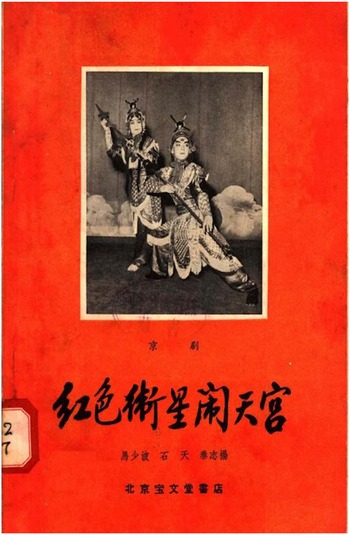
The Beijing Opera Red Satellites Make an Uproar in Heaven (Hongse weixing naotiangong 紅色衛星鬧天宮, Red Satellites hereafter), for instance, mythologizes the satellite within a celestial drama. After rebuffing the flirtation with the wolf spirit Wood Wolf Star (Kuimulang 奎木狼), Chang’e 嫦娥, the Chinese moon goddess, implores the Heavenly Emperor (Yudi 玉帝) for justice, but is instead blamed for causing a disturbance. Returned to the Moon Palace, Chang’e laments her fate with Yutu 玉兔, her companion rabbit spirit, until the Red Satellites arrive (see Figure 3) from ‘where rays of red lights shine’.Footnote 67 They announce that the earth has undergone revolutionary changes, and people have been released (fansheng 翻身) from oppression. Then, Zhinü 織女, the goddess of weaving and vega in Chinese mythology, arrives on the moon, weeping at her separation from her mortal husband. The Red Satellites’ presence provokes the emperor who then imprisons Chang’e and Zhinü. In response, Red Satellites, with help from Monkey King, who once made havoc in heaven, overthrow the emperor and liberate the goddesses.
Cover of Red Satellites. The theatrical helmets worn by the two impersonators are decorated with satellite models. Source: Ma, Shi and Qin, Hongse weixing naotiangong, no pagination.

The opera was composed ‘in celebration of and in gratitude for the great success of the Soviet satellites’,Footnote 68 and itself was a wenyi weixing 文藝衛星 (arts satellite), as it was created ‘within one day and one night’ and performed on stage in less than half a month.Footnote 69 The character design of Red Satellites is irrefutably inspired by the Soviet satellites whose silver colour was, nevertheless, manipulated into a socialist red.Footnote 70 In addition, allying Red Satellites with Monkey King, an incarnation of rebellion, recognizes the agency of the satellite in fighting against feudalism and imperialism. Chang’e is a more intricately drawn character. Her rescue by Red Satellites epitomizes the righteous power of the socialist camp. Although the opera provides no additional details on her fate, lines from a 1958 Sichuan 四川 folksong—‘red satellites buzz all around, flying to the west and the east; Chang’e on the moon sees that, wanting to return China to work’Footnote 71—suggest her return to China. This result is foregrounded in the opera as Chang’e confesses her guilt for stealing the potion that will make her immortal; in response, Zhinü declares that ‘now the earth is far better than heaven’.Footnote 72 It is crucial that the immortals recognize the earth’s superiority over heaven, and even choose to renounce immortality to join socialist construction, as only when the celestial willingly returns to the mundane can socialist superiority be affirmed.
In comparison with the opera, other narratives have a more straightforward simplicity, with the mythologized satellite serving either to exaggerate domestic achievements or to ridicule the Cold War. The former often appears in scenarios where the satellite reaches the Moon Palace or Heavenly Gate, startling the celestial figures (see Figures 4 and 5). The latter is commonly realized by comparisons between the Soviet and American satellites (see Figure 6). For example, in a piece of Shumao 書帽 arts entitled ‘American Satellite Meets Dragon King’, the 1957 American satellite Vanguard, which failed to launch, is depicted as having fallen into the Dragon King’s Crystal Palace, where the Dragon King mocks it for failing to fly.Footnote 73 The work also satirizes the hypocrisy and incompetence of the then US Secretary of State John Foster Dulles.
A cabbage stands over Five Ridges (wuling 五嶺) and reaches the moon. The drawing is annotated by a folksong: ‘The leaf tip reaches the Moon Palace; the thick branch overwhelms the Five Ridges. If you ask what this is? A cabbage satellite it is’. Source: Jie Shoufeng 界首峰, ‘Baicai fangweixing 白菜放衛星’ [Launching Cabbage Satellites], in Huadong renmin meishu zuopingxuan, p. 56.

An illustration to accompany a poem entitled ‘The Satellite Soars into the Ninth Heaven’ about the Monkey King being compelled to make a U-turn as the rice heap has reached the Heavenly Gate. Source: Hong Zuoyuan 洪作元, ‘Weixing chongshang jiuchongtian 衛星衝上九重天’ [The Satellite Soars into the Ninth Heaven], in Gandongbei mingexuan diyiji 贛東北民歌第一輯 [Folksong Collection of North-Eastern Jiangxi, Volume One], (ed.) Jiangxisheng Shangrao zhuanshu wenjiaochu (Shangrao: Gandongbei renmin chubanshe, 1959), pp. 110–111.

‘The East Wind has prevailed over the West Wind; the East Wind will continue to prevail over the West Wind’. The Soviet satellites are roaring in outer space (a), while the American satellite falls (b). Source: Image courtesy of Private Collection, chineseposters.net.

Through mythological materials and earth-heaven/earth-sea metaphors, both the Soviet and the American satellites are imbued with narrative weight and political implications. The mythologization of the satellite attests to what Mao proposed in early 1958 as the ‘combining way’ (liangjiehe 兩結合) of revolutionary realism and revolutionary romanticism. His initiative was warmly welcomed by critics.Footnote 74 One of Mao’s most supported literary theorists and cadres, Zhou Yang 周揚, for instance, lauded the combining way as ‘a scientifically articulated synopsis of insights gleaned from the history of literary development, an exceptionally accurate advocacy aligned with the distinctive characteristics and requirements of the contemporary era, and a guiding trajectory for which all our cultural workers should strive’.Footnote 75
The tenet of revolutionary romanticism mandates that the satellite draws on a wider range of cultural resources, particularly mythologies. Due to its imaginative nature and resemblance to religion (zongjiao 宗教) and superstition (mixin 迷信), the definition of mythology ignited heated discussions in the 1950s, particularly during the GLF.Footnote 76 Maxim Gorky’s work functioned as an authoritative voice asserting that mythology, contrary to superstition or religion, is fundamentally realistic. This conclusion was supported by Gorky’s ‘Soviet Literature’, which was translated into Chinese and published multiple times in the 1950s.Footnote 77 It holds up mythology as clear evidence of the processes of labour in the broader social life of ancient societies.Footnote 78 Unlike religion, which arises from ‘social strife’, mythology not only reflects the past but also relies on romanticism, which ‘provokes a revolutionary attitude to reality, an attitude that changes the world in a practical way’.Footnote 79
To mythologize the satellite, then, the crux is not whether mythologies could be integrated into the socialist rhetoric but how. Rather than simplistically situating itself in mythologies, the satellite reinvents mythological elements to deliver messages appropriate to the age. In Red Satellites, for example, the satellite’s morality is underscored by the gender interplay between the characters. Red Satellites help Chang’e return to earth, manifesting how the imperial and patriarchal order of traditional mythologies can be reformed by socialist power. It bears emphasizing that, unlike other works that leverage love affairs to romanticize the GLF,Footnote 80 the satellite’s agency is derived from technology.Footnote 81
This phenomenon directs our attention to what Josephson describes as ‘technological utopianism’,Footnote 82 which points to the future, yet intriguingly, the future recurrently draws on the past to validate itself. The key is that technological utopianism derives its legitimacy less from actual technological advancements than from appropriating an imagined future for present use. Yuan He, in the preface attached to his translation of Soviet satellite technology, pinpoints the position of the satellite between technology and mythology:
Can mythologies be realized? The answer is yes. Today, advanced science has turned many of our ancestors’ mythical aspirations into tangible realities. For example, flying across vast distances in airplanes surpasses even the Monkey King’s cloud somersault. Now the Soviet Union has successfully launched two satellites, and scientists are actively developing space travel technologies, envisioning journeys to the moon and beyond via nuclear rockets. All these developments, from our ancestors’ perspective, aren’t mythologies?Footnote 83
The satellite embodies a logic in which the realization of ancient mythologies implies the plausibility of fulfilling socialist ones. In this light, the satellite bridges the gap between reality and mythology. Historical social relations are not merely reflections of current conditions but also function as justifications for the future development of the labour force. This triadic temporal framework—past, present, and future—which is contingent on technological agency, fuels an inexorable historical progression towards a socialist utopia.Footnote 84
Ying Qian’s insights into the temporality of the GLF shed light on the satellite as a metonymy for the transformability of the past, present, and future.Footnote 85 Highlighting the ‘document tomorrow’ feature of GLF documentaries, Qian acknowledges their function in bringing ‘the future instantaneously into view to boost confidence’, for ‘there was no time to wait for success stories to emerge in due time’.Footnote 86 Although future-oriented, the materials for documenting tomorrow are actually the ‘useful pasts’ which include ‘folklore, mythology, and traditional arts and technologies’.Footnote 87 A notable consistency emerges between the production of documentaries and the launching of satellites in regard to the materials employed and the spirits they embody. If documentaries capture and present what is forthcoming, the satellite stands as a tangible manifestation of the already realized ‘future’ envisioned in mythologies. The future thus is authorized by the satellite to be borrowed by the present as a utopia with a promise that will be realized.
Launching satellite satellites
As elaborated, during the fevered years, weixing underwent a forceful process of signifier inflation. While weixing remained linguistically legitimate and rhetorically secure as an imaginary articulation, it nevertheless ran counter to the political imperative—not merely to speak of satellites, but to produce them. Words were not merely representational but registered to a mode of production. Political slogans required enactment; plans demanded embodiment; and myths insisted on being realized.
To speak of words and objects here is to invoke a dialectic central to the socialist country’s post-revolutionary construction. If the word refers to the complex apparatus of envisioning, planning, and mobilizing, the object stands for the concrete operations—production, labour, transformation—that must follow. The command economy, exemplified by the Five-Year Plans, may be read as exercises in orchestrating this choreography between the symbolic and the material. This choreography, however, was made to collapse in the GLF. The boundary between the word and the object was no longer merely porous but violently undone. The word had been conscripted into the order of objects, and in so doing, revealed the political delirium of a regime that mistook words for objects.
Let me reiterate: the significance of treating the satellite as method lies in the fact that the satellite, whether gesturing towards the technological apparatus or to its proliferating metaphorical impostors, was never, during the GLF, an object. Instead, it was an object-yet-to-be-made, whose belatedness generated what might be called a structural anxiety of production, one most succinctly encoded in the ‘more, faster, better, and cheaper’ (duo kuai hao sheng 多快好省)Footnote 88 slogan prescribed to close the word–object rift. The satellite, as signifier, became overdetermined by this anxiety. And indeed, it was filled, or perhaps overfilled, as hyper-inflation made clear.
But this inflation did not remain suspended in the abstract register of speech. The signifier, indeed, attempted to summon the signified—not metaphorically, but quite literally. As early as the Moscow Conference, Mao Zedong had enthusiastically assured fellow delegates that China, too, would plan to launch satellites.Footnote 89 This promise found institutional momentum in the second session of the CCP’s eighth Congress, held in Beijing in May 1958, a moment ‘adjudged ripe’ to officially launch the movement.Footnote 90 Midway through this session, on 15 May, the Soviet Union successfully launched its third satellite. The co-occurrence of this launching and the Congress intensified the symbolic weight of the satellite, transforming it into a recurring motif in the latter half of the Congress. On 17 May, Mao delivered a second speech at the Congress, during which the satellite was highlighted, revealing how the signifier was poised to materialize in an object form:
Let’s talk about launching satellites. Going into the space is a good thing. This satellite is more than twice as big as the second one. In a few months, or a year, two years, or several years from now, maybe we’ll make even bigger ones—two thousand kilograms or more. At the Moscow meeting, I said we should make fifty-thousand-kilogram satellites. Five thousand kilograms is only one-tenth of that. Once we break through this barrier, we can make satellites weighing twenty or thirty thousand kilograms, which would be a very great achievement.Footnote 91
Last year, the Soviet Union launched a satellite into the space. A few months ago, the United States also launched one. What about us? We, too, must make satellites! If we launch, we must launch big ones! If we do it, we should do it with satellites weighing ten or twenty thousand kilograms. Maybe we must start from small ones first, but even so, we would start from one or two thousand kilograms. We will never accept those tiny egg-sized things the Americans have!Footnote 92
In fact, six months before this speech, when the Soviet Union launched the first satellite, satellite research was already underway. After the Congress, Vice Premier Nie Rongzhen 聶榮臻, who oversaw science and technology, took more active steps by instructing the CAS and the Ministry of National Defense to begin satellite planning. By July, the CAS reported to Nie that China’s satellite programme would proceed in three phases: launching sounding rockets, launching small satellites ranging in size from tens of kilograms to several tons, and finally launching large satellites weighing over five tons and up to several dozen tons.Footnote 93 The goal was to launch China’s first satellite in three years. In August, Zhang Jinfu convened experts, including Qian Xuesen and Zhao Jiuzhang 趙九章, to draft a preliminary satellite research project and flagged this project as a key task. For secrecy, the project was given the code name ‘581’. After the establishment of the ‘581’ group, the CAS further expanded the project into a nationwide collaboration scheme.
It is undeniable that while the entire nation was fervently engaged in launching grain, steel, and even artistic satellites, plans were underway for launching satellite satellites. Mao’s speech had become a symbol of political conformity. Chronologically, the goal was to launch China’s first satellite within three years. In terms of scale, there was a blind pursuit of satellite weight, with increasing mass symbolically equated with political and technological progress.
However, when it came to the actual launch of a satellite, setbacks arrived swiftly. By the end of 1958, the CAS had dispatched a delegation, known as the ‘High-Altitude Atmospheric Physics Delegation’, to the Soviet Union to seek technical assistance. The visit revealed a harsh reality: compared to the Soviet Union, China was still far from possessing the technological capability necessary for satellite launch. Moreover, the delegation was met with a cold reception; the Soviet Union remained guarded and imposed restrictions on sharing advanced technologies with China.Footnote 94 Domestically, the government also lacked funding and materials.Footnote 95 In light of these challenges, Deng Xiaoping 鄧小平, then the CCP general secretary, remarked: ‘We won’t launch a satellite next year or the year after; it doesn’t match our current national strength. But we’re still going to work on it; it just needs to be pushed back a bit.’Footnote 96 On 21 January 1959, Zhang Jinfu conveyed Deng’s instructions to the CAS. In accordance with the Party’s new directive, it was decided that due to national economic difficulties, work on satellite development would be suspended and resources would be concentrated on the development of sounding rockets instead.Footnote 97
Here emerges the irony: during the GLF, nearly all the false satellites were launched—except the real one. Yet paradoxically, the true infrastructural groundwork for that real satellite was in fact being laid. Foundational efforts in rocket design, payload assembly, launch site selection, and telemetry systems marked a substantial investment in the techno-scientific sphere. These material preparations, spurred on by the symbolic power of the satellite as a signifier, laid the groundwork for satellite development efforts in the 1960s and paved the way for the materialization of the real satellite in 1970. In this light, the signifier weixing points neither to a pure absence of signified nor to pure illusion, but to a generative contradiction: the word moved faster than the object, and yet the object was galvanized by the word.
Beyond this word/object interplay, the satellite implies more. Let us return to the scene of the Congress, in order to better contextualize Mao’s remarks on the satellite. Mao’s comments on the satellite appear at the beginning of his second speech on the international situation; the real thrust of his message, however, comes at the end of that section. ‘We must break with superstition,’ Mao urged, ‘and put ourselves in the right position. Dare to think, dare to speak, dare to act, but the foundation must be Marxism-Leninism.’Footnote 98 The logic of this sequence is revealing: the exhortations to ‘dare to think’ and ‘dare to speak’, both operations grounded in language, precede the imperative to ‘dare to act’, which points to concrete praxis. I do not mean to suggest that Mao was a utopian idealist—he himself emphasized the anchoring force of Marxism-Leninism. Rather, what I want to underscore here is that this placing of thought and speech before action affirms, once again, the formidable agency of the word in Maoist China.
And perhaps more importantly, what Mao’s words suggest is a localized reinterpretation, if not a transcendence, of orthodox Marxism-Leninism. Elsewhere in this speech, Mao remarked, ‘Three satellites have gone up—that is one method. Can we perhaps find another?’Footnote 99 Here, the satellite is endowed with another layer of connotation. Distinct from socialism’s ascendancy over capitalism, the satellite, itself within the socialist camp, came to symbolize the Soviet path, its ideology, hierarchy, and gravitational pull. Mao’s question, therefore, was in truth a decree: to pursue a trajectory no longer bound by Moscow’s orbit. The Chinese satellite, both the very machine and the metaphorical beacon, would have to rise under its own power, unmoored from the Soviet precedents.
Intriguingly, a prescient metaphor had already surfaced in the West. On 9 May 1957, David Kelly, former British ambassador to the Soviet Union, published an article in The Sunday Times titled ‘China: Satellite or Sun?’.Footnote 100 Responding to Mao’s 1956 article, ‘Revisiting the Historical Experience of the Dictatorship of the Proletariat’,Footnote 101 Kelly offered a somewhat provocative statement that China was no mere satellite but was the sun. What may have seemed like rhetoric then, now reads as an inadvertent prophecy. The GLF’s sweeping campaigns and radical social experiments embodied a distinct Maoist radicalism rather than orthodox Marxism-Leninism. They amounted to a declaration of a new political cosmology, one in which Mao was not a satellite orbiting the Soviet Union, but the central sun.
A decade after the GLF, on 24 April 1970, China finally succeeded in launching Dongfanghong 1 into orbit. The launch took place at the height of the Cultural Revolution, which, as an intensified extension of the GLF, depended heavily on the escalating cult of Mao. This heightened cult found fitting expression in the satellite’s broadcast of the anthem ‘Dongfanghong’ into space. The song famously proclaims, ‘The East is red, the sun rises; China has brought forth a Mao Zedong’, casting Mao as the sun—a metaphor that echoes David Kelly’s observation. By the time Dongfanghong 1 ascended, a decade had passed since the Sino-Soviet split, and the satellite’s launch seemed to confirm Mao’s earlier call at the eighth Party Congress to seek a method different from the Soviet model of launching three satellites. In this sense, Mao did become the sun at the centre—not in the astronomical sense, since satellites do not orbit the sun, but within a gravitational field of Mao’s control. Within this cosmological order, Mao exerted ideological force akin to stellar gravity, reorganizing China’s revolutionary trajectory around his totalitarian charisma.Footnote 102
Conclusion: The satellite yet to be launched
Serving as a research object qua method, the article argues that the satellite is a multivalent thing whose cultural legibility looms out of its insistent interplay with multiple agents in the GLF. Like other movements in Mao’s China, the GLF indicates ‘radical transformations’ that not only register changes in political and economic structures but also, as stated by Qian Ying, ‘usher in upheavals in epistemology, perception, and common sense’.Footnote 103 Viewed through the lens of the satellite, the crux of this epistemological turmoil lay in the misrecognition of the word as the object. The satellite, of course, functioned rhetorically as a linguistic trope, yet due to Mao’s totalitarianism, the factional calculations of political elites, the bureaucratic competitiveness of cadres, and mass-level zealotry, this linguistic fraud metastasized into national policy, eventually subjugating material production under the tyranny of language.
The recursive tension between a word that raced ahead and an object that lagged behind constituted a Derridean différance: the satellite became not a stable signifier, but an empty placeholder whose meaning was endlessly deferred. Worse still, the signifier did not merely precede the object—it postponed it. In this sense, the satellite did not fail to signify; rather, it signified too much, too soon, and in doing so, ironically deferred the very object it sought to summon into being—the development of satellite technology itself was impeded and the infrastructural and economic construction disrupted.
This logic of deferral applies not only to the GLF, though it represented its most extreme and thus catastrophic form, but also to the broader socialist linguistic-material dichotomy. The political discourse represented by MaoSpeak was far from empty rhetoric;Footnote 104 rather, it was imbued with imperative force and demanded concrete material construction. Scientists such as Zhang Jingfu and Qian Xuesen, for instance, found themselves straddling two contradictory imperatives: on the one hand, countering popular enthusiasm with scientific realism, or even attempting to rationalize satellite launches with scientific theory; on the other hand, engaging in concrete planning and technological work. These parallel trajectories illustrate that the dialectic between word and object in socialist China was not purely absurd—it also exhibited a sort of productive resilience.
Suspended in the interval between word and object, the satellite embodies a perpetually unfulfilled state as an object-yet-to-be-made, giving rise to innumerable modernizing struggles. As Qian Ying’s research on GLF documentaries illustrates, these struggles unfold within what Timothy Mitchell calls a process of ‘temporal arrangement’, whereby selective representations of the past, present, and future are mobilized to serve political ends.Footnote 105 Within such a chrono-socialist regime, an even more defining feature was speed. Modern China has often been trapped in a temporal logic of ‘lagging behind’ and ‘catching up’, which demanded an accelerated pace of development—not merely to match the West, but to surpass it. Although the GLF marked the most radical form of acceleration, speed, as with satellites, is tricky: if moving too fast, the satellite risks flying off course; too slow, and the gravitational force would pull it to ruin. This unravels the tension between historical velocity and political coordination. In a planned economy, the problem is not only how to move forward, but how to manage the tempo of transformation without collapse.
In this light, I argue that the satellite’s most critical function for understanding the GLF, or more broadly, Maoist China lies in its unfinished, indeterminate status. As such a non-objectal object, the satellite came to stand for the material abundance promised by socialism—or, more precisely, it functioned as a metonym for socialism itself. In this sense, the satellite was not a singular technological artefact, but a hyperobject of socialist futurity: a sign charged with the gravitational pull of an imagined plenitude, refracting hopes, contradictions, and ideological struggles—not only between word and object, but also between classes, epistemes, and competing visions of the socialist modern.
Acknowledgements
I am deeply grateful to the reviewers and editors of Modern Asian Studies for their valuable suggestions and guidance, without which this article could not have achieved its present breadth and depth. I also want to thank my colleagues and friends who have engaged with me in discussions on this project at various stages: they are Dr Du Kexin, Dr Wang Hongri, Chen Wenqi, Zheng Pengfei, and Li Sizhang. An early draft of this article was read by Zhang Qingheng, whose insightful comments and encouragement are gratefully acknowledged. I am likewise indebted to Dr Yan Caiping, who generously assisted in locating and providing some of the materials used in this article at the project’s inception.
Competing interests
The author declares none.