Introduction
This paper describes a new species of Allorhogas Gahan (Hymenoptera: Braconidae: Doryctinae) from Costa Rica that has been reared from fruit galls on Miconia longifolia (Aubl.) DC. (Melastomataceae). In Costa Rica, 17 species of Allorhogas have been described (Marsh, Reference Marsh2002; Chavarría et al., Reference Chavarría, Hanson, Marsh and Shaw2009). Allorhogas species, distinguished by their excavated frons and curved hindwing vein m-cu, are of particular interest because of the intriguing discovery that several species are phytophagous primary gall formers (Marsh, Reference Marsh2002; Wharton and Hanson, Reference Wharton, Hanson, Raman, Schaefer and Withers2005; Chavarría et al., Reference Chavarría, Hanson, Marsh and Shaw2009).
Allorhogas is assigned to the subfamily Doryctinae, which includes other gall makers such as Monitoriella (Infante et al., Reference Infante, Hanson and Wharton1995), probably Labania (Wharton and Hanson, Reference Wharton, Hanson, Raman, Schaefer and Withers2005) and Mononeuron (Chavarría et al., Reference Chavarría, Hanson, Marsh and Shaw2009), and possibly Psenobolus (Ramírez and Marsh, Reference Ramírez and Marsh1996). Although Monitoriella has been of controversial placement, a recent molecular phylogenetic analysis places these genera (except Mononeuron, which was not analysed) in the same lineage within subfamily Doryctinae (Zaldivar-Riverón et al., Reference Zaldivar-Riverón, Belokobylskij, León-Regagnon, Martínez, Briceño and Quicke2007). Beyond the Doryctinae species, gall-making braconids are scarce but are reported in an Australian Mesostoa (subfamily Mesostoinae) (Austin and Dangerfield, Reference Austin and Dangerfield1998) and in a Venezuelan Bracon species (subfamily Braconinae) (Flores et al., Reference Flores, Nassar and Quicke2005).
Although the genus was described almost a century ago (Gahan, Reference Gahan1912), the biology of Allorhogas species has remained mysterious until fairly recently. The detailed biology of most Allorhogas species is still unstudied (Chavarría et al., Reference Chavarría, Hanson, Marsh and Shaw2009). The first publication of a plant-feeding braconid wasp was Allorhogas dyspistus Marsh from Brazil, which makes galls in the seeds of Pithecellobium tortum Mart. (Fabaceae) (Macêdo and Monteiro, Reference Macêdo and Monteiro1989; Marsh, Reference Marsh1991; Macêdo et al., Reference Macêdo, Pimentel and Vieira1998). Later two species of Allorhogas were found to cause galls in the seeds of other Fabaceae in Brazil (Marsh et al., Reference Marsh, Macêdo and Pimental2000), Allorhogas brasiliensis Marsh on Balizia pedicellaris (DC.) Barnaby & Grimes (cited as Pithecellobium) and Allorhogas spermaphagus Marsh on Stryphnodendron polyphyllum Mart. In Costa Rica, Allorhogas argentinus Marsh is known to make galls in seeds of Abarema macradenia (Pittier) Barnaby & Grimes (cited as Pithecellobium), and Allorhogas hansoni Marsh is reported as associated with Inga vera Willd. (Marsh, Reference Marsh2002). These five species are all associated with trees in the plant family Fabaceae. In Argentina, Allorhogas mendocinus (Kieffer and Jörgensen) was hypothesized to be a possible inducer of bud galls on Lycium chilense Miers ex Bertero (Solanaceae) based on a few observations, but further observations are desired (Martinez et al., Reference Martinez, Zadivar-Riverón and Sáez2008). Most recently, a phytophagous Allorhogas has been discovered on fruits of a species of Conostegia (Melastomataceae) in Costa Rica (Chavarría et al., Reference Chavarría, Hanson, Marsh and Shaw2009).
In this paper, we describe a new phytophagous Allorhogas from Costa Rica that provides the first record of an Allorhogas species from fruit galls on M. longifolia, and only the second record of an association of this genus with the plant family Melastomataceae.
Materials and methods
Specimens were determined as subfamily Doryctinae using the subfamily key of Shaw (Reference Shaw, Hanson and Gauld1995). Specimens were determined as genus Allorhogas new species near Allorhogas ardisia Marsh using the genus and species keys of Marsh (Reference Marsh2002) for Costa Rican Doryctinae. Specimens of the new species were compared directly with paratype specimens of A. ardisia Marsh deposited at the University of Wyoming Insect Museum (ESUW). Morphological terminology is based on Sharkey and Wharton (Reference Sharkey, Wharton, Wharton, Marsh and Sharkey1997) and Marsh (Reference Marsh2002). Microsculpture terminology follows Harris (Reference Harris1979). The specimens were measured using a Motic SMZ-168 advanced stereomicroscope with magnification zoom range 7.5 × to 50 × and eyepiece of 10 × with microrule attached to a JVC digital camera. Scanning electron microscopy was done at the University of Wyoming Microscopy Core Facility using a Hitachi tabletop scanning electron microscope, model TM-1000. Specimens were examined uncoated at an operating voltage of 15 kV. Photographs of wings mounted on slides in Canadian balsam were taken using a Nikon DXM-1200 digital camera mounted on a Leica MZAPO dissecting microscope and enhanced using Adobe Photoshop.
Acronyms for museum collections are as follows: University of Wyoming, Laramie (ESUW); Museum of Comparative Zoology, Harvard University, Cambridge, Massachusetts (MCZ), Museo de Zoología, Universidad de Costa Rica, San José (MZCR); and National Museum of Natural History, Washington, DC (USNM).
Results
Description holotype female
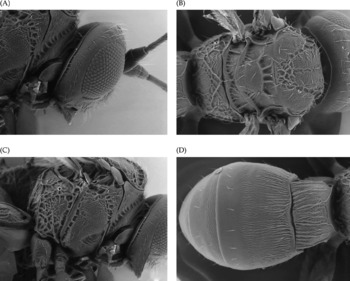
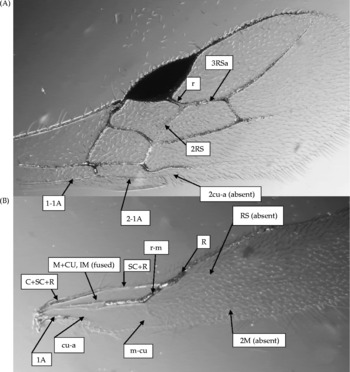
Colour: body dark brown; lower portion of face, clypeus, labrum, tegula and wing venation light brown; mandible light-yellow; stigma darker than wing venation; petiole and terga 2, 3 and 4 infused with light brown apically; pronotum, scape, pedicel and legs yellow; hind femur infused with light brown; mesopleuron infused medially with yellow; tarsi and palpi white-yellow; wings hyaline; ovipositor dark yellow; eyes and ocelli silver; apical membrane surrounding ovipositor and sternum medially whitish; telotarsi and tarsal claws dark-brown; flagellum dark-brown apically. Body length: 1.09 mm. Head: frons excavation without distinct margins near eyes; face coriaceous and raised medially; vertex, frons and temple coriaceous; temple smooth laterally (Fig. 1(A)); malar space 0.37 eye-height; ocell-ocular distance 2.25 diameter of median ocellus; 16 antennomeres. Mesosoma: (Fig. 1(B) and (C)) pronotum coriaceous; pronotal groove weakly scrobiculate; mesoscutal lobes acinose, median lobe with indistinct median longitudinal rugose line; notauli shallow, rugose; scutellum acinose, smooth laterally, and weakly areolate in posterior section; pre-scutellar furrow defined by three cross-carinae; metanotum scrobiculate; mesopleuron coriaceous–acinose; sub-alar groove scrobiculate; sternaulus tear-drop shaped, weakly rugose with indistinct longitudinal carinae, 0.5 length of mesopleuron; propodeum defined by a distinct V-shaped carina separating the anterior areas from the posterior section, anterior lateral lobes acinose, carina bordered by scrobiculate sculpting, smooth in medial posterior section; metapleuron areolate defined by anterior medial acinose patch. Wings: forewing veins 1-1A, 2-1A and 2RS non-tubular but defined by light brown pigmentation (Fig. 1(D)); forewing vein r 0.47 length of vein 3RSa; hindwing veins M+CU and 1M fused together, difficult to separate due to spectral or absent cu-a cross-vein; hindwing veins M+CU apically, 1M, 1A basally, C+SC+R, SC+R apically, r-m and R well-sclerotized; hindwing veins M+CU basally, SC+R basally and 1A apically are indicated by light brown pigmentation; hindwing veins RS, and 2M absent; m-cu and cu-a cross-veins spectral or absent (Fig. 2(A)). Metasoma: first tergum shorter than apical width, medium area distinctly defined by complete carinae basally and indistinctly defined apically; smooth basally, coriaceous medially and costate–acinose apically; second and third terga combined slightly shorter than length of remaining apical terga; second and third terga finely longitudinally rugo-costate for basal two-thirds, smooth apically; remainder of terga transversely scarified basally, smooth apically (Fig. 2(B)); ovipositor less than 0.5 length of the metasoma.
Scanning electron image of Allorhogas minimus. (A) head, lateral view; (B) mesosoma, dorsal view; (C) mesosoma, lateral view; (D) mesosoma, dorsal view.

(A) Forewing and (B) hindwing of Allorhogas minimus with significant veins indicated

Female variation
Colour: pronotum light brown to off-white; flagellum light brown to dark brown apically; stigma either same shade as wing venation or significantly darker than venation; petiole infused with yellow to light brown; terga 1–3 infused with light brown or terga 1–3 fully light brown; tarsi light-yellow to white-yellow; scape and pedicel off-white to yellow; tegula off-white to light-brown. Body length: 0.83–1.42 mm. Head: malar space 0.24–0.38 eye-height; ocell-ocular distance 1.5–5.0 diameter of median ocellus; 14–16 antennomeres. Wings: forewing vein r 0.24–0.50 length of vein 3RSa.
Male variation
Colour: body dark brown to light brown; mesopleuron infused distally with yellow; terga 2–3 infused with light-brown or are entirely light brown; tergum 4 infused with light brown apically or infused with light brown distally; hind femur infused with light brown or is light brown; lower portion of face, clypeus and labrum light brown to dark brown; pedicel and scape off-white to yellow; flagellum light-brown to dark-brown apically; legs yellow to off-white; stigma either significantly darker than wing venation or same shade as wing venation; tegula off-white to light-brown; front femur infused with light brown. Body length: 1.02–1.4 mm. Head: malar space 0.19–0.38 eye-height; ocell-ocular distance 2.2–5.0 diameter of median ocellus; 14–16 antennomeres. Wings: forewing vein r 0.25–0.66 length of vein 3RSa.
Holotype female
Costa Rica. Heredia Province, OTS, La Selva, 30 m, 10°12′38.6″N, 83°40′45.6″W, April 2002, Kenji Nishida, M. longifolia fruit gall. Deposited ESUW.
Paratypes
Costa Rica. Heredia Province: 77 females, 62 males, same data as holotype. Deposited in ESUW, MZCR, USNM and MCZ.
Etymology
The specific epithet means ‘least’, ‘smallest’ and ‘slightest’ in Latin, and refers to the reduced wing venation in both the fore- and hindwing veins and the reduced number of antennomeres. This species has the smallest body length of any of the described species in the genus Allorhogas.
Discussion
This new species is most similar to A. ardisia Marsh, and it keys out as such using Paul Marsh's key on pages 37 and 38 of Doryctinae of Costa Rica (Marsh, Reference Marsh2002). The forewing vein m-cu is directly in line with vein 2RS and vein RS+Mb is present. In both species, the ovipositor is shorter than the metasoma, although it appears to be slightly shorter in Allorhogas minimus. In both species, forewing vein r is shorter than vein 3RSa. The last couplet is less definitive. The character choices are: ‘Propodeum coriaceous laterally, at most weakly rugulose above hind coxa’ and ‘Propodeum usually entirely rugose laterally, rarely weakly coriaceous at extreme base’ (Marsh, Reference Marsh2002). The propodeum of A. minimus does not exactly match either of these statements; however, it is closest to the first statement, because anterolaterally, it has acinose sculpturing and it is smooth near the base of the hind coxa. The second statement in the couplet would not apply here, because the propodeum has no uniform sculpturing laterally and is never rugose, only scrobiculate along the carina. Therefore, A. minimus New Species will key out as closest to A. ardisia Marsh. Both species have the same colouration pattern, although A. minimus has darker colouration. The sculpturing of the head, as well as ratios of measurement of the head, is virtually the same in the two species. On the mesosoma, pronotal and subalar sculpturing is very similar. The sternaulus is 0.5 the length of the mesopleuron in both species.
There are, however, many distinct differences between A. ardisia Marsh and the new species described here. The colouration for A. minimus is darker overall than that for A. ardisia, and the propodeum is significantly darker than the rest of the body in A. minimus. Also, the gradation of colour on the terga in A. minimus is a characteristic unique to this species. Body length in A. minimus is much smaller than 2.0–2.5 mm in A. ardisia (Marsh, Reference Marsh2002). The number of antennomeres is also lower in A. minimus than in A. ardisia, where the range is 21–23 antennomeres. Mesosomal sculpturing in A. minimus is very distinctive (Fig. 1(B) and (C)). Many areas described as coriaceous in A. ardisia are acinose in A. minimus. The scutellum, sternaulus and propodeum each have more varied sculpturing in A. minimus than in A. ardisia. Also, A. minimus has distinctive sculpturing on the metapleuron, where A. ardisia does not. In this new species, hindwing veins M+CU and 1M are difficult to separate as the cu-a cross-vein is very weak, and many veins in both the fore- and hindwings have lost tubularity, are spectral or are entirely absent; characteristics are not present in A. ardisia. In the metasoma, the width of the first tergum is shorter than the apical length, but longer in A. ardisia. A unique feature in A. ardisia is that terga 2 and 3 are longer than the rest of the terga combined, yet in A. minimus, terga 2 and 3 are shorter than the length of the remaining terga in the metasoma. Finally, in A. ardisia, terga 2 and 3 have minimal sculpturing, and the remainder of terga is entirely smooth, whereas in A. minimus, terga 2 and 3 have extensive sculpturing and there is some sculpturing on the remaining terga (Fig. 2(B)).
Key to species of Allorhogas from Costa Rica modified from Marsh (Reference Marsh2002)
1. Forewing vein m-cu arising distal to vein 2RS, vein RS+Mb absent ……………… 2
– Forewing vein m-cu arising basal to or directly in line with vein 2RS, vein RS+Mb often present ……….………… 5
2(1). Median mesonotal lobe with distinct median longitudinal scrobiculate groove; temple broad, about 0.75 eye width …… 3
– Median mesonotal lobe with weak or no median groove; temple narrower, 0.5 or less eye width ………………………….. 4
3(2). Median mesonotal groove distinct over entire length of mesonotum; body colour mostly black; body length 3.5–4.0 mm; 28 flagellomeres ………… sulcatus Marsh
– Median mesonotal groove distinct only in triangular rugose area, weakly indicated anteriorly; body colour mostly yellowish brown; body length 2.5–3.0 mm; 18–22 flagellomeres; reared from Conostegia xalapensis galls ..…………………….…… …… conostegia Marsh & Shaw (in part)
4(2). Body yellow ……………….. gauldi Marsh
– Body brown or bicoloured brown and honey yellow ……… shawi Marsh (in part)
5(1). Ovipositor longer than metasoma; associated with Inga vera ….………….… 6
– Ovipositor equal to or shorter than metasoma ………………………….…… 7
6(5). Scutellum coriaceous; reared from leaf galls …………………………… ingavera Marsh
– Scutellum smooth; reared from fruits ……. …………………….……… hansoni Marsh
7(5). Forewing vein r equal to or longer than vein 3RSa ……………………….……… 8
– Forewing vein r shorter than vein 3RSa … …………………………………………. 10
8(7). Ovipositor extremely short, barely extending beyond apex of metasoma ………………… ………………………………. tectus Marsh
– Ovipositor longer, barely extending beyond apex of metasoma by at least length of first metasomal tergum ……………………… 9
9(8). Hind tarsus yellow; propodeum and first metasomal tergum usually black; reared from seed galls in Pithecellobium macradenium ………… argentinus (Brèthes)
– Hind tarsus black; propodeum and first metasomal tergum yellow …………….… ………………………. infuscotarsus Marsh
10(7). Body length 0.8–1.4 mm; 12–14 flagellomeres; reared from Miconia galls …. …………….……… minimus New Species
– Body length 2.0 mm or greater; 19 or more flagellomeres ………………………….. 11
11(10). Propodeum coriaceous laterally, at most weakly rugulose above hind coxa; reared from Ardisia galls …………. ardisia Marsh
– Propodeum usually entirely rugose laterally, rarely coriaceous basally .…… 12
12(11). Body yellow or honey yellow ………… 13
– Body black or dark brown, at least in part.. .…………………….…….……….…… 15
13(11). Mesoscutal lobes rugulose, at least along notauli ……………….… rugosus Marsh
– Mesoscutal lobes coriaceous or granular ……………….…………………….… 14
14(13). Median mesonotal groove absent on mesonotum; body length 3.5–4.5 mm; 24–28 flagellomeres ……………….…..… ….…………………… zurquiensis Marsh
– Median mesonotal groove distinct in triangular rugose area, weakly indicated anteriorly; body length 2.5–3.0 mm; 18–22 flagellomeres; reared from C. xalapensis galls …………… conostegia Marsh & Shaw (in part)
15(12). Sternaulus absent: vertex rugulose- coriaceous ……… shawi Marsh (in part)
– Sternaulus present; vertex coriaceous …. ……………………………….………. 16
16(15). Median mesonotal lobe with distinct median longitudinal groove extending from anterior declivity of lobe to meeting notauli …………………………….… 17
– Median mesonotal lobe without a distinct median longitudinal groove ………… 19
17(16). Mesoscutal lobes weakly coriaceous; frons excavation wide, edges close to eye margin ……….……… platyfrons Marsh
– Mesoscutal lobes coarsely coriaceous; frons excavation narrow, edges not near eye margin ……………………..…… 18
18(17). Forewing vein r 0.5 length of vein 3RSa .. …………………..…… breviarius Marsh
– Forewing vein r 0.33 length of vein 3RSa ……………………… costaricensis Marsh
19(16). Face longer than wide; frons depression deep; eyes not bulging beyond temple in dorsal view ……….…… prolatus Marsh
– Face as wide or wider than long; frons depression not deep; eyes bulging beyond temple in dorsal view ……… laselva Marsh
Conclusion
This new gall-forming Allorhogas species from Costa Rica provides the first record of an Allorhogas species from fruit galls on M. longifolia, and only the second record of an association of this genus with the plant family Melastomataceae. An undetermined Allorhogas has previously been reported in the fruits of the invasive weedy tree Miconia calvescens DC. (Badenes-Perez and Johnson, Reference Badenes-Perez and Johnson2007), suggesting that some braconids may have potential economic value as weed biological control agents. The velvet tree M. calvescens is a small tree native to Central and South America that has become a serious invasive weed on some Pacific islands. The tree is considered a serious pest on Hawaii and other Pacific islands, and it is estimated to have already displaced as much as 65% of the native forest on Tahiti (Badenes-Perez and Johnson, Reference Badenes-Perez and Johnson2007). It is our hope that the discovery of this new Allorhogas associated with a Miconia species may be a contribution to the research and discovery of possible weed biocontrol agents for reducing populations of the velvet tree in the Pacific region.
Acknowledgements
Special thanks are given to Kenji Nishida and Paul E. Hanson (Universidad de Costa Rica) for sampling the specimens on which this study is based, kindly providing them for our study, and stimulating our interest in gall-forming braconids. We thank Zhaojie Zhang of the University of Wyoming Microscopy Core Facility for his kind assistance with scanning electron microscopy. We thank Guinevere Z. Jones, Paul M. Marsh and Paul E. Hanson for their helpful advice on this manuscript and plates. We are especially thankful to Dr Paul Marsh for granting permission to modify his key to species and for proofreading the identification key. This research was supported by National Science Foundation grants DEB-97-26141, BSI-07-17458, DEB-07-17034 and NSF Research Experience for Undergraduates supplemental grants DEB-08-23094 and DEB-09-13110, and in part by McIntire-Stennis project No. WYO-362-02, Braconid Wasps in Forest Ecosystems.